Asia Pacific Connected Car Market Outlook to 2030

Region:Asia

Author(s):Yogita Sahu

Product Code:KROD1775

Published On

October 2024

Total pages

98

About the Report

Asia Pacific Connected Car Market Overview

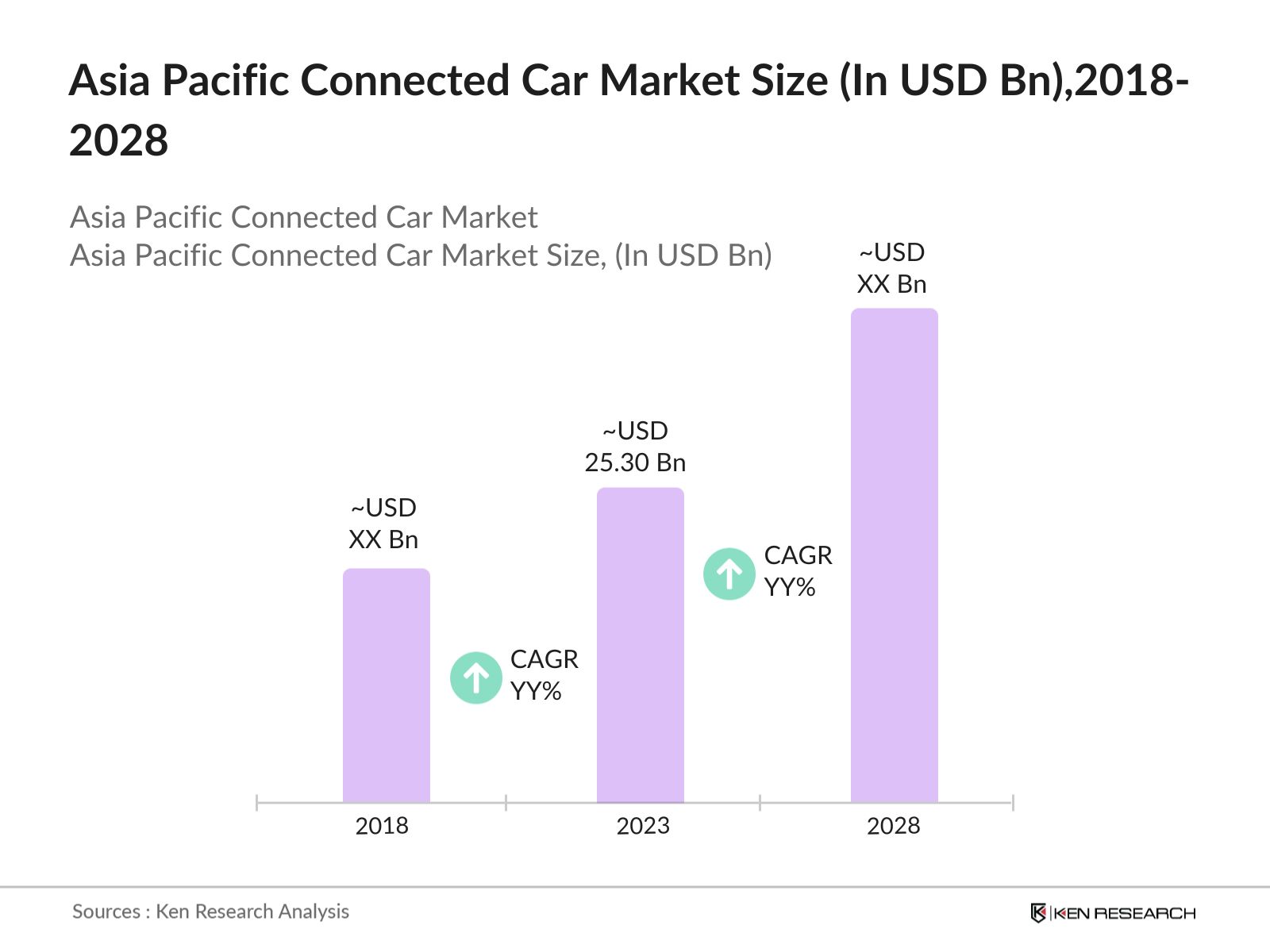
  • The Asia Pacific Connected Car Market was valued at USD 25.30 billion in 2023. The growth is driven by the increasing adoption of advanced technologies in the automotive industry, the rise of electric vehicles, and the demand for enhanced driving experiences.
  • The market is dominated by several key players are Toyota, Hyundai Motor Company, Honda, Nissan, and Tata Motors. These companies have been investing heavily in R&D to enhance connected car technologies and expand their market presence across the region.
  • The partnership between Toyota and NTT Communications in 2023 to enhance connected car services. This partnership aims to leverage NTT's communication technology to improve vehicle data transmission efficiency, thereby enabling better navigation, safety, and infotainment services.
  • China is currently the dominant player in the market, due to the country's large automotive market, significant government support for smart vehicle technologies, and the rapid adoption of electric vehicles. The Chinese government's focus on becoming a global leader in connected and autonomous vehicles has positioned the country as a key hub for innovation in this sector.

Asia Pacific Connected Car Market Size

Asia Pacific Connected Car Market Segmentation

The market is segmented into various factors like connectivity type, application, and region.

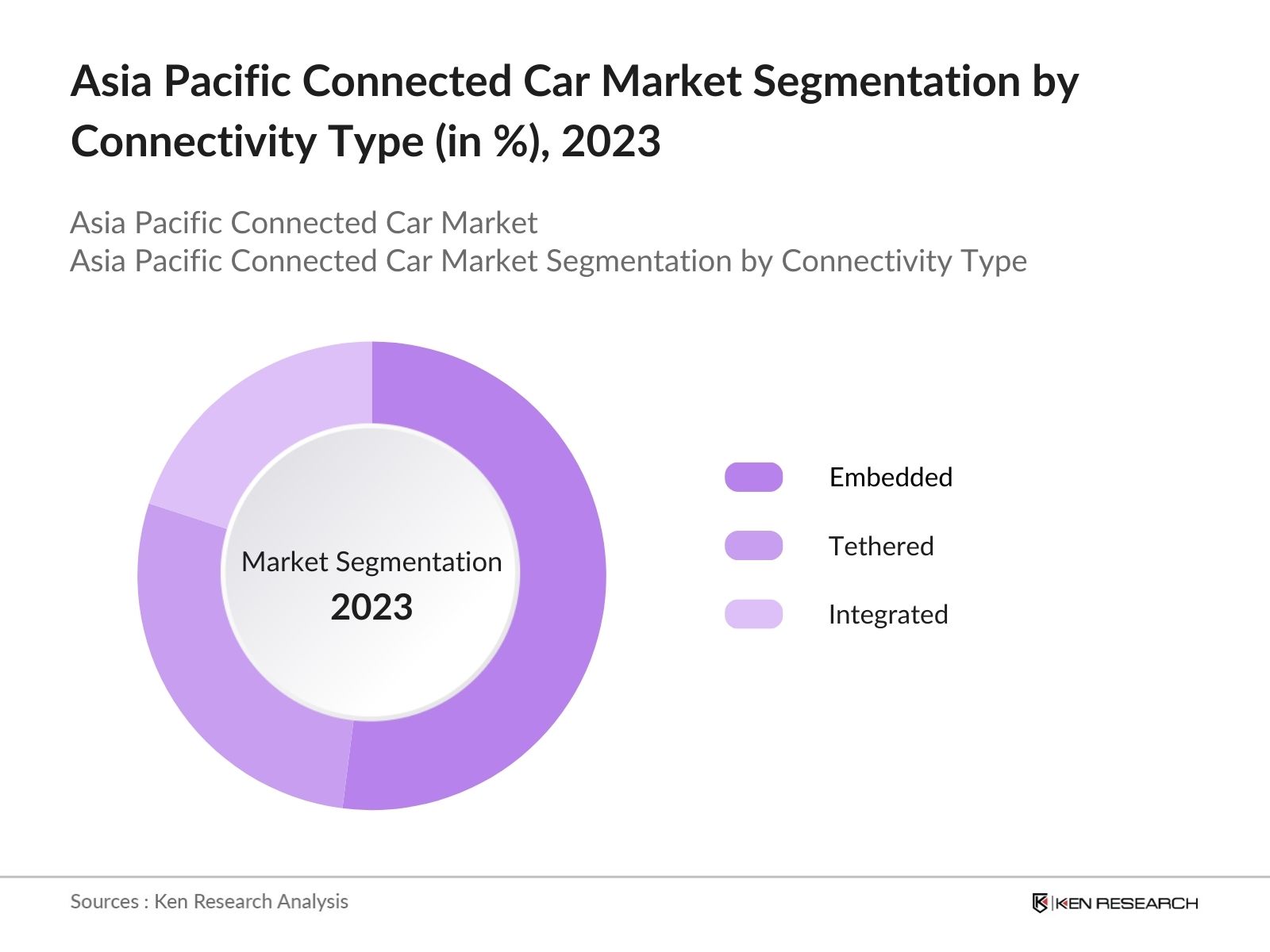
By Connectivity Type: The market is segmented by connectivity type into embedded, tethered, and integrated connectivity. In 2023, Embedded Connectivity held the largest market share due to the growing preference for factory-installed solutions that offer seamless integration with vehicle systems and enhanced reliability.
Asia Pacific Connected Car Market Segmentation by connectivity type

By Application: The market is segmented by navigation, infotainment, safety and security, and vehicle management. In 2023, Safety and Security was the leading segment with the increasing focus on enhancing vehicle safety features, such as advanced driver-assistance systems (ADAS) and real-time traffic alerts, has driven the growth of this segment.

Asia Pacific Connected Car Market Segmentation by Application

By Region: The market is segmented by China, South Korea, Japan, India, Australia, and Rest of APAC. In 2023, China led the market due to its massive automotive industry, strong government backing, and rapid adoption of connected and electric vehicles, positioning it as the region's innovation hub.

Asia Pacific Connected Car Market Competitive Landscape

Company Name

Establishment Year

Headquarters

Toyota Motor Corporation

1937

Toyota, Japan

Hyundai Motor Company

1967

Seoul, South Korea

Honda Motor Co., Ltd.

1948

Tokyo, Japan

Nissan Motor Co., Ltd.

1933

Yokohama, Japan

Tata Motors

1945

Mumbai, India

  • Hyundai Motor Company: In 2023, Hyundai announced a partnership with South Korea's SK Telecom to develop 5G-based connected car services. This collaboration aims to create a more seamless driving experience by integrating high-speed communication technologies with vehicle systems. The partnership highlights the growing trend of automotive companies collaborating with tech firms to advance connected vehicle technologies.
  • Honda Motor Co., Ltd.: Honda introduced a new AI-powered in-car assistant in 2023, capable of providing personalized driving recommendations and real-time traffic updates. This innovation is part of Honda's broader strategy to enhance the user experience in its connected vehicles. The AI assistant has been well-received, in Japan with its launch.

Asia Pacific Connected Car Market Analysis

Market Growth Drivers

  • Expansion of 5G Networks: The deployment of 5G networks across the Asia Pacific region is a growth driver for the connected car sector. In 2024, over 600 million people in Asia Pacific are expected to have access to 5G services, enabling faster and more reliable communication between vehicles and infrastructure. This is crucial for the development of real-time data transmission and autonomous driving features, driving the adoption of connected cars.
  • Rise in Electric Vehicle Sales: The increasing demand for electric vehicles (EVs) is propelling the connected car market. Asia-Pacific region will account for11.18 million EVsin 2024, which represents about66% of total global EV shipmentsexpected to reach16.84 millionunits worldwide. The integration of connected technologies in EVs enhances the user experience, further driving market growth.
  • Growing Consumer Demand for Safety Features: The demand for enhanced safety features in vehicles is rising, with consumers increasingly seeking cars equipped with advanced driver assistance systems (ADAS) and real-time traffic alerts. In 2024, it is expected that over 30 million vehicles in the Asia Pacific will be equipped with some form of connected safety feature, reflecting the growing consumer preference for safer driving experiences.

Market Challenges

  • Infrastructure Development Lagging Behind: While smart infrastructure is crucial for the success of connected cars, many regions in Asia Pacific are still lagging in terms of necessary infrastructure development. In 2024, only about 60% of major highways in India are expected to be equipped with intelligent transport systems (ITS), which are essential for the functioning of connected vehicles. This infrastructure gap presents a significant challenge to market growth.
  • High Costs of Connected Car Technologies: The development and implementation of connected car technologies are expensive, with the average cost of integrating advanced connectivity solutions into vehicles. This high cost can be prohibitive for mass adoption, especially in emerging markets within the Asia Pacific region, where price sensitivity is higher.

Government Initiatives

  • Chinas Intelligent Vehicle Development Strategy: In 2024, the Chinese government is expected to continue its strong support for the market through its Intelligent Vehicle Development Strategy, which includes plans to install over 200,000 smart traffic signals across major cities. This initiative is part of Chinas broader push to lead in the global connected and autonomous vehicle space, boosting the market.
  • South Koreas Smart City and Autonomous Vehicle Initiative: South Korea's overall budget for research and development in 2024 totals USD 4.4 billion, which include its smart city initiative, the development of infrastructure for autonomous and connected vehicles. The governments focus on creating a conducive environment for the deployment of these technologies is expected to accelerate market growth.

Asia Pacific Connected Car Market Future Outlook

The future trends in the Asia Pacific connected car industry include the rise of autonomous connected vehicles, the growth of Vehicle-to-Everything (V2X) communication technologies, the expansion of subscription-based connected car services, and the integration of advanced cybersecurity measures to protect against potential threats.

Future Market Trends

  • Growth of Vehicle-to-Everything (V2X) Communication: The future of the market will be heavily influenced by the growth of V2X communication technologies. By 2028, it is anticipated that more than 80% of new vehicles in Asia Pacific will be equipped with V2X systems, enabling real-time communication with infrastructure, pedestrians, and other vehicles, significantly enhancing road safety and traffic management.
  • Integration of Advanced Cybersecurity Measures: As connected car technologies evolve, the need for robust cybersecurity measures will become increasingly critical. By 2028, it is expected that all major automakers in Asia Pacific will implement advanced cybersecurity protocols in their connected vehicles, ensuring data privacy and protection against cyber threats. This will be a key factor in gaining consumer trust and driving market adoption.

Scope of the Report

By Connectivity Type

Embedded

Tethered

Integrated

By Application

Safety and Security

Infotainment

Navigation

Vehicle Management

By Region

China

South Korea

Japan

India

Australia

Rest of APAC

Products

Key Target Audience Organizations and Entities Who Can Benefit by Subscribing This Report:

  • Telecommunications Companies

  • Automotive Companies

  • Government Regulatory Bodies (e.g., Ministry of Transportation)

  • Fleet Management Companies

  • Insurance Companies

  • Autonomous Vehicle Startups

  • Venture Capitalist


Companies

Players Mentioned in the Report:

  • Toyota Motor Corporation

  • Hyundai Motor Company

  • Honda Motor Co., Ltd.

  • Nissan Motor Co., Ltd.

  • Tata Motors

  • Mitsubishi Motors Corporation

  • Suzuki Motor Corporation

  • SAIC Motor Corporation Limited

  • Geely Automobile Holdings

  • Mahindra & Mahindra

  • Kia Corporation

  • Subaru Corporation

  • Isuzu Motors Limited

  • BYD Auto Co., Ltd.

  • Changan Automobile Company

Table of Contents

1. Asia Pacific Connected Car Market Overview

1.1. Definition and Scope

1.2. Market Taxonomy

1.3. Market Growth Rate

1.4. Market Segmentation Overview

2. Asia Pacific Connected Car Market Size (in USD Bn), 2018-2023

2.1. Historical Market Size

2.2. Year-on-Year Growth Analysis

2.3. Key Market Developments and Milestones

3. Asia Pacific Connected Car Market Analysis

3.1. Growth Drivers

3.1.1. Expansion of 5G Networks

3.1.2. Rise in Electric Vehicle Sales

3.1.3. Government Investments in Smart Infrastructure

3.1.4. Consumer Demand for Safety Features

3.2. Restraints

3.2.1. High Costs of Connected Car Technologies

3.2.2. Data Privacy and Security Concerns

3.2.3. Infrastructure Development Challenges

3.2.4. Regulatory Hurdles and Standardization Issues

3.3. Opportunities

3.3.1. Autonomous Vehicle Integration

3.3.2. V2X Communication Technology Expansion

3.3.3. Subscription-Based Services Growth

3.3.4. Advanced Cybersecurity Measures

3.4. Trends

3.4.1. Adoption of AI in Connected Vehicles

3.4.2. Integration with Smart City Initiatives

3.4.3. Enhanced Vehicle-to-Cloud Communication

3.4.4. Growth of Telematics and Predictive Maintenance

3.5. Government Regulation

3.5.1. Chinas Intelligent Vehicle Development Strategy

3.5.2. Japans V2X Communication Network Expansion

3.5.3. South Koreas Smart City and Autonomous Vehicle Initiative

3.5.4. Indias Automotive Mission Plan 2026

3.6. SWOT Analysis

3.7. Stake Ecosystem

3.8. Competition Ecosystem

4. Asia Pacific Connected Car Market Segmentation, 2023

4.1. By Connectivity Type (in Value %)

4.1.1. Embedded Connectivity

4.1.2. Tethered Connectivity

4.1.3. Integrated Connectivity

4.2. By Application Type (in Value %)

4.2.1. Safety and Security

4.2.2. Infotainment

4.2.3. Navigation

4.2.4. Vehicle Management

4.3. By Region (in Value %)

4.3.1. China

4.3.2. Japan

4.3.3. South Korea

4.3.4. India

4.3.5. Australia

4.3.6. Rest of APAC

5. Asia Pacific Connected Car Market Cross Comparison

5.1 Detailed Profiles of Major Companies

5.1.1. Toyota Motor Corporation

5.1.2. Hyundai Motor Company

5.1.3. Honda Motor Co., Ltd.

5.1.4. Nissan Motor Co., Ltd.

5.1.5. Tata Motors

5.1.6. Mitsubishi Motors Corporation

5.1.7. Suzuki Motor Corporation

5.1.8. SAIC Motor Corporation Limited

5.1.9. Geely Automobile Holdings

5.1.10. Mahindra & Mahindra

5.2. Cross Comparison Parameters (No. of Employees, Headquarters, Inception Year, Revenue)

6. Asia Pacific Connected Car Market Competitive Landscape

6.1. Market Share Analysis

6.2. Strategic Initiatives

6.3. Mergers and Acquisitions

6.4. Investment Analysis

6.4.1. Venture Capital Funding

6.4.2. Government Grants

6.4.3. Private Equity Investments

7. Asia Pacific Connected Car Market Regulatory Framework

7.1. Environmental Standards

7.2. Compliance Requirements

7.3. Certification Processes

8. Asia Pacific Connected Car Future Market Size (in USD Bn), 2023-2028

8.1. Future Market Size Projections

8.2. Key Factors Driving Future Market Growth

9. Asia Pacific Connected Car Market Future Market Segmentation, 2028

9.1. By Connectivity Type (in Value %)

9.2. By Application Type (in Value %)

9.3. By Region (in Value %)

10. Asia Pacific Connected Car Market Analysts Recommendations

10.1. TAM/SAM/SOM Analysis

10.2. Customer Cohort Analysis

10.3. Marketing Initiatives

10.4. White Space Opportunity Analysis

Disclaimer Contact Us

Research Methodology

Step:1 Identifying Key Variables:

Ecosystem creation for all the major entities and referring to multiple secondary and proprietary databases to perform desk research around market to collate industry level information.

Step:2 Market Building:

Collating statistics on this industry over the years, penetration of marketplaces and service providers ratio to compute revenue generated for Asia Pacific Connected Car industry. We will also review service quality statistics to understand revenue generated which can ensure accuracy behind the data points shared.

Step:3 Validating and Finalizing:

Building market hypothesis and conducting CATIs with industry experts belonging to different companies to validate statistics and seek operational and financial information from company representatives.

Step:4 Research output:

Our team will approach multiple automotive companies and understand nature of product segments and sales, consumer preference and other parameters, which will support us validate statistics derived through bottom to top approach from such automotive companies.

Frequently Asked Questions

01 How big is the Asia Pacific Connected Car market?

The Asia Pacific Connected Car Market was valued at USD 25.30 billion in 2023. The growth is driven by the increasing adoption of advanced technologies in the automotive industry, the rise of electric vehicles, and the demand for enhanced driving experiences.

02 What are the challenges in the Asia Pacific Connected Car market?

The challenges in the Asia Pacific Connected Car market include the high costs associated with developing and implementing connected car technologies, concerns over data privacy and security, lagging infrastructure development in some regions, and regulatory inconsistencies across different countries.

03 Who are the major players in the Asia Pacific Connected Car market?

Key players in the Asia Pacific Connected Car market include Toyota, Hyundai Motor Company, Honda, Nissan, and Tata Motors. These companies are leading the development and deployment of connected car technologies across the region.

04 What are the main growth drivers of the Asia Pacific Connected Car market?

The growth of the Asia Pacific Connected Car market is the expansion of 5G networks, the rise in electric vehicle adoption, significant government investments in smart infrastructure, and growing consumer demand for advanced safety features in vehicles.

Why Buy From Us?

RRR
Refine Robust Result (RRR) Framework

What makes us stand out is that our consultants follows Robust, Refine and Result (RRR) methodology. i.e. Robust for clear definitions, approaches and sanity checking, Refine for differentiating respondents facts and opinions and Result for presenting data with story

Our Reach Is Unmatched

We have set a benchmark in the industry by offering our clients with syndicated and customized market research reports featuring coverage of entire market as well as meticulous research and analyst insights.

Research
Shifting the Research Paradigm

While we don't replace traditional research, we flip the method upside down. Our dual approach of Top Bottom & Bottom Top ensures quality deliverable by not just verifying company fundamentals but also looking at the sector and macroeconomic factors.

Insite
More Insights-Better Decisions

With one step in the future, our research team constantly tries to show you the bigger picture. We help with some of the tough questions you may encounter along the way: How is the industry positioned? Best marketing channel? KPI's of competitors? By aligning every element, we help maximize success.

Trust
Transparency and Trust

Our report gives you instant access to the answers and sources that other companies might choose to hide. We elaborate each steps of research methodology we have used and showcase you the sample size to earn your trust.

support
Round the Clock Support

If you need any support, we are here! We pride ourselves on universe strength, data quality, and quick, friendly, and professional service.

Why Client Choose Us?

400000+ Reports in repository
150+ Consulting project a year
100+ Analysts
8000+ Client Queries in 2022