















Asia Pacific Conventional Lathe Machine Market Outlook to 2030
Region:Asia
Author(s):Vijay Kumar
Product Code:KROD9914
November 2024
89
About the Report
Asia Pacific Conventional Lathe Machine Market Overview
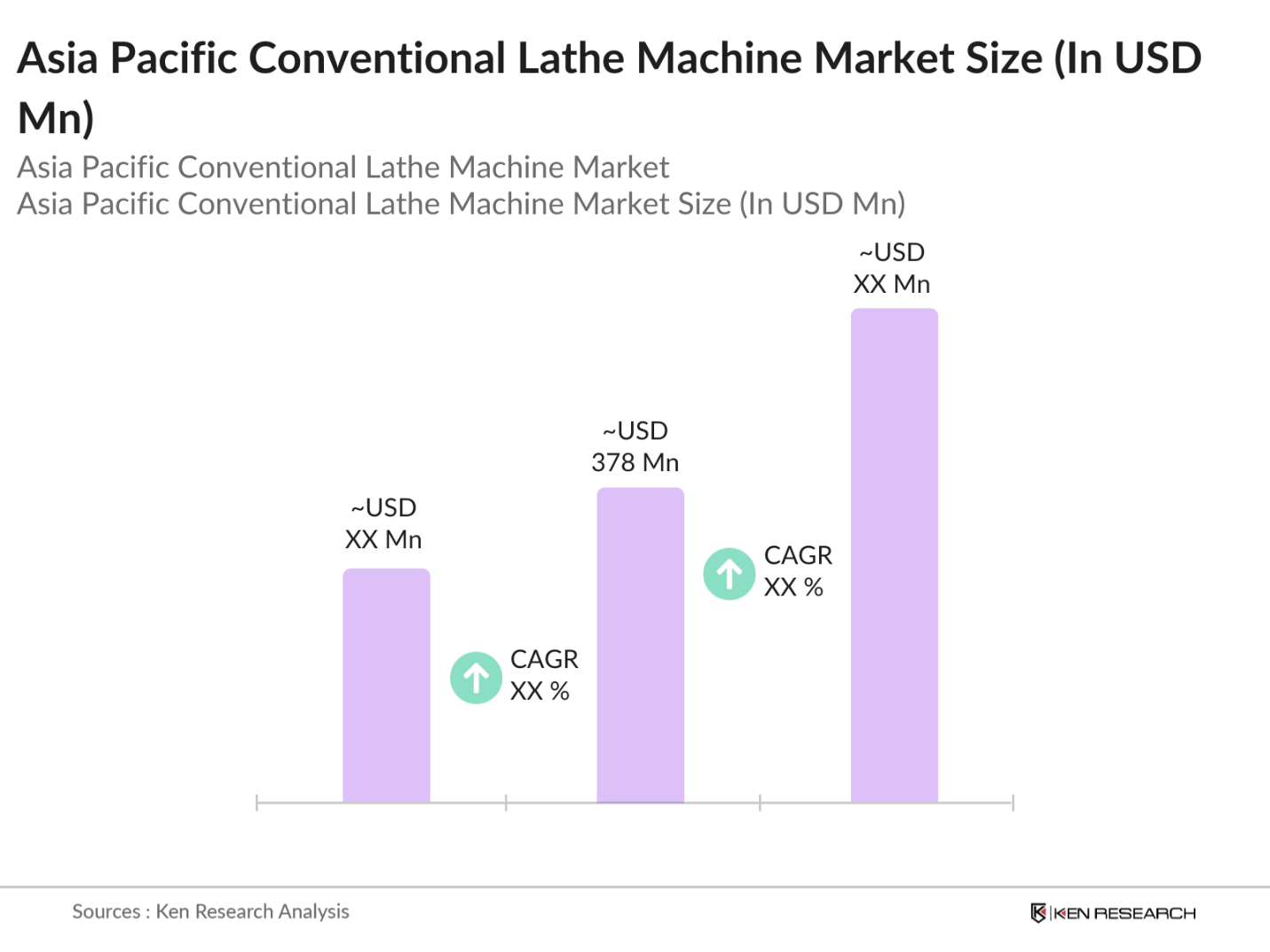
- The Asia Pacific Conventional Lathe Machine Market is valued at USD 378 million, based on a five-year historical analysis. This market is primarily driven by the growing demand from the automotive and aerospace sectors, where precision machining is essential for producing components with tight tolerances. The push for automation and increased productivity in manufacturing processes further boosts the demand for conventional lathe machines, which are favored for their reliability and lower operating costs compared to CNC alternatives.
- Dominant countries in the Asia Pacific region include China, India, and Japan, driven by government-led industrialization programs and heavy investments in the automotive and electronics sectors. Chinas market dominance is supported by its focus on the Made in China 2025 initiative, which emphasizes local production capacity for high-end machinery. India and Japan also remain influential due to their robust manufacturing infrastructures, catering primarily to automotive, aerospace, and general machinery needs.
- Countries in Asia-Pacific are enforcing stricter emission controls, impacting machine operations. Chinas National Emission Standards for Industrial Air Pollutants cover machine shops and manufacturing facilities, demanding lower particulate emissions, which has led to upgraded machining facilities. South Koreas emission standards are similar, with new regulations requiring reductions in volatile organic compound emissions, thus affecting the manufacturing environment for conventional lathes.
Asia Pacific Conventional Lathe Machine Market Segmentation
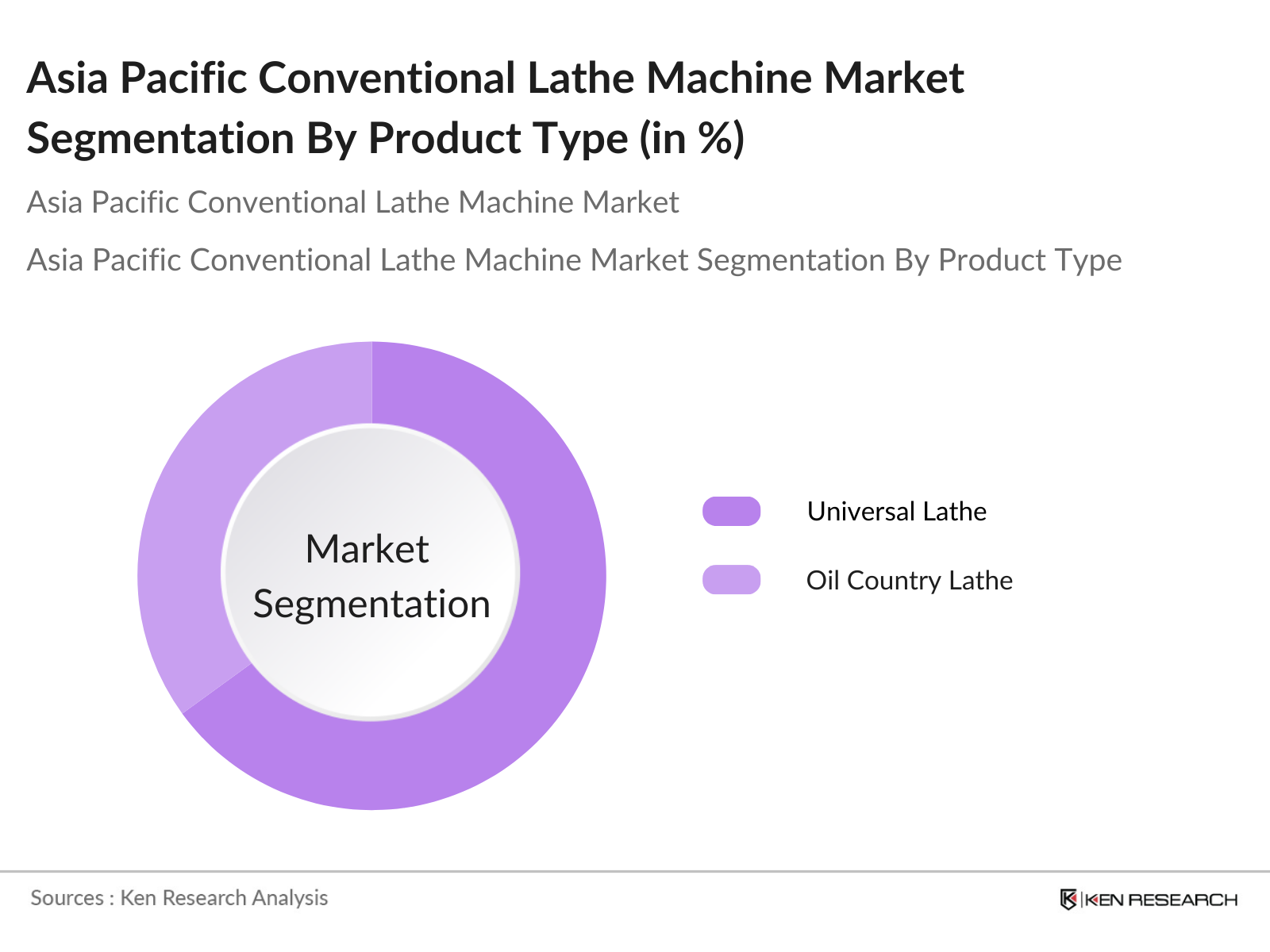
By Product Type: The Asia Pacific Conventional Lathe Machine Market is segmented by product type into Universal Lathes and Oil Country Lathes. Universal lathes hold a dominant market share due to their versatility in applications across various sectors such as automotive and aerospace. They are widely used in metalworking due to their adaptable functionality, making them essential in workshops and large manufacturing setups. The flexibility of universal lathes in handling diverse materials and requirements supports their continued demand.
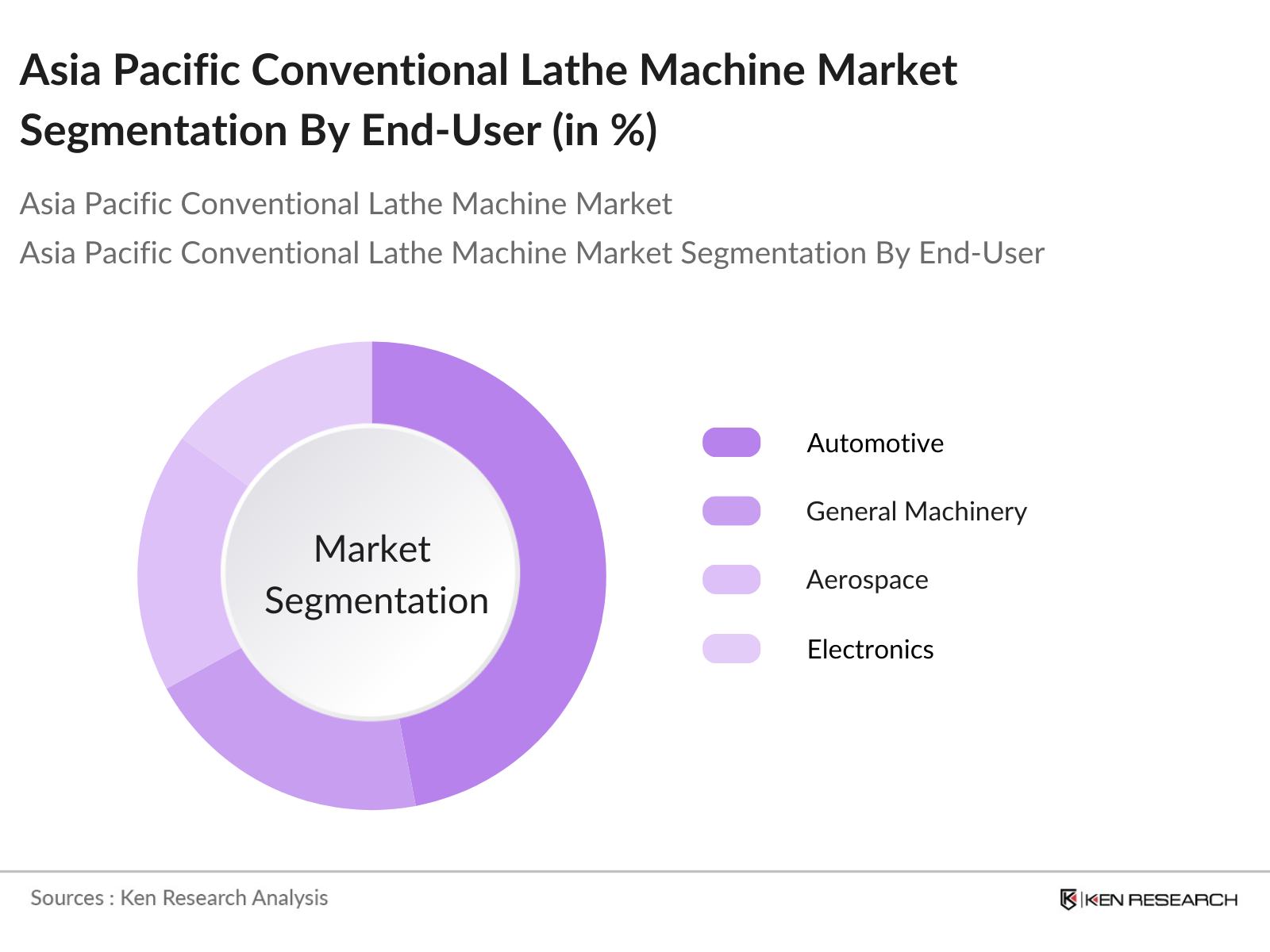
By End-User: The market is further segmented by end-user into Automotive, General Machinery, Aerospace, Electronics, and Oil & Gas sectors. Among these, the automotive sector holds a leading position, largely attributed to the rising demand for electric vehicles and advancements in hybrid technologies. Conventional lathes play a crucial role in machining automotive parts like engine components, facilitating the mass production required in the automotive industry.
Asia Pacific Conventional Lathe Machine Market Competitive Landscape
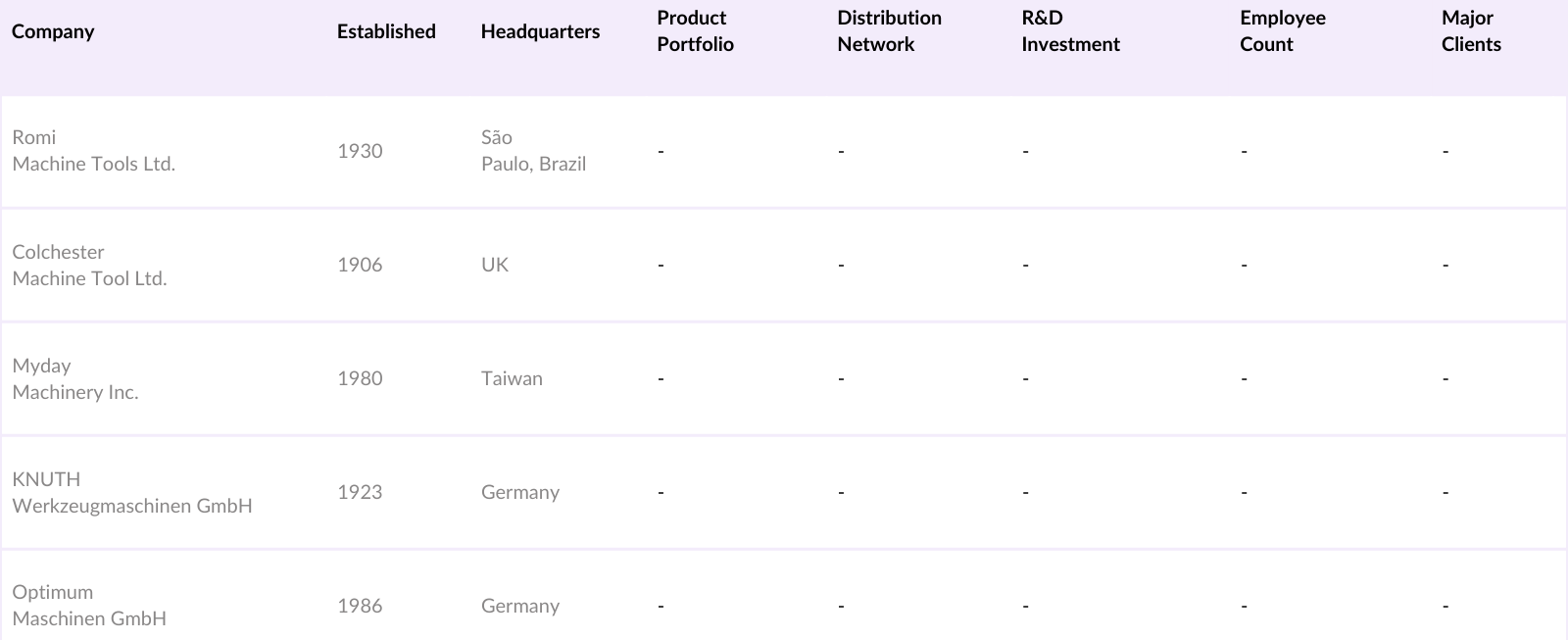
The Asia Pacific Conventional Lathe Machine Market is dominated by key players such as Romi Machine Tools Ltd., Colchester Machine Tool Solutions Ltd., and Myday Machinery Inc., indicating a concentrated market with strong competition. These players emphasize product innovation, extensive distribution networks, and customer loyalty programs to maintain their competitive edge.
Asia Pacific Conventional Lathe Machine Industry Analysis
Growth Drivers
- Industrial Manufacturing Demand (Automotive, Aerospace, Electronics): The industrial manufacturing sector in the Asia-Pacific region is buoyant, particularly in automotive, aerospace, and electronics. In 2024, the automotive sector experienced growth with China manufacturing over 27 million vehicles, including 5 million electric vehicles, meeting local demand and export needs. Japan, as the third-largest automotive producer globally, also contributes to rising manufacturing activities in Asia. The electronics manufacturing sector, driven by countries like South Korea and Taiwan, represents over $400 billion in export value across the region.
- Technological Developments (Incremental Technology Advancements): Technological advancements in lathe machinery in Asia focus on enhancing efficiency and precision while reducing production time. These advancements are crucial, given that over 65% of factories in East Asia are pursuing digital transformation, particularly in machine-tooling and manufacturing sectors. China's industrial upgrade initiatives, such as Made in China 2025, heavily promote advanced machining and manufacturing equipment. The rise of smart manufacturing within regional economies like Japan and South Korea contributes to consistent demand for technologically updated lathes, making incremental technological progress a driver for this market.
- Rise in Precision Engineering: Precision engineering, which is integral to industries such as aerospace and automotive, is growing rapidly across the Asia-Pacific region. Japan, a global leader in high-precision tools, exports billions in precision machinery annually, while Singapore's manufacturing value-add reached $92 billion in 2024, with precision engineering as a key contributor. High-quality lathes are crucial to achieving the tolerances required in precision engineering, which is fundamental in sectors like medical technology and aerospace, where Asia is seeing increased investment, further propelling the demand for conventional lathes in the region.
Market Challenges
- High Initial Setup Costs: Establishing a facility equipped with conventional lathe machines remains cost-prohibitive for many small and medium enterprises (SMEs) in the Asia-Pacific region. The cost of industrial-grade lathe machines ranges from $10,000 to $100,000 per unit, depending on specifications. Additionally, high utility costs in manufacturing hubs like Japan and South Korea add to the burden, with electricity costs in South Korea averaging 110 KRW/kWh for industrial use. This cost barrier affects smaller firms, limiting their capacity to adopt conventional lathes in manufacturing operations.
- Skilled Labor Shortage: The Asia-Pacific region faces a skilled labor shortage in manufacturing, particularly in high-precision lathe operations. According to the World Bank, countries like Vietnam, Thailand, and the Philippines report that only around 30% of their manufacturing workforce has the necessary technical skills. This shortage is compounded by rapid digital adoption and the need for training in machine operation, further limiting access to skilled workers capable of operating and maintaining lathe machinery, which impacts productivity and efficiency in the regions manufacturing sectors.
Asia Pacific Conventional Lathe Machine Market Future Outlook
Over the next five years, the Asia Pacific Conventional Lathe Machine Market is projected to grow significantly, driven by continued industrial growth in emerging markets, increased investment in precision engineering, and rising demand for heavy-duty machinery in the automotive and aerospace sectors. The expansion of electric vehicle (EV) manufacturing will create additional demand for machinery capable of producing complex, high-precision components.
Market Opportunities
- Growth in Emerging Markets: Emerging markets in Southeast Asia, such as Vietnam and Indonesia, are experiencing rapid industrial growth. Vietnams manufacturing sector grew by approximately 9% year-on-year, and Indonesias industrial sector attracted foreign investments exceeding $30 billion in 2023. These countries are building up their manufacturing infrastructure, which includes investments in conventional lathe machines essential for primary metalworking and fabrication. Such growth presents an opportunity for lathe machine manufacturers to expand into these emerging economies, capitalizing on the need for foundational industrial tools.
- Renewable Energy Sector Investments: The Asia-Pacific region is seeing substantial investment in renewable energy projects, particularly in wind turbine manufacturing. China, the largest renewable energy producer, installed more than 100 GW of renewable energy capacity in 2024. Manufacturing components for wind and solar installations, including shafts and housings, requires lathe machining for precision. This growth in renewable infrastructure offers conventional lathe manufacturers new applications and markets, especially as precision machining remains critical for the renewable energy supply chain.
Scope of the Report
|
Product Type |
Universal Lathes Oil Country Lathes |
|
End-User |
Automotive General Machinery Aerospace Electronics Oil & Gas |
|
Spindle Orientation |
2-Axis 3-Axis |
|
Number of Axis |
Individual Users Commercial Spaces |
|
Region |
China India Japan Australia South Korea Other APAC Countries |
Products
Key Target Audience
Industrial Machinery Manufacturers
Automotive Component Suppliers
Aerospace Manufacturing Firms
Electronics Manufacturers
Oil & Gas Equipment Suppliers
Investments and Venture Capitalist Firms
Government and Regulatory Bodies (e.g., Ministry of Industry and Information Technology, Bureau of Industrial Machinery Standards)
Precision Engineering Workshops
Companies
Players Mentioned in the Report
Romi Machine Tools Ltd.
Colchester Machine Tool Solutions Ltd.
Myday Machinery Inc.
KNUTH Werkzeugmaschinen GmbH
Optimum Maschinen GmbH
ITAMA Srl
Ace Micromatic Group
CNC-TAKANG Co., Ltd.
GDW Werkzeugmaschinen GmbH
Winho Technology Industrial Co., Ltd.
Table of Contents
1. Asia Pacific Conventional Lathe Machine Market Overview
1.1. Definition and Scope
1.2. Market Taxonomy
1.3. Market Dynamics
1.4. Market Segmentation Overview
2. Asia Pacific Conventional Lathe Machine Market Size (in USD Million)
2.1. Historical Market Size
2.2. Year-On-Year Growth Analysis
2.3. Key Market Milestones
3. Asia Pacific Conventional Lathe Machine Market Analysis
3.1. Growth Drivers
3.1.1. Industrial Manufacturing Demand (automotive, aerospace, electronics)
3.1.2. Technological Developments (incremental technology advancements)
3.1.3. Rise in Precision Engineering
3.2. Market Challenges
3.2.1. High Initial Setup Costs
3.2.2. Skilled Labor Shortage
3.2.3. Increasing CNC Machine Competition
3.3. Opportunities
3.3.1. Growth in Emerging Markets
3.3.2. Renewable Energy Sector Investments
3.3.3. Expansion in Electric Vehicle Production
3.4. Trends
3.4.1. IoT and Industry 4.0 Integration
3.4.2. Increased Focus on Heavy-Duty Lathes
3.4.3. Rising Interest in Smart Manufacturing Practices
3.5. Regulatory Environment
3.5.1. Safety Standards (OSHA, ISO standards)
3.5.2. Compliance for Emissions
3.5.3. Environmental Certifications
3.6. SWOT Analysis
3.7. Stakeholder Ecosystem
3.8. Porters Five Forces
3.9. Competition Landscape
4. Asia Pacific Conventional Lathe Machine Market Segmentation
4.1. By Product Type (in Value %)
4.1.1. Universal Lathe
4.1.2. Oil Country Lathe
4.2. By End-User (in Value %)
4.2.1. Automotive
4.2.2. General Machinery
4.2.3. Aerospace
4.2.4. Electronics
4.2.5. Oil & Gas
4.3. By Lathe Type (in Value %)
4.3.1. Horizontal Lathe
4.3.2. Vertical Lathe
4.4. By Spindle Orientation (in Value %)
4.4.1. Single Spindle
4.4.2. Multi-Spindle
4.5. By Number of Axis (in Value %)
4.5.1. 2-Axis
4.5.2. 3-Axis
5. Asia Pacific Conventional Lathe Machine Competitive Analysis
5.1. Detailed Profiles of Major Companies
5.1.1. Romi Machine Tools Ltd.
5.1.2. Colchester Machine Tool Solutions Ltd.
5.1.3. ITAMA Srl
5.1.4. Myday Machinery Inc.
5.1.5. Knuth Werkzeugmaschinen GmbH
5.1.6. Optimum Maschinen GmbH
5.1.7. Summit Machine Tool
5.1.8. Winho Technology Industrial Co., Ltd.
5.1.9. GDW Werkzeugmaschinen GmbH
5.1.10. CNC-TAKANG Co., Ltd.
5.1.11. Annn Yang Machinery Co. Ltd
5.1.12. Ace Micromatic Group
5.1.13. DMG Mori Co., Ltd.
5.1.14. Doosan Machine Tools Co., Ltd.
5.1.15. Hardinge Inc.
5.2. Cross Comparison Parameters (Revenue, Headquarters, Number of Employees, Product Portfolio, Distribution Network, Market Share, Key Clients, Innovation Index)
5.3. Market Share Analysis
5.4. Strategic Initiatives
5.5. Mergers and Acquisitions
5.6. Investment Landscape
5.7. Government Grants
5.8. Private Equity Involvement
6. Asia Pacific Conventional Lathe Machine Market Regulatory Framework
6.1. Industrial and Safety Regulations
6.2. Emission Compliance Standards
6.3. Certification and Licensing Requirements
7. Asia Pacific Conventional Lathe Machine Market Future Projections
7.1. Market Size Forecast
7.2. Emerging Market Dynamics
7.3. New Technology Adoption (automation, smart machining)
8. Asia Pacific Conventional Lathe Machine Market Future Segmentation
8.1. By Product Type (in Value %)
8.2. By End-User (in Value %)
8.3. By Lathe Type (in Value %)
8.4. By Spindle Orientation (in Value %)
8.5. By Region (in Value %)
9. Asia Pacific Conventional Lathe Machine Market Analysts Recommendations
9.1. Total Addressable Market (TAM) Analysis
9.2. Strategic Market Entry Recommendations
9.3. White Space Opportunity Analysis
Disclaimer Contact UsResearch Methodology
Step 1: Identification of Key Variables
This phase involves mapping the entire ecosystem of stakeholders in the Asia Pacific Conventional Lathe Machine Market. Comprehensive desk research is conducted using secondary databases to define critical factors influencing market trends.
Step 2: Market Analysis and Construction
In this stage, historical data on market segments and regional sales are compiled and analyzed to assess market penetration and revenue growth. This data is instrumental in developing reliable projections.
Step 3: Hypothesis Validation and Expert Consultation
Key market hypotheses are tested through expert consultations with representatives from key firms. These insights, collected through interviews, refine the accuracy of the market analysis.
Step 4: Research Synthesis and Final Output
The final stage involves integrating findings from data analysis and expert consultations to produce a validated, comprehensive report on the Asia Pacific Conventional Lathe Machine Market.
Frequently Asked Questions
1. How big is the Asia Pacific Conventional Lathe Machine Market?
The Asia Pacific Conventional Lathe Machine Market is valued at USD 378 million, based on a five-year historical analysis. This market is primarily driven by the growing demand from the automotive and aerospace sectors, where precision machining is essential for producing components with tight tolerances.
2. What are the challenges in the Asia Pacific Conventional Lathe Machine Market?
Challenges include high initial costs, increased competition from CNC machines, and the shortage of skilled labor, which limits widespread adoption in smaller workshops.
3. Who are the major players in the Asia Pacific Conventional Lathe Machine Market?
Key players include Romi Machine Tools Ltd., Colchester Machine Tool Solutions Ltd., Myday Machinery Inc., KNUTH Werkzeugmaschinen GmbH, and Optimum Maschinen GmbH.
4. What are the growth drivers of the Asia Pacific Conventional Lathe Machine Market?
Growth is driven by factors such as industrialization, high demand for heavy-duty machining, and increasing adoption in electric vehicle manufacturing, especially within China and India.
Why Buy From Us?

What makes us stand out is that our consultants follows Robust, Refine and Result (RRR) methodology. i.e. Robust for clear definitions, approaches and sanity checking, Refine for differentiating respondents facts and opinions and Result for presenting data with story

We have set a benchmark in the industry by offering our clients with syndicated and customized market research reports featuring coverage of entire market as well as meticulous research and analyst insights.

While we don't replace traditional research, we flip the method upside down. Our dual approach of Top Bottom & Bottom Top ensures quality deliverable by not just verifying company fundamentals but also looking at the sector and macroeconomic factors.

With one step in the future, our research team constantly tries to show you the bigger picture. We help with some of the tough questions you may encounter along the way: How is the industry positioned? Best marketing channel? KPI's of competitors? By aligning every element, we help maximize success.

Our report gives you instant access to the answers and sources that other companies might choose to hide. We elaborate each steps of research methodology we have used and showcase you the sample size to earn your trust.

If you need any support, we are here! We pride ourselves on universe strength, data quality, and quick, friendly, and professional service.