
Asia Pacific Digital Production Inkjet Printing Market Outlook to 2030
Region:Global
Author(s):Abhinav kumar
Product Code:KROD7115
December 2024
96
About the Report
Asia Pacific Digital Production Inkjet Printing Market Overview
- The Asia Pacific digital production inkjet printing market is valued at USD 1.4 billion, driven primarily by the increasing demand for high-speed printing solutions across industries like packaging, textiles, and commercial printing. Technological advancements in inkjet printheads and the introduction of eco-friendly inks have further fueled market growth. The industry's growth is also supported by the growing demand for cost-effective and customizable print solutions that allow for shorter print runs, which are more sustainable and responsive to consumer demands.
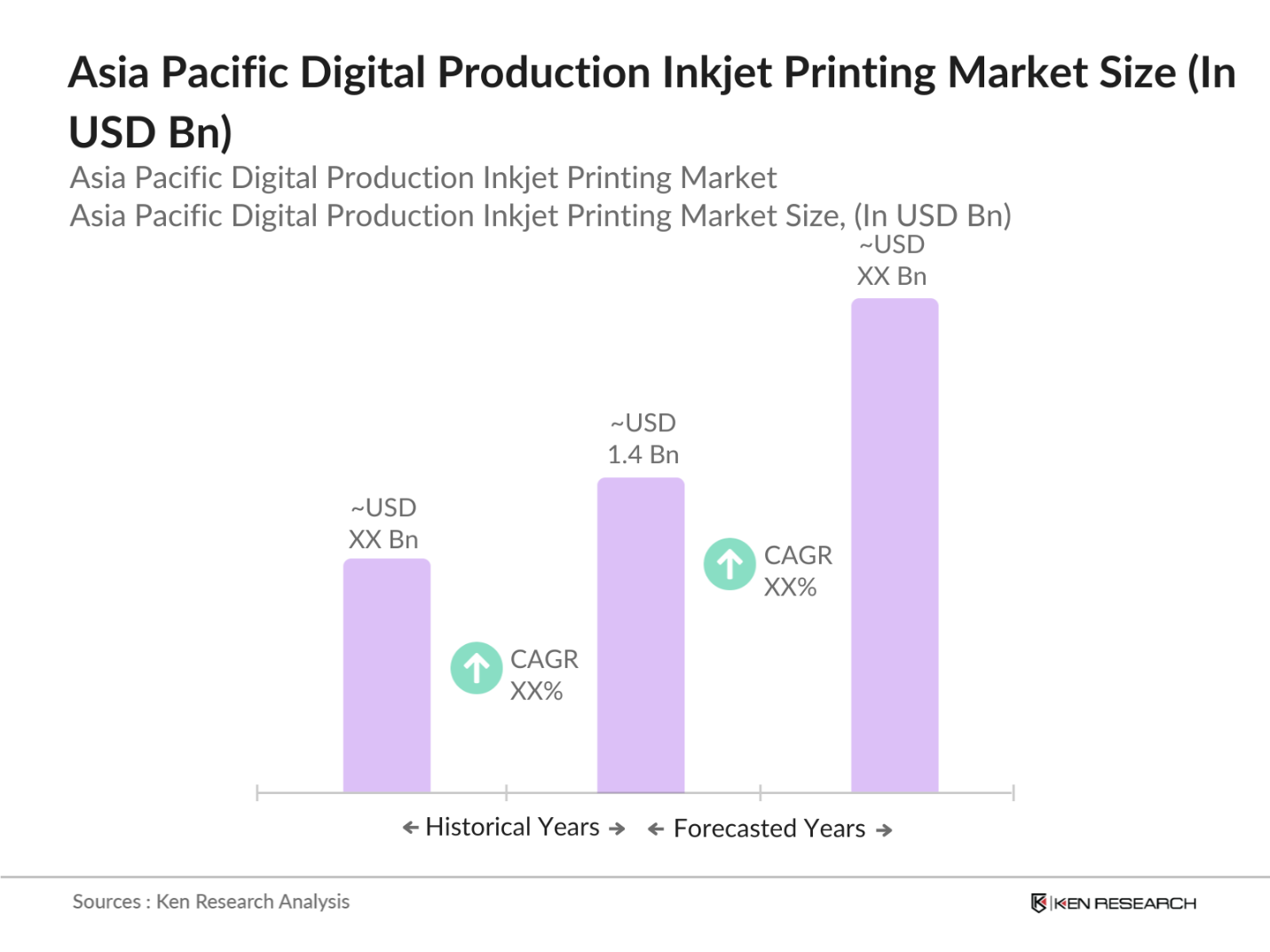
- China, Japan, and India dominate the Asia Pacific digital production inkjet printing market due to their strong manufacturing capabilities and demand for both industrial and commercial printing. China leads in terms of production volume due to its expansive packaging and textiles industries, while Japan is known for its technological innovations in printheads and ink formulations. India, on the other hand, is experiencing rapid adoption of inkjet technology, driven by the country's growing e-commerce sector and the demand for fast and flexible printing solutions.
- The integration of digital production inkjet printing with Industry 4.0 technologies is a significant trend reshaping the market landscape. In 2022, around 20% of manufacturers began implementing smart technologies to streamline production processes, utilizing IoT (Internet of Things) devices for real-time monitoring and data analysis. This integration allows for improved efficiency, reduced downtime, and enhanced quality control in printing operations. As companies strive for greater automation and data-driven decision-making, the synergy between digital printing technologies and Industry 4.0 is expected to drive innovation and operational excellence in the printing industry.
Asia Pacific Digital Production Inkjet Printing Market Segmentation
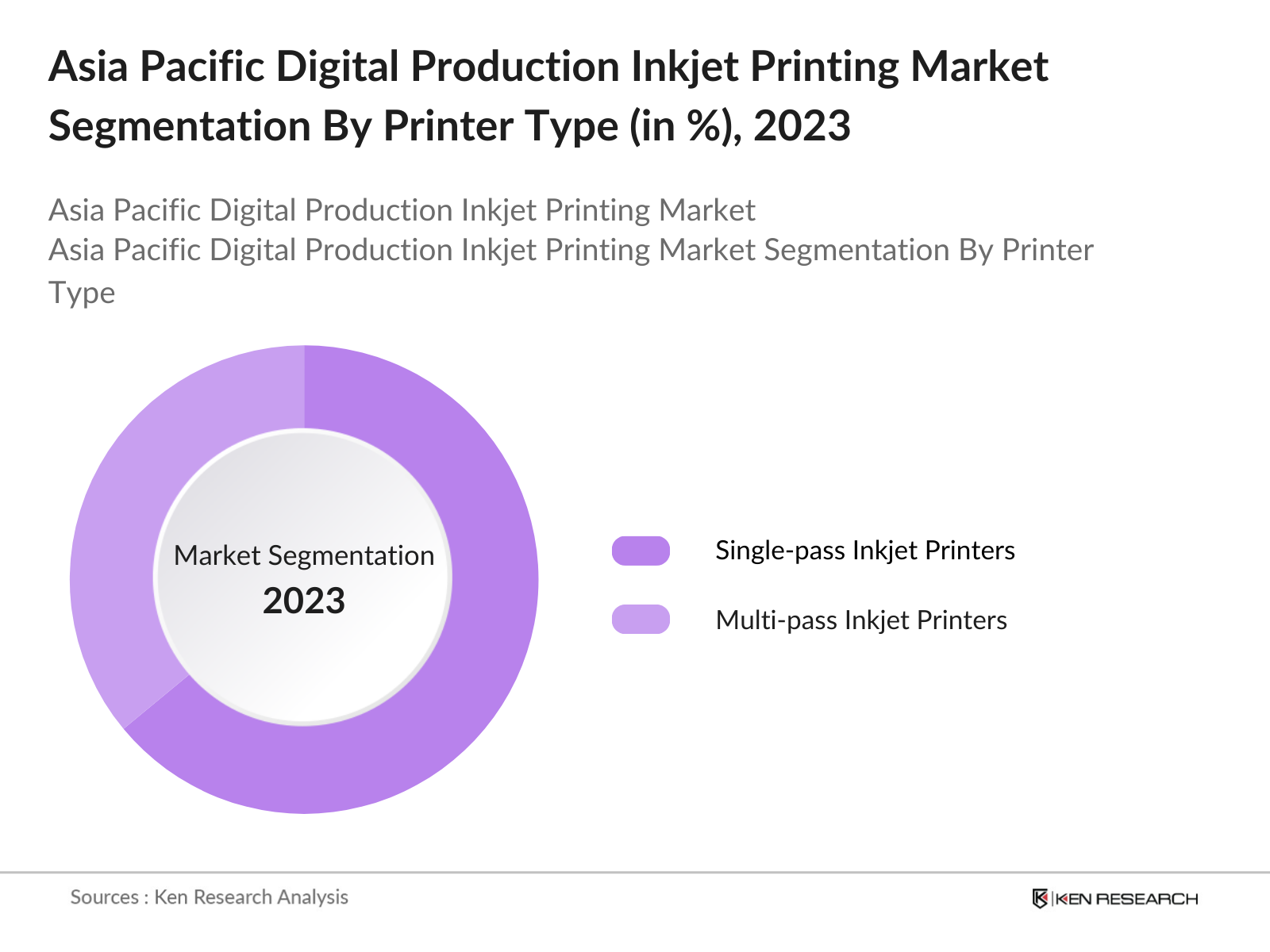
By Printer Type: The Asia Pacific digital production inkjet printing market is segmented by printer type into Single-pass Inkjet Printers and Multi-pass Inkjet Printers.
Single-pass inkjet printers hold a dominant market share in 2023 due to their ability to produce high-quality prints at faster speeds, making them ideal for industrial applications such as packaging and textile printing. The efficiency of single-pass printers, combined with lower operational costs, has made them the preferred choice for large-scale production environments.
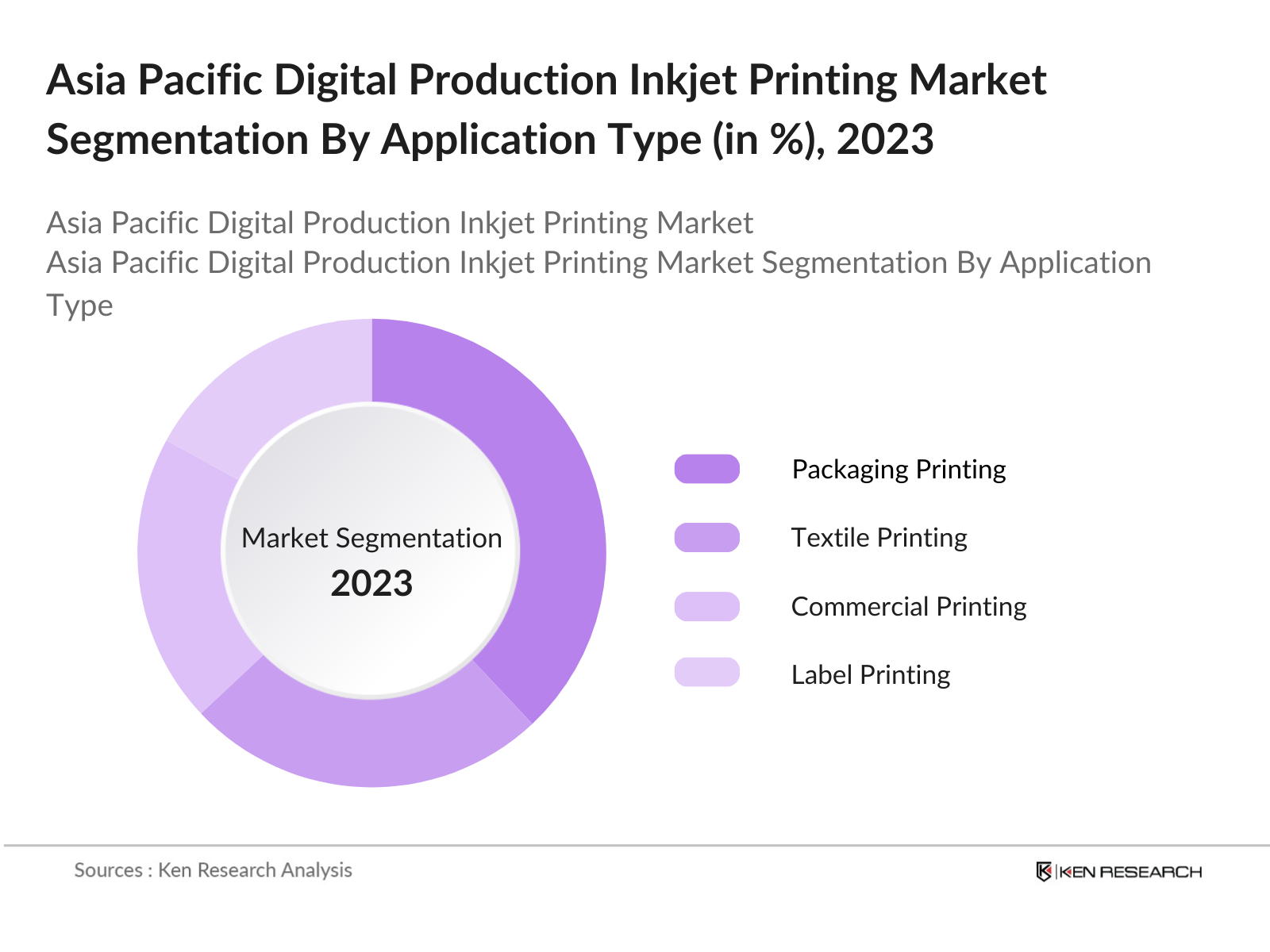
By Application: The market is further segmented by application into Commercial Printing, Textile Printing, Packaging Printing, Label Printing, and Publication Printing. Packaging printing holds a significant market share due to the growing demand for flexible packaging solutions in industries such as food and beverages, pharmaceuticals, and personal care. The rise of e-commerce and consumer preference for customized packaging has also contributed to the dominance of packaging printing in the market.
Asia Pacific Digital Production Inkjet Printing Market Competitive Landscape
The Asia Pacific digital production inkjet printing market is characterized by a mix of local and international players, each contributing to the growth and innovation in the sector. The market is dominated by companies that have invested heavily in research and development to create technologically advanced printers and eco-friendly inks. The Asia Pacific digital production inkjet printing market is dominated by major players such as Canon Inc., HP Inc., and Seiko Epson Corporation, which lead the market through continuous innovation and a strong presence in multiple application areas like packaging and textile printing. These companies have established themselves by offering cutting-edge technologies that cater to the growing demand for sustainable and efficient printing solutions.
|
Company Name |
Establishment Year |
Headquarters |
Market Specialization |
Revenue (USD) |
Employees |
Technological Innovation |
R&D Investments |
Geographic Reach |
Key Clients |
|
Canon Inc. |
1937 |
Tokyo, Japan |
_ |
_ |
_ |
_ |
_ |
_ |
_ |
|
HP Inc. |
1939 |
Palo Alto, USA |
_ |
_ |
_ |
_ |
_ |
_ |
_ |
|
Seiko Epson Corporation |
1942 |
Nagano, Japan |
_ |
_ |
_ |
_ |
_ |
_ |
_ |
|
Ricoh Company, Ltd. |
1936 |
Tokyo, Japan |
_ |
_ |
_ |
_ |
_ |
_ |
_ |
|
Fujifilm Holdings Corp. |
1934 |
Tokyo, Japan |
_ |
_ |
_ |
_ |
_ |
_ |
_ |
Asia Pacific Digital Production Inkjet Printing Industry Analysis
Growth Drivers
- Technological advancements in inkjet printheads: Technological advancements in inkjet printheads are propelling the Asia Pacific digital production inkjet printing market. The introduction of MEMS (Micro-Electro-Mechanical Systems) technology has enhanced the performance and efficiency of printheads, enabling faster and higher-resolution printing. In 2022, the global inkjet printhead market was valued at approximately $1.65 billion and is projected to grow, reflecting significant investment in R&D for improved print quality. This aligns with the increasing focus on automation and digital solutions in manufacturing processes. As of 2024, government funding for technology innovation in the printing sector has increased to support these advancements, showcasing a commitment to maintaining competitive standards.
- Increasing demand for customization in packaging: The demand for customization in packaging is significantly driving the growth of digital production inkjet printing in the Asia Pacific region. In 2023, the custom packaging market was valued at around $300 billion, with projections indicating continued growth as brands seek unique packaging solutions. As companies invest in personalized packaging to enhance brand identity, the need for flexible and efficient printing solutions rises. This demand is supported by a substantial shift towards e-commerce, which saw a 19% increase in 2022 in Asia, necessitating packaging that caters to individual customer preferences. Such trends are bolstered by government initiatives promoting digital transformation in manufacturing.
- Growing adoption of inkjet printing for textile production: The textile industry in Asia Pacific is witnessing a growing adoption of inkjet printing technology, particularly for customized and on-demand fabric printing. In 2022, the textile market in the region was valued at approximately $260 billion, with inkjet printing capturing a significant share due to its efficiency and ability to produce intricate designs without the need for extensive setup. This trend is reinforced by the increasing consumer demand for fast fashion and unique designs, leading to an estimated 15% growth in digital textile printing technology adoption. The rise in eco-conscious consumers has also driven the shift towards digital solutions, as inkjet printing minimizes waste compared to traditional methods.
Market Challenges
- High capital investment for industrial-scale inkjet printers: One of the primary challenges facing the digital production inkjet printing market in Asia Pacific is the high capital investment required for industrial-scale inkjet printers. The cost of advanced inkjet printers ranges from $100,000 to over $1 million, which poses a barrier for small to medium-sized enterprises (SMEs) looking to adopt this technology. Furthermore, the high cost of maintenance and operational expenses can deter potential users. In 2023, it was reported that over 50% of SMEs cited financial constraints as a reason for not upgrading their printing technologies, which could stifle innovation and limit market growth in the region.
- Limited adoption of inkjet technology in certain industries: Despite its advantages, the adoption of inkjet technology remains limited in several industries, particularly in heavy manufacturing and large-scale production environments. Traditional printing methods, such as offset printing, continue to dominate these sectors due to their established processes and lower cost per unit. In 2022, only about 10% of companies in the heavy manufacturing sector utilized inkjet technology for production, indicating a significant gap in technology adoption. This reluctance to transition to digital solutions can impede overall market growth and innovation within the region.
Asia Pacific Digital Production Inkjet Printing Market Future Outlook
Over the next five years, the Asia Pacific digital production inkjet printing market is expected to show strong growth driven by advancements in printing technologies and increased adoption in high-growth sectors such as packaging and textiles. Growing environmental concerns will also drive the demand for sustainable, water-based inks and eco-friendly printing solutions, positioning inkjet printing as a preferred technology in multiple applications. Furthermore, the digital transformation of industries will continue to create opportunities for automation and customization in print solutions.
Opportunities
- Expansion in the packaging and textile printing sectors: The expansion in the packaging and textile printing sectors presents significant opportunities for the digital production inkjet printing market in Asia Pacific. In 2022, the packaging industry in the region was valued at around $350 billion, with digital printing technology becoming increasingly vital for meeting the growing demand for customized packaging solutions. The textile sector is also projected to continue its upward trajectory, with estimates indicating a market value of approximately $300 billion by 2025. Companies are increasingly adopting inkjet printing for its versatility and efficiency in producing short runs and unique designs, capitalizing on the shift towards personalized consumer products. This trend is supported by government initiatives promoting innovation and sustainable practices in manufacturing.
- Digital transformation in printing for on-demand production: The digital transformation in the printing industry, particularly towards on-demand production, is creating vast opportunities for growth. In 2023, approximately 30% of printing companies in Asia Pacific reported significant investments in digital technologies to facilitate on-demand production capabilities. This shift is driven by the rise of e-commerce, which has led to a demand for quick turnaround times and flexible printing solutions. As businesses increasingly seek to optimize their supply chains and reduce inventory costs, digital production inkjet printing becomes a key solution, supporting efficient production processes. Government policies that encourage digitalization in manufacturing further enhance this opportunity.
Scope of the Report
|
Printer Type |
Single-pass Inkjet Printers, Multi-pass Inkjet Printers |
|
Application |
Commercial Printing Textile Printing Packaging Printing Label Printing Publication Printing |
|
Ink Type |
Solvent-based Inks UV-curable Inks Water-based Inks, Aqueous Inks |
|
Print Substrate |
Paper Plastics Textiles Metal |
|
Region |
China Japan India Australia South Korea |
Products
Key Target Audience Organizations and Entities Who Can Benefit by Subscribing to This Report:
Digital Printing Equipment Companies
Packaging Companies
Textile Industries
Ink Manufacturing companies
Industrial Printing Companies
Investments and Venture Capitalist Firms
Government and Regulatory Bodies (e.g., Ministry of Industry, Ministry of Information and Communication)
E-commerce Companies
Companies
Players Mentioned in the Report:
Canon Inc.
HP Inc.
Seiko Epson Corporation
Ricoh Company, Ltd.
Fujifilm Holdings Corporation
Brother Industries, Ltd.
Durst Group
EFI Electronics For Imaging, Inc.
Domino Printing Sciences PLC
Konica Minolta, Inc.
Kyocera Corporation
Mimaki Engineering Co., Ltd.
Roland DG Corporation
Kodak Alaris Inc.
Agfa-Gevaert N.V.
Table of Contents
1. Asia Pacific Digital Production Inkjet Printing Market Overview
1.1. Definition and Scope
1.2. Market Taxonomy (Market-specific production techniques, print substrate types, printing resolution)
1.3. Market Growth Rate
1.4. Market Segmentation Overview
2. Asia Pacific Digital Production Inkjet Printing Market Size (In USD Bn)
2.1. Historical Market Size
2.2. Year-On-Year Growth Analysis (Volume and Value)
2.3. Key Market Developments and Milestones (Technological developments, strategic partnerships)
3. Asia Pacific Digital Production Inkjet Printing Market Analysis
3.1. Growth Drivers
3.1.1. Technological advancements in inkjet printheads
3.1.2. Increasing demand for customization in packaging
3.1.3. Growing adoption of inkjet printing for textile production
3.1.4. Environmental sustainability in printing technology
3.2. Market Challenges
3.2.1. High capital investment for industrial-scale inkjet printers
3.2.2. Limited adoption of inkjet technology in certain industries
3.2.3. Technical limitations in high-speed printing
3.3. Opportunities
3.3.1. Expansion in the packaging and textile printing sectors
3.3.2. Digital transformation in printing for on-demand production
3.3.3. Adoption of water-based inkjet inks for eco-friendly printing
3.4. Trends
3.4.1. Increasing use of hybrid digital printing technologies
3.4.2. Integration with Industry 4.0 for workflow automation
3.4.3. Growing popularity of high-speed inkjet printers
3.4.4. Adoption of UV inkjet technology for direct-to-object printing
3.5. Government Regulation
3.5.1. Environmental regulations on printing ink composition
3.5.2. Standards for waste management and emissions control
3.5.3. Incentives for adopting sustainable printing technologies
3.5.4. Certifications for industrial printing equipment
3.6. SWOT Analysis
3.7. Stake Ecosystem (Printer manufacturers, ink suppliers, end-users)
3.8. Porters Five Forces (Bargaining power of suppliers, buyers, threat of substitutes)
3.9. Competition Ecosystem
4. Asia Pacific Digital Production Inkjet Printing Market Segmentation
4.1. By Printer Type (In Value %)
4.1.1. Single-pass Inkjet Printers
4.1.2. Multi-pass Inkjet Printers
4.2. By Application (In Value %)
4.2.1. Commercial Printing
4.2.2. Textile Printing
4.2.3. Packaging Printing
4.2.4. Label Printing
4.2.5. Publication Printing
4.3. By Ink Type (In Value %)
4.3.1. Solvent-based Inks
4.3.2. UV-curable Inks
4.3.3. Water-based Inks
4.3.4. Aqueous Inks
4.4. By Print Substrate (In Value %)
4.4.1. Paper
4.4.2. Plastics
4.4.3. Textiles
4.4.4. Metal
4.5. By Region (In Value %)
4.5.1. China
4.5.2. Japan
4.5.3. India
4.5.4. Australia
4.5.5. South Korea
5. Asia Pacific Digital Production Inkjet Printing Market Competitive Analysis
5.1 Detailed Profiles of Major Companies
5.1.1. Canon Inc.
5.1.2. HP Inc.
5.1.3. Xerox Corporation
5.1.4. Ricoh Company, Ltd.
5.1.5. Fujifilm Holdings Corporation
5.1.6. Brother Industries, Ltd.
5.1.7. Konica Minolta, Inc.
5.1.8. Seiko Epson Corporation
5.1.9. Durst Group
5.1.10. EFI Electronics For Imaging, Inc.
5.1.11. Domino Printing Sciences PLC
5.1.12. Kyocera Corporation
5.1.13. Mimaki Engineering Co., Ltd.
5.1.14. Roland DG Corporation
5.1.15. Kodak Alaris Inc.
5.2 Cross Comparison Parameters (Headquarters, Revenue, No. of Employees, Market Specialization, R&D Investments, Product Portfolio, Market Share, Strategic Initiatives)
5.3. Market Share Analysis
5.4. Strategic Initiatives (Partnerships, Innovations, Collaborations)
5.5. Mergers And Acquisitions
5.6. Investment Analysis
5.7 Venture Capital Funding
5.8. Government Grants
5.9. Private Equity Investments
6. Asia Pacific Digital Production Inkjet Printing Market Regulatory Framework
6.1. Environmental Standards (Ink composition, Waste Management)
6.2. Compliance Requirements
6.3. Certification Processes (ISO certifications, Eco-Labels)
7. Asia Pacific Digital Production Inkjet Printing Future Market Size (In USD Bn)
7.1. Future Market Size Projections
7.2. Key Factors Driving Future Market Growth
8. Asia Pacific Digital Production Inkjet Printing Future Market Segmentation
8.1. By Printer Type (In Value %)
8.2. By Application (In Value %)
8.3. By Ink Type (In Value %)
8.4. By Print Substrate (In Value %)
8.5. By Region (In Value %)
9. Asia Pacific Digital Production Inkjet Printing Market Analysts Recommendations
9.1. TAM/SAM/SOM Analysis
9.2. Customer Cohort Analysis
9.3. Marketing Initiatives
9.4. White Space Opportunity Analysis
Disclaimer
Contact Us
Research Methodology
Step 1: Identification of Key Variables
The research process starts with mapping the ecosystem of the Asia Pacific digital production inkjet printing market. Through extensive secondary research, we identify key stakeholders, including printer manufacturers, ink suppliers, and end-users, and define the critical variables affecting market dynamics.
Step 2: Market Analysis and Construction
This stage involves collecting and analyzing historical market data to evaluate trends in print technology adoption, revenue generation from ink sales, and key drivers of market growth. We also assess the impact of technological innovations on production efficiency and market demand.
Step 3: Hypothesis Validation and Expert Consultation
Industry experts from major companies are engaged via interviews to validate market data and insights. These consultations offer valuable perspectives on operational challenges, technological innovations, and future trends in inkjet printing.
Step 4: Research Synthesis and Final Output
The final step involves synthesizing the research findings and compiling a comprehensive report. This includes verifying data through direct engagement with industry players, ensuring that the report provides accurate and actionable insights into the Asia Pacific digital production inkjet printing market.
Frequently Asked Questions
01. How big is the Asia Pacific Digital Production Inkjet Printing Market?
The Asia Pacific digital production inkjet printing market is valued at USD 1.4 billion, driven by increasing demand for high-speed, customizable printing solutions across industries like textiles and packaging.
02. What are the challenges in the Asia Pacific Digital Production Inkjet Printing Market?
The market faces challenges such as high capital investment costs for advanced printing technology, limited adoption in certain industries, and the need for continuous technological upgrades to meet industry demands.
03. Who are the major players in the Asia Pacific Digital Production Inkjet Printing Market?
Key players in the market include Canon Inc., HP Inc., Seiko Epson Corporation, Ricoh Company, and Fujifilm Holdings, all of whom dominate due to their strong technological capabilities and extensive product portfolios.
04. What are the growth drivers of the Asia Pacific Digital Production Inkjet Printing Market?
Key growth drivers include technological advancements in inkjet printheads, increasing demand for sustainable printing solutions, and the rise in e-commerce, which has driven the demand for fast and flexible packaging solutions.
Why Buy From Us?

What makes us stand out is that our consultants follows Robust, Refine and Result (RRR) methodology. i.e. Robust for clear definitions, approaches and sanity checking, Refine for differentiating respondents facts and opinions and Result for presenting data with story

We have set a benchmark in the industry by offering our clients with syndicated and customized market research reports featuring coverage of entire market as well as meticulous research and analyst insights.

While we don't replace traditional research, we flip the method upside down. Our dual approach of Top Bottom & Bottom Top ensures quality deliverable by not just verifying company fundamentals but also looking at the sector and macroeconomic factors.

With one step in the future, our research team constantly tries to show you the bigger picture. We help with some of the tough questions you may encounter along the way: How is the industry positioned? Best marketing channel? KPI's of competitors? By aligning every element, we help maximize success.

Our report gives you instant access to the answers and sources that other companies might choose to hide. We elaborate each steps of research methodology we have used and showcase you the sample size to earn your trust.

If you need any support, we are here! We pride ourselves on universe strength, data quality, and quick, friendly, and professional service.