















Asia Pacific Dishwasher Market Outlook to 2030
Region:Asia
Author(s):Vijay Kumar
Product Code:KROD6859
November 2024
81
About the Report
Asia Pacific Dishwasher Market Overview
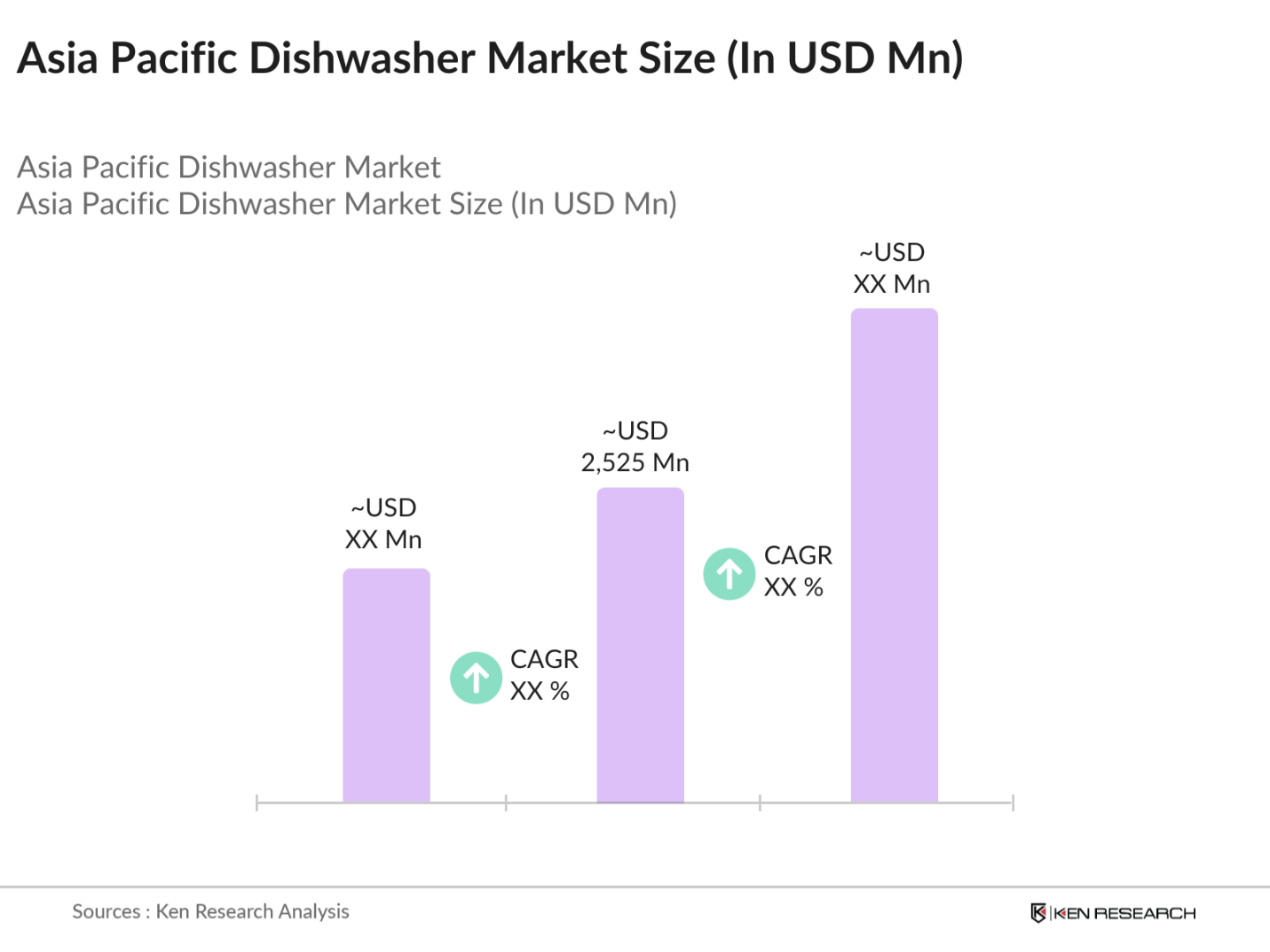
- The Asia Pacific dishwasher market is valued at USD 2,525 million, based on a five-year historical analysis. This market is primarily driven by the rapid urbanization in the region, the increasing disposable incomes of middle-class households, and the growing demand for smart and energy-efficient home appliances. As consumers in countries like China, India, and Japan seek more convenient and time-saving kitchen solutions, dishwashers have gained significant traction. The rise of e-commerce platforms has also contributed to the accessibility and popularity of various dishwasher models across the region.
- China and Japan dominate the Asia Pacific dishwasher market due to their advanced manufacturing sectors and high levels of consumer technology adoption. In China, rising middle-class income levels and an expanding urban population create a robust demand for home appliances. Japan's dominance is attributed to its technological innovation and strong domestic brands that offer advanced, smart-connected dishwasher models. Additionally, consumer preferences for eco-friendly and energy-efficient appliances drive the market in these countries.
- Many countries in the Asia-Pacific region have introduced stringent energy efficiency standards for home appliances, including dishwashers. According to the Australian Department of Energy, all dishwashers sold in the country must meet minimum energy performance standards (MEPS) as part of the government's efforts to reduce residential energy consumption. Similarly, in Japan, energy-efficient dishwashers are required to display a government-issued energy label, which helps consumers make informed purchasing decisions.
Asia Pacific Dishwasher Market Segmentation
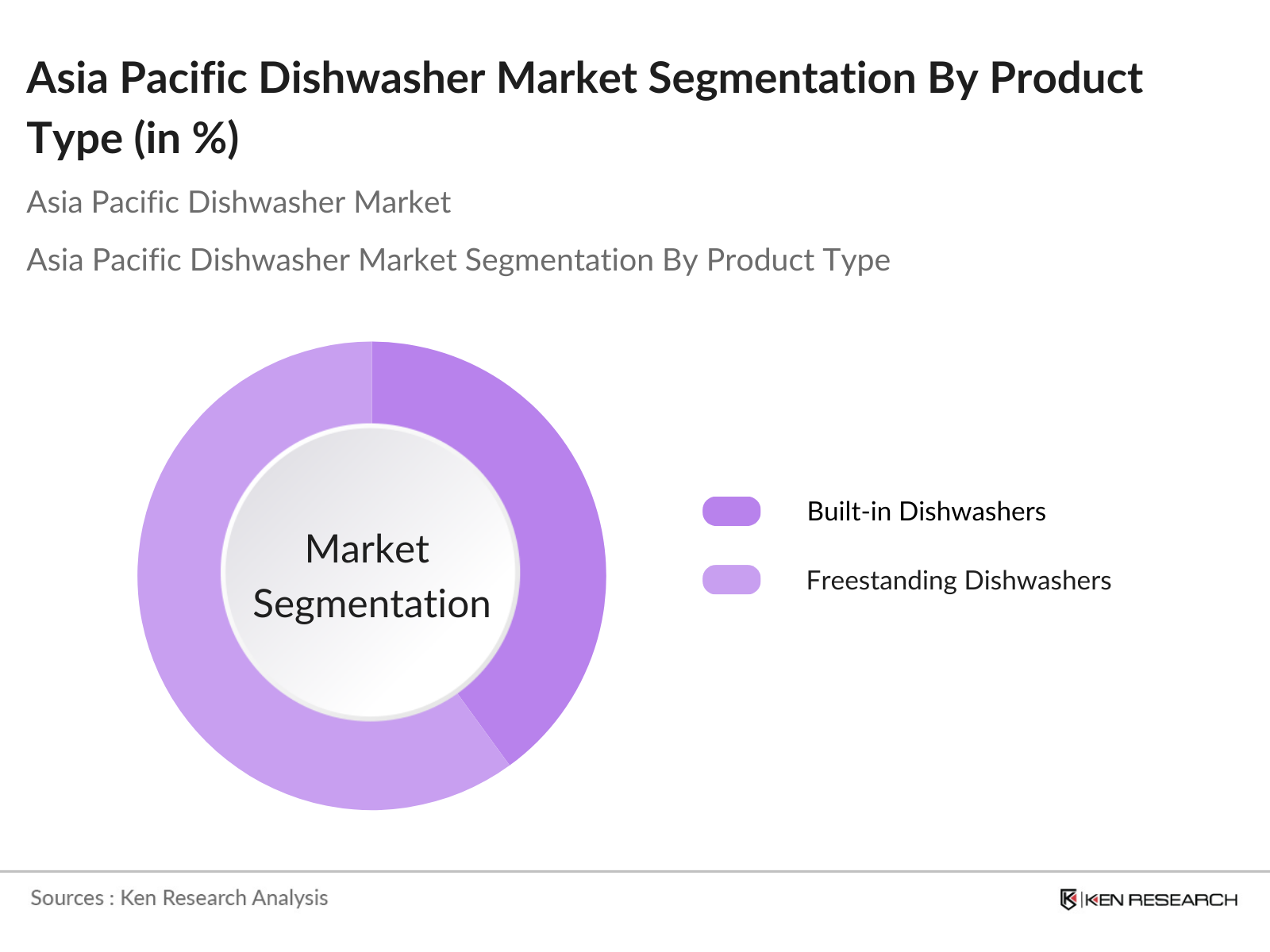
By Product Type: The Asia Pacific dishwasher market is segmented by product type into built-in dishwashers and freestanding dishwashers. Freestanding dishwashers dominate this segment due to their flexibility and ease of installation, making them an attractive choice for renters and homeowners alike.
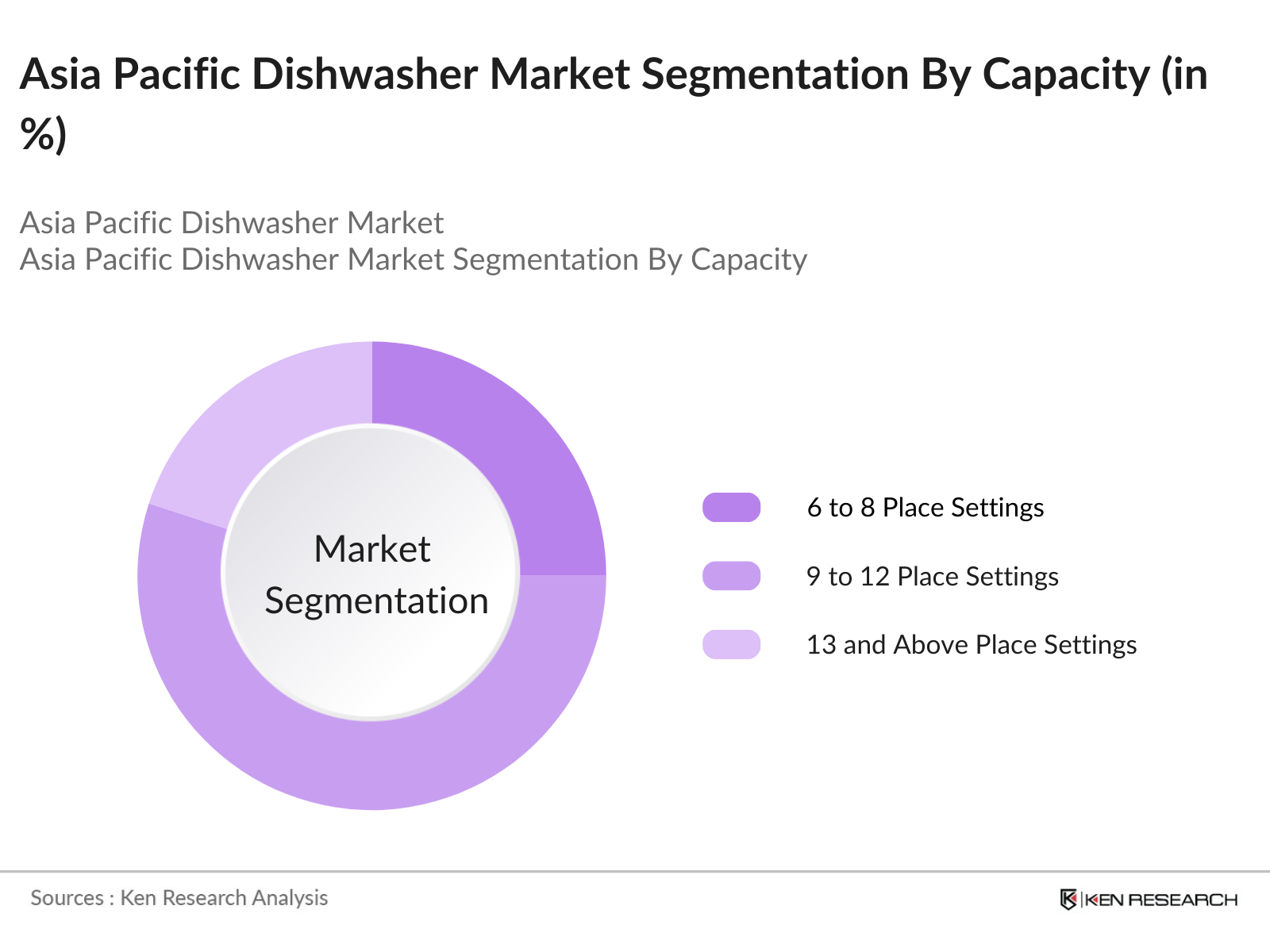
By Capacity: Dishwashers in the Asia Pacific market is categorized based on their capacity, specifically into 6 to 8 place settings, 9 to 12 place settings, and 13 and above place settings. Dishwashers with 9 to 12 place settings hold a significant share due to the rising demand from mid-size households. These models strike a balance between functionality and space, making them ideal for families that require frequent dishwashing but are constrained by kitchen space.
Asia Pacific Dishwasher Market Competitive Landscape
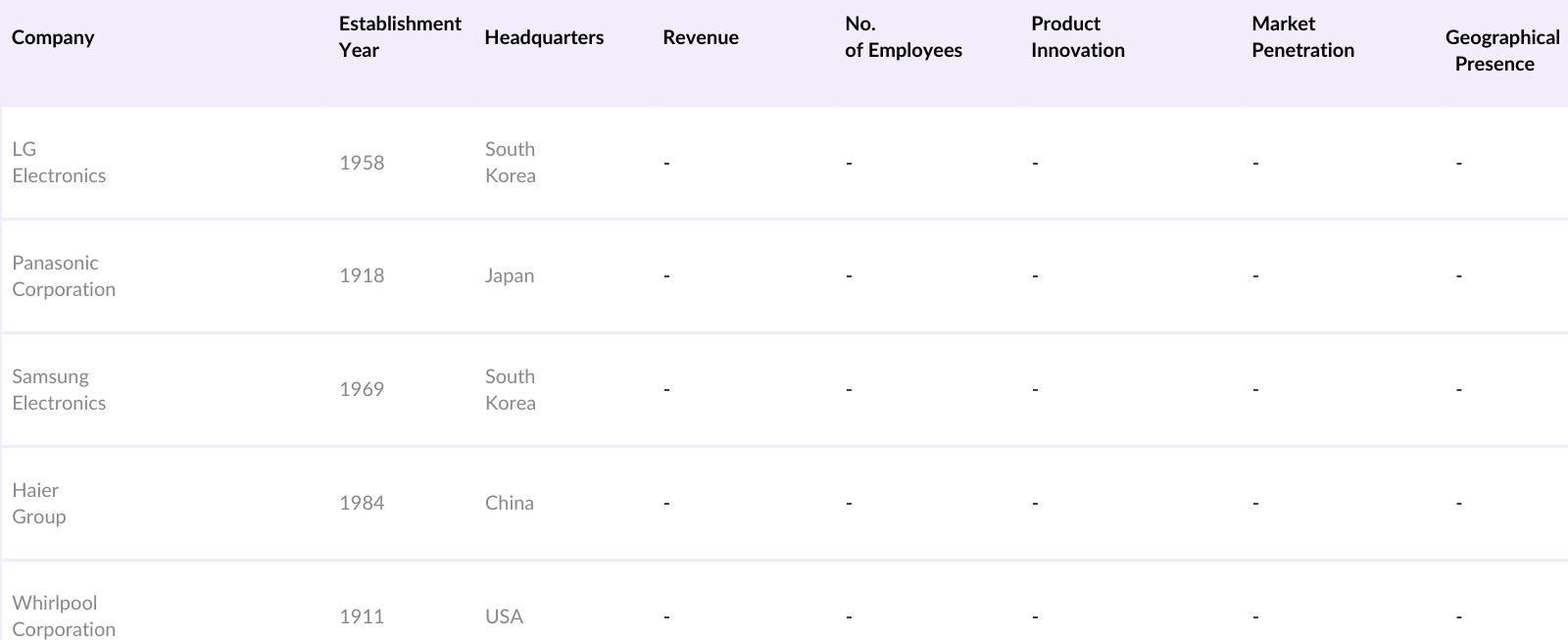
The Asia Pacific dishwasher market is dominated by several key players, with competition primarily centered on product innovation, sustainability features, and regional expansion strategies. The key companies are leveraging technological advancements such as IoT-enabled dishwashers, energy-efficient models, and eco-friendly designs to capture market share.
Asia Pacific Dishwasher Industry Analysis
Growth Drivers
- Rising Disposable Income (Regional Economic Trends): The Asia-Pacific region has witnessed significant economic growth in recent years, with a collective GDP of over $35 trillion in 2023, according to the International Monetary Fund (IMF). Countries such as China, Japan, and South Korea have seen a surge in disposable incomes, with China alone reporting per capita disposable income reaching $6,315 in urban areas in 2023, based on data from the National Bureau of Statistics of China.
- Increasing Adoption of Smart Appliances (Consumer Behavior): Smart appliances, including dishwashers, are increasingly being adopted by tech-savvy consumers across Asia-Pacific. According to the International Data Corporation (IDC), there were over 300 million connected home devices in use in 2023 in the region, with a significant portion of these being smart kitchen appliances. Countries like South Korea and Japan lead the way in the adoption of smart dishwashers, where 80% of new household appliance purchases include smart capabilities, as reported by the Korea Electronics Association.
- Urbanization and Smaller Living Spaces (Urban Development): Asia-Pacific is rapidly urbanizing, with 2.3 billion people now living in urban areas, based on data from the United Nations (UN). As cities expand and more people move into high-density housing, living spaces are becoming smaller. For example, in Tokyo, the average apartment size is less than 700 square feet. This trend drives the demand for space-saving, efficient home appliances like dishwashers.
Market Challenges
- High Energy Consumption (Environmental Constraints): One of the key challenges in the Asia-Pacific dishwasher market is the high energy consumption of traditional dishwashers. According to the International Energy Agency (IEA), household appliances account for about 18% of total residential electricity use in the region, with dishwashers being a significant contributor. Countries like India and Indonesia have seen increased demand for energy-efficient appliances due to growing concerns over power shortages and environmental sustainability.
- Lack of Awareness in Emerging Markets (Market Penetration): Despite growing urbanization, many emerging markets in the Asia-Pacific region still lack awareness of the benefits of dishwashers. For example, in India, a country with a population of over 1.4 billion, the penetration rate for dishwashers remains below 1%, according to the Indian Ministry of Statistics and Programme Implementation (MOSPI).
Asia Pacific Dishwasher Market Future Outlook
Over the next five years, the Asia Pacific dishwasher market is expected to witness significant growth, driven by increasing consumer demand for smart and energy-efficient appliances, government regulations promoting energy-saving devices, and the ongoing expansion of the urban middle class. The demand for eco-friendly appliances, coupled with the integration of advanced technologies such as IoT and AI, will propel the market's growth trajectory.
Market Opportunities
- Integration of AI and IoT in Dishwashers (Technological Innovations): The integration of Artificial Intelligence (AI) and the Internet of Things (IoT) in dishwashers is creating new opportunities for growth in the Asia-Pacific market. As of 2023, over 70 million households in the region are equipped with smart appliances, according to Statista. IoT-enabled dishwashers, which can be remotely controlled via smartphones and integrated with smart home systems, are in high demand.
- Growing Demand for Sustainable Appliances (Eco-Friendly Trends): Consumers in Asia-Pacific are increasingly prioritizing eco-friendly appliances due to growing awareness of climate change and sustainability. According to a report by the Asia-Pacific Economic Cooperation (APEC), 63% of consumers in the region prefer energy-efficient and water-saving appliances. Dishwashers that use less water and energy are becoming particularly popular in countries like Japan and South Korea, where strict environmental regulations are in place.
Products
Key Target Audience
Home Appliance Manufacturers
Retailers (Online and Offline)
Government and Regulatory Bodies (Ministry of Industry and Information Technology, Energy Commission)
OEMs (Original Equipment Manufacturers)
Distribution Partners
Investors and Venture Capitalist Firms
Hospitality Industry (Hotels, Restaurants)
Smart Home Technology Integrators
Companies
Players Mentioned in the Report
LG Electronics
Panasonic Corporation
Samsung Electronics
Haier Group
Whirlpool Corporation
Miele & Cie. KG
Bosch Siemens Hausgerte GmbH (BSH)
Electrolux AB
SMEG S.p.A.
Arelik A.S.
Table of Contents
1. Asia Pacific Dishwasher Market Overview
1.1. Definition and Scope
1.2. Market Taxonomy
1.3. Market Growth Rate
1.4. Market Segmentation Overview
2. Asia Pacific Dishwasher Market Size (In USD Bn)
2.1. Historical Market Size
2.2. Year-On-Year Growth Analysis
2.3. Key Market Developments and Milestones
3. Asia Pacific Dishwasher Market Analysis
3.1. Growth Drivers
3.1.1. Rising Disposable Income (Regional Economic Trends)
3.1.2. Increasing Adoption of Smart Appliances (Consumer Behavior)
3.1.3. Urbanization and Smaller Living Spaces (Urban Development)
3.1.4. Expansion of Retail E-commerce (Channel Distribution)
3.2. Market Challenges
3.2.1. High Energy Consumption (Environmental Constraints)
3.2.2. Lack of Awareness in Emerging Markets (Market Penetration)
3.2.3. Relatively High Price for Mid-Income Households (Affordability Issues)
3.3. Opportunities
3.3.1. Integration of AI and IoT in Dishwashers (Technological Innovations)
3.3.2. Growing Demand for Sustainable Appliances (Eco-Friendly Trends)
3.3.3. Penetration in Rural Markets (Geographical Expansion)
3.4. Trends
3.4.1. Voice-Controlled and Smart Home Integration (Smart Home Connectivity)
3.4.2. Rise in Energy-Efficient Models (Energy Efficiency Regulations)
3.4.3. Growing Consumer Preference for Freestanding Dishwashers (Product Preferences)
3.5. Government Regulations
3.5.1. Appliance Energy Efficiency Standards (Energy Efficiency Compliance)
3.5.2. Water Conservation Regulations (Water Usage Regulations)
3.5.3. Import Tariffs and Trade Agreements (Trade and Tariff Policies)
3.5.4. Sustainability Policies for Home Appliances (Environmental Policies)
3.6. SWOT Analysis
3.7. Stakeholder Ecosystem
3.8. Porters Five Forces
3.9. Competition Ecosystem
4. Asia Pacific Dishwasher Market Segmentation
4.1. By Product Type (In Value %)
4.1.1. Built-In Dishwashers
4.1.2. Freestanding Dishwashers
4.2. By Capacity (In Value %)
4.2.1. 6 to 8 Place Settings
4.2.2. 9 to 12 Place Settings
4.2.3. 13 and Above Place Settings
4.3. By End-User (In Value %)
4.3.1. Residential
4.3.2. Commercial (Restaurants, Hotels, Offices)
4.4. By Distribution Channel (In Value %)
4.4.1. Online Retail
4.4.2. Offline Retail (Specialty Stores, Supermarkets, and Hypermarkets)
4.5. By Region (In Value %)
4.5.1. China
4.5.2. Japan
4.5.3. India
4.5.4. Australia
4.5.5. Southeast Asia
5. Asia Pacific Dishwasher Market Competitive Analysis
5.1 Detailed Profiles of Major Companies
5.1.1. LG Electronics
5.1.2. Panasonic Corporation
5.1.3. Samsung Electronics
5.1.4. Haier Group
5.1.5. Miele & Cie. KG
5.1.6. Bosch Siemens Hausgerte GmbH (BSH)
5.1.7. Electrolux AB
5.1.8. Whirlpool Corporation
5.1.9. IFB Industries
5.1.10. SMEG S.p.A.
5.1.11. Arelik A.S.
5.1.12. Godrej & Boyce
5.1.13. Fagor Electrodomsticos
5.1.14. Videocon Industries
5.1.15. AEG Appliances
5.2 Cross Comparison Parameters (No. of Employees, Headquarters, Inception Year, Revenue, Product Innovation Index, Market Penetration Rate, Regional Presence, Manufacturing Units)
5.3. Market Share Analysis
5.4. Strategic Initiatives
5.5. Mergers and Acquisitions
5.6. Investment Analysis
5.7 Venture Capital Funding
5.8. Government Grants
5.9. Private Equity Investments
6. Asia Pacific Dishwasher Market Regulatory Framework
6.1. Energy Efficiency Standards
6.2. Water Conservation Compliance
6.3. Import Tariffs and Trade Regulations
6.4. Appliance Certification Processes
7. Asia Pacific Dishwasher Future Market Size (In USD Bn)
7.1. Future Market Size Projections
7.2. Key Factors Driving Future Market Growth
8. Asia Pacific Dishwasher Future Market Segmentation
8.1. By Product Type (In Value %)
8.2. By Capacity (In Value %)
8.3. By End-User (In Value %)
8.4. By Distribution Channel (In Value %)
8.5. By Region (In Value %)
9. Asia Pacific Dishwasher Market Analysts Recommendations
9.1. TAM/SAM/SOM Analysis
9.2. Customer Cohort Analysis
9.3. Marketing Initiatives
9.4. White Space Opportunity Analysis
Research Methodology
Step 1: Identification of Key Variables
The initial phase involves mapping the dishwasher market ecosystem in the Asia Pacific, identifying all significant stakeholders such as manufacturers, retailers, and regulatory bodies. Extensive desk research and proprietary databases are employed to gather key industry data. This step focuses on pinpointing critical variables influencing the market, including technological innovations, consumer preferences, and regulatory frameworks.
Step 2: Market Analysis and Construction
In this stage, historical data on market penetration, regional trends, and sales performances of different product segments are compiled and analyzed. The analysis also includes examining the impact of government policies and consumer behavior shifts on market dynamics, providing a well-rounded view of market performance.
Step 3: Hypothesis Validation and Expert Consultation
Hypotheses are developed to predict future market trends and validate the collected data through direct consultation with industry experts. These experts provide valuable insights through CATIs (computer-assisted telephone interviews), which are integral in refining market predictions and confirming the reliability of the research.
Step 4: Research Synthesis and Final Output
The final stage involves synthesizing the gathered data and expert insights to produce a cohesive market report. This stage ensures that the output is a well-rounded, data-driven analysis that combines bottom-up and top-down approaches to accurately reflect the Asia Pacific dishwasher market landscape.
Frequently Asked Questions
1. How big is the Asia Pacific Dishwasher Market?
The Asia Pacific dishwasher market is valued at USD 2,525 million, based on a five-year historical analysis. This market is primarily driven by the rapid urbanization in the region, the increasing disposable incomes of middle-class households, and the growing demand for smart and energy-efficient home appliances.
2. What are the challenges in the Asia Pacific Dishwasher Market?
Challenges include high initial costs, limited consumer awareness in some emerging markets, and infrastructure constraints in regions with unreliable water and electricity supplies, affecting dishwasher adoption.
3. Who are the major players in the Asia Pacific Dishwasher Market?
Key players include LG Electronics, Panasonic Corporation, Samsung Electronics, Haier Group, and Whirlpool Corporation. These companies dominate the market due to their technological innovations and extensive distribution networks.
4. What are the growth drivers of the Asia Pacific Dishwasher Market?
The market is propelled by the growing demand for energy-efficient and smart appliances, increasing urbanization, and the expanding middle class, especially in countries like China and India.
Why Buy From Us?

What makes us stand out is that our consultants follows Robust, Refine and Result (RRR) methodology. i.e. Robust for clear definitions, approaches and sanity checking, Refine for differentiating respondents facts and opinions and Result for presenting data with story

We have set a benchmark in the industry by offering our clients with syndicated and customized market research reports featuring coverage of entire market as well as meticulous research and analyst insights.

While we don't replace traditional research, we flip the method upside down. Our dual approach of Top Bottom & Bottom Top ensures quality deliverable by not just verifying company fundamentals but also looking at the sector and macroeconomic factors.

With one step in the future, our research team constantly tries to show you the bigger picture. We help with some of the tough questions you may encounter along the way: How is the industry positioned? Best marketing channel? KPI's of competitors? By aligning every element, we help maximize success.

Our report gives you instant access to the answers and sources that other companies might choose to hide. We elaborate each steps of research methodology we have used and showcase you the sample size to earn your trust.

If you need any support, we are here! We pride ourselves on universe strength, data quality, and quick, friendly, and professional service.