















Asia Pacific Dishwashing Products Market Outlook to 2030
Region:Asia
Author(s):Meenakshi Bisht
Product Code:KROD8001
December 2024
91
About the Report
Asia Pacific Dishwashing Products Market Overview
- The Asia Pacific Dishwashing Products Market is valued at USD 16.42 billion, based on a five-year historical analysis. This market is primarily driven by the increasing focus on hygiene and cleanliness in households and commercial settings, further influenced by growing urbanization and middle-class expansion. The rise of e-commerce platforms has strongly contributed to the broader reach of dishwashing products, particularly in developing countries where consumers are increasingly adopting branded and premium products for convenience and better cleaning performance.
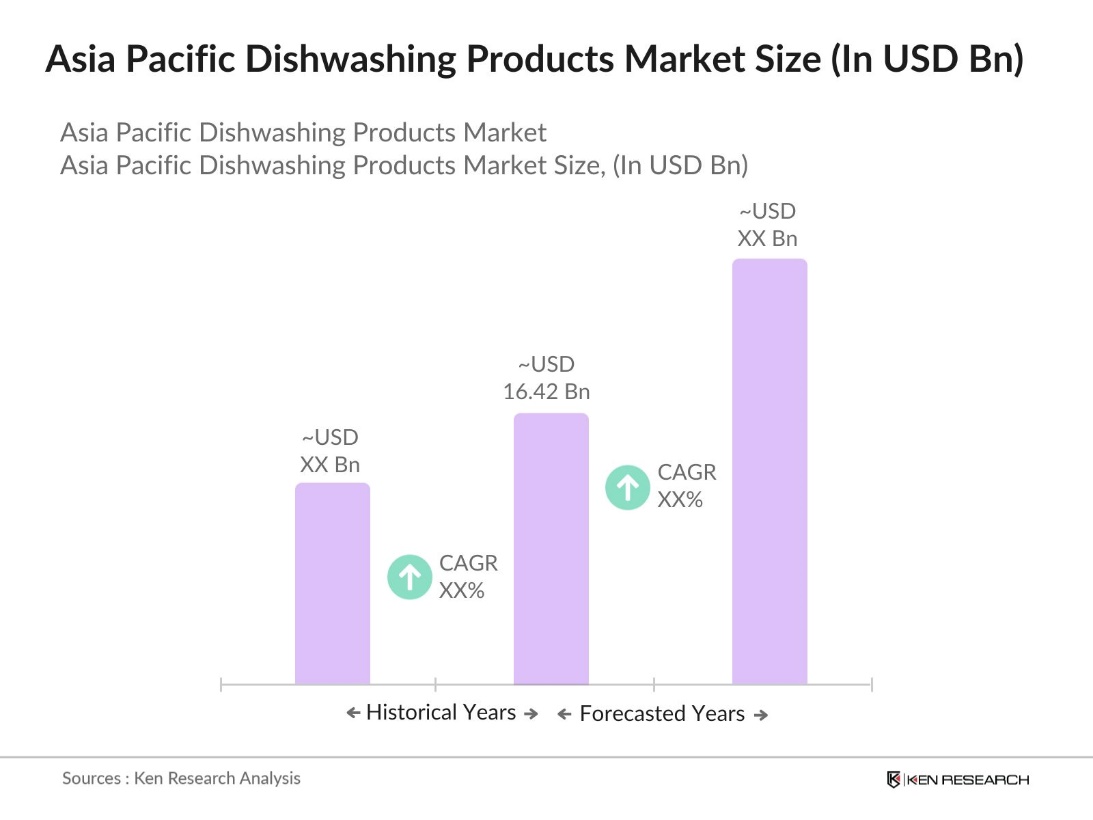
- China and India dominate the Asia Pacific Dishwashing Products market due to their large populations, rapid urbanization, and increasing disposable income levels. In China, the dominance is further fueled by the rapid expansion of the middle class, which demands higher-quality cleaning products. India's dominance stems from the growing awareness of hygiene and health, supported by government campaigns promoting cleanliness.
- Countries like Japan and Malaysia are imposing stricter regulations to reduce plastic waste. In 2023, Japan initiated a significant policy aimed at reducing plastic waste, setting a target to cut single-use plastic consumption by 25% by 2030, prompting manufacturers to shift towards biodegradable and recyclable packaging. These regulations are expected to drive the adoption of sustainable packaging in the dishwashing products market.
Asia Pacific Dishwashing Products Market Segmentation
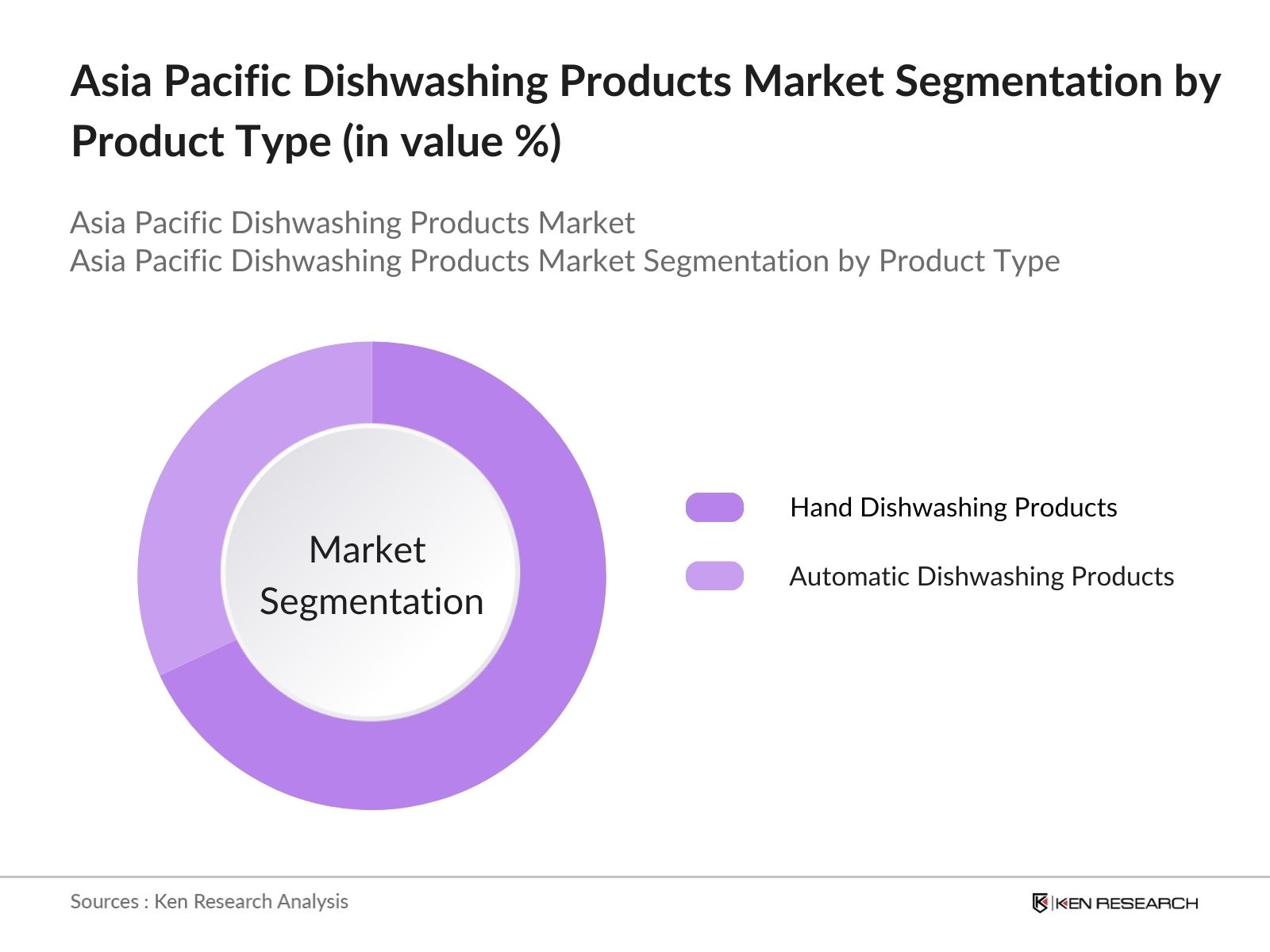
By Product Type: The Asia Pacific Dishwashing Products market is segmented by product type into hand dishwashing products and automatic dishwashing products. Hand dishwashing products, including liquids, soaps, and powders, hold a dominant market share. This is largely due to the preference for manual dishwashing in many households across the region, particularly in rural areas where automatic dishwashing machines are not as prevalent. Brands such as Unilevers Vim and Procter & Gambles Joy dominate this sub-segment due to their affordability, availability, and brand loyalty built over the years.
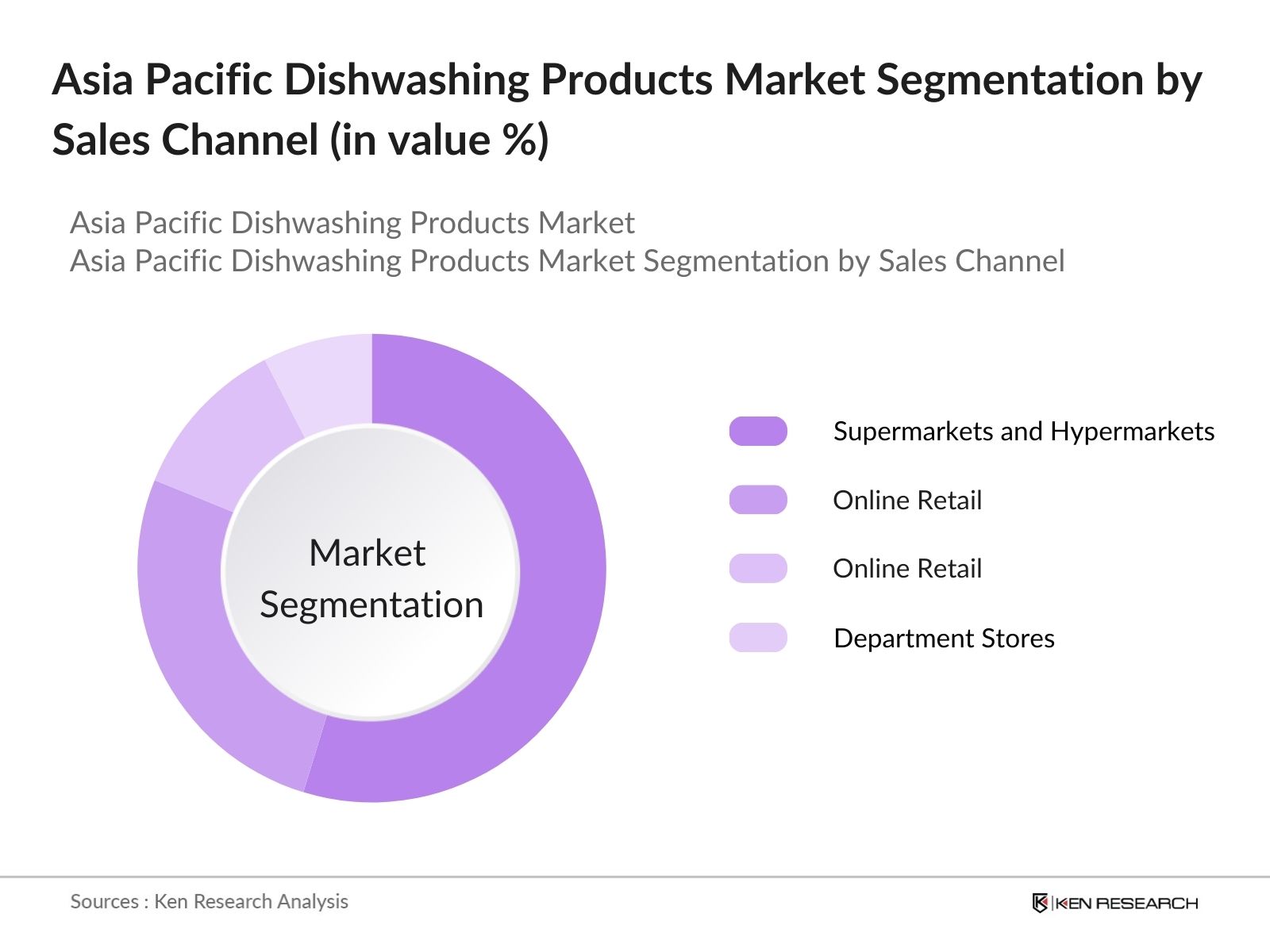
 By Sales Channel: The Asia Pacific Dishwashing Products market is segmented by sales channel into supermarkets and hypermarkets, online retail, specialty stores, and department stores. Supermarkets and hypermarkets dominate this segment due to their widespread availability and the convenience they offer to consumers. The rise of large retail chains in urban and semi-urban areas, along with discounts and promotions, has made them the preferred shopping destination for dishwashing products.
Asia Pacific Dishwashing Products Market Competitive Landscape
The Asia Pacific Dishwashing Products market is primarily controlled by key players like Unilever, Procter & Gamble, and Reckitt Benckiser. These companies dominate due to their wide range of products catering to different consumer segments, their investment in product innovation (such as eco-friendly and plant-based options), and their robust distribution channels. The competitive landscape also features local manufacturers that offer competitively priced alternatives, contributing to price competition in the region.
|
Company Name |
Establishment Year |
Headquarters |
Product Range |
R&D Investment |
Sustainability Initiatives |
Green Certifications |
Market Share |
Geographic Reach |
|
Unilever |
1929 |
London, UK |
||||||
|
Procter & Gamble |
1837 |
Cincinnati, USA |
||||||
|
Reckitt Benckiser Group |
1819 |
Slough, UK |
||||||
|
Colgate-Palmolive Company |
1806 |
New York, USA |
||||||
|
Henkel AG & Co. KGaA |
1876 |
Dsseldorf, Germany |
Asia Pacific Dishwashing Products Industry Analysis
Growth Drivers
- Urbanization and Changing Lifestyles (Increased Demand for Convenience): With urbanization expanding rapidly, the demand for convenience-oriented products like dishwashing liquids and tablets has grown significantly in the Asia Pacific. As of 2023, over 52.3% of Asia Pacific's population lived in urban areas, according to the United Nations. This urban shift, combined with rising incomes, has increased the reliance on efficient household products. Countries like Malaysia, where urbanization reached 78.21% in 2022, are prime markets for such products.
- Growing Middle-Class Population (Increased Disposable Income): A rapidly growing middle class in countries like Indonesia, Thailand, and India has contributed to rising disposable incomes. As of 2024, Indonesia's middle class is estimated to be around 47.85 million, which constitutes approximately 17.13% of the total population, increasing the ability to spend on household care products, including dishwashing detergents. These economic shifts have directly fueled the growth of the dishwashing products market across the region.
- E-Commerce Penetration (Online Purchasing Behavior): E-commerce has become a crucial channel for purchasing dishwashing products in the Asia Pacific region. The convenience of online shopping, combined with a wide range of product choices and home delivery options, has made e-commerce platforms a preferred shopping method. Platforms like Lazada and Shopee have contributed to the growing trend by providing consumers with easy access to various dishwashing products. The shift towards online purchasing has been driven by the increasing digitalization across the region, with more consumers relying on these platforms for their household care needs.
Market Challenges
- Raw Material Price Volatility (Chemical Ingredients, Packaging Costs): Fluctuations in the cost of raw materials, particularly chemicals and packaging, have significantly impacted the Asia Pacific dishwashing products market. Manufacturers face challenges due to the unstable prices of key ingredients like surfactants and phosphates, which are essential for production. Additionally, the cost of plastic packaging, closely linked to oil prices, has further increased production expenses, putting pressure on manufacturers to manage costs effectively.
- Competition from Local Manufacturers (Price Wars, Brand Loyalty): Local manufacturers in countries across the Asia Pacific, such as Vietnam and the Philippines, have increased competition in the dishwashing products market by adopting aggressive pricing strategies. These local brands, often more affordable, have garnered strong consumer loyalty, making it difficult for international companies to compete. The lower prices of locally produced dishwashing liquids create a competitive environment that challenges global brands to differentiate themselves.
Asia Pacific Dishwashing Products Market Future Outlook
The Asia Pacific Dishwashing Products market is expected to see steady growth in the coming years. This growth is driven by the increasing consumer awareness of hygiene, a growing focus on sustainability, and the rising demand for eco-friendly dishwashing products. The expanding middle class in key markets such as China, India, and Southeast Asian countries will continue to drive demand for premium and convenient cleaning products. Additionally, the growing penetration of e-commerce will further boost product availability and consumer choice, allowing brands to expand their reach.
Market Opportunities
- Introduction of Eco-Friendly Products: The demand for eco-friendly dishwashing products has been steadily rising across the Asia Pacific. Consumers are increasingly favoring products made with sustainable ingredients and bio-based packaging. Companies are responding to this trend by introducing plant-based detergents and biodegradable packaging, aligning with growing environmental awareness and regulatory standards. This shift is driven by consumers preference for products that are both effective and environmentally responsible.
- Expansion of Premium Product Segments: The expanding middle class and increasing disposable incomes in the Asia Pacific have boosted the demand for premium dishwashing products. High-end detergents and specialized cleaners are gaining popularity due to their superior cleaning performance and environmentally friendly formulations. Consumers seeking higher-quality products are willing to invest in premium options, driving growth in this segment. This trend reflects a shift towards more specialized and value-added products in the market.
Scope of the Report
|
Product Type |
Hand Dishwashing Products Automatic Dishwashing Products |
|
Application |
Residential Commercial |
|
Form |
Liquid Powder Tablets/Packs |
|
Sales Channel |
Supermarkets and Hypermarkets Online Retail Specialty Stores Department Stores |
|
Country |
China India Japan Australia Indonesia |
Products
Key Target Audience
Dishwashing Product Manufacturers
Logistics and Distribution Companies
Private Label Manufacturers
Food and Beverage Manufacturers
Packaging Manufacturers
Investors and Venture Capitalist Firms
Government and Regulatory Bodies (e.g., Ministry of Health, Environmental Protection Agencies)
Banks and Financial Institutions
Companies
Players Mentioned in the Report
Unilever
Procter & Gamble
Reckitt Benckiser Group
Colgate-Palmolive Company
Henkel AG & Co. KGaA
Kao Corporation
S. C. Johnson & Son, Inc.
LION Corporation
Amway
Church & Dwight Co., Inc.
Table of Contents
1. Asia Pacific Dishwashing Products Market Overview
1.1. Definition and Scope
1.2. Market Taxonomy
1.3. Market Growth Rate (CAGR, Volume Growth, Value Growth)
1.4. Market Segmentation Overview
2. Asia Pacific Dishwashing Products Market Size (in USD Bn)
2.1. Historical Market Size
2.2. Year-On-Year Growth Analysis (Volume, Value, Demand Fluctuations)
2.3. Key Market Developments and Milestones (Innovation, Sustainability Initiatives)
3. Asia Pacific Dishwashing Products Market Analysis
3.1. Growth Drivers
3.1.1. Rising Consumer Awareness on Hygiene (Health-Conscious Consumers, Pandemic Impact)
3.1.2. Urbanization and Changing Lifestyles (Increased Demand for Convenience)
3.1.3. Growing Middle-Class Population (Increased Disposable Income)
3.1.4. E-Commerce Penetration (Online Purchasing Behavior)
3.2. Market Challenges
3.2.1. Raw Material Price Volatility (Chemical Ingredients, Packaging Costs)
3.2.2. Competition from Local Manufacturers (Price Wars, Brand Loyalty)
3.2.3. Environmental Concerns (Plastic Usage, Carbon Footprint)
3.3. Opportunities
3.3.1. Introduction of Eco-Friendly Products (Bio-Based Packaging, Sustainable Ingredients)
3.3.2. Expansion of Premium Product Segments (High-End Detergents, Specialized Cleaners)
3.3.3. Untapped Markets in Rural Areas (Increased Distribution, Affordability)
3.4. Trends
3.4.1. Adoption of Refill and Zero-Waste Packaging (Sustainability Push)
3.4.2. Rising Popularity of Plant-Based and Organic Products (Green Products Demand)
3.4.3. Innovation in Dishwashing Tablets and Pods (Compact, Concentrated Formulas)
3.5. Government Regulations
3.5.1. Regulatory Policies on Ingredient Safety (Chemicals Usage, Environmental Impact)
3.5.2. Plastic Waste Management Regulations (Plastic Ban, Recycling Initiatives)
3.5.3. Green Certifications (Eco-Labels, Energy Star Ratings)
3.5.4. Trade Tariffs and Import-Export Regulations (Regional Trade Dynamics)
3.6. SWOT Analysis (Strengths, Weaknesses, Opportunities, Threats)
3.7. Stakeholder Ecosystem (Manufacturers, Distributors, Retailers, Consumers)
3.8. Porters Five Forces (Bargaining Power of Suppliers, Buyers, Competitive Rivalry, Threat of New Entrants, Substitutes)
3.9. Competition Ecosystem (Market Share Distribution, Competitive Landscape)
4. Asia Pacific Dishwashing Products Market Segmentation
4.1. By Product Type (in Value %)
4.1.1. Hand Dishwashing Products (Liquids, Soaps, Powders)
4.1.2. Automatic Dishwashing Products (Tablets, Gels, Powders)
4.2. By Application (in Value %)
4.2.1. Residential
4.2.2. Commercial (Hotels, Restaurants, Catering, Healthcare)
4.3. By Form (in Value %)
4.3.1. Liquid
4.3.2. Powder
4.3.3. Tablets/Packs
4.4. By Sales Channel (in Value %)
4.4.1. Supermarkets and Hypermarkets
4.4.2. Online Retail
4.4.3. Specialty Stores
4.4.4. Department Stores
4.5. By Country (in Value %)
4.5.1. China
4.5.2. India
4.5.3. Japan
4.5.4. Australia
4.5.5. Indonesia
5. Asia Pacific Dishwashing Products Market Competitive Analysis
5.1. Detailed Profiles of Major Companies
5.1.1. Unilever
5.1.2. Procter & Gamble
5.1.3. Reckitt Benckiser Group Plc
5.1.4. Colgate-Palmolive Company
5.1.5. Henkel AG & Co. KGaA
5.1.6. Kao Corporation
5.1.7. S. C. Johnson & Son, Inc.
5.1.8. LION Corporation
5.1.9. Amway
5.1.10. Church & Dwight Co., Inc.
5.1.11. Godrej Consumer Products Ltd
5.1.12. Frosch
5.1.13. Earth Friendly Products
5.1.14. The Clorox Company
5.1.15. Seventh Generation, Inc.
5.2. Cross Comparison Parameters (Product Range, Green Certifications, R&D Investments, Sustainability Initiatives, Geographic Reach, Market Share, Employee Base, Manufacturing Footprint)
5.3. Market Share Analysis (Market Leadership, Regional Dominance)
5.4. Strategic Initiatives (Product Launches, Brand Expansions, Market Entry Strategies)
5.5. Mergers and Acquisitions (Recent Consolidations, Partnerships)
5.6. Investment Analysis (Venture Capital, Private Equity, Expansion Capital)
5.7. Government Grants (Incentives for Sustainable Product Development)
5.8. Private Equity Investments (Key Investors, Major Deals)
6. Asia Pacific Dishwashing Products Market Regulatory Framework
6.1. Environmental and Safety Standards (Chemical Use, Plastic Regulations)
6.2. Compliance Requirements (Labels, Certifications)
6.3. Certification Processes (ISO, Eco Labels)
7. Asia Pacific Dishwashing Products Future Market Size (in USD Bn)
7.1. Future Market Size Projections
7.2. Key Factors Driving Future Market Growth
8. Asia Pacific Dishwashing Products Future Market Segmentation
8.1. By Product Type (in Value %)
8.2. By Application (in Value %)
8.3. By Form (in Value %)
8.4. By Sales Channel (in Value %)
8.5. By Country (in Value %)
9. Asia Pacific Dishwashing Products Market Analysts Recommendations
9.1. TAM/SAM/SOM Analysis (Total Available Market, Serviceable Available Market, Serviceable Obtainable Market)
9.2. Consumer Cohort Analysis (Customer Segmentation, Preferences)
9.3. Marketing Initiatives (Digital Campaigns, Influencer Marketing)
9.4. White Space Opportunity Analysis (Untapped Markets, New Product Categories)
Disclaimer Contact UsResearch Methodology
Step 1: Identification of Key Variables
In the initial phase, the research team mapped out key stakeholders in the Asia Pacific Dishwashing Products Market. Extensive desk research was conducted using secondary data sources, including industry databases, reports, and government publications. The goal was to identify the critical variables that drive the market, such as product innovations, consumer demand trends, and distribution channels.
Step 2: Market Analysis and Construction
Historical data was compiled to assess the penetration of dishwashing products in key markets across the Asia Pacific region. Market size, growth rates, and consumer behavior were evaluated. Additionally, supply chain dynamics and sales channel effectiveness were analyzed to ensure accurate revenue estimates.
Step 3: Hypothesis Validation and Expert Consultation
Hypotheses about market trends and challenges were developed and validated through consultations with industry experts via computer-assisted interviews. These experts provided insights on operational and financial strategies, helping refine the research findings.
Step 4: Research Synthesis and Final Output
Finally, a comprehensive synthesis of the research was conducted, incorporating insights from leading dishwashing product manufacturers. This phase helped validate the bottom-up approach used in estimating the market size and share, ensuring the accuracy of the final report.
Frequently Asked Questions
01. How big is the Asia Pacific Dishwashing Products Market?
The Asia Pacific Dishwashing Products Market is valued at USD 16.42 billion, primarily driven by the growing focus on hygiene and cleanliness among households and commercial establishments.
02. What are the challenges in the Asia Pacific Dishwashing Products Market?
Challenges in this Asia Pacific Dishwashing Products Market include fluctuating raw material prices, growing competition from local manufacturers, and the rising demand for sustainable, eco-friendly products, which require innovation and investments from manufacturers.
03. Who are the major players in the Asia Pacific Dishwashing Products Market?
Key players in the Asia Pacific Dishwashing Products Market include Unilever, Procter & Gamble, Reckitt Benckiser Group, Colgate-Palmolive, and Henkel AG. These companies lead due to their wide product portfolios, strong brand presence, and extensive distribution networks.
04. What are the growth drivers of the Asia Pacific Dishwashing Products Market?
The Asia Pacific Dishwashing Products Market is driven by increasing urbanization, rising disposable income, and growing consumer awareness about hygiene. Additionally, the growing middle class in China and India is pushing demand for premium cleaning products.
Why Buy From Us?

What makes us stand out is that our consultants follows Robust, Refine and Result (RRR) methodology. i.e. Robust for clear definitions, approaches and sanity checking, Refine for differentiating respondents facts and opinions and Result for presenting data with story

We have set a benchmark in the industry by offering our clients with syndicated and customized market research reports featuring coverage of entire market as well as meticulous research and analyst insights.

While we don't replace traditional research, we flip the method upside down. Our dual approach of Top Bottom & Bottom Top ensures quality deliverable by not just verifying company fundamentals but also looking at the sector and macroeconomic factors.

With one step in the future, our research team constantly tries to show you the bigger picture. We help with some of the tough questions you may encounter along the way: How is the industry positioned? Best marketing channel? KPI's of competitors? By aligning every element, we help maximize success.

Our report gives you instant access to the answers and sources that other companies might choose to hide. We elaborate each steps of research methodology we have used and showcase you the sample size to earn your trust.

If you need any support, we are here! We pride ourselves on universe strength, data quality, and quick, friendly, and professional service.