
Asia Pacific E-Commerce Platforms Market Outlook to 2030
Region:Afganistan
Author(s):Sanjna Verma
Product Code:KROD5270
Region:Afganistan
Author(s):Sanjna Verma
Product Code:KROD5270
December 2024
83
The Asia Pacific e-commerce market is highly competitive, with major players dominating through innovation, logistics networks, and large user bases. The competition is consolidated in a few major players who have the financial and technological strength to continue their dominance. The market is characterized by significant investments in logistics, technology, and customer service, with these factors contributing to market consolidation. Companies like Alibaba and JD.com have set benchmarks in terms of delivery efficiency and technological integration, ensuring sustained leadership positions.
|
Company Name |
Established Year |
Headquarters |
Revenue (2023) |
Employees |
Market Presence |
Digital Wallet Integration |
Logistics Capacity |
Partnerships |
Product Range |
|
Alibaba Group Holding Ltd. |
1999 |
Hangzhou, China |
- |
- |
- |
- |
- |
- |
- |
|
Amazon.com Inc. |
1994 |
Seattle, USA |
- |
- |
- |
- |
- |
- |
- |
|
JD.com |
1998 |
Beijing, China |
- |
- |
- |
- |
- |
- |
- |
|
Rakuten Inc. |
1997 |
Tokyo, Japan |
- |
- |
- |
- |
- |
- |
- |
|
Flipkart Internet Pvt. Ltd. |
2007 |
Bangalore, India |
- |
- |
- |
- |
- |
- |
- |
Asia Pacific e-commerce platforms market is expected to show strong growth, driven by increasing consumer demand, rising internet penetration, and continuous technological advancements. Additionally, government initiatives aimed at supporting digital ecosystems and expanding online trade infrastructure are likely to create further opportunities for growth in the region. Strategic partnerships and innovations such as AI-driven customer engagement and the expansion of mobile commerce will be key to shaping the future market landscape.
|
Platform Type |
B2C Platforms B2B Platforms C2C Platforms Mobile E-Commerce Platforms Web-Based E-Commerce Platforms |
|
Payment Mode |
Credit/Debit Cards Digital Wallets Bank Transfers Cash on Delivery |
|
Business Model |
Direct-to-Consumer (D2C) Marketplace Drop Shipping |
|
End-User |
Retail Healthcare FMCG Apparel & Fashion |
|
Region |
China India Japan Australia Southeast Asia (Indonesia, Vietnam, Thailand) |
1.1. Definition and Scope
1.2. Market Taxonomy
1.3. Key Industry Insights
1.4. Market Segmentation Overview
2.1. Historical Market Size
2.2. Year-On-Year Growth Analysis (Market Trends, Milestones)
2.3. Factors Influencing Market Size
3.1. Growth Drivers (Mobile Commerce Penetration, Cross-Border E-Commerce Growth)
3.1.1. Internet Penetration (Internet Users Growth)
3.1.2. Payment Gateways Adoption (Digital Payment Growth)
3.1.3. Government Initiatives Supporting E-Commerce (Policy Changes)
3.1.4. Increased Consumer Spending (Consumer Expenditure Data)
3.2. Market Challenges (Logistics and Infrastructure, Regulatory Complexities)
3.2.1. Lack of Uniform Regulatory Framework (Regulatory Differences)
3.2.2. High Delivery Costs (Impact on Market Share)
3.2.3. Cybersecurity Concerns (Online Fraud)
3.2.4. Intense Competition (Market Fragmentation)
3.3. Opportunities (Untapped Markets, Emerging E-Commerce Models)
3.3.1. Growth of Rural E-Commerce (Consumer Penetration in Rural Areas)
3.3.2. Expansion of Social Commerce (Integration of Social Media and E-Commerce)
3.3.3. Strategic Alliances and Partnerships (Cross-Platform Collaborations)
3.3.4. AI and Big Data Integration (Data-Driven Insights)
3.4. Trends (B2B E-Commerce, Subscription Services)
3.4.1. Personalization of Consumer Experience (Data Analytics in Personalization)
3.4.2. Rise of Omni-Channel Retailing (Integration of Online and Offline Platforms)
3.4.3. Sustainability in E-Commerce (Eco-Friendly Practices)
3.4.4. Localized Content and Language Preferences (Localized Marketing)
3.5. Government Regulations (Data Privacy Laws, Cross-Border Regulations)
3.5.1. Data Protection and Privacy Laws (GDPR Compliance)
3.5.2. Taxation and Duties on E-Commerce (Regional Tax Policies)
3.5.3. Consumer Protection Laws (Regulatory Enforcement)
3.5.4. Regulations on Cross-Border E-Commerce (Tariff and Trade Policies)
3.6. SWOT Analysis (Strengths, Weaknesses, Opportunities, Threats)
3.7. Stakeholder Ecosystem (E-Commerce Enablers, Market Intermediaries)
3.8. Porters Five Forces Analysis (Market Power of Buyers, Sellers, and Competitors)
3.9. Competitive Ecosystem (Impact of Competitors)
4.1. By Platform Type (In Value %)
4.1.1. B2C Platforms
4.1.2. B2B Platforms
4.1.3. C2C Platforms
4.1.4. Mobile E-Commerce Platforms
4.1.5. Web-Based E-Commerce Platforms
4.2. By Payment Mode (In Value %)
4.2.1. Credit/Debit Cards
4.2.2. Digital Wallets
4.2.3. Bank Transfers
4.2.4. Cash on Delivery
4.3. By Business Model (In Value %)
4.3.1. Direct-to-Consumer (D2C)
4.3.2. Marketplace
4.3.3. Drop Shipping
4.4. By End-User (In Value %)
4.4.1. Retail
4.4.2. Healthcare
4.4.3. FMCG
4.4.4. Apparel & Fashion
4.5. By Region (In Value %)
4.5.1. China
4.5.2. India
4.5.3. Japan
4.5.4. Australia
4.5.5. Southeast Asia (Indonesia, Vietnam, Thailand)
5.1. Detailed Profiles of Major Companies (Company Overview, Key Metrics)
5.1.1. Alibaba Group Holding Ltd.
5.1.2. Amazon.com Inc.
5.1.3. JD.com
5.1.4. Rakuten Inc.
5.1.5. Flipkart Internet Pvt. Ltd.
5.1.6. SEA Group (Shopee)
5.1.7. Lazada Group
5.1.8. Coupang
5.1.9. eBay Inc.
5.1.10. Zalora
5.2. Cross Comparison Parameters (Revenue, Customer Base, No. of Employees, Global Presence)
5.3. Market Share Analysis
5.4. Strategic Initiatives (Partnerships, Expansions, Mergers & Acquisitions)
5.5. Investment Analysis
5.6. Venture Capital and Private Equity Funding
6.1. Licensing and Compliance
6.2. Data Protection and Privacy Laws
6.3. E-Commerce Trade Policies
6.4. Cross-Border E-Commerce Regulations
7.1. Market Size Projections
7.2. Factors Driving Future Market Growth
8.1. By Platform Type (In Value %)
8.2. By Payment Mode (In Value %)
8.3. By Business Model (In Value %)
8.4. By End-User (In Value %)
8.5. By Region (In Value %)
9.1. TAM/SAM/SOM Analysis
9.2. Customer Cohort Analysis
9.3. Marketing Initiatives
9.4. White Space Opportunity Analysis
The research begins by identifying key variables within the Asia Pacific e-commerce platforms market, focusing on major stakeholders such as e-commerce companies, digital payment providers, and government regulatory bodies. A combination of proprietary databases and secondary research is employed to gather relevant data on these variables.
In this phase, historical data is compiled and analyzed to determine the penetration of e-commerce platforms across various markets in the Asia Pacific region. Additionally, the proportion of mobile versus web-based e-commerce is examined to establish a clear understanding of market distribution.
Experts from leading e-commerce companies in Asia Pacific are consulted through telephonic interviews to validate market assumptions. These interviews provide critical insights into consumer preferences, platform performance, and the challenges faced by e-commerce companies in the region.
The final phase involves synthesizing the findings from the desk research and expert consultations into a comprehensive report. This report provides a detailed view of the Asia Pacific e-commerce platforms market, ensuring that all statistics are accurate and validated by industry experts.
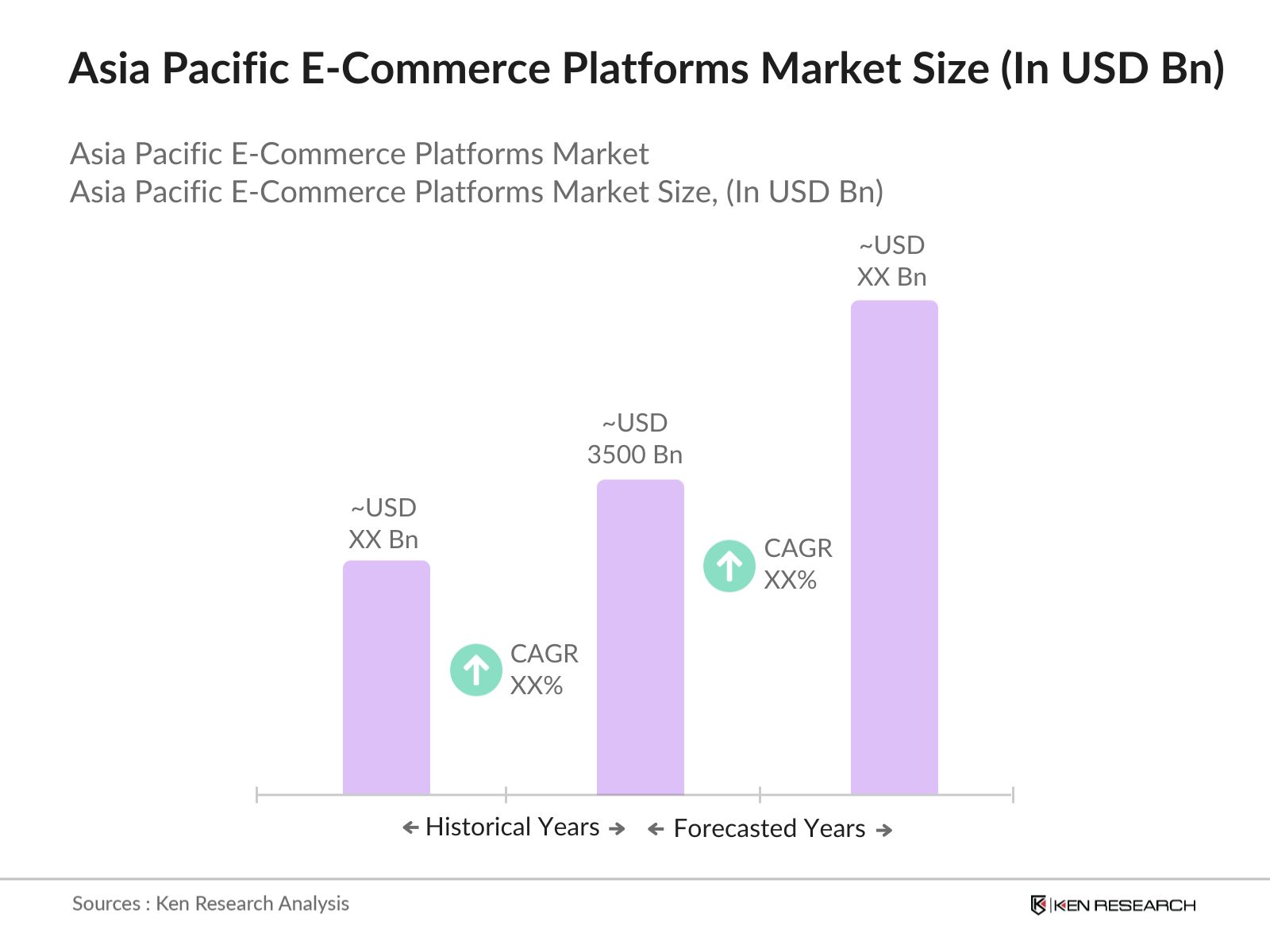
The Asia Pacific e-commerce platforms market is valued at USD 3500 billion. This figure is reflective of the region's large and rapidly growing digital consumer base, driven by increasing smartphone penetration and government support for online trade.
Challenges in Asia Pacific e-commerce platforms market market include regulatory complexities, particularly regarding cross-border e-commerce, logistics inefficiencies in rural areas, and the growing concern around cybersecurity, which impacts both consumers and businesses.
Major players in Asia Pacific e-commerce platforms market include Alibaba Group, Amazon.com, JD.com, Flipkart, and SEA Group. These companies dominate due to their expansive logistics networks, technological innovations, and wide consumer reach.
Asia Pacific e-commerce platforms market is driven by factors such as the rise in internet users, the growth of mobile commerce, and increasing consumer demand for convenience. Government initiatives to foster digital economies also contribute to the growth of the market.

What makes us stand out is that our consultants follows Robust, Refine and Result (RRR) methodology. i.e. Robust for clear definitions, approaches and sanity checking, Refine for differentiating respondents facts and opinions and Result for presenting data with story

We have set a benchmark in the industry by offering our clients with syndicated and customized market research reports featuring coverage of entire market as well as meticulous research and analyst insights.

While we don't replace traditional research, we flip the method upside down. Our dual approach of Top Bottom & Bottom Top ensures quality deliverable by not just verifying company fundamentals but also looking at the sector and macroeconomic factors.

With one step in the future, our research team constantly tries to show you the bigger picture. We help with some of the tough questions you may encounter along the way: How is the industry positioned? Best marketing channel? KPI's of competitors? By aligning every element, we help maximize success.

Our report gives you instant access to the answers and sources that other companies might choose to hide. We elaborate each steps of research methodology we have used and showcase you the sample size to earn your trust.

If you need any support, we are here! We pride ourselves on universe strength, data quality, and quick, friendly, and professional service.