















Asia Pacific Electric Car Market Outlook to 2030
Region:Asia
Author(s):Shreya
Product Code:KROD6849
December 2024
94
About the Report
Asia Pacific Electric Car Market Overview
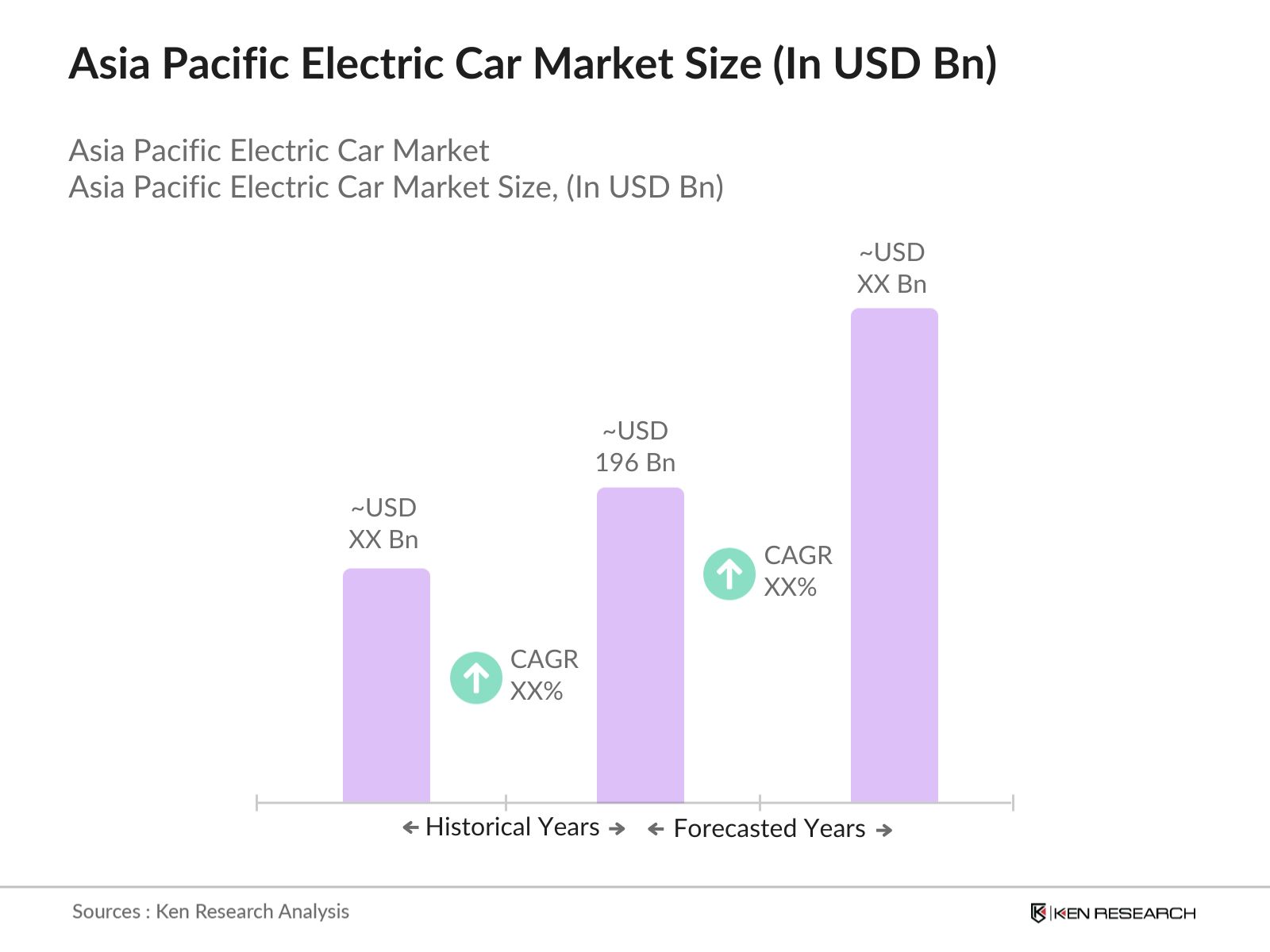
- The Asia Pacific Electric Car Market, valued at USD 196 billion, has experienced rapid growth due to government incentives and increasing demand for sustainable transportation solutions. The market has been driven by advancements in battery technology, lower production costs, and increased consumer awareness regarding environmental sustainability. Countries in the region are further enhancing their EV infrastructure, which supports the growth trajectory of electric car adoption.
- China and Japan dominate the Asia Pacific Electric Car Market, primarily due to their established manufacturing capabilities, technological innovations, and supportive governmental policies. Chinas market is bolstered by significant subsidies and a strong push for environmental regulation compliance, while Japan benefits from a robust automobile industry and a high focus on research and development in EV technology.
- China, India, and Japan have introduced EV production mandates that require automakers to meet a minimum EV production quota. In 2024, Chinas mandate required 15% of all vehicles produced to be electric, pushing automakers to focus on EV manufacturing. This regulation has contributed significantly to the increase in EV availability across the region.
Asia Pacific Electric Car Market Segmentation
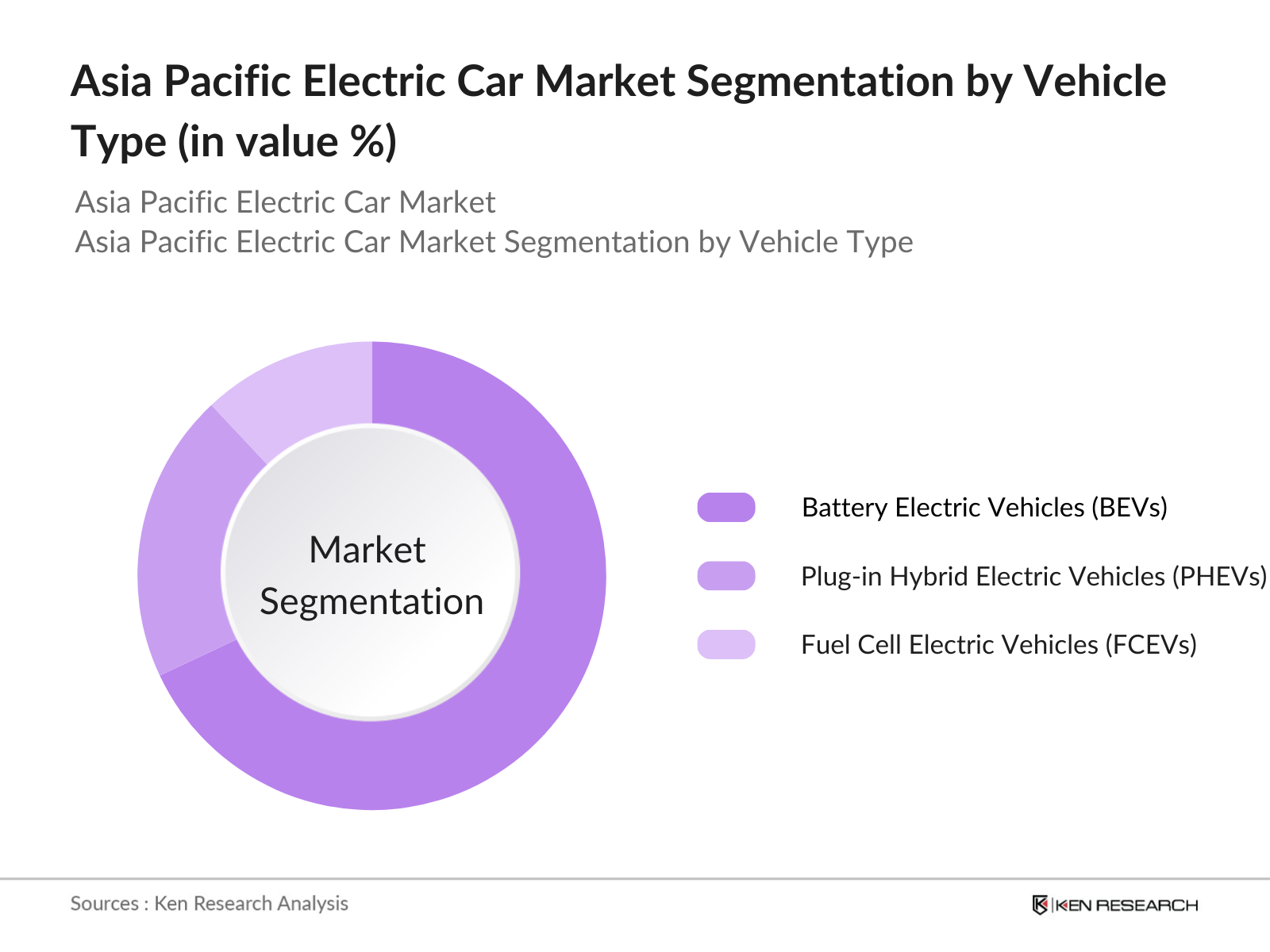
- By Vehicle Type: The Market is segmented by vehicle type into Battery Electric Vehicles (BEVs), Plug-in Hybrid Electric Vehicles (PHEVs), and Fuel Cell Electric Vehicles (FCEVs). BEVs currently hold the dominant market share in this segment due to their zero emissions and increasing affordability, making them attractive in markets with stringent emissions regulations. The technological maturity and availability of charging infrastructure also support the widespread adoption of BEVs.
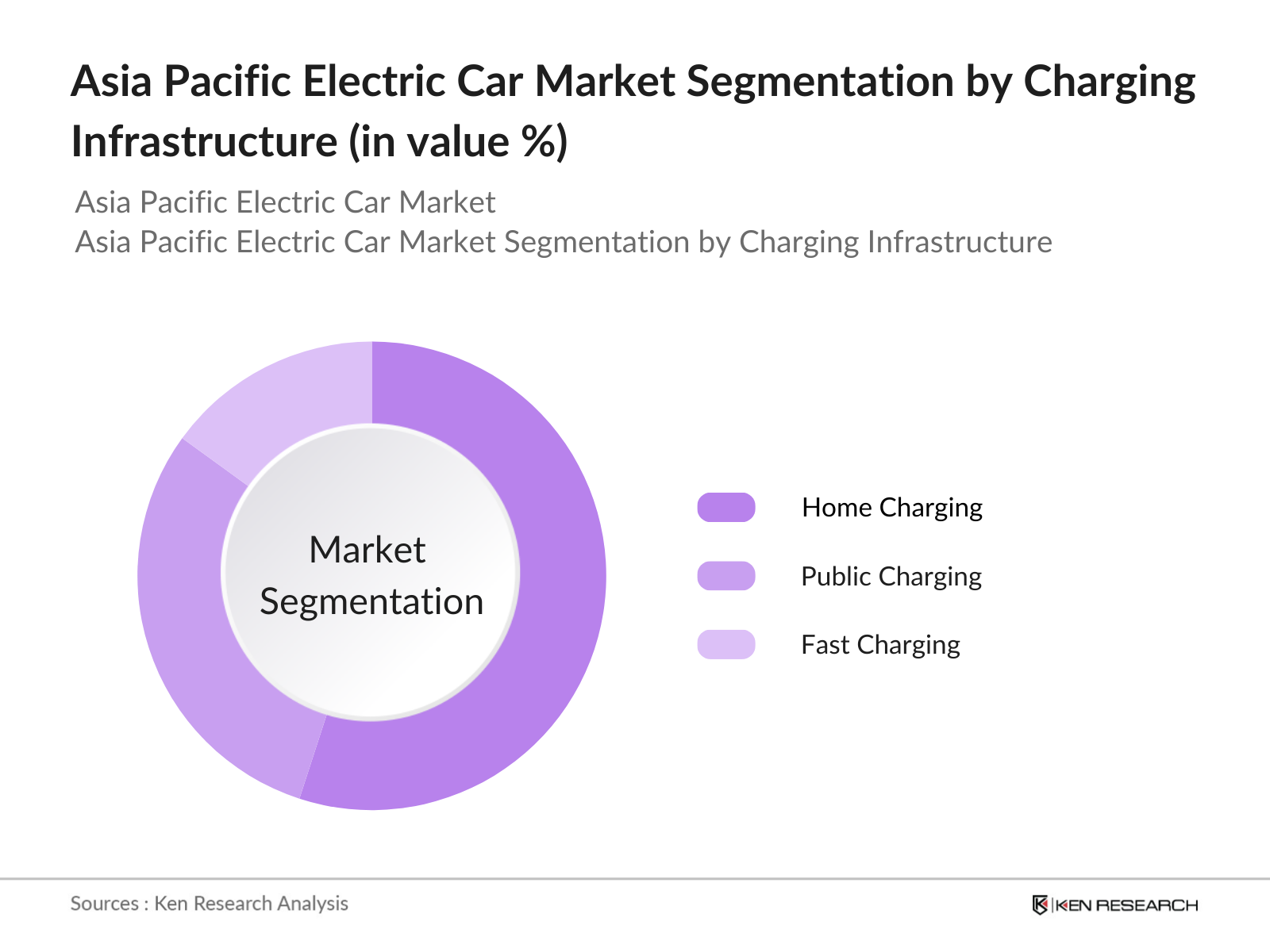
- By Charging Infrastructure: The market is further segmented by charging infrastructure, including Home Charging, Public Charging, and Fast Charging. Home Charging dominates this segment, as it provides convenient, low-cost charging options for consumers. The extensive installation of home charging units aligns with consumer preferences for cost-effective and accessible solutions, especially in residential zones of urban areas.
Asia Pacific Electric Car Market Competitive Landscape
The Asia Pacific Electric Car Market is dominated by a mix of local and international players, including industry giants such as Tesla, BYD, and Nissan. This competitive environment underscores the influence of key companies and their investments in R&D, partnerships, and regional expansion strategies to maintain market leadership. 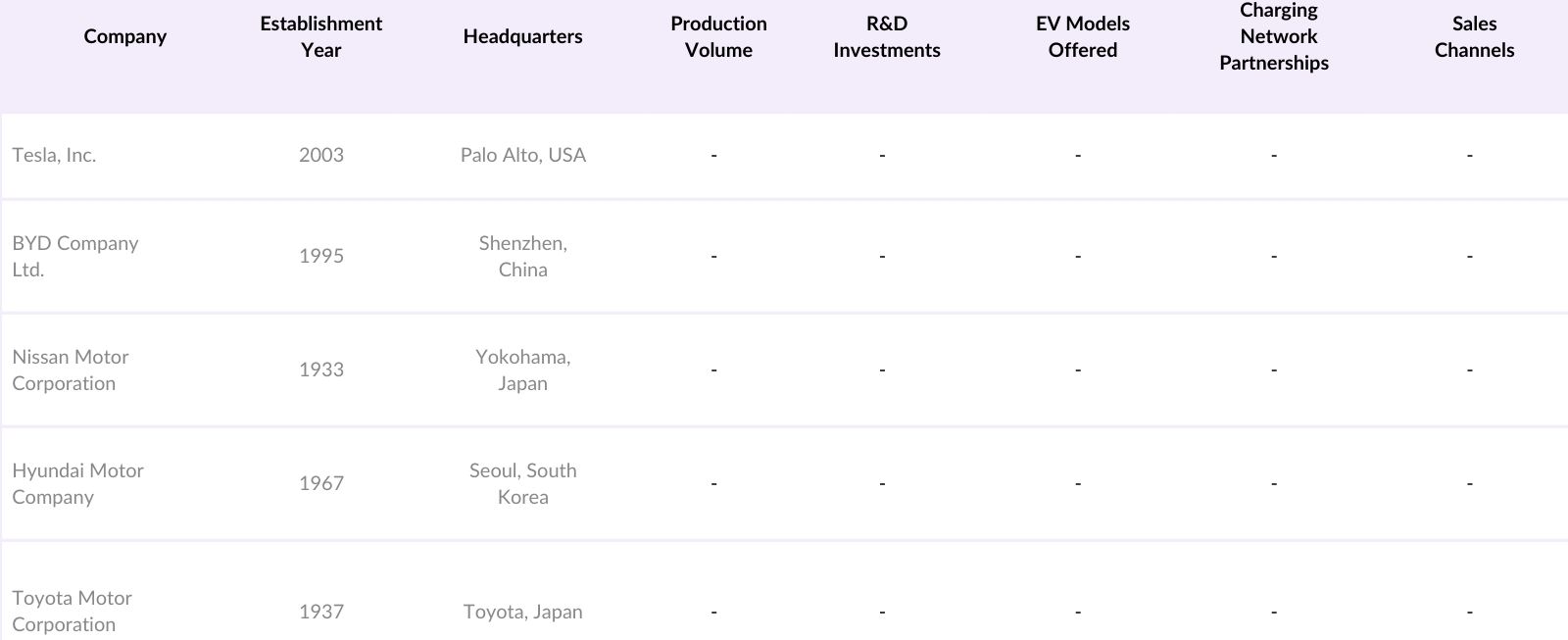
Asia Pacific Electric Car Market
Growth Drivers
- Government Incentives and Subsidies: Governments in the Asia Pacific region have implemented significant incentives to encourage EV adoption, including tax benefits and reduced import tariffs on electric vehicles. For example, Japan offers substantial tax rebates to EV buyers, saving up to 200,000 yen per vehicle, while China provides subsidies that reduce the purchase price of EVs by up to 10,000 yuan. South Korea recently committed approximately $1 billion toward EV incentives and infrastructure improvements to promote eco-friendly transport, with clear policies set by the Ministry of Environment and Energy.
- Rising Fuel Costs: Increasing oil prices across the Asia Pacific region have highlighted the cost-effectiveness of electric cars. With the average price of crude oil reaching $90 per barrel in 2024, fuel prices have risen across major economies. In Australia, fuel prices have exceeded AUD 2 per liter, whereas, in India, petrol prices have consistently averaged around INR 100 per liter. This cost dynamic drives demand for electric vehicles, particularly in countries heavily dependent on fuel imports.
- Advances in Battery Technology: Recent advancements in battery technology, particularly in lithium-ion and solid-state batteries, have significantly increased EV range and efficiency. The average EV range has improved by over 30% since 2022, with leading models achieving ranges above 500 kilometers per charge. The battery energy density has increased from 250 Wh/kg to around 300 Wh/kg, according to data from the Japan Battery Association, making EVs more practical for long-distance travel.
Market Challenges
- Limited Charging Infrastructure: One major challenge in the Asia Pacific region is the limited availability of charging stations, with an estimated 3,000 fast-charging stations for EVs across the entire region as of 2024. This infrastructure gap is particularly evident in rural and semi-urban areas. For instance, Indonesia has less than 1 charging station per 100 EVs, which hampers adoption outside of major cities. Source: Ministry of Transportation, Indonesia.
- High Initial Vehicle Costs: Electric cars remain costlier than traditional fuel vehicles, with the average EV priced at approximately $30,000 USD in Asia, as compared to conventional internal combustion engine vehicles at $20,000 USD. While government incentives help mitigate these costs, the high upfront expense remains a barrier, particularly in developing countries where per capita income is lower. This cost barrier persists even with incentives offered by governments, such as India's Faster Adoption and Manufacturing of Electric Vehicles (FAME) scheme.
Asia Pacific Electric Car Market Future Outlook
The Asia Pacific Electric Car Market is set to expand significantly, driven by continuous support from regional governments, technological advancements, and growing consumer interest in eco-friendly vehicles. Increasing investments in EV infrastructure and renewable energy are expected to further accelerate market growth in the coming years, enhancing accessibility and affordability of EVs across multiple countries in Asia.
Future Market Opportunities
- Expansion in Rural and Semi-Urban Areas: As urban centers become saturated with EVs, theres a growing opportunity to expand into rural and semi-urban areas where EV penetration is below 5%. Government initiatives are targeting these regions, particularly in India and Thailand, where rural populations represent over 60% of the total. Programs like Indias National Electric Mobility Mission aim to introduce affordable, locally manufactured EVs in these areas. Source: Ministry of Road Transport and Highways, India.
- Innovations in Fast Charging Technologies: The development of ultra-fast charging technologies presents a significant opportunity. Recent advancements allow EV batteries to charge to 80% capacity within 10-15 minutes. In 2024, South Korea installed its first 350 kW fast chargers, capable of charging a standard EV within 15 minutes. Expansion of such infrastructure across other APAC nations could significantly boost EV adoption. Source: Ministry of Trade, Industry and Energy, South Korea.
Scope of the Report
|
Vehicle Type |
Battery Electric Vehicle (BEV) |
|
Battery Type |
Lithium-Ion Battery |
|
Charging Infrastructure |
Public Charging |
|
Power Output |
Less than 100 kW |
|
Region |
China |
Products
Key Target Audience
EV Manufacturers and Suppliers
Battery Manufacturers
Charging Infrastructure Providers
Investments and Venture Capitalist Firms
Government and Regulatory Bodies (e.g., China Ministry of Industry and Information Technology, Japan Ministry of Economy, Trade and Industry)
Automobile Dealers and Distributors
Environmental Agencies and NGOs
Renewable Energy Providers
Companies
Major Players
Tesla, Inc.
BYD Company Ltd.
Nissan Motor Corporation
Hyundai Motor Company
Toyota Motor Corporation
Honda Motor Co., Ltd.
SAIC Motor Corporation
Mitsubishi Motors Corporation
BMW AG
Audi AG
Volkswagen AG
Geely Automobile Holdings
Tata Motors Limited
Kia Corporation
Rivian Automotive, Inc.
Table of Contents
1. Asia Pacific Electric Car Market Overview
1.1. Definition and Scope
1.2. Market Taxonomy
1.3. Market Growth Rate
1.4. Market Segmentation Overview
2. Asia Pacific Electric Car Market Size (In USD Bn)
2.1. Historical Market Size
2.2. Year-On-Year Growth Analysis
2.3. Key Market Developments and Milestones
3. Asia Pacific Electric Car Market Analysis
3.1. Growth Drivers
3.1.1. Government Incentives and Subsidies (EV Tax Benefits, Import Tariffs)
3.1.2. Rising Fuel Costs
3.1.3. Advances in Battery Technology (Range, Efficiency)
3.1.4. Urbanization and Demand for Sustainable Transport
3.2. Market Challenges
3.2.1. Limited Charging Infrastructure
3.2.2. High Initial Vehicle Costs
3.2.3. Battery Disposal and Environmental Impact
3.3. Opportunities
3.3.1. Expansion in Rural and Semi-Urban Areas
3.3.2. Innovations in Fast Charging Technologies
3.3.3. Partnerships with Renewable Energy Providers
3.4. Trends
3.4.1. Development of Autonomous EVs
3.4.2. EV Rental and Sharing Platforms
3.4.3. Integration with Smart Grids
3.5. Government Regulations
3.5.1. Emission Reduction Targets
3.5.2. EV Production Mandates
3.5.3. Safety and Quality Standards
3.5.4. Public and Private Incentives for EV Adoption
3.6. SWOT Analysis
3.7. Stakeholder Ecosystem
3.8. Porters Five Forces Analysis
3.9. Competition Ecosystem
4. Asia Pacific Electric Car Market Segmentation
4.1. By Vehicle Type (In Value %)
4.1.1. Battery Electric Vehicles (BEV)
4.1.2. Plug-in Hybrid Electric Vehicles (PHEV)
4.1.3. Fuel Cell Electric Vehicles (FCEV)
4.2. By Battery Type (In Value %)
4.2.1. Lithium-Ion Batteries
4.2.2. Nickel-Metal Hydride Batteries
4.2.3. Solid-State Batteries
4.3. By Charging Infrastructure (In Value %)
4.3.1. Home Charging
4.3.2. Public Charging
4.3.3. Fast Charging
4.4. By Price Range (In Value %)
4.4.1. Low-Range EVs
4.4.2. Mid-Range EVs
4.4.3. Premium EVs
4.5. By Region (In Value %)
4.5.1. China
4.5.2. Japan
4.5.3. South Korea
4.5.4. India
4.5.5. Southeast Asia
5. Asia Pacific Electric Car Market Competitive Analysis
5.1. Detailed Profiles of Major Companies
5.1.1. Tesla, Inc.
5.1.2. BYD Company Ltd.
5.1.3. Nissan Motor Corporation
5.1.4. Toyota Motor Corporation
5.1.5. Hyundai Motor Company
5.1.6. Honda Motor Co., Ltd.
5.1.7. SAIC Motor Corporation
5.1.8. Mitsubishi Motors Corporation
5.1.9. BMW AG
5.1.10. Audi AG
5.1.11. Volkswagen AG
5.1.12. Geely Automobile Holdings
5.1.13. Tata Motors Limited
5.1.14. Kia Corporation
5.1.15. Rivian Automotive, Inc.
5.2. Cross-Comparison Parameters (Production Volume, R&D Investments, EV Models Offered, Charging Network Partnerships, Sales Channels, EV-Specific Revenues, Customer Satisfaction, Warranty & Service Packages)
5.3. Market Share Analysis
5.4. Strategic Initiatives (Partnerships, Product Launches, Market Expansion)
5.5. Mergers and Acquisitions
5.6. Investment Analysis (Green Bonds, Public-Private Partnerships)
5.7. Venture Capital Funding
5.8. Government Grants
5.9. Private Equity Investments
6. Asia Pacific Electric Car Market Regulatory Framework
6.1. Emission Standards and Compliance
6.2. Certification Requirements for EVs
6.3. Import Tariffs on EV Components
6.4. Safety and Emissions Testing for EVs
7. Asia Pacific Electric Car Future Market Size (In USD Bn)
7.1. Future Market Size Projections
7.2. Key Factors Driving Future Market Growth
8. Asia Pacific Electric Car Future Market Segmentation
8.1. By Vehicle Type (In Value %)
8.2. By Battery Type (In Value %)
8.3. By Charging Infrastructure (In Value %)
8.4. By Price Range (In Value %)
8.5. By Region (In Value %)
9. Asia Pacific Electric Car Market Analysts Recommendations
9.1. TAM/SAM/SOM Analysis
9.2. Customer Cohort Analysis
9.3. Marketing Initiatives
9.4. White Space Opportunity Analysis
Disclaimer Contact UsResearch Methodology
Step 1: Identification of Key Variables
The research begins by constructing a detailed map of the stakeholders within the Asia Pacific Electric Car Market. This process utilizes extensive desk research across various industry databases to identify primary market variables impacting growth and competitiveness.
Step 2: Market Analysis and Construction
This phase involves gathering and analyzing historical data related to production, sales, and revenue in the electric car sector. Through this data, market penetration and customer preferences are assessed, facilitating a foundation for accurate growth projections.
Step 3: Hypothesis Validation and Expert Consultation
Market assumptions are refined through interviews with industry experts and senior executives from key companies. These discussions validate critical market insights and provide direct feedback on operational challenges and industry expectations.
Step 4: Research Synthesis and Final Output
The final stage includes synthesizing information from EV manufacturers to verify data accuracy and provide a comprehensive view of market dynamics. This includes detailed insights into segment performance, revenue breakdown, and consumer demand trends.
Frequently Asked Questions
01. How big is the Asia Pacific Electric Car Market?
The Asia Pacific Electric Car Market is valued at USD 196 billion, driven by the region's proactive policies, infrastructure development, and consumer awareness about sustainable transportation.
02. What are the major challenges in the Asia Pacific Electric Car Market?
Challenges in the Asia Pacific Electric Car Market include limited charging infrastructure, high upfront vehicle costs, and issues related to battery recycling and disposal, which impact environmental sustainability efforts.
03. Who are the key players in the Asia Pacific Electric Car Market?
Major players in the Asia Pacific Electric Car Market include Tesla, BYD, Nissan, Hyundai, and Toyota, who dominate due to their significant investments in technology, partnerships, and production scale.
04. What factors drive growth in the Asia Pacific Electric Car Market?
The Asia Pacific Electric Car Market growth is propelled by government incentives, technological advancements, and the increasing affordability of electric vehicles, making them accessible to a broader range of consumers.
05. Which regions dominate the Asia Pacific Electric Car Market?
China and Japan dominate the Asia Pacific Electric Car Market due to their extensive production capabilities, technological expertise, and supportive government policies aimed at reducing carbon emissions.
Why Buy From Us?

What makes us stand out is that our consultants follows Robust, Refine and Result (RRR) methodology. i.e. Robust for clear definitions, approaches and sanity checking, Refine for differentiating respondents facts and opinions and Result for presenting data with story

We have set a benchmark in the industry by offering our clients with syndicated and customized market research reports featuring coverage of entire market as well as meticulous research and analyst insights.

While we don't replace traditional research, we flip the method upside down. Our dual approach of Top Bottom & Bottom Top ensures quality deliverable by not just verifying company fundamentals but also looking at the sector and macroeconomic factors.

With one step in the future, our research team constantly tries to show you the bigger picture. We help with some of the tough questions you may encounter along the way: How is the industry positioned? Best marketing channel? KPI's of competitors? By aligning every element, we help maximize success.

Our report gives you instant access to the answers and sources that other companies might choose to hide. We elaborate each steps of research methodology we have used and showcase you the sample size to earn your trust.

If you need any support, we are here! We pride ourselves on universe strength, data quality, and quick, friendly, and professional service.