















Asia Pacific Electric Forklift Market Outlook to 2030
Region:Asia
Author(s):Abhinav kumar
Product Code:KROD4680
December 2024
96
About the Report
Asia Pacific Electric Forklift Market Overview
- The Asia Pacific Electric Forklift Market is valued at approximately USD 17.2 billion, driven by the region's rapid industrialization, growing e-commerce, and increased warehouse automation. The shift toward electric vehicles for material handling has been propelled by government incentives and environmental regulations encouraging the reduction of carbon emissions. The adoption of advanced battery technologies, such as lithium-ion batteries, further enhances operational efficiency, which has spurred the market's steady growth.
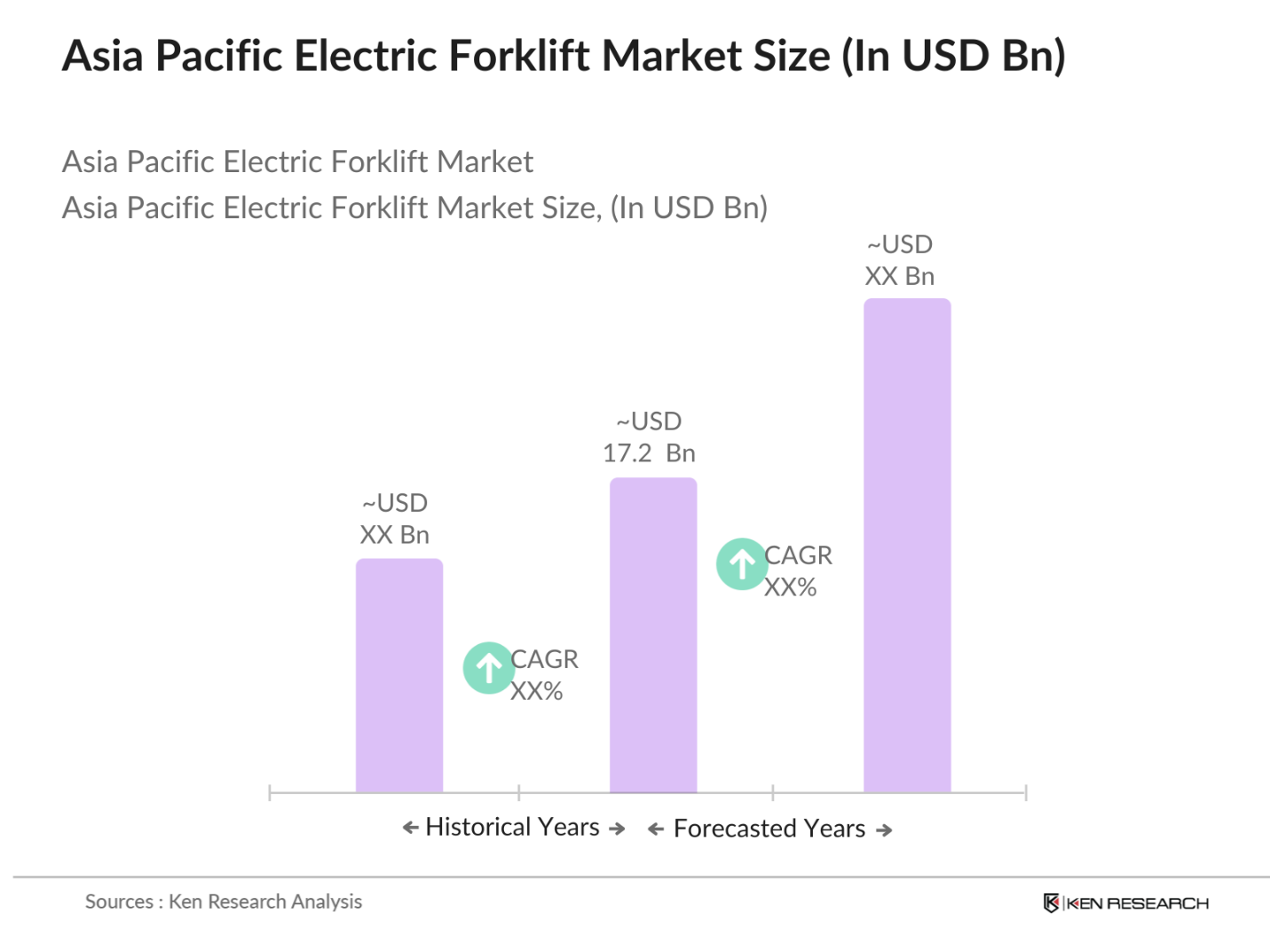
- Countries such as China, Japan, and India dominate the Asia Pacific Electric Forklift Market due to their significant manufacturing and warehousing sectors. China leads the market with its well-established industrial base and government support for electric vehicles, while Japan and India benefit from strong domestic demand and the presence of major logistics hubs. These countries also exhibit a strong focus on sustainability and industrial automation, further driving the demand for electric forklifts.
- Governments across Asia Pacific are providing tax benefits and subsidies to accelerate the adoption of electric forklifts. In 2023, India introduced a tax rebate of up to $7,000 on electric industrial vehicle purchases. Similarly, China's subsidy program for EV adoption includes a $5,000 grant per forklift for businesses transitioning from ICE to electric alternatives. These financial incentives are crucial in reducing the initial investment barrier for businesses
Asia Pacific Electric Forklift Market Segmentation
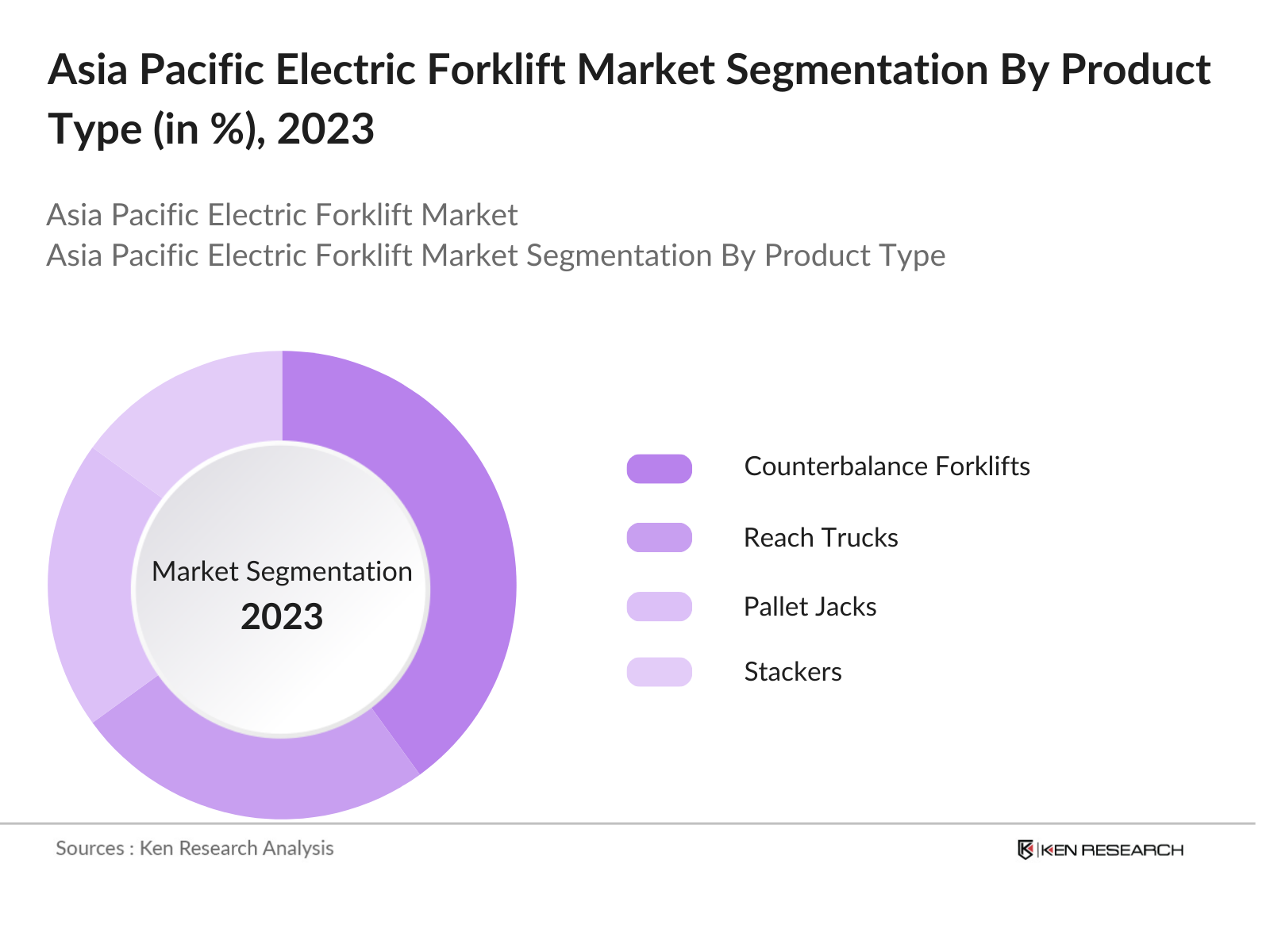
By Product Type: The Asia Pacific Electric Forklift Market is segmented by product type into counterbalance forklifts, reach trucks, pallet jacks, stackers, and tow tractors. Counterbalance forklifts hold the dominant market share due to their versatility in handling different types of loads across varied industries. Their wide application across warehouses, manufacturing plants, and distribution centers ensures that they remain a core part of material handling operations. The ability of counterbalance forklifts to perform indoor and outdoor tasks makes them highly sought after in the Asia Pacific region's growing e-commerce and warehousing sector.
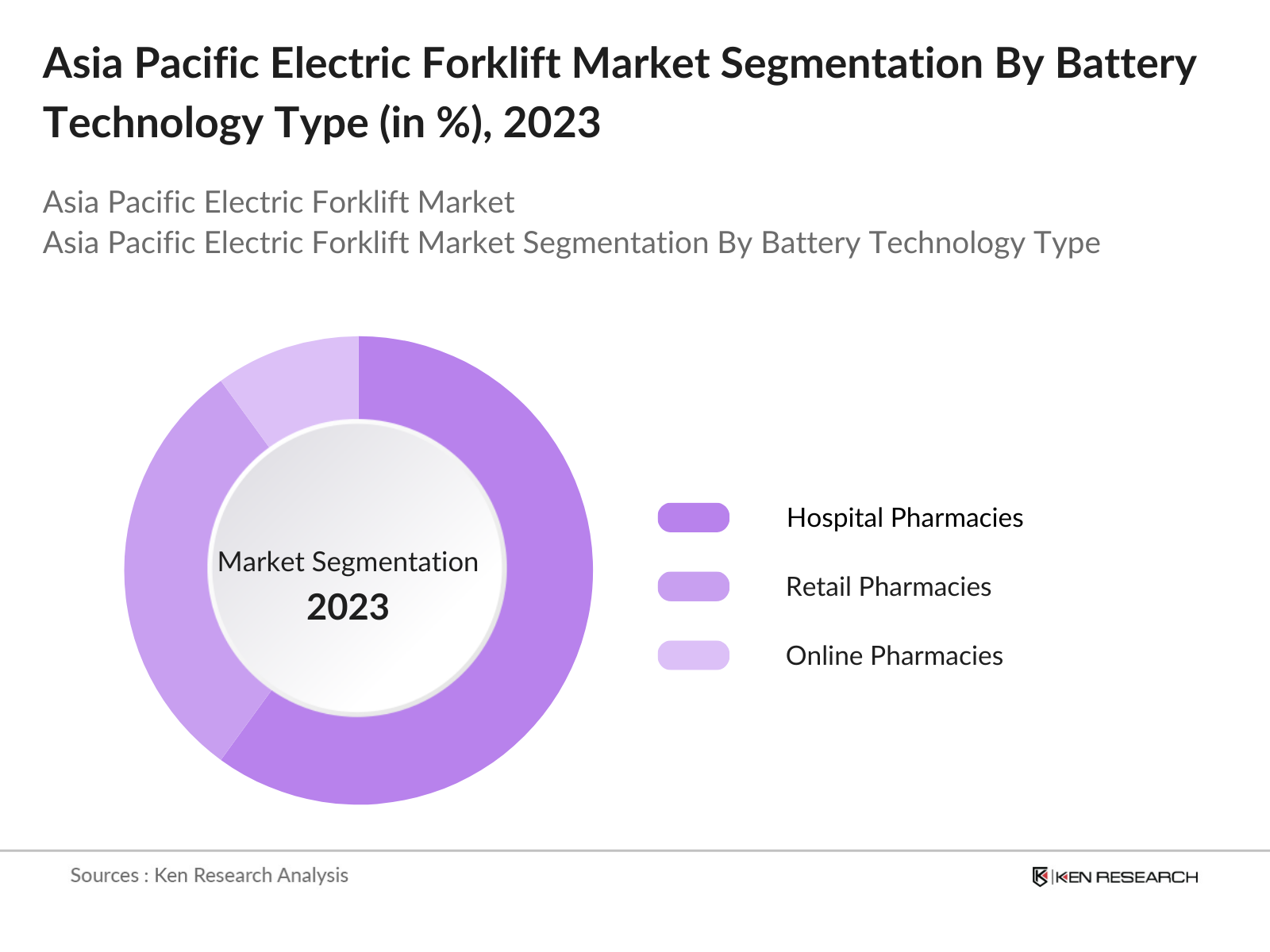
By Battery Technology: The market is also segmented by battery technology into lead-acid batteries, lithium-ion batteries, and hydrogen fuel cells. Lithium-ion batteries dominate the market due to their advantages, including faster charging times, longer lifespans, and lower maintenance requirements compared to traditional lead-acid batteries. These features significantly reduce downtime and operational costs for businesses, making them the preferred choice in high-demand industrial applications. Additionally, lithium-ion batteries align with the sustainability goals of many companies, contributing to their growing adoption.
Asia Pacific Electric Forklift Market Competitive Landscape
The Asia Pacific Electric Forklift Market is competitive, with a mix of global and regional players. Companies such as Toyota Industries Corporation and Kion Group AG dominate the market due to their established supply chains, R&D investments, and expansive product portfolios. Local players in China and Japan also maintain a strong presence, leveraging government incentives for electric vehicles to expand their footprint.
|
Company |
Establishment Year |
Headquarters |
R&D Investment |
Global Market Share |
Product Range |
Sustainability Focus |
Recent Developments |
Regional Presence |
|
Toyota Industries Corporation |
1926 |
Japan |
_ |
_ |
_ |
_ |
_ |
_ |
|
Kion Group AG |
2006 |
Germany |
_ |
_ |
_ |
_ |
_ |
_ |
|
Jungheinrich AG |
1953 |
Germany |
_ |
_ |
_ |
_ |
_ |
_ |
|
Mitsubishi Logisnext Co., Ltd |
1937 |
Japan |
_ |
_ |
_ |
_ |
_ |
_ |
|
Crown Equipment Corporation |
1945 |
USA |
_ |
_ |
_ |
_ |
_ |
_ |
Asia Pacific Electric Forklift Industry Analysis
Growth Drivers
- Electrification of Material Handling Equipment: The increasing focus on reducing carbon emissions is driving the shift towards electric forklifts across the Asia Pacific region. By 2023, Asia's electric forklift production capacity was bolstered by over 350,000 units, aligning with national climate goals. Governments such as China's are phasing out internal combustion engines (ICE), resulting in a rise in electric vehicle (EV) alternatives in industrial settings. Additionally, the region's reliance on industrial growth in logistics has increased the demand for material handling equipment by 15% year-on-year.
- Government Incentives for Electric Vehicles (EVs) in Industrial Applications: Several Asia Pacific governments, including China, Japan, and South Korea, have introduced tax incentives and subsidies for adopting electric forklifts in industrial settings. In 2023, China allocated $2.5 billion to industrial electrification subsidies to cut greenhouse gas emissions by 20%. Japan's Ministry of Economy has provided incentives of up to $10,000 per electric forklift purchased under its Green Growth Strategy, driving industrial adoption.
- Rising E-Commerce and Warehousing Demand: The Asia Pacific region's booming e-commerce sector, particularly in India and China, has led to a significant increase in warehouse development, contributing to a growing demand for electric forklifts. In 2023, India recorded a 25% increase in warehouse construction compared to 2022, driven by major e-commerce players like Alibaba and Flipkart. As a result, the demand for forklifts grew by an estimated 80,000 units in China and India alone.
Market Challenges
- High Initial Investment and Battery Cost: Despite operational savings, electric forklifts have a high upfront cost, primarily due to battery expenses. For instance, in 2023, the average price of a lithium-ion battery for forklifts in the Asia Pacific was $5,000, representing 30% of the total cost. This is a significant barrier for small and medium enterprises (SMEs) in countries like India and Thailand, where industrial capital expenditures are tightly controlled. Source: Thailand Board of Investment.
- Battery Recycling and Disposal Regulations: Battery recycling regulations in the Asia Pacific are still evolving, particularly concerning lithium-ion batteries used in electric forklifts. As of 2023, less than 15% of forklift batteries in China were recycled, creating environmental concerns and additional costs for disposal. Japan and South Korea have stricter regulations, mandating 70% recycling rates by 2025, which increases compliance costs for businesses. Source: China Ministry of Ecology and Environment.
Asia Pacific Electric Forklift Market Future Outlook
Over the next five years, the Asia Pacific Electric Forklift Market is expected to experience significant growth driven by ongoing industrialization, the expansion of the e-commerce sector, and advancements in electric vehicle technologies. The market is further bolstered by government initiatives aimed at reducing carbon emissions, which will likely result in higher demand for electric forklifts across key industries such as logistics, manufacturing, and retail. As battery technology continues to evolve, with innovations like solid-state batteries becoming more accessible, the operational efficiency of electric forklifts is expected to improve, encouraging wider adoption across both developed and developing countries in the region.
Opportunities
- Development of Advanced Battery Technologies: Technological advancements in battery systems, such as lithium-ion and solid-state batteries, offer significant opportunities for the electric forklift market. By 2023, South Korea invested $1.2 billion in solid-state battery research, aiming to improve forklift efficiency by reducing charging times and extending battery life. These advancements are expected to accelerate the shift towards electric forklifts, particularly in high-demand industries like manufacturing and warehousing.
- Expansion into Emerging Markets: Emerging markets in Southeast Asia, such as Vietnam and the Philippines, are experiencing rapid industrialization, providing growth opportunities for electric forklift manufacturers. In 2023, Vietnam's industrial output grew by 12%, leading to increased demand for material handling equipment, particularly electric models. Additionally, government initiatives in these countries, such as the Philippines' EV incentives, are expected to further drive market expansion.
Scope of the Report
|
By Product Type |
Counterbalance Forklifts Reach Trucks Pallet Jacks Stackers Tow Tractors |
|
By Application |
Warehousing Manufacturing Logistics & Distribution Retail Automotive |
|
By Battery Tech |
Lead-Acid Batteries Lithium-Ion Batteries Hydrogen Fuel Cells |
|
By Load Capacity |
Below 1.5 Tons 1.5-3 Tons Above 3 Tons |
|
By Region |
China Japan India South Korea Southeast Asia |
Products
Key Target Audience Organizations and Entities Who Can Benefit by Subscribing This Report:
Industrial Equipment Companies
Electric Vehicle Battery Manufacturing Companies
Logistics and Warehousing Companies
Automotive Manufacturers Companies
Government and Regulatory Bodies (Chinas Ministry of Industry and Information Technology, Japans Ministry of Economy, Trade and Industry)
Investor and Venture Capitalist Firms
Retail and E-Commerce Companies
Industrial Automation Industries
Companies
Players Mentioned in the Report
Toyota Industries Corporation
Kion Group AG
Jungheinrich AG
Mitsubishi Logisnext Co., Ltd.
Crown Equipment Corporation
Hyster-Yale Materials Handling, Inc.
Hangcha Group Co., Ltd.
Anhui Heli Co., Ltd.
Doosan Corporation
Komatsu Ltd.
Table of Contents
1. Asia Pacific Electric Forklift Market Overview
1.1. Definition and Scope
1.2. Market Taxonomy
1.3. Market Growth Rate
1.4. Market Segmentation Overview
2. Asia Pacific Electric Forklift Market Size (In USD Bn)
2.1. Historical Market Size
2.2. Year-On-Year Growth Analysis
2.3. Key Market Developments and Milestones
3. Asia Pacific Electric Forklift Market Analysis
3.1. Growth Drivers
3.1.1. Electrification of Material Handling Equipment (Forklifts)
3.1.2. Government Incentives for Electric Vehicles (EVs) in Industrial Applications
3.1.3. Rising E-Commerce and Warehousing Demand
3.1.4. Cost Efficiency and Operational Benefits of Electric Forklifts
3.2. Market Challenges
3.2.1. High Initial Investment and Battery Cost
3.2.2. Battery Recycling and Disposal Regulations
3.2.3. Limited Charging Infrastructure in Developing Regions
3.3. Opportunities
3.3.1. Development of Advanced Battery Technologies (Li-Ion, Solid State)
3.3.2. Expansion into Emerging Markets
3.3.3. Integration with Warehouse Automation and IoT
3.4. Trends
3.4.1. Adoption of Lithium-Ion Batteries over Lead-Acid Batteries
3.4.2. Integration with Fleet Management Systems
3.4.3. Rising Focus on Sustainability and Zero Emission
3.5. Government Regulations
3.5.1. Tax Benefits and Subsidies for EV Adoption
3.5.2. Environmental Regulations Impacting ICE Forklifts
3.5.3. National Policies Promoting Industrial Automation
3.5.4. Public-Private Partnerships for Infrastructure Development
3.6. SWOT Analysis
3.7. Stakeholder Ecosystem
3.8. Porters Five Forces
3.9. Competition Ecosystem
4. Asia Pacific Electric Forklift Market Segmentation
4.1. By Product Type (In Value %)
4.1.1. Counterbalance Forklifts
4.1.2. Reach Trucks
4.1.3. Pallet Jacks
4.1.4. Stackers
4.1.5. Tow Tractors
4.2. By Application (In Value %)
4.2.1. Warehousing
4.2.2. Manufacturing
4.2.3. Logistics & Distribution
4.2.4. Retail
4.2.5. Automotive
4.3. By Battery Technology (In Value %)
4.3.1. Lead-Acid Batteries
4.3.2. Lithium-Ion Batteries
4.3.3. Hydrogen Fuel Cells
4.4. By Load Capacity (In Value %)
4.4.1. Below 1.5 Tons
4.4.2. 1.5-3 Tons
4.4.3. Above 3 Tons
4.5. By Region (In Value %)
4.5.1. China
4.5.2. Japan
4.5.3. India
4.5.4. South Korea
4.5.5. Southeast Asia
5. Asia Pacific Electric Forklift Market Competitive Analysis
5.1. Detailed Profiles of Major Companies
5.1.1. Toyota Industries Corporation
5.1.2. Kion Group AG
5.1.3. Jungheinrich AG
5.1.4. Mitsubishi Logisnext Co., Ltd.
5.1.5. Crown Equipment Corporation
5.1.6. Hyster-Yale Materials Handling, Inc.
5.1.7. Hangcha Group Co., Ltd.
5.1.8. Anhui Heli Co., Ltd.
5.1.9. Doosan Corporation
5.1.10. Komatsu Ltd.
5.1.11. Hyundai Heavy Industries Group
5.1.12. CLARK Material Handling Company
5.1.13. EP Equipment
5.1.14. Manitou Group
5.1.15. Godrej Material Handling
5.2. Cross Comparison Parameters (Battery Type, Power Source, Headquarters, Revenue, Market Share, Employees, Regional Presence, R&D Investment)
5.3. Market Share Analysis
5.4. Strategic Initiatives
5.5. Mergers and Acquisitions
5.6. Investment Analysis
5.7. Venture Capital Funding
5.8. Government Grants
5.9. Private Equity Investments
6. Asia Pacific Electric Forklift Market Regulatory Framework
6.1. Emission Standards for Material Handling Equipment
6.2. Battery Recycling Regulations
6.3. Safety Standards for Forklifts
6.4. Certification Processes for Electric Vehicles in Industrial Sectors
7. Asia Pacific Electric Forklift Future Market Size (In USD Bn)
7.1. Future Market Size Projections
7.2. Key Factors Driving Future Market Growth
8. Asia Pacific Electric Forklift Future Market Segmentation
8.1. By Product Type (In Value %)
8.2. By Application (In Value %)
8.3. By Battery Technology (In Value %)
8.4. By Load Capacity (In Value %)
8.5. By Region (In Value %)
9. Asia Pacific Electric Forklift Market Analysts Recommendations
9.1. TAM/SAM/SOM Analysis
9.2. Market Penetration Strategies
9.3. White Space Opportunity Analysis
Research Methodology
Step 1: Identification of Key Variables
The initial step focuses on identifying and mapping critical variables impacting the Asia Pacific Electric Forklift Market. This includes extensive desk research using proprietary databases and industry reports to establish foundational data on key stakeholders, technology advancements, and government policies.
Step 2: Market Analysis and Construction
Historical market data for the electric forklift market is analyzed in this step, including industry growth patterns, product adoption rates, and revenue generation from key segments. This stage also involves cross-referencing industry benchmarks to ensure data consistency and accuracy.
Step 3: Hypothesis Validation and Expert Consultation
Market hypotheses are developed from initial findings and validated through in-depth interviews with industry experts. These interviews provide insights into operational challenges, strategic initiatives, and market opportunities from major companies in the market.
Step 4: Research Synthesis and Final Output
Finally, all gathered data is synthesized into actionable insights. This involves a bottom-up analysis to verify sales performance, regional demand trends, and forecast models. The output is cross-checked for accuracy and completeness, ensuring the final market report provides a comprehensive view of the Asia Pacific Electric Forklift Market.
Frequently Asked Questions
01. How big is the Asia Pacific Electric Forklift Market?
The Asia Pacific Electric Forklift Market is valued at approximately USD 17.2 billion, driven by the increasing demand for electric material handling solutions in the logistics, e-commerce, and warehousing sectors.
02. What are the challenges in the Asia Pacific Electric Forklift Market?
The market faces challenges such as the high initial cost of electric forklifts, limited charging infrastructure in developing regions, and battery disposal and recycling regulations, which could hinder broader adoption.
03. Who are the major players in the Asia Pacific Electric Forklift Market?
Key players include Toyota Industries Corporation, Kion Group AG, Jungheinrich AG, Mitsubishi Logisnext Co., Ltd., and Crown Equipment Corporation, which dominate due to their expansive product offerings and strategic investments in R&D.
04. What are the growth drivers of the Asia Pacific Electric Forklift Market?
Growth is propelled by increased industrialization, the rise of e-commerce, government incentives for electric vehicles, and the need for efficient and sustainable material handling solutions across industries.
Why Buy From Us?

What makes us stand out is that our consultants follows Robust, Refine and Result (RRR) methodology. i.e. Robust for clear definitions, approaches and sanity checking, Refine for differentiating respondents facts and opinions and Result for presenting data with story

We have set a benchmark in the industry by offering our clients with syndicated and customized market research reports featuring coverage of entire market as well as meticulous research and analyst insights.

While we don't replace traditional research, we flip the method upside down. Our dual approach of Top Bottom & Bottom Top ensures quality deliverable by not just verifying company fundamentals but also looking at the sector and macroeconomic factors.

With one step in the future, our research team constantly tries to show you the bigger picture. We help with some of the tough questions you may encounter along the way: How is the industry positioned? Best marketing channel? KPI's of competitors? By aligning every element, we help maximize success.

Our report gives you instant access to the answers and sources that other companies might choose to hide. We elaborate each steps of research methodology we have used and showcase you the sample size to earn your trust.

If you need any support, we are here! We pride ourselves on universe strength, data quality, and quick, friendly, and professional service.