















Asia Pacific Food Colors Market Outlook to 2030
Region:Asia
Author(s):Yogita Sahu
Product Code:KROD6367
November 2024
81
About the Report
Asia Pacific Food Colors Market Overview
- The Asia Pacific Food Colors Market is valued at USD 636 million, based on a comprehensive five-year historical analysis. The markets growth is driven by increasing consumer preference for natural and clean-label products. The demand for plant-based and organic food colors has surged, particularly in countries where health consciousness and regulatory measures promoting food safety are on the rise.

- China and India dominate the market due to their large food manufacturing sectors and rising consumer demand for visually appealing processed foods. China has become a significant player due to its substantial food production capacity, while Indias growth is fueled by its burgeoning processed food industry and increasing urbanization.
- In 2024, ASEAN nations initiated the harmonization of food safety standards across member countries, which includes unified guidelines on the use of food colorants. This initiative is designed to ease the regulatory burden on manufacturers and exporters by creating a common framework for the approval of food additives, including food colors. As a result, companies can more easily navigate regulatory requirements across multiple countries, reducing compliance costs.
Asia Pacific Food Colors Market Segmentation
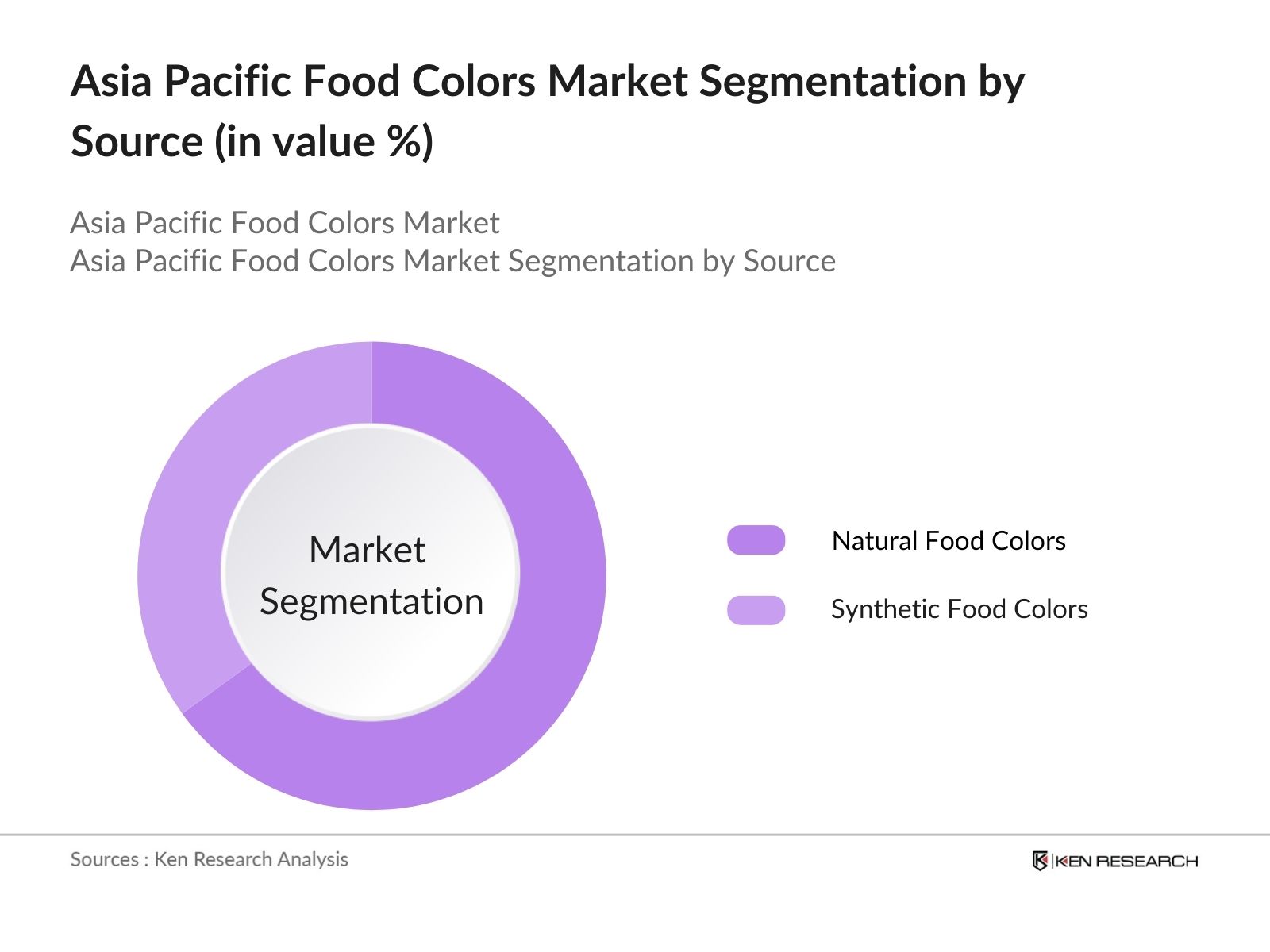
By Source: The market is segmented by source into Natural Food Colors and Synthetic Food Colors. Natural Food Colors dominate the market, driven by a growing trend toward healthier food options. This segment includes plant-based pigments like Carotenoids, Anthocyanins, Chlorophyll, and Curcumin, among others. Increasing consumer awareness of the adverse effects of synthetic additives is propelling the demand for natural alternatives.
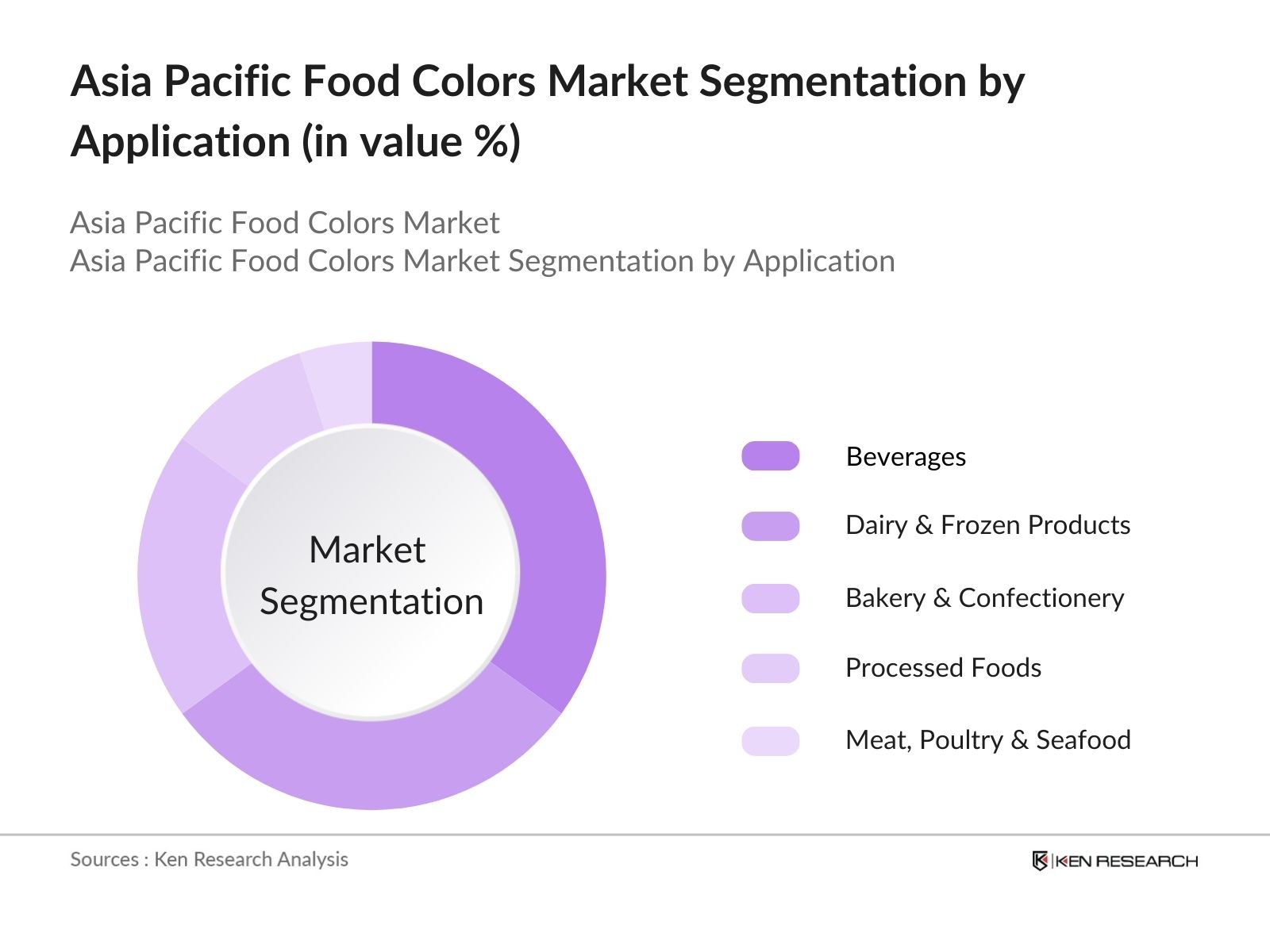
By Application: The market is also segmented by application into Beverages, Dairy & Frozen Products, Bakery & Confectionery, Processed Foods, and Meat, Poultry & Seafood. Beverages hold the dominant market share, accounting for a significant portion of food color consumption in the Asia Pacific region. The rising demand for ready-to-drink beverages, flavored waters, and energy drinks has led to an increased use of vibrant natural and synthetic colors to enhance the visual appeal of products.
Asia Pacific Food Colors Market Competitive Landscape
The market is characterized by the presence of both global and regional players, with a few major companies dominating market shares. These players focus on product innovations, sustainable sourcing of natural colors, and strategic partnerships to maintain their competitive edge.
|
Company Name |
Establishment Year |
Headquarters |
Revenue (USD Mn) |
No. of Employees |
R&D Expenditure |
Global Presence |
Product Portfolio |
Key Partnerships |
|
Sensient Technologies |
1882 |
United States |
||||||
|
Chr. Hansen Holding A/S |
1874 |
Denmark |
||||||
|
ADM |
1902 |
United States |
||||||
|
Dohler Group |
1838 |
Germany |
||||||
|
GNT Group |
1978 |
Netherlands |
Asia Pacific Food Colors Market Analysis
Market Growth Drivers
- Increasing Processed Food Demand: The processed food industry in Asia Pacific is experiencing growth, driven by increasing demand for convenience foods. In 2024, the consumption of processed food products in countries like China and India reached over 290 million metric tons. This rise has fueled the need for natural and synthetic food colors in packaged goods like snacks, beverages, and baked goods. The food color market in these countries is expected to grow in tandem with the processed food sector, especially as consumer preference for visually appealing products increases.
- Growing Awareness of Natural Ingredients: As consumers in Asia Pacific become more health-conscious, there is a rising preference for products made with natural ingredients, including natural food colors. In 2024, countries like Japan, South Korea, and Australia saw a 4.5% rise in the consumption of food products containing natural additives. This shift has boosted the demand for naturally derived food colors like carotenoids, anthocyanins, and beet juice extracts, as more consumers seek to avoid synthetic colorants.
- Expansion of the Food & Beverage Industry: The food and beverage industry in Asia Pacific is witnessing substantial expansion, with the regions retail food sector crossing the mark in 2024. Food manufacturers are increasingly using food colors to enhance product appeal and differentiate their offerings in an increasingly competitive market. Key food categories, such as bakery, confectionery, and beverages, are leading users of food colors to enhance the visual appeal of their products.
Market Challenges
- Stringent Regulatory Framework: Governments in countries such as Japan, India, and Australia have introduced strict regulations on the use of synthetic food colors, with several synthetic dyes already banned for health reasons. In 2024, Indias food safety authority flagged several products due to their non-compliance with the revised food coloring norms. Navigating such regulatory hurdles increases operational costs for manufacturers and limits the use of synthetic food colorants.
- Price Volatility of Natural Raw Materials: Natural food colors, derived from sources like vegetables and fruits, are subject to price volatility due to fluctuations in agricultural output. In 2024, the price of key raw materials such as annatto seeds and beetroot rose by 15%-20% due to adverse weather conditions in major producing countries. This price variability creates uncertainty in production costs, making it challenging for manufacturers to offer competitively priced natural food color products.
Asia Pacific Food Colors Market Future Outlook
Over the next five years, the Asia Pacific Food Colors industry is expected to experience growth, driven by continuous innovations in natural colorants, rising demand for plant-based ingredients, and regulatory push for safer food products. The increasing focus on sustainability and clean-label initiatives by food and beverage companies will also propel market expansion.
Future Market Opportunities
- Advancements in Microbial-Derived Colors: By 2029, there will be an increase in the use of microbial fermentation to produce food colors. Research is currently underway in countries like Japan and Singapore to harness microorganisms such as algae and fungi for sustainable food color production. These microbial-derived colorants are expected to reduce the environmental impact of food color manufacturing and offer more vibrant, heat-stable alternatives to existing natural colors.
- Development of Transparent Regulatory Frameworks: Over the next five years, the Asia Pacific region will see the introduction of more transparent and uniform regulations for food color additives, particularly in ASEAN countries. By 2029, these harmonized regulations will reduce compliance costs for food color manufacturers and increase the ease of exporting food products across the region. This regulatory clarity will promote innovation and encourage investment in both synthetic and natural food colorants.
Scope of the Report
|
By Source |
Natural (Plant, Mineral, Animal, Microbial) |
|
By Type |
Carmine |
|
By Application |
Beverages |
|
By Form |
Liquid |
|
By Region |
China |
Products
Key Target Audience Organizations and Entities Who Can Benefit by Subscribing This Report:
Food and Beverage Manufacturers
Banks and Financial Institution
Packaging Companies
Government and Regulatory Bodies (FDA, FSSAI)
Investors and Venture Capitalist Firms
Natural Ingredient Producers
Processed Food Companies
Private Equity Firms
Companies
Players Mentioned in the Report:
Sensient Technologies
Chr. Hansen Holding A/S
ADM
Dohler Group
GNT Group
BASF SE
Naturex (Givaudan)
D.D. Williamson & Co.
Roha Dyechem Pvt. Ltd.
Kalsec Inc.
Symrise AG
San-Ei Gen F.F.I. Inc.
Biocon Colors
International Flavors & Fragrances (IFF)
Synthite Industries
Table of Contents
1. Asia Pacific Food Colors Market Overview
1.1 Definition and Scope
1.2 Market Taxonomy (By Source, By Application, By Form, By Type)
1.3 Market Growth Rate (CAGR, Revenue Contribution, Volume Growth)
1.4 Market Segmentation Overview
2. Asia Pacific Food Colors Market Size (In USD Mn)
2.1 Historical Market Size (Revenue, Volume, Demand Trends)
2.2 Year-On-Year Growth Analysis (Region-Wise, Application-Wise, Source-Wise)
2.3 Key Market Developments and Milestones (Launches, Innovations, Regulatory Updates)
3. Asia Pacific Food Colors Market Analysis
3.1 Growth Drivers (Increasing Demand for Natural Colors, Stringent Food Regulations, Rising Health Awareness)
3.2 Market Challenges (High Cost of Natural Colors, Strict Regulatory Compliance, Supply Chain Constraints)
3.3 Opportunities (Expansion in Emerging Economies, Development of Organic Products, Growing Demand for Plant-Based Ingredients)
3.4 Trends (Shift Towards Clean Label Products, Innovation in Extraction Technologies, Use of Microalgae and Spirulina in Color Production)
3.5 Government Regulations (FDA Approval for Natural Additives, Regional Standards in APAC, Regulatory Barriers)
3.6 SWOT Analysis (Strengths, Weaknesses, Opportunities, Threats)
3.7 Stake Ecosystem (Suppliers, Manufacturers, Distributors, End-Users)
3.8 Porters Five Forces (Threat of New Entrants, Supplier Power, Buyer Power, Threat of Substitutes, Industry Rivalry)
3.9 Competition Ecosystem (Competitor Landscape, Market Positioning, Competitive Intensity)
4. Asia Pacific Food Colors Market Segmentation
4.1 By Source (In Value %)
4.1.1 Natural Food Colors (Plant, Mineral, Animal, Microbial)
4.1.2 Synthetic Food Colors (Coal-Tar, Petroleum-Derived, Dye-Based)
4.2 By Type (In Value %)
4.2.1 Carmine
4.2.2 Anthocyanins
4.2.3 Curcumin
4.2.4 Chlorophyll
4.2.5 Others (Carotenoids, Beta-Carotene, Riboflavin)
4.3 By Application (In Value %)
4.3.1 Beverages
4.3.2 Dairy & Frozen Products
4.3.3 Bakery & Confectionery
4.3.4 Processed Foods
4.3.5 Meat, Poultry & Seafood
4.4 By Form (In Value %)
4.4.1 Liquid
4.4.2 Powder
4.4.3 Gel
4.4.4 Paste
4.5 By Region (In Value %)
4.5.1 China
4.5.2 India
4.5.3 Japan
4.5.4 Australia
4.5.5 Southeast Asia
5. Asia Pacific Food Colors Market Competitive Analysis
5.1 Detailed Profiles of Major Companies
5.1.1 Sensient Technologies
5.1.2 Chr. Hansen Holding A/S
5.1.3 ADM
5.1.4 International Flavors & Fragrances (IFF)
5.1.5 D.D. Williamson & Co.
5.1.6 GNT Group
5.1.7 Naturex (Givaudan)
5.1.8 Dohler Group
5.1.9 Kalsec Inc.
5.1.10 Roha Dyechem Pvt. Ltd.
5.1.11 Symrise AG
5.1.12 Sensient Food Colors
5.1.13 BASF SE
5.1.14 San-Ei Gen F.F.I. Inc.
5.1.15 Biocon Colors
5.2 Cross Comparison Parameters (Product Portfolio, Innovation, Sustainability Initiatives, Revenue, Market Share, Supply Chain Reach, Regulatory Compliance, Customer Base)
5.3 Market Share Analysis (Global, Regional, Key Players)
5.4 Strategic Initiatives (Joint Ventures, Collaborations, Partnerships)
5.5 Mergers and Acquisitions (Recent Deals, Market Impact)
5.6 Investment Analysis (Venture Capital, Private Equity, Government Initiatives)
5.7 Venture Capital Funding (Notable Investments, Impact on Growth)
5.8 Government Grants (Grants by APAC Governments, Impact on the Industry)
5.9 Private Equity Investments (Recent Transactions, Market Influence)
6. Asia Pacific Food Colors Market Regulatory Framework
6.1 Food Safety Standards (FSSAI, APAC Regional Regulations, Codex Alimentarius)
6.2 Compliance Requirements (Labeling, Additives, Testing Standards)
6.3 Certification Processes (Organic Certification, Clean Label, Non-GMO)
7. Asia Pacific Food Colors Future Market Size (In USD Mn)
7.1 Future Market Size Projections (Volume, Value)
7.2 Key Factors Driving Future Market Growth (Sustainability, Organic Demand, Health Trends)
8. Asia Pacific Food Colors Future Market Segmentation
8.1 By Source (In Value %)
8.2 By Type (In Value %)
8.3 By Application (In Value %)
8.4 By Form (In Value %)
8.5 By Region (In Value %)
9. Asia Pacific Food Colors Market Analysts Recommendations
9.1 TAM/SAM/SOM Analysis (Total Addressable Market, Serviceable Addressable Market, Serviceable Obtainable Market)
9.2 Customer Cohort Analysis (Industry-Specific Demand, Consumer Behavior, Regional Preferences)
9.3 Marketing Initiatives (Digital, B2B Outreach, Brand Positioning)
9.4 White Space Opportunity Analysis (Untapped Markets, Emerging Segments)
Research Methodology
Step 1: Identification of Key Variables
This step involves identifying the key drivers, challenges, and opportunities within the Asia Pacific Food Colors Market. Extensive desk research is conducted using proprietary databases and secondary sources to map the entire ecosystem and define market influencers.
Step 2: Market Analysis and Construction
Historical market data is analyzed to evaluate market trends and segment growth. Data on production, revenue generation, and product innovation are collected and assessed to build a comprehensive view of the market.
Step 3: Hypothesis Validation and Expert Consultation
Insights from industry experts are gathered through interviews to validate market hypotheses. These consultations help refine market data and offer a more accurate picture of the market.
Step 4: Research Synthesis and Final Output
The final phase synthesizes data from multiple sources to present a validated analysis of market size, growth trends, and future opportunities. This is complemented by direct feedback from key players in the industry.
Frequently Asked Questions
01. How big is the Asia Pacific Food Colors Market?
The Asia Pacific Food Colors Market is valued at USD 636 million, driven by growing demand for natural and clean-label products.
02. What are the challenges in the Asia Pacific Food Colors Market?
The Asia Pacific Food Colors Market faces challenges like high costs of natural colors, strict regulatory requirements, and supply chain constraints for sourcing raw materials.
03. Who are the major players in the Asia Pacific Food Colors Market?
Major players in the Asia Pacific Food Colors Market include Sensient Technologies, Chr. Hansen Holding A/S, ADM, Dohler Group, and GNT Group, known for their innovative and sustainable food color solutions.
04. What are the growth drivers of the Asia Pacific Food Colors Market?
The Asia Pacific Food Colors Market is driven by increasing consumer demand for natural ingredients, regulatory support for clean-label products, and innovations in plant-based food colors.
05. What is the future of the Asia Pacific Food Colors Market?
The future of the Asia Pacific Food Colors Market looks promising, with growth expected from the expansion of processed food industries and innovations in natural color extraction technologies.
Why Buy From Us?

What makes us stand out is that our consultants follows Robust, Refine and Result (RRR) methodology. i.e. Robust for clear definitions, approaches and sanity checking, Refine for differentiating respondents facts and opinions and Result for presenting data with story

We have set a benchmark in the industry by offering our clients with syndicated and customized market research reports featuring coverage of entire market as well as meticulous research and analyst insights.

While we don't replace traditional research, we flip the method upside down. Our dual approach of Top Bottom & Bottom Top ensures quality deliverable by not just verifying company fundamentals but also looking at the sector and macroeconomic factors.

With one step in the future, our research team constantly tries to show you the bigger picture. We help with some of the tough questions you may encounter along the way: How is the industry positioned? Best marketing channel? KPI's of competitors? By aligning every element, we help maximize success.

Our report gives you instant access to the answers and sources that other companies might choose to hide. We elaborate each steps of research methodology we have used and showcase you the sample size to earn your trust.

If you need any support, we are here! We pride ourselves on universe strength, data quality, and quick, friendly, and professional service.