















Asia-Pacific Golf Cart Market Outlook to 2030
Region:Asia
Author(s):Naman Rohilla
Product Code:KROD3941
September 2024
94
About the Report
Asia-Pacific Golf Cart Market Overview
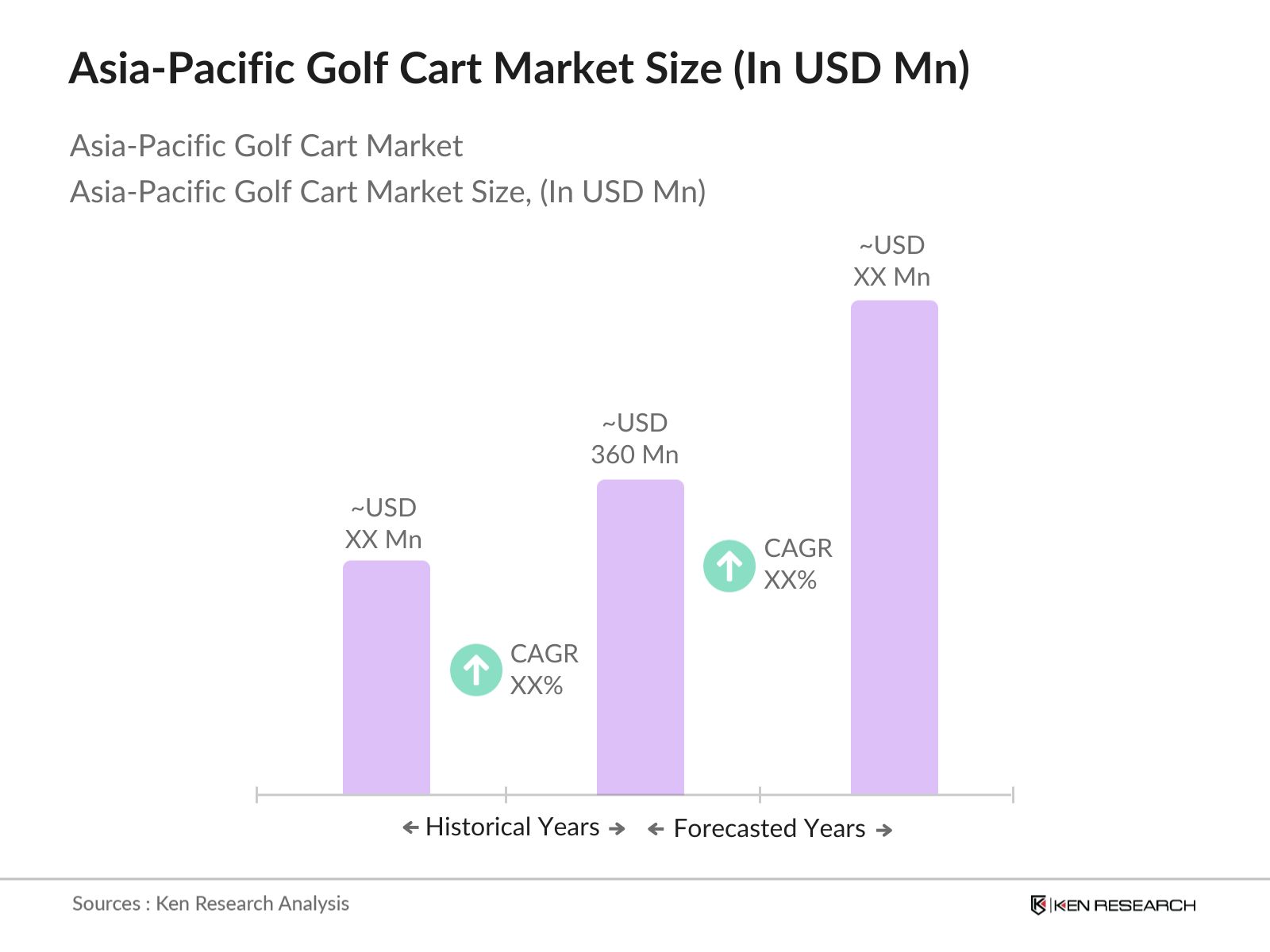
- The Asia-Pacific Golf Cart market is valued at USD 360 million, driven by strong demand in multiple sectors beyond traditional golf courses. The surge in golf cart adoption is due to an increasing number of luxury resorts, eco-friendly urban transport initiatives, and expanding applications in airports and large commercial properties. The demand for electric-powered golf carts has surged, driven by eco-conscious consumer preferences and regulatory mandates favouring lower-emission vehicles. Urbanization trends and the expansion of golf courses across major regions also contribute to this market's growth.
- Among the dominant players in the Asia-Pacific region, countries like Japan and China lead due to their advanced infrastructure and technological integration. In Japan, the focus on smart urban mobility and eco-friendly transport solutions, coupled with a robust golf culture, boosts market dominance. Similarly, China's increasing investments in golf courses, leisure resorts, and technological advancements in electric vehicles make it a key player in the market.
- Several Asia-Pacific countries, including India, Japan, and South Korea, are offering subsidies and incentives for electric vehicles, which include golf carts. In India, the Faster Adoption and Manufacturing of Hybrid and Electric Vehicles (FAME) scheme offers up to $1,500 in subsidies for electric vehicles. These policies aim to encourage the transition to electric-powered golf carts, reducing their overall cost and making them more accessible for resorts and commercial users. Additionally, the Chinese government has introduced tax reductions on the purchase of electric vehicles, boosting the market for electric carts.
Asia-Pacific Golf Cart Market Segmentation
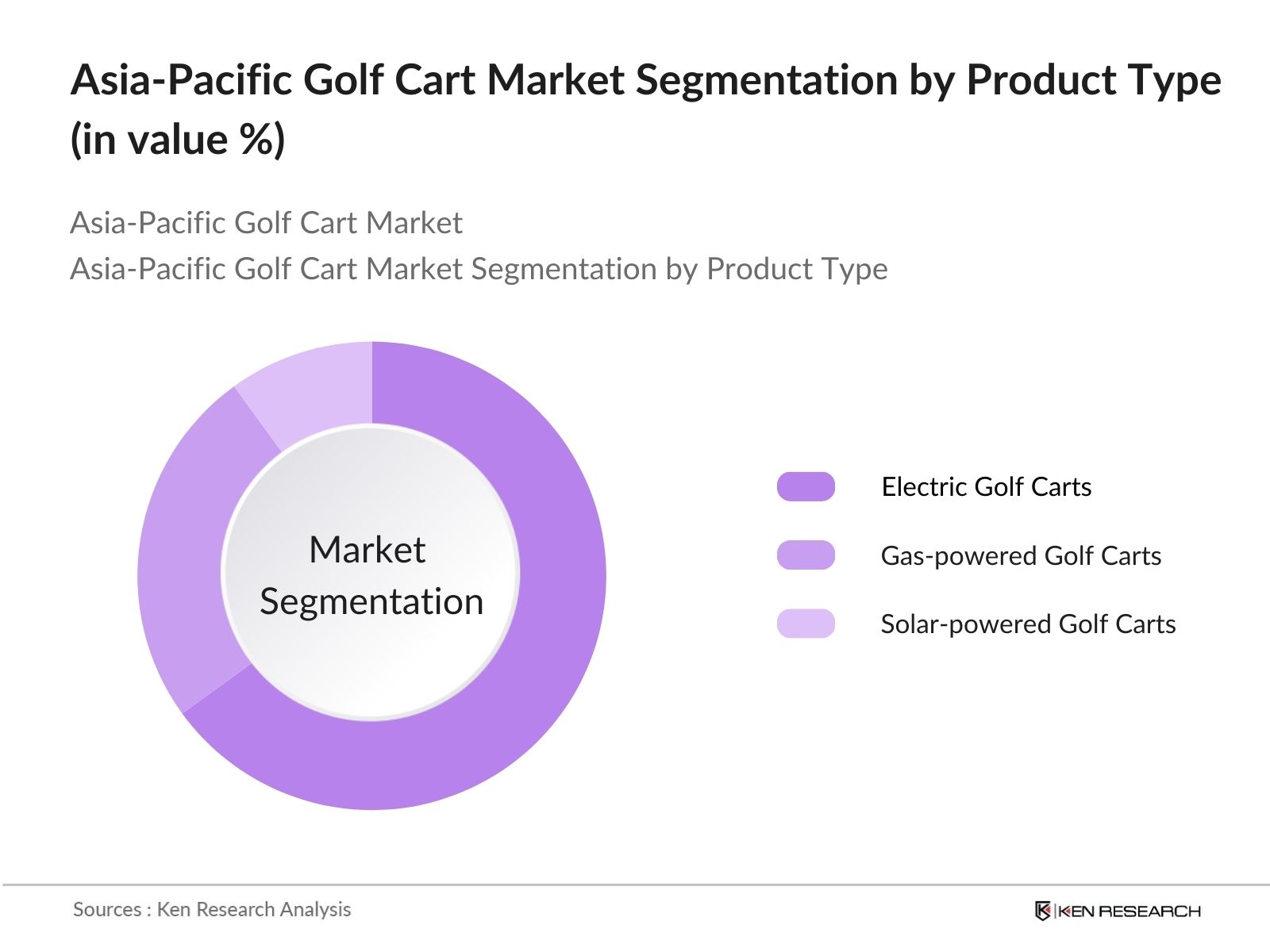
- By Product Type: The Asia-Pacific Golf Cart market is segmented by product type into electric, gas-powered, and solar-powered golf carts. Electric golf carts dominate this segmentation due to their widespread use in various sectors, including resorts, airports, and urban mobility solutions. The shift toward sustainable and eco-friendly transport alternatives is the driving force behind the growth of electric carts. Additionally, improvements in battery technology and government policies supporting electric vehicle adoption have contributed to the dominance of electric golf carts.
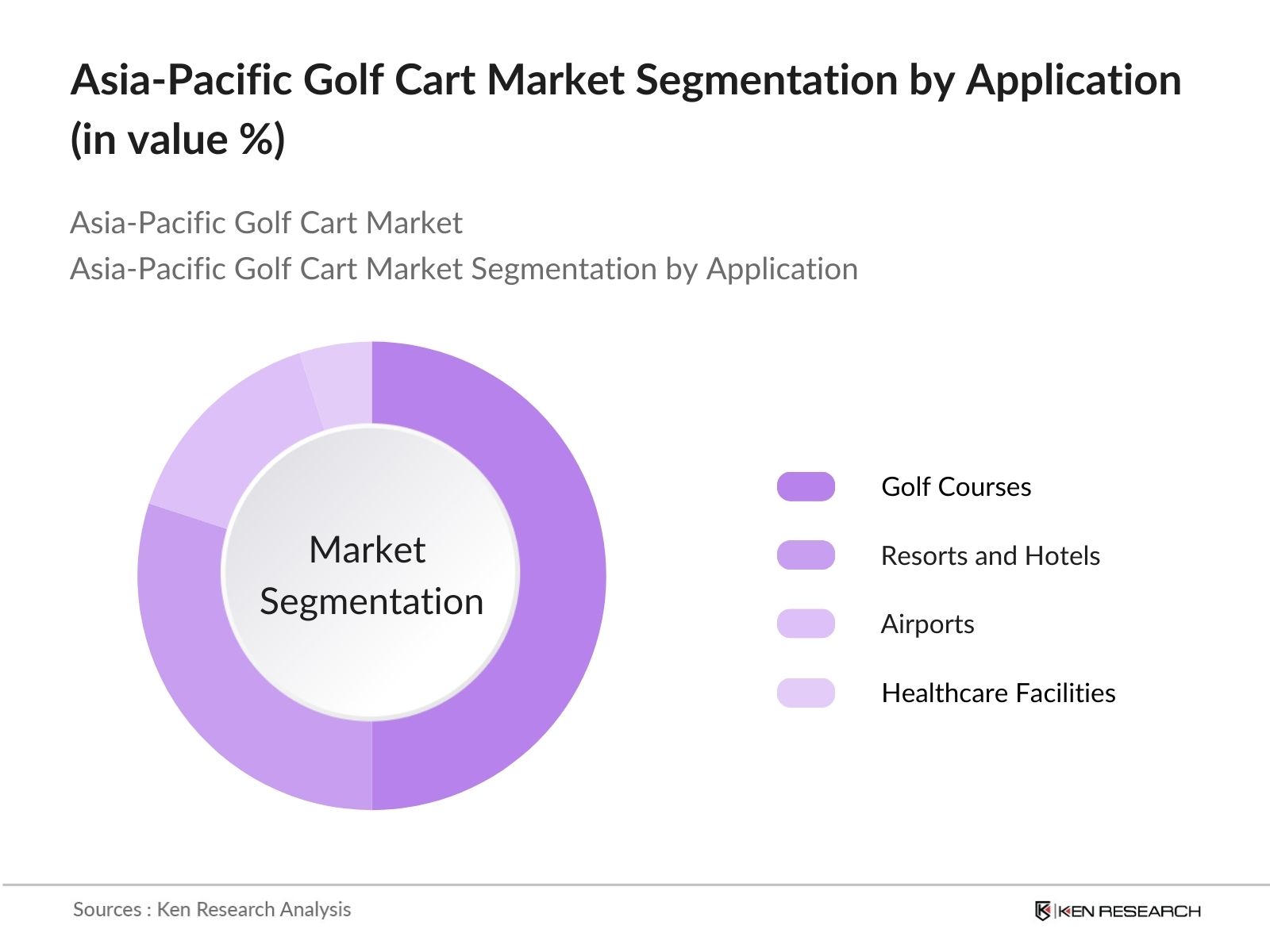
- By Application: The market is segmented by application into golf courses, resorts and hotels, airports, and healthcare facilities. Golf courses are the dominant sub-segment, with widespread adoption across Asia-Pacific. This dominance is attributed to the ingrained popularity of golf in countries like Japan, China, and South Korea. Additionally, the increasing number of international tournaments and luxury golfing events has heightened the demand for modern and customized golf carts in these regions.
Asia-Pacific Golf Cart Market Competitive Landscape
The Asia-Pacific Golf Cart market is highly competitive, with key players leveraging innovation, regional expansion, and partnerships to strengthen their market presence. Established companies have integrated technological advancements into their golf cart offerings, such as autonomous driving and solar charging capabilities.
| Company | Establishment Year | Headquarters | No. of Employees | Revenue (USD Mn) | Product Portfolio | Technological Innovation | Market Share | Distribution Network | Green Initiatives |
|---|---|---|---|---|---|---|---|---|---|
| Yamaha Golf-Car Company | 1955 | Japan | |||||||
| Club Car | 1958 | USA | |||||||
| EZGO | 1954 | USA | |||||||
| Garia Inc. | 2005 | Denmark | |||||||
| Suzhou Eagle Electric Vehicle | 1999 | China |
Asia-Pacific Golf Cart Market Analysis
Asia-Pacific Golf Cart Market Growth Drivers
- Increasing Golf Course Development: The Asia-Pacific region is witnessing a surge in golf course development, particularly in countries like China and India, where tourism and luxury segments are on the rise. According to the Asia-Pacific Golf Confederation, more than 150 new golf courses have been planned across China and Southeast Asia in the past five years. Governments and private developers are investing in the renovation of existing courses and the construction of new ones to accommodate the growing interest in golf. With an expanding middle class and an influx of international tourists, this trend is expected to fuel golf cart demand for transport and facility management across new and revamped courses.
- Tourism and Recreational Sector Expansion: Tourism and recreation sectors are booming across the Asia-Pacific region, with international tourist arrivals surpassing 260 million in 2022, according to the World Bank. Luxury resorts and eco-tourism destinations, particularly in countries like Thailand and Indonesia, are increasingly incorporating golf facilities to cater to high-end tourists. Golf carts are becoming essential for intra-resort transport, contributing to market growth. Furthermore, eco-tourism initiatives are boosting the demand for electric carts as resorts focus on sustainability and minimizing their environmental footprint.
- Rising Adoption in Non-Golf Applications: Golf carts are no longer limited to golf courses but are now commonly used in resorts, airports, and large residential complexes for efficient transportation. In 2022, the Airports Council International reported that Asia-Pacific airports handled over 1.8 billion passengers. Resorts and residential developments across Malaysia, the Philippines, and Vietnam are integrating golf carts for transport within expansive properties. These non-golf applications are diversifying the market, with resorts and airports deploying larger fleets to meet growing transport needs within their complexes.
Asia-Pacific Golf Cart Market Market Challenges
- High Initial Purchase Costs: The cost of purchasing a golf cart remains a major barrier to market expansion in the Asia-Pacific region. A new electric golf cart can cost between $5,000 and $15,000 depending on the make and model, which poses a challenge for smaller golf courses and resorts operating on limited budgets. This high initial cost is often compounded by import taxes and duties in certain countries, such as India, where import duties can add up to 30% of the cart's total cost. For many smaller-scale operations, such as local eco-tourism resorts, these costs are prohibitive.
- Limited Charging Infrastructure: While electric golf carts are gaining popularity due to environmental benefits, the lack of widespread charging infrastructure is an obstacle in it, especially in rural or developing regions. According to the Asian Development Bank, only 45% of Southeast Asian regions have access to reliable electric charging stations for vehicles. This shortage hinders the deployment of electric golf carts in areas that are rapidly expanding in tourism and residential development but lack the energy infrastructure to support the adoption of electric carts on a large scale.
Asia-Pacific Golf Cart Market Future Outlook
The Asia-Pacific Golf Cart market is projected to experience substantial growth over the next few years. Key factors driving this growth include increasing investments in eco-friendly transportation, the rising popularity of electric and solar-powered carts, and expanding applications of golf carts beyond traditional golf courses. The integration of smart technology and autonomous driving systems into golf carts is expected to further enhance their utility, especially in urban environments and hospitality sectors.
Asia-Pacific Golf Cart Market Opportunities
- Partnerships with Smart City Projects: Golf carts are increasingly becoming part of urban planning in smart city projects, particularly in countries like Singapore and South Korea, where urban mobility is a key focus. Smart cities are integrating electric golf carts into sustainable transportation networks for short-distance travel, such as within commercial and residential complexes. With the Asian Development Bank planning over $100 billion in smart city development across Asia by 2025, there is ample opportunity for golf cart manufacturers to partner with urban planners to provide eco-friendly and efficient transport solutions.
- Customization and Rental Services: Customization and rental services for golf carts are emerging as lucrative business models, particularly in high-end resorts and events. The World Travel and Tourism Council reported that Asia-Pacific's travel and tourism sector contributed over $1.6 trillion to GDP in 2022. Golf carts are increasingly being rented for weddings, festivals, and large-scale events, offering customizable designs and features. With resorts seeking to provide unique experiences, the demand for tailored and short-term golf cart rental services is growing substantially, offering manufacturers new revenue streams.
Scope of the Report
| By Product Type |
Electric Gas-powered Solar-powered |
| By Application |
Golf Courses Resorts Airports |
| By Seating Capacity |
2-seater 4-seater 6-seater 8-seater |
| By Ownership Type |
Owned Leased |
| By Region |
China Japan Australia South Korea |
Products
Key Target Audience
Golf Course Operators
Luxury Resort and Hotel Chains
Airports and Aviation Authorities
Healthcare Facility Managers
Electric Vehicle Manufacturers
Banks and Financial Institutions
Urban Mobility Solution Providers
Investments and Venture Capitalist Firms
Government and Regulatory Bodies (EV Subsidies and Emission Control Policies)
Companies
Asia-Pacific Golf Cart Market Major Players
Yamaha Golf-Car Company
Club Car
EZGO
Garia Inc.
Suzhou Eagle Electric Vehicle
Polaris Industries
Textron Specialized Vehicles
Tomberlin Automotive Group
HDK Electric Vehicle
ACG, Inc.
Star EV Corporation
Marshell Green Power
Columbia Vehicle Group
Xiamen Dalle Electric Car Co. Ltd.
JH Global Services, Inc.
Table of Contents
1. Asia-Pacific Golf Cart Market Overview
1.1 Definition and Scope
1.2 Market Taxonomy
1.3 Market Growth Rate
1.4 Market Segmentation Overview
2. Asia-Pacific Golf Cart Market Size (In USD Bn)
2.1 Historical Market Size
2.2 Year-On-Year Growth Analysis
2.3 Key Market Developments and Milestones
3. Asia-Pacific Golf Cart Market Analysis
3.1 Growth Drivers
3.1.1 Increasing Golf Course Development (New Course Construction, Course Renovations)
3.1.2 Tourism and Recreational Sector Expansion (Luxury Resorts, Eco-tourism)
3.1.3 Rising Adoption in Non-Golf Applications (Resorts, Airports, Residential Complexes)
3.1.4 Electrification Trends in Transportation (Battery Innovations, Renewable Energy Integration)
3.2 Market Challenges
3.2.1 High Initial Purchase Costs
3.2.2 Limited Charging Infrastructure (For Electric Carts)
3.2.3 Strict Government Regulations (Emission Standards, Safety Requirements)
3.3 Opportunities
3.3.1 Technological Advancements (Autonomous Golf Carts, AI-enabled Fleet Management)
3.3.2 Partnerships with Smart City Projects
3.3.3 Customization and Rental Services (For Resorts, Events)
3.4 Trends
3.4.1 Shift Towards Electric and Solar-powered Golf Carts
3.4.2 Increasing Demand for Lightweight Materials
3.4.3 Rising Use of Golf Carts in Healthcare Facilities
3.5 Government Regulations
3.5.1 Electric Vehicle Subsidies and Incentives
3.5.2 Emission Control and Compliance Policies
3.5.3 Urban Mobility Programs
3.6 SWOT Analysis
3.7 Stakeholder Ecosystem
3.8 Porter’s Five Forces
3.9 Competitive Landscape Analysis
4. Asia-Pacific Golf Cart Market Segmentation
4.1 By Product Type (In Value %)
4.1.1 Electric Golf Carts
4.1.2 Gas-powered Golf Carts
4.1.3 Solar-powered Golf Carts
4.2 By Application (In Value %)
4.2.1 Golf Courses
4.2.2 Resorts and Hotels
4.2.3 Airports
4.2.4 Healthcare Facilities
4.3 By Seating Capacity (In Value %)
4.3.1 2-seater
4.3.2 4-seater
4.3.3 6-seater
4.3.4 8-seater
4.4 By Ownership Type (In Value %)
4.4.1 Owned
4.4.2 Leased
4.5 By Region (In Value %)
4.5.1 China
4.5.2 Japan
4.5.3 Australia
4.5.4 South Korea
4.5.5 Rest of Asia-Pacific
5. Asia-Pacific Golf Cart Market Competitive Analysis
5.1 Detailed Profiles of Major Companies
5.1.1 Yamaha Golf-Car Company
5.1.2 Club Car
5.1.3 EZGO
5.1.4 Polaris Industries
5.1.5 Textron Specialized Vehicles
5.1.6 Garia Inc.
5.1.7 Star EV Corporation
5.1.8 Tomberlin Automotive Group
5.1.9 JH Global Services, Inc.
5.1.10 ACG, Inc.
5.1.11 Suzhou Eagle Electric Vehicle
5.1.12 HDK Electric Vehicle
5.1.13 Marshell Green Power
5.1.14 Columbia Vehicle Group
5.1.15 Xiamen Dalle Electric Car Co. Ltd.
5.2 Cross Comparison Parameters (No. of Employees, Revenue, Headquarters, Production Capacity, Product Portfolio, Technological Innovations, Distribution Network, Market Share)
5.3 Market Share Analysis
5.4 Strategic Initiatives
5.5 Mergers and Acquisitions
5.6 Investment Analysis
5.7 Venture Capital Funding
6. Asia-Pacific Golf Cart Market Regulatory Framework
6.1 Environmental Standards
6.2 Compliance Requirements
6.3 Certification Processes
7. Asia-Pacific Golf Cart Future Market Size (In USD Bn)
7.1 Future Market Size Projections
7.2 Key Factors Driving Future Market Growth
8. Asia-Pacific Golf Cart Future Market Segmentation
8.1 By Product Type (In Value %)
8.2 By Application (In Value %)
8.3 By Seating Capacity (In Value %)
8.4 By Ownership Type (In Value %)
8.5 By Region (In Value %)
9. Asia-Pacific Golf Cart Market Analysts’ Recommendations
9.1 TAM/SAM/SOM Analysis
9.2 Customer Cohort Analysis
9.3 Marketing Initiatives
9.4 White Space Opportunity Analysis
Disclaimer Contact UsResearch Methodology
Step 1: Identification of Key Variables
The first step involved creating an ecosystem map that included all the major stakeholders within the Asia-Pacific Golf Cart Market. Extensive desk research utilizing both proprietary databases and secondary sources was conducted to identify and define the critical variables affecting the market.
Step 2: Market Analysis and Construction
In this phase, historical data regarding the Asia-Pacific Golf Cart Market was compiled and analyzed. This included assessing the market’s penetration across various applications such as golf courses and airports and the corresponding revenue generated. This step was crucial in validating the market size.
Step 3: Hypothesis Validation and Expert Consultation
Market hypotheses were developed and validated through in-depth interviews with industry experts. These consultations provided insights into operational and financial factors from industry insiders, enabling the refinement of the data collected during the initial research phase.
Step 4: Research Synthesis and Final Output
The final step involved direct engagement with golf cart manufacturers and industry stakeholders. This interaction helped validate and synthesize the data gathered and contributed to a comprehensive understanding of market trends, segmentation, and future growth prospects.
Frequently Asked Questions
01. How big is the Asia-Pacific Golf Cart Market?
The Asia-Pacific Golf Cart Market is valued at USD USD 360 million, with growth driven by the increasing adoption of electric golf carts, expanding applications beyond golf courses, and the rising demand for eco-friendly transportation solutions.
02. What are the challenges in the Asia-Pacific Golf Cart Market?
Challenges in the Asia-Pacific Golf Cart Market include high initial purchase costs for electric golf carts, limited charging infrastructure, and stringent government regulations surrounding emission standards.
03. Who are the major players in the Asia-Pacific Golf Cart Market?
Key players in the Asia-Pacific Golf Cart Market include Yamaha Golf-Car Company, Club Car, EZGO, Garia Inc., and Suzhou Eagle Electric Vehicle. These companies dominate due to their strong brand presence, technological innovations, and extensive distribution networks.
04. What are the growth drivers of the Asia-Pacific Golf Cart Market?
The Asia-Pacific Golf Cart Market is driven by factors such as increasing golf course developments, expanding applications in airports and resorts, and the rising adoption of electric-powered golf carts supported by government incentives for green transportation.
Why Buy From Us?

What makes us stand out is that our consultants follows Robust, Refine and Result (RRR) methodology. i.e. Robust for clear definitions, approaches and sanity checking, Refine for differentiating respondents facts and opinions and Result for presenting data with story

We have set a benchmark in the industry by offering our clients with syndicated and customized market research reports featuring coverage of entire market as well as meticulous research and analyst insights.

While we don't replace traditional research, we flip the method upside down. Our dual approach of Top Bottom & Bottom Top ensures quality deliverable by not just verifying company fundamentals but also looking at the sector and macroeconomic factors.

With one step in the future, our research team constantly tries to show you the bigger picture. We help with some of the tough questions you may encounter along the way: How is the industry positioned? Best marketing channel? KPI's of competitors? By aligning every element, we help maximize success.

Our report gives you instant access to the answers and sources that other companies might choose to hide. We elaborate each steps of research methodology we have used and showcase you the sample size to earn your trust.

If you need any support, we are here! We pride ourselves on universe strength, data quality, and quick, friendly, and professional service.