
Asia Pacific Herbal Medicine Market Outlook to 2030
Region:Asia
Author(s):Sanjna
Product Code:KROD6012
November 2024
89
About the Report
Asia Pacific Herbal Medicine Market Overview
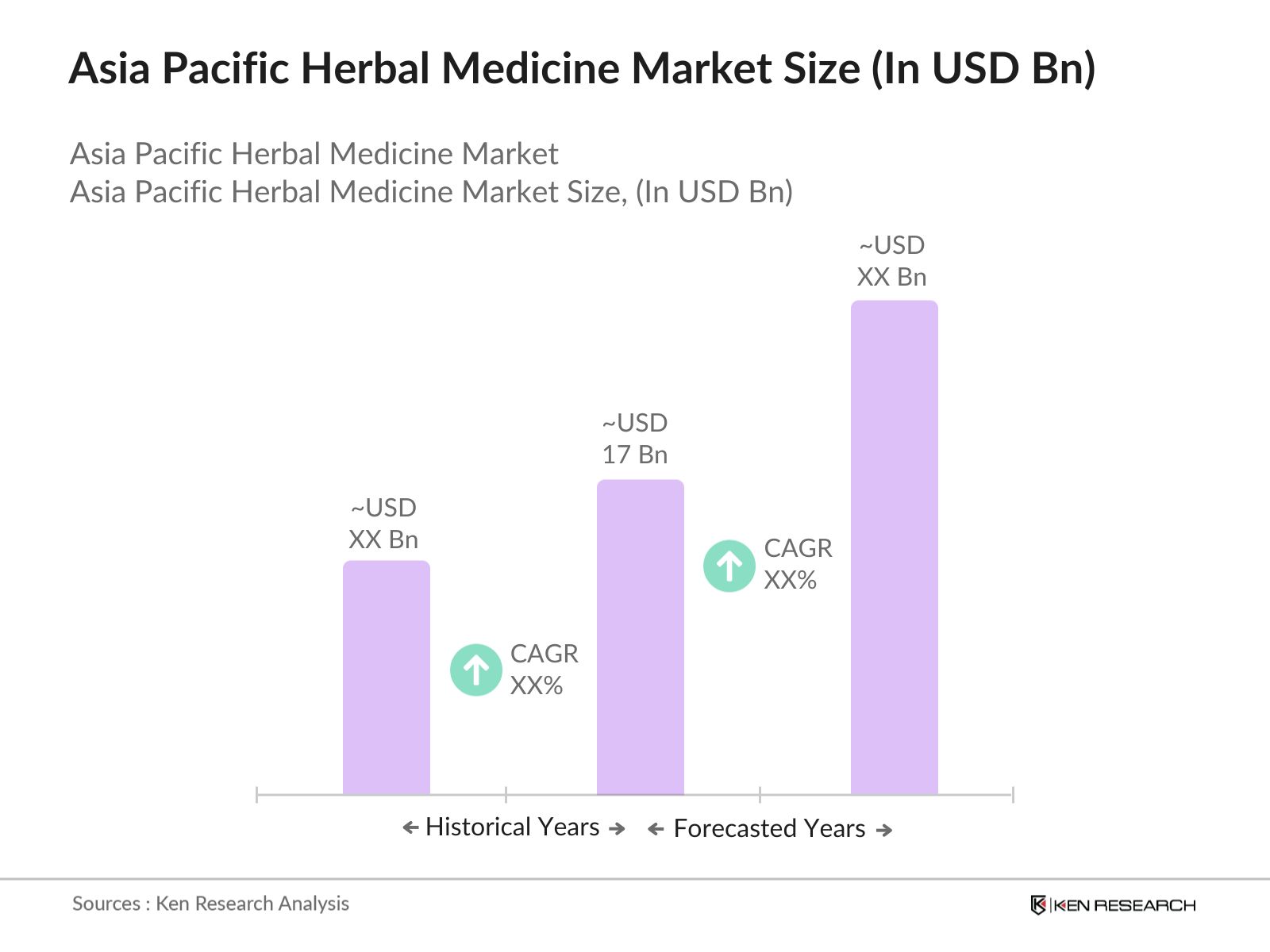
- The Asia Pacific herbal medicine market is valued at USD 17 billion, driven by an increasing consumer preference for natural remedies. This growing demand is propelled by heightened awareness of the health benefits offered by herbal treatments, particularly for chronic ailments such as digestive issues and immune support. Governments in the region are also promoting traditional medicine through regulatory support and inclusion in national health systems. The market growth is further fueled by the rise of wellness trends and a shift towards preventive healthcare.
- China, India, and Japan dominate the Asia Pacific herbal medicine market. China is the largest producer and consumer of herbal medicines due to its deep-rooted traditional Chinese medicine practices. India, with its long-standing Ayurvedic medicine system, holds a strong position supported by government initiatives. Japans dominance stems from its advanced pharmaceutical industry, where herbal medicine is integrated into modern healthcare systems. These countries dominance is attributed to their rich cultural heritage, established regulatory frameworks, and government support for traditional medicine.
- National health authorities across the Asia Pacific region have implemented stringent regulations and certification requirements for herbal medicine products. In 2024, the China Food and Drug Administration (CFDA) mandated that all herbal products must meet Good Manufacturing Practices (GMP) standards before entering the market. Similarly, Indias Ministry of AYUSH has made it compulsory for herbal medicine manufacturers to obtain certifications from the AYUSH Mark Scheme to ensure quality and safety.
Asia Pacific Herbal Medicine Market Segmentation
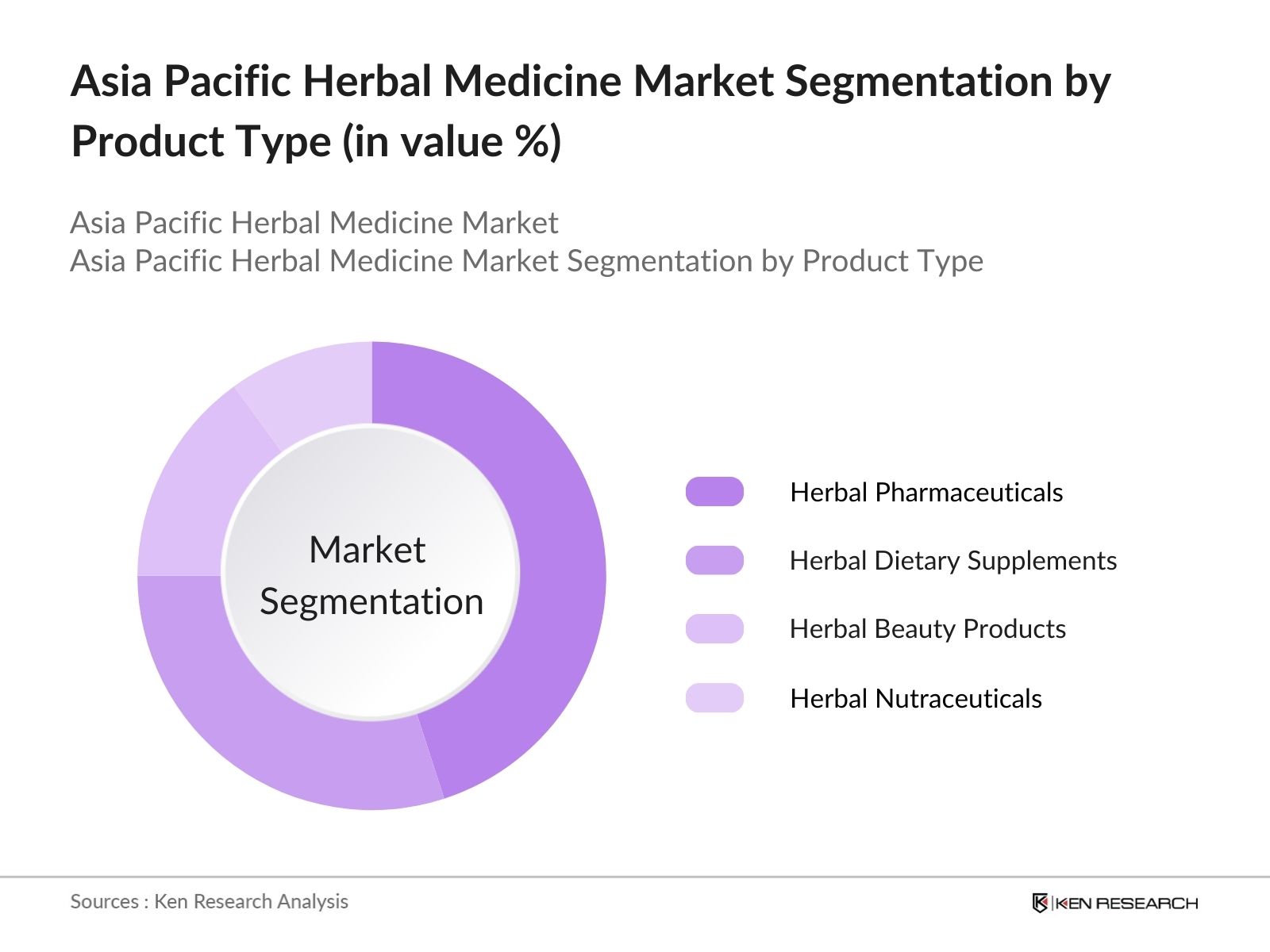
By Product Type: The Asia Pacific herbal medicine market is segmented by product type into herbal pharmaceuticals, herbal dietary supplements, herbal beauty products, and herbal nutraceuticals. Herbal pharmaceuticals hold a dominant market share due to their integration into formal healthcare systems, particularly in China and Japan. The acceptance of these products within mainstream medical treatments has expanded their reach, with products like herbal remedies for respiratory ailments and digestive health experiencing high demand.
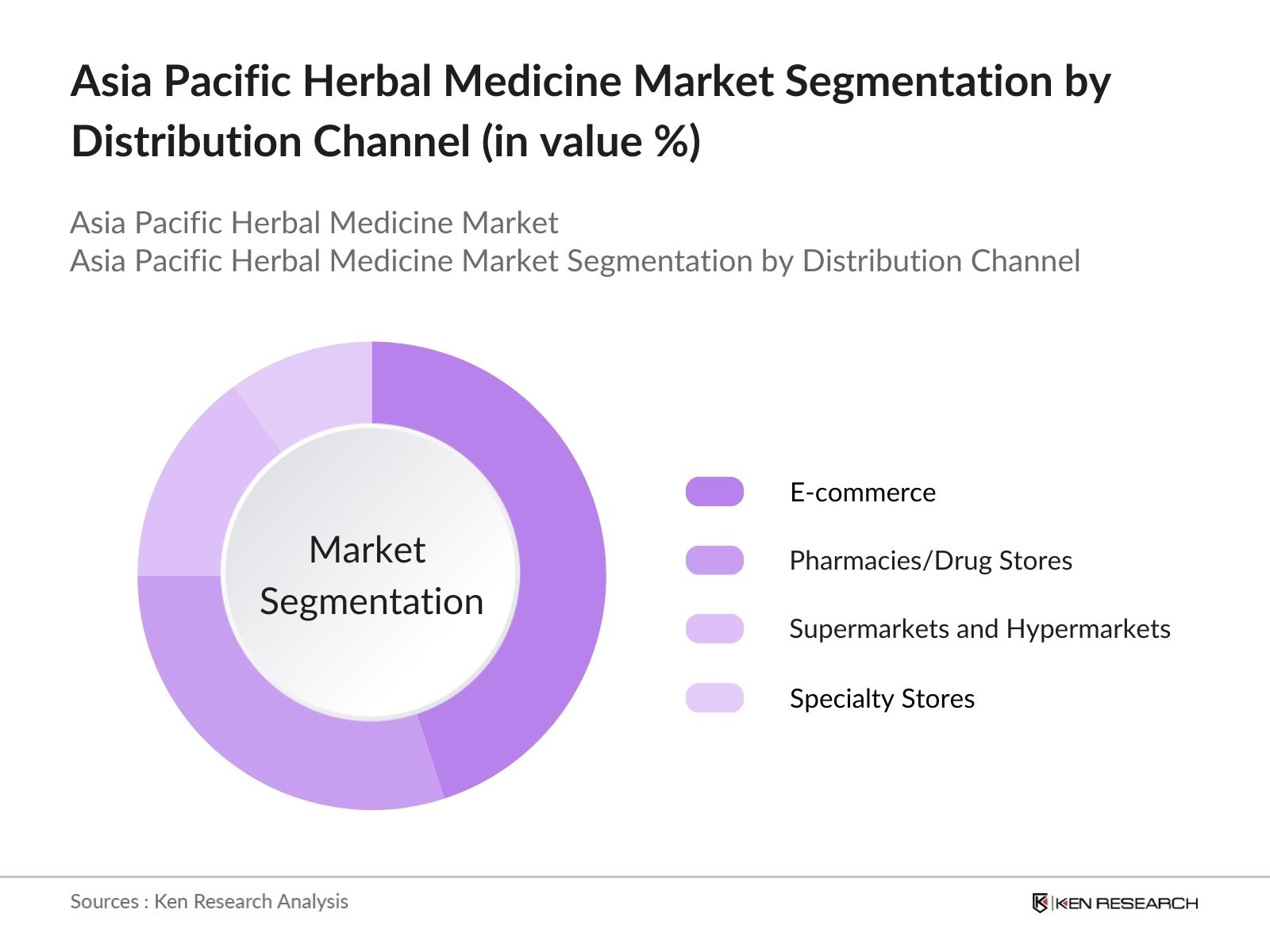
 By Distribution Channel: The herbal medicine market is also segmented by distribution channel into pharmacies/drug stores, e-commerce, supermarkets and hypermarkets, and specialty stores. E-commerce platforms dominate this segment, capturing a large portion of the market share due to the increasing penetration of digital platforms and the convenience of online shopping. Consumers are increasingly purchasing herbal medicines and supplements through online channels due to the availability of a wide variety of products, easy access to information, and direct-to-consumer models.
 Asia Pacific Herbal Medicine Market Competitive Landscape
The Asia Pacific herbal medicine market is dominated by several key players, both local and international. Companies in the market focus on expanding their product portfolios and research and development activities to innovate new herbal products. Collaborations between pharmaceutical and herbal medicine companies are also becoming common to bridge the gap between modern and traditional medicine. Additionally, players are increasingly adopting online distribution strategies to reach a wider customer base.
|
Company Name |
Year of Establishment |
Headquarters |
Revenue (2023) |
Product Portfolio |
R&D Expenditure |
Market Share |
Collaborations |
|
Himalaya Drug Company |
1930 |
India |
- |
- |
- |
- |
- |
|
Dabur India Ltd. |
1884 |
India |
- |
- |
- |
- |
- |
|
Blackmores Limited |
1930 |
Australia |
- |
- |
- |
- |
- |
|
Schwabe Group |
1866 |
Germany |
- |
- |
- |
- |
- |
|
Amway |
1959 |
United States |
- |
- |
- |
- |
- |
Asia Pacific Herbal Medicine Market Analysis
Growth Drivers
- Rising Preference for Natural Remedies: The increasing demand for herbal medicine across the Asia Pacific region is strongly tied to consumers' preference for natural remedies. In 2024, over 2.5 billion people in the region rely on traditional herbal medicines as their primary form of healthcare, particularly in countries like China and India. This shift towards natural solutions is a response to rising concerns over synthetic drug side effects. Macroeconomic growth, along with increasing disposable incomes, has fueled this demand.
- Increasing Awareness of Health Benefits: Growing awareness of the health benefits of traditional medicine, including practices like Ayurveda, is a significant driver in the Asia Pacific herbal medicine market. According to a survey conducted by the National Sample Survey Office (NSSO) from July 2022 to June 2023, about46% of ruraland53% of urban individualsreported using AYUSH systems for prevention or treatment of ailments in the past year.
- Expanding Middle-Class Population: The rising middle-class population in countries like China, India, and Southeast Asian nations is a key driver of herbal medicine consumption. By 2024, the middle class in the Asia Pacific region is projected to reach over 2.3 billion, according to the World Bank. This expanding demographic is characterized by higher disposable income and increased spending on health and wellness products, including herbal remedies.
Challenges
- High Cost of Research and Development: The high costs associated with research and development in the herbal medicine sector pose a significant challenge, as companies need to conduct scientific validation to meet regulatory requirements. According to the World Intellectual Property Organization (WIPO), R&D costs in the herbal medicine field have surged by 15% from 2022 to 2024, with companies investing heavily in clinical trials to prove the efficacy of their products.
- Regulatory Hurdles: Countries like India and China have implemented stringent safety and efficacy standards for herbal products. The Indian Ministry of AYUSH reported that over 45% of herbal medicine applications faced delays or were denied approval in 2023 due to non-compliance with safety standards. These regulatory bottlenecks slow down market expansion and add complexity to the approval processes, particularly for companies aiming to export their products to international markets.
Asia Pacific Herbal Medicine Future Market Outlook
The Asia Pacific herbal medicine market is expected to witness significant growth in the coming years. This growth will be driven by increasing consumer demand for natural and preventive healthcare solutions. The integration of herbal medicine into formal healthcare systems and the rise of digital distribution channels are expected to bolster market expansion. Additionally, advancements in research and the incorporation of modern scientific methods in validating herbal treatments are likely to further fuel growth in the sector.
Market Opportunities
- Collaboration with Modern Pharmaceutical Companies: Collaboration between herbal medicine manufacturers and modern pharmaceutical companies presents a lucrative opportunity for market growth. In 2024, pharmaceutical companies in India and China began investing in the herbal medicine market to develop innovative treatments combining traditional and modern therapies. These partnerships are expected to improve the credibility and scientific backing of herbal remedies, providing a significant boost to the market.
- Expansion of Online Distribution Channels: The growing use of e-commerce platforms is unlocking new opportunities for herbal medicine providers. In 2024, internet penetration in the Asia Pacific region reached over 60%, according to the International Telecommunication Union (ITU), with rural areas accounting for a significant portion of this growth. As a result, online sales of herbal products are surging, particularly on platforms like Alibaba and Amazon. Herbal medicine companies are increasingly adopting digital marketing strategies to reach wider audiences, benefiting from the expanding online retail ecosystem.
Scope of the Report
|
Segments |
Sub-Segments |
|
By Product Type |
Herbal Pharmaceuticals Herbal Dietary Supplements Herbal Beauty Products Herbal Nutraceuticals |
|
By Form |
Capsules Tablets Teas Extracts |
|
By Distribution Channel |
Pharmacies/Drug Stores E-commerce Supermarkets and Hypermarkets Specialty Stores |
|
By Application |
Digestive Health Immune Support Detoxification Stress and Anxiety Relief |
|
By Region |
China India Japan South Korea Southeast Asia |
Products
Key Target Audience
Herbal medicine manufacturers
Pharmaceutical companies
Nutraceutical Companies
Cosmetics Companies
E-commerce platforms
Health and wellness brands
Investors and venture capitalist firms
Government and regulatory bodies (National Health Authority, Ministry of AYUSH)
Companies
List of Major Players
Himalaya Drug Company
Dabur India Ltd.
Blackmores Limited
Schwabe Group
Amway
Ricola AG
Nature's Bounty
Zandu Pharmaceuticals
Bio-Botanica Inc.
Arkopharma
Young Living Essential Oils
Traditional Medicinals
Herbalife Nutrition Ltd.
Mediherb
Integria Healthcare
Table of Contents
1. Asia Pacific Herbal Medicine Market Overview
1.1. Definition and Scope
1.2. Market Taxonomy
1.3. Market Growth Rate
1.4. Market Segmentation Overview
2. Asia Pacific Herbal Medicine Market Size (In USD Bn)
2.1. Historical Market Size
2.2. Year-On-Year Growth Analysis
2.3. Key Market Developments and Milestones
3. Asia Pacific Herbal Medicine Market Analysis
3.1. Growth Drivers
3.1.1. Rising Preference for Natural Remedies
3.1.2. Increasing Awareness of Health Benefits (Traditional Knowledge, Ayurveda)
3.1.3. Government Support for Traditional Medicine Practices
3.1.4. Expanding Middle-Class Population (Increased Consumer Spending)
3.2. Market Challenges
3.2.1. High Cost of Research and Development (Limited Scientific Validation)
3.2.2. Regulatory Hurdles (Approval Processes, Safety Standards)
3.2.3. Limited Market Access (Distribution Issues in Rural Areas)
3.3. Opportunities
3.3.1. Collaboration with Modern Pharmaceutical Companies
3.3.2. Expansion of Online Distribution Channels
3.3.3. Emerging Markets in Southeast Asia
3.4. Trends
3.4.1. Growing Demand for Organic and Chemical-Free Products
3.4.2. Adoption of E-commerce and Direct-to-Consumer Models
3.4.3. Integration of Modern Medicine with Herbal Solutions (Holistic Treatment Approaches)
3.5. Government Regulation
3.5.1. Regulations and Certifications by National Health Authorities (China, India, ASEAN)
3.5.2. GMP and ISO Certification Requirements
3.5.3. Harmonization Efforts across the Region
3.6. SWOT Analysis
3.7. Stakeholder Ecosystem
3.8. Porters Five Forces
3.9. Competition Ecosystem
4. Asia Pacific Herbal Medicine Market Segmentation
4.1. By Product Type (In Value %)
4.1.1. Herbal Pharmaceuticals
4.1.2. Herbal Dietary Supplements
4.1.3. Herbal Beauty Products
4.1.4. Herbal Nutraceuticals
4.2. By Form (In Value %)
4.2.1. Capsules
4.2.2. Tablets
4.2.3. Teas
4.2.4. Extracts
4.3. By Distribution Channel (In Value %)
4.3.1. Pharmacies/Drug Stores
4.3.2. E-commerce
4.3.3. Supermarkets and Hypermarkets
4.3.4. Specialty Stores
4.4. By Application (In Value %)
4.4.1. Digestive Health
4.4.2. Immune Support
4.4.3. Detoxification
4.4.4. Stress and Anxiety Relief
4.5. By Region (In Value %)
4.5.1. China
4.5.2. India
4.5.3. Japan
4.5.4. South Korea
4.5.5. Southeast Asia
5. Asia Pacific Herbal Medicine Market Competitive Analysis
5.1 Detailed Profiles of Major Companies
5.1.1. Himalaya Drug Company
5.1.2. Dabur India Ltd.
5.1.3. Ricola AG
5.1.4. Bio-Botanica Inc.
5.1.5. Blackmores Limited
5.1.6. Zandu Pharmaceuticals
5.1.7. Nature's Bounty
5.1.8. Schwabe Group
5.1.9. Arkopharma
5.1.10. Amway
5.1.11. Integria Healthcare
5.1.12. Mediherb
5.1.13. Young Living Essential Oils
5.1.14. Traditional Medicinals
5.1.15. Herbalife Nutrition Ltd.
5.2 Cross Comparison Parameters (Headquarters, Market Share, Product Portfolio, Research Focus, Revenue)
5.3. Market Share Analysis
5.4. Strategic Initiatives
5.5. Mergers and Acquisitions
5.6. Investment Analysis
5.7. Research and Development Efforts
6. Asia Pacific Herbal Medicine Market Regulatory Framework
6.1. National Herbal Medicine Policies (Country-Specific)
6.2. Certification and Labeling Standards (ISO, GMP, HACCP)
6.3. Import-Export Regulations
6.4. Guidelines for Market Entry and Distribution
7. Asia Pacific Herbal Medicine Future Market Size (In USD Bn)
7.1. Future Market Size Projections
7.2. Key Factors Driving Future Market Growth
8. Asia Pacific Herbal Medicine Future Market Segmentation
8.1. By Product Type (In Value %)
8.2. By Form (In Value %)
8.3. By Distribution Channel (In Value %)
8.4. By Application (In Value %)
8.5. By Region (In Value %)
9. Asia Pacific Herbal Medicine Market Analysts Recommendations
9.1. TAM/SAM/SOM Analysis
9.2. Market Positioning Strategy
9.3. Customer Acquisition and Retention Tactics
9.4. Market Penetration Strategies
Disclaimer
Contact Us
Research Methodology
Step 1: Identification of Key Variables
The research process begins by mapping the ecosystem of the Asia Pacific herbal medicine market. Extensive secondary research is conducted using proprietary databases and industry reports to identify the key variables influencing market growth, such as consumer behavior, regulatory frameworks, and distribution channels.
Step 2: Market Analysis and Construction
Historical data is compiled to analyze the market dynamics over the past five years. This includes assessing the market penetration of herbal products across different countries and the growth of distribution channels. The goal is to quantify market revenues and understand the underlying demand drivers.
Step 3: Hypothesis Validation and Expert Consultation
Market assumptions are validated through consultations with industry experts, including manufacturers, distributors, and healthcare professionals. These consultations provide insights into operational and market-specific challenges, product performance, and consumer preferences.
Step 4: Research Synthesis and Final Output
In the final stage, data collected through primary and secondary research is synthesized to form the final market analysis. This involves cross-verification of data using both top-down and bottom-up approaches to ensure the accuracy and reliability of market size and growth projections.
Frequently Asked Questions
01. How big is the Asia Pacific herbal medicine market?
The Asia Pacific herbal medicine market is valued at USD 17 billion, with growth driven by increased demand for natural health remedies and traditional medicine practices in countries like China and India.
0.2 What are the challenges in the Asia Pacific herbal medicine market?
Asia Pacific Herbal Medicine Market faces challenges such as high research and development costs for scientific validation, regulatory barriers in different countries, and limited market access in rural areas.
03. Who are the major players in the Asia Pacific herbal medicine market?
Key players of Asia Pacific Herbal Medicine Market include Himalaya Drug Company, Dabur India Ltd., Blackmores Limited, Schwabe Group, and Amway. These companies dominate due to their strong product portfolios, research capabilities, and widespread distribution networks.
04. What are the growth drivers of the Asia Pacific herbal medicine market?
Asia Pacific Herbal Medicine Market is driven by consumer preferences for natural and preventive healthcare, increased government support for traditional medicine, and the growing trend towards wellness and organic products.
Why Buy From Us?

What makes us stand out is that our consultants follows Robust, Refine and Result (RRR) methodology. i.e. Robust for clear definitions, approaches and sanity checking, Refine for differentiating respondents facts and opinions and Result for presenting data with story

We have set a benchmark in the industry by offering our clients with syndicated and customized market research reports featuring coverage of entire market as well as meticulous research and analyst insights.

While we don't replace traditional research, we flip the method upside down. Our dual approach of Top Bottom & Bottom Top ensures quality deliverable by not just verifying company fundamentals but also looking at the sector and macroeconomic factors.

With one step in the future, our research team constantly tries to show you the bigger picture. We help with some of the tough questions you may encounter along the way: How is the industry positioned? Best marketing channel? KPI's of competitors? By aligning every element, we help maximize success.

Our report gives you instant access to the answers and sources that other companies might choose to hide. We elaborate each steps of research methodology we have used and showcase you the sample size to earn your trust.

If you need any support, we are here! We pride ourselves on universe strength, data quality, and quick, friendly, and professional service.