Asia Pacific Image Recognition Market Outlook to 2030

Region:Asia

Author(s):Naman Rohilla

Product Code:KROD6284

Published On

December 2024

Total pages

96

About the Report

Asia Pacific Image Recognition Market Overview

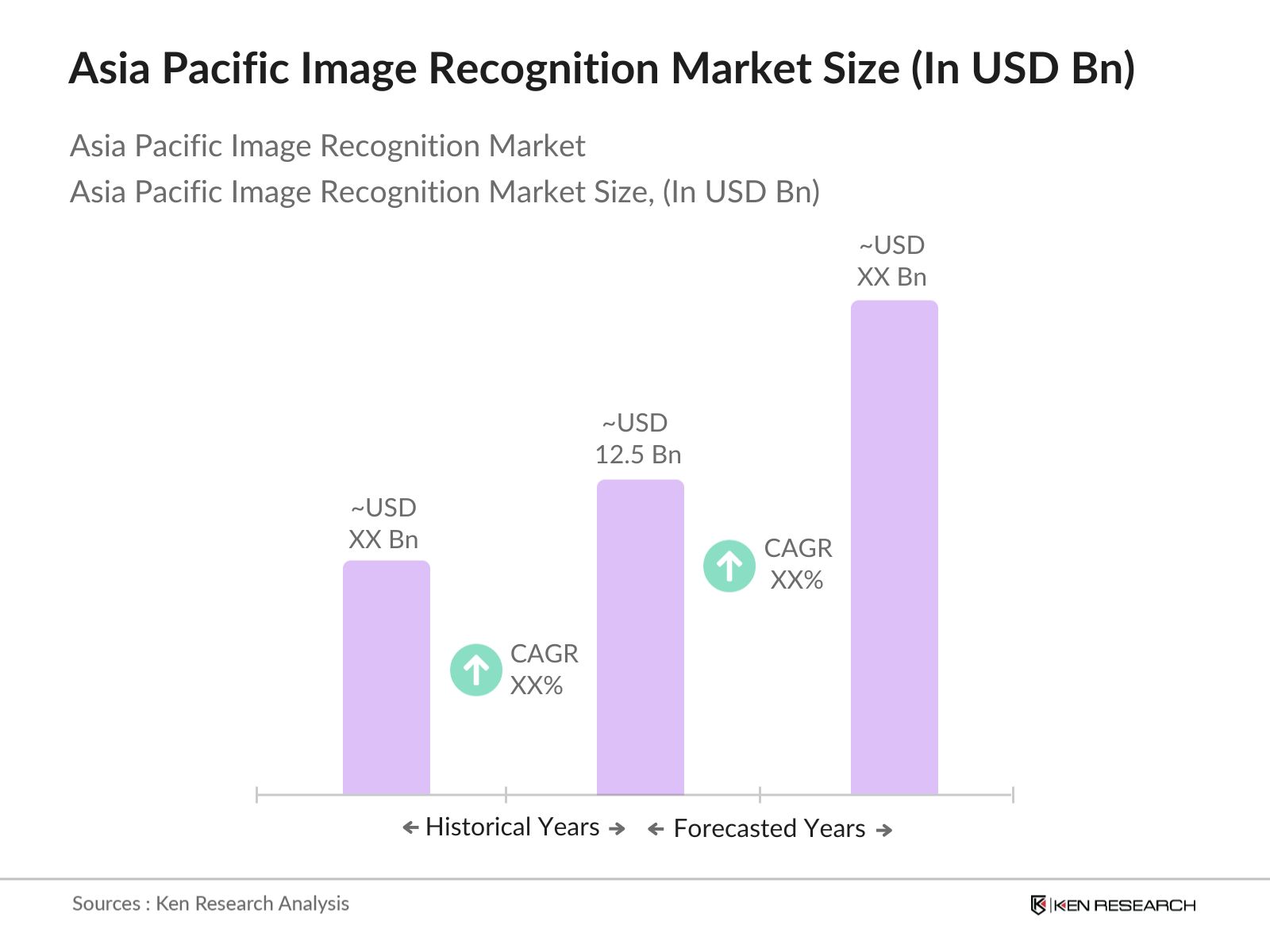
  • The Asia Pacific Image Recognition Market is valued at USD 12.5 billion, based on a five-year historical analysis. This market growth is driven by the rapid adoption of artificial intelligence (AI) and machine learning (ML) technologies across various sectors such as retail, healthcare, and security. The increasing deployment of image recognition solutions in these industries, particularly for automation and optimization purposes, has propelled the market. The rise in e-commerce and digital transformation initiatives across the region has also played a major role in driving demand for image recognition technologies.
  • Countries such as China, Japan, and South Korea dominate the Asia Pacific Image Recognition Market due to their technological advancements and strong AI infrastructure. China leads with government investment in AI innovation, primarily in the surveillance and security sectors, which utilize facial recognition technology. Japan is at the forefront of integrating image recognition in autonomous vehicles and healthcare systems, while South Korea's leadership stems from its high adoption of image recognition in consumer electronics and digital entertainment, reflecting the technological landscape in these countries.
  • Data protection regulations play a critical role in shaping the image recognition market across the Asia Pacific. In 2024, countries like Japan and Australia have implemented stringent AI policies that govern the use of facial recognition technologies. Japans "AI Governance Guidelines" mandate transparency in AI algorithms, ensuring companies provide users with clear information about how their data is used. Australia has similarly introduced "AI Ethics Frameworks," ensuring ethical deployment of AI technologies. These regulations aim to safeguard consumer data while promoting innovation, impacting the deployment of image recognition systems.

Asia Pacific Image Recognition Market Size

Asia Pacific Image Recognition Market Segmentation

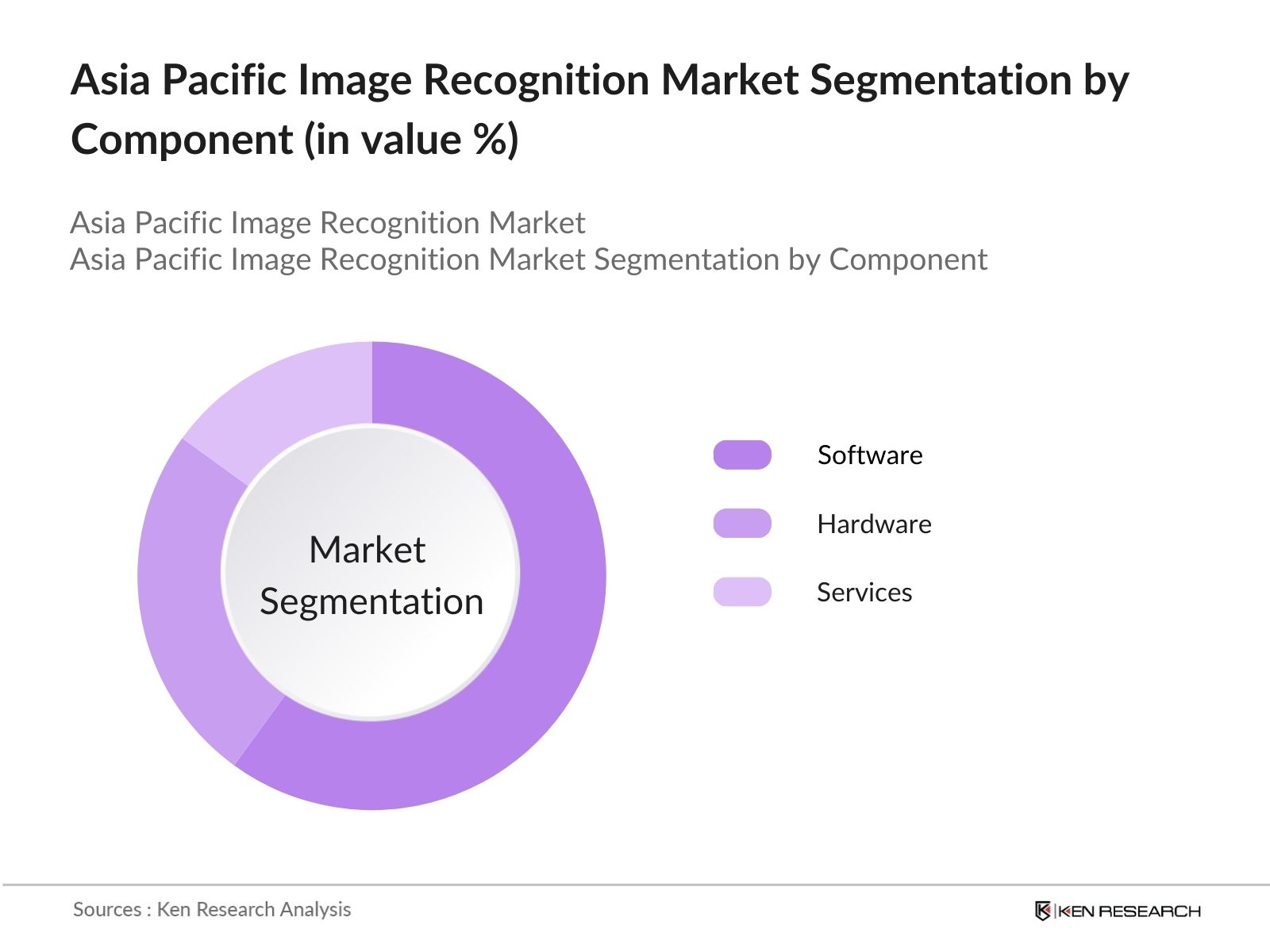
  • By Component: The market is segmented by component into software, hardware, and services. The software segment holds a dominant market share due to the increasing adoption of AI-powered applications, especially in sectors like retail and security. Businesses are increasingly relying on sophisticated image recognition software for applications such as facial recognition, object detection, and visual search. The adaptability of software solutions and their ability to integrate with various platforms make them a preferred choice for enterprises aiming to optimize their operations and enhance customer experience.

Asia Pacific Image Recognition Market Segmentation By Component

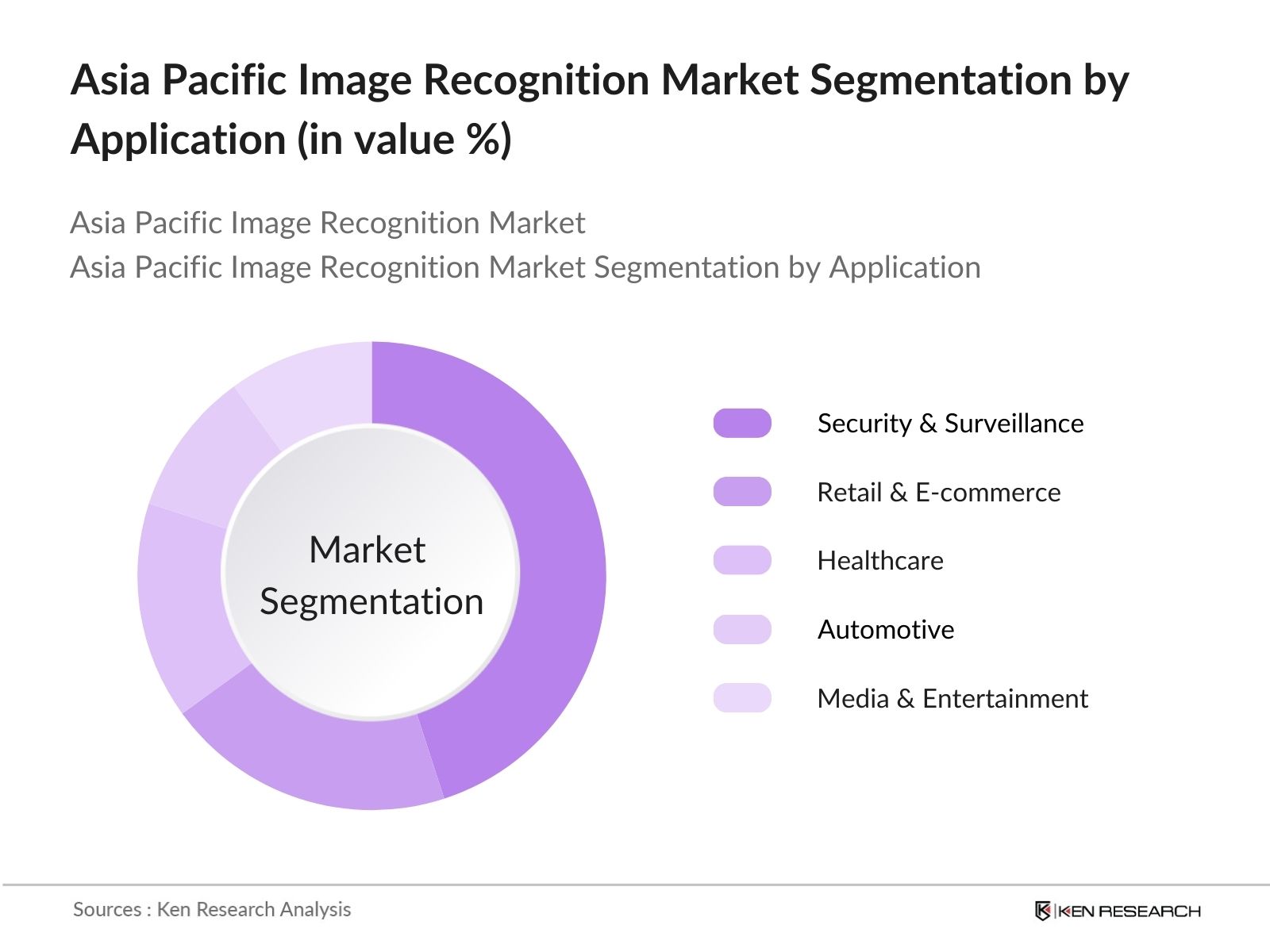
  • By Application: The market is also segmented by application into security & surveillance, retail & e-commerce, healthcare, automotive, and media & entertainment. The security & surveillance segment dominates the market, driven by the growing need for advanced security solutions across urban centers and public infrastructures. Governments and private sectors in countries like China and India are heavily investing in facial recognition technologies for public safety, crime prevention, and access control, which has led to growth in this segment.

Asia Pacific Image Recognition Market Segmentation By Application

Asia Pacific Image Recognition Market Competitive Landscape

The Asia Pacific Image Recognition Market is dominated by several global and regional players, leveraging their technological expertise and strong market presence. These companies are investing heavily in research and development to maintain a competitive edge, especially in sectors such as retail, automotive, and healthcare, where image recognition is becoming increasingly essential.

Company

Established Year

Headquarters

Product Portfolio

R&D Investment

Market Position

Partnerships

AI Capabilities

Global Presence

Strategic Acquisitions

NEC Corporation

1899

Tokyo, Japan

- - - - - - -

Google LLC

1998

Mountain View, USA

- - - - - - -

SenseTime Group Ltd.

2014

Hong Kong, China

- - - - - - -

Megvii Technology Ltd

2011

Beijing, China

- - - - - - -

Apple Inc.

1976

Cupertino, USA

- - - - - - -

Asia Pacific Image Recognition Market Analysis

Asia Pacific Image Recognition Market Growth Drivers:

  • Increasing adoption of AI and deep learning: The Asia Pacific image recognition market is witnessing growth due to the increasing adoption of AI and deep learning technologies. For instance, in 2024, nearly 50% of global AI investments are focused on the Asia Pacific region, particularly China and India, where these technologies are being rapidly integrated across industries like healthcare and retail. Government initiatives, such as Chinas AI Development Plan, which aims to lead in AI by 2030, are driving this adoption. Furthermore, countries like South Korea are advancing AI, allocating over $2 billion for AI development by 2025.
  • Expanding applications across industries: The proliferation of image recognition applications across industries is another growth driver. The healthcare sector in Japan has witnessed a rise in AI adoption, with over 200 hospitals using AI-powered image recognition for diagnostics in 2023. In retail, e-commerce giants like Alibaba have invested over $500 million in AI-powered image recognition technologies to improve online customer experience. Security applications are also on the rise, with India deploying image recognition systems in over 10 major cities for surveillance purposes. These investments are accelerating the demand for image recognition across diverse sectors.
  • Proliferation of smartphones and smart devices: The rapid increase in smartphone usage in the Asia Pacific is another growth driver for the image recognition market. In 2024, the region accounted for over 1.6 billion smartphone users, with India and China leading the market. This proliferation of smartphones has enabled more widespread adoption of image recognition technologies. For example, in India, over 40% of smartphone users use facial recognition for secure authentication on their devices. Additionally, the growing number of smart devicesover 500 million connected devices in 2023is boosting the demand for image recognition applications in sectors like home automation and security.

Asia Pacific Image Recognition Market Challenges:

  • Data privacy and security concerns: Data privacy and security issues remain a key challenge for the Asia Pacific image recognition market. According to a 2023 survey by the World Bank, over 60% of businesses in the region expressed concerns about implementing image recognition technologies due to stringent data privacy laws. For example, South Koreas Personal Information Protection Act (PIPA) limits the collection and use of biometric data, creating compliance challenges for companies. Additionally, Chinas Cybersecurity Law requires companies to store all personal data locally, adding extra layers of complexity to cross-border image recognition applications.
  • High implementation costs: The high cost of implementing advanced image recognition systems is another barrier to adoption, especially for small and medium-sized enterprises (SMEs). In 2024, the average cost of deploying an image recognition system in Asia Pacific is estimated at $500,000 per enterprise, according to government reports from Japan and India. These costs include hardware, software, and integration services. Additionally, the lack of infrastructure in some developing regions of Asia Pacific further increases the financial burden for businesses, slowing down the implementation of image recognition technologies in these areas.

Asia Pacific Image Recognition Market Future Outlook

Over the next five years, the Asia Pacific Image Recognition Market is expected to experience growth, driven by advancements in AI, increasing demand for automated systems, and the expansion of e-commerce. The rise of smart cities and the need for enhanced security measures in public infrastructure will continue to fuel the demand for image recognition technology. Additionally, the automotive sector is anticipated to provide lucrative opportunities for image recognition applications in autonomous driving and driver-assistance systems.

Asia Pacific Image Recognition Market Opportunities

  • Growth of e-commerce and retail automation: The rapid expansion of e-commerce in the Asia Pacific presents a opportunity for image recognition technologies. As of 2024, e-commerce sales in the region surpassed $2 trillion, with China and India leading the growth. Retail giants are increasingly leveraging AI-driven image recognition to enhance customer experiences, enabling faster and more accurate product searches, personalized recommendations, and virtual try-ons. The deployment of automated checkout systems, powered by image recognition, is also growing, with companies like JD.com and Reliance Retail investing millions to streamline their operations.
  • Expansion of video analytics in surveillance: The Asia Pacific region is witnessing a substantial rise in the use of video analytics powered by image recognition technologies in surveillance. In 2023, governments in countries like China, Japan, and India deployed over 500,000 smart surveillance cameras, up 15% from the previous year. These systems use AI-driven image recognition to monitor public spaces, detect criminal activities, and enhance public safety. The integration of advanced video analytics in smart city projects further expands this opportunity, with investments in surveillance expected to reach over $10 billion across Asia Pacific in 2024.

Scope of the Report

Component

Software

Hardware

Services

Application

Security & Surveillance

Retail & E-commerce

Automotive

Healthcare

Media & Entertainment

Technology

Facial Recognition

Object Detection

Pattern Recognition

Optical Character Recognition

Deployment Type

Cloud-Based

On-Premises

Region

China

Japan

South Korea

India

Southeast Asia

Products

Key Target Audience

  • AI Technology Providers

  • Image Recognition Software Developers

  • Hardware Manufacturers

  • Banks and Financial Institutions

  • Security and Surveillance System Integrators

  • Automotive Manufacturers

  • Healthcare Solution Providers

  • Investor and Venture Capitalist Firms

  • Government and Regulatory Bodies (AI & Data Privacy Agencies, Smart City Initiative Councils)

Companies

Players Mentioned in the Report

  • NEC Corporation

  • Google LLC

  • Apple Inc.

  • SenseTime Group Ltd.

  • Megvii Technology Ltd.

  • Qualcomm Technologies

  • Microsoft Corporation

  • IBM Corporation

  • Honeywell International Inc.

  • Intel Corporation

Table of Contents

1. Asia Pacific Image Recognition Market Overview

1.1 Definition and Scope
1.2 Market Taxonomy
1.3 Market Growth Rate
1.4 Market Segmentation Overview

2. Asia Pacific Image Recognition Market Size (In USD Bn)

2.1 Historical Market Size
2.2 Year-On-Year Growth Analysis
2.3 Key Market Developments and Milestones

3. Asia Pacific Image Recognition Market Analysis

3.1 Growth Drivers
3.1.1 Increasing adoption of AI and deep learning
3.1.2 Expanding applications across industries (Healthcare, Retail, Security)
3.1.3 Proliferation of smartphones and smart devices
3.1.4 Advancements in facial and object recognition technologies

3.2 Market Challenges
3.2.1 Data privacy and security concerns
3.2.2 High implementation costs
3.2.3 Regulatory hurdles

3.3 Opportunities
3.3.1 Growth of e-commerce and retail automation
3.3.2 Expansion of video analytics in surveillance
3.3.3 Increased use in automotive and autonomous driving systems

3.4 Trends
3.4.1 Growing demand for contactless biometric solutions
3.4.2 Integration of AR/VR technologies
3.4.3 Adoption of cloud-based image recognition platforms

3.5 Government Regulation
3.5.1 Data protection and AI policies
3.5.2 Privacy laws affecting image recognition deployment
3.5.3 Intellectual property regulations related to AI algorithms

3.6 SWOT Analysis
3.6.1 Strengths
3.6.2 Weaknesses
3.6.3 Opportunities
3.6.4 Threats

3.7 Stakeholder Ecosystem
3.8 Porters Five Forces Analysis
3.9 Competition Ecosystem

4. Asia Pacific Image Recognition Market Segmentation

4.1 By Component (In Value %)
4.1.1 Software
4.1.2 Hardware
4.1.3 Services

4.2 By Application (In Value %)
4.2.1 Security and Surveillance
4.2.2 Retail and E-commerce
4.2.3 Automotive
4.2.4 Healthcare
4.2.5 Media & Entertainment

4.3 By Technology (In Value %)
4.3.1 Facial Recognition
4.3.2 Object Detection
4.3.3 Pattern Recognition
4.3.4 Optical Character Recognition

4.4 By Deployment Type (In Value %)
4.4.1 Cloud-Based
4.4.2 On-Premises

4.5 By Region (In Value %)
4.5.1 China
4.5.2 Japan
4.5.3 South Korea
4.5.4 India
4.5.5 Southeast Asia

5. Asia Pacific Image Recognition Market Competitive Analysis

5.1 Detailed Profiles of Major Companies
5.1.1 NEC Corporation
5.1.2 Google LLC
5.1.3 Apple Inc.
5.1.4 Amazon Web Services
5.1.5 IBM Corporation
5.1.6 Qualcomm Technologies
5.1.7 Intel Corporation
5.1.8 Clarifai Inc.
5.1.9 Microsoft Corporation
5.1.10 Honeywell International Inc.
5.1.11 Xilinx Inc.
5.1.12 Slyce Inc.
5.1.13 Blippar Ltd.
5.1.14 SenseTime Group Limited
5.1.15 Megvii Technology Limited

5.2 Cross Comparison Parameters (Technology Specialization, Market Share, R&D Investments, Regional Presence, AI Capabilities, Patent Portfolio, Strategic Partnerships, Number of Employees)
5.3 Market Share Analysis
5.4 Strategic Initiatives
5.5 Mergers and Acquisitions
5.6 Investment Analysis
5.7 Venture Capital Funding

6. Asia Pacific Image Recognition Market Regulatory Framework

6.1 Data Privacy Regulations
6.2 AI Ethics and Compliance
6.3 Standardization in Image Recognition

7. Asia Pacific Image Recognition Future Market Size (In USD Bn)

7.1 Future Market Size Projections
7.2 Key Factors Driving Future Market Growth

8. Asia Pacific Image Recognition Market Segmentation

8.1 By Component (In Value %)

8.2 By Application (In Value %)

8.3 By Technology (In Value %)

8.4 By Deployment Type (In Value %)

8.5 By Region (In Value %)

9. Asia Pacific Image Recognition Market Analysts Recommendations

9.1 TAM/SAM/SOM Analysis
9.2 Customer Cohort Analysis
9.3 Marketing Initiatives
9.4 White Space Opportunity Analysis

Disclaimer Contact Us

Research Methodology

Step 1: Identification of Key Variables

The initial phase involved mapping the stakeholder ecosystem within the Asia Pacific Image Recognition Market. Extensive desk research utilizing secondary and proprietary databases was conducted to gather information on key market variables, such as product innovation, technological advancements, and regulatory frameworks.

Step 2: Market Analysis and Construction

his phase involved compiling historical data on market penetration, revenue generation, and technological integration in various industries. A thorough assessment of image recognition technologies in key sectors like retail and security helped in constructing accurate market forecasts.

Step 3: Hypothesis Validation and Expert Consultation

Market hypotheses were validated through interviews with industry experts using computer-assisted telephone interviews (CATI). These consultations provided financial and operational insights, further refining the data gathered in the previous steps.

Step 4: Research Synthesis and Final Output

The final step involved direct engagement with image recognition technology providers, providing detailed insights into market dynamics, consumer preferences, and product performance. This ensured a comprehensive and validated report on the Asia Pacific Image Recognition Market.

Frequently Asked Questions

01. How big is the Asia Pacific Image Recognition Market?

The Asia Pacific Image Recognition Market is valued at USD 12.5 billion, based on a five-year historical analysis. Growth is driven by the increased adoption of AI technologies in sectors such as security, retail, and healthcare.

02. What are the challenges in the Asia Pacific Image Recognition Market?

Challenges include data privacy concerns, high implementation costs, and regulatory hurdles surrounding the use of facial recognition technologies. Moreover, there is growing scrutiny around AI-driven systems in public surveillance.

03. Who are the major players in the Asia Pacific Image Recognition Market?

Major players include NEC Corporation, Google LLC, Apple Inc., SenseTime Group Limited, and Megvii Technology Limited. These companies are leading the market due to their technological expertise, R&D investments, and partnerships with governments and enterprises.

04. What are the growth drivers of the Asia Pacific Image Recognition Market?

Key growth drivers include advancements in AI and deep learning, increasing use of image recognition in retail and security applications, and the expansion of autonomous vehicles. The rise of smart cities and the demand for automated systems also contribute to market growth.

Why Buy From Us?

RRR
Refine Robust Result (RRR) Framework

What makes us stand out is that our consultants follows Robust, Refine and Result (RRR) methodology. i.e. Robust for clear definitions, approaches and sanity checking, Refine for differentiating respondents facts and opinions and Result for presenting data with story

Our Reach Is Unmatched

We have set a benchmark in the industry by offering our clients with syndicated and customized market research reports featuring coverage of entire market as well as meticulous research and analyst insights.

Research
Shifting the Research Paradigm

While we don't replace traditional research, we flip the method upside down. Our dual approach of Top Bottom & Bottom Top ensures quality deliverable by not just verifying company fundamentals but also looking at the sector and macroeconomic factors.

Insite
More Insights-Better Decisions

With one step in the future, our research team constantly tries to show you the bigger picture. We help with some of the tough questions you may encounter along the way: How is the industry positioned? Best marketing channel? KPI's of competitors? By aligning every element, we help maximize success.

Trust
Transparency and Trust

Our report gives you instant access to the answers and sources that other companies might choose to hide. We elaborate each steps of research methodology we have used and showcase you the sample size to earn your trust.

support
Round the Clock Support

If you need any support, we are here! We pride ourselves on universe strength, data quality, and quick, friendly, and professional service.

Why Client Choose Us?

400000+ Reports in repository
150+ Consulting project a year
100+ Analysts
8000+ Client Queries in 2022