
Asia Pacific Juices Market Outlook to 2030
Region:Asia
Author(s):Meenakshi Bisht
Product Code:KROD6043
Region:Asia
Author(s):Meenakshi Bisht
Product Code:KROD6043
December 2024
81
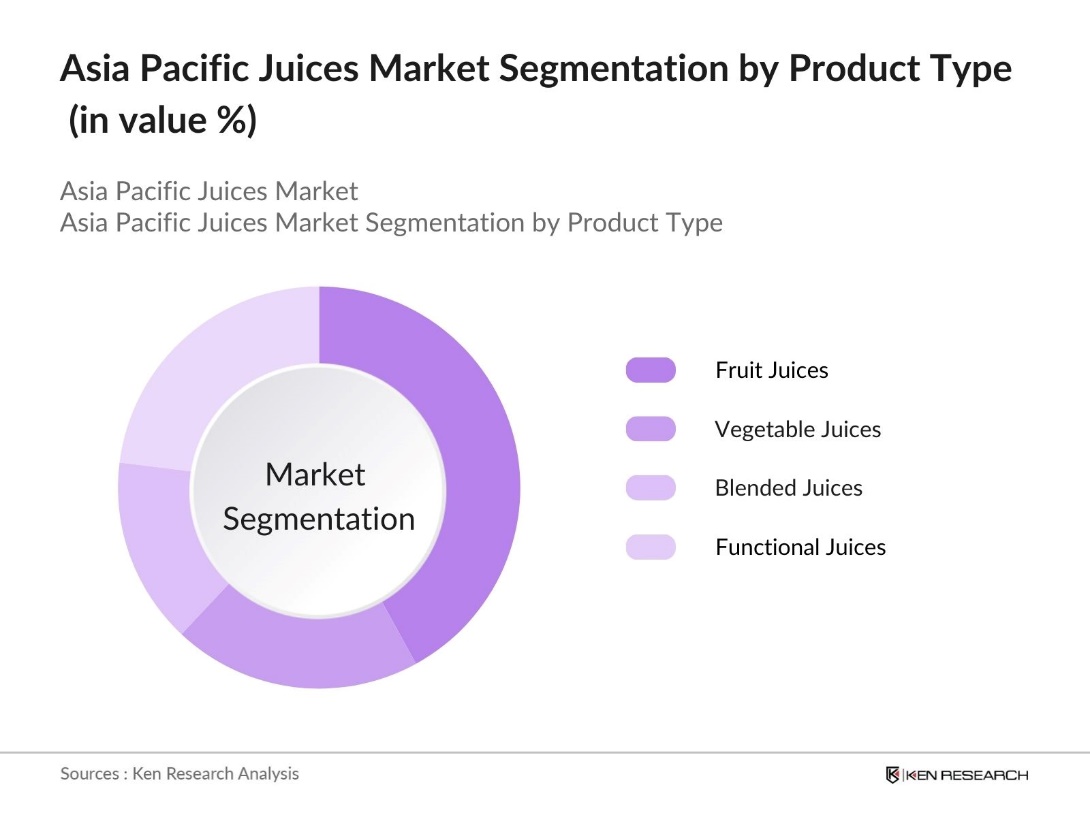
By Product Type: The market is segmented by product type into fruit juices, vegetable juices, blended juices, and functional juices. Fruit juices dominate this segment, owing to their established popularity and nutritional appeal. Key brands in fruit juices, such as Tropicana and Minute Maid, have successfully built strong consumer loyalty over the years, contributing to the segment's dominance.
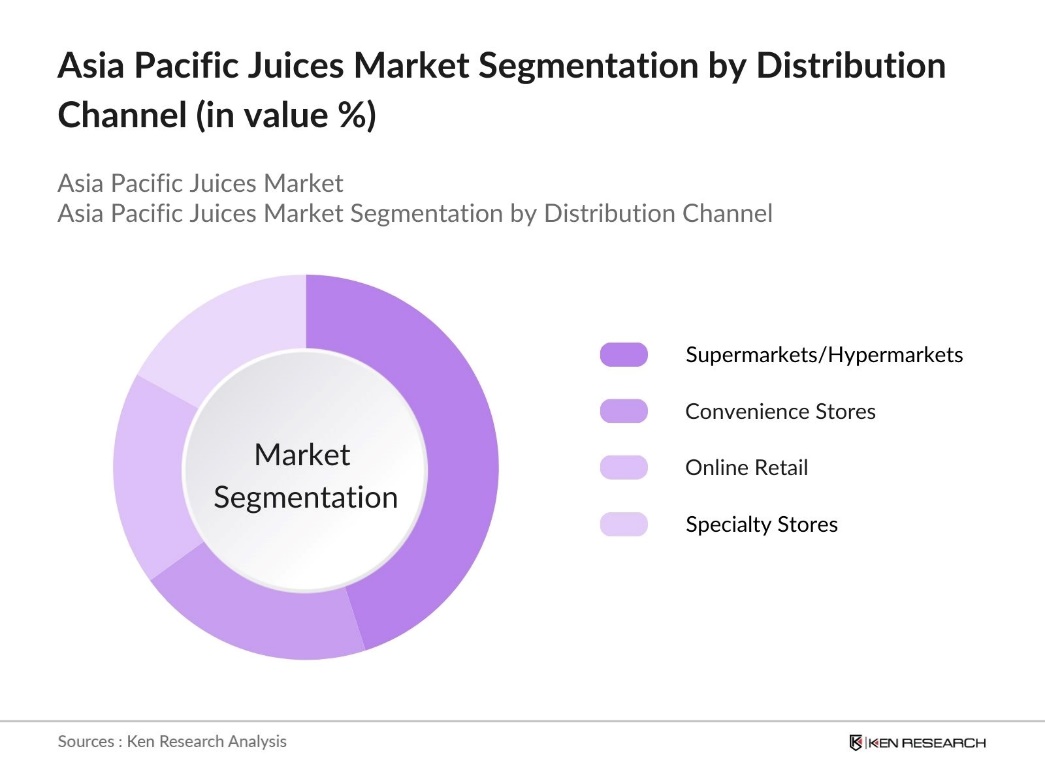
By Distribution Channel: The market is segmented by distribution channels into supermarkets/hypermarkets, convenience stores, online retail, and specialty stores. Supermarkets/hypermarkets hold the largest market share within this segment due to the widespread availability of juices in these stores, particularly in urban areas. The convenience of bulk shopping and the availability of varied product ranges in supermarkets further contribute to this segments strong performance.
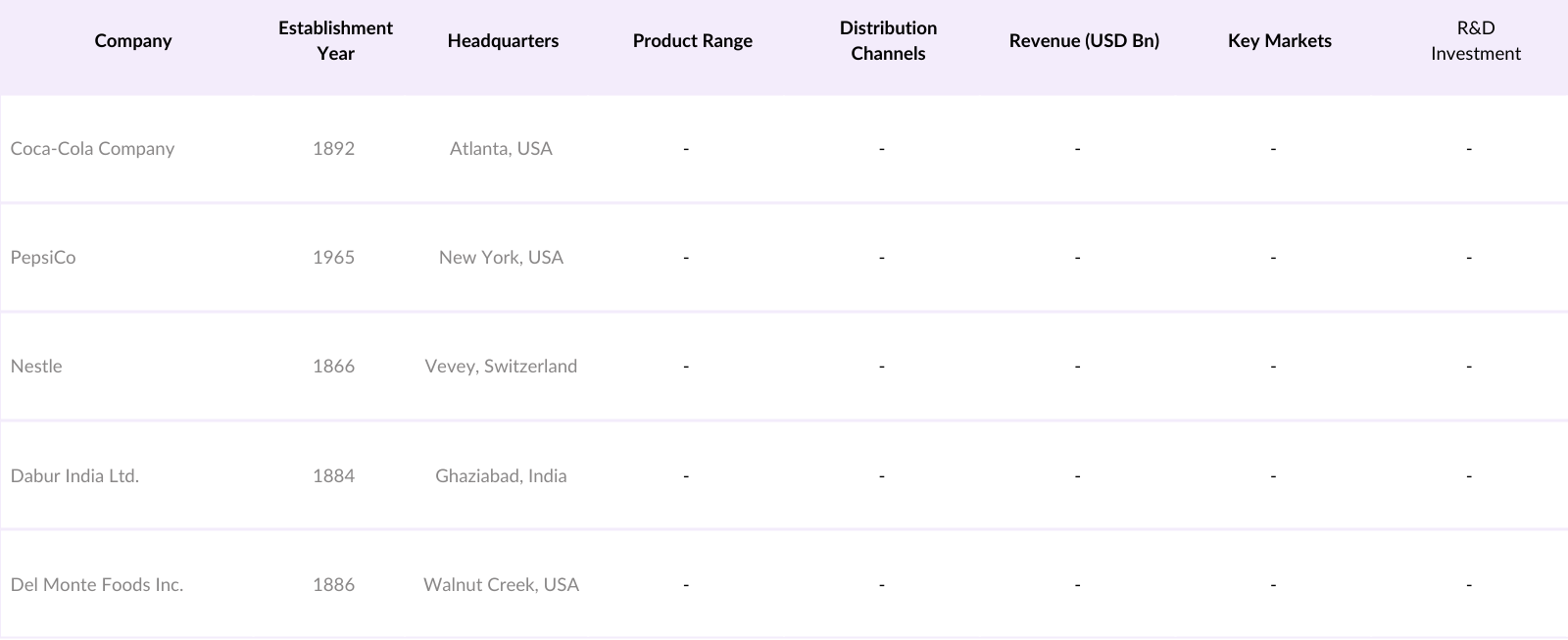
The Asia Pacific juices market is characterized by the presence of both local and global brands. Major players include Coca-Cola, PepsiCo, and Nestle, who dominate due to their extensive distribution networks and established brand reputation. These companies have a competitive advantage owing to economies of scale and product diversity, allowing them to cater to various consumer segments.
Over the next five years, the Asia Pacific juices market is expected to grow significantly, fueled by an increased focus on health and wellness, particularly in urban areas. Innovations such as organic, low-sugar, and functional juices will play a central role in appealing to health-conscious consumers. Additionally, online retail is likely to gain momentum as e-commerce platforms expand their offerings and reach, providing consumers with more convenient access to premium juice products.
|
By Product Type |
Fruit Juices Vegetable Juices Blended Juices |
|
By Processing Method |
Cold-Pressed Pasteurized Fresh-Squeezed |
|
By Flavor |
Citrus-Based Juices Berry-Based Juices Tropical Juices |
|
By Distribution Channel |
Retail Stores Supermarkets/Hypermarkets Online Retail |
|
By Region |
East Asia Southeast Asia South Asia Oceania |
1.1 Definition and Scope
1.2 Market Taxonomy
1.3 Market Growth Rate
1.4 Market Segmentation Overview
2.1 Historical Market Size
2.2 Year-On-Year Growth Analysis
2.3 Key Market Developments and Milestones
3.1 Growth Drivers
3.1.1 Increasing Health Awareness
3.1.2 Rise in Demand for Natural & Organic Beverages
3.1.3 Expanding Middle-Class Population
3.1.4 Strategic Product Innovations (Organic Juice, Cold-Pressed Juice)
3.2 Market Challenges
3.2.1 High Production and Sourcing Costs
3.2.2 Regulatory Standards on Ingredients (Additives, Sugar Content)
3.2.3 Competition from Alternative Beverages (Smoothies, Energy Drinks)
3.3 Opportunities
3.3.1 Growth in E-commerce Sales Channels
3.3.2 Investment in Emerging Markets (Southeast Asia)
3.3.3 Expansion of Premium Juice Segment
3.4 Trends
3.4.1 Popularity of Functional Juices (Added Vitamins, Probiotics)
3.4.2 Rise in Single-Serve Packaging
3.4.3 Growing Interest in Plant-Based and Vegan Juices
3.5 Government Regulation
3.5.1 Labeling and Additive Standards
3.5.2 Sugar Tax Implementation
3.5.3 Import-Export Regulations
3.6 SWOT Analysis
3.7 Value Chain Analysis (Raw Materials, Production, Distribution)
3.8 Porters Five Forces
3.9 Competition Ecosystem
4.1 By Product Type (In Value %)
4.1.1 Fruit Juices (Single-Flavor, Blends)
4.1.2 Vegetable Juices
4.1.3 Functional Juices (With Added Health Ingredients)
4.1.4 Cold-Pressed Juices
4.2 By Packaging Type (In Value %)
4.2.1 Bottles (Glass, PET)
4.2.2 Cartons
4.2.3 Cans
4.2.4 Pouches
4.3 By Distribution Channel (In Value %)
4.3.1 Supermarkets/Hypermarkets
4.3.2 Convenience Stores
4.3.3 Online Stores
4.3.4 Specialty Stores
4.4 By Flavor Type (In Value %)
4.4.1 Single-Fruit Flavors
4.4.2 Mixed Fruit and Vegetable Blends
4.4.3 Exotic and Unique Flavors
4.5 By Region (In Value %)
4.5.1 China
4.5.2 India
4.5.3 Japan
4.5.4 Australia
4.5.5 Rest of Asia Pacific
5.1 Detailed Profiles of Major Companies
5.1.1 Coca-Cola Co.
5.1.2 PepsiCo Inc.
5.1.3 Nestl S.A.
5.1.4 Dabur India Ltd.
5.1.5 Tropicana Products Inc.
5.1.6 Parle Agro Pvt. Ltd.
5.1.7 Del Monte Pacific Ltd.
5.1.8 Kagome Co. Ltd.
5.1.9 ITC Limited
5.1.10 Hain Celestial Group Inc.
5.1.11 Suntory Holdings Ltd.
5.1.12 Fresh Del Monte Produce Inc.
5.1.13 Lotte Chilsung Beverage Co.
5.1.14 Nongfu Spring Co. Ltd.
5.1.15 Marico Ltd.
5.2 Cross-Comparison Parameters (Revenue, Market Share, Geographical Presence, Product Range, R&D Expenditure, Sustainability Initiatives, Brand Recognition, Distribution Reach)
5.3 Market Share Analysis
5.4 Strategic Initiatives (Partnerships, Collaborations)
5.5 Mergers and Acquisitions
5.6 Investment Analysis
5.7 Venture Capital Funding
5.8 Government Subsidies and Grants
5.9 Private Equity Investments
6.1 Quality Standards and Certifications
6.2 Food Safety and Health Regulations
6.3 Packaging and Labeling Requirements
6.4 Import/Export Regulations
7.1 Future Market Size Projections
7.2 Key Factors Influencing Future Growth
8.1 By Product Type (In Value %)
8.2 By Packaging Type (In Value %)
8.3 By Distribution Channel (In Value %)
8.4 By Flavor Type (In Value %)
8.5 By Region (In Value %)
9.1 TAM/SAM/SOM Analysis
9.2 Consumer Behavior and Preference Analysis
9.3 Marketing and Branding Strategies
9.4 White Space Opportunity Analysis
Disclaimer Contact UsThe initial phase includes building a comprehensive ecosystem of stakeholders in the Asia Pacific juices market. Extensive desk research is conducted through secondary sources and proprietary databases, focusing on defining critical variables like consumer demand trends and product types.
This phase involves aggregating historical data to analyze the growth trends within the Asia Pacific juices market. Various parameters, such as consumer preferences, distribution channels, and product innovation, are assessed to gauge market behavior and estimate revenue growth accurately.
Key market hypotheses are formed and validated through in-depth interviews with industry experts and major market players. This step allows for acquiring detailed financial and operational insights, which help in refining the market analysis.
Engagement with manufacturers and distributors is performed to validate statistics and gain insights into the consumer response toward different juice products. This step ensures the final analysis is accurate, with a well-rounded perspective on market trends.
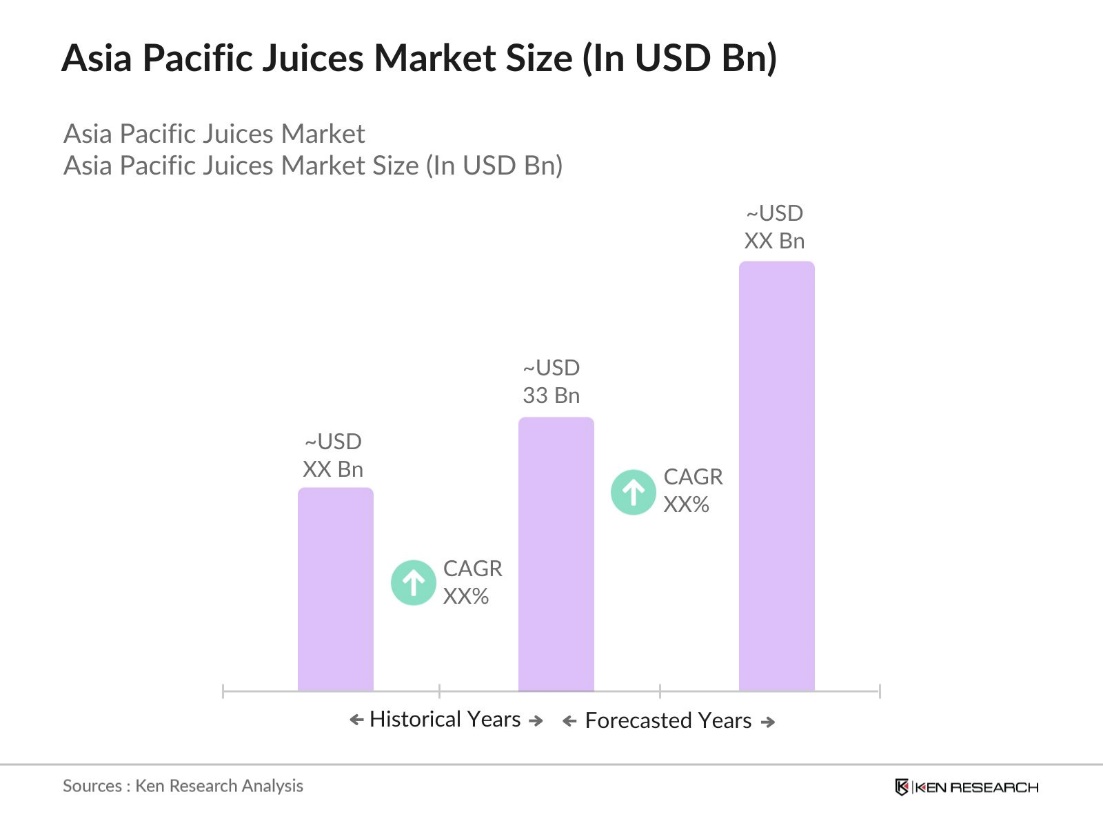
The Asia Pacific juices market is valued at USD 33 billion, with growth driven by increasing consumer demand for health-conscious beverage options.
Key challenges in Asia Pacific juices market include high production costs due to premium ingredient sourcing and regulatory hurdles associated with labeling and additive use.
Prominent players in the Asia Pacific juices market include Coca-Cola Company, PepsiCo, Nestle, Dabur India, and Del Monte, owing to their strong distribution networks and diverse product portfolios.
The Asia Pacific juices market is propelled by rising health consciousness, increased availability of premium juice options, and a growing middle-class population that demands natural and organic beverages.

What makes us stand out is that our consultants follows Robust, Refine and Result (RRR) methodology. i.e. Robust for clear definitions, approaches and sanity checking, Refine for differentiating respondents facts and opinions and Result for presenting data with story

We have set a benchmark in the industry by offering our clients with syndicated and customized market research reports featuring coverage of entire market as well as meticulous research and analyst insights.

While we don't replace traditional research, we flip the method upside down. Our dual approach of Top Bottom & Bottom Top ensures quality deliverable by not just verifying company fundamentals but also looking at the sector and macroeconomic factors.

With one step in the future, our research team constantly tries to show you the bigger picture. We help with some of the tough questions you may encounter along the way: How is the industry positioned? Best marketing channel? KPI's of competitors? By aligning every element, we help maximize success.

Our report gives you instant access to the answers and sources that other companies might choose to hide. We elaborate each steps of research methodology we have used and showcase you the sample size to earn your trust.

If you need any support, we are here! We pride ourselves on universe strength, data quality, and quick, friendly, and professional service.