
Asia Pacific Logistics Market Outlook to 2030
Region:Bangladesh
Author(s):Meenakshi
Product Code:KROD3876
Region:Bangladesh
Author(s):Meenakshi
Product Code:KROD3876
October 2024
81
By Mode of Transportation: The Asia Pacific logistics market is segmented by mode of transportation into road transportation, rail transportation, air freight, and sea freight. Recently, road transportation has dominated the market share under this segmentation due to its flexibility and efficiency in delivering goods across vast distances within the region. The increasing number of road infrastructure projects in countries like India, Japan, and Australia has further reinforced this segment's dominance.

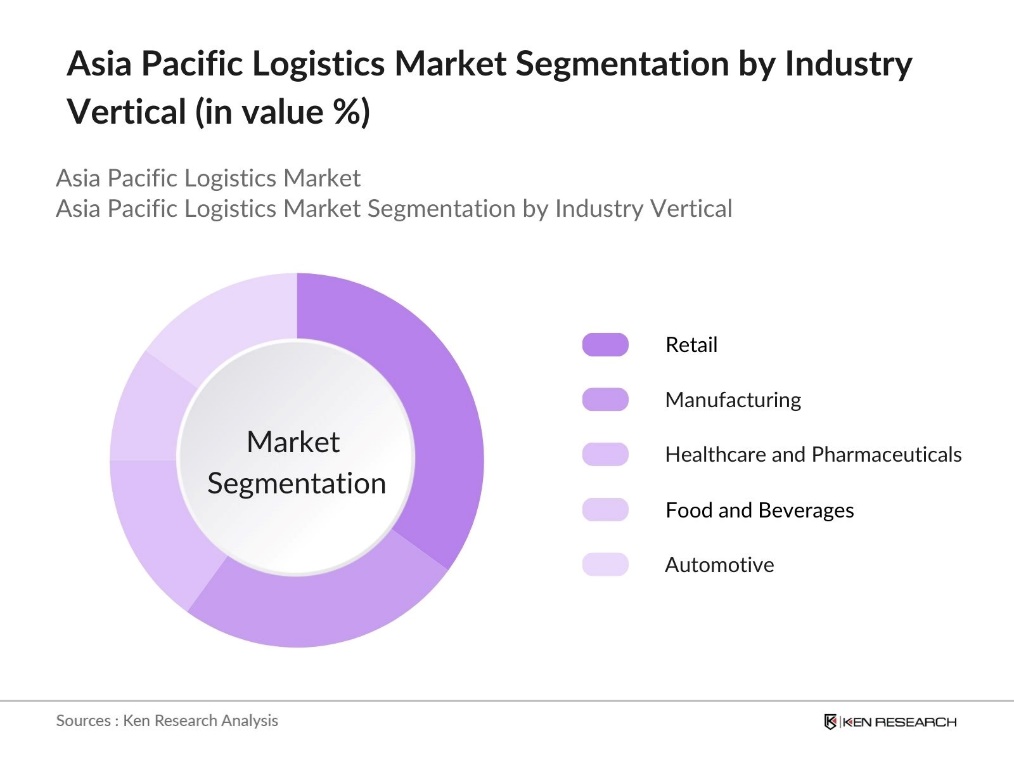
By Industry Vertical: The logistics market is segmented by industry vertical into retail, manufacturing, healthcare and pharmaceuticals, food and beverages, and automotive. Retail has a dominant market share due to the rapid rise of e-commerce in the region. Companies such as Alibaba and Amazon have transformed the logistics landscape by creating complex supply chains and last-mile delivery networks to meet the increasing demand from online shoppers.
The Asia Pacific logistics market is dominated by both global and regional players. The market is highly fragmented with several multinational corporations competing alongside local logistics providers. The regions logistics network is highly dynamic, and the market is shaped by factors such as technological integration, network expansion, and competitive pricing. Companies like DHL Supply Chain and Kuehne + Nagel have significant market shares, owing to their strong global presence and comprehensive service offerings. Meanwhile, local companies such as Sinotrans leverage their deep understanding of regional markets to maintain a competitive edge.
|
Company Name |
Establishment Year |
Headquarters |
Fleet Size |
Number of Employees |
Revenue (USD Bn) |
Market Penetration |
Technology Adoption |
Strategic Partnerships |
Service Diversification |
|
DHL Supply Chain |
1969 |
Germany |
|||||||
|
Kuehne + Nagel |
1890 |
Switzerland |
|||||||
|
DB Schenker |
1872 |
Germany |
|||||||
|
Nippon Express |
1937 |
Japan |
|||||||
|
Sinotrans |
1950 |
China |
Over the next five years, the Asia Pacific logistics market is expected to see strong growth driven by ongoing infrastructural development, technological advancements, and increased trade activity. The rise of e-commerce across the region will remain a key driver, as consumers increasingly demand faster and more reliable delivery services. Furthermore, emerging trends such as automation in warehouses, the use of autonomous vehicles for logistics, and the development of cold chain logistics for the healthcare and food sectors will also propel market growth.
|
By Mode of Transportation |
Road Rail Air Freight Sea Freight |
|
By Industry Vertical |
Retail Manufacturing Healthcare Food & Beverages |
|
By Logistics Type |
First Mile Middle Mile Last Mile |
|
By Solution Type |
Warehouse Management Systems Transportation Management |
|
By Region |
China Japan India Australia Indonesia |
1.1. Definition and Scope
1.2. Market Taxonomy
1.3. Market Growth Rate
1.4. Market Segmentation Overview
2.1. Historical Market Size
2.2. Year-On-Year Growth Analysis
2.3. Key Market Developments and Milestones
3.1. Growth Drivers
3.1.1. E-commerce Expansion (Market Penetration, Digitalization)
3.1.2. Infrastructure Investments (Port Development, Rail Network Expansion)
3.1.3. Trade Agreements (Free Trade Zones, Cross-border Trade Facilitation)
3.1.4. Urbanization (Rural-Urban Supply Chain Expansion, Last Mile Delivery Efficiency)
3.2. Market Challenges
3.2.1. High Logistics Costs (Fuel Prices, Customs Duties)
3.2.2. Regulatory Complexity (Compliance, Regional Trade Barriers)
3.2.3. Skilled Workforce Shortage (Driver and Staff Retention)
3.3. Opportunities
3.3.1. Technological Advancements (AI, Blockchain, IoT in Logistics)
3.3.2. Sustainability Initiatives (Green Logistics, Electric Vehicles)
3.3.3. Increasing Regional Trade (Asia Pacific Free Trade Area)
3.4. Trends
3.4.1. Integration of Automation (Warehouse Robotics, Autonomous Trucks)
3.4.2. Shift to 3PL and 4PL Models (Outsourcing, Contract Logistics)
3.4.3. Development of Cold Chain Logistics (Perishable Goods, Vaccine Distribution)
3.5. Government Regulations
3.5.1. Customs Modernization Initiatives (Single Window System, Customs Digitization)
3.5.2. Transportation Safety Standards (Vehicle Emission Regulations, Driver Safety Laws)
3.5.3. Port and Infrastructure Regulations (Public-Private Partnerships)
3.6. SWOT Analysis
3.7. Stakeholder Ecosystem
3.8. Porters Five Forces Analysis
3.9. Competition Ecosystem
4.1. By Mode of Transportation (In Value %)
4.1.1. Road Transportation
4.1.2. Rail Transportation
4.1.3. Air Freight
4.1.4. Sea Freight
4.2. By Industry Vertical (In Value %)
4.2.1. Retail
4.2.2. Manufacturing
4.2.3. Healthcare and Pharmaceuticals
4.2.4. Food and Beverages
4.2.5. Automotive
4.3. By Logistics Type (In Value %)
4.3.1. First Mile
4.3.2. Middle Mile
4.3.3. Last Mile
4.4. By Solution Type (In Value %)
4.4.1. Warehouse Management Systems (WMS)
4.4.2. Transportation Management Systems (TMS)
4.4.3. Freight Forwarding Services
4.5. By Country (In Value %)
4.5.1. China
4.5.2. Japan
4.5.3. India
4.5.4. Australia
4.5.5. Indonesia
5.1. Detailed Profiles of Major Companies
5.1.1. DHL Supply Chain
5.1.2. Kuehne + Nagel
5.1.3. DB Schenker
5.1.4. Nippon Express
5.1.5. C.H. Robinson
5.1.6. Sinotrans
5.1.7. Yusen Logistics
5.1.8. XPO Logistics
5.1.9. CEVA Logistics
5.1.10. CJ Logistics
5.1.11. DSV Panalpina
5.1.12. Kerry Logistics
5.1.13. Agility Logistics
5.1.14. FedEx Corporation
5.1.15. UPS Supply Chain Solutions
5.2. Cross Comparison Parameters (Revenue, Fleet Size, Service Diversification, Global Presence, Number of Employees, Technology Adoption, Partnerships and Collaborations, Market Penetration)
5.3. Market Share Analysis
5.4. Strategic Initiatives
5.5. Mergers And Acquisitions
5.6. Investment Analysis
5.7. Venture Capital Funding
5.8. Government Grants
5.9. Private Equity Investments
6.1. Logistics Licensing and Compliance Requirements
6.2. Environmental Standards and Regulations
6.3. Trade Tariffs and Customs Regulations
7.1. Future Market Size Projections
7.2. Key Factors Driving Future Market Growth
8.1. By Mode of Transportation (In Value %)
8.2. By Industry Vertical (In Value %)
8.3. By Logistics Type (In Value %)
8.4. By Solution Type (In Value %)
8.5. By Country (In Value %)
9.1. TAM/SAM/SOM Analysis
9.2. White Space Opportunity Analysis
9.3. Market Expansion Strategy
The initial step involves identifying major stakeholders in the Asia Pacific logistics market. Extensive desk research, drawing from both secondary and proprietary databases, helps to establish the key variables influencing the market. This includes infrastructure, technology, trade regulations, and consumer behavior.
In this phase, we analyze historical market data to determine logistics penetration and evaluate revenue generation. Data is collected on market structure, including the number of players, logistics providers, and service offerings. Service quality data is examined to support reliable revenue projections.
Market hypotheses are created based on historical data and tested through interviews with industry professionals. These consultations, conducted via telephone, provide valuable insights into market operations, supply chain dynamics, and future growth trajectories.
The final step involves direct engagement with logistics providers to obtain deeper insights into market trends, emerging technologies, and consumer preferences. This data is then synthesized into a comprehensive report, using a bottom-up approach to ensure accuracy and relevancy in the final market projections.
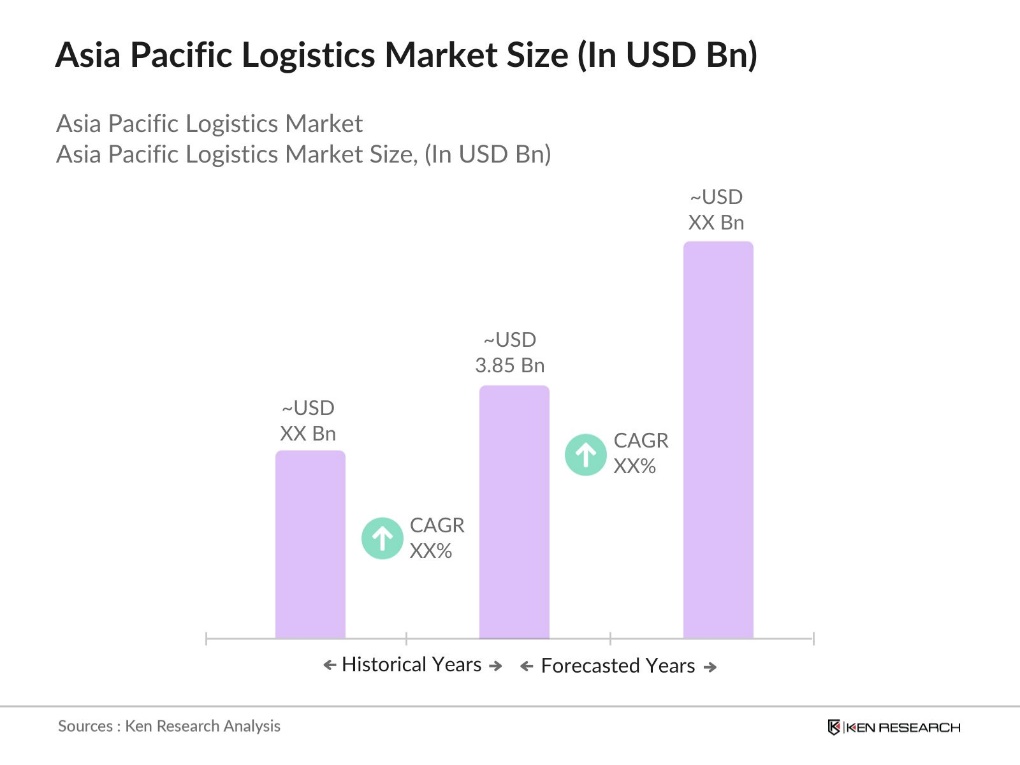
The Asia Pacific logistics market is valued at USD 3.85 million, driven by the growing e-commerce sector, infrastructure investments, and increasing international trade.
Challenges in the Asia Pacific logistics market include high operational costs, complex regulatory environments across countries, and a lack of skilled labor in logistics and supply chain management.
Key players in the Asia Pacific logistics market include DHL Supply Chain, Kuehne + Nagel, DB Schenker, Nippon Express, and Sinotrans. These companies dominate the market due to their extensive logistics networks and investments in technological advancements.
The growth of the Asia Pacific logistics market is driven by rapid e-commerce expansion, infrastructure development, and government initiatives aimed at improving transportation and trade routes across the region.

What makes us stand out is that our consultants follows Robust, Refine and Result (RRR) methodology. i.e. Robust for clear definitions, approaches and sanity checking, Refine for differentiating respondents facts and opinions and Result for presenting data with story

We have set a benchmark in the industry by offering our clients with syndicated and customized market research reports featuring coverage of entire market as well as meticulous research and analyst insights.

While we don't replace traditional research, we flip the method upside down. Our dual approach of Top Bottom & Bottom Top ensures quality deliverable by not just verifying company fundamentals but also looking at the sector and macroeconomic factors.

With one step in the future, our research team constantly tries to show you the bigger picture. We help with some of the tough questions you may encounter along the way: How is the industry positioned? Best marketing channel? KPI's of competitors? By aligning every element, we help maximize success.

Our report gives you instant access to the answers and sources that other companies might choose to hide. We elaborate each steps of research methodology we have used and showcase you the sample size to earn your trust.

If you need any support, we are here! We pride ourselves on universe strength, data quality, and quick, friendly, and professional service.