















Asia Pacific Marine Engine Market Outlook to 2030
Region:Asia
Author(s):Meenakshi
Product Code:KROD11086
November 2024
86
About the Report
Asia Pacific Marine Engine Market Overview
- The Asia Pacific Marine Engine Market, valued at USD 5.21 billion, is primarily driven by robust maritime trade, especially from major export-driven economies like China, Japan, and South Korea. This market benefits from extensive investment in shipbuilding infrastructure and the modernization of marine vessels. An emphasis on fuel efficiency and the integration of hybrid technology further supports market growth, catering to a global shift towards sustainable maritime practices.
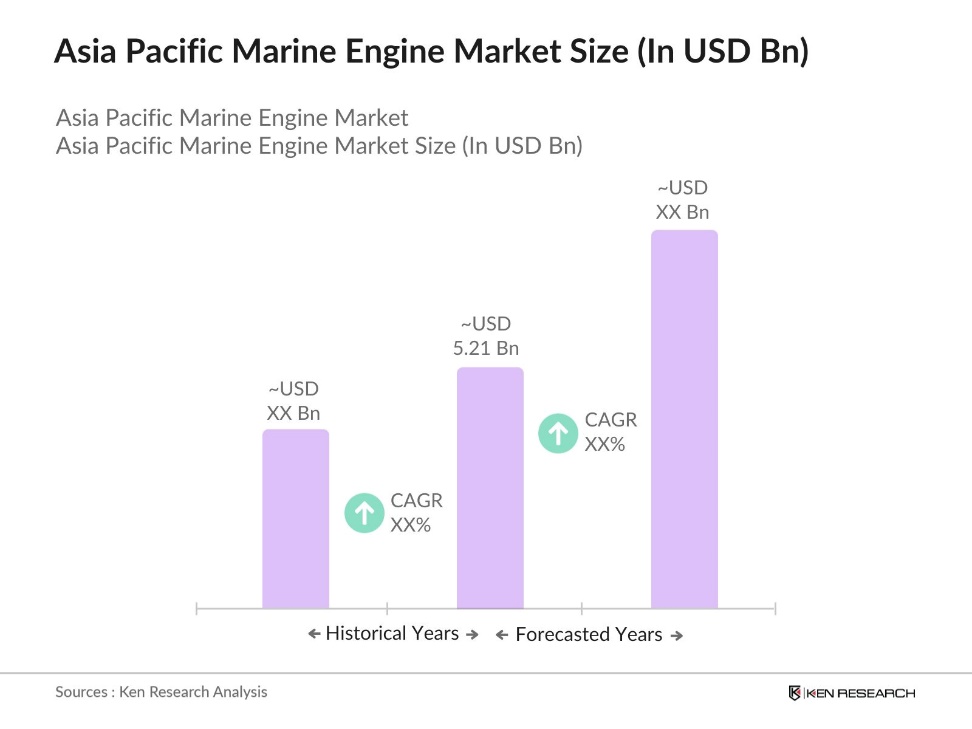
- China, Japan, and South Korea dominate the marine engine market due to their expansive shipbuilding industries and deep-sea fishing activities. Chinas state support for shipbuilding, coupled with technological advancements in Japan and South Korea, gives these nations a competitive edge. Additionally, these countries have a well-established ecosystem of suppliers and manufacturers, which strengthens their presence in the regional and global marine engine market.
- The International Maritime Organization (IMO) has set stringent emission standards that impact the Asia-Pacific marine engine market significantly South Korea has implemented stringent regulations, including the establishment of Emission Control Areas (ECAs) where ships are required to use fuel with a maximum sulfur content of 0.1%. This regulation began in September 2020 for certain ports and was extended to all vessels from January 2022.
Asia Pacific Marine Engine Market Segmentation
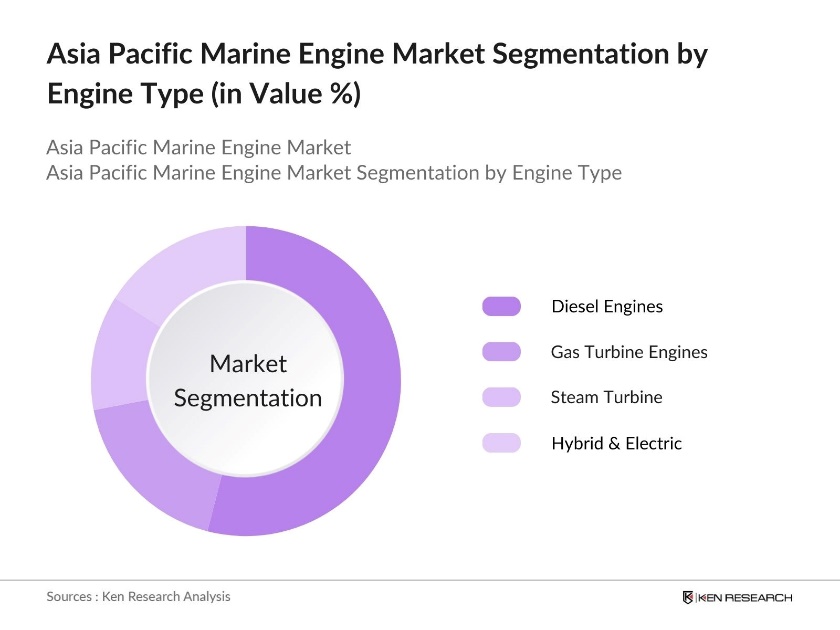
By Engine Type: The market is segmented by engine type into diesel engines, gas turbine engines, steam turbine engines, and hybrid and electric engines. Currently, diesel engines hold a dominant market share in this category, largely because of their cost-efficiency and established infrastructure for fuel distribution. Diesel engines are preferred across commercial shipping due to their reliability and comparatively lower operational costs, which aligns with the demand for efficient and high-performance maritime engines.
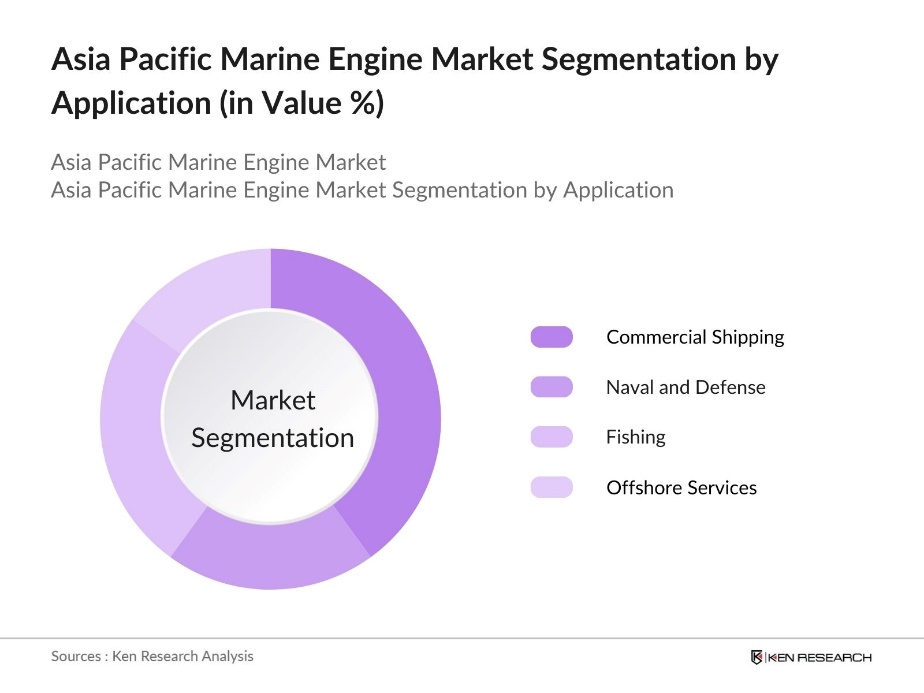
By Application: The market is segmented by application into commercial shipping, naval and defense, fishing, and offshore services. Commercial shipping leads in this segment, driven by rising international trade and the demand for bulk cargo transport. The established network of ports and the increasing volume of goods traded make commercial shipping a vital segment in the Asia Pacific marine engine market, further supported by advancements in engine technology and fuel efficiency requirements.
Asia Pacific Marine Engine Market Competitive Landscape
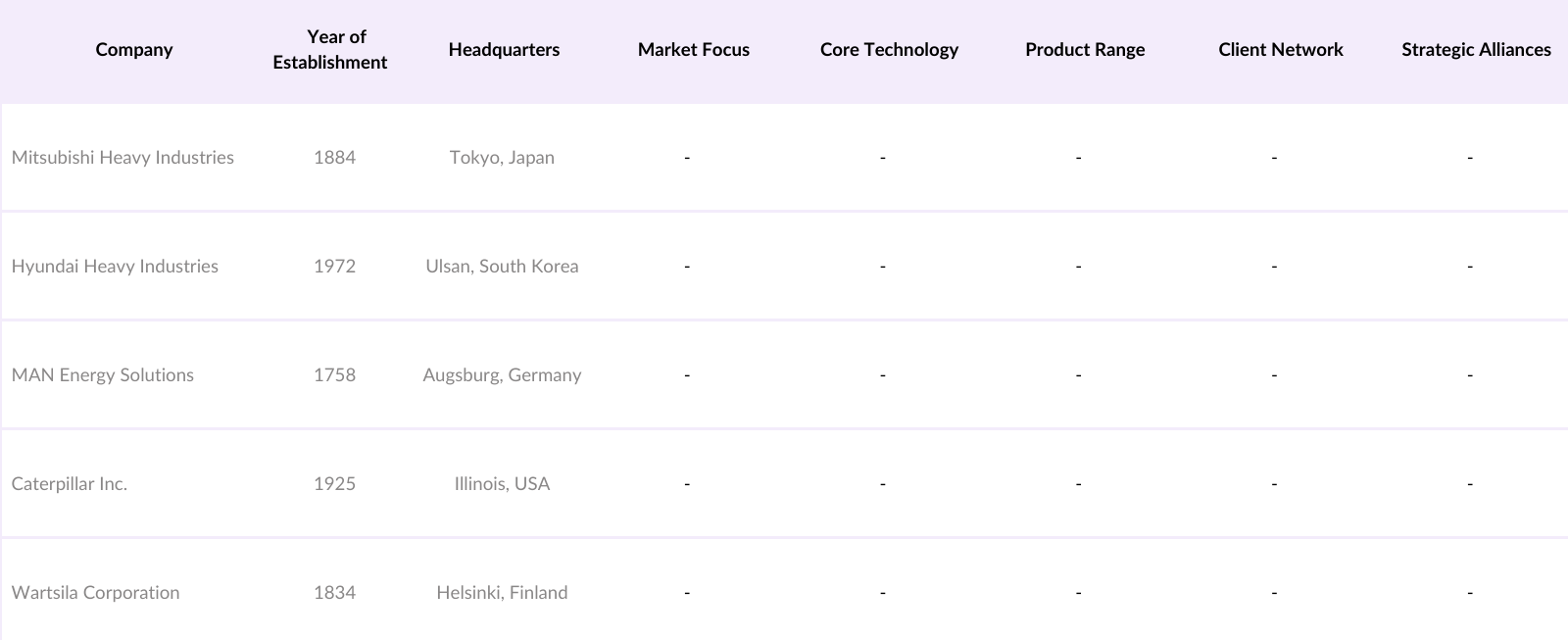
The Asia Pacific Marine Engine market is dominated by both regional and global players. Major companies like Mitsubishi Heavy Industries, Hyundai Heavy Industries, and MAN Energy Solutions have established strong positions through significant technological expertise and competitive pricing. These companies, supported by decades of industry experience and innovation, provide comprehensive solutions across various engine types, cementing their market presence.
Asia Pacific Marine Engine Industry Analysis
Growth Drivers
- Rise in Maritime Trade: The Asia-Pacific region is a critical hub for global maritime trade, accounting for approximately 60% of global maritime trade by volume and value, with significant contributions from major economies like China, Japan, and the United States. This growth is driven by major export economies like China, Japan, and South Korea, all investing in enhanced shipping infrastructure to support economic growth.
- Increased Demand for Fuel-Efficient Engines: The Asia-Pacific regions dependence on maritime trade has also amplified the demand for fuel-efficient marine engines to reduce operating costs and environmental impact. According to the International Energy Agency (IEA), Asia-Pacific countries, notably Japan and South Korea, aim to reduce marine fuel consumption by adopting technologies that increase engine efficiency. For example, Japan's government is requesting around 1.6 trillion ($11 billion) for its green transformation strategy aimed at achieving net-zero emissions by 2050.
- Technological Advancements in Engine Design: Technological advancements in the Asia-Pacific marine engine market focus on improving efficiency and reducing emissions. Japan and Singapore lead in developing hybrid and LNG-based engines that support eco-friendly shipping. Innovations prioritize fuel reduction and real-time monitoring, aiming to enhance performance and compliance with environmental standards. These advancements position the Asia-Pacific region as a key player in sustainable marine engine technology.
Market Challenges
- High Initial Costs of Marine Engines: Asia-Pacifics transition to cleaner marine technologies encounters challenges due to the high initial investment required. Cleaner technologies, such as LNG-fueled engines, generally have significantly higher costs compared to conventional options, making them financially challenging for smaller operators. This barrier affects broader adoption across the industry, as the substantial upfront expenses make it difficult for smaller companies to invest in these environmentally friendly upgrades.
- Emission Regulations and Compliance Costs: Strict emission regulations from the International Maritime Organization (IMO) present cost challenges for Asia-Pacific maritime operators. Compliance with these standards often requires investing in emission-reduction technologies or retrofitting existing fleets. These investments, while essential for regulatory compliance, increase operational costs and affect profitability, particularly impacting operators who must balance environmental commitments with financial constraints.
Asia Pacific Marine Engine Market Future Outlook
In the coming years, the Asia Pacific Marine Engine market is anticipated to experience sustained growth due to rising investments in green shipping technologies, government incentives for emission reduction, and a shift towards LNG and dual-fuel engines. Expansive trade routes within the region and the global push for eco-friendly fuel solutions will likely continue to enhance the market dynamics, leading to further innovation and adoption in the sector.
Market Opportunities
- Expansion in Emerging Markets: Emerging economies in the Asia-Pacific region, such as Vietnam and Indonesia, offer promising growth opportunities for the marine engine sector. Increasing maritime activities and investments in port infrastructure in these countries drive demand for new marine engines. This trend presents manufacturers with opportunities to expand their operations in these growing markets, catering to the evolving needs of expanding fleets and modernizing shipping infrastructure.
- Innovations in Hybrid and Electric Marine Engines: Hybrid and electric engine technologies are increasingly popular in the Asia-Pacific marine engine market, offering alternatives to conventional fuel engines. These innovations focus on achieving lower emissions and greater fuel efficiency, supported by regional incentives for low-emission technologies. Such advancements not only align with sustainability goals but also create a pathway for the marine industry to adopt more energy-efficient and environmentally friendly engine options.
Scope of the Report
|
By Engine Type |
Diesel Engines Gas Turbine Engines Steam Turbine Engines Hybrid and Electric Engines |
|
By Application |
Commercial Shipping Naval and Defense Fishing Offshore Services |
|
By Power Rating |
<1,000 kW 1,0005,000 kW >5,000 kW |
|
By Fuel Type |
Diesel LNG Dual-Fuel |
|
By Region |
China Japan South Korea Australia Southeast Asia |
Products
Key Target Audience
Commercial Shipping Companies
Engine Manufacturers
Offshore Oil & Gas Services Companies
Government and Regulatory Bodies (International Maritime Organization, Marine Environmental Protection Committee)
Investors and venture capital Firms
Banks and Financial Institutions
Companies
Players Mentioned in the Report
Mitsubishi Heavy Industries
Hyundai Heavy Industries
MAN Energy Solutions
Caterpillar Inc.
Wartsila Corporation
Yanmar Co., Ltd.
Daihatsu Diesel Mfg. Co., Ltd.
Rolls-Royce Holdings
Volvo Penta
Doosan Engine Co., Ltd.
Table of Contents
1. Asia Pacific Marine Engine Market Overview
1.1 Definition and Scope
1.2 Market Taxonomy
1.3 Market Growth Rate
1.4 Market Segmentation Overview
2. Asia Pacific Marine Engine Market Size (In USD Mn)
2.1 Historical Market Size
2.2 Year-On-Year Growth Analysis
2.3 Key Market Developments and Milestones
3. Asia Pacific Marine Engine Market Analysis
3.1 Growth Drivers
3.1.1 Rise in Maritime Trade
3.1.2 Increased Demand for Fuel-Efficient Engines
3.1.3 Government Subsidies and Incentives
3.1.4 Technological Advancements in Engine Design
3.2 Market Challenges
3.2.1 High Initial Costs of Marine Engines
3.2.2 Emission Regulations and Compliance Costs
3.2.3 Shortage of Skilled Workforce
3.3 Opportunities
3.3.1 Expansion in Emerging Markets
3.3.2 Innovations in Hybrid and Electric Marine Engines
3.3.3 Collaborations for Green Marine Technology
3.4 Trends
3.4.1 Integration of IoT in Engine Monitoring
3.4.2 Adoption of Dual-Fuel Engines
3.4.3 Increasing Use of LNG as Marine Fuel
3.5 Government Regulation
3.5.1 IMO Emission Standards
3.5.2 Ballast Water Management Convention
3.5.3 National Maritime Environmental Laws
3.6 SWOT Analysis
3.7 Stake Ecosystem (Manufacturers, Distributors, Shipbuilders, Fleet Owners)
3.8 Porters Five Forces Analysis
3.9 Competition Ecosystem (Marine Engine OEMs, Component Suppliers, Aftermarket Providers)
4. Asia Pacific Marine Engine Market Segmentation
4.1 By Engine Type (In Value %)
4.1.1 Diesel Engines
4.1.2 Gas Turbine Engines
4.1.3 Steam Turbine Engines
4.1.4 Hybrid and Electric Engines
4.2 By Application (In Value %)
4.2.1 Commercial Shipping
4.2.2 Naval and Defense
4.2.3 Fishing
4.2.4 Offshore Services
4.3 By Power Rating (In Value %)
4.3.1 <1,000 kW
4.3.2 1,0005,000 kW
4.3.3 >5,000 kW
4.4 By Fuel Type (In Value %)
4.4.1 Diesel
4.4.2 LNG
4.4.3 Dual-Fuel
4.5 By Region (In Value %)
4.5.1 China
4.5.2 Japan
4.5.3 South Korea
4.5.4 Australia
4.5.5 Southeast Asia
5. Asia Pacific Marine Engine Market Competitive Analysis
5.1 Detailed Profiles of Major Companies
5.1.1 Wartsila Corporation
5.1.2 MAN Energy Solutions
5.1.3 Caterpillar Inc.
5.1.4 Hyundai Heavy Industries
5.1.5 Rolls-Royce Holdings
5.1.6 Cummins Inc.
5.1.7 Mitsubishi Heavy Industries
5.1.8 Yanmar Co., Ltd.
5.1.9 Daihatsu Diesel Mfg. Co., Ltd.
5.1.10 Volvo Penta
5.1.11 Doosan Engine Co., Ltd.
5.1.12 General Electric Co.
5.1.13 Scania AB
5.1.14 Deutz AG
5.1.15 STX Engine Co., Ltd.
5.2 Cross Comparison Parameters (Revenue, Product Portfolio, Geographical Reach, Power Range, Technology Focus, Innovation Capability, Environmental Certifications, Key Clients)
5.3 Market Share Analysis
5.4 Strategic Initiatives
5.5 Mergers and Acquisitions
5.6 Investment Analysis
5.7 Joint Ventures and Partnerships
5.8 Government Subsidies and Grants
6. Asia Pacific Marine Engine Market Regulatory Framework
6.1 Environmental Standards
6.2 Safety Standards for Marine Engines
6.3 Fuel Quality Regulations
6.4 Compliance and Certification Requirements
7. Asia Pacific Marine Engine Future Market Size (In USD Mn)
7.1 Future Market Size Projections
7.2 Key Factors Driving Future Market Growth
8. Asia Pacific Marine Engine Future Market Segmentation
8.1 By Engine Type (In Value %)
8.2 By Application (In Value %)
8.3 By Power Rating (In Value %)
8.4 By Fuel Type (In Value %)
8.5 By Region (In Value %)
9. Asia Pacific Marine Engine Market Analysts Recommendations
9.1 TAM/SAM/SOM Analysis
9.2 Customer Cohort Analysis
9.3 Marketing Initiatives
9.4 White Space Opportunity Analysis
Disclaimer Contact UsResearch Methodology
Step 1: Identification of Key Variables
An ecosystem map of the Asia Pacific Marine Engine market was created to identify essential stakeholders, including manufacturers, suppliers, and end-users. This foundational step involved comprehensive desk research and utilization of proprietary databases to determine the key variables impacting market trends and dynamics.
Step 2: Market Analysis and Construction
A historical analysis of the Asia Pacific Marine Engine market was conducted, including assessments of penetration, demand ratios, and revenue generation across various segments. This step also involved gathering quality metrics to ensure accurate and reliable revenue estimates.
Step 3: Hypothesis Validation and Expert Consultation
Market assumptions were tested and validated via in-depth consultations with industry experts from leading marine engine manufacturers and stakeholders. These consultations offered operational and financial insights that strengthened the foundational market data.
Step 4: Research Synthesis and Final Output
The final stage involved direct engagement with marine engine producers, capturing insights on product segments, performance metrics, and customer preferences. This bottom-up approach allowed us to refine and verify the market data, yielding a comprehensive and validated analysis of the Asia Pacific Marine Engine market.
Frequently Asked Questions
01. How big is the Asia Pacific Marine Engine Market?
The Asia Pacific Marine Engine Market is valued at USD 5.21 billion, driven by the region's extensive maritime trade and investments in fuel-efficient engine technology.
02. What are the challenges in the Asia Pacific Marine Engine Market?
Key challenges in Asia Pacific Marine Engine Market include high costs for compliance with emission standards and a shortage of skilled labor for the operation and maintenance of advanced marine engines.
03. Who are the major players in the Asia Pacific Marine Engine Market?
Top players in Asia Pacific Marine Engine Market include Mitsubishi Heavy Industries, MAN Energy Solutions, Hyundai Heavy Industries, Caterpillar Inc., and Wartsila Corporation, all recognized for their advanced technology and regional influence.
04. What factors are driving growth in the Asia Pacific Marine Engine Market?
The Asia Pacific Marine Engine Market is driven by growth in maritime trade, demand for hybrid technology, and government incentives for emission reduction, fueling steady market expansion.
Why Buy From Us?

What makes us stand out is that our consultants follows Robust, Refine and Result (RRR) methodology. i.e. Robust for clear definitions, approaches and sanity checking, Refine for differentiating respondents facts and opinions and Result for presenting data with story

We have set a benchmark in the industry by offering our clients with syndicated and customized market research reports featuring coverage of entire market as well as meticulous research and analyst insights.

While we don't replace traditional research, we flip the method upside down. Our dual approach of Top Bottom & Bottom Top ensures quality deliverable by not just verifying company fundamentals but also looking at the sector and macroeconomic factors.

With one step in the future, our research team constantly tries to show you the bigger picture. We help with some of the tough questions you may encounter along the way: How is the industry positioned? Best marketing channel? KPI's of competitors? By aligning every element, we help maximize success.

Our report gives you instant access to the answers and sources that other companies might choose to hide. We elaborate each steps of research methodology we have used and showcase you the sample size to earn your trust.

If you need any support, we are here! We pride ourselves on universe strength, data quality, and quick, friendly, and professional service.