















Asia Pacific Marine Propulsion Systems Market Outlook to 2030
Region:Asia
Author(s):Naman Rohilla
Product Code:KROD7263
December 2024
83
About the Report
Asia Pacific Marine Propulsion Systems Market Overview
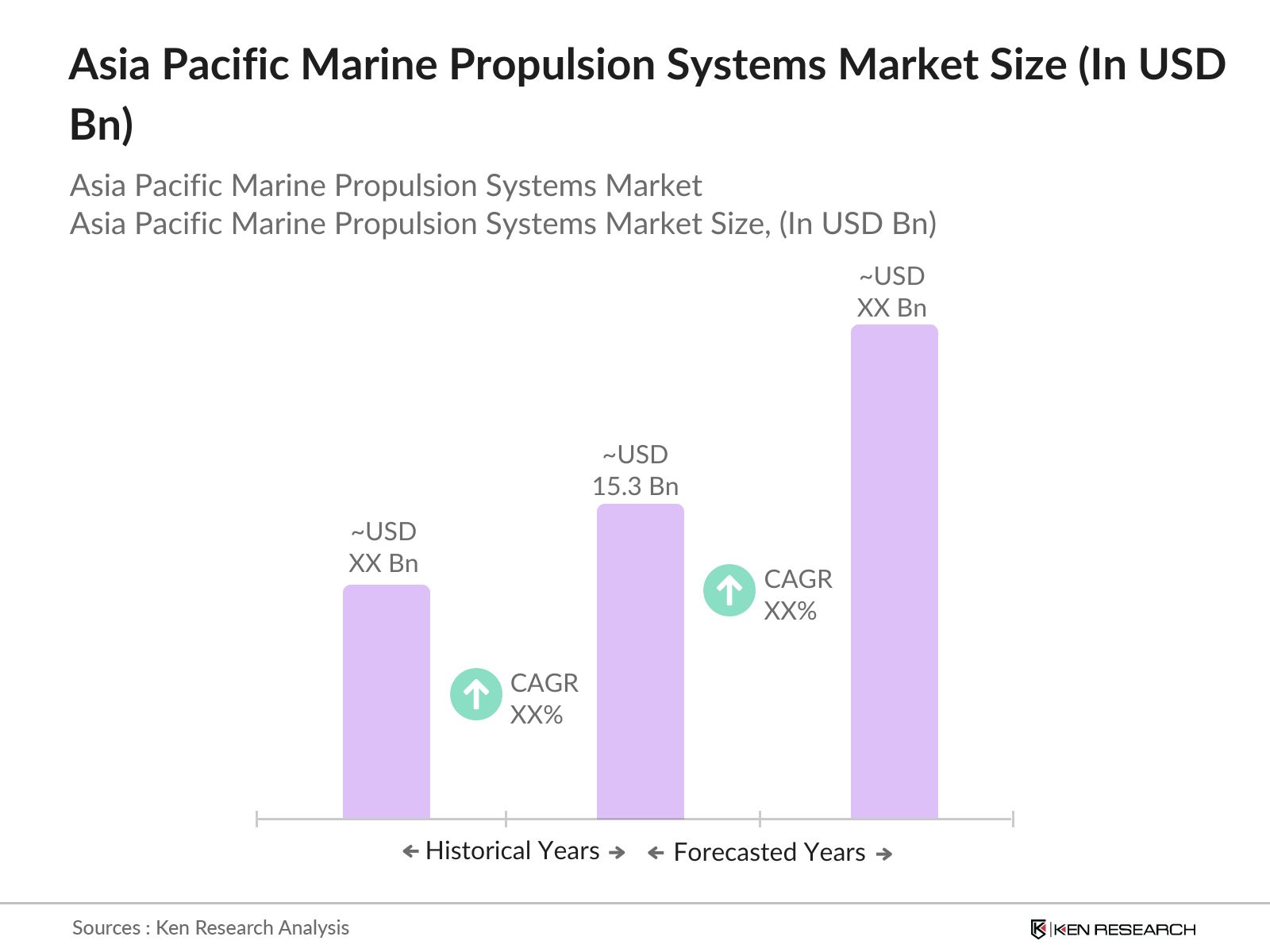
- The Asia Pacific marine propulsion systems market is valued at USD 15.3 billion, driven by the regions expanding maritime trade and increasing focus on energy efficiency. The growth in shipbuilding, especially in countries like China and South Korea, has fueled demand for advanced propulsion systems. The regions push for environmental compliance has also led to the adoption of cleaner propulsion technologies, such as hybrid and LNG-based systems, which are gaining popularity among shipping companies.
- Countries such as China, Japan, and South Korea dominate the marine propulsion systems market in the Asia Pacific due to their strong shipbuilding industries and technological advancements. China, in particular, benefits from its large-scale production capacity and government support for its maritime sector. South Korea and Japan also maintain a market presence due to their well-established shipyards and expertise in high-performance propulsion systems. These countries' dominance stems from their global export capacity and focus on research and innovation in marine technologies.
- Electric propulsion systems are gaining traction in the Asia Pacific maritime sector, with more than 200 vessels in the region being equipped with electric motors in 2023. These systems offer lower operating costs and reduce emissions by up to 90% compared to traditional engines, as per the International Energy Agency. The growing adoption of electric propulsion is driven by regulatory requirements and advancements in battery technology, particularly in countries like Japan and South Korea. The rising interest in zero-emission shipping solutions has made electric propulsion systems a key trend in the region.
Asia Pacific Marine Propulsion Systems Market Segmentation
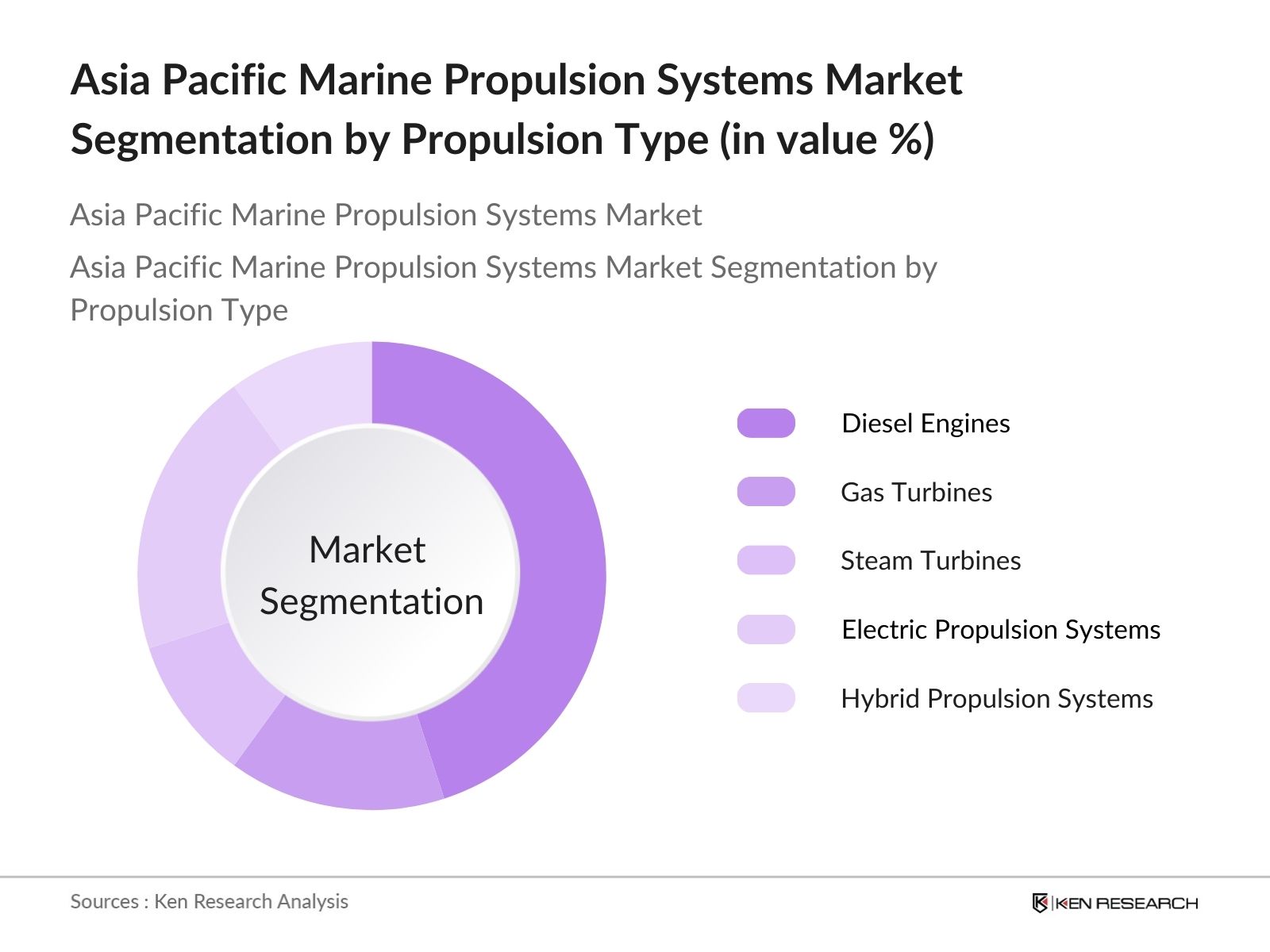
- By Propulsion Type: The market is segmented by propulsion type into diesel engines, gas turbines, steam turbines, electric propulsion systems, and hybrid propulsion systems. Recently, diesel engines have maintained a dominant share in this segment due to their reliability, cost-effectiveness, and extensive application across various vessel types. Diesel engines are favored by most shipowners because of their proven efficiency in long-haul maritime operations, and their ability to operate on different fuel types enhances their versatility, making them a popular choice in both commercial and military fleets.
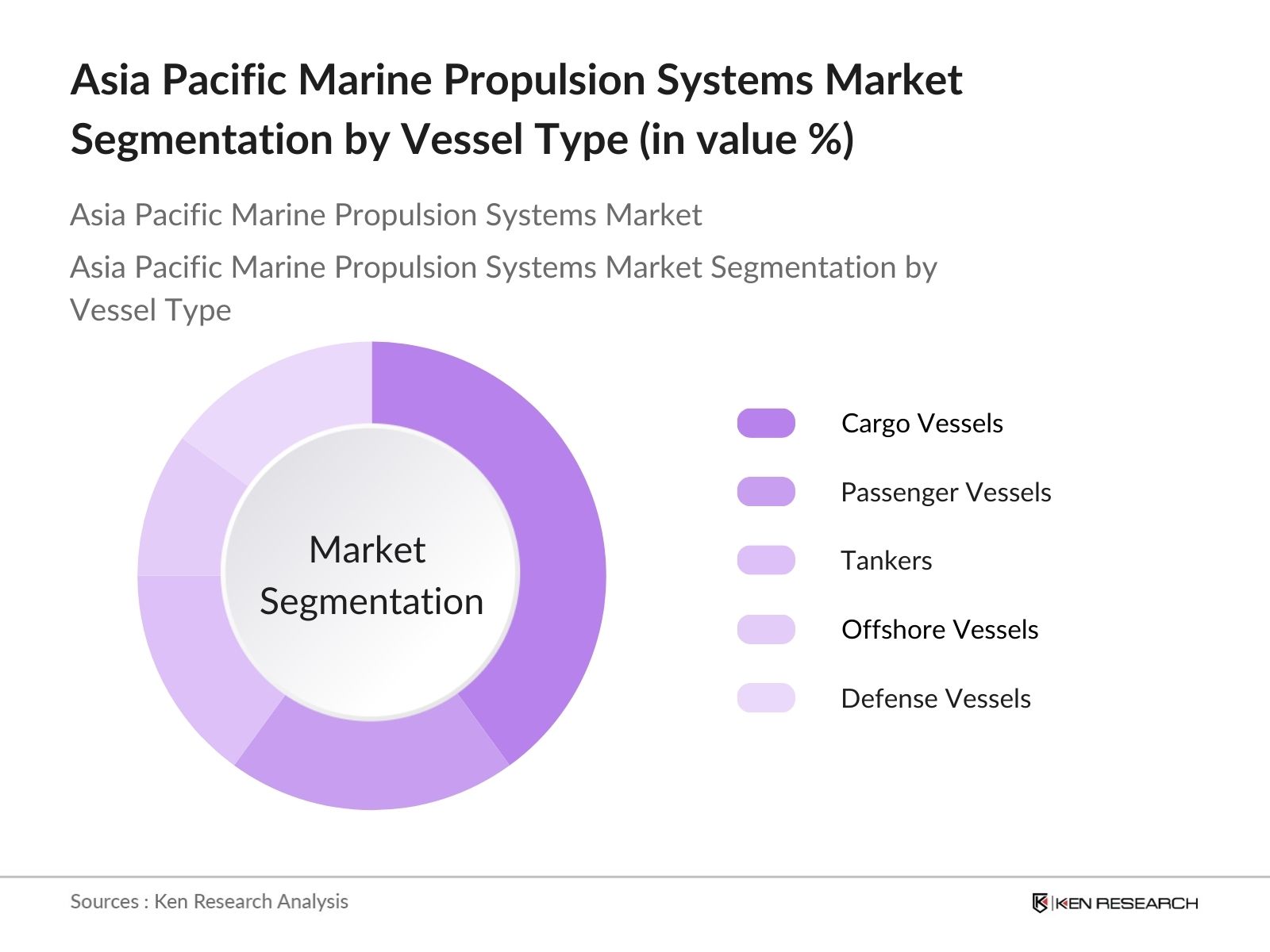
- By Vessel Type: The market is further segmented by vessel type into cargo vessels, passenger vessels, tankers, offshore vessels, and defense vessels. Cargo vessels hold the dominant market share due to the region's booming export-driven economies. The large-scale production of container ships, bulk carriers, and other cargo vessels in China and South Korea has bolstered the demand for propulsion systems in this sub-segment. With the rise in global e-commerce and increased cross-border trade, the need for efficient cargo vessels has further supported the propulsion systems market.
Asia Pacific Marine Propulsion Systems Market Competitive Landscape
The Asia Pacific marine propulsion systems market is dominated by key players, with a few large multinational corporations holding a notable portion of the market. These players have a strong foothold due to their technological expertise and diversified product portfolios. Companies like Wrtsil Corporation, Rolls-Royce Holdings plc, and MAN Energy Solutions lead the market with their innovative propulsion solutions. The market's competitive landscape is further shaped by ongoing mergers, acquisitions, and partnerships aimed at enhancing market share and expanding product offerings.
|
Company Name |
Establishment Year |
Headquarters |
No. of Employees |
Revenue (USD) |
Key Products |
Market Share (%) |
Research & Development (R&D) Focus |
Geographical Reach |
Partnerships with Shipbuilders |
|
Wrtsil Corporation |
1834 |
Finland |
- |
- |
- |
- |
- |
- |
- |
|
Rolls-Royce Holdings plc |
1906 |
UK |
- |
- |
- |
- |
- |
- |
- |
|
MAN Energy Solutions |
1758 |
Germany |
- |
- |
- |
- |
- |
- |
- |
|
Mitsubishi Heavy Industries Ltd |
1870 |
Japan |
- |
- |
- |
- |
- |
- |
- |
|
Hyundai Heavy Industries Co. |
1972 |
South Korea |
- |
- |
- |
- |
- |
- |
- |
Asia Pacific Marine Propulsion Systems Market Analysis
Asia Pacific Marine Propulsion Systems Market Growth Drivers
- Expansion in Maritime Trade: The Asia Pacific region has witnessed a surge in maritime trade, with the region accounting for over 40% of global trade volume in 2023, according to the International Maritime Organization (IMO). Countries like China, Japan, and South Korea are major players, contributing to a substantial share of global seaborne trade. China alone handled 14.5 billion metric tons of cargo in its ports in 2023. This increased trade volume is pushing the demand for advanced marine propulsion systems, as shipping companies seek more efficient, reliable systems to handle growing volumes.
- Growing Demand for Fuel-Efficient Systems: In 2024, the global push for fuel-efficient systems has driven ship operators to upgrade their fleets. A report from the United Nations Conference on Trade and Development (UNCTAD) indicates that over 70% of vessels in the Asia Pacific region are adopting more fuel-efficient marine engines to comply with emission regulations and reduce operating costs. Shipping firms are also increasingly turning to LNG-fueled engines, which offer up to 20% improved fuel efficiency compared to traditional heavy fuel oil engines. This shift is directly related to fuel price volatility and the need for more cost-effective marine operations.
- Adoption of Hybrid and Electric Propulsion Technologies: The growing emphasis on reducing emissions has led to the rapid adoption of hybrid and electric propulsion technologies in the Asia Pacific marine sector. In 2023, more than 500 vessels in the region were retrofitted with hybrid systems, which combine traditional engines with electric motors for better fuel efficiency and lower emissions. South Korea and Japan have spearheaded this shift, with their governments providing incentives to shipbuilders incorporating these systems. The International Maritime Organization's data shows that hybrid propulsion systems can reduce emissions by up to 30%, supporting the region's commitment to greener maritime operations.
Asia Pacific Marine Propulsion Systems Market Challenges
- High Capital Investment: The initial capital investment required for developing and installing advanced marine propulsion systems remains a major challenge in the Asia Pacific market. According to the World Bank, the cost of installing LNG-based propulsion systems can exceed $12 million per vessel, higher than traditional systems. This high upfront cost deters small and medium-sized shipping companies from adopting such technologies, despite the long-term operational savings and environmental benefits. Shipbuilders also face high R&D costs when developing new technologies, which further limits their ability to invest in more innovative propulsion systems.
- Complex Regulatory Landscape: The regulatory landscape for marine propulsion systems is becoming increasingly complex due to varying emission standards and safety requirements across different countries. For instance, compliance with the International Maritime Organizations Sulphur Cap regulations, which mandate a 0.5% limit on sulphur content in marine fuels, has led to increased costs for ship operators in the Asia Pacific region. The International Energy Agency (IEA) highlights that ship operators need to invest in scrubbers, which can cost upwards of $2 million per vessel, to meet these regulations. Navigating this evolving regulatory environment adds financial and operational burdens to shipping companies.
Asia Pacific Marine Propulsion Systems Market Future Outlook
Over the next five years, the Asia Pacific marine propulsion systems market is expected to experience steady growth driven by the ongoing demand for fuel-efficient and environmentally compliant technologies. The increasing emphasis on reducing greenhouse gas emissions from ships, along with innovations in propulsion systems like electric and hybrid technologies, will further boost market expansion. Additionally, the rising adoption of LNG-powered vessels and the development of autonomous shipping solutions are anticipated to shape the future of marine propulsion in the region.
Asia Pacific Marine Propulsion Systems Market Opportunities
- Innovations in LNG and Green Propulsion: The Asia Pacific region is at the forefront of innovations in LNG and green propulsion technologies. In 2023, more than 250 new LNG-powered vessels were commissioned in the region, reflecting the growing demand for environmentally friendly propulsion systems. These LNG systems can reduce CO2 emissions by up to 25% compared to conventional marine engines, according to the International Energy Agency. Additionally, governments in China and South Korea have introduced subsidies and tax breaks for the adoption of green technologies in shipbuilding, providing shipowners with further incentives to invest in LNG propulsion systems.
- Emerging Markets for Autonomous Shipping: Autonomous shipping is an emerging trend that presents growth opportunities for the marine propulsion systems market in the Asia Pacific. According to the World Bank, several countries in the region, including Japan and Singapore, are investing heavily in autonomous vessels, with over $5 billion allocated for research and development in this area in 2023. These autonomous vessels require advanced propulsion systems integrated with smart technologies for better control and fuel efficiency. The growing interest in autonomous shipping is expected to boost demand for innovative propulsion systems that support these vessels.
Scope of the Report
|
By Propulsion Type |
Diesel Engines Gas Turbines Steam Turbines Electric Propulsion Systems Hybrid Propulsion Systems |
|
By Vessel Type |
Cargo Vessels Passenger Vessels Tankers Offshore Vessels Defense Vessels |
|
By Power Output |
Below 500 kW 500 kW to 5000 kW 5000 kW to 10,000 kW Above 10,000 kW |
|
By Fuel Type |
Diesel Natural Gas LNG Hybrid/Battery |
|
By Region |
China Japan South Korea Southeast Asia Oceania |
Products
Key Target Audience
Shipbuilding Companies
Marine Equipment Manufacturers
Banks and Financial Institutions
Government and Regulatory Bodies (International Maritime Organization, Asia Pacific Maritime Authorities)
Naval Defense Contractors
Shipping Companies
Marine Engineers and Technologists
Investor and Venture Capitalist Firms
Environmental Agencies
Companies
Players Mentioned in the Report
Wrtsil Corporation
Rolls-Royce Holdings plc
MAN Energy Solutions
Mitsubishi Heavy Industries Ltd.
Hyundai Heavy Industries Co.
ABB Ltd.
Caterpillar Inc.
Cummins Inc.
Siemens AG
Volvo Penta
Table of Contents
1. Asia Pacific Marine Propulsion Systems Market Overview
1.1 Definition and Scope
1.2 Market Taxonomy
1.3 Market Growth Rate
1.4 Market Segmentation Overview
2. Asia Pacific Marine Propulsion Systems Market Size (In USD Bn)
2.1 Historical Market Size
2.2 Year-On-Year Growth Analysis
2.3 Key Market Developments and Milestones
3. Asia Pacific Marine Propulsion Systems Market Analysis
3.1 Growth Drivers
3.1.1 Expansion in Maritime Trade
3.1.2 Growing Demand for Fuel-Efficient Systems
3.1.3 Adoption of Hybrid and Electric Propulsion Technologies
3.1.4 Government Initiatives to Boost Domestic Shipbuilding
3.2 Market Challenges
3.2.1 High Capital Investment
3.2.2 Complex Regulatory Landscape
3.2.3 Fluctuations in Fuel Prices
3.2.4 Technological Obsolescence
3.3 Opportunities
3.3.1 Innovations in LNG and Green Propulsion
3.3.2 Emerging Markets for Autonomous Shipping
3.3.3 Increasing Preference for Dual-Fuel Engines
3.3.4 Demand for Retrofitting Existing Fleets
3.4 Trends
3.4.1 Rise of Electric Propulsion Systems
3.4.2 Adoption of Smart Marine Technologies
3.4.3 Integration of IoT for Remote Monitoring
3.4.4 Shift Towards Modular Propulsion Systems
3.5 Government Regulation
3.5.1 Emission Control Standards (IMO Sulphur Cap, EEDI)
3.5.2 Support for Local Shipbuilding (Incentives, Subsidies)
3.5.3 Safety and Environmental Norms for Marine Engines
3.6 SWOT Analysis
3.7 Stakeholder Ecosystem
3.8 Porters Five Forces Analysis
3.9 Competition Ecosystem
4. Asia Pacific Marine Propulsion Systems Market Segmentation
4.1 By Propulsion Type (In Value %)
4.1.1 Diesel Engines
4.1.2 Gas Turbines
4.1.3 Steam Turbines
4.1.4 Electric Propulsion Systems
4.1.5 Hybrid Propulsion Systems
4.2 By Vessel Type (In Value %)
4.2.1 Cargo Vessels
4.2.2 Passenger Vessels
4.2.3 Tankers
4.2.4 Offshore Vessels
4.2.5 Defense Vessels
4.3 By Power Output (In Value %)
4.3.1 Below 500 kW
4.3.2 500 kW to 5000 kW
4.3.3 5000 kW to 10,000 kW
4.3.4 Above 10,000 kW
4.4 By Fuel Type (In Value %)
4.4.1 Diesel
4.4.2 Natural Gas
4.4.3 LNG
4.4.4 Hybrid/Battery
4.5 By Region (In Value %)
4.5.1 China
4.5.2 Japan
4.5.3 South Korea
4.5.4 Southeast Asia
4.5.5 Oceania
5. Asia Pacific Marine Propulsion Systems Market Competitive Analysis
5.1 Detailed Profiles of Major Companies
5.1.1 Wrtsil Corporation
5.1.2 Rolls-Royce Holdings plc
5.1.3 MAN Energy Solutions
5.1.4 ABB Ltd.
5.1.5 General Electric Company
5.1.6 Mitsubishi Heavy Industries Ltd.
5.1.7 Caterpillar Inc.
5.1.8 Cummins Inc.
5.1.9 Volvo Penta
5.1.10 Hyundai Heavy Industries Co., Ltd.
5.1.11 Kawasaki Heavy Industries Ltd.
5.1.12 Siemens AG
5.1.13 Doosan Engine Co., Ltd.
5.1.14 SCANIA AB
5.1.15 Yanmar Co., Ltd.
5.2 Cross Comparison Parameters (No. of Employees, Headquarters, Revenue, Market Share, Product Portfolio, R&D Investment, Key Partnerships, Geographic Reach)
5.3 Market Share Analysis
5.4 Strategic Initiatives
5.5 Mergers and Acquisitions
5.6 Investment Analysis
5.7 Venture Capital Funding
5.8 Government Grants
5.9 Private Equity Investments
6. Asia Pacific Marine Propulsion Systems Market Regulatory Framework
6.1 Environmental Standards
6.2 Compliance Requirements
6.3 Certification Processes
7. Asia Pacific Marine Propulsion Systems Future Market Size (In USD Bn)
7.1 Future Market Size Projections
7.2 Key Factors Driving Future Market Growth
8. Asia Pacific Marine Propulsion Systems Future Market Segmentation
8.1 By Propulsion Type (In Value %)
8.2 By Vessel Type (In Value %)
8.3 By Power Output (In Value %)
8.4 By Fuel Type (In Value %)
8.5 By Region (In Value %)
9. Asia Pacific Marine Propulsion Systems Market Analysts Recommendations
9.1 TAM/SAM/SOM Analysis
9.2 Customer Cohort Analysis
9.3 Marketing Initiatives
9.4 White Space Opportunity Analysis
Research Methodology
Step 1: Identification of Key Variables
In the initial phase, we map the entire marine propulsion systems market in the Asia Pacific region. Secondary research, including industry reports and proprietary databases, helps to identify crucial variables affecting market growth, such as technological advancements, fuel efficiency standards, and regulatory frameworks.
Step 2: Market Analysis and Construction
We compile and assess historical data related to the Asia Pacific marine propulsion systems market, focusing on revenue generation, adoption rates, and market penetration across key countries. The analysis also includes service quality assessments, ensuring the validity of the market figures presented.
Step 3: Hypothesis Validation and Expert Consultation
We validate our market hypotheses through consultations with industry experts, including marine propulsion manufacturers and shipbuilders. These interviews provide direct insights into market trends, challenges, and innovations, ensuring our research is grounded in industry realities.
Step 4: Research Synthesis and Final Output
In the final phase, we engage with propulsion system manufacturers to gather specific data on product performance, sales trends, and end-user preferences. This process ensures the accuracy and completeness of the market analysis.
Frequently Asked Questions
01. How big is the Asia Pacific Marine Propulsion Systems Market?
The Asia Pacific marine propulsion systems market is valued at USD 15.3 billion, driven by expanding maritime trade and increasing focus on energy-efficient propulsion technologies.
02. What are the challenges in the Asia Pacific Marine Propulsion Systems Market?
Challenges in the Asia Pacific marine propulsion systems market include fluctuating fuel prices, high capital investment for advanced propulsion systems, and stringent environmental regulations that complicate the adoption of traditional propulsion methods.
03. Who are the major players in the Asia Pacific Marine Propulsion Systems Market?
Key players in the Asia Pacific marine propulsion systems market include Wrtsil Corporation, Rolls-Royce Holdings plc, MAN Energy Solutions, Mitsubishi Heavy Industries Ltd., and Hyundai Heavy Industries Co.
04. What are the growth drivers of the Asia Pacific Marine Propulsion Systems Market?
The Asia Pacific marine propulsion systems market is driven by the demand for energy-efficient systems, the shift towards hybrid and electric propulsion, and the expansion of the shipbuilding industry in countries like China and South Korea.
Why Buy From Us?

What makes us stand out is that our consultants follows Robust, Refine and Result (RRR) methodology. i.e. Robust for clear definitions, approaches and sanity checking, Refine for differentiating respondents facts and opinions and Result for presenting data with story

We have set a benchmark in the industry by offering our clients with syndicated and customized market research reports featuring coverage of entire market as well as meticulous research and analyst insights.

While we don't replace traditional research, we flip the method upside down. Our dual approach of Top Bottom & Bottom Top ensures quality deliverable by not just verifying company fundamentals but also looking at the sector and macroeconomic factors.

With one step in the future, our research team constantly tries to show you the bigger picture. We help with some of the tough questions you may encounter along the way: How is the industry positioned? Best marketing channel? KPI's of competitors? By aligning every element, we help maximize success.

Our report gives you instant access to the answers and sources that other companies might choose to hide. We elaborate each steps of research methodology we have used and showcase you the sample size to earn your trust.

If you need any support, we are here! We pride ourselves on universe strength, data quality, and quick, friendly, and professional service.