















Asia Pacific Military Drones Market Outlook to 2030
Region:Asia
Author(s):Paribhasha Tiwari
Product Code:KROD9381
November 2024
100
About the Report
Asia Pacific Military Drones Market Overview
- The Asia Pacific military drones market is valued at USD 10 billion, based on a five-year historical analysis. The market is primarily driven by increasing defense budgets across countries like China, India, and Japan, along with a growing need for advanced ISR (Intelligence, Surveillance, and Reconnaissance) capabilities. Additionally, geopolitical tensions and the emphasis on border security and maritime surveillance have further accelerated the adoption of military drones in the region.
- Countries such as China, India, and Japan dominate the military drones market in the Asia Pacific due to their significant investments in defense modernization programs. Chinas focus on military autonomy, Indias emphasis on border security, and Japans concerns regarding regional security threats have led these nations to become major players in the market. Their dominance is further supported by local manufacturing capabilities and strategic government initiatives aimed at bolstering defense technologies.
- China has been actively investing in its military drone capabilities as part of its broader modernization initiatives. The Chinese governments 2024 defense strategy emphasized the deployment of drones for ISR, electronic warfare, and strike missions. This initiative involves collaboration with local companies for the development of long-range, high-endurance drones to monitor the South China Sea region.

Asia Pacific Military Drones Market Segmentation
By Drone Type: The Asia Pacific military drones market is segmented by drone type into fixed-wing drones, rotary-wing drones, and hybrid drones. Fixed-wing drones hold a dominant market share due to their longer endurance and higher altitude capabilities, making them ideal for surveillance and combat missions. These drones are particularly favored by countries like China and India for extensive border and maritime patrolling.

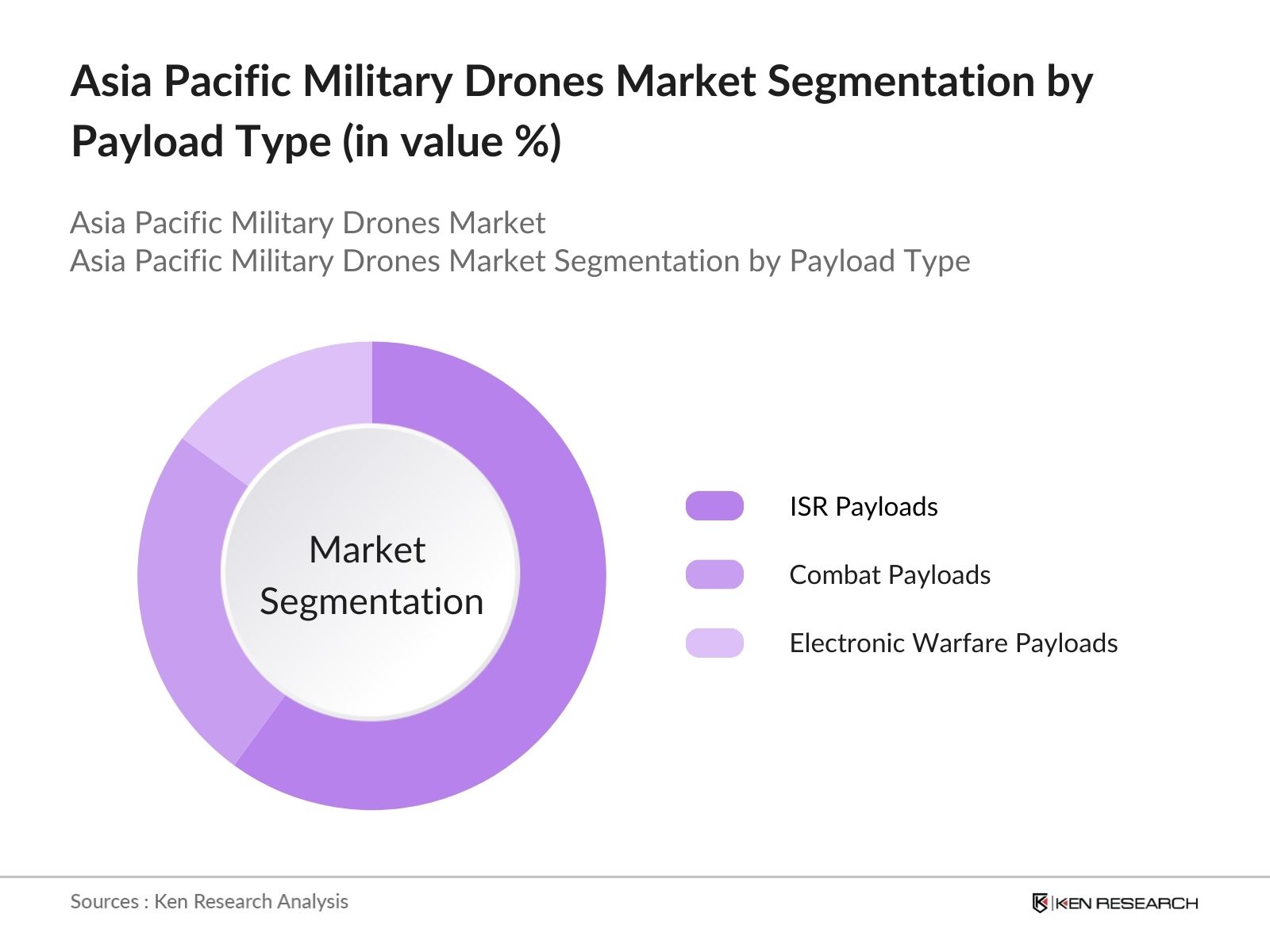
By Payload Type: The market is segmented by payload type into ISR payloads, combat payloads, and electronic warfare payloads. ISR (Intelligence, Surveillance, and Reconnaissance) payloads dominate the market due to the rising demand for real-time data gathering and border surveillance. Governments in countries like Japan and South Korea are investing heavily in ISR capabilities to maintain national security.
Asia Pacific Military Drones Market Competitive Landscape
The Asia Pacific military drones market is dominated by major global and regional players who provide advanced UAV (Unmanned Aerial Vehicle) solutions for defense applications. The market is competitive, with key players constantly engaging in mergers, acquisitions, and collaborations to strengthen their market presence. Companies such as Northrop Grumman and General Atomics Aeronautical Systems continue to lead due to their strong product portfolios and innovative drone technology.
|
Company Name |
Establishment Year |
Headquarters |
No. of Drones Delivered |
R&D Expenditure |
Defense Contracts |
Annual Revenue |
Technological Innovation |
Global Presence |
|
Northrop Grumman Corporation |
1939 |
Falls Church, VA, USA |
- | - | - | - | - | - |
|
General Atomics Aeronautical Systems |
1993 |
Poway, CA, USA |
- | - | - | - | - | - |
|
Israel Aerospace Industries |
1953 |
Tel Aviv, Israel |
- | - | - | - | - | - |
|
AeroVironment Inc. |
1971 |
Arlington, VA, USA |
- | - | - | - | - | - |
|
DJI Innovations |
2006 |
Shenzhen, China |
- | - | - | - | - | - |
Asia Pacific Military Drones Market Analysis
Growth Drivers
- Increased Defense Expenditures in APAC: The Asia Pacific region has seen a significant rise in defense budgets, driven by the need for modernized military forces. Countries like China, India, and Japan have allocated substantial portions of their defense budgets toward drone acquisition and development. In 2024, Chinas defense spending exceeded USD 224 billion, with a large part focused on unmanned aerial systems (UAS) for military use, contributing to the increased demand for military drones.
- Rising Geopolitical Tensions in APAC: Geopolitical tensions in the Asia Pacific, particularly in the South China Sea, have intensified in recent years, fueling demand for advanced military equipment, including drones. These tensions have prompted nations like India and Australia to ramp up their surveillance and intelligence capabilities using drones to monitor disputed regions. By 2024, India allocated over USD 73 billion to its defense sector, with a significant portion dedicated to drone procurement for intelligence, surveillance, and reconnaissance (ISR) purposes.
- Advancements in Drone Technology: Technological advancements in military drones, especially in autonomous operations and enhanced payload capacities, are driving their adoption. The integration of AI for real-time decision-making and long-endurance drones is transforming military operations in the Asia Pacific. Countries like South Korea and Japan are heavily investing in R&D to develop next-gen drones, contributing to the increased deployment of drones in defense strategies. For example, in 2024, South Korea invested USD 15 billion in its defense R&D sector, focusing on AI-enabled drones.
Market Challenges
- Stringent Government Regulations: Regulatory constraints remain a significant challenge for the growth of military drones in the Asia Pacific market. Strict government regulations regarding airspace usage, especially in populated and strategic zones, limit the operational scope of drones. For instance, Japans Civil Aeronautics Act enforces strict rules on drone flight operations, which hinders the adoption of military drones. In 2024, regulations in South Korea and Australia delayed the deployment of advanced drones due to airspace restrictions and data privacy concerns.
- High Procurement and Maintenance Costs: Military drones come with high procurement costs, along with additional maintenance and operational expenses. These costs can deter smaller economies in the Asia Pacific from fully adopting drone technologies for military purposes. For example, advanced drones with AI capabilities cost upwards of USD 10 million per unit, with annual maintenance costs reaching USD 2 million. This restricts the market penetration in countries with limited defense budgets.
Asia Pacific Military Drones Market Future Outlook
Over the next five years, the Asia Pacific military drones market is expected to grow significantly, driven by increasing defense expenditures, technological advancements in autonomous flight, and heightened security concerns in the region. The demand for ISR and combat drones will continue to rise, especially with the evolving geopolitical landscape and the need for superior surveillance technology. Additionally, governments in the region are anticipated to invest further in indigenous drone manufacturing, reducing dependency on imports and boosting local industries.
Market Opportunities
- Technological Innovations in AI and Autonomy: AI-powered military drones offer advanced features such as real-time data processing and autonomous decision-making. These innovations have opened up new possibilities for multi-role drones, capable of handling ISR, combat, and logistics support simultaneously. In 2024, Japan invested over USD 5 billion in AI research, significantly advancing autonomous military drone capabilities, and offering a competitive edge to its defense forces.
- Collaboration Between Governments and Private Sector: Increased collaboration between governments and private defense contractors has created growth opportunities in the APAC military drone market. Several governments in the region are signing agreements with private firms to develop customized drone technologies. In 2024, South Korea and Israel entered into a USD 2.7 billion partnership aimed at enhancing military drone capabilities, focusing on drone swarming and AI integration.
Scope of the Report
|
By Drone Type |
Fixed-Wing Drones Rotary-Wing Drones Hybrid Drones |
|
By Payload Type |
ISR Combat and Attack Payloads Electronic Warfare Communication Relay |
|
By Application |
Border Surveillance Combat Operations Maritime Security HADR |
|
By End-User |
Army Navy Air Force Special Forces |
|
By Region |
China India Japan South Korea Australia |
Products
Key Target Audience
Defense Ministries (China, India, Japan, South Korea)
Military and Defense Contractors
Border Security Agencies
UAV Manufacturers
R&D Institutes in Defense Technology
Investors and Venture Capitalist Firms
Government and Regulatory Bodies (Ministry of Defence, Civil Aviation Authorities)
Homeland Security Departments
Companies
Players Mentioned in the Report:
Northrop Grumman Corporation
General Atomics Aeronautical Systems
Israel Aerospace Industries
AeroVironment Inc.
DJI Innovations
Lockheed Martin Corporation
Elbit Systems Ltd.
Saab AB
FLIR Systems Inc.
China Aerospace Science and Technology Corporation
Table of Contents
1. Asia Pacific Military Drones Market Overview
1.1. Definition and Scope
1.2. Market Taxonomy
1.3. Market Growth Rate
1.4. Market Segmentation Overview
2. Asia Pacific Military Drones Market Size (In USD Bn)
2.1. Historical Market Size
2.2. Year-On-Year Growth Analysis
2.3. Key Market Developments and Milestones
3. Asia Pacific Military Drones Market Analysis
3.1. Growth Drivers (Market specific metrics: defense spending, regional geopolitical tensions, technological advancements)
3.1.1. Increased Defense Expenditures
3.1.2. Rising Geopolitical Tensions in APAC
3.1.3. Advancements in Drone Technology
3.1.4. Demand for ISR (Intelligence, Surveillance, and Reconnaissance) Capabilities
3.2. Market Challenges (Market specific metrics: regulatory constraints, cost limitations, operational risks)
3.2.1. Stringent Government Regulations
3.2.2. High Procurement and Maintenance Costs
3.2.3. Technical Limitations and Flight Restrictions
3.2.4. Operational Risks in Conflict Zones
3.3. Opportunities (Market specific metrics: collaboration initiatives, market penetration, technological innovation)
3.3.1. Technological Innovations in AI and Autonomy
3.3.2. Collaboration Between Governments and Private Sector
3.3.3. Expanding Markets for Combat and Surveillance Drones
3.3.4. Potential for Multi-role Drones
3.4. Trends (Market specific metrics: AI integration, drone swarming technology, electronic warfare capabilities)
3.4.1. Integration of Artificial Intelligence for Autonomous Operations
3.4.2. Increasing Adoption of Drone Swarming Technology
3.4.3. Enhanced Electronic Warfare and Countermeasures Capabilities
3.4.4. Dual-use Technologies for Civil and Defense Applications
3.5. Government Regulation (Market specific metrics: UAV regulations, export restrictions, licensing requirements)
3.5.1. Regional Export Restrictions and Trade Policies
3.5.2. UAV Flight Regulations and Airspace Management
3.5.3. Licensing Requirements for Military Drones
3.5.4. Cross-Border Cooperation and Military Agreements
3.6. SWOT Analysis
3.7. Stakeholder Ecosystem
3.8. Porters Five Forces Analysis
3.9. Competitive Landscape
4. Asia Pacific Military Drones Market Segmentation
4.1. By Drone Type (In Value %)
4.1.1. Fixed-Wing Drones
4.1.2. Rotary-Wing Drones
4.1.3. Hybrid Drones
4.2. By Payload Type (In Value %)
4.2.1. Intelligence, Surveillance, and Reconnaissance (ISR)
4.2.2. Combat and Attack Payloads
4.2.3. Electronic Warfare Payloads
4.2.4. Communication and Data Relay
4.3. By Application (In Value %)
4.3.1. Border Surveillance
4.3.2. Combat Operations
4.3.3. Maritime Security
4.3.4. Humanitarian Aid and Disaster Relief (HADR)
4.4. By End-User (In Value %)
4.4.1. Army
4.4.2. Navy
4.4.3. Air Force
4.4.4. Special Forces
4.5. By Region (In Value %)
4.5.1. China
4.5.2. India
4.5.3. Japan
4.5.4. South Korea
4.5.5. Australia
5. Asia Pacific Military Drones Market Competitive Analysis
5.1. Detailed Profiles of Major Companies
5.1.1. Northrop Grumman Corporation
5.1.2. Lockheed Martin Corporation
5.1.3. Elbit Systems Ltd.
5.1.4. Israel Aerospace Industries
5.1.5. Boeing Defense, Space & Security
5.1.6. General Atomics Aeronautical Systems
5.1.7. AeroVironment Inc.
5.1.8. Saab AB
5.1.9. Thales Group
5.1.10. Textron Systems
5.1.11. Baykar Technologies
5.1.12. Leonardo S.p.A
5.1.13. China Aerospace Science and Technology Corporation
5.1.14. DJI Innovations
5.1.15. FLIR Systems Inc.
5.2. Cross Comparison Parameters (Market specific: No. of drones delivered, headquarters, inception year, defense contracts, R&D expenditure, annual revenue, technological innovation, partnerships)
5.3. Market Share Analysis
5.4. Strategic Initiatives
5.5. Mergers And Acquisitions
5.6. Investment Analysis
5.7. Venture Capital Funding
5.8. Government Grants
5.9. Private Equity Investments
6. Asia Pacific Military Drones Market Regulatory Framework
6.1. National Defense Regulations on UAV Use
6.2. Export Compliance and Regulations
6.3. Licensing and Certification Procedures
7. Asia Pacific Military Drones Future Market Size (In USD Bn)
7.1. Future Market Size Projections
7.2. Key Factors Driving Future Market Growth
8. Asia Pacific Military Drones Future Market Segmentation
8.1. By Drone Type (In Value %)
8.2. By Payload Type (In Value %)
8.3. By Application (In Value %)
8.4. By End-User (In Value %)
8.5. By Region (In Value %)
9. Asia Pacific Military Drones Market Analysts Recommendations
9.1. TAM/SAM/SOM Analysis
9.2. Customer Cohort Analysis
9.3. Marketing Initiatives
9.4. White Space Opportunity Analysis
Research Methodology
Step 1: Identification of Key Variables
This initial step involves mapping the entire ecosystem of the Asia Pacific Military Drones Market, including stakeholders such as defense ministries, UAV manufacturers, and contractors. Extensive desk research is conducted, leveraging both secondary and proprietary databases to gather detailed market information. The aim is to identify the key drivers, challenges, and opportunities influencing the market.
Step 2: Market Analysis and Construction
In this phase, historical data on drone production, deployment, and market penetration is compiled and analyzed. This step involves evaluating the current market size, usage rates, and the impact of military procurement trends. The data is corroborated through secondary sources such as defense white papers and government reports.
Step 3: Hypothesis Validation and Expert Consultation
Market assumptions are validated through discussions with industry experts and stakeholders using interviews and surveys. Insights on technological innovations, defense strategies, and procurement plans are collected from subject matter experts to refine and confirm market data.
Step 4: Research Synthesis and Final Output
In the final step, detailed insights from drone manufacturers, defense contractors, and market influencers are synthesized to produce a comprehensive analysis. This phase ensures that all data points are validated through the bottom-up approach, guaranteeing the accuracy and reliability of the market report.
Frequently Asked Questions
1. How big is the Asia Pacific Military Drones Market?
The Asia Pacific military drones market is valued at USD 10 billion, driven by increasing defense budgets, technological advancements, and a growing need for ISR capabilities in countries like China and India.
2. What are the key challenges in the Asia Pacific Military Drones Market?
Challenges include regulatory hurdles, high costs of procurement and maintenance, and operational risks associated with drone deployment in conflict zones. Stringent export and airspace regulations also limit market expansion.
3. Who are the major players in the Asia Pacific Military Drones Market?
Key players in the Asia Pacific military drones market include Northrop Grumman, General Atomics, Israel Aerospace Industries, AeroVironment Inc., and DJI Innovations, all of which dominate due to their advanced technology and strong presence in defense contracts.
4. What drives the growth of the Asia Pacific Military Drones Market?
The market is driven by increasing defense expenditures, rising geopolitical tensions, and the growing need for advanced ISR and combat capabilities. Countries in the region are investing heavily in modernizing their defense forces with UAV technology.
Why Buy From Us?

What makes us stand out is that our consultants follows Robust, Refine and Result (RRR) methodology. i.e. Robust for clear definitions, approaches and sanity checking, Refine for differentiating respondents facts and opinions and Result for presenting data with story

We have set a benchmark in the industry by offering our clients with syndicated and customized market research reports featuring coverage of entire market as well as meticulous research and analyst insights.

While we don't replace traditional research, we flip the method upside down. Our dual approach of Top Bottom & Bottom Top ensures quality deliverable by not just verifying company fundamentals but also looking at the sector and macroeconomic factors.

With one step in the future, our research team constantly tries to show you the bigger picture. We help with some of the tough questions you may encounter along the way: How is the industry positioned? Best marketing channel? KPI's of competitors? By aligning every element, we help maximize success.

Our report gives you instant access to the answers and sources that other companies might choose to hide. We elaborate each steps of research methodology we have used and showcase you the sample size to earn your trust.

If you need any support, we are here! We pride ourselves on universe strength, data quality, and quick, friendly, and professional service.