
Asia Pacific Musical Instrument Market Outlook to 2030
Region:Asia
Author(s):Shreya Garg
Product Code:KROD9078
Region:Asia
Author(s):Shreya Garg
Product Code:KROD9078
December 2024
99
By Product Type: The Asia Pacific musical instrument market is segmented by product type into string instruments, percussion instruments, wind instruments, keyboards, and electronic instruments. Among these, string instruments, particularly guitars, have a dominant market share due to their widespread popularity in contemporary music genres. Brands like Yamaha and Fender have established strong brand loyalty in this segment. The increasing number of independent musicians and rising popularity of live performances have further boosted demand for string instruments. 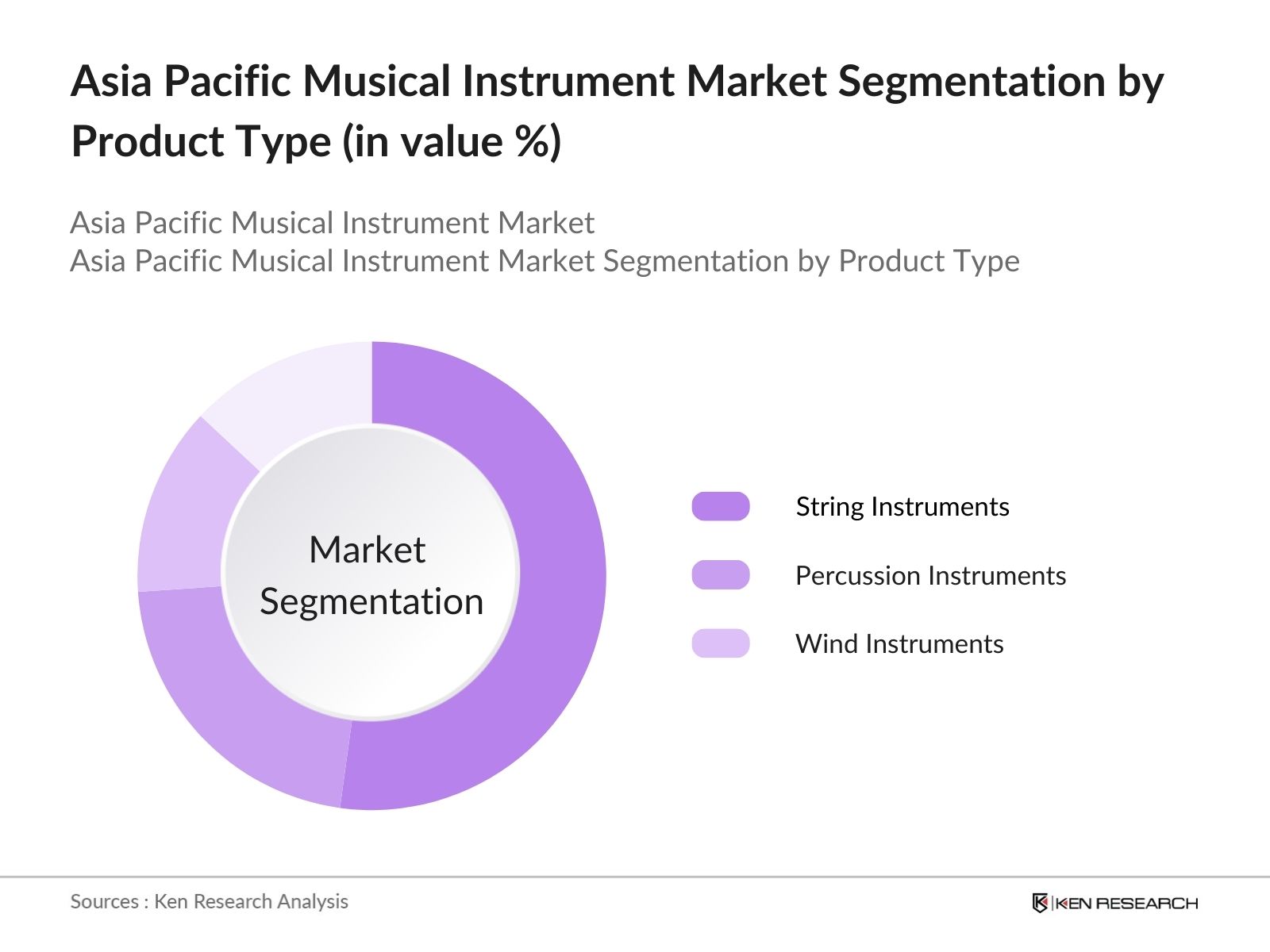
By Application: In terms of application, the market is segmented into music schools, individual/personal use, professional use/studios, concerts/live performances, and online music learning platforms. Music schools hold a dominant market share due to the rising trend of formal music education, especially in countries like China and Japan. The growing number of music schools and institutes, along with government subsidies for music education, drives demand in this segment. Moreover, the integration of music education in public schools further strengthens the position of this sub-segment. 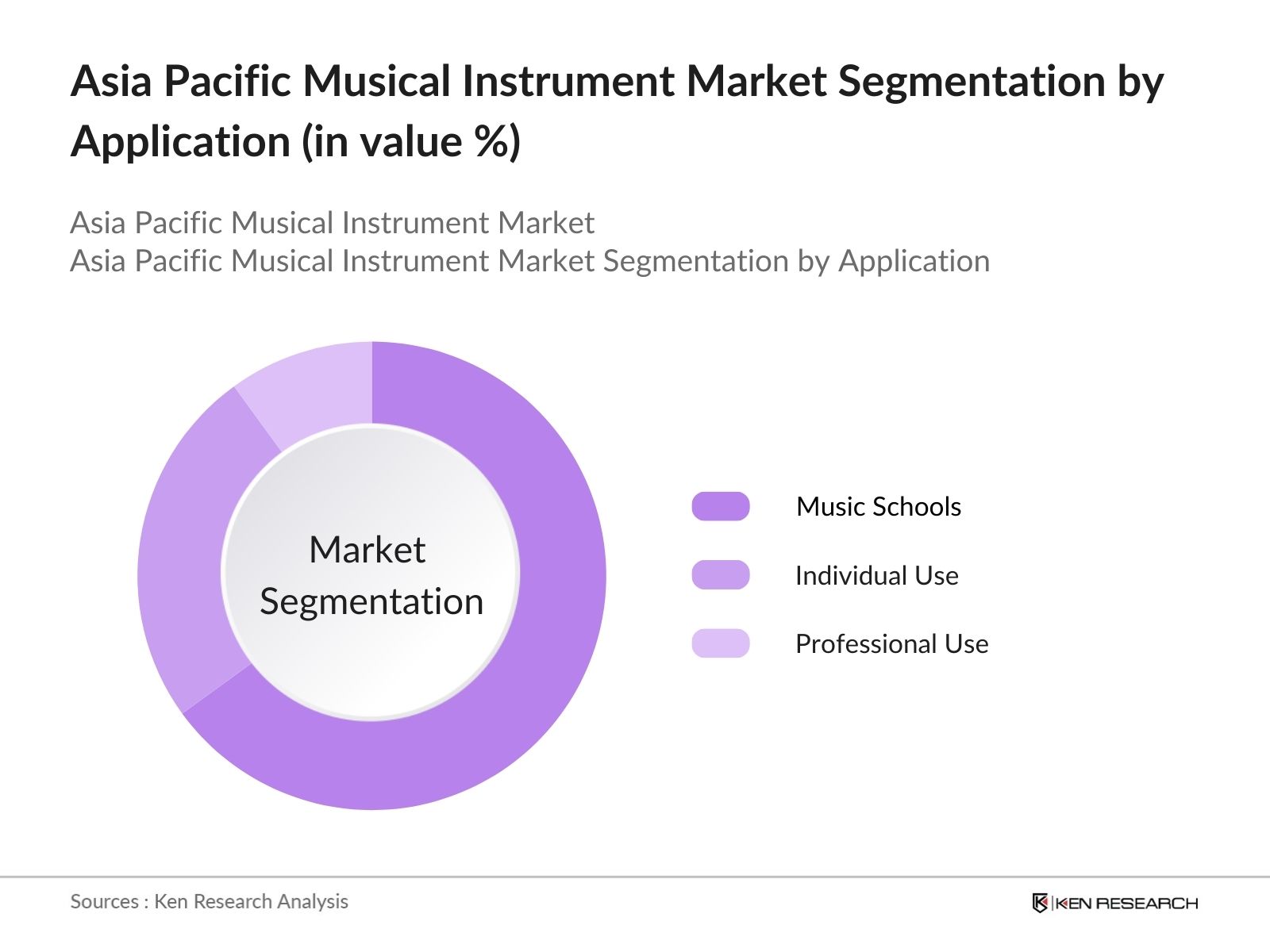
The Asia Pacific musical instrument market is dominated by several key players that include both local manufacturers and global brands. The presence of such well-established companies highlights the competitive nature of this market. The Asia Pacific musical instrument market is highly consolidated, with Yamaha Corporation, Kawai, Roland, and Casio dominating due to their extensive product offerings, high brand recognition, and superior quality control. These companies have continued to innovate, especially in the digital and electronic instrument sectors, securing their leadership in the market.
|
Company Name |
Establishment Year |
Headquarters |
Product Range |
R&D Investment |
Distribution Reach |
Market Penetration |
Revenue |
|
Yamaha Corporation |
1887 |
Japan |
|||||
|
Kawai Musical Instruments |
1927 |
Japan |
|||||
|
Roland Corporation |
1972 |
Japan |
|||||
|
Casio Computer Co., Ltd. |
1946 |
Japan |
|||||
|
Pearl Musical Instrument Co. |
1946 |
Japan |
Over the next five years, the Asia Pacific musical instrument market is expected to exhibit steady growth driven by the rising adoption of digital instruments, technological advancements like AI-powered learning, and increasing awareness of music education in emerging economies. Countries like China and India are expected to see the fastest growth due to expanding middle-class populations, increasing disposable incomes, and government policies promoting arts and music education. Furthermore, the shift toward online music learning platforms is anticipated to play a crucial role in shaping future market dynamics.
|
By Product Type |
String Instruments (Guitar, Violin, Cello) Percussion Instruments (Drums, Xylophone) Wind Instruments (Flute, Clarinet, Saxophone) Electronic Instruments (Digital Pianos, MIDI Controllers) |
|
|
|
|
|
|
|
|
|
|
|
|
|
By Application |
Music Schools Individual/Personal Use Professional Use/Studios Concerts/Live Performances Online Music Learning Platforms |
|
By Distribution Channel |
Offline Stores (Retail Shops, Music Stores) Online Channels (E-commerce, Direct Online Sales) |
|
By Material |
Wood Metal Synthetic Materials Hybrid Materials |
|
By Country |
China Japan India South Korea Australia |
1.1. Definition and Scope
1.2. Market Taxonomy
1.3. Market Growth Rate
1.4. Market Segmentation Overview
2.1. Historical Market Size
2.2. Year-on-Year Growth Analysis
2.3. Key Market Developments and Milestones
3.1. Growth Drivers
3.1.1. Increasing Disposable Income (Per Capita Disposable Income)
3.1.2. Cultural Influence and Rising Popularity of Music Education (Cultural Penetration Index)
3.1.3. Expansion of Online Music Instrument Sales (E-commerce Market Share)
3.1.4. Government Support and Music Education Policies (Government Educational Policies)
3.2. Market Challenges
3.2.1. Counterfeit Products and Unorganized Sector (Market Fragmentation)
3.2.2. High Cost of Musical Instruments (Price Sensitivity Analysis)
3.2.3. Economic Instability in Emerging Markets (Economic Volatility Index)
3.3. Opportunities
3.3.1. Integration of AI and IoT in Instruments (AI and IoT Adoption Rate in Music Sector)
3.3.2. Growth of DIY Music and Independent Musicians (Growth in Independent Music Scene)
3.3.3. Emerging Popularity of Digital and Electronic Instruments (Electronic Music Segment Growth Rate)
3.4. Trends
3.4.1. Rise in Mobile Music Production Applications (App Usage Growth)
3.4.2. Digital Platforms for Music Learning (Digital Learning Platform Market Penetration)
3.4.3. Sustainability Initiatives in Instrument Manufacturing (Green Initiatives in Manufacturing)
3.5. Government Regulation
3.5.1. Music Education Subsidies and Grants (Government Subsidy Trends)
3.5.2. Import Duties and Trade Regulations (Import Duty Regulations by Country)
3.5.3. Anti-Counterfeiting Measures in Music Industry (Anti-Counterfeiting Frameworks)
3.6. SWOT Analysis
3.7. Stakeholder Ecosystem
3.8. Porters Five Forces
3.9. Competitive Landscape Analysis
4.1. By Product Type (In Value %)
4.1.1. String Instruments (e.g., Guitar, Violin, Cello)
4.1.2. Percussion Instruments (e.g., Drums, Xylophone)
4.1.3. Wind Instruments (e.g., Flute, Clarinet, Saxophone)
4.1.4. Keyboards (e.g., Piano, Synthesizers, Organs)
4.1.5. Electronic Instruments (e.g., Digital Pianos, MIDI Controllers)
4.2. By Application (In Value %)
4.2.1. Music Schools
4.2.2. Individual/Personal Use
4.2.3. Professional Use/Studios
4.2.4. Concerts/Live Performances
4.2.5. Online Music Learning Platforms
4.3. By Distribution Channel (In Value %)
4.3.1. Offline Stores (Retail Shops, Music Stores)
4.3.2. Online Channels (E-commerce, Direct Online Sales)
4.4. By Material (In Value %)
4.4.1. Wood
4.4.2. Metal
4.4.3. Synthetic Materials
4.4.4. Hybrid Materials
4.5. By Country (In Value %)
4.5.1. China
4.5.2. Japan
4.5.3. India
4.5.4. South Korea
4.5.5. Australia
5.1. Detailed Profiles of Major Companies
5.1.1. Yamaha Corporation
5.1.2. Kawai Musical Instruments Mfg. Co. Ltd.
5.1.3. Roland Corporation
5.1.4. Casio Computer Co. Ltd.
5.1.5. Pearl Musical Instrument Company
5.1.6. Fender Musical Instruments Corporation
5.1.7. Gibson Brands, Inc.
5.1.8. Steinway & Sons
5.1.9. C.F. Martin & Company
5.1.10. Shure Incorporated
5.1.11. Harman International
5.1.12. Audio-Technica Corporation
5.1.13. Alesis
5.1.14. Kurzweil Music Systems
5.1.15. Hoshino Gakki Co. Ltd.
5.2. Cross Comparison Parameters (Product Portfolio Depth, Distribution Reach, Innovation Capability, Annual R&D Investment, Supply Chain Resilience, Consumer Perception, Brand Value, Market Share)
5.3. Market Share Analysis
5.4. Strategic Initiatives
5.5. Mergers and Acquisitions
5.6. Investment Analysis
5.7. Private Equity and Venture Capital Funding
5.8. Government Grants and Subsidies
6.1. Export and Import Regulations
6.2. Compliance and Safety Standards
6.3. Certification and Licensing
7.1. Future Market Size Projections
7.2. Key Factors Driving Future Market Growth
8.1. By Product Type (In Value %)
8.2. By Application (In Value %)
8.3. By Distribution Channel (In Value %)
8.4. By Material (In Value %)
8.5. By Country (In Value %)
9.1. TAM/SAM/SOM Analysis
9.2. Customer Segmentation Analysis
9.3. Competitive Positioning Strategy
9.4. Growth Opportunity Analysis
The initial step involves identifying the key stakeholders in the Asia Pacific musical instrument market, which includes manufacturers, distributors, consumers, and educational institutions. Using secondary research, including industry reports and market studies, we mapped out the major influencing factors for the market, such as consumer trends, product innovations, and government initiatives.
In this phase, historical data for the Asia Pacific musical instrument market was compiled, covering the sales of various instruments and their applications. Data was gathered from national music associations and government reports. We analyzed the growth rates of different product segments, including both traditional and digital instruments, to assess their impact on overall market revenue.
Key market assumptions were validated through expert interviews with professionals from leading companies such as Yamaha and Roland. These interviews provided insights into the changing preferences of consumers, the impact of emerging technologies, and the outlook for different product categories.
The final stage of the research included synthesizing all the data and insights gathered from primary and secondary sources. This was followed by the preparation of a detailed report, ensuring the accuracy of market size estimations and segmentation analysis.
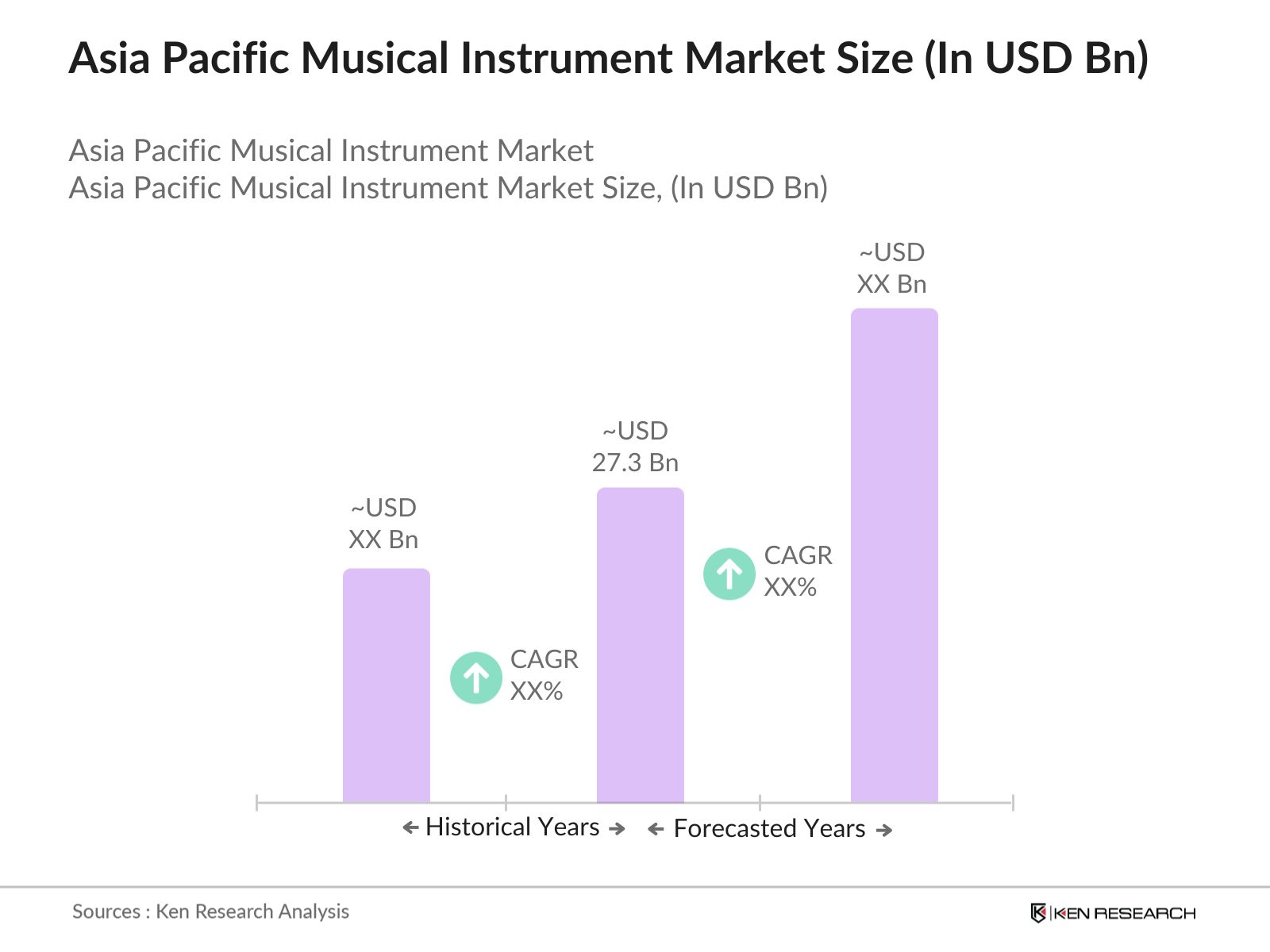
The Asia Pacific musical instrument market is valued at USD 27.3 billion, driven by increasing consumer spending on music education and rising demand for modern electronic instruments across key countries.
Challenges in the Asia Pacific musical instrument market includes high competition from counterfeit products, the unorganized sector, and economic instability in emerging markets, which can hinder the growth of high-end instrument sales.
The Asia Pacific musical instrument market is dominated by key players such as Yamaha Corporation, Kawai Musical Instruments, Roland Corporation, Casio Computer Co., and Pearl Musical Instrument Company. These companies lead in terms of innovation and market presence.
Key growth drivers in the Asia Pacific musical instrument market include the rising popularity of music education, government support for arts programs, and the integration of advanced technologies like AI and IoT in musical instruments.
Trends in the Asia Pacific musical instrument market such as the increasing use of digital platforms for music learning, the growing preference for electronic instruments, and the emergence of AI-powered music production tools are shaping the market's future trajectory.

What makes us stand out is that our consultants follows Robust, Refine and Result (RRR) methodology. i.e. Robust for clear definitions, approaches and sanity checking, Refine for differentiating respondents facts and opinions and Result for presenting data with story

We have set a benchmark in the industry by offering our clients with syndicated and customized market research reports featuring coverage of entire market as well as meticulous research and analyst insights.

While we don't replace traditional research, we flip the method upside down. Our dual approach of Top Bottom & Bottom Top ensures quality deliverable by not just verifying company fundamentals but also looking at the sector and macroeconomic factors.

With one step in the future, our research team constantly tries to show you the bigger picture. We help with some of the tough questions you may encounter along the way: How is the industry positioned? Best marketing channel? KPI's of competitors? By aligning every element, we help maximize success.

Our report gives you instant access to the answers and sources that other companies might choose to hide. We elaborate each steps of research methodology we have used and showcase you the sample size to earn your trust.

If you need any support, we are here! We pride ourselves on universe strength, data quality, and quick, friendly, and professional service.