
Asia-Pacific MVNO Market Outlook to 2030
Region:Asia
Author(s):Vijay Kumar
Product Code:KROD1192
December 2024
85
About the Report
Asia-Pacific MVNO Market Overview
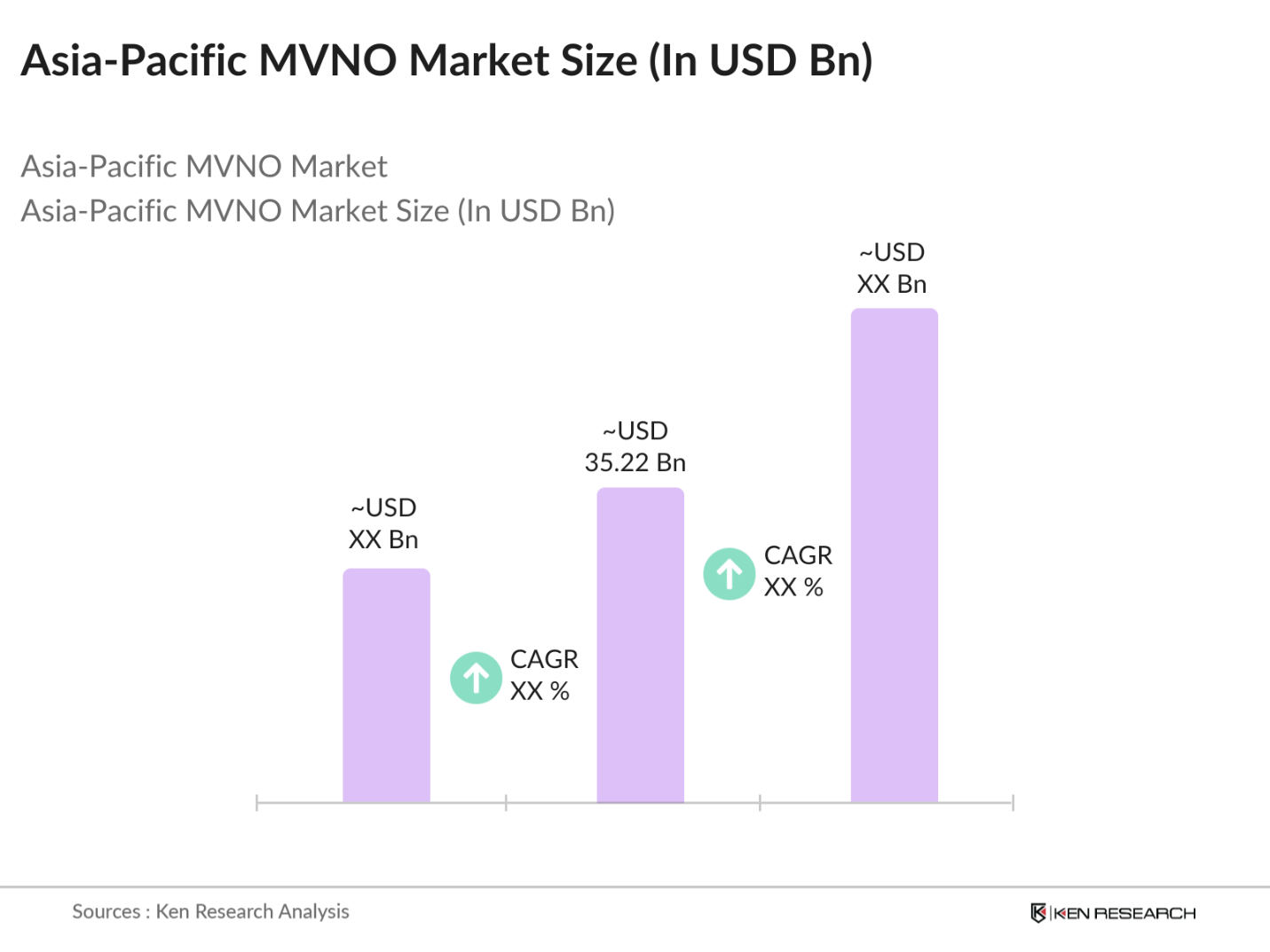
- The Asia-Pacific MVNO market was valued at USD 35.22 billion in 2023. The market is driven by increasing smartphone penetration, rising mobile data consumption, and the expansion of 5G networks. Government initiatives supporting digital transformation and technological advancements in eSIM technology are further bolstering market growth.
- Major players in the Asia-Pacific MVNO market include Virgin Mobile, Lebara Mobile, KDDI Mobile, Circles.Life, and China Telecom. These companies are known for their strong brand presence, innovative service offerings, and strategic partnerships. Their continuous investments in technology and customer service enhancements support their leadership positions in the market.
- In 2023, Virgin Mobile announced its strategic partnership with Huawei to deploy 5G technology across its network in Southeast Asia. This collaboration aims to enhance network capabilities and offer high-speed internet services to customers. The rollout is expected to cover major cities in Thailand, Indonesia, and Malaysia by the end of 2024, significantly boosting the MVNOs service offerings and competitive edge in the region.
- Tokyo, Seoul, and Sydney are among the dominant cities in the Asia-Pacific MVNO market. Tokyo leads due to its advanced technological infrastructure and high consumer spending on mobile services. Seouls dominance is driven by its rapid adoption of 5G technology and innovative digital services. Sydneys strong market presence is attributed to its robust telecom infrastructure and high penetration of smartphones, fostering a competitive MVNO environment.
Asia-Pacific MVNO Market Segmentation
By Business Model: The Asia-Pacific MVNO market is segmented by business model into Full MVNOs, Service Operator MVNOs, and Reseller MVNOs. In 2023, Full MVNOs dominated the market due to their comprehensive control over core network elements and customer relationships. These MVNOs offer differentiated services and enhanced customer experiences, attracting a diverse customer base.

By Subscriber Type: The market is segmented by subscriber type into Consumer MVNOs, Enterprise MVNOs, and M2M MVNOs. In 2023, Consumer MVNOs held a dominant market share. The increasing demand for budget-friendly mobile services and innovative marketing strategies have enabled Consumer MVNOs to capture a large customer base.

By Region: The market is segmented by region into China, Japan, India, South Korea, Indonesia, Rest of APAC. Dominated by China and Japan, the northern region has the highest market share due to significant industrial activities, technological advancements, and large-scale 5G projects.
Asia-Pacific MVNO Market Competitive Landscape
|
Company |
Establishment Year |
Headquarters |
|
Virgin Mobile |
1999 |
London, UK |
|
Lebara Mobile |
2001 |
London, UK |
|
KDDI Mobile |
2005 |
Tokyo, Japan |
|
Circles.Life |
2016 |
Singapore |
|
China Telecom |
2002 |
Beijing, China |
- Lebara Mobile: Lebara Mobile launched new international calling plans in 2023, targeting expatriate communities in Australia and New Zealand. These plans offer competitive rates and high-quality services, enabling Lebara to strengthen its market position in the Asia-Pacific region. The companys focus on catering to niche markets has been instrumental in its continued growth and success.
- China Telecom: In March 2024, China Mobile International (CMI) and Singapore Telecommunications Limited (Singtel) signed an MoU at the Mobile World Congress 2024. This agreement, aimed at developing innovative connectivity solutions for enterprise customers in China and Singapore, also seeks to expand their business across the broader Asia-Pacific region, impacting over 500 million potential users.
Asia-Pacific MVNO Market Analysis
Asia-Pacific MVNO Market Growth Drivers
- Increasing Smartphone Penetration: The Asia-Pacific region has witnessed significant growth in smartphone adoption, with 2.3 billion smartphone users in 2024, up from 2.1 billion in 2023. This increase in smartphone penetration drives the demand for MVNO services, as more consumers seek affordable and flexible mobile plans. Countries like India and China lead the market, with smartphone shipments reaching 200 million units in India and 340 million units in China in 2024, enhancing the MVNO markets expansion.
- Rising Mobile Data Consumption: Mobile data consumption in the Asia-Pacific region has surged, with an average user consuming 14 GB of data per month in 2024, compared to 11 GB in 2023. This growth is driven by the increasing use of video streaming, social media, and online gaming. MVNOs capitalize on this trend by offering competitive data plans, attracting data-hungry consumers and boosting their market share. For instance, Japan and South Korea report some of the highest data usage rates, further propelling the market.
- Expansion of 5G Networks: The rollout of 5G networks across the Asia-Pacific region significantly enhances the MVNO market. By 2024, over 650 million 5G subscriptions are expected in the region, with countries like China, Japan, and South Korea leading the deployment. The superior speed and connectivity of 5G technology enable MVNOs to offer advanced services, such as IoT and augmented reality applications, attracting a broader customer base and driving market growth.
Asia-Pacific MVNO Market Challenges
- Regulatory Barriers: Regulatory challenges persist in the Asia-Pacific MVNO market, with varying policies across countries. For instance, in India, the Telecom Regulatory Authority of India (TRAI) imposes stringent guidelines on MVNO operations, affecting their market entry and growth. Similarly, Chinas complex licensing procedures and market access restrictions pose significant hurdles for MVNOs, limiting their expansion and operational flexibility.
- Intense Competition: The Asia-Pacific MVNO market is highly competitive, with numerous players vying for market share. Major telecom operators, such as China Mobile and NTT Docomo, dominate the market, making it challenging for MVNOs to establish a foothold. The presence of well-established MVNOs like Virgin Mobile and Lebara Mobile further intensifies the competition, requiring new entrants to invest heavily in marketing and customer acquisition strategies.
Asia-Pacific MVNO Market Government Initiatives
- Rapid 5G Adoption in India: Since the launch of 5G technology in 4Q 2022, Indian MNOs have rapidly rolled out 5G networks, achieving a 20.8% share of mobile connections in India by 1Q 2024. This swift adoption highlights the significant penetration of 5G within the country's mobile market.
- China Mobile International (CMI): In March 2024, China Mobile International (CMI) and Singapore Telecommunications Limited (Singtel) signed a Memorandum of Understanding (MoU) to develop innovative connectivity solutions for enterprises in China and Singapore. The agreement also aims to broaden their business operations throughout the Asia-Pacific region, enhancing their market presence and collaboration.
Asia-Pacific MVNO Market Future Outlook
Asia-Pacific MVNO Market Future Trends
- Growth of IoT Connectivity: By 2028, the Asia-Pacific MVNO market will see substantial growth driven by the proliferation of IoT devices. The number of connected IoT devices is expected to exceed 8 billion, creating significant opportunities for MVNOs to offer specialized IoT connectivity solutions. This trend will be supported by advancements in 5G technology, enabling seamless connectivity and driving the adoption of smart city applications, industrial automation, and connected healthcare.
- Increased Focus on Data Security: With the growing importance of data privacy and security, MVNOs will prioritize robust security measures to protect customer data. By 2028, regulatory frameworks will mandate stringent data protection standards, compelling MVNOs to invest in advanced security technologies. This focus on data security will enhance customer trust and compliance, positioning MVNOs as reliable service providers in an increasingly digital landscape.
Scope of the Report
|
By Business Model |
Full MVNOs Service Operator MVNOs Reseller MVNOs |
|
By Subscriber |
Consumer MVNOs Enterprise MVNOs M2M MVNOs |
|
By Region |
China Japan India South Korea Indonesia Rest of APAC |
Products
Key Target Audience
Mobile Network Operators (MNOs)
Telecom Infrastructure Providers
Mobile Device Manufacturers
Application Developers
Government and Regulatory Bodies
SMEs
IoT Solution Providers
Digital Service Providers
Retail and E-commerce Companies
Time Period Captured in the Report
Historical Period: 2018-2023
Base Year: 2023
Forecast Period: 2023-2028
Companies
Players Mentioned in the Report
Virgin Mobile
Lebara Mobile
KDDI Mobile
Circles.Life
China Telecom
TPG Telecom
Optus
SK Telecom
NTT Docomo
Reliance Jio
Table of Contents
1. Asia-Pacific MVNO Market Overview
1.1. Definition and Scope
1.2. Market Taxonomy
1.3. Market Growth Rate
1.4. Market Segmentation Overview
2. Asia-Pacific MVNO Market Size (in USD Bn), 2018-2023
2.1. Historical Market Size
2.2. Year-on-Year Growth Analysis
2.3. Key Market Developments and Milestones
3. Asia-Pacific MVNO Market Analysis
3.1. Growth Drivers
3.1.1. Increased Smartphone Penetration
3.1.2. Rising Mobile Data Consumption
3.1.3. Expansion of 5G Networks
3.1.4. Government Digital Transformation Initiatives
3.2. Restraints
3.2.1. Regulatory Barriers
3.2.2. Intense Competition
3.2.3. Technological Integration Issues
3.3. Opportunities
3.3.1. Adoption of eSIM Technology
3.3.2. Expansion into Emerging Markets
3.3.3. Partnerships with OTT Service Providers
3.4. Trends
3.4.1. Growth in Niche MVNO Segments
3.4.2. Increasing Use of Mobile Virtual Network Enablers (MVNEs)
3.4.3. Development of Customized Data Plans
3.5. Government Regulation
3.5.1. Telecommunications Regulatory Frameworks
3.5.2. Policies on MVNO Licensing
3.5.3. Data Privacy and Security Regulations
3.6. SWOT Analysis
3.7. Stake Ecosystem
3.8. Competition Ecosystem
4. Asia-Pacific MVNO Market Segmentation, 2023
4.1. By Business Model Type (in Value %)
4.1.1. Full MVNOs
4.1.2. Service Operator MVNOs
4.1.3. Reseller MVNOs
4.2. By Subscriber Type (in Value %)
4.2.1. Consumer MVNOs
4.2.2. Enterprise MVNOs
4.2.3. M2M MVNOs
4.4. By Region (in Value %)
4.4.1. China
4.4.2. Japan
4.4.3. India
4.4.4. South Korea
4.4.5. Indonesia
4.4.6. APAC
5. Asia-Pacific MVNO Market Cross Comparison
5.1. Detailed Profiles of Major Companies
5.1.1. Virgin Mobile
5.1.2. Lebara Mobile
5.1.3. KDDI Mobile
5.1.4. Circles.Life
5.1.5. China Telecom
5.1.6. TPG Telecom
5.1.7. Hutchison 3
5.1.8. Optus
5.1.9. MobileOne
5.1.10. Telstra
5.1.11. AIS
5.1.12. Singtel
5.1.13. MyRepublic
5.1.14. TrueMove H
5.1.15. Digi Telecommunications
5.2. Cross Comparison Parameters (No. of Employees, Headquarters, Inception Year, Revenue)
6. Asia-Pacific MVNO Market Competitive Landscape
6.1. Market Share Analysis
6.2. Strategic Initiatives
6.3. Mergers and Acquisitions
6.4. Investment Analysis
6.4.1. Venture Capital Funding
6.4.2. Government Grants
6.4.3. Private Equity Investments
7. Asia-Pacific MVNO Market Regulatory Framework
7.1. Telecommunications Regulatory Policies
7.2. Licensing Requirements
7.3. Data Privacy and Security Regulations
8. Asia-Pacific MVNO Future Market Size (in USD Bn), 2023-2028
8.1. Future Market Size Projections
8.2. Key Factors Driving Future Market Growth
9. Asia-Pacific MVNO Future Market Segmentation, 2028
9.1. By Service Type (in Value %)
9.2. By Customer Type (in Value %)
9.3. By Technology (in Value %)
9.4. By Region (in Value %)
10. Asia-Pacific MVNO Market Analysts Recommendations
10.1. TAM/SAM/SOM Analysis
10.2. Customer Cohort Analysis
10.3. Marketing Initiatives
10.4. White Space Opportunity Analysis
Disclaimer
Contact Us
Research Methodology
Step 1: Identifying Key Variables
Develop a comprehensive ecosystem involving all major MVNO entities and refer to a range of secondary and proprietary databases. Perform desk research to gather and collate industry-level information on the MVNO market.
Step 2: Market Building
Gather statistics on the Asia-Pacific MVNO market over the years. Analyze the penetration of marketplaces and the ratio of service providers to calculate the revenue generated. Review service quality metrics to ensure accuracy in the revenue data and understand market dynamics.
Step 3: Validating and Finalizing
Formulate market hypotheses and conduct Computer-Assisted Telephone Interviews (CATIs) with industry experts from various MVNO companies. Validate the statistics and seek detailed operational and financial insights from company representatives to confirm data accuracy.
Step 4: Research Output
Engage with key MVNO companies to understand their product segments, sales patterns, and consumer preferences. This approach will help validate the statistics derived through a bottom-up analysis and ensure that the research findings are robust and reliable.
Frequently Asked Questions
1. How big is the Asia-Pacific MVNO market?
The Asia-Pacific MVNO market was valued at USD 35.22 billion in 2023. The market is driven by increasing smartphone penetration, rising mobile data consumption, and the expansion of 5G networks.
2. What are the challenges in the Asia-Pacific MVNO market?
Challenges include regulatory barriers, intense competition from established telecom operators, and technological integration issues, such as the deployment of eSIM and IoT technologies, which require significant investment and expertise.
3. Who are the major players in the Asia-Pacific MVNO market?
Key players in the market include Virgin Mobile, Lebara Mobile, KDDI Mobile, Circles.Life, and China Telecom. These companies lead the market due to their strong brand presence, innovative service offerings, and strategic partnerships.
4. What are the growth drivers of the Asia-Pacific MVNO market?
The market is propelled by the increasing adoption of smartphones, rising mobile data consumption, and the expansion of 5G networks. The adoption of eSIM technology and government initiatives supporting digital transformation also contribute to market growth.
Why Buy From Us?

What makes us stand out is that our consultants follows Robust, Refine and Result (RRR) methodology. i.e. Robust for clear definitions, approaches and sanity checking, Refine for differentiating respondents facts and opinions and Result for presenting data with story

We have set a benchmark in the industry by offering our clients with syndicated and customized market research reports featuring coverage of entire market as well as meticulous research and analyst insights.

While we don't replace traditional research, we flip the method upside down. Our dual approach of Top Bottom & Bottom Top ensures quality deliverable by not just verifying company fundamentals but also looking at the sector and macroeconomic factors.

With one step in the future, our research team constantly tries to show you the bigger picture. We help with some of the tough questions you may encounter along the way: How is the industry positioned? Best marketing channel? KPI's of competitors? By aligning every element, we help maximize success.

Our report gives you instant access to the answers and sources that other companies might choose to hide. We elaborate each steps of research methodology we have used and showcase you the sample size to earn your trust.

If you need any support, we are here! We pride ourselves on universe strength, data quality, and quick, friendly, and professional service.