
Asia Pacific Nylon Market Outlook to 2030
Region:Asia
Author(s):Shambhavi
Product Code:KROD3975
November 2024
83
About the Report
Asia Pacific Nylon Market Overview
- The Asia Pacific Nylon Market is currently valued at USD 980 billion, based on a five-year historical analysis. This market's growth is driven by increasing demand from the automotive, textiles, and industrial sectors. The rising use of nylon in engineering plastics, textile fibers, and packaging applications plays a significant role in expanding its adoption. The market is also influenced by advancements in bio-based nylon production, which appeal to environmentally conscious manufacturers and consumers. Increased investments in eco-friendly materials are further stimulating the nylon market's growth in the region.
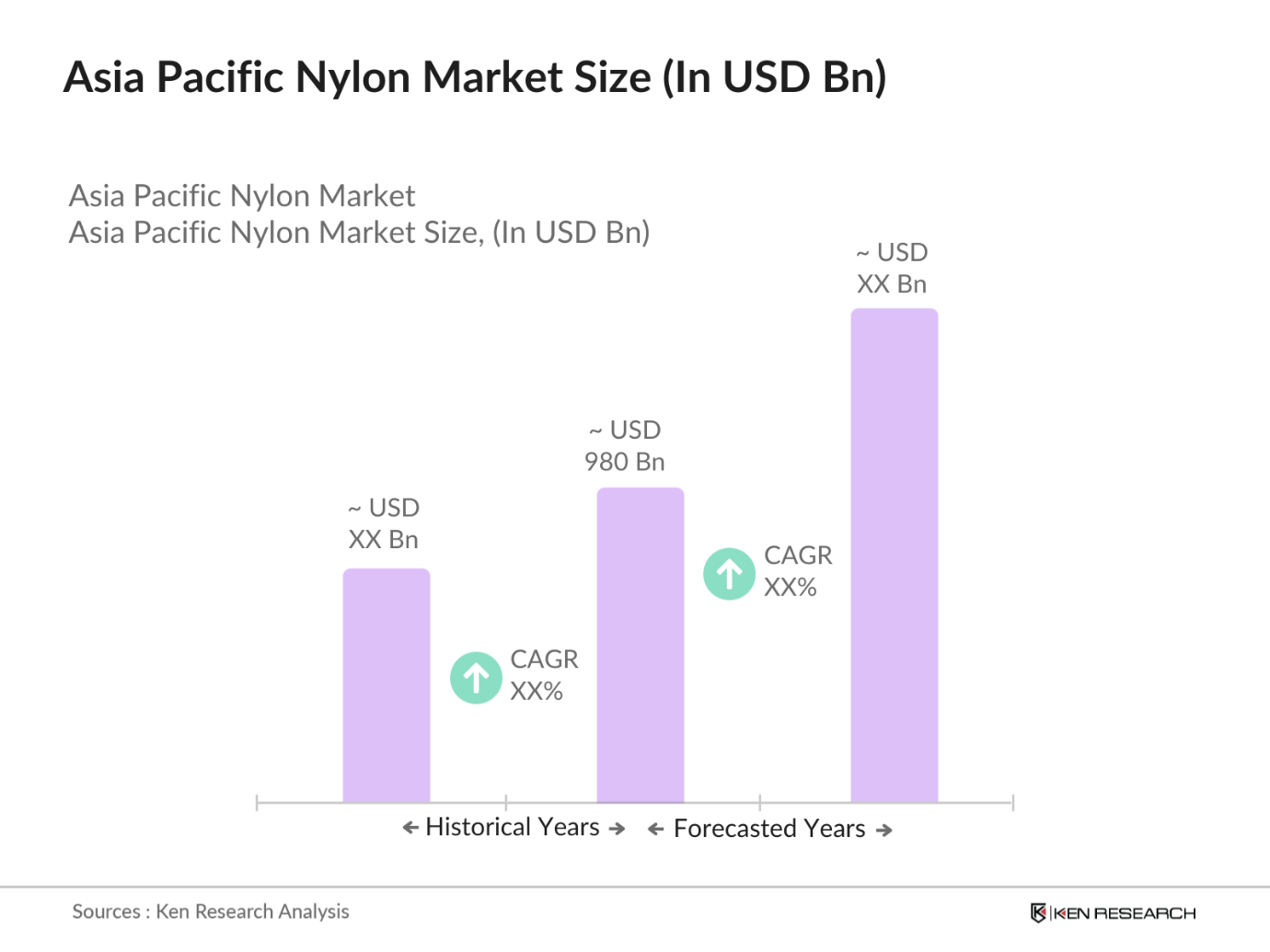
- Countries like China, Japan, and India dominate the Asia Pacific Nylon Market due to their well-established automotive and textiles industries. China, in particular, stands out due to its strong manufacturing base and the high demand for industrial applications. The country's large-scale production facilities and lower manufacturing costs give it an edge in this market. Meanwhile, Japan's advanced technology in engineering plastics and India's growing textile sector contribute significantly to the dominance of these regions.
- Stringent emission standards in the Asia Pacific region are impacting nylon production processes. In 2023, China implemented new emission regulations targeting high-emission industries, including petrochemicals and nylon manufacturing. These standards are part of Chinas broader strategy to achieve carbon neutrality by 2060. The new regulations mandate the adoption of cleaner technologies, pushing nylon manufacturers to invest in low-emission production methods.
Asia Pacific Nylon Market Segmentation
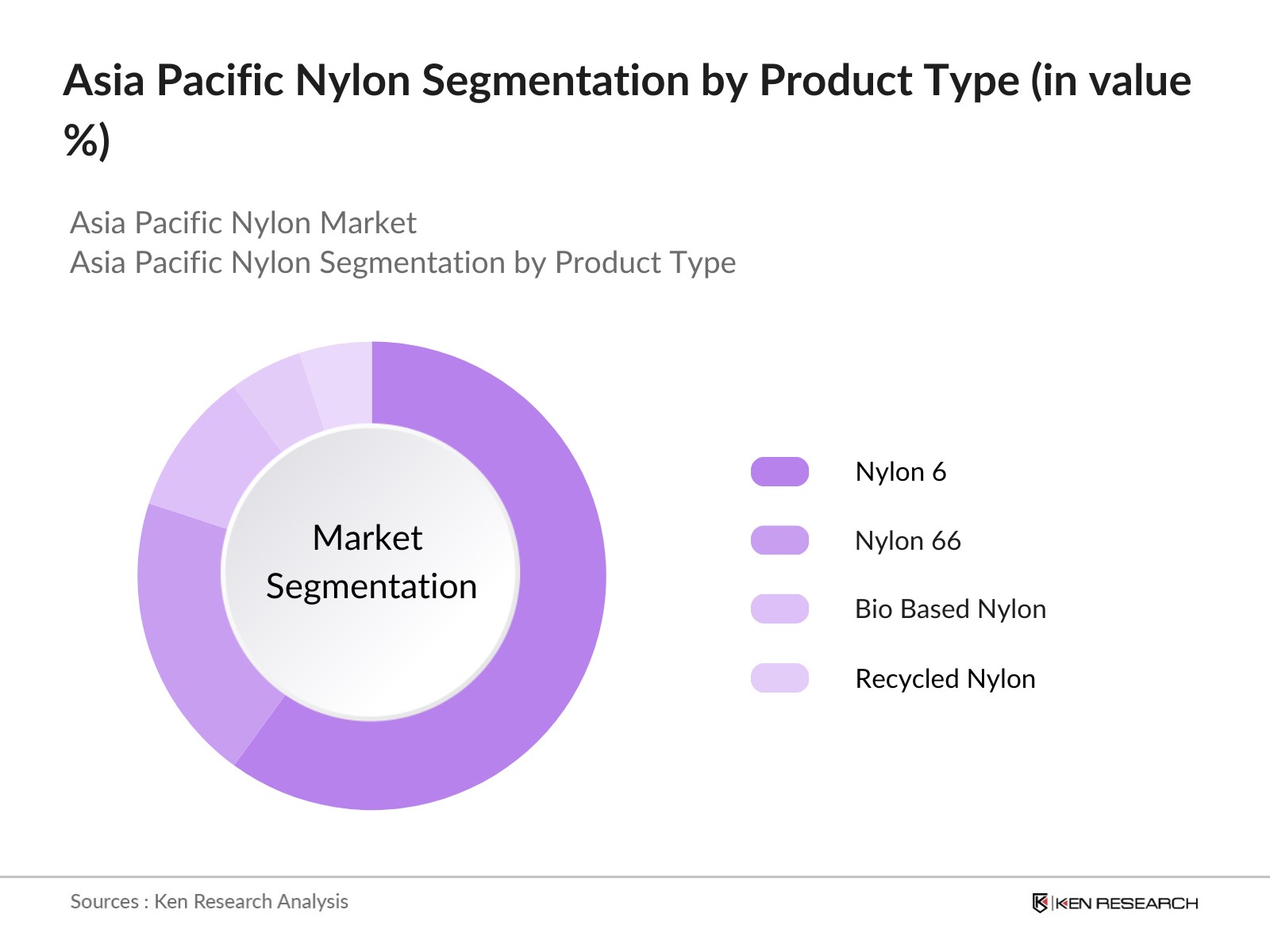
By Product Type: The Asia Pacific Nylon Market is segmented by product type into Nylon 6, Nylon 66, bio-based nylon, and recycled nylon. Nylon 6 holds a dominant market share in the region due to its versatile applications in textiles, automotive components, and industrial goods. Its lower production cost compared to Nylon 66 and its ability to provide high tensile strength make it a preferred choice among manufacturers. The widespread use of Nylon 6 in engineering plastics and textile fibers has solidified its position in the Asia Pacific market, particularly in industries that require durability and flexibility.
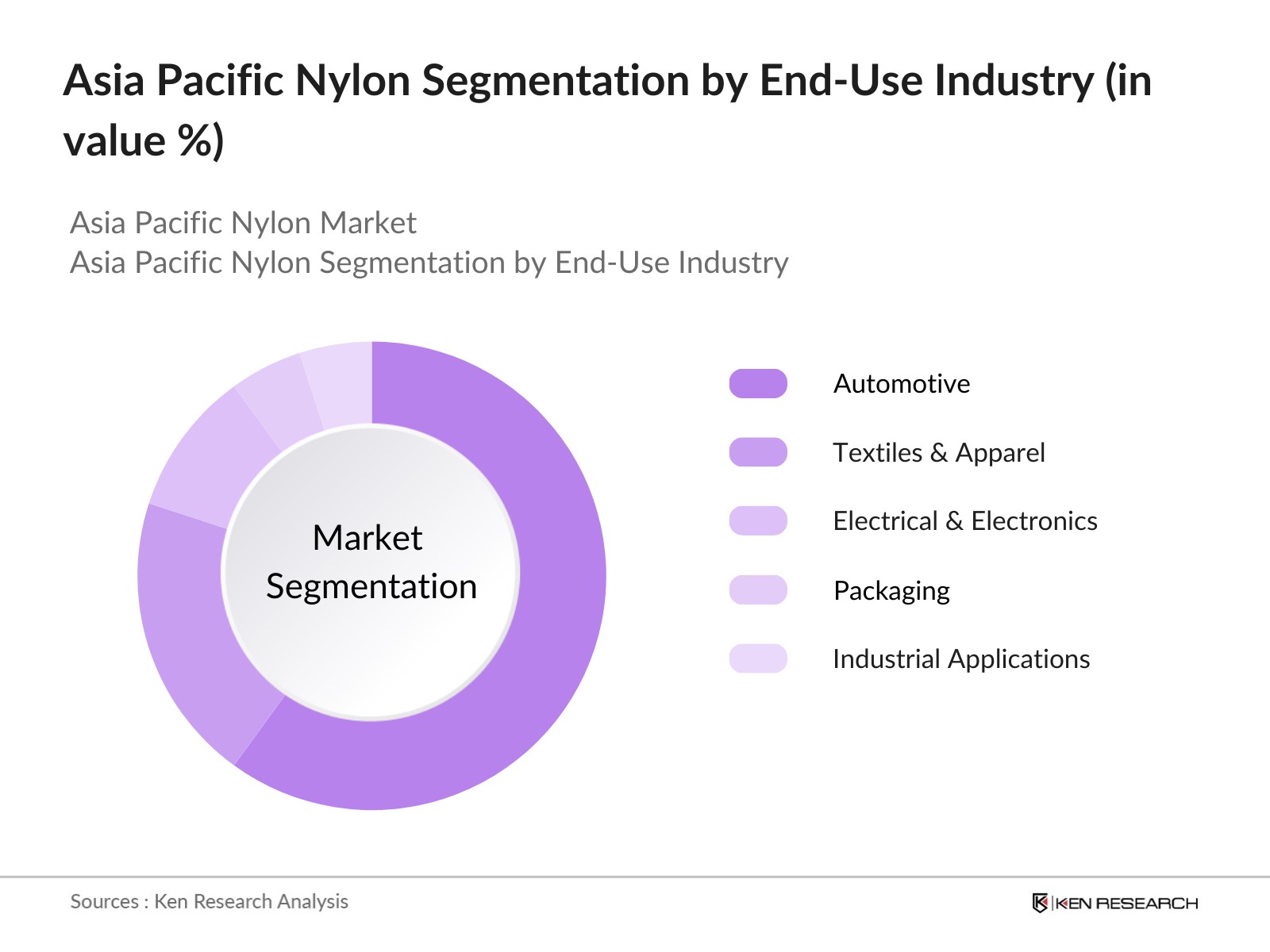
By End-Use Industry: The Asia Pacific Nylon Market is also segmented by end-use industry into automotive, textiles & apparel, electrical & electronics, packaging, and industrial applications. The automotive industry dominates this segment due to the increasing demand for lightweight, high-strength materials that improve fuel efficiency. Nylons properties, such as resistance to heat and wear, make it suitable for automotive parts, including air intake manifolds, radiator end tanks, and engine covers. In addition, the shift towards electric vehicles in key markets like China and Japan has further amplified the demand for nylon in automotive applications.
Asia Pacific Nylon Market Competitive Landscape
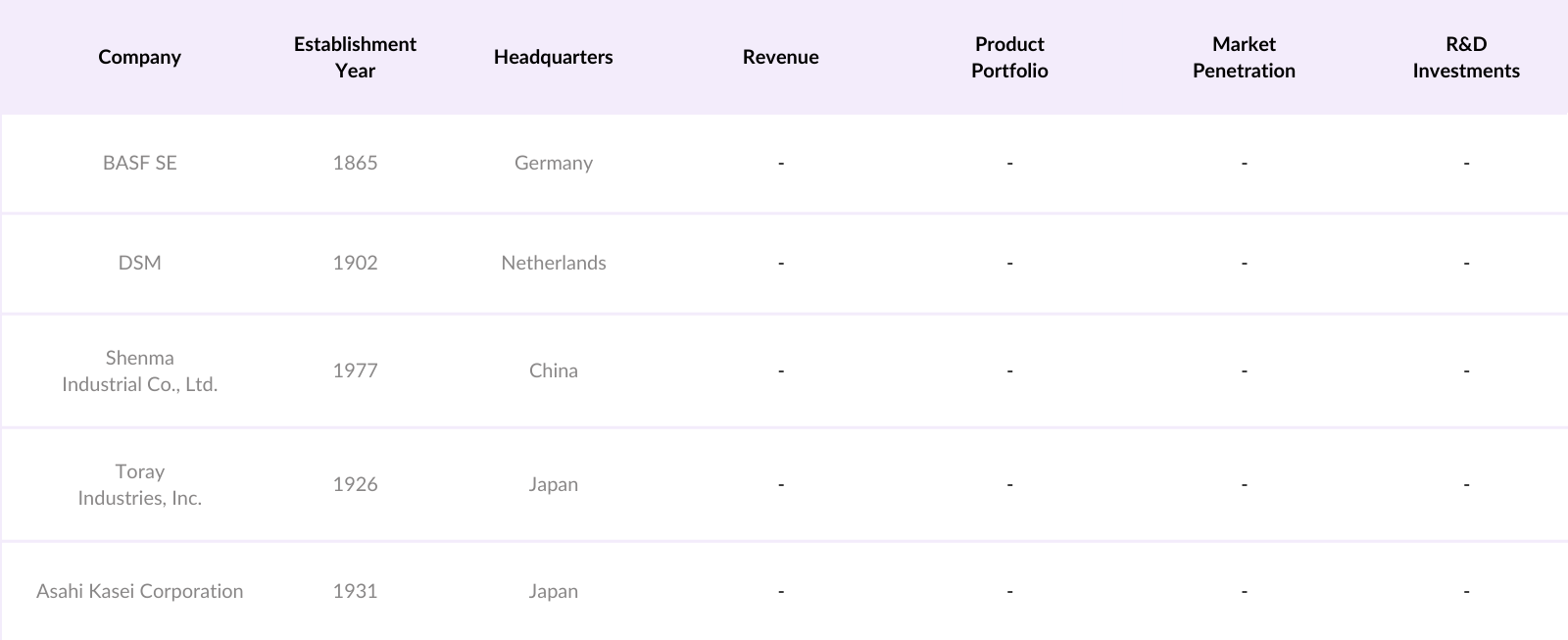
The Asia Pacific Nylon Market is dominated by both regional and global players. Major companies such as BASF SE and DSM maintain strong presences due to their expansive product portfolios and advanced R&D capabilities. Local manufacturers like Shenma Industrial Co., Ltd. benefit from favorable government policies and access to low-cost raw materials, contributing to their market influence. Global players are also focusing on sustainability initiatives by increasing investments in bio-based nylon production, further differentiating themselves in this competitive market.
Asia Pacific Nylon Market Analysis
Growth Drivers
- Increasing Demand from Automotive Industry: The Asia Pacific automotive industry is witnessing a surge in demand for nylon, driven by the shift towards lightweight, fuel-efficient vehicles. Nylon is heavily used in automotive components like airbags, engine covers, and wiring harnesses due to its high tensile strength and heat resistance. According to the World Bank, Asia Pacific's automotive sector, especially in China, saw the production of over 23 million cars in 2023. This demand correlates with the increasing need for durable and lightweight materials like nylon to reduce vehicle weight and enhance fuel efficiency.
- Growing Investments in Nylon 6 and Nylon 66: The Asia Pacific region is seeing significant investments in Nylon 6 and Nylon 66 production, especially in markets like India and South Korea. Major players are expanding capacity to cater to increasing demand from automotive and textile industries. For instance, India witnessed a 15% rise in investments in polymer production, with several new projects approved in 2023. In China, over USD 8 billion was invested in new nylon manufacturing facilities in the past three years, reflecting the strategic importance of nylon in industrial applications.
- Eco-friendly Innovations in Nylon Production: As environmental concerns rise, companies in Asia Pacific are increasingly focusing on producing eco-friendly nylon. This includes innovations like bio-based nylon, which reduces reliance on fossil fuels. Japan has invested over USD 500 million in research to develop bio-based and recyclable nylons, while South Korea is focusing on low-carbon production methods. These innovations are supported by regional initiatives aimed at reducing carbon emissions, as countries like China and Japan push for carbon neutrality by 2060. According to the IMF, Chinas carbon-neutrality plans are anticipated to impact all major industries, including polymers like nylon.
Market Challenges
- Fluctuating Raw Material Prices: Nylon production relies heavily on petrochemical derivatives, such as caprolactam, which are subject to volatile pricing due to fluctuating crude oil prices. In 2023, crude oil prices varied between USD 70 and USD 100 per barrel, significantly affecting nylon production costs across Asia Pacific. The region's dependence on oil imports, particularly in countries like Japan and South Korea, further exacerbates this volatility. According to the World Bank, the region's reliance on oil imports is expected to impact material costs, presenting a significant challenge for manufacturers.
- Regulatory Restrictions on Environmental Impact: Governments across Asia Pacific are imposing stricter regulations on nylon production due to its environmental impact, particularly in terms of greenhouse gas emissions. Chinas Ministry of Ecology and Environment introduced new guidelines in 2023 to limit emissions from petrochemical industries, including nylon production. The new regulations require companies to adopt eco-friendly production processes, which can increase operational costs. The regulatory push aligns with China's goal of reducing emissions by 65% from 2005 levels by 2030.
Asia Pacific Nylon Market Future Outlook
Over the next five years, the Asia Pacific Nylon Market is expected to experience strong growth, driven by the increasing demand for sustainable and bio-based nylon materials. The region's automotive and textile industries will continue to be the key growth drivers, with advancements in lightweight materials and eco-friendly fibers playing a pivotal role. The expansion of electric vehicles in China and Japan, combined with the growth of the technical textiles sector in India, will provide significant opportunities for nylon manufacturers to capitalize on this demand. Moreover, investments in bio-based and recycled nylon technologies are expected to become more prominent, shaping the future of the industry.
Market Opportunities
- Expanding Applications in Electrical & Electronics: The electrical and electronics sector in Asia Pacific is expanding rapidly, providing new opportunities for nylon applications. Nylons excellent insulation and durability make it an ideal material for electronic components like connectors, housings, and circuit boards. According to the World Bank, the electronics manufacturing output in Asia Pacific, led by countries like China, South Korea, and Japan, surpassed USD 500 billion in 2023. This sector's growth opens up substantial demand for nylon-based components, especially as the region focuses on high-tech industries such as 5G and semiconductor manufacturing.
- Technological Advancements in Bio-based Nylon: Technological advancements in bio-based nylon production are opening up new growth avenues in Asia Pacific. Countries like Japan and South Korea are at the forefront of this shift, investing in bio-based polymer research. In 2023, Japan allocated USD 1 billion to the development of biodegradable plastics and polymers, including nylon. These advancements cater to increasing consumer demand for sustainable products, as well as government initiatives to reduce the carbon footprint of industries.
Products
Key Target Audience
Nylon Manufacturers
Automotive OEMs
Textile Manufacturers
Electrical & Electronics Companies
Industrial Product Manufacturers
Packaging Companies
Investor and Venture Capitalist Firms
Government and Regulatory Bodies (Chinas Ministry of Industry and Information Technology, Japans Ministry of Economy, Trade and Industry)
Companies
Players Mentioned In the report
BASF SE
DSM
Ube Industries, Ltd.
Asahi Kasei Corporation
Toray Industries, Inc.
Lanxess AG
Ascend Performance Materials
DuPont
Radici Group
Shenma Industrial Co., Ltd.
Hyosung Corporation
Aquafil S.p.A
INVISTA
Li Peng Enterprise Co., Ltd.
EMS-Chemie Holding AG
Table of Contents
1. Asia Pacific Nylon Market Overview
1.1. Definition and Scope
1.2. Market Taxonomy
1.3. Market Growth Rate
1.4. Market Segmentation Overview
2. Asia Pacific Nylon Market Size (In USD Mn)
2.1. Historical Market Size
2.2. Year-On-Year Growth Analysis
2.3. Key Market Developments and Milestones
3. Asia Pacific Nylon Market Analysis
3.1. Growth Drivers
3.1.1. Increasing Demand from Automotive Industry
3.1.2. Rising Textile and Apparel Applications
3.1.3. Growing Investments in Nylon 6 and Nylon 66
3.1.4. Eco-friendly Innovations in Nylon Production
3.2. Market Challenges
3.2.1. Fluctuating Raw Material Prices
3.2.2. Regulatory Restrictions on Environmental Impact
3.2.3. Competition from Alternative Materials (Polyester, Polypropylene)
3.3. Opportunities
3.3.1. Expanding Applications in Electrical & Electronics
3.3.2. Technological Advancements in Bio-based Nylon
3.3.3. Growth of the Asia Pacific Textile Industry
3.4. Trends
3.4.1. Shift Towards Sustainable Nylon Production
3.4.2. Adoption of Lightweight Materials in Automotive
3.4.3. Increasing Use in 3D Printing Applications
3.5. Government Regulations
3.5.1. Emission Standards for Nylon Production
3.5.2. Trade Tariffs and Import-Export Policies
3.5.3. Recycling Initiatives and Sustainability Goals
3.6. SWOT Analysis
3.7. Stakeholder Ecosystem
3.8. Porters Five Forces
3.9. Competition Ecosystem
4. Asia Pacific Nylon Market Segmentation
4.1. By Product Type (In Value %)
4.1.1. Nylon 6
4.1.2. Nylon 66
4.1.3. Bio-based Nylon
4.1.4. Recycled Nylon
4.2. By End-use Industry (In Value %)
4.2.1. Automotive
4.2.2. Textile & Apparel
4.2.3. Electrical & Electronics
4.2.4. Packaging
4.2.5. Industrial Applications
4.3. By Form (In Value %)
4.3.1. Fibers
4.3.2. Resins
4.3.3. Films
4.4. By Application (In Value %)
4.4.1. Engineering Plastics
4.4.2. Textile Yarn
4.4.3. Industrial Yarn
4.5. By Region (In Value %)
4.5.1. China
4.5.2. Japan
4.5.3. India
4.5.4. South Korea
4.5.5. Southeast Asia
5. Asia Pacific Nylon Market Competitive Analysis
5.1. Detailed Profiles of Major Companies
5.1.1. BASF SE
5.1.2. DSM
5.1.3. Ube Industries, Ltd.
5.1.4. Asahi Kasei Corporation
5.1.5. Toray Industries, Inc.
5.1.6. Lanxess AG
5.1.7. Ascend Performance Materials
5.1.8. DuPont
5.1.9. Radici Group
5.1.10. Shenma Industrial Co., Ltd.
5.1.11. Hyosung Corporation
5.1.12. Aquafil S.p.A
5.1.13. INVISTA
5.1.14. Li Peng Enterprise Co., Ltd.
5.1.15. EMS-Chemie Holding AG
5.2. Cross Comparison Parameters (Revenue, Product Portfolio, Market Penetration, Manufacturing Capacity, R&D Investments, Technological Innovations, Regional Presence, Sustainability Initiatives)
5.3. Market Share Analysis
5.4. Strategic Initiatives
5.5. Mergers and Acquisitions
5.6. Investment Analysis
5.7. Venture Capital Funding
5.8. Government Grants
5.9. Private Equity Investments
6. Asia Pacific Nylon Market Regulatory Framework
6.1. Environmental Standards for Nylon Manufacturing
6.2. Compliance with International Quality Certifications
6.3. Trade Regulations Impacting Nylon Imports/Exports
7. Asia Pacific Nylon Market Future Size (In USD Mn)
7.1. Future Market Size Projections
7.2. Key Factors Driving Future Market Growth
8. Asia Pacific Nylon Market Future Segmentation
8.1. By Product Type (In Value %)
8.2. By End-use Industry (In Value %)
8.3. By Form (In Value %)
8.4. By Application (In Value %)
8.5. By Region (In Value %)
9. Asia Pacific Nylon Market Analysts' Recommendations
9.1. TAM/SAM/SOM Analysis
9.2. Customer Cohort Analysis
9.3. Marketing Initiatives
9.4. White Space Opportunity Analysis
Research Methodology
Step 1: Identification of Key Variables
In the initial phase, we developed an in-depth understanding of the key variables driving the Asia Pacific Nylon Market. This involved extensive desk research, using secondary databases to map out the ecosystem and identify major stakeholders across industries like automotive and textiles.
Step 2: Market Analysis and Construction
This phase involved compiling historical data from verified sources such as trade reports and government publications to assess nylon penetration in the automotive and textile markets. This data helped to develop a structured market analysis covering growth trends and industry developments.
Step 3: Hypothesis Validation and Expert Consultation
We conducted primary interviews with key stakeholders and industry experts, validating the hypotheses with practical insights. These interviews provided critical inputs regarding production trends, technological innovations, and future market expectations, ensuring an accurate forecast.
Step 4: Research Synthesis and Final Output
Finally, the research was synthesized into a comprehensive market report. We integrated data obtained from both bottom-up and top-down approaches, ensuring accuracy in the final market estimates. This phase also included final validation from multiple manufacturers and distributors.
Frequently Asked Questions
01. How big is the Asia Pacific Nylon Market?
The Asia Pacific Nylon Market is valued at USD 17.5 billion, driven by robust demand from the automotive, textiles, and industrial sectors. The increasing use of nylon in engineering plastics and textile fibers is bolstering market growth.
02. What are the challenges in the Asia Pacific Nylon Market?
The market faces challenges like fluctuating raw material prices, regulatory restrictions on the environmental impact of nylon production, and competition from alternative materials like polyester and polypropylene.
03. Who are the major players in the Asia Pacific Nylon Market?
Key players include BASF SE, DSM, Ube Industries, Ltd., Asahi Kasei Corporation, and Toray Industries, Inc. These companies dominate due to their advanced production technologies, extensive product portfolios, and strong global presence.
04. What are the growth drivers of the Asia Pacific Nylon Market?
The market is driven by the increasing demand from the automotive sector, technological advancements in bio-based nylon production, and the growing textile and packaging industries.
05. What role does sustainability play in the Asia Pacific Nylon Market?
Sustainability is becoming a key focus, with manufacturers investing in bio-based and recycled nylon production to meet the rising demand for eco-friendly materials. Initiatives to reduce emissions during production are also gaining momentum.
Why Buy From Us?

What makes us stand out is that our consultants follows Robust, Refine and Result (RRR) methodology. i.e. Robust for clear definitions, approaches and sanity checking, Refine for differentiating respondents facts and opinions and Result for presenting data with story

We have set a benchmark in the industry by offering our clients with syndicated and customized market research reports featuring coverage of entire market as well as meticulous research and analyst insights.

While we don't replace traditional research, we flip the method upside down. Our dual approach of Top Bottom & Bottom Top ensures quality deliverable by not just verifying company fundamentals but also looking at the sector and macroeconomic factors.

With one step in the future, our research team constantly tries to show you the bigger picture. We help with some of the tough questions you may encounter along the way: How is the industry positioned? Best marketing channel? KPI's of competitors? By aligning every element, we help maximize success.

Our report gives you instant access to the answers and sources that other companies might choose to hide. We elaborate each steps of research methodology we have used and showcase you the sample size to earn your trust.

If you need any support, we are here! We pride ourselves on universe strength, data quality, and quick, friendly, and professional service.