















Asia Pacific Perovskite Solar Cell Market Outlook to 2030
Region:Asia
Author(s):Yogita Sahu
Product Code:KROD9069
November 2024
91
About the Report
Asia Pacific Perovskite Solar Cell Market Overview
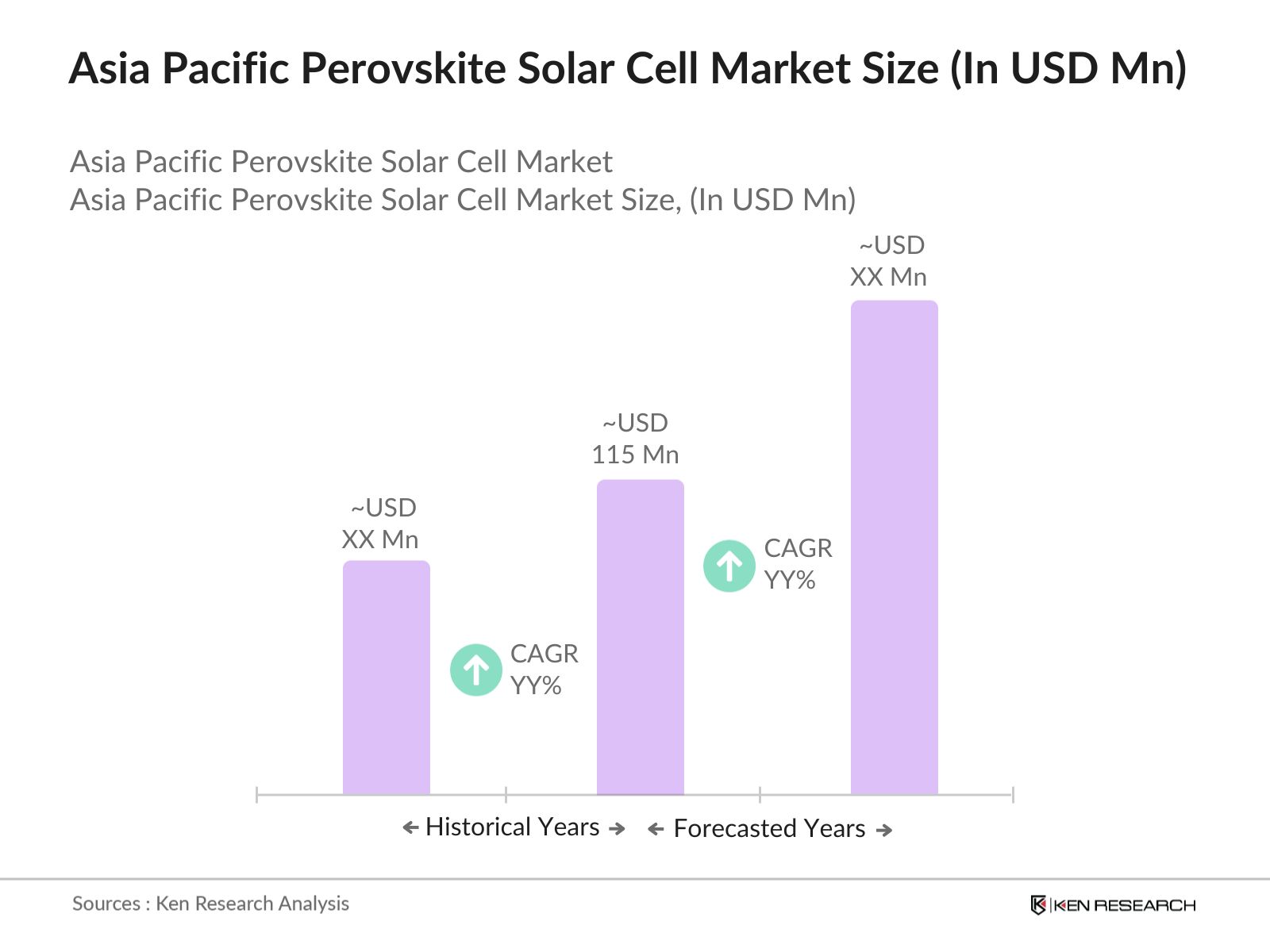
- The Asia Pacific Perovskite Solar Cell market, valued at USD 115 million, is experiencing rapid growth driven by its potential to produce cost-effective, highly efficient solar cells. The technologys compatibility with flexible substrates, unlike conventional silicon-based panels, has attracted significant investment from both private entities and government bodies aiming to address rising energy demands with sustainable solutions.
- China, Japan, and South Korea are dominant players in the Asia Pacific Perovskite Solar Cell market due to their substantial investments in renewable energy technologies and strong manufacturing capabilities. These countries leverage established research ecosystems and governmental support to advance perovskite technologies, enabling them to maintain market leadership through technological advancements and efficient production methodologies.
- The Chinese government allocated RMB 20 billion to its Solar Innovation Program in 2024, dedicated to perovskite solar cell research and infrastructure. The program aims to establish 10 pilot production lines nationwide by 2025, focusing on producing efficient, low-cost perovskite cells to meet domestic and export demands.
Asia Pacific Perovskite Solar Cell Market Segmentation
By Material Type: The market is segmented by material type into lead-based perovskite and lead-free perovskite. Currently, lead-based perovskite dominates this segment due to its higher energy conversion efficiency, which has made it a preferred material choice in both commercial and utility-scale projects. Despite concerns over environmental impact, its cost-effectiveness and scalability have driven significant demand across multiple applications, especially in industrial and power generation sectors.

By Application: The market is segmented by application into utility-scale power generation, building-integrated photovoltaics (BIPV), consumer electronics, and automotive. Building-integrated photovoltaics (BIPV) hold a dominant share within this segment, primarily due to the adaptability of perovskite solar cells to be integrated seamlessly into architectural structures. The lightweight and flexible nature of perovskite cells make them suitable for incorporation into facades and roofs, responding to a growing demand for sustainable infrastructure in densely populated cities.

Asia Pacific Perovskite Solar Cell Market Competitive Landscape
The market is dominated by a select group of established companies, including both local innovators and global giants. This consolidation emphasizes the competitive advantage held by firms with advanced research facilities and partnerships with universities and research institutions, which enables rapid technological advancements in the perovskite domain.

Asia Pacific Perovskite Solar Cell Market Analysis
Market Growth Drivers
- High Energy Demand in the Asia Pacific Region: In 2024, Asia Pacific is experiencing an energy demand increase, especially in countries like China and India, driven by industrial and commercial expansions. For instance, in 2023, China's annual electricity demand exceeded 7,800 TWh, a trend expected to rise as industrial sectors expand and urbanization grows. The push for renewable sources, including perovskite solar cells, is vital to meet these demands sustainably.
- Government Incentives and Subsidies for Renewable Energy: Across the Asia Pacific, governments are incentivizing renewable energy initiatives. For instance, the Indian government allocated INR 10,000 crore in 2024 to fund solar energy projects, including perovskite solar cells, aiming to produce at least 40 GW of solar capacity by 2025. In South Korea, a recent policy mandates renewable energy sources to contribute 35% of the national energy mix by 2030, channeling funds specifically into solar technologies.
- Declining Material and Production Costs for Perovskite Cells: The cost of raw materials for perovskite solar cells has been decreasing steadily. In 2024, the cost of lead iodide, a key material, fell to $200 per kilogram due to advancements in extraction and processing techniques. Furthermore, innovations in low-cost roll-to-roll printing have cut production costs by over 30%, making perovskite cells more affordable and scalable.
Market Challenges
- Durability and Stability Issues: Perovskite solar cells face challenges with durability, especially under high-temperature conditions common in the Asia Pacific. Studies have shown that the average lifespan of perovskite cells remains at approximately five years, limiting their long-term adoption compared to silicon-based alternatives with a lifespan exceeding 20 years.
- Supply Chain Dependency on Key Materials: The supply chain for perovskite production is vulnerable due to reliance on materials like lead and iodine, primarily sourced from limited suppliers in Asia. In 2024, raw material shortages impacted production rates, leading to project delays across Japan and South Korea. This dependency risks further supply chain disruptions, especially during geopolitical tensions or resource shortages, affecting perovskite cell manufacturing continuity.
Asia Pacific Perovskite Solar Cell Market Future Outlook
Over the next five years, the Asia Pacific Perovskite Solar Cell industry is expected to see growth due to ongoing government support, advancements in perovskite material technologies, and the rising demand for energy-efficient solutions in infrastructure and personal devices.
Future Market Opportunities
- Advancement in Efficiency Levels for Mass Deployment: By 2029, perovskite solar cells in the Asia Pacific are projected to achieve efficiency levels surpassing 30 watts per square meter, supported by ongoing R&D. These advancements will allow perovskite cells to compete with traditional silicon solar cells in terms of both cost and efficiency, facilitating wider adoption across residential and commercial sectors.
- Expansion of Perovskite Solar in Building-Integrated Photovoltaics (BIPV): BIPV installations using perovskite technology are anticipated to grow in urban centers, with cities like Tokyo and Seoul projected to increase solar installations on high-rise buildings. By 2029, the Asia Pacific market for BIPV is expected to grow fivefold, driven by government incentives and urban planning regulations encouraging renewable energy.
Scope of the Report
|
Material Type |
Lead-Based Perovskite |
|
Application |
Utility-Scale Power Generation |
|
Structure |
Planar Structure |
|
Technology |
Single-Junction |
|
Region |
China |
Products
Key Target Audience Organizations and Entities Who Can Benefit by Subscribing This Report:
Solar Panel Manufacturers
Renewable Energy Investors and Venture Capitalist Firms
Government and Regulatory Bodies (e.g., Ministry of Energy, National Renewable Energy Laboratory)
Banks and Financial Institution
Private Equity Firms
Environmental and Sustainability Consultants
Utility Companies
Construction and Infrastructure Companies
Companies
Oxford PV
Saule Technologies
Swift Solar
Greatcell Solar
Dyenamo
Frontier Energy Solution
GCL-Poly Energy Holdings
Microquanta Semiconductor
Hangzhou Microquanta Solar
Toshiba Corporation
Table of Contents
1. Asia Pacific Perovskite Solar Cell Market Overview
1.1 Definition and Scope
1.2 Market Taxonomy
1.3 Growth Rate Analysis
1.4 Market Segmentation Overview
2. Asia Pacific Perovskite Solar Cell Market Size (In USD Mn)
2.1 Historical Market Size Analysis
2.2 Year-On-Year Growth Patterns
2.3 Key Market Developments and Milestones
3. Asia Pacific Perovskite Solar Cell Market Analysis
3.1 Growth Drivers
3.1.1 Technological Advancements (Advanced Coating Techniques, Material Efficiency)
3.1.2 Increase in Renewable Energy Investments
3.1.3 Expansion of Clean Energy Goals (Policy Incentives)
3.1.4 Rising Demand for Lightweight, Flexible Solar Panels
3.2 Market Challenges
3.2.1 Stability and Durability Issues
3.2.2 High Production Costs (Raw Material and Manufacturing Constraints)
3.2.3 Regulatory Compliance Variations (Regional Standards)
3.3 Opportunities
3.3.1 Integration into Portable Power Sources
3.3.2 Collaborative R&D in Material Innovation
3.3.3 Applications in Building-Integrated Photovoltaics (BIPV)
3.4 Trends
3.4.1 Increasing Investment in Tandem Solar Cells
3.4.2 Adoption in Consumer Electronics
3.4.3 Growth of Small-Scale Distributed Generation
3.5 Government Regulations
3.5.1 National Energy Frameworks
3.5.2 Tax Incentives for Renewable Energy Adoption
3.5.3 Carbon Neutrality Targets
3.6 SWOT Analysis
3.7 Value Chain Analysis
3.8 Porters Five Forces Analysis
3.9 Competitive Landscape and Ecosystem
4. Asia Pacific Perovskite Solar Cell Market Segmentation
4.1 By Material Type (In Value %)
4.1.1 Lead-Based Perovskite
4.1.2 Lead-Free Perovskite
4.2 By Application (In Value %)
4.2.1 Utility-Scale Power Generation
4.2.2 Building-Integrated Photovoltaics (BIPV)
4.2.3 Consumer Electronics
4.2.4 Automotive
4.3 By Structure (In Value %)
4.3.1 Planar Structure
4.3.2 Mesoporous Structure
4.4 By Technology (In Value %)
4.4.1 Single-Junction
4.4.2 Tandem Solar Cells
4.5 By Region (In Value %)
4.5.1 China
4.5.2 Japan
4.5.3 South Korea
4.5.4 India
4.5.5 Australia and New Zealand
5. Asia Pacific Perovskite Solar Cell Market Competitive Analysis
5.1 Detailed Profiles of Major Companies
5.1.1 Oxford PV
5.1.2 Saule Technologies
5.1.3 Swift Solar
5.1.4 Greatcell Solar
5.1.5 Dyenamo
5.1.6 Frontier Energy Solution
5.1.7 GCL-Poly Energy Holdings
5.1.8 Microquanta Semiconductor
5.1.9 Hangzhou Microquanta Solar
5.1.10 Toshiba Corporation
5.1.11 Panasonic Corporation
5.1.12 Trina Solar
5.1.13 Yingli Green Energy
5.1.14 JinkoSolar Holding Co., Ltd.
5.1.15 Hyundai Energy Solutions
5.2 Cross Comparison Parameters (Production Capacity, R&D Investments, Product Innovation, Market Share, Technology Adoption Rate, Geographic Presence, Strategic Partnerships, Environmental Impact Initiatives)
5.3 Market Share Analysis
5.4 Strategic Initiatives and Mergers & Acquisitions
5.5 Investment and Funding Overview
5.6 Government Grants and Subsidies
5.7 Private Equity and Venture Capital Analysis
6. Asia Pacific Perovskite Solar Cell Market Regulatory Framework
6.1 Renewable Energy Standards
6.2 Environmental Compliance and Certifications
6.3 National and Regional Policy Requirements
7. Asia Pacific Perovskite Solar Cell Future Market Size (In USD Mn)
7.1 Projected Market Size and Growth Projections
7.2 Key Market Drivers for Future Growth
8. Asia Pacific Perovskite Solar Cell Future Market Segmentation
8.1 By Material Type (In Value %)
8.2 By Application (In Value %)
8.3 By Structure (In Value %)
8.4 By Technology (In Value %)
8.5 By Region (In Value %)
9. Asia Pacific Perovskite Solar Cell Market Analysts Recommendations
9.1 Total Addressable Market (TAM), Serviceable Addressable Market (SAM), and Serviceable Obtainable Market (SOM) Analysis
9.2 Consumer Profile and Demand Insights
9.3 Product Differentiation Opportunities
9.4 Strategic Roadmap for Market Entry
Disclaimer Contact UsResearch Methodology
Step 1: Identification of Key Variables
The research process begins with the identification of core market dynamics and stakeholders, utilizing comprehensive desk research and data from proprietary sources. The primary objective of this step is to outline critical metrics impacting the Asia Pacific Perovskite Solar Cell Market, such as adoption rates, technological advancements, and government incentives.
Step 2: Market Analysis and Construction
Historical data from various industry reports is analyzed to determine market trends and revenue generation rates. This phase includes a detailed examination of the production and supply chain components to ensure data accuracy and reliability in projecting growth rates.
Step 3: Hypothesis Validation and Expert Consultation
Market assumptions are refined and validated through telephonic interviews and surveys conducted with industry experts and company executives. These consultations provide firsthand insights into perovskite solar technology applications and challenges, reinforcing the report's findings.
Step 4: Research Synthesis and Final Output
In the final stage, data from multiple manufacturers and suppliers is synthesized to ensure a comprehensive market overview. This approach verifies the projected market scope, focusing on production, consumer demand, and product innovations within the Asia Pacific Perovskite Solar Cell Market.
Frequently Asked Questions
01. How big is the Asia Pacific Perovskite Solar Cell Market?
The Asia Pacific Perovskite Solar Cell market is valued at USD 115 million, driven by increased demand for flexible and efficient solar technologies across residential, commercial, and industrial applications.
02. What challenges does the Asia Pacific Perovskite Solar Cell Market face?
Key challenges in the Asia Pacific Perovskite Solar Cell market include high initial production costs, stability issues in extreme weather conditions, and the environmental concerns associated with lead-based perovskite cells, which may limit their adoption in some regions.
03. Who are the major players in the Asia Pacific Perovskite Solar Cell Market?
The Asia Pacific Perovskite Solar Cell market includes companies such as Oxford PV, Saule Technologies, Swift Solar, and Trina Solar, with each firm excelling in research capabilities, strategic partnerships, or production capacity, strengthening their competitive positioning.
04. What drives the Asia Pacific Perovskite Solar Cell Market?
The Asia Pacific Perovskite Solar Cell market is propelled by advancements in perovskite technology, a growing demand for renewable energy, and government initiatives promoting solar energy adoption, especially in urban and industrial infrastructure.
Why Buy From Us?

What makes us stand out is that our consultants follows Robust, Refine and Result (RRR) methodology. i.e. Robust for clear definitions, approaches and sanity checking, Refine for differentiating respondents facts and opinions and Result for presenting data with story

We have set a benchmark in the industry by offering our clients with syndicated and customized market research reports featuring coverage of entire market as well as meticulous research and analyst insights.

While we don't replace traditional research, we flip the method upside down. Our dual approach of Top Bottom & Bottom Top ensures quality deliverable by not just verifying company fundamentals but also looking at the sector and macroeconomic factors.

With one step in the future, our research team constantly tries to show you the bigger picture. We help with some of the tough questions you may encounter along the way: How is the industry positioned? Best marketing channel? KPI's of competitors? By aligning every element, we help maximize success.

Our report gives you instant access to the answers and sources that other companies might choose to hide. We elaborate each steps of research methodology we have used and showcase you the sample size to earn your trust.

If you need any support, we are here! We pride ourselves on universe strength, data quality, and quick, friendly, and professional service.