
Asia Pacific Pneumatic Actuators Market Outlook to 2030
Region:Asia
Author(s):Meenakshi
Product Code:KROD3395
Region:Asia
Author(s):Meenakshi
Product Code:KROD3395
November 2024
96
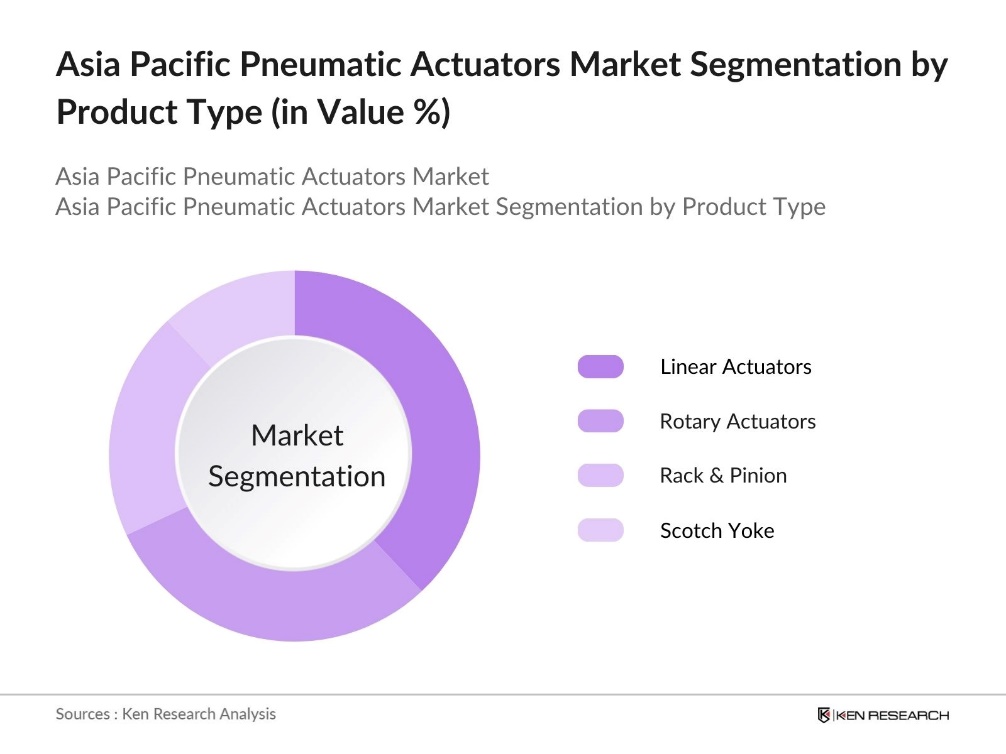
By Product Type: The market is segmented by product type into Linear Actuators, Rotary Actuators, Rack & Pinion Actuators, and Scotch Yoke Actuators. Recently, Linear Actuators have a dominant market share within this segment due to their wide applicability across industries, including oil and gas, chemical processing, and automotive manufacturing. The ability of linear actuators to offer precise control, reliability in harsh environments, and their relatively low cost of maintenance makes them a preferred choice among manufacturers in these sectors.
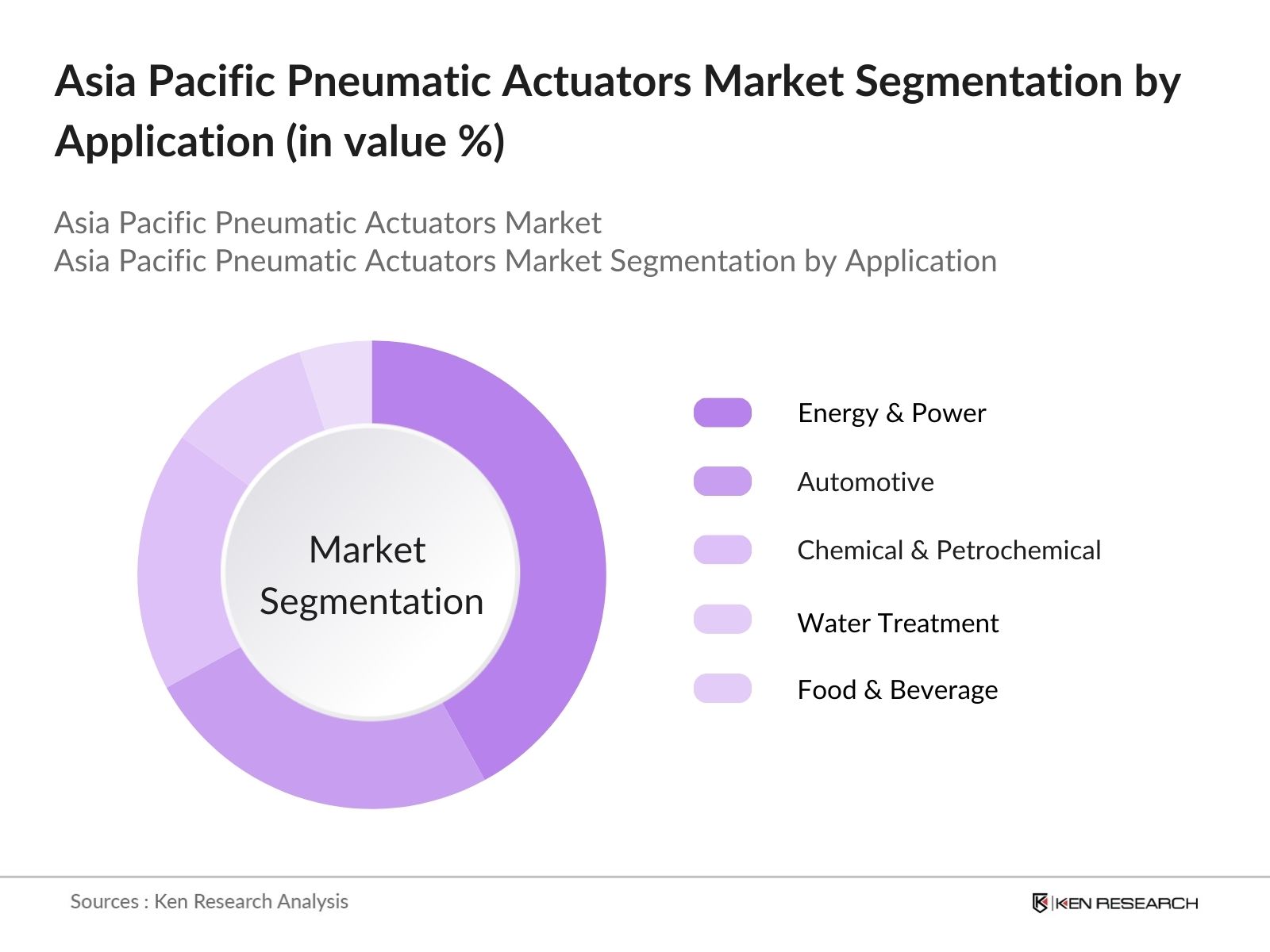
By Application: The market is segmented by application into Energy & Power, Automotive, Food & Beverage, Chemical & Petrochemical, and Water Treatment. Energy & Power emerges as the leading segment, driven by the need for automation in power generation and the growing focus on renewable energy projects. Pneumatic actuators play a critical role in controlling valves and flow mechanisms, making them essential for power plants, especially in environments where electrical solutions may not be feasible.
The Asia Pacific Pneumatic Actuators market is characterized by a combination of global and regional players, leading to a competitive yet fragmented market landscape. Major international companies, such as Emerson Electric Co., Festo AG & Co. KG, and SMC Corporation, dominate the market due to their extensive product portfolios, strong distribution networks, and continuous innovation in pneumatic technologies. These companies benefit from economies of scale and have established long-term relationships with key customers in industries such as energy, automotive, and chemical processing.
|
Company |
Establishment Year |
Headquarters |
Production Sites |
Product Portfolio |
R&D Spend |
Patents Filed |
Customer Base |
Regional Focus |
|
Emerson Electric Co. |
1890 |
St. Louis, USA |
||||||
|
Festo AG & Co. KG |
1925 |
Esslingen, Germany |
||||||
|
SMC Corporation |
1959 |
Tokyo, Japan |
||||||
|
Bosch Rexroth AG |
1795 |
Lohr, Germany |
||||||
|
Parker Hannifin Corp. |
1917 |
Cleveland, USA |
The Asia Pacific Pneumatic Actuators market is expected to grow substantially over the next five years. This growth will be driven by increased investments in industrial automation, the rising demand for energy-efficient solutions, and the expansion of sectors such as renewable energy, oil and gas, and automotive manufacturing. Governments across the region are pushing for more stringent regulations regarding energy consumption and emissions, further fueling the demand for pneumatic actuators, which offer energy-efficient alternatives to electric and hydraulic systems.
|
Product Type |
Linear Actuators Rotary Actuators Rack & Pinion Actuators Scotch Yoke Actuators |
|
Application |
Energy & Power Automotive Food & Beverage Chemical & Petrochemical Water Treatment |
|
Technology |
Double-Acting Pneumatic Actuators Single-Acting Pneumatic Actuators |
|
Material |
Stainless Steel Aluminum Composite |
|
Region |
China Japan South Korea India |
1.1. Definition and Scope
1.2. Market Taxonomy
1.3. Market Growth Rate (Units Sold, Revenue in USD Mn, Installed Base)
1.4. Market Segmentation Overview
2.1. Historical Market Size (Revenue, Volume, Installed Base)
2.2. Year-On-Year Growth Analysis (Value % and Volume %)
2.3. Key Market Developments and Milestones
3.1. Growth Drivers
3.1.1. Increasing Demand in Process Automation
3.1.2. Expansion of Energy & Power Sector
3.1.3. Rising Adoption in Automotive Industry
3.1.4. Focus on Energy Efficiency & Cost Savings
3.2. Market Challenge
3.2.1. High Maintenance and Repair Costs
3.2.2. Lack of Skilled Workforce
3.2.3. Competitive Pressure from Electric Actuators
3.2.4. Regulatory Compliance Issues
3.3. Opportunities
3.3.1. Growth in Emerging Economies
3.3.2. Technological Advancements (e.g., Smart Pneumatics, IIoT Integration)
3.3.3. Increasing R&D Investments by Key Players
3.3.4. Customization and Modular Solutions
3.4. Trends
3.4.1. Shift Towards Industry 4.0 in Manufacturing
3.4.2. Increasing Adoption of Compact Actuators
3.4.3. Emphasis on Green Actuation Technologies
3.5. Government Regulation
3.5.1. Environmental Standards (Emission Reduction, Safety Norms)
3.5.2. Industrial Safety Guidelines
3.5.3. Certification Processes for Pneumatic Components
3.6. SWOT Analysis (Market-specific: Strengths in Energy Efficiency, Weaknesses in Product Differentiation)
3.7. Stakeholder Ecosystem (Manufacturers, OEMs, Distributors, End-users)
3.8. Porters Five Forces
3.8.1. Bargaining Power of Suppliers
3.8.2. Bargaining Power of Buyers
3.8.3. Threat of Substitutes (Electric and Hydraulic Actuators)
3.8.4. Threat of New Entrants
3.8.5. Competitive Rivalry
3.9. Competition Ecosystem (Tier 1, Tier 2, and Local Manufacturers)
4.1. By Product Type (In Value % and Volume %)
4.1.1. Linear Actuators
4.1.2. Rotary Actuators
4.1.3. Rack & Pinion Actuators
4.1.4. Scotch Yoke Actuators
4.2. By Application (In Value % and Volume %)
4.2.1. Energy & Power
4.2.2. Automotive
4.2.3. Food & Beverage
4.2.4. Chemical & Petrochemical
4.2.5. Water Treatment
4.3. By Technology (In Value % and Volume %)
4.3.1. Double-Acting Pneumatic Actuators
4.3.2. Single-Acting Pneumatic Actuators
4.4. By Material (In Value % and Volume %)
4.4.1. Stainless Steel
4.4.2. Aluminum
4.4.3. Composite
4.5. By Region (In Value % and Volume %)
4.5.1. China
4.5.2. Japan
4.5.3. South Korea
4.5.4. India
4.5.5. Australia
5.1 Detailed Profiles of Major Competitors
5.1.1. Emerson Electric Co.
5.1.2. Festo AG & Co. KG
5.1.3. SMC Corporation
5.1.4. Parker Hannifin Corp.
5.1.5. Bosch Rexroth AG
5.1.6. Rotork Plc
5.1.7. Camozzi Automation
5.1.8. KOSO Kent Introl
5.1.9. Bimba Manufacturing
5.1.10. Air Torque
5.1.11. Bray International, Inc.
5.1.12. AVENTICS GmbH
5.1.13. Auma Riester GmbH
5.1.14. Kinetrol Ltd
5.1.15. Norgren (IMI Precision Engineering)
5.2 Cross Comparison Parameters (Market-specific: No. of Patents Filed, Global Reach, Production Capacity, Market Share, Key Clients, R&D Spend, Strategic Partnerships, Product Portfolio)
5.3. Market Share Analysis (In Value % and Volume %)
5.4. Strategic Initiatives (Collaborations, Partnerships, Product Launches)
5.5. Mergers And Acquisitions
5.6. Investment Analysis (Capex by Key Players)
5.7. Government Grants & Incentives
5.8. Private Equity Investments
6.1. Industry Standards (ISO, IEC, ANSI, and Regional Certifications)
6.2. Compliance Requirements (Safety, Environmental, Performance)
6.3. Certification Processes (CE Marking, RoHS, ATEX)
7.1. Future Market Size Projections (Value % and Volume %)
7.2. Key Factors Driving Future Market Growth (Industrial Automation, Energy Infrastructure Investments)
8.1. By Product Type (In Value % and Volume %)
8.2. By Application (In Value % and Volume %)
8.3. By Technology (In Value % and Volume %)
8.4. By Material (In Value % and Volume %)
8.5. By Region (In Value % and Volume %)
9.1. TAM/SAM/SOM Analysis
9.2. Customer Cohort Analysis (Purchasing Trends, Buying Cycles, Decision Makers)
9.3. Marketing Initiatives (Channel Strategies, Digital Adoption)
9.4. White Space Opportunity Analysi
Disclaimer Contact UsThe first step involved constructing an ecosystem map of all the stakeholders in the Asia Pacific Pneumatic Actuators market. Through extensive desk research and analysis of proprietary databases, critical market variables such as revenue drivers, operational capacities, and customer demands were identified.
Historical data from the past five years was compiled to assess market penetration and revenue generation across different sub-segments. Additionally, key performance indicators (KPIs) such as production capacity, sales volume, and pricing trends were analyzed.
Market hypotheses were tested through direct consultations with industry experts, including key decision-makers at pneumatic actuator manufacturers and distributors. These interviews helped refine data and offer real-world insights into current trends and challenges.
Data from manufacturers and other stakeholders were synthesized to produce the final market estimates. This included detailed insights into product segmentation, geographic trends, and competitive dynamics, ensuring a robust and reliable market outlook.
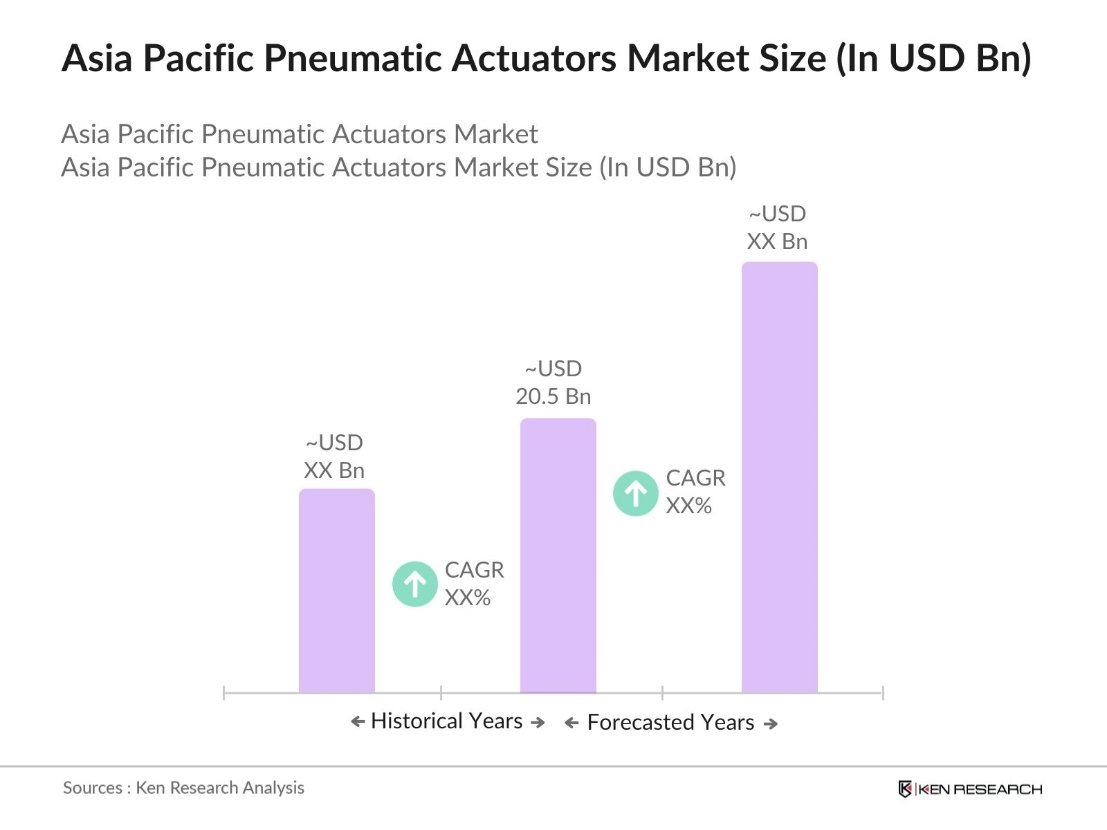
The Asia Pacific Pneumatic Actuators market is valued at USD 20.5 billion, driven by growing automation across industries like energy, automotive, and chemical processing.
Challenges in Asia Pacific Pneumatic Actuators market include high maintenance costs, competition from electric actuators, and the lack of skilled workforce to handle pneumatic systems. Compliance with safety and environmental regulations also presents hurdles.
Key players in Asia Pacific Pneumatic Actuators market include Emerson Electric Co., Festo AG & Co. KG, SMC Corporation, Parker Hannifin Corp., and Bosch Rexroth AG. These companies dominate the market due to their extensive product offerings and strong presence in industrial automation.
The Asia Pacific Pneumatic Actuators market is primarily driven by the increasing need for industrial automation, particularly in the energy, automotive, and chemical sectors. Technological advancements like smart pneumatics and IIoT integration are also fueling market growth.

What makes us stand out is that our consultants follows Robust, Refine and Result (RRR) methodology. i.e. Robust for clear definitions, approaches and sanity checking, Refine for differentiating respondents facts and opinions and Result for presenting data with story

We have set a benchmark in the industry by offering our clients with syndicated and customized market research reports featuring coverage of entire market as well as meticulous research and analyst insights.

While we don't replace traditional research, we flip the method upside down. Our dual approach of Top Bottom & Bottom Top ensures quality deliverable by not just verifying company fundamentals but also looking at the sector and macroeconomic factors.

With one step in the future, our research team constantly tries to show you the bigger picture. We help with some of the tough questions you may encounter along the way: How is the industry positioned? Best marketing channel? KPI's of competitors? By aligning every element, we help maximize success.

Our report gives you instant access to the answers and sources that other companies might choose to hide. We elaborate each steps of research methodology we have used and showcase you the sample size to earn your trust.

If you need any support, we are here! We pride ourselves on universe strength, data quality, and quick, friendly, and professional service.