















Asia Pacific Polyacrylamide Market Outlook to 2030
Region:Asia
Author(s):Paribhasha Tiwari
Product Code:KROD6412
December 2024
91
About the Report
Asia Pacific Polyacrylamide Market Overview
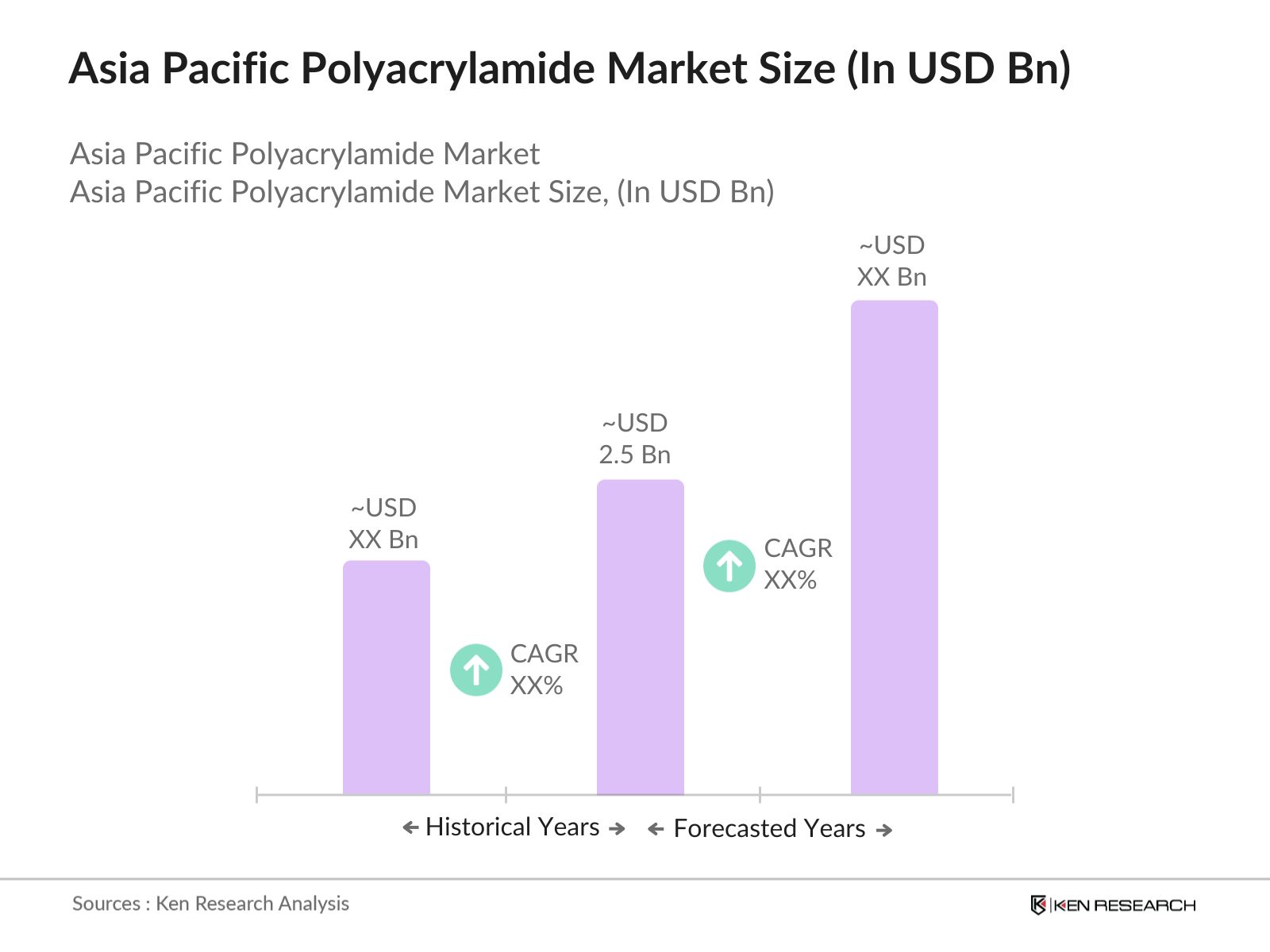
- The Asia Pacific polyacrylamide market, valued at USD 2.5 billion, is driven by its extensive application in water treatment, oil recovery, and the pulp & paper industry. The demand surge is attributed to the region's increasing industrialization and stringent government regulations for wastewater management. Countries like China and India have shown rapid industrial growth, necessitating the use of polyacrylamide in municipal and industrial water treatment.
- China and India dominate the polyacrylamide market due to their large industrial base and significant investments in water treatment infrastructure. China's leadership in enhanced oil recovery applications and India's burgeoning industrial and agricultural sectors are key factors contributing to this dominance. Both countries also benefit from local production and cost advantages in raw materials and labor.
- In September 2023, the Suez Group secured a contract for a significant water treatment project in Chongqing, China. This project aligns with China's ambitious goal of achieving carbon neutrality by 2060 and involves an investment of approximately USD 168 million. The initiative highlights China's commitment to enhancing its water treatment capabilities and reducing reliance on freshwater resources.
Asia Pacific Polyacrylamide Market Segmentation
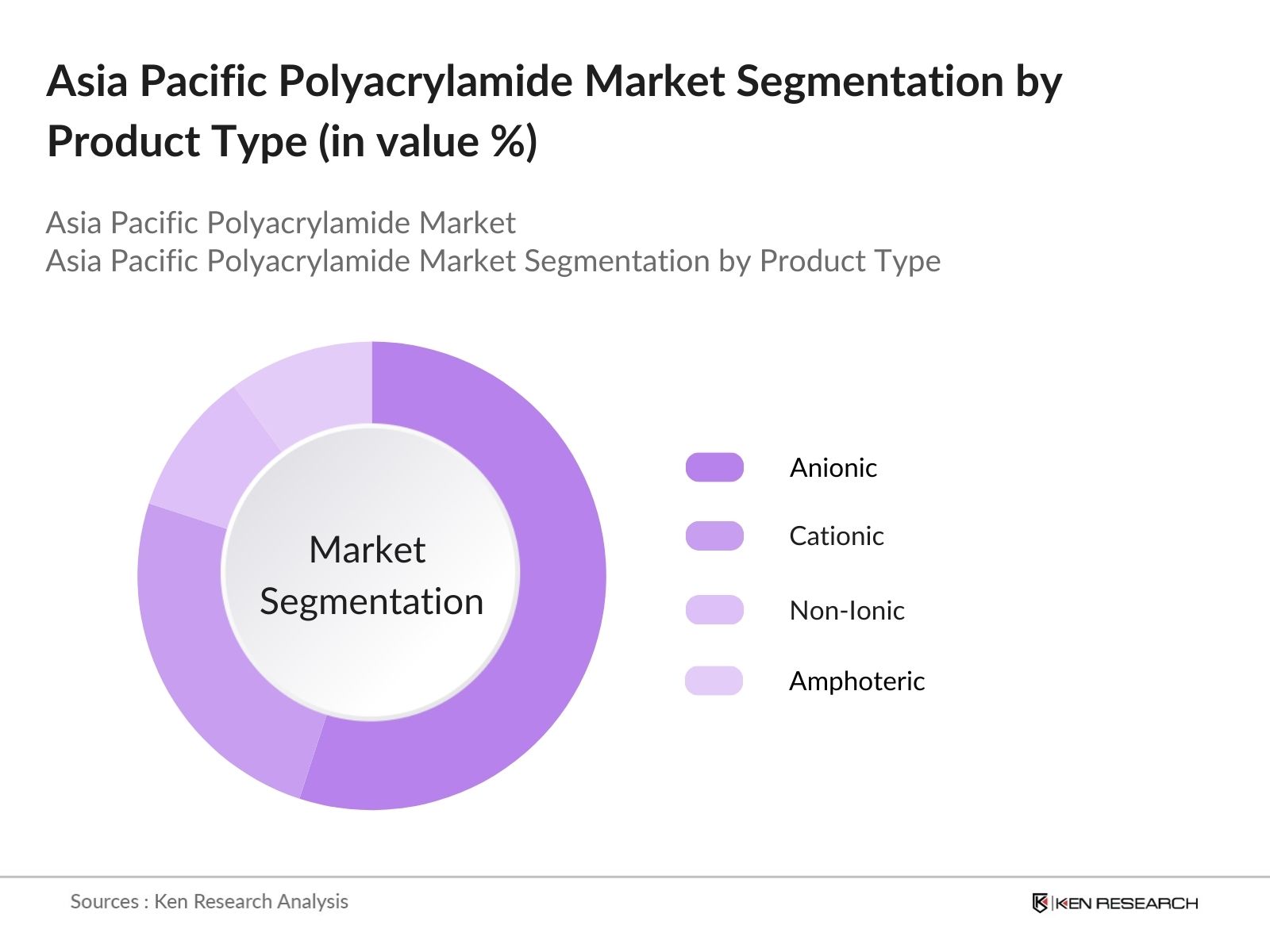
By Product Type: The Asia Pacific polyacrylamide market is segmented into anionic, cationic, non-ionic, and amphoteric polyacrylamide. Anionic polyacrylamide holds a dominant share due to its wide applicability in water treatment and enhanced oil recovery. Its ability to increase viscosity and improve the efficiency of industrial processes makes it indispensable in municipal wastewater treatment and industrial effluent management. The growing adoption of eco-friendly practices further strengthens its position in the market.
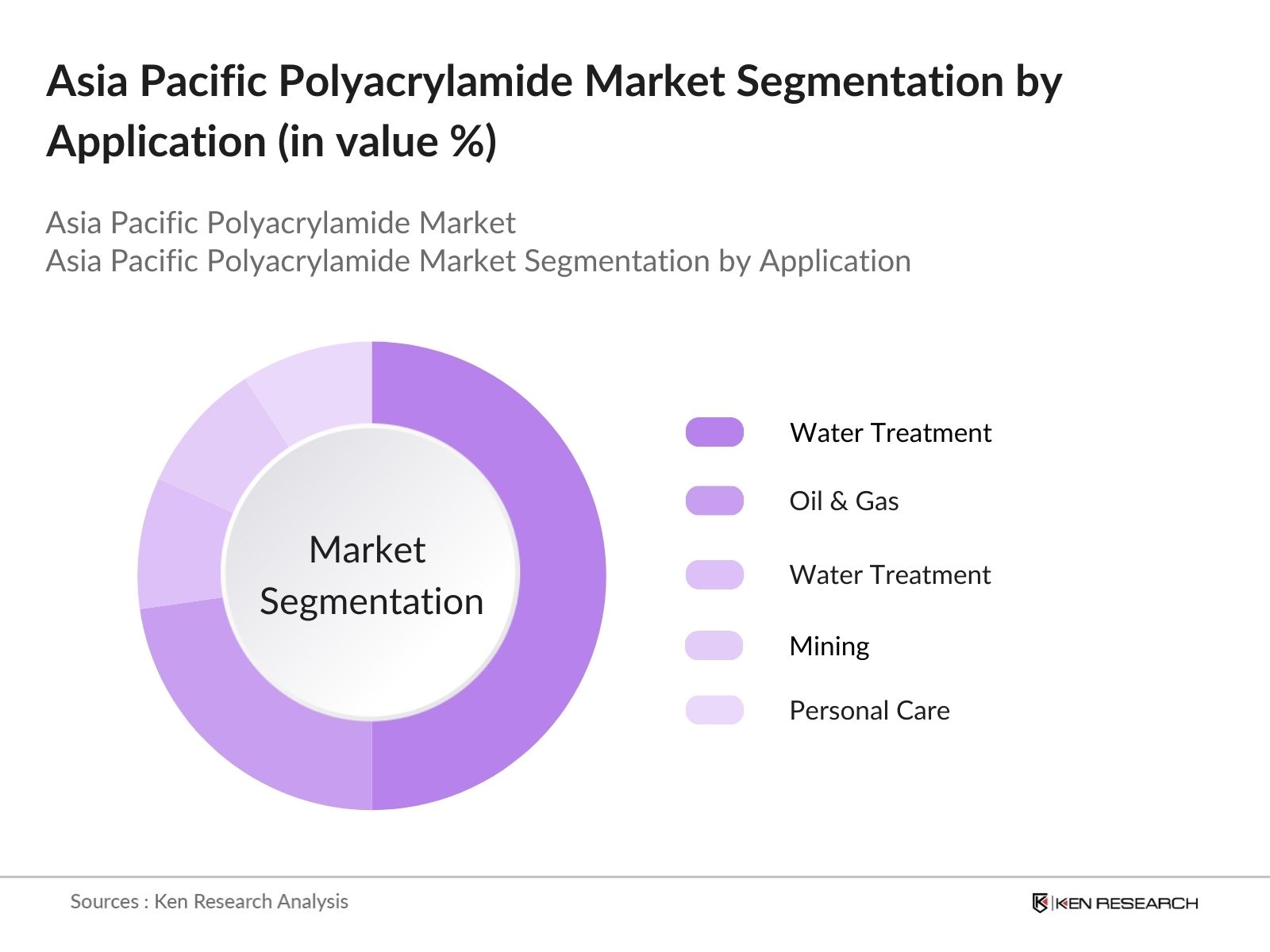
By Application: The market is segmented by application into water treatment, oil & gas, pulp & paper, mining, and personal care. Water treatment dominates due to its critical role in addressing the regions increasing water scarcity and pollution. Polyacrylamide's effectiveness in flocculation and coagulation processes makes it essential for industrial and municipal wastewater treatment. The rapid industrialization of developing nations like India and China adds to the demand for effective water treatment solutions.
Asia Pacific Polyacrylamide Market Competitive Landscape
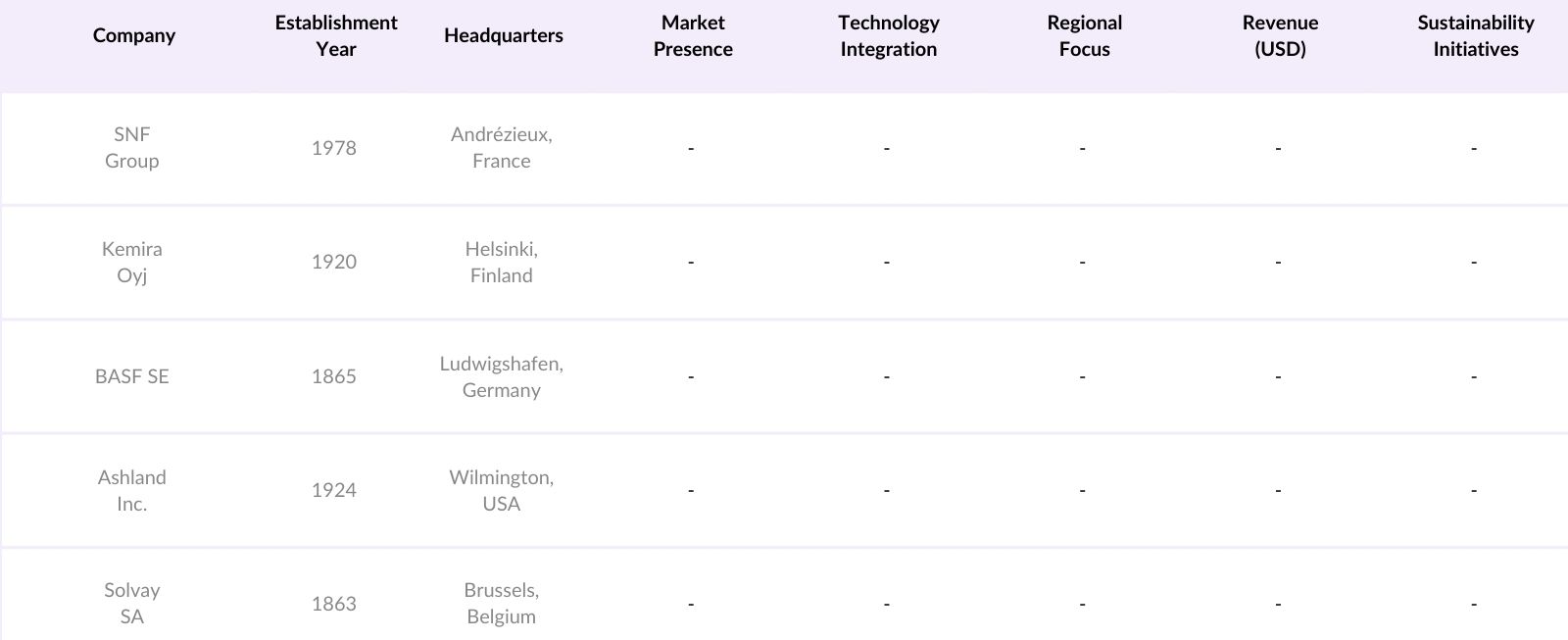
The Asia Pacific polyacrylamide market is dominated by a mix of multinational and regional players. The market shows high consolidation, with top companies focusing on expanding production capabilities and technological innovations.
Asia Pacific Polyacrylamide Market Analysis
Growth Drivers
- Industrialization and Urbanization: In 2024, over 3.1 billion tons of industrial wastewater are expected to be generated globally, with North America contributing approximately 340 million tons. This surge is driving demand for effective water treatment chemicals like polyacrylamide. The U.S. has allocated $6.7 billion for wastewater treatment upgrades, highlighting the importance of advanced solutions in this sector.
- Expansion of Water Treatment Facilities: The U.S. governments Clean Water State Revolving Fund (CWSRF) disbursed $2.3 billion in 2023 to develop modern water treatment infrastructure, significantly increasing the demand for polyacrylamide in treating municipal water systems. Estimates indicate an addition of 450 treatment facilities by 2025.
- Rising Demand in the Oil & Gas Sector: With the U.S. Energy Information Administration reporting a production of 18.9 million barrels per day in 2024, enhanced oil recovery (EOR) techniques, which heavily rely on polyacrylamide, are gaining traction. The Middle East also witnessed increased adoption in their drilling operations, influencing the global supply chain.
Market Challenges
- Fluctuating Raw Material Prices: The price of acrylonitrile, a key raw material for polyacrylamide, surged to $1,950 per metric ton in 2023, with continued volatility projected due to supply chain disruptions in 2024. This unpredictability impacts manufacturing costs and margins.
- Environmental and Health Concerns: Over 5,000 documented cases of acrylamide contamination in water supplies were reported globally in 2023. This raises significant environmental and health concerns, restricting the widespread application of non-biodegradable polyacrylamides.
Asia Pacific Polyacrylamide Market Future Outlook
Over the next five years, the Asia Pacific polyacrylamide market is poised to experience significant growth, driven by advancements in manufacturing technologies, a focus on sustainability, and expanding applications in newer industries like agriculture and personal care. Government initiatives to address water scarcity and pollution will remain pivotal in shaping the market's trajectory.
Market Opportunities
- Development of Bio-based Polyacrylamide: With a $4 billion investment in sustainable chemistry research globally in 2023, bio-based polyacrylamides are gaining traction as a viable alternative. The U.S. Department of Energy has allocated $750 million toward research into biodegradable polymers.
- Emerging Applications in Agriculture: In 2024, U.S. agricultural water consumption is projected to exceed 38 billion gallons per day, creating a demand for polyacrylamide in soil conditioning and irrigation efficiency. Its application could reduce water usage by up to 25%.
Scope of the Report
|
By Product Type |
Anionic Polyacrylamide |
|
By Application |
Water Treatment |
|
By Form |
Powder/Granular |
|
By End-User Industry |
Municipal Water Treatment |
|
By Country |
China |
Products
Key Target Audience
Polyacrylamide Manufacturers
Wastewater Treatment Plants
Oil & Gas Companies
Pulp & Paper Manufacturers
Agricultural Sector Stakeholders
Investors and Venture Capitalist Firms
Government and Regulatory Bodies (Ministry of Environment, National Water Agencies)
Research & Development Departments in Chemical Industries
Companies
Players Mentioned in the Report:
SNF Group
Kemira Oyj
BASF SE
Ashland Inc.
Solvay SA
Anhui Jucheng Fine Chemicals Co., Ltd.
Beijing Hengju Chemical Group Corporation
Mitsubishi Chemical Corporation
PetroChina Company Limited
Ecolab Inc.
Table of Contents
1. Asia Pacific Polyacrylamide Market Overview
1.1. Definition and Scope
1.2. Market Taxonomy
1.3. Market Growth Rate
1.4. Market Segmentation Overview
2. Asia Pacific Polyacrylamide Market Size (In USD Billion)
2.1. Historical Market Size
2.2. Year-On-Year Growth Analysis
2.3. Key Market Developments and Milestones
3. Asia Pacific Polyacrylamide Market Analysis
3.1. Growth Drivers
3.1.1. Industrialization and Urbanization
3.1.2. Expansion of Water Treatment Facilities
3.1.3. Rising Demand in Oil & Gas Sector
3.1.4. Growth in Pulp & Paper Industry
3.2. Market Challenges
3.2.1. Fluctuating Raw Material Prices
3.2.2. Environmental and Health Concerns
3.2.3. Regulatory Compliance
3.3. Opportunities
3.3.1. Development of Bio-based Polyacrylamide
3.3.2. Emerging Applications in Agriculture
3.3.3. Technological Advancements in Production
3.4. Trends
3.4.1. Shift Towards Sustainable Products
3.4.2. Increased Investment in R&D
3.4.3. Strategic Collaborations and Partnerships
3.5. Government Regulations
3.5.1. Environmental Protection Policies
3.5.2. Wastewater Treatment Standards
3.5.3. Industry-Specific Regulations
3.6. SWOT Analysis
3.7. Stakeholder Ecosystem
3.8. Porters Five Forces Analysis
3.9. Competitive Landscape
4. Asia Pacific Polyacrylamide Market Segmentation
4.1. By Product Type (In Value %)
4.1.1. Anionic Polyacrylamide
4.1.2. Cationic Polyacrylamide
4.1.3. Non-Ionic Polyacrylamide
4.1.4. Amphoteric Polyacrylamide
4.2. By Application (In Value %)
4.2.1. Water Treatment
4.2.2. Oil & Gas
4.2.3. Pulp & Paper
4.2.4. Mining
4.2.5. Personal Care
4.3. By Form (In Value %)
4.3.1. Powder/Granular
4.3.2. Emulsion
4.3.3. Liquid
4.4. By End-User Industry (In Value %)
4.4.1. Municipal Water Treatment
4.4.2. Industrial Water Treatment
4.4.3. Enhanced Oil Recovery
4.4.4. Mineral Processing
4.4.5. Cosmetics
4.5. By Country (In Value %)
4.5.1. China
4.5.2. Japan
4.5.3. India
4.5.4. South Korea
4.5.5. Australia
4.5.6. Rest of Asia Pacific
5. Asia Pacific Polyacrylamide Market Competitive Analysis
5.1. Detailed Profiles of Major Companies
5.1.1. SNF Group
5.1.2. Kemira Oyj
5.1.3. BASF SE
5.1.4. Ashland Inc.
5.1.5. Anhui Jucheng Fine Chemicals Co., Ltd.
5.1.6. Solvay SA
5.1.7. Black Rose Industries Ltd.
5.1.8. Shandong Polymer Bio-chemicals Co., Ltd.
5.1.9. Xitao Polymer Co., Ltd.
5.1.10. ZL EOR Chemicals Ltd.
5.1.11. Dongying Kechuang Biochemical Industrial Co., Ltd.
5.1.12. Beijing Hengju Chemical Group Corporation
5.1.13. Mitsubishi Chemical Corporation
5.1.14. PetroChina Company Limited
5.1.15. Ecolab Inc.
5.2. Cross Comparison Parameters (Revenue, Market Share, Product Portfolio, Regional Presence, R&D Investment, Strategic Initiatives, Production Capacity, Number of Employees)
5.3. Market Share Analysis
5.4. Strategic Initiatives
5.5. Mergers and Acquisitions
5.6. Investment Analysis
5.6.1. Venture Capital Funding
5.6.2. Government Grants
5.6.3. Private Equity Investments
6. Asia Pacific Polyacrylamide Market Regulatory Framework
6.1. Environmental Standards
6.2. Compliance Requirements
6.3. Certification Processes
7. Asia Pacific Polyacrylamide Future Market Size (In USD Billion)
7.1. Future Market Size Projections
7.2. Key Factors Driving Future Market Growth
8. Asia Pacific Polyacrylamide Future Market Segmentation
8.1. By Product Type (In Value %)
8.2. By Application (In Value %)
8.3. By Form (In Value %)
8.4. By End-User Industry (In Value %)
8.5. By Country (In Value %)
9. Asia Pacific Polyacrylamide Market Analysts Recommendations
9.1. Total Addressable Market (TAM), Serviceable Available Market (SAM), and Serviceable Obtainable Market (SOM) Analysis
9.2. Customer Cohort Analysis
9.3. Marketing Initiatives
9.4. White Space Opportunity Analysis
Research Methodology
Step 1: Identification of Key Variables
The research commenced by mapping the ecosystem of the Asia Pacific polyacrylamide market, identifying key stakeholders and market influencers through secondary research. This stage included insights from proprietary and public databases.
Step 2: Market Analysis and Construction
Historical market data was analyzed to determine patterns in demand and supply. Detailed segmentation data was compiled, focusing on production capacities and end-user demand for polyacrylamide in the region.
Step 3: Hypothesis Validation and Expert Consultation
Industry experts were consulted through structured interviews to validate hypotheses. These consultations provided insights into industry trends, regulatory impacts, and competitive strategies.
Step 4: Research Synthesis and Final Output
The research process culminated in synthesizing the validated data into actionable insights. The final output integrated primary and secondary research to provide an accurate market forecast and segmentation analysis.
Frequently Asked Questions
1. How big is the Asia Pacific Polyacrylamide Market?
The Asia Pacific polyacrylamide market is valued at USD 2.5 billion, driven by applications in water treatment and enhanced oil recovery across key countries like China and India.
2. What are the challenges in the Asia Pacific Polyacrylamide Market?
Challenges in the Asia Pacific polyacrylamide market include fluctuating raw material costs, environmental concerns over synthetic chemicals, and stringent regulatory compliance for wastewater treatment.
3. Who are the major players in the Asia Pacific Polyacrylamide Market?
Major players in the Asia Pacific polyacrylamide market include SNF Group, Kemira Oyj, BASF SE, Solvay SA, and Ashland Inc., known for their strong market presence and technological advancements.
4. What are the growth drivers for the Asia Pacific Polyacrylamide Market?
Key growth drivers in the Asia Pacific polyacrylamide market include increasing demand for water treatment solutions, industrial expansion, and innovations in bio-based polyacrylamide products.
Why Buy From Us?

What makes us stand out is that our consultants follows Robust, Refine and Result (RRR) methodology. i.e. Robust for clear definitions, approaches and sanity checking, Refine for differentiating respondents facts and opinions and Result for presenting data with story

We have set a benchmark in the industry by offering our clients with syndicated and customized market research reports featuring coverage of entire market as well as meticulous research and analyst insights.

While we don't replace traditional research, we flip the method upside down. Our dual approach of Top Bottom & Bottom Top ensures quality deliverable by not just verifying company fundamentals but also looking at the sector and macroeconomic factors.

With one step in the future, our research team constantly tries to show you the bigger picture. We help with some of the tough questions you may encounter along the way: How is the industry positioned? Best marketing channel? KPI's of competitors? By aligning every element, we help maximize success.

Our report gives you instant access to the answers and sources that other companies might choose to hide. We elaborate each steps of research methodology we have used and showcase you the sample size to earn your trust.

If you need any support, we are here! We pride ourselves on universe strength, data quality, and quick, friendly, and professional service.