
Asia Pacific Polybutylene Succinate Market Outlook to 2030
Region:Asia
Author(s):Yogita Sahu
Product Code:KROD9101
November 2024
97
About the Report
Asia Pacific Polybutylene Succinate Market Overview
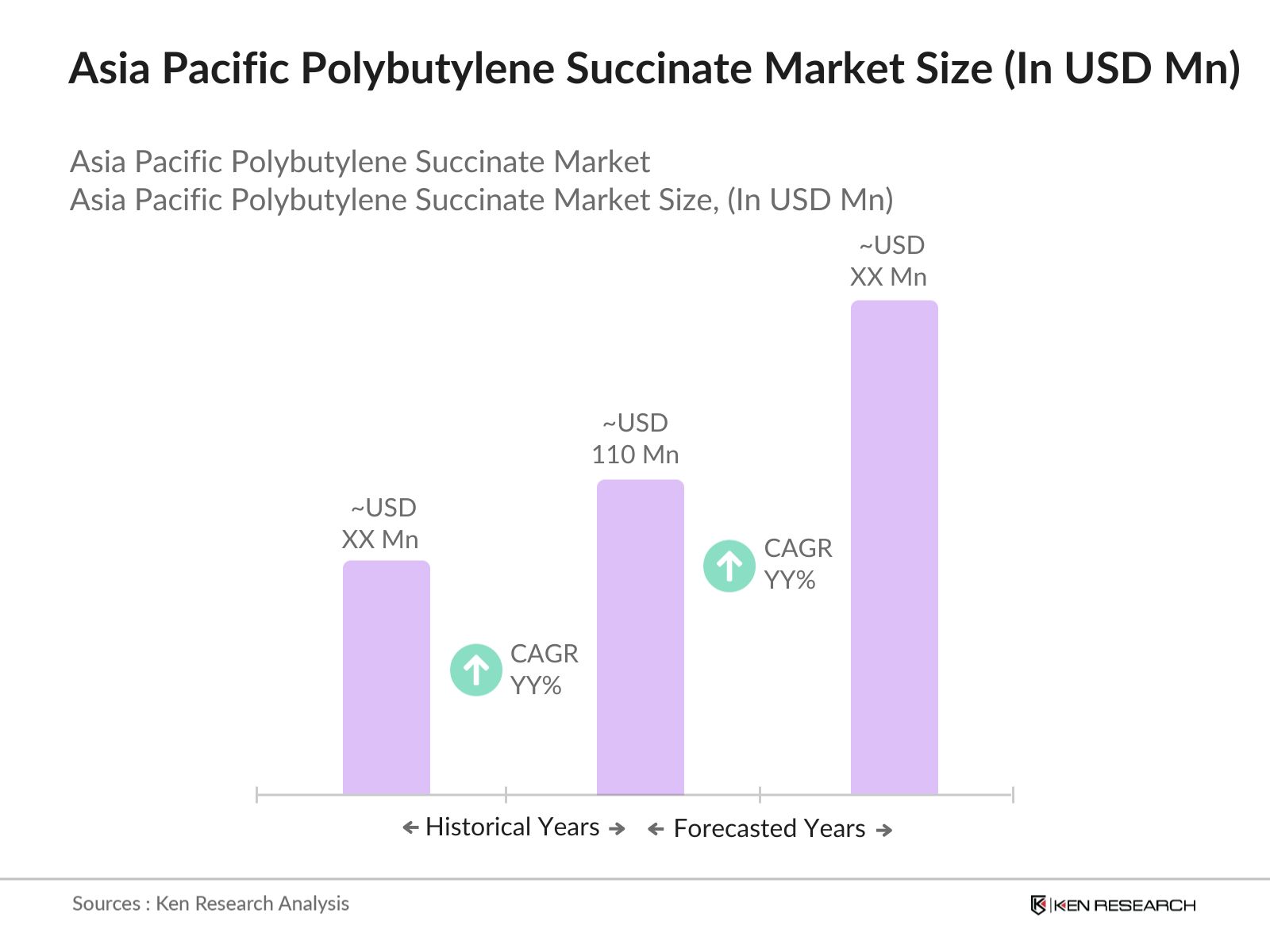
- The Asia Pacific Polybutylene Succinate market, valued at USD 110 million, is primarily driven by the regions shift towards eco-friendly and biodegradable materials in packaging and manufacturing sectors. This market size is reinforced by growing governmental support for sustainable solutions, with mandates for biodegradable packaging materials across various industries.
- Countries like China and Japan dominate the market, largely due to their well-established manufacturing industries and governmental policies favoring biodegradable products. Chinas advanced production capabilities and Japans focus on sustainable product development make these countries strongholds for PBS production and application. Strategic investments in biodegradable plastics by major corporations further contribute to their market leadership.
- In 2024, the Chinese government reinforced its green plastics mandate, which includes promoting PBS and other biodegradable materials. The policy includes tax exemptions for manufacturers producing PBS, aiming to achieve an annual reduction of 1 million metric tons of plastic waste. This government push aligns with Chinas broader environmental objectives, setting the stage for increased PBS production and adoption in various industries.
Asia Pacific Polybutylene Succinate Market Segmentation
By Application Type: The market is segmented by application type into packaging, agriculture, medical, automotive, and textiles. Packaging applications hold a dominant market share under this segmentation, as industries increasingly replace conventional plastic with biodegradable alternatives. Companies like Showa Denko and Mitsubishi Chemical have focused on PBSs durability and compostability, positioning it as an optimal choice for sustainable packaging solutions.

By End-Use Industry: The market is further segmented by end-use industry, with consumer goods, agriculture, and healthcare as primary categories. Consumer goods dominate the market share within this segment, driven by increased consumer demand for biodegradable packaging and products. Leading players in consumer goods are investing in sustainable alternatives to appeal to environmentally-conscious consumers, thus strengthening PBS's foothold in this industry.

Asia Pacific Polybutylene Succinate Market Competitive Landscape
The market is dominated by key players focused on innovation and sustainability. These companies leverage strategic partnerships, advancements in biodegradable technology, and regional expertise to maintain their positions.

Asia Pacific Polybutylene Succinate Market Analysis
Market Growth Drivers
- Increased Adoption in Packaging Applications: Polybutylene succinate (PBS) is seeing a rise in demand across packaging applications in the Asia Pacific, with over 15,000 metric tons of PBS estimated to be utilized in 2024 for sustainable packaging. Countries like Japan and South Korea are leading the adoption due to strict regulations on plastic usage. A shift toward biodegradable alternatives is supported by local policies promoting renewable materials, boosting PBSs presence across food and beverage packaging sectors.
- Rising Demand in Agricultural Applications: In 2024, the Asia Pacific region has seen a rise in PBS usage in agriculture, with an estimated 20,000 hectares of farmland benefiting from biodegradable mulch films. China and India are at the forefront, using PBS to reduce soil contamination. Government-backed schemes in India promoting sustainable farming practices have boosted PBS demand, aligning with targets to reduce agricultural waste.
- Expansion in Biodegradable Plastics Market: By 2024, Asia Pacifics biodegradable plastics market is projected to exceed 150,000 metric tons in production, a key segment being PBS. With demand fueled by stringent environmental laws in countries like Thailand and Vietnam, PBS has emerged as a preferred material for reducing dependency on conventional plastics.
Market Challenges
- High Production Costs: Despite its benefits, PBS production costs remain high compared to conventional plastics, with an average cost of production for PBS reaching $3,500 per metric ton in 2024. These costs are particularly challenging for small-scale manufacturers in Asia Pacific. Additionally, higher raw material costs for bio-based PBS variants contribute to pricing constraints, limiting its adoption in cost-sensitive sectors like consumer goods.
- Limited Awareness and Adoption Among SMEs: While large corporations in Asia Pacific are shifting toward sustainable materials, small and medium-sized enterprises (SMEs) struggle with adoption due to limited awareness of PBSs benefits. Approximately 60% of SMEs in the region are still reliant on traditional plastics, according to recent market assessments.
Asia Pacific Polybutylene Succinate Market Future Outlook
Over the next few years, the Asia Pacific Polybutylene Succinate industry is expected to experience substantial growth due to regulatory support for biodegradable products, technological advancements in PBS processing, and growing demand for eco-friendly materials across multiple sectors.
Future Market Opportunities
- Increased Integration of PBS in Electronics by 2029: The demand for PBS is projected to grow in the electronics sector in Asia Pacific, where bio-based plastics are becoming preferred for small components and casings. By 2029, over 10,000 metric tons of PBS are estimated to be utilized in electronics manufacturing in Japan and South Korea, driven by regulations mandating the use of biodegradable materials to reduce electronic waste.
- Adoption in Automotive Parts Production: Over the next five years, the Asia Pacific automotive industry is expected to increase the use of PBS in interior components, with projected consumption reaching 20,000 metric tons by 2029. This shift is fueled by rising regulations against plastic waste, particularly in China, where the automotive industry has set targets for sustainable material adoption in vehicle manufacturing.
Scope of the Report
|
Application |
Packaging Agriculture Medical Automotive Textiles |
|
End-Use Industry |
Consumer Goods Healthcare Electronics Agriculture Automotive |
|
Production Process |
Direct Polycondensation Melt Polymerization Solution Polymerization |
|
Distribution Channel |
Direct Sales Distributors Online Platforms Specialized Retailers |
|
Region |
East Asia Southeast Asia South Asia Oceania Central Asia |
Products
Key Target Audience Organizations and Entities Who Can Benefit by Subscribing This Report:
Polybutylene Succinate (PBS) Manufacturers
Packaging and Consumer Goods Companies
Automotive Component Manufacturers
Agriculture Product Manufacturers
Healthcare Product Manufacturers
Investor and Venture Capitalist Firms
Government and Regulatory Bodies (e.g., Ministry of Industry and Information Technology, Japan Bioplastics Association)
Distributors and Suppliers in the Polymer Industry
Companies
Showa Denko K.K.
Mitsubishi Chemical Corporation
BASF SE
PTT MCC Biochem Co., Ltd.
NatureWorks LLC
Anqing Hexing Chemical Co., Ltd.
Succinity GmbH
China National Petroleum Corporation (CNPC)
Reverdia
Jiangsu CleanTech Innovation Co., Ltd.
Table of Contents
1. Asia Pacific Polybutylene Succinate Market Overview
1.1 Definition and Scope
1.2 Market Taxonomy (Biodegradable Polymer Types, Source Materials)
1.3 Market Growth Rate Analysis (CAGR and Volume Metrics)
1.4 Market Segmentation Overview
2. Asia Pacific Polybutylene Succinate Market Size (USD Mn)
2.1 Historical Market Size
2.2 Year-On-Year Growth Analysis
2.3 Key Developments and Innovations
3. Asia Pacific Polybutylene Succinate Market Analysis
3.1 Growth Drivers
3.1.1 Increased Demand for Sustainable Packaging Solutions
3.1.2 Government Initiatives for Biodegradable Polymers
3.1.3 Rising Awareness and Shift Toward Eco-Friendly Materials
3.2 Market Challenges
3.2.1 High Production Cost
3.2.2 Limited Commercial Scale Production
3.2.3 Dependency on Non-Renewable Resources
3.3 Opportunities
3.3.1 Technological Advancements in Polymerization Processes
3.3.2 Expanding Applications in Medical and Automotive Sectors
3.3.3 Collaboration with Biopolymer Innovators
3.4 Trends
3.4.1 Increase in Bio-Based PBS Production
3.4.2 Integration in Circular Economy Initiatives
3.4.3 Advances in Compostability Standards
3.5 Regulatory Landscape
3.5.1 Biodegradability Certification Requirements
3.5.2 Regional Compliance for Plastic Waste Management
3.5.3 Import-Export Policies and Tariff Regulations
3.6 SWOT Analysis
3.7 Value Chain Analysis (Raw Material Supply, Manufacturing, Distribution)
3.8 Porters Five Forces Model
3.9 Competitive Ecosystem
4. Asia Pacific Polybutylene Succinate Market Segmentation
4.1 By Application (In Volume %)
4.1.1 Packaging (Rigid, Flexible)
4.1.2 Agriculture (Mulch Films, Other Applications)
4.1.3 Medical (Implantable Devices, Tissue Engineering)
4.1.4 Automotive (Interior Components, Seat Foams)
4.1.5 Textiles (Fibers, Nonwovens)
4.2 By End-Use Industry (In Volume %)
4.2.1 Consumer Goods
4.2.2 Healthcare
4.2.3 Electronics
4.2.4 Agriculture
4.2.5 Automotive
4.3 By Production Process (In Volume %)
4.3.1 Direct Polycondensation
4.3.2 Melt Polymerization
4.3.3 Solution Polymerization
4.4 By Distribution Channel (In Volume %)
4.4.1 Direct Sales
4.4.2 Distributors
4.4.3 Online Platforms
4.4.4 Specialized Retailers
4.5 By Region (In Volume %)
4.5.1 East Asia
4.5.2 Southeast Asia
4.5.3 South Asia
4.5.4 Oceania
4.5.5 Central Asia
5. Asia Pacific Polybutylene Succinate Market Competitive Analysis
5.1 Profiles of Major Companies
5.1.1 Showa Denko K.K.
5.1.2 BASF SE
5.1.3 Mitsubishi Chemical Corporation
5.1.4 PTT MCC Biochem Co., Ltd.
5.1.5 NatureWorks LLC
5.1.6 Anqing Hexing Chemical Co., Ltd.
5.1.7 Succinity GmbH
5.1.8 China National Petroleum Corporation (CNPC)
5.1.9 Reverdia
5.1.10 Jiangsu CleanTech Innovation Co., Ltd.
5.1.11 Indorama Ventures Public Company Limited
5.1.12 Eastman Chemical Company
5.1.13 FKuR Kunststoff GmbH
5.1.14 Bio-On SpA
5.1.15 PolyOne Corporation
5.2 Cross Comparison Parameters (R&D Investments, Market Reach, Sustainability Initiatives, Distribution Channels, Production Capacities, Profit Margins, Geographic Presence, Strategic Partnerships)
5.3 Market Share Analysis
5.4 Key Strategic Initiatives
5.5 Mergers, Acquisitions, and Joint Ventures
5.6 Investment Analysis
5.7 Private Equity and Venture Capital Funding
6. Asia Pacific Polybutylene Succinate Market Regulatory Framework
6.1 Environmental Regulations for Bioplastics
6.2 Compliance Standards for Biodegradability
6.3 Certification Processes for PBS Manufacturing
7. Asia Pacific Polybutylene Succinate Future Market Size (USD Mn)
7.1 Market Size Forecasts
7.2 Key Growth Catalysts and Projections
8. Asia Pacific Polybutylene Succinate Future Market Segmentation
8.1 By Application
8.2 By End-Use Industry
8.3 By Production Process
8.4 By Distribution Channel
8.5 By Region
9. Asia Pacific Polybutylene Succinate Market Analyst Recommendations
9.1 Total Addressable Market (TAM)/Serviceable Available Market (SAM)/Serviceable Obtainable Market (SOM) Analysis
9.2 Consumer Behavior Analysis
9.3 Marketing Strategies and Recommendations
9.4 Emerging White Space Opportunities
Disclaimer Contact UsResearch Methodology
Step 1: Identification of Key Variables
The initial phase entails creating a market ecosystem map with all major stakeholders within the Asia Pacific Polybutylene Succinate Market. Comprehensive desk research, including secondary and proprietary databases, helps identify critical variables impacting market trends.
Step 2: Market Analysis and Construction
In this phase, historical data on market penetration, application growth, and revenue generation is gathered and analyzed. Data validation ensures reliability and offers a foundational understanding of PBS's influence in various industries.
Step 3: Hypothesis Validation and Expert Consultation
Consultations with industry experts via structured interviews provide valuable insights into operational and financial trends, allowing for hypothesis validation and refining market estimates.
Step 4: Research Synthesis and Final Output
Final engagement with PBS manufacturers provides product-specific details, sales trends, and consumer insights. This final verification step corroborates the statistics derived from primary research, ensuring a comprehensive analysis.
Frequently Asked Questions
1. How big is the Asia Pacific Polybutylene Succinate Market?
The Asia Pacific Polybutylene Succinate market was valued at USD 110 million and has shown consistent growth driven by the demand for sustainable packaging and regulatory support for biodegradable materials.
2. What are the challenges in the Asia Pacific Polybutylene Succinate Market?
Challenges in the Asia Pacific Polybutylene Succinate market include high production costs, limited commercial production facilities, and dependency on non-renewable sources, which affect scalability and profitability.
3. Who are the major players in the Asia Pacific Polybutylene Succinate Market?
Key players in the Asia Pacific Polybutylene Succinate market include Showa Denko, Mitsubishi Chemical Corporation, and BASF SE, who dominate due to strong R&D capabilities, partnerships, and distribution networks.
4. What are the growth drivers of the Asia Pacific Polybutylene Succinate Market?
The growth in the Asia Pacific Polybutylene Succinate market is fueled by the increased adoption of biodegradable packaging solutions and regulatory incentives, which encourage industries to adopt eco-friendly alternatives.
Why Buy From Us?

What makes us stand out is that our consultants follows Robust, Refine and Result (RRR) methodology. i.e. Robust for clear definitions, approaches and sanity checking, Refine for differentiating respondents facts and opinions and Result for presenting data with story

We have set a benchmark in the industry by offering our clients with syndicated and customized market research reports featuring coverage of entire market as well as meticulous research and analyst insights.

While we don't replace traditional research, we flip the method upside down. Our dual approach of Top Bottom & Bottom Top ensures quality deliverable by not just verifying company fundamentals but also looking at the sector and macroeconomic factors.

With one step in the future, our research team constantly tries to show you the bigger picture. We help with some of the tough questions you may encounter along the way: How is the industry positioned? Best marketing channel? KPI's of competitors? By aligning every element, we help maximize success.

Our report gives you instant access to the answers and sources that other companies might choose to hide. We elaborate each steps of research methodology we have used and showcase you the sample size to earn your trust.

If you need any support, we are here! We pride ourselves on universe strength, data quality, and quick, friendly, and professional service.