
Asia-Pacific Pressure Vessels Market Outlook to 2030
Region:Asia
Author(s):Naman Rohilla
Product Code:KROD2989
Region:Asia
Author(s):Naman Rohilla
Product Code:KROD2989
November 2024
95
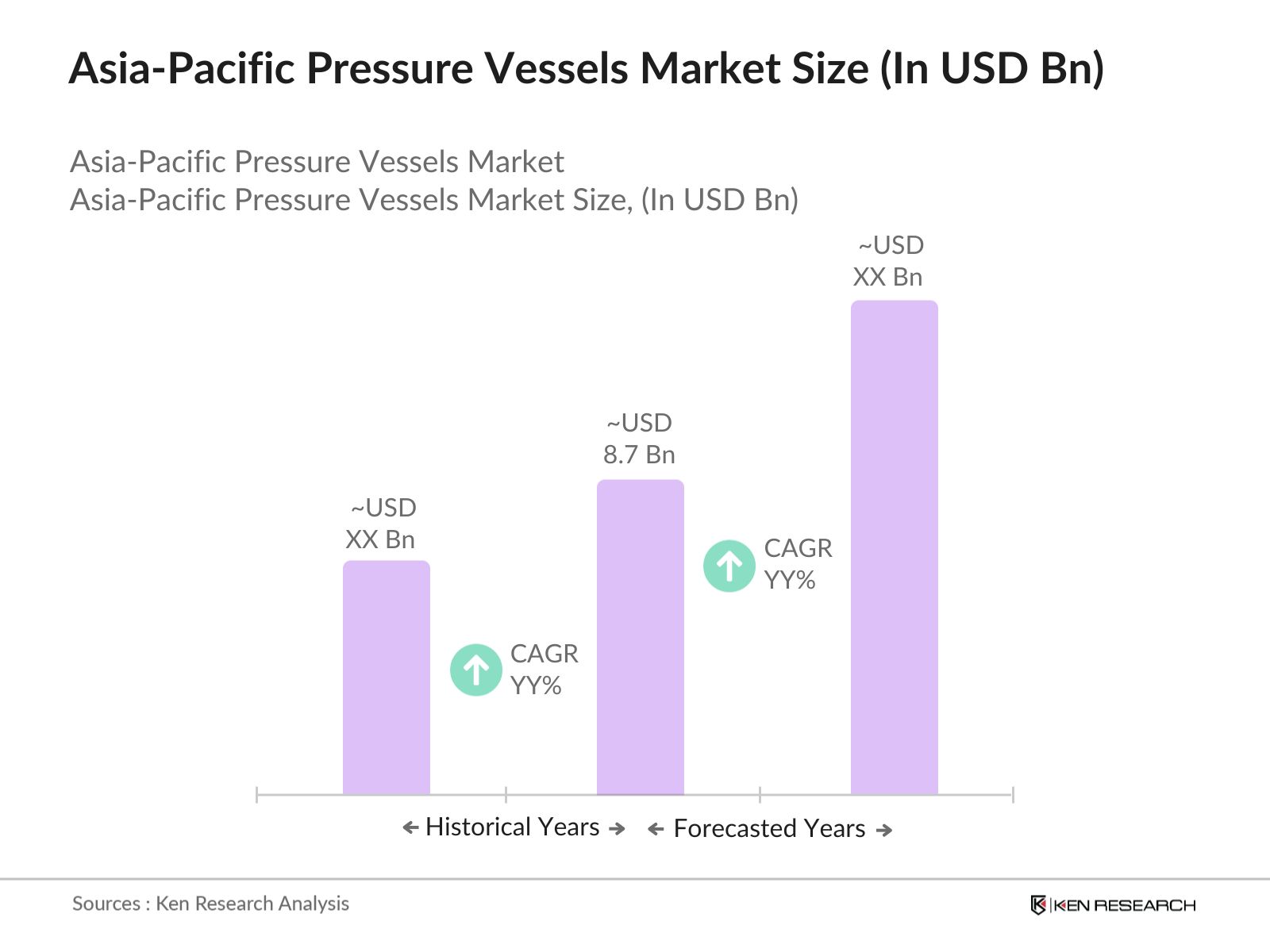
The Asia-Pacific Pressure Vessels Market is segmented by technology, end-use industry, platform type, retailer type, and geographical region.
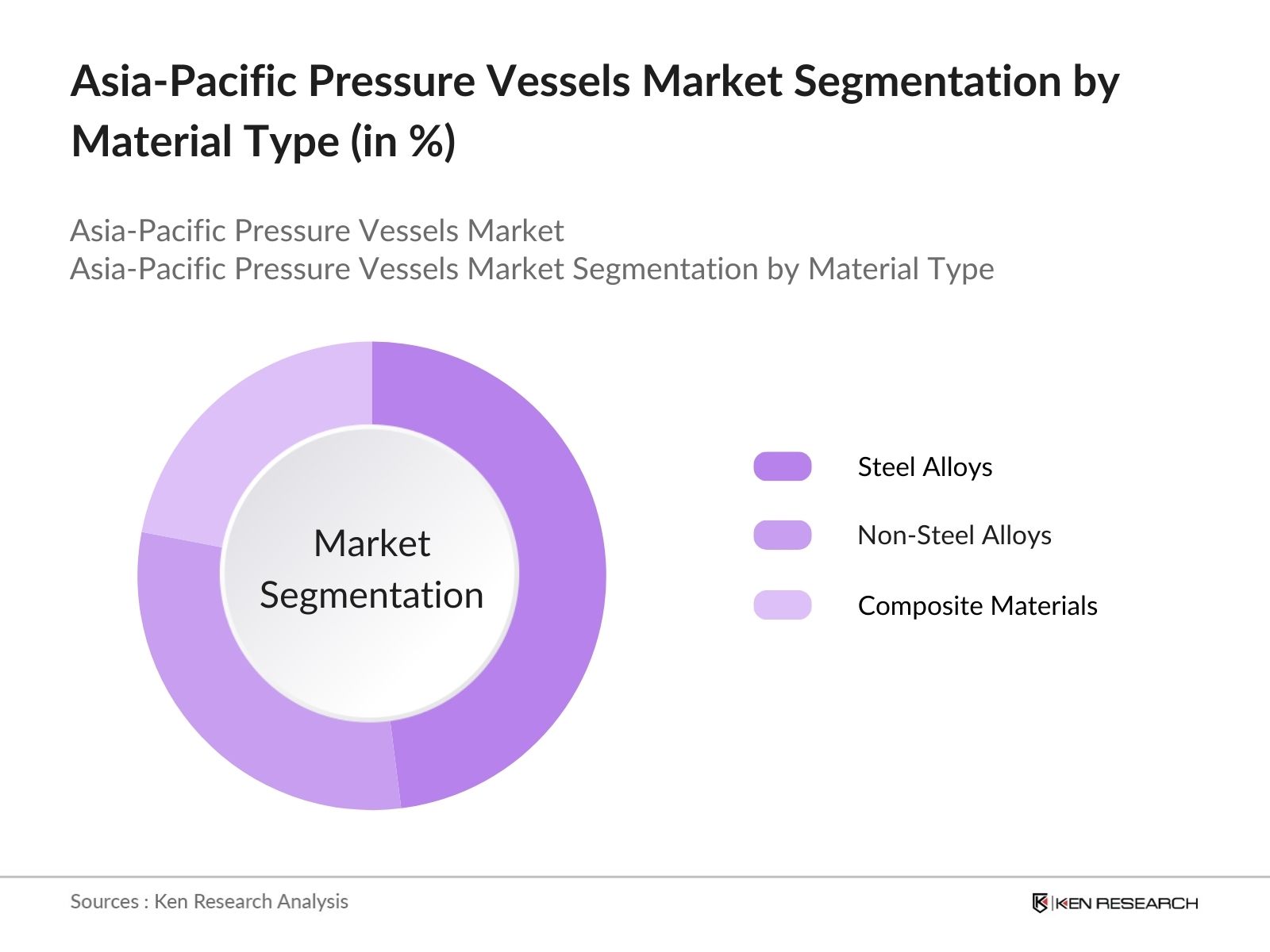
By Material Type: The Asia-Pacific pressure vessels market is segmented by material type into steel alloys, non-steel alloys, and composite materials. Recently, steel alloys have captured a dominant market share within this segmentation due to their widespread usage in high-pressure applications such as boilers, heat exchangers, and reactors. Steel alloys are preferred for their durability, corrosion resistance, and ability to withstand extreme temperatures, making them a crucial material in industries like oil & gas, power generation, and chemicals.
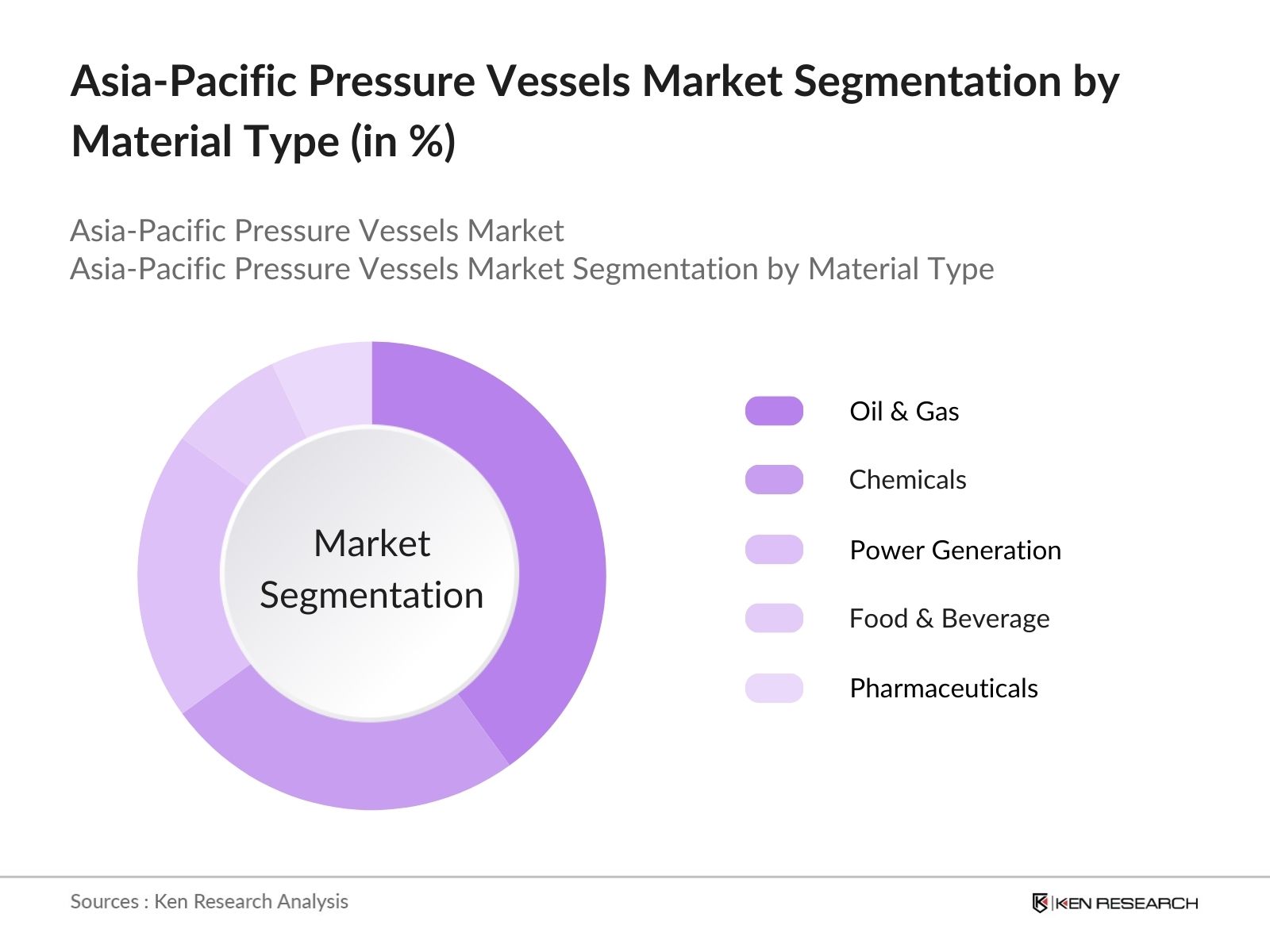
By Application: The pressure vessels market in Asia-Pacific is segmented by application into oil & gas, chemicals, power generation, food & beverage, and pharmaceuticals. Oil & gas dominate the market share due to the high demand for pressure vessels in upstream, midstream, and downstream operations. The requirement for specialized pressure vessels in refining, transportation, and storage of hydrocarbons is the key factor driving demand in this segment. Countries like China and India are witnessing increased exploration activities, fueling the growth in this application.
The Asia-Pacific pressure vessels market is characterized by intense competition, with a mix of regional and international players. Key companies are focusing on technological innovation, expanding their manufacturing capacities, and forming strategic partnerships to strengthen their market positions. Major players are investing in R&D to develop new materials, such as composite and smart pressure vessels, to cater to the evolving needs of various industries.
|
Company Name |
Establishment Year |
Headquarters |
Revenue (USD Bn) |
No. of Employees |
Global Footprint |
Key Markets |
Technological Innovations |
Certifications |
|
Babcock & Wilcox Enterprises |
1867 |
Ohio, USA |
- |
- |
- |
- |
- |
- |
|
Larsen & Toubro |
1938 |
Mumbai, India |
- |
- |
- |
- |
- |
- |
|
Mitsubishi Heavy Industries |
1884 |
Tokyo, Japan |
- |
- |
- |
- |
- |
- |
|
Dongfang Electric Corporation |
1951 |
Chengdu, China |
- |
- |
- |
- |
- |
- |
|
Bharat Heavy Electricals Ltd |
1964 |
New Delhi, India |
- |
- |
- |
- |
- |
- |
Over the next five years, the Asia-Pacific pressure vessels market is expected to grow substantially due to the rapid expansion of energy infrastructure and industrial development. Continuous government support for renewable energy projects, combined with advancements in pressure vessel technologies such as smart monitoring systems, will drive demand. The regions growing focus on nuclear energy and hydrogen storage will further fuel the market. As industrial safety standards tighten, there will be increased investments in high-performance materials and IoT-enabled vessels for predictive maintenance and real-time performance tracking.
|
By Technology |
Steel Alloys Non-Steel Alloys Composite Materials |
|
By End-Use Industry |
Oil & Gas Chemicals Power Generation Food & Beverage Pharmaceuticals |
|
By Platform Type |
Boilers Separators Heat Exchangers Reactors |
|
By Retailer Type |
Low Pressure Medium Pressure High Pressure |
|
By Region |
China India Japan Australia Rest of APAC |
1.1. Definition and Scope
1.2. Market Taxonomy
1.3. Market Growth Rate
1.4. Market Segmentation Overview
2.1. Historical Market Size
2.2. Year-On-Year Growth Analysis
2.3. Key Market Developments and Milestones
3.1. Growth Drivers
3.1.1. Expansion of Oil & Gas Sector
3.1.2. Rising Chemical Industry Output
3.1.3. Increasing Investments in Power Generation
3.1.4. Stringent Government Regulations on Safety Standards
3.2. Market Challenges
3.2.1. High Raw Material Costs (Steel, Alloys)
3.2.2. Technical Complexity in Design
3.2.3. Environmental Concerns
3.3. Opportunities
3.3.1. Technological Advancements (Composite Materials, Smart Vessels)
3.3.2. Growing Demand in Renewable Energy (Hydrogen Storage, Offshore Wind)
3.3.3. Expansion in Developing Economies (India, Indonesia)
3.4. Trends
3.4.1. Adoption of IoT and Sensors for Predictive Maintenance
3.4.2. Shift Toward Lightweight and Corrosion-Resistant Materials
3.4.3. Integration of Advanced Welding Techniques
3.5. Government Regulation
3.5.1. ASME Boiler and Pressure Vessel Code Compliance
3.5.2. Regional Safety Standards (APAC Jurisdictions)
3.5.3. Environmental Standards and Emission Norms
3.6. SWOT Analysis
3.7. Stakeholder Ecosystem (OEMs, End-Users, Raw Material Suppliers)
3.8. Porters Five Forces Analysis
3.9. Competition Ecosystem
4.1. By Material Type (In Value %)
4.1.1. Steel Alloys
4.1.2. Non-Steel Alloys
4.1.3. Composite Materials
4.2. By Application (In Value %)
4.2.1. Oil & Gas
4.2.2. Chemicals
4.2.3. Power Generation
4.2.4. Food & Beverage
4.2.5. Pharmaceuticals
4.3. By Product Type (In Value %)
4.3.1. Boilers
4.3.2. Separators
4.3.3. Heat Exchangers
4.3.4. Reactors
4.4. By Pressure Range (In Value %)
4.4.1. Low Pressure
4.4.2. Medium Pressure
4.4.3. High Pressure
4.5. By Region (In Value %)
4.5.1. China
4.5.2. India
4.5.3. Japan
4.5.4. Australia
4.5.5. Rest of APAC
5.1. Detailed Profiles of Major Companies
5.1.1. Babcock & Wilcox Enterprises
5.1.2. Larsen & Toubro
5.1.3. Mitsubishi Heavy Industries
5.1.4. Dongfang Electric Corporation
5.1.5. Bharat Heavy Electricals Limited (BHEL)
5.1.6. General Electric
5.1.7. Doosan Heavy Industries
5.1.8. Alfa Laval
5.1.9. IHI Corporation
5.1.10. Hitachi Zosen Corporation
5.1.11. Samuel Pressure Vessel Group
5.1.12. Pressure Vessels India
5.1.13. KNM Group
5.1.14. Toyo Engineering Corporation
5.1.15. Belleli International
5.2. Cross Comparison Parameters (No. of Employees, Headquarters, Inception Year, Revenue, Market Share, Key Innovations, Global Footprint, Industry-Specific Certifications)
5.3. Market Share Analysis
5.4. Strategic Initiatives
5.5. Mergers and Acquisitions
5.6. Investment Analysis
5.7. Venture Capital Funding
5.8. Government Grants
5.9. Private Equity Investments
6.1. Compliance with ASME, PED, and Other International Standards
6.2. Local Certification Processes (APAC Markets)
6.3. Environmental and Safety Regulations (Regional Focus)
7.1. Future Market Size Projections
7.2. Key Factors Driving Future Market Growth
8.1. By Material Type (In Value %)
8.2. By Application (In Value %)
8.3. By Product Type (In Value %)
8.4. By Pressure Range (In Value %)
8.5. By Region (In Value %)
9.1. TAM/SAM/SOM Analysis
9.2. Customer Cohort Analysis
9.3. Marketing Initiatives
9.4. White Space Opportunity Analysis
Disclaimer Contact UsThe initial phase involves constructing a comprehensive map of stakeholders in the Asia-Pacific pressure vessels market. This is done through extensive desk research using a combination of proprietary and public databases to collect industry-level insights. The aim is to identify key variables such as production capacity, demand patterns, and regulatory influences.
Historical data related to the Asia-Pacific pressure vessels market is compiled and analyzed. This involves examining production trends, market penetration, and regional consumption. Data is cross-verified through proprietary sources and third-party reports to ensure accuracy and reliability.
Key market hypotheses are formed and validated through interviews with industry experts. These experts offer insights into technological advancements, market challenges, and evolving customer preferences. Their input ensures that the market analysis is well-rounded and grounded in practical industry realities.
In the final phase, data from manufacturers, suppliers, and other industry stakeholders is synthesized to create a comprehensive report. The synthesis includes insights into market growth, competitive dynamics, and future outlook, ensuring a detailed understanding of the Asia-Pacific pressure vessels market.
The Asia-Pacific pressure vessels market is valued at USD 8.7 billion, driven by industrial expansion in the oil & gas and chemical sectors and increasing demand for energy infrastructure.
The Asia-Pacific pressure vessels market challenges include high raw material costs, complex technical designs, and compliance with strict safety and environmental regulations, all of which add to manufacturing complexity.
The Asia-Pacific pressure vessels market key players include Babcock & Wilcox Enterprises, Mitsubishi Heavy Industries, Larsen & Toubro, Dongfang Electric Corporation, and Bharat Heavy Electricals Ltd (BHEL), who lead due to their global reach and technological innovations.
The Asia-Pacific pressure vessels market is driven by the expansion of the oil & gas, power generation, and chemical processing sectors, along with government-backed infrastructure projects across key APAC economies.

What makes us stand out is that our consultants follows Robust, Refine and Result (RRR) methodology. i.e. Robust for clear definitions, approaches and sanity checking, Refine for differentiating respondents facts and opinions and Result for presenting data with story

We have set a benchmark in the industry by offering our clients with syndicated and customized market research reports featuring coverage of entire market as well as meticulous research and analyst insights.

While we don't replace traditional research, we flip the method upside down. Our dual approach of Top Bottom & Bottom Top ensures quality deliverable by not just verifying company fundamentals but also looking at the sector and macroeconomic factors.

With one step in the future, our research team constantly tries to show you the bigger picture. We help with some of the tough questions you may encounter along the way: How is the industry positioned? Best marketing channel? KPI's of competitors? By aligning every element, we help maximize success.

Our report gives you instant access to the answers and sources that other companies might choose to hide. We elaborate each steps of research methodology we have used and showcase you the sample size to earn your trust.

If you need any support, we are here! We pride ourselves on universe strength, data quality, and quick, friendly, and professional service.