
Asia-Pacific Processed Meat Market Outlook to 2030
Region:Asia
Author(s):Abhinav kumar
Product Code:KROD9128
December 2024
90
About the Report
Asia-Pacific Processed Meat Market Overview
- The Asia-Pacific processed meat market is valued at USD 70 billion, driven by changing consumer preferences, urbanization, and increased demand for convenient food options. The rapid expansion of urban areas across Asia-Pacific has fueled demand for processed meats as consumers seek quick and accessible meal solutions. Large meat-processing companies have capitalized on this shift by expanding their operations, thereby boosting the availability of processed meat products across the region.
- Major countries leading the market include China, Japan, and South Korea. China dominates due to its vast population and high demand for convenient, protein-rich foods. Japans market influence is driven by advanced food processing technology and high consumption of processed products. South Korea follows closely due to its robust food retailing industry and popular consumption of meat-based convenience foods, further strengthening its position in the market.
- Food safety standards across Asia-Pacific are increasingly stringent, directly impacting the processed meat industry. The Asian Food Safety Association indicates that over 70% of countries in the region implemented new food safety measures between 2022 and 2024, emphasizing product labeling and contamination control. These regulations are crucial for maintaining high safety standards but require companies to adhere to rigorous compliance practices, influencing operational costs.
Asia-Pacific Processed Meat Market Segmentation
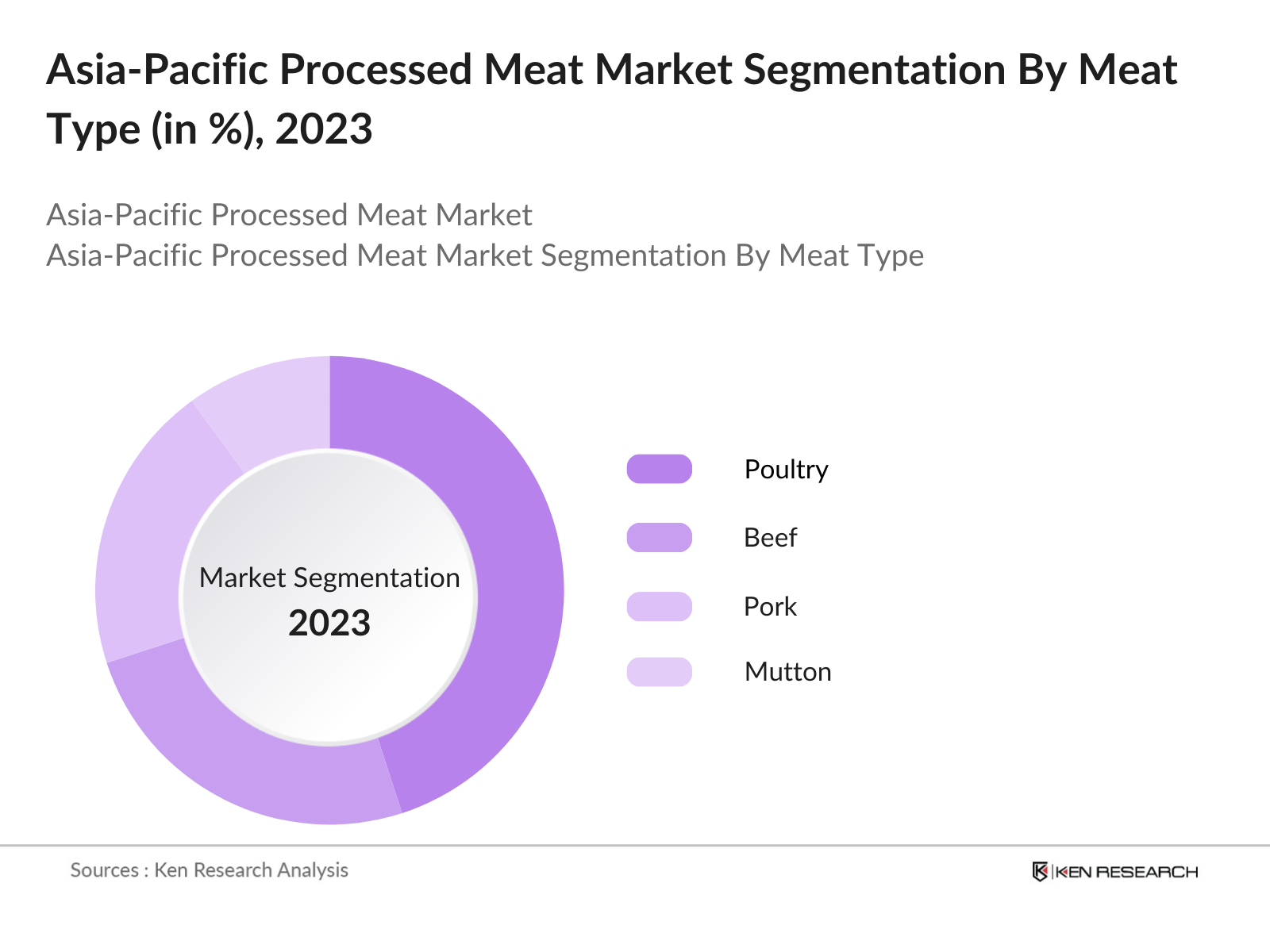
By Meat Type: The Asia-Pacific processed meat market is segmented by meat type into poultry, beef, pork, mutton, and other meats. Poultry holds a dominant market share within this segment, largely due to its affordability, ease of cooking, and widespread availability across the region. Countries like China and India have experienced substantial growth in poultry demand, supported by growing health awareness among consumers who prefer leaner protein options, thus propelling poultry to the forefront.
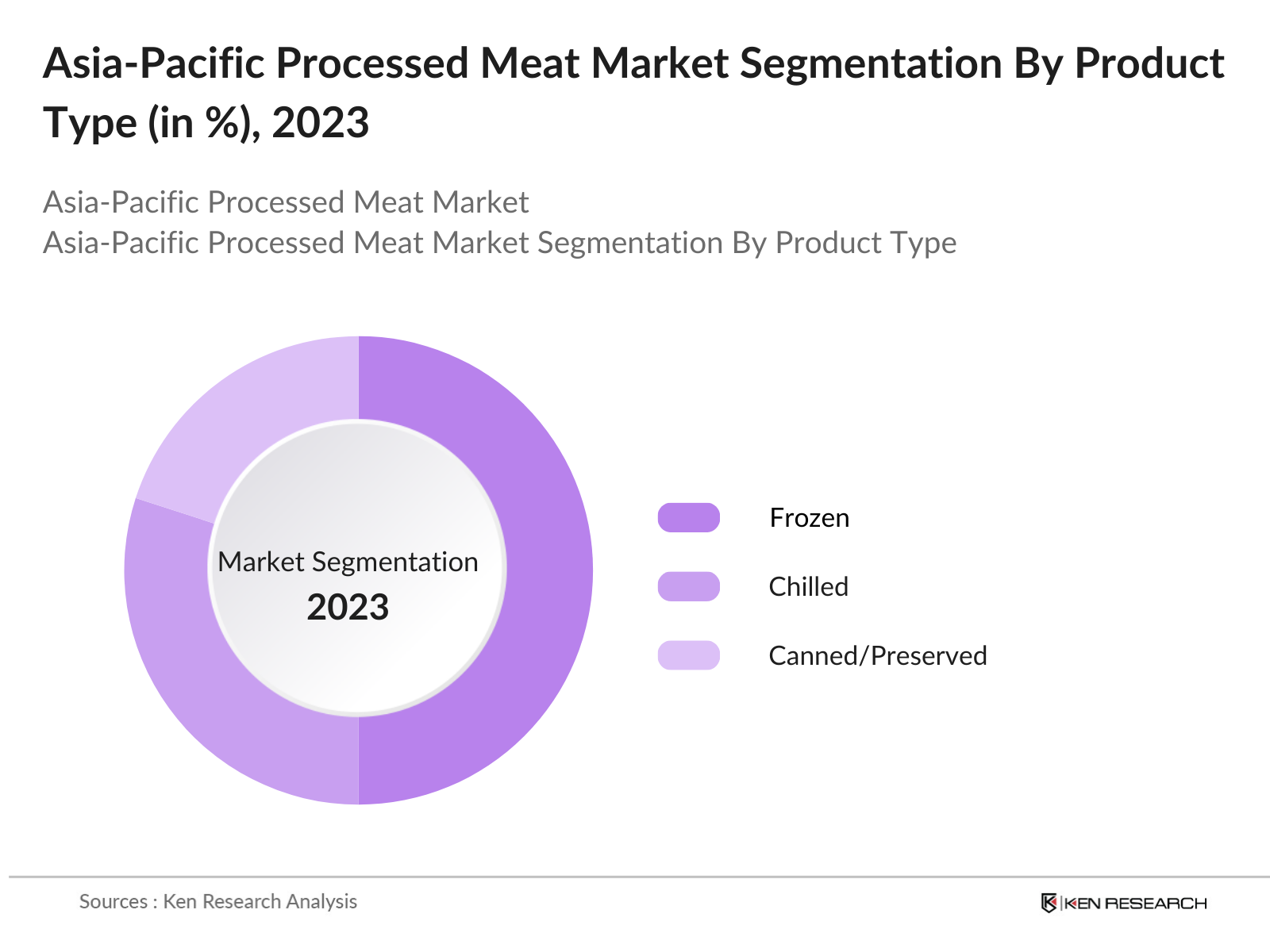
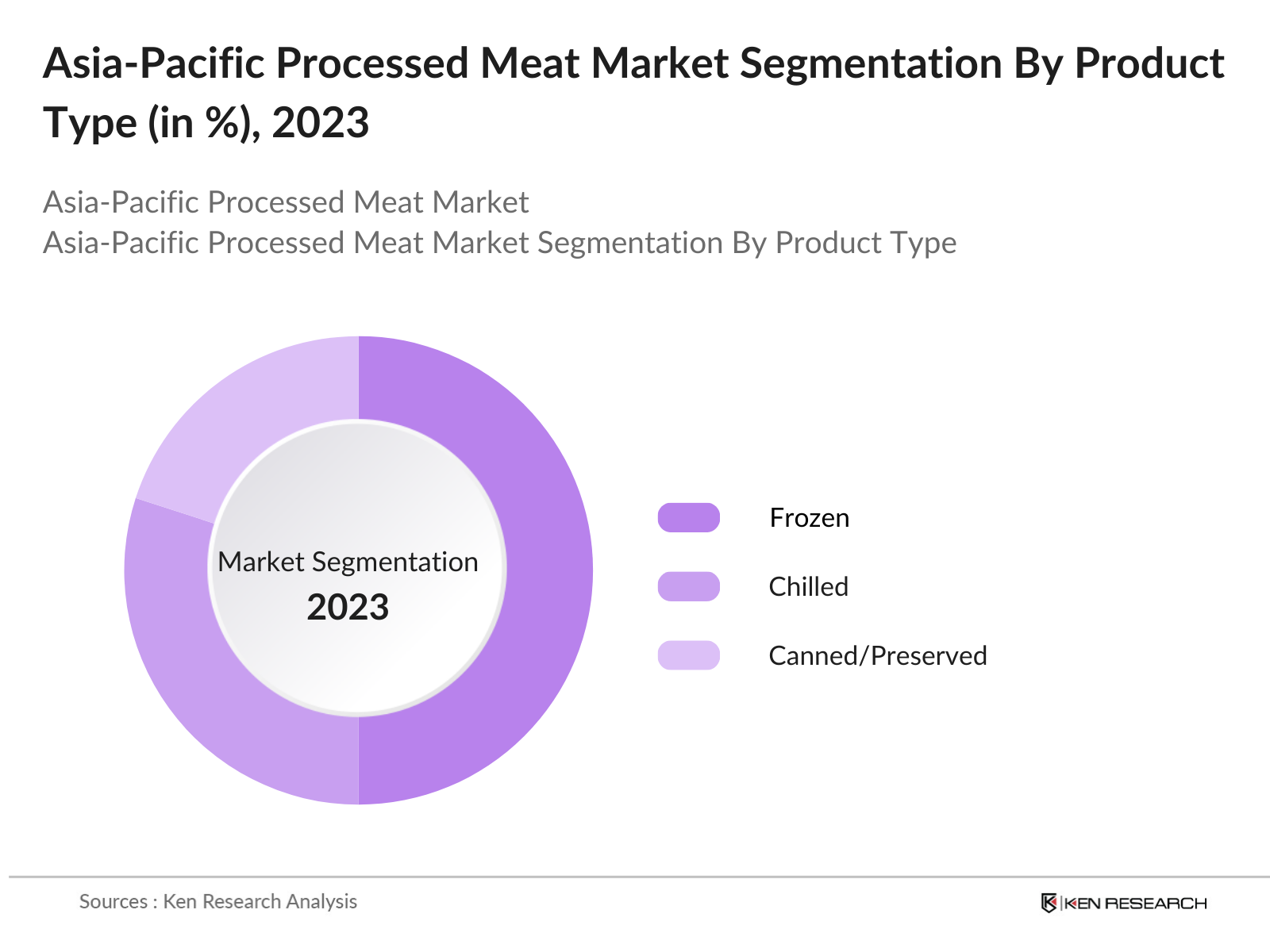
By Product Type: The Asia-Pacific processed meat market is also segmented by product type, including frozen, chilled, and canned/preserved processed meats. Frozen processed meat leads this category, driven by consumer demand for longer shelf-life products and the convenience of storage. The increasing presence of supermarkets and hypermarkets offering various frozen options further bolsters this sub-segments market dominance.
Asia-Pacific Processed Meat Market Competitive Landscape
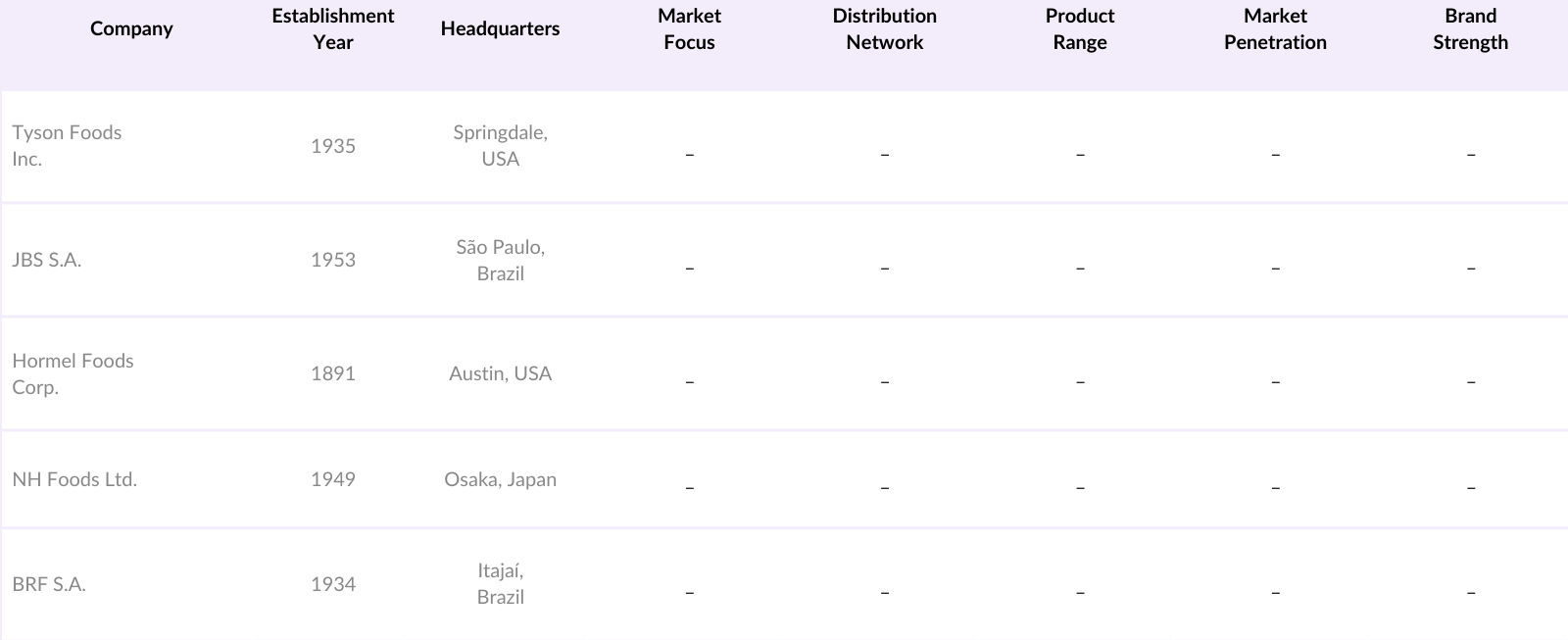
The Asia-Pacific processed meat market is dominated by both regional and international players, creating a competitive environment. Major players in the market include established companies with a strong brand presence and extensive distribution networks across multiple countries in the region. The competition is marked by continuous innovation in product offerings and packaging, enhancing convenience and shelf life.
Asia-Pacific Processed Meat Industry Analysis
Growth Drivers
- Urbanization: The Asia-Pacific region is experiencing significant urbanization, which directly influences consumer lifestyles, leading to a preference for convenience foods like processed meat. The United Nations reports that Asias urban population rose by over 100 million from 2022 to 2024, reaching nearly 2.4 billion. This demographic shift fosters demand for quick, prepared food options, including processed meats, to suit the busier urban lifestyle. For example, urban dwellers in countries like China and India are increasingly opting for ready-to-eat processed meats, fueling market growth.
- Rising Disposable Income: The increase in disposable income across Asia-Pacific has enhanced consumers' purchasing power, enabling more spending on processed and convenience foods. The International Monetary Fund (IMF) notes that the regions average disposable income increased by approximately $1,000 per capita between 2022 and 2024, primarily in Southeast Asia. This growth empowers middle-income households to purchase higher-value foods, including processed meat, as a part of their diet.
- Expansion of Retail Chains: Asia-Pacifics expanding retail network, especially in emerging economies, is creating robust distribution channels for processed meats. For instance, Japan and South Koreas retail market has grown with the addition of over 1,200 modern trade outlets since 2022, allowing for greater availability and variety of processed meat products. These expanded retail channels, including supermarkets and convenience stores, improve product accessibility and drive consumer uptake of processed meat.
Market Challenges
- Health Concerns: Growing awareness of health risks related to processed meat consumption, such as high sodium and preservative levels, poses a challenge for the market. According to the World Health Organization (WHO), the prevalence of hypertension in urban Asia increased by approximately 15 million cases from 2022 to 2024, partly due to diets high in processed foods. This rising health consciousness could deter consumers from processed meat options and impact market growth.
- Stringent Government Regulations: Stringent regulatory standards for food safety in Asia-Pacific impact the processed meat industry, with several countries tightening their safety protocols for processed foods. For instance, Chinas food safety regulations enforced over 600 product recalls in 2023 alone. Countries like Japan and South Korea have imposed stricter labeling requirements and limitations on additives, increasing compliance costs for companies operating in the processed meat sector.
Asia-Pacific Processed Meat Market Future Outlook
The Asia-Pacific processed meat market is poised for continued growth over the next five years, driven by a shift in consumer preferences towards ready-to-eat products, expansion of retail channels, and rising disposable incomes. Increasing consumer awareness regarding protein-rich diets and advancements in meat preservation technology are anticipated to further propel market expansion.
Opportunities
- Increasing Demand for Ready-to-Eat Products: With a rising inclination towards convenience foods, the demand for ready-to-eat processed meats in Asia-Pacific is growing significantly. In 2024, the FAO estimated that the market for convenience foods in the region was valued at over $300 billion, with a notable share driven by processed meat products due to their ease of preparation and storage. This demand reflects a strong growth trajectory for processed meat in the convenience food sector.
- Growth in Online Retail Channels: Asia-Pacifics e-commerce sector is expanding rapidly, providing a new sales avenue for processed meats. The World Bank reports that the regions online retail sales reached over $4 trillion in 2023, marking an increase in consumer reliance on e-commerce for grocery shopping. Processed meat brands are capitalizing on this trend by partnering with e-commerce platforms, making it easier for consumers to access these products online, further driving market growth.
Scope of the Report
|
Meat Type |
Poultry Beef Pork Mutton Others |
|
Product Type |
Frozen Chilled Canned/Preserved |
|
Processing Type |
Fresh Processed Meat Cured Meat Smoked Meat Fermented Meat Dried Meat |
|
Distribution Channel |
Supermarkets/Hypermarkets Specialty Stores Convenience Stores Online Channels |
|
Region |
East Asia South Asia Southeast Asia Oceania |
Products
Key Target Audience Organizations and Entities Who Can Benefit by Subscribing to This Report:
Processed Meat Manufacturing Industries
Online Retail Companies
Cold Storage Companies
Government and Regulatory Bodies (e.g., Food Safety Standards Authority, Ministry of Agriculture)
Investors and Venture Capitalist Firms
Meat Processing Equipment Companies
Packaged Food Companies
Companies
Players Mentioned in the Report
Tyson Foods Inc.
JBS S.A.
Hormel Foods Corporation
Cargill Inc.
NH Foods Ltd.
BRF S.A.
Marfrig Global Foods S.A.
Smithfield Foods Inc.
CP Foods Public Co. Ltd.
Nestle S.A.
Table of Contents
1. Asia-Pacific Processed Meat Market Overview
1.1 Definition and Scope
1.2 Market Taxonomy
1.3 Market Growth Rate
1.4 Market Segmentation Overview
2. Asia-Pacific Processed Meat Market Size (In USD Mn)
2.1 Historical Market Size
2.2 Year-On-Year Growth Analysis
2.3 Key Market Developments and Milestones
3. Asia-Pacific Processed Meat Market Analysis
3.1 Growth Drivers
3.1.1 Urbanization
3.1.2 Rising Disposable Income
3.1.3 Expansion of Retail Chains
3.1.4 Technological Advancements in Meat Processing
3.2 Market Challenges
3.2.1 Health Concerns
3.2.2 Stringent Government Regulations
3.2.3 Supply Chain Disruptions
3.3 Opportunities
3.3.1 Increasing Demand for Ready-to-Eat Products
3.3.2 Growth in Online Retail Channels
3.3.3 Expansion into Emerging Markets
3.4 Trends
3.4.1 Adoption of Clean Label and Organic Products
3.4.2 Innovations in Packaging Solutions
3.4.3 Rising Popularity of Plant-Based Meat Alternatives
3.5 Government Regulations
3.5.1 Food Safety Standards
3.5.2 Import and Export Policies
3.5.3 Labeling and Packaging Requirements
3.6 SWOT Analysis
3.7 Stake Ecosystem
3.8 Porters Five Forces Analysis
3.9 Competitive Landscape
4. Asia-Pacific Processed Meat Market Segmentation
4.1 By Meat Type (In Value %)
4.1.1 Poultry
4.1.2 Beef
4.1.3 Pork
4.1.4 Mutton
4.1.5 Others
4.2 By Product Type (In Value %)
4.2.1 Frozen
4.2.2 Chilled
4.2.3 Canned/Preserved
4.3 By Processing Type (In Value %)
4.3.1 Fresh Processed Meat
4.3.2 Cured Meat
4.3.3 Smoked Meat
4.3.4 Fermented Meat
4.3.5 Dried Meat
4.4 By Distribution Channel (In Value %)
4.4.1 Supermarkets/Hypermarkets
4.4.2 Specialty Stores
4.4.3 Convenience Stores
4.4.4 Online Channels
4.5 By Region (In Value %)
4.5.1 East Asia
4.5.2 South Asia
4.5.3 Southeast Asia
4.5.4 Oceania
5. Asia-Pacific Processed Meat Market Competitive Analysis
5.1 Detailed Profiles of Major Companies
5.1.1 Tyson Foods Inc.
5.1.2 JBS S.A.
5.1.3 Hormel Foods Corporation
5.1.4 Cargill Inc.
5.1.5 Marfrig Global Foods S.A.
5.1.6 NH Foods Ltd.
5.1.7 BRF S.A.
5.1.8 Smithfield Foods, Inc.
5.1.9 CP Foods Public Co. Ltd.
5.1.10 Nestle S.A.
5.1.11 Conagra Brands Inc.
5.1.12 Maple Leaf Foods Inc.
5.1.13 Sigma Alimentos
5.1.14 Kerry Group
5.1.15 Superior Foods Group
5.2 Cross Comparison Parameters (Headquarters Location, Inception Year, Revenue, Employee Count, Market Presence, Product Portfolio, Key Competitors, Regional Penetration)
5.3 Market Share Analysis
5.4 Strategic Initiatives
5.5 Mergers and Acquisitions
5.6 Investment Analysis
5.7 Venture Capital Funding
5.8 Government Grants
5.9 Private Equity Investments
6. Asia-Pacific Processed Meat Market Regulatory Framework
6.1 Food Safety Standards
6.2 Compliance Requirements
6.3 Certification Processes
7. Asia-Pacific Processed Meat Market Future Size (In USD Mn)
7.1 Future Market Size Projections
7.2 Key Factors Driving Future Market Growth
8. Asia-Pacific Processed Meat Market Future Segmentation
8.1 By Meat Type (In Value %)
8.2 By Product Type (In Value %)
8.3 By Processing Type (In Value %)
8.4 By Distribution Channel (In Value %)
8.5 By Region (In Value %)
9. Asia-Pacific Processed Meat Market Analysts Recommendations
9.1 TAM/SAM/SOM Analysis
9.2 Customer Cohort Analysis
9.3 Marketing Initiatives
9.4 White Space Opportunity Analysis
Disclaimer Contact UsResearch Methodology
Step 1: Identification of Key Variables
This phase involves creating an ecosystem map covering stakeholders in the Asia-Pacific Processed Meat Market. Through comprehensive desk research, including proprietary databases, the critical market variables influencing demand are identified.
Step 2: Market Analysis and Construction
Historical data is compiled to evaluate market penetration rates, consumer demographics, and revenue generation metrics, ensuring reliability in market growth estimates.
Step 3: Hypothesis Validation and Expert Consultation
Hypotheses regarding consumer preferences and processing advancements are validated through interviews with industry experts. Insights gathered aid in corroborating market data.
Step 4: Research Synthesis and Final Output
In this step, extensive feedback from industry leaders is integrated into final estimates, ensuring accuracy in processed meat demand forecasts across key markets.
Frequently Asked Questions
01. How big is the Asia-Pacific Processed Meat Market?
The Asia-Pacific processed meat market is valued at USD 70 billion, driven by changing lifestyles and increasing demand for convenient food options in major economies like China and Japan.
02. What are the challenges in the Asia-Pacific Processed Meat Market?
Key challenges include stringent government regulations on food safety, logistical issues in cold storage, and health concerns related to processed foods.
03. Who are the major players in the Asia-Pacific Processed Meat Market?
Leading companies include Tyson Foods Inc., JBS S.A., Hormel Foods Corporation, and NH Foods Ltd., known for their diverse product ranges and strong market presence.
04. What drives growth in the Asia-Pacific Processed Meat Market?
The market is fueled by urbanization, rising disposable incomes, and the growing demand for ready-to-eat meals, with innovations in processing technology also contributing to expansion.
Why Buy From Us?

What makes us stand out is that our consultants follows Robust, Refine and Result (RRR) methodology. i.e. Robust for clear definitions, approaches and sanity checking, Refine for differentiating respondents facts and opinions and Result for presenting data with story

We have set a benchmark in the industry by offering our clients with syndicated and customized market research reports featuring coverage of entire market as well as meticulous research and analyst insights.

While we don't replace traditional research, we flip the method upside down. Our dual approach of Top Bottom & Bottom Top ensures quality deliverable by not just verifying company fundamentals but also looking at the sector and macroeconomic factors.

With one step in the future, our research team constantly tries to show you the bigger picture. We help with some of the tough questions you may encounter along the way: How is the industry positioned? Best marketing channel? KPI's of competitors? By aligning every element, we help maximize success.

Our report gives you instant access to the answers and sources that other companies might choose to hide. We elaborate each steps of research methodology we have used and showcase you the sample size to earn your trust.

If you need any support, we are here! We pride ourselves on universe strength, data quality, and quick, friendly, and professional service.