















Asia Pacific PV Inverter Market Outlook to 2030
Region:Asia
Author(s):Paribhasha Tiwari
Product Code:KROD4197
December 2024
90
About the Report
Asia Pacific PV Inverter Market Overview
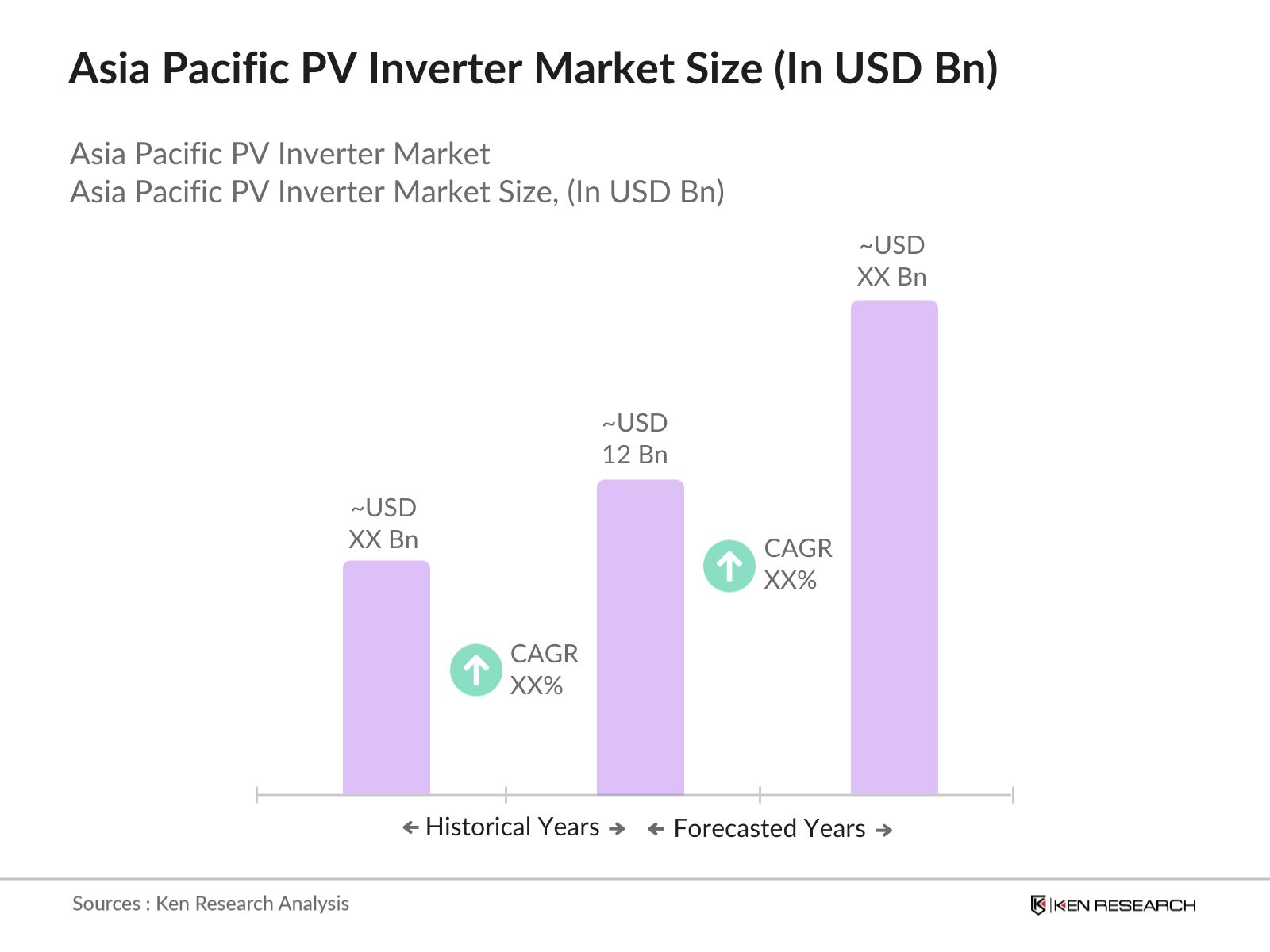
- The Asia Pacific PV Inverter Market is valued at USD 12 billion, based on a five-year historical analysis. The market is driven by the rapid adoption of solar energy across the region, encouraged by various government policies and subsidies aimed at promoting renewable energy sources. The increasing number of large-scale solar installations in countries like China and India, coupled with the continuous decline in the cost of solar components, is propelling the demand for PV inverters. Furthermore, advancements in inverter technology, such as the integration of AI and IoT, have significantly enhanced system efficiency, contributing to the market's growth.
- China and India dominate the Asia Pacific PV Inverter Market due to their large-scale investments in solar energy projects. China's aggressive policies towards carbon neutrality, massive solar farm developments, and its position as the world's largest producer of solar panels have made it a key player in the PV inverter market. In India, the government's ambitious solar energy goals under the National Solar Mission and substantial investments in renewable energy infrastructure have positioned the country as a leading market for PV inverters.
- The Chinese governments 14th Five-Year Plan (20212025) emphasizes the rapid deployment of solar energy, with a target to increase its solar capacity to 400 GW by 2025. This ambitious plan includes financial support for solar projects and prioritizes the installation of PV inverters to enhance grid stability.
Asia Pacific PV Inverter Market Segmentation
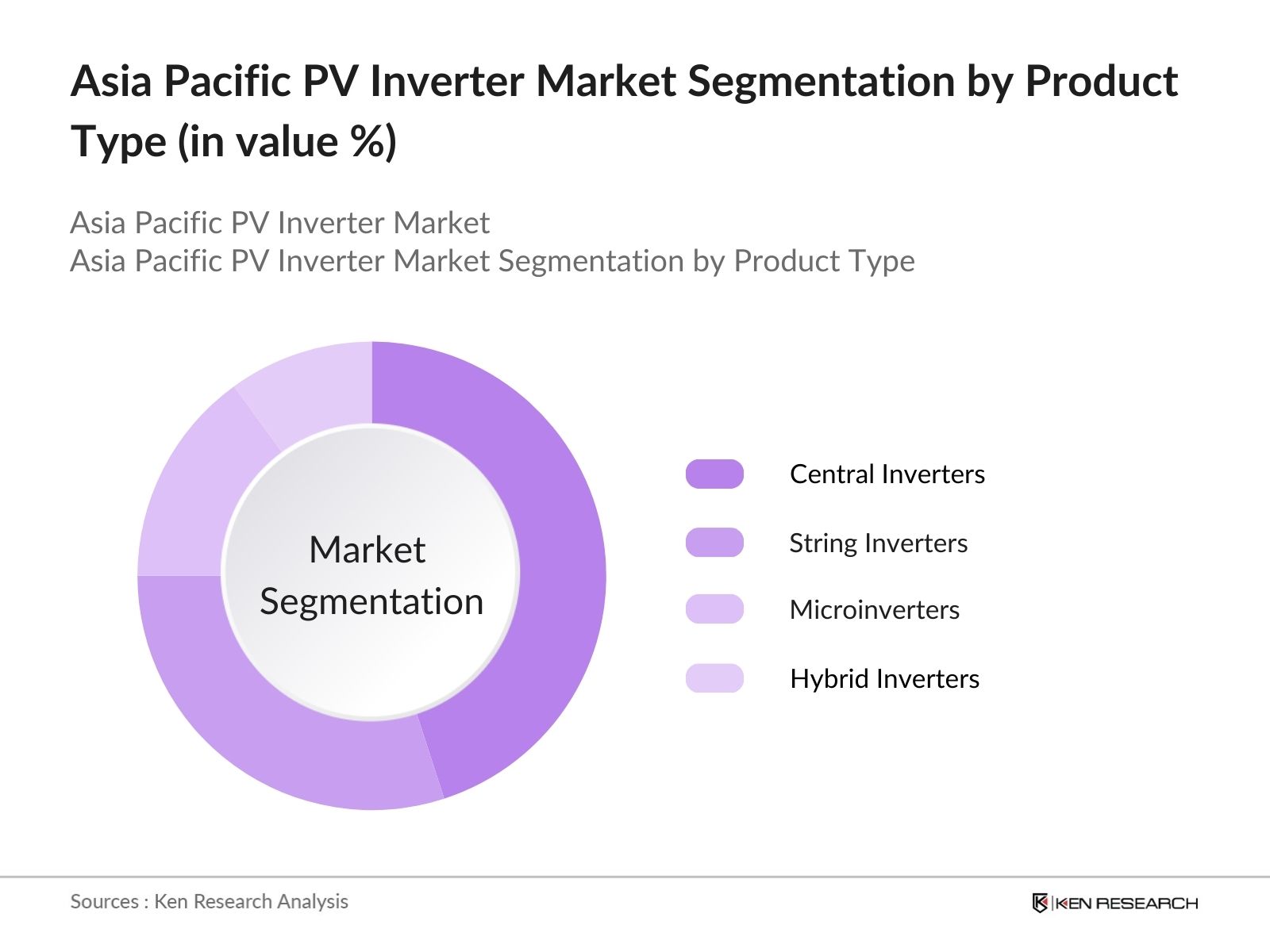
By Product Type: The Asia Pacific PV Inverter Market is segmented by product type into central inverters, string inverters, microinverters, and hybrid inverters. Central inverters currently hold the dominant market share in large-scale utility applications due to their ability to handle high power output and their cost-efficiency in large solar installations. With the increasing deployment of utility-scale solar farms in countries like China and India, central inverters remain the preferred choice for energy providers looking for reliability and lower operational costs in high-output installations.
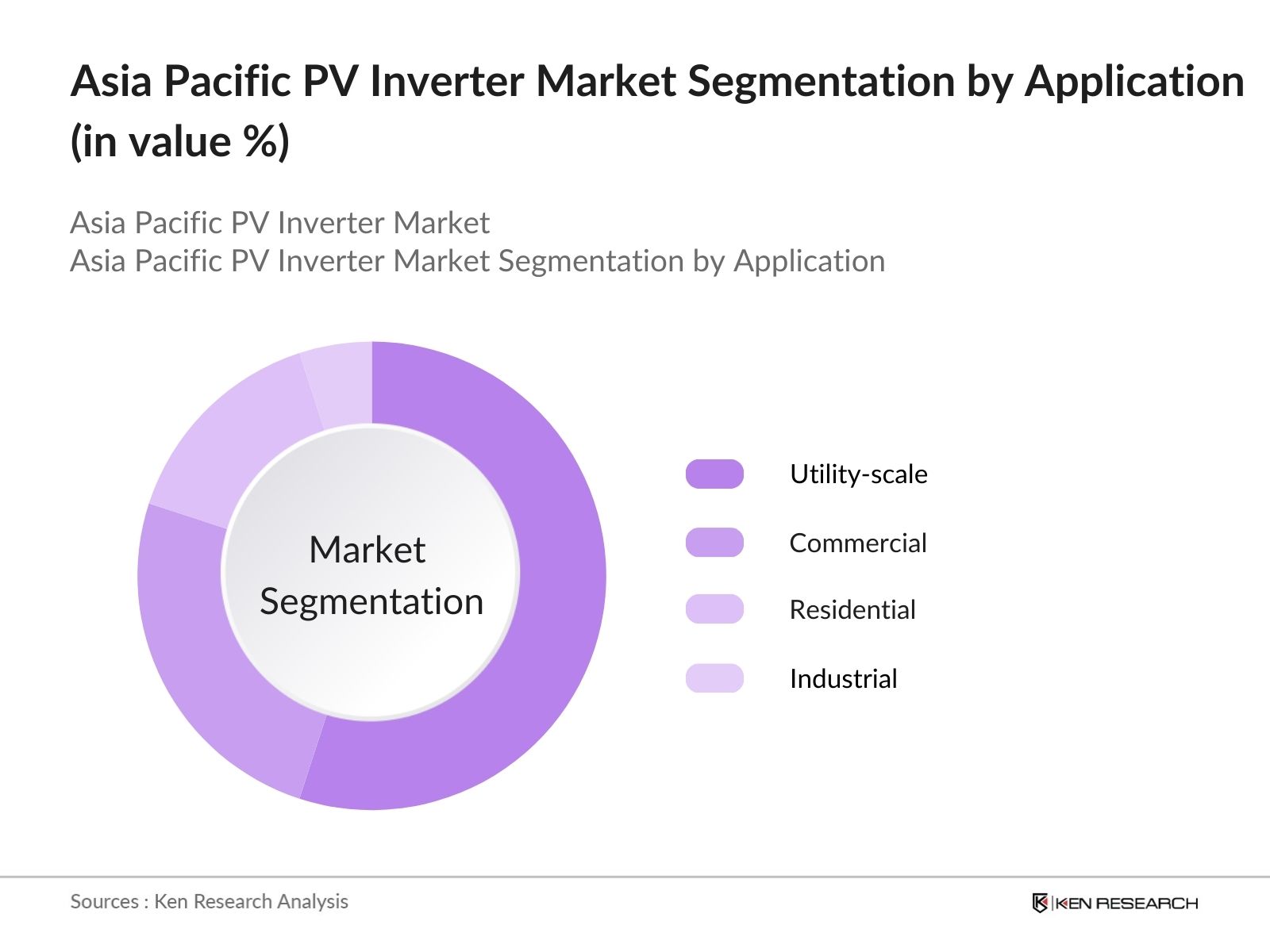
By Application: The market is further segmented by application into residential, commercial, utility-scale, and industrial. Utility-scale applications dominate the PV inverter market due to the surge in solar energy farms that supply power to the grid. These large-scale projects, particularly in China and India, require high-capacity inverters to manage the substantial energy output. As governments push for renewable energy expansion, utility-scale installations will continue to drive the majority of demand in this market.
Asia Pacific PV Inverter Market Competitive Landscape
The Asia Pacific PV Inverter Market is dominated by key players who have established strong product portfolios and significant market presence. Companies like Huawei Technologies and Sungrow Power Supply Co. have led the industry with their technological innovations, particularly in the field of smart and hybrid inverters. This competitive landscape reflects a blend of global powerhouses and local manufacturers, emphasizing the region's capacity for solar power generation.
|
Company Name |
Establishment Year |
Headquarters |
R&D Investment |
Global Reach |
Product Range |
Technological Advancements |
Market Penetration |
|
Huawei Technologies Co. |
1987 |
Shenzhen, China |
- | - | - | - | - |
|
Sungrow Power Supply Co. |
1997 |
Hefei, China |
- | - | - | - | - |
|
SMA Solar Technology AG |
1981 |
Niestetal, Germany |
- | - | - | - | - |
|
Fimer SpA |
1942 |
Vimercate, Italy |
- | - | - | - | - |
|
Delta Electronics, Inc. |
1971 |
Taipei, Taiwan |
- | - | - | - | - |
Asia Pacific PV Inverter Market Analysis
Growth Drivers
- Increasing Solar Energy Adoption: The Asia Pacific (APAC) region is witnessing an increased focus on solar energy due to the regions abundant sunlight and rising energy demands. In 2023, countries like China, India, and Australia collectively added over 160 GW of solar capacity. The global trend toward decarbonization is driving this growth, with solar energy representing a key component of energy strategies. China, which installed 108 GW of solar capacity in 2023, continues to lead, while India installed 15 GW of solar capacity that same year, positioning it as a major player.
- Investments in Renewable Energy Infrastructure: APAC governments and private entities have significantly increased investments in renewable energy projects, including solar parks and distributed generation systems. In 2024, renewable energy investment in APAC reached $300 billion, with a large portion allocated to solar energy. This surge in investment has resulted in a strong demand for PV inverters, essential for converting solar energy into usable electricity across large utility-scale projects.
- Advancement Inverter Technology: The emergence of smart PV inverters, capable of grid management and remote monitoring, is revolutionizing solar installations in APAC. In 2024, more than 70% of new solar installations in the region incorporated smart inverters. These systems improve energy efficiency by up to 15% and provide grid stability, particularly in markets like Japan and South Korea, where solar energy capacity continues to expand rapidly.
Market Challenges
- High Initial Installation Costs: The upfront cost of solar PV systems, including inverters, remains a significant barrier in developing countries across APAC. In 2024, the average installation cost for a solar PV system in India ranged from INR 50,000 to INR 60,000 per kW, which is prohibitive for many small businesses and residential consumers. The lack of financing options further compounds the challenge, limiting adoption rates in cost-sensitive markets like Vietnam.
- Lack of Grid Infrastructure in Remote Areas: Many APAC countries, particularly in Southeast Asia and South Asia, struggle with inadequate grid infrastructure in remote areas. For example, Indonesia, with over 17,000 islands, has limited grid coverage, particularly in its eastern provinces. In 2023, the electrification rate in rural areas of Indonesia was below 60%, limiting the feasibility of PV systems. This lack of infrastructure significantly hampers the potential for solar PV installations and inverter demand.
Asia Pacific PV Inverter Market Future Outlook
Over the next five years, the Asia Pacific PV Inverter Market is expected to witness significant growth, driven by government policies aimed at boosting renewable energy adoption. Countries like China, India, and Japan are set to continue their investments in solar energy infrastructure, ensuring the steady demand for PV inverters. Additionally, advancements in smart inverter technologies, particularly those enabling energy storage integration and grid stabilization, are likely to open new opportunities for market players. The increasing focus on decentralized energy systems and hybrid inverters is expected to further drive the demand across both residential and utility-scale sectors.
Market Opportunities
- Expansion of Microgrids and Hybrid Systems: The growing focus on energy decentralization in the APAC region is driving the demand for microgrids and hybrid energy systems. In 2024, microgrid projects worth $2.5 billion were launched across Southeast Asia, with solar PV and battery storage as the primary components. These systems require advanced PV inverters to integrate multiple energy sources, creating a substantial market opportunity.
- Growing Demand for Energy Storage Systems (ESS) Integration: The integration of solar PV systems with energy storage solutions is emerging as a key trend, especially in regions with intermittent grid connectivity. In 2024, Australia announced plans to add 10 GWh of battery storage capacity, primarily for residential solar systems. This integration requires advanced PV inverters that can manage energy storage and improve system efficiency, opening new opportunities for inverter manufacturers.
Scope of the Report
|
By Product Type |
Central Inverters String Inverters Microinverters Hybrid Inverters |
|
By Application |
Residential Commercial Utility-scale Industrial |
|
By Connectivity |
On-grid Off-grid Hybrid Systems |
|
By Power Rating |
Up to 10 kW 10-100 kW 100-500 kW Above 500 kW |
|
By Region |
China India Japan Australia Southeast Asia |
Products
Key Target Audience
Solar Energy Installers and Contractors
PV Inverter Manufacturers
Investors and Venture Capitalist Firms
Renewable Energy Associations
Government and Regulatory Bodies (e.g., Ministry of New and Renewable Energy, NDRC)
Solar Energy Project Developers
Utility Companies and Grid Operators
Energy Storage System Providers
Companies
Players Mentioned in the Report:
Huawei Technologies Co., Ltd.
Sungrow Power Supply Co., Ltd.
SMA Solar Technology AG
Fimer SpA
Delta Electronics, Inc.
ABB Ltd.
Schneider Electric SE
Solaredge Technologies Inc.
Enphase Energy
Growatt New Energy Technology Co., Ltd.
Table of Contents
1. Asia Pacific PV Inverter Market Overview
1.1 Definition and Scope
1.2 Market Taxonomy
1.3 Market Growth Rate (DC-AC conversion efficiency, PV system penetration)
1.4 Market Segmentation Overview
2. Asia Pacific PV Inverter Market Size (In USD Billion)
2.1 Historical Market Size
2.2 Year-on-Year Growth Analysis (Inverter demand by residential, commercial, and utility-scale installations)
2.3 Key Market Developments and Milestones (Government incentives, solar grid integrations)
3. Asia Pacific PV Inverter Market Analysis
3.1 Growth Drivers
3.1.1 Increasing Solar Energy Adoption
3.1.2 Government Subsidies and Feed-in Tariff Programs
3.1.3 Rising Investments in Renewable Energy Infrastructure
3.1.4 Advancements in Smart Inverter Technology
3.2 Market Challenges
3.2.1 High Initial Installation Costs
3.2.2 Lack of Grid Infrastructure in Remote Areas
3.2.3 Regulatory Complexity Across APAC Countries
3.3 Opportunities
3.3.1 Expansion of Microgrids and Hybrid Systems
3.3.2 Growing Demand for Energy Storage Systems (ESS) Integration
3.3.3 Technological Advancements in Digital Inverters
3.4 Trends
3.4.1 Integration of IoT and AI in PV Inverters (Inverter analytics and monitoring)
3.4.2 Shifting Focus Towards Hybrid Inverters for Off-grid Solutions
3.4.3 Rising Demand for Grid Stabilization and Ancillary Services
3.5 Government Regulations
3.5.1 Renewable Energy Targets (Country-wise renewable energy targets in APAC)
3.5.2 Net Metering Policies
3.5.3 Energy Storage Mandates
3.5.4 Emission Reduction Goals and Carbon Offset Programs
3.6 SWOT Analysis
3.7 Stake Ecosystem (PV module manufacturers, Grid operators, Installers)
3.8 Porters Five Forces
3.9 Competitive Ecosystem
4. Asia Pacific PV Inverter Market Segmentation
4.1 By Product Type (In Value %)
4.1.1 Central Inverters
4.1.2 String Inverters
4.1.3 Microinverters
4.1.4 Hybrid Inverters
4.2 By Application (In Value %)
4.2.1 Residential
4.2.2 Commercial
4.2.3 Utility-scale
4.2.4 Industrial
4.3 By Connectivity (In Value %)
4.3.1 On-grid
4.3.2 Off-grid
4.3.3 Hybrid Systems
4.4 By Power Rating (In Value %)
4.4.1 Up to 10 kW
4.4.2 10-100 kW
4.4.3 100-500 kW
4.4.4 Above 500 kW
4.5 By Region (In Value %)
4.5.1 China
4.5.2 India
4.5.3 Japan
4.5.4 Australia
4.5.5 Southeast Asia
5. Asia Pacific PV Inverter Market Competitive Analysis
5.1 Detailed Profiles of Major Companies
5.1.1 Huawei Technologies Co., Ltd.
5.1.2 Sungrow Power Supply Co., Ltd.
5.1.3 SMA Solar Technology AG
5.1.4 Fimer SpA
5.1.5 Power Electronics
5.1.6 Delta Electronics, Inc.
5.1.7 ABB Ltd.
5.1.8 Schneider Electric SE
5.1.9 Solaredge Technologies Inc.
5.1.10 Enphase Energy
5.1.11 Growatt New Energy Technology Co., Ltd.
5.1.12 Sineng Electric
5.1.13 TBEA Co., Ltd.
5.1.14 Ginlong Technologies
5.1.15 Ingeteam
5.2 Cross Comparison Parameters
(Inverter efficiency, R&D expenditure, geographic presence, product range, after-sales services, revenue, market share, customer base)
5.3 Market Share Analysis
5.4 Strategic Initiatives
5.5 Mergers and Acquisitions
5.6 Investment Analysis
5.7 Venture Capital Funding
5.8 Government Grants
5.9 Private Equity Investments
6. Asia Pacific PV Inverter Market Regulatory Framework
6.1 Compliance Standards (International standards such as IEC, UL)
6.2 Grid Code Regulations
6.3 Certification Processes for Inverter Manufacturing
7. Asia Pacific PV Inverter Future Market Size (In USD Billion)
7.1 Future Market Size Projections
7.2 Key Factors Driving Future Market Growth
8. Asia Pacific PV Inverter Future Market Segmentation
8.1 By Product Type (In Value %)
8.2 By Application (In Value %)
8.3 By Connectivity (In Value %)
8.4 By Power Rating (In Value %)
8.5 By Region (In Value %)
9. Asia Pacific PV Inverter Market Analysts Recommendations
9.1 TAM/SAM/SOM Analysis
9.2 Customer Cohort Analysis
9.3 Marketing Initiatives
9.4 White Space Opportunity Analysis
Research Methodology
Step 1: Identification of Key Variables
The research begins by mapping out the major stakeholders within the Asia Pacific PV Inverter Market. This involves desk research from a variety of credible sources, including governmental reports and proprietary databases. The main objective is to define and capture the critical market variables that influence market dynamics.
Step 2: Market Analysis and Construction
In this phase, historical data related to the PV Inverter Market is compiled and analyzed. This includes examining solar power installations, government policy impacts, and technological advancements. A thorough assessment of inverter deployment by application type (residential, commercial, utility) is performed.
Step 3: Hypothesis Validation and Expert Consultation
Market hypotheses are created based on initial findings and then validated through expert interviews. These interviews, conducted with industry leaders and practitioners, provide additional insights into market trends, investment patterns, and operational challenges within the PV inverter industry.
Step 4: Research Synthesis and Final Output
The final stage involves direct engagement with PV inverter manufacturers and solar project developers. This helps to confirm market data and provides a comprehensive understanding of product performance, consumer demand, and market trends. The findings are then synthesized into a detailed report.
Frequently Asked Questions
1. How big is the Asia Pacific PV Inverter Market?
The Asia Pacific PV Inverter Market is valued at USD 12 billion, driven by increasing solar energy installations and government initiatives to expand renewable energy capacity across the region.
2. What are the challenges in the Asia Pacific PV Inverter Market?
Challenges in the Asia Pacific PV Inverter Market include high installation costs for large-scale solar projects, inconsistent grid infrastructure in remote areas, and regulatory variations across different countries in the region.
3. Who are the major players in the Asia Pacific PV Inverter Market?
Major players in the Asia Pacific PV Inverter Market include Huawei Technologies Co., Ltd., Sungrow Power Supply Co., Ltd., SMA Solar Technology AG, Fimer SpA, and Delta Electronics, Inc., which dominate due to their technological advancements and broad product portfolios.
4. What are the growth drivers of the Asia Pacific PV Inverter Market?
The Asia Pacific PV Inverter Market is driven by increasing government support for renewable energy, declining costs of solar installations, and technological innovations in smart inverters and energy storage systems.
Why Buy From Us?

What makes us stand out is that our consultants follows Robust, Refine and Result (RRR) methodology. i.e. Robust for clear definitions, approaches and sanity checking, Refine for differentiating respondents facts and opinions and Result for presenting data with story

We have set a benchmark in the industry by offering our clients with syndicated and customized market research reports featuring coverage of entire market as well as meticulous research and analyst insights.

While we don't replace traditional research, we flip the method upside down. Our dual approach of Top Bottom & Bottom Top ensures quality deliverable by not just verifying company fundamentals but also looking at the sector and macroeconomic factors.

With one step in the future, our research team constantly tries to show you the bigger picture. We help with some of the tough questions you may encounter along the way: How is the industry positioned? Best marketing channel? KPI's of competitors? By aligning every element, we help maximize success.

Our report gives you instant access to the answers and sources that other companies might choose to hide. We elaborate each steps of research methodology we have used and showcase you the sample size to earn your trust.

If you need any support, we are here! We pride ourselves on universe strength, data quality, and quick, friendly, and professional service.