
Asia Pacific Radar Market Outlook to 2030
Region:Afganistan
Author(s):Meenakshi Bisht
Product Code:KROD10702
Region:Afganistan
Author(s):Meenakshi Bisht
Product Code:KROD10702
November 2024
88
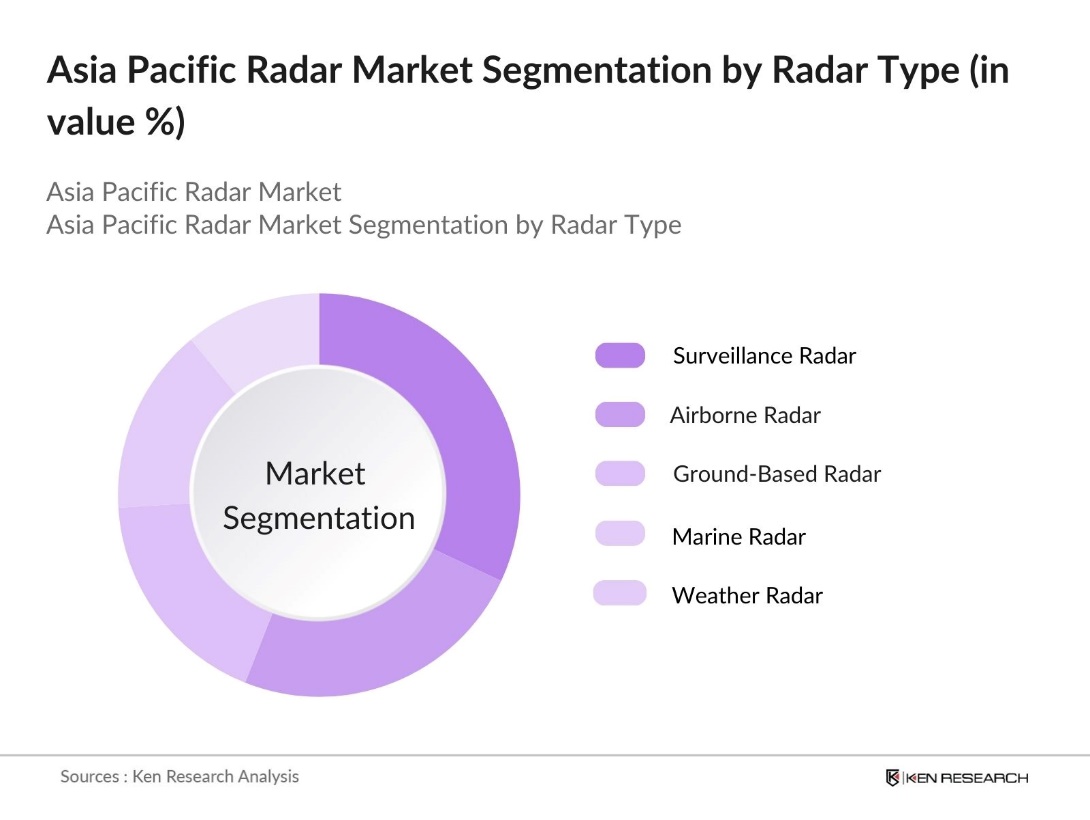
By Radar Type: The market is segmented by radar type into surveillance radar, airborne radar, ground-based radar, marine radar, and weather radar. Surveillance radar holds the dominant market share within this segment due to its crucial role in national security and military applications. Countries such as China and India have heavily invested in surveillance radar for border and maritime security, ensuring high demand for this segment. This growth is supported by continuous technological advancements and the integration of radar systems in national defense infrastructures.
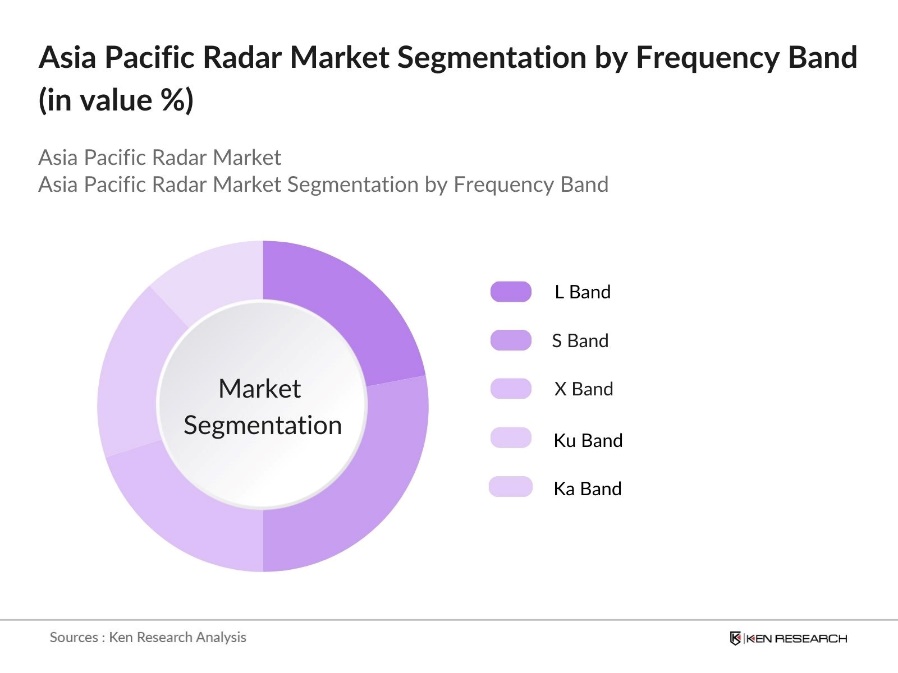
By Frequency Band: The is segmented by frequency band into L band, S band, X band, Ku band, and Ka band. The S band radar leads in this category, primarily due to its extensive use in aviation and weather forecasting. The versatility of the S band in penetrating clouds, rain, and fog makes it ideal for applications in air traffic control and meteorological monitoring, thereby driving its adoption across various APAC regions.
The Asia Pacific Radar Market is dominated by several major players, a mix of global defense giants and regional specialists, all contributing to the growth and innovation in radar technologies. Key players like Lockheed Martin Corporation, Raytheon Technologies, and Thales Group hold strong positions due to their extensive portfolios and robust investments in R&D, enabling advanced radar solutions for defense and commercial applications. 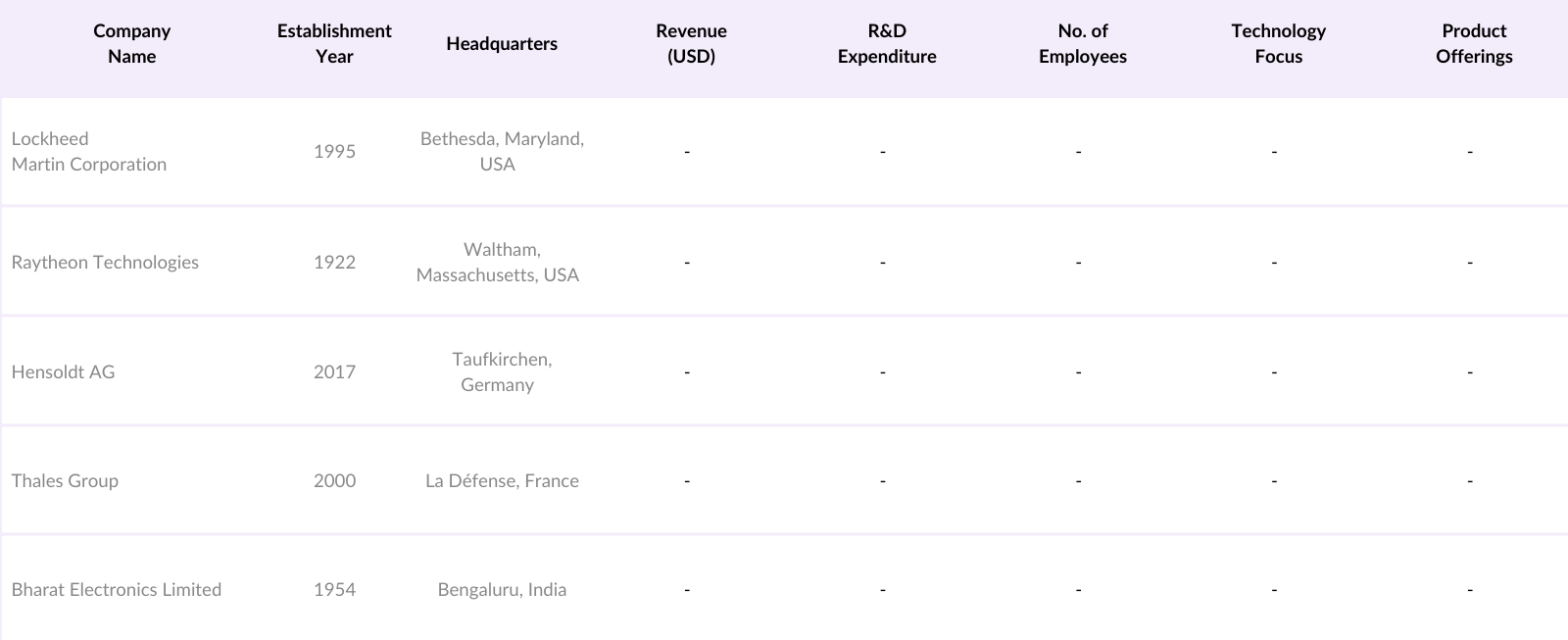
The Asia Pacific radar market is set for continued growth due to the ongoing technological evolution in radar systems and increasing governmental emphasis on national defense modernization. Enhanced radar systems with AI capabilities are becoming essential for the expanding defense and security sector. Additionally, advancements in radar applications in civilian areas, such as air traffic control and maritime surveillance, are expected to bolster the market further.
|
Radar Type |
Surveillance Radar Airborne Radar Ground-Based Radar Marine Radar Weather Radar |
|
Component |
Antenna Transmitter Receiver Power Supply Signal Processor |
|
Frequency Band |
L Band S Band X Band Ku Band Ka Band |
|
Application |
Defense & Military Commercial Aviation Maritime Space Exploration Automotive |
|
Region |
China Japan South Korea Australia Southeast Asia |
1.1 Definition and Scope
1.2 Market Taxonomy
1.3 Industry Growth Rate and Dynamics
1.4 Key Market Developments and Milestones
2.1 Historical Market Size Analysis
2.2 Year-On-Year Growth Analysis
2.3 Key Market Developments and Milestones
3.1 Growth Drivers
3.1.1 Defense Spending (By Government Allocation)
3.1.2 Technological Advancements (Integration of AI & Machine Learning)
3.1.3 Rising Border Security Concerns
3.1.4 Increased Demand for Surveillance Systems (Public Safety & Defense)
3.2 Market Challenges
3.2.1 High Initial Capital Investment
3.2.2 Stringent Government Regulations (By Environmental Compliance)
3.2.3 Skilled Workforce Shortage (Technical Expertise Requirement)
3.3 Opportunities
3.3.1 Emerging Markets in APAC
3.3.2 Government Subsidies and Grants (Defense Innovation)
3.3.3 Growing Adoption in Commercial Applications (Transportation & Aviation)
3.4 Market Trends
3.4.1 Miniaturization of Radar Systems (Reduction in Size & Weight)
3.4.2 Integration with Autonomous Vehicles
3.4.3 Increased Adoption of 3D Radar Technology
3.5 Government Regulations
3.5.1 National Defense Standards Compliance
3.5.2 Import/Export Controls
3.5.3 Environmental and Safety Standards
3.5.4 Cybersecurity Regulations
3.6 SWOT Analysis
3.7 Stakeholder Ecosystem
3.8 Porters Five Forces Analysis
3.9 Competition Landscape Overview
4.1 By Radar Type (Value %)
4.1.1 Surveillance Radar
4.1.2 Airborne Radar
4.1.3 Ground-Based Radar
4.1.4 Marine Radar
4.1.5 Weather Radar
4.2 By Component (Value %)
4.2.1 Antenna
4.2.2 Transmitter
4.2.3 Receiver
4.2.4 Power Supply
4.2.5 Signal Processor
4.3 By Frequency Band (Value %)
4.3.1 L Band
4.3.2 S Band
4.3.3 X Band
4.3.4 Ku Band
4.3.5 Ka Band
4.4 By Application (Value %)
4.4.1 Defense & Military
4.4.2 Commercial Aviation
4.4.3 Maritime
4.4.4 Space Exploration
4.4.5 Automotive
4.5 By Region (Value %)
4.5.1 China
4.5.2 Japan
4.5.3 South Korea
4.5.4 Australia
4.5.5 Southeast Asia
5.1 Detailed Profiles of Major Companies
5.1.1 Lockheed Martin Corporation
5.1.2 Northrop Grumman Corporation
5.1.3 Raytheon Technologies Corporation
5.1.4 BAE Systems plc
5.1.5 Thales Group
5.1.6 Leonardo S.p.A.
5.1.7 Hensoldt AG
5.1.8 Saab AB
5.1.9 Mitsubishi Electric Corporation
5.1.10 Bharat Electronics Limited
5.1.11 Israel Aerospace Industries Ltd.
5.1.12 General Dynamics Corporation
5.1.13 Honeywell International Inc.
5.1.14 Elbit Systems Ltd.
5.1.15 Indra Sistemas, S.A.
5.2 Cross Comparison Parameters (R&D Expenditure, Market Presence, Technological Innovation Index, Revenue Growth, Defense Contracts, Regional Expansion, Patent Portfolio, Client Base Diversification)
5.3 Market Share Analysis
5.4 Strategic Initiatives (R&D Focus, Regional Partnerships)
5.5 Mergers and Acquisitions (Value in USD, Segmental Growth)
5.6 Investment Analysis (Venture Capital and Private Equity Inflows)
5.7 Government Grants and Subsidies
5.8 Private Equity Investments
5.9 Innovation Funding and Support Programs
6.1 Defense Export Controls and Compliance
6.2 Environmental Compliance Standards
6.3 Technology and Innovation Regulatory Bodies
6.4 Compliance Certifications (ISO, ITAR, etc.)
7.1 Projections Based on Defense and Commercial Demand
7.2 Key Factors Driving Market Growth
8.1 By Radar Type (Value %)
8.2 By Component (Value %)
8.3 By Frequency Band (Value %)
8.4 By Application (Value %)
8.5 By Region (Value %)
9.1 Total Addressable Market (TAM) Analysis
9.2 Specific Customer Cohort Analysis
9.3 Strategic Marketing Initiatives
9.4 Identification of White Space Opportunities
Disclaimer Contact UsThe first step involves identifying the primary drivers and constraints within the Asia Pacific radar market, employing extensive desk research and leveraging reputable secondary data sources. The objective is to map essential market variables influencing growth and demand.
This phase focuses on collecting historical data to assess market trends, technological advancements, and revenue patterns. An in-depth analysis of both defense and commercial sectors offers a balanced understanding of market dynamics.
Hypotheses regarding market drivers, such as defense spending trends and technological adoption rates, are validated through consultations with industry experts. These insights offer operational and financial perspectives to enrich the analysis.
Engaging with radar manufacturers and technology providers, this stage aims to verify data through industry-specific insights. Synthesizing information from bottom-up and top-down approaches ensures a comprehensive, accurate, and market-reflective report.
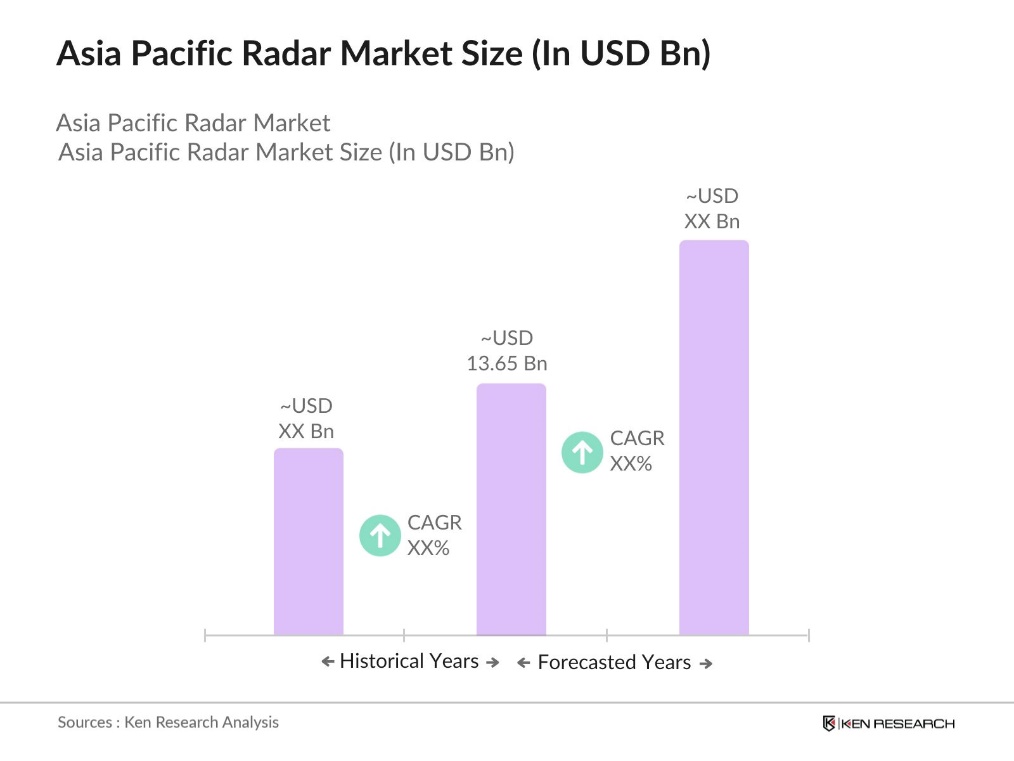
The Asia Pacific radar market is valued at USD 13.65 billion, driven by defense investments, increasing security concerns, and technological advancements in radar systems.
Key challenges in Asia Pacific radar market include high initial capital requirements, stringent government regulations, and the need for a skilled workforce to operate complex radar technologies.
Leading companies in the Asia Pacific radar market include Lockheed Martin, Raytheon Technologies, Thales Group, Hensoldt AG, and Bharat Electronics Limited, known for their robust technology portfolios and defense contracts.
Growth drivers in Asia Pacific radar market include heightened defense spending, particularly in China and India, adoption of radar in commercial applications, and advances in AI-integrated radar systems.

What makes us stand out is that our consultants follows Robust, Refine and Result (RRR) methodology. i.e. Robust for clear definitions, approaches and sanity checking, Refine for differentiating respondents facts and opinions and Result for presenting data with story

We have set a benchmark in the industry by offering our clients with syndicated and customized market research reports featuring coverage of entire market as well as meticulous research and analyst insights.

While we don't replace traditional research, we flip the method upside down. Our dual approach of Top Bottom & Bottom Top ensures quality deliverable by not just verifying company fundamentals but also looking at the sector and macroeconomic factors.

With one step in the future, our research team constantly tries to show you the bigger picture. We help with some of the tough questions you may encounter along the way: How is the industry positioned? Best marketing channel? KPI's of competitors? By aligning every element, we help maximize success.

Our report gives you instant access to the answers and sources that other companies might choose to hide. We elaborate each steps of research methodology we have used and showcase you the sample size to earn your trust.

If you need any support, we are here! We pride ourselves on universe strength, data quality, and quick, friendly, and professional service.