
Asia Pacific Seaweed Market Outlook to 2030
Region:Asia
Author(s):Sanjna
Product Code:KROD9162
November 2024
83
About the Report
Asia Pacific Seaweed Market Overview
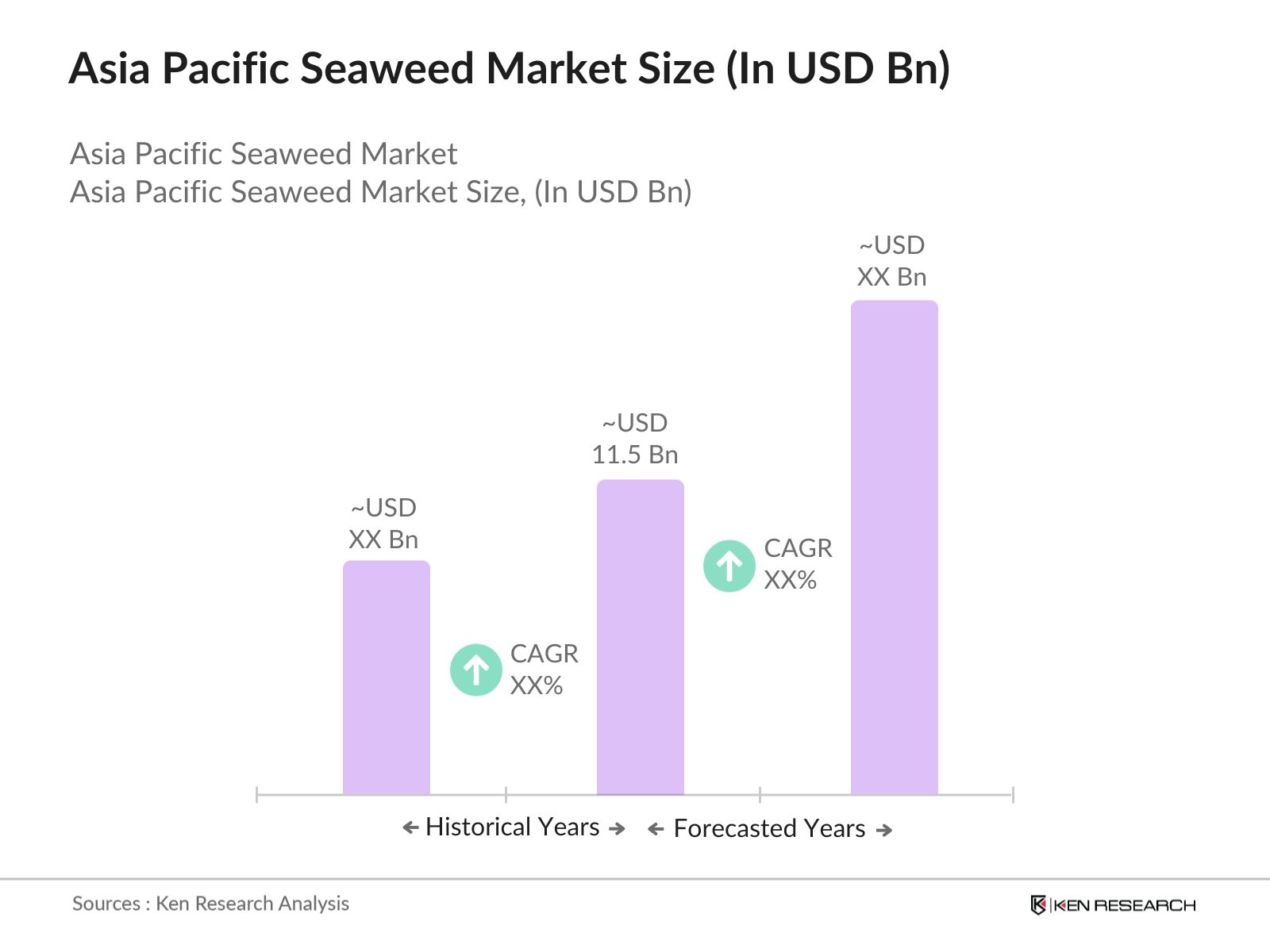
- The Asia Pacific Seaweed Market is valued at USD 11.5 billion based on a five-year historical analysis. This market is driven by the growing demand for sustainable food sources, nutraceuticals, and biofuels. The increasing use of seaweed as an ingredient in fertilizers, cosmetics, and animal feed also propels the market growth. The demand is fueled by consumer preferences for plant-based products and organic farming practices, making seaweed a crucial resource for various industries.
- The countries dominating the Asia Pacific seaweed market include China, Japan, and South Korea. These nations are significant producers of seaweed due to their extensive coastal areas and well-established aquaculture industries. China leads the market owing to its massive production capacity, while Japan and South Korea have a long history of seaweed cultivation, which has enabled them to maintain technological leadership and expertise in the field.
- Despite the growing demand, trade barriers remain a challenge. Seaweed exporters in countries like the Philippines and Indonesia face stringent quality standards from markets such as the EU and the US. In 2023, approximately 20% of seaweed exports from these countries failed to meet EU quality standards, resulting in significant economic losses. Governments are working on improving processing technologies and aligning with international standards.
Asia Pacific Seaweed Market Segmentation
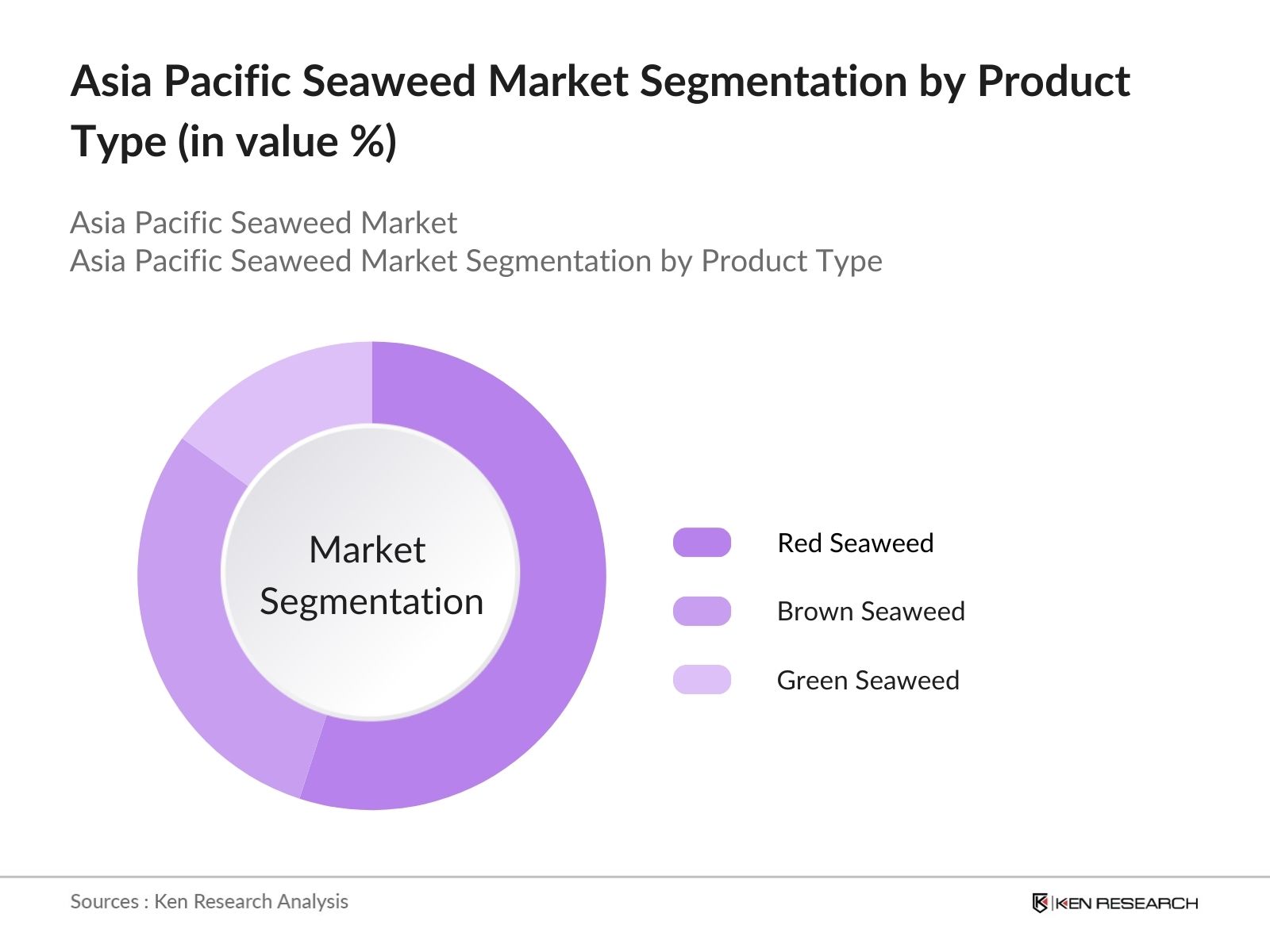
By Product Type: The Asia Pacific Seaweed market is segmented by product type into red seaweed, brown seaweed, and green seaweed. Red seaweed holds the dominant market share in the region, primarily due to its high commercial demand for producing carrageenan, a thickening agent used extensively in food products, pharmaceuticals, and cosmetics. Moreover, the versatile application of red seaweed in food and beverages, as well as its contribution to animal feed, further supports its dominance. Red seaweed species such as Kappaphycus and Eucheuma are particularly valuable, with a well-established supply chain in China and Southeast Asia.
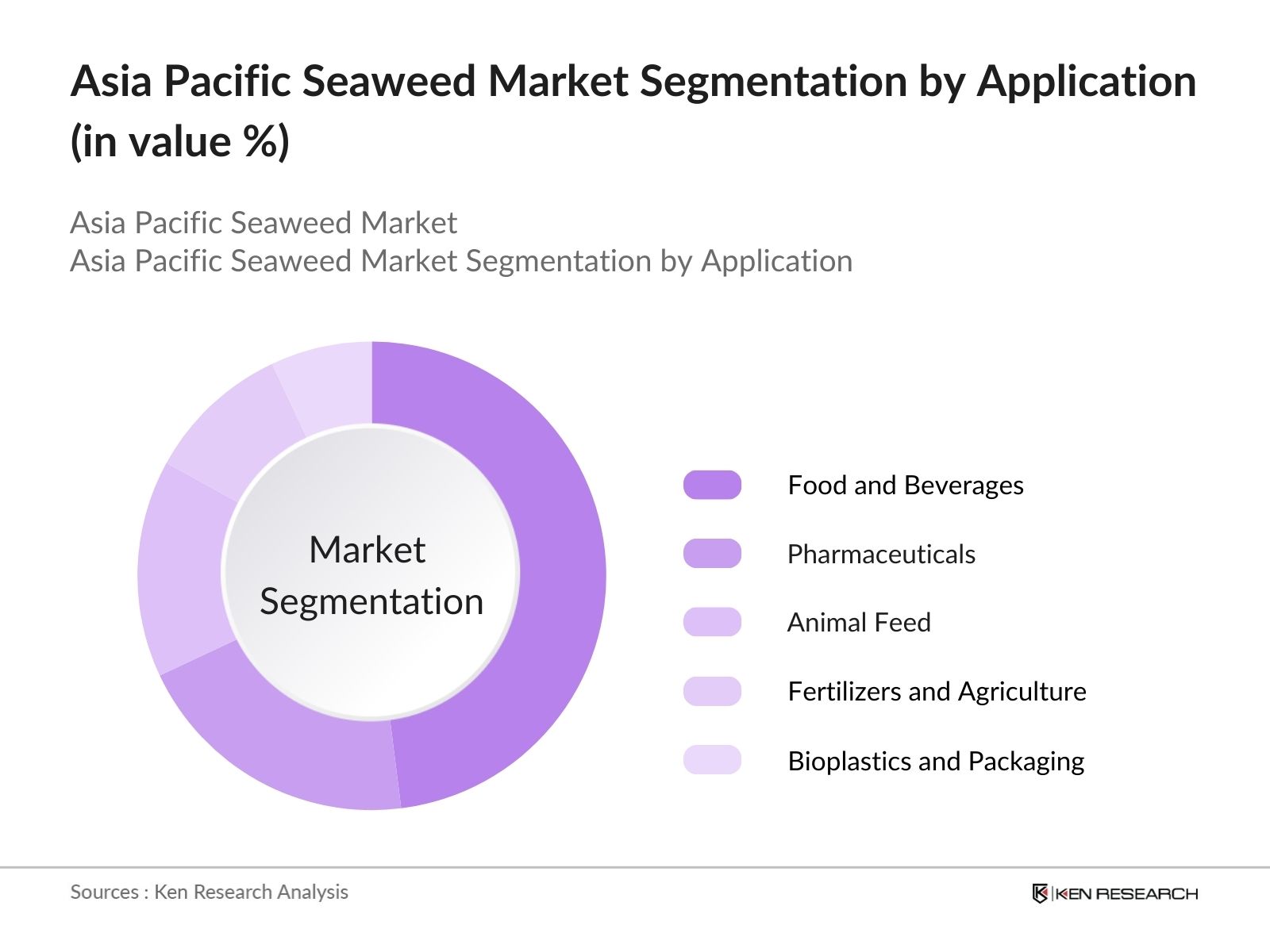
By Application: The Asia Pacific Seaweed market is segmented by application into food and beverages, pharmaceuticals, animal feed, fertilizers and agriculture, and bioplastics and packaging. The food and beverages segment dominates the market, primarily due to the rising demand for plant-based ingredients in everyday diets. Seaweed is widely recognized for its rich nutrient profile, offering essential minerals, vitamins, and dietary fiber, which has boosted its inclusion in various food products such as snacks, salads, and condiments. Furthermore, the growing trend of veganism and health-conscious consumers in Asia Pacific supports the steady growth of this segment.
 Asia Pacific Seaweed Market Competitive Landscape
The Asia Pacific Seaweed market is dominated by key players, including large-scale producers and companies that focus on processing seaweed into valuable products. These companies invest in research and development, leveraging technological advancements to enhance production efficiency, product quality, and sustainability. The competitive landscape highlights the consolidation of the market with a few dominant players controlling the supply chain, particularly in China, Japan, and South Korea.
|
Company |
Establishment Year |
Headquarters |
R&D Investments |
No. of Employees |
Revenue |
Product Portfolio |
Sustainability Initiatives |
|
Cargill, Incorporated |
1865 |
United States |
- |
- |
- |
- |
- |
|
CP Kelco |
1929 |
United States |
- |
- |
- |
- |
- |
|
Algaia SA |
2016 |
France |
- |
- |
- |
- |
- |
|
Qingdao Gather Great Ocean Algae |
1968 |
China |
- |
- |
- |
- |
- |
|
DuPont de Nemours, Inc. |
1802 |
United States |
- |
- |
- |
- |
- |
The competitive landscape in the Asia Pacific seaweed market is dominated by the presence of a few key players, including multinational corporations and local manufacturers. Companies such as Cargill, CP Kelco, and Qingdao Gather Great Ocean Algae Industry Group have established strong production and distribution networks, enabling them to capture significant market shares. These companies are also heavily invested in research and development, focusing on sustainable farming practices and innovative seaweed-based products.
Asia Pacific Seaweed Market Analysis
Growth Drivers
- Increased Demand for Plant-based Ingredients: The Asia Pacific seaweed market has seen increased demand for plant-based ingredients due to the rising focus on sustainable food production. Seaweed, a key source of plant-based protein, is central to this shift. Seaweed's application in plant-based foods is being promoted by local governments through sustainable food production incentives, notably in Japan and South Korea, which are pushing for reduced meat consumption to meet carbon-neutral goals.
- Government Policies on Sustainable Aquaculture: Governments in Asia Pacific are increasingly adopting policies to promote sustainable aquaculture. For instance, South Korea's Ministry of Oceans and Fisheries has allocated $40 million USD to promote seaweed cultivation by 2024, aiming to reduce overfishing and promote marine biodiversity. Similarly, Chinas 2022 Five-Year Plan included seaweed cultivation as part of its sustainable aquaculture goals, with over 1.5 million hectares designated for seaweed farming to ensure food security and environmental sustainability.
- Growing Popularity of Functional Foods: Functional foods, which offer health benefits beyond basic nutrition, are gaining popularity in the Asia Pacific region. Seaweed is a leading component, rich in iodine, antioxidants, and essential minerals. As of 2023, Japan and South Korea account for nearly 70% of the total functional seaweed product consumption. This trend aligns with government healthcare initiatives, such as Japan's "Healthy Japan 21," which promotes the integration of nutrient-dense foods like seaweed in diets to combat lifestyle diseases.
Challenges
- Seasonal Production Fluctuations: Seaweed production is highly susceptible to seasonal fluctuations, especially in countries like Indonesia, the worlds largest producer of red seaweed. Indonesia's seaweed production was reported at approximately9.05 million tons in 2021. These fluctuations disrupt supply chains, and producers are often forced to import seaweed to meet domestic demand, which has driven up production costs.
- High Initial Cultivation Costs: Seaweed farming requires significant upfront investment, particularly in infrastructure such as offshore farming rigs. In countries like China and Japan, the initial cost of setting up a seaweed farm can range between $15,000 to $30,000 per hectare, with high maintenance costs due to environmental and logistical challenges. This has slowed the expansion of new seaweed farms in emerging markets like Vietnam, where smaller producers lack the capital to compete with larger, more established operations.
Asia Pacific Seaweed Market Future Outlook
Asia Pacific Seaweed market is expected to show significant growth driven by the increased adoption of seaweed in diverse industries, including bioplastics, nutraceuticals, and pharmaceuticals. The rising global focus on environmental sustainability and the growing demand for organic and vegan products will further drive the market. Additionally, technological advancements in seaweed farming and processing are anticipated to enhance production efficiency and product quality, fostering long-term market growth.
Market Opportunities
- Increasing Investment in R&D: Research and development in seaweed cultivation and processing have surged in recent years. In 2023, Japan allocated over $45 million USD for R&D in the seaweed sector, focusing on biotechnological advancements in cultivation techniques to increase yields and improve sustainability. Chinas National Natural Science Foundation also contributed around 30 million RMB to support seaweed-related research, especially in biofuel and bioplastic production, to align with their green energy transition goals.
- Expansion in Emerging Markets: Emerging markets in Southeast Asia, such as Vietnam and the Philippines, are rapidly expanding their seaweed production capacity. According to available data, Vietnam's total seaweed production for 2023 was approximately150,000 tons, harvested from about16,500 hectaresof cultivation. The Philippine governments Bureau of Fisheries and Aquatic Resources has set aside $3.6 million USD to improve seaweed farming infrastructure and meet export quality standards, positioning the country as a key player in the global market.
Scope of the Report
|
Segment |
Sub-segments |
|
By Product Type |
Red Seaweed Brown Seaweed Green Seaweed |
|
By Application |
Food and Beverages Pharmaceuticals Animal Feed Fertilizers Bioplastics Packaging |
|
By Form |
Liquid Seaweed Extracts Powder Seaweed Seaweed Granules |
|
By Distribution Channel |
Direct Sales Retail Sales E-commerce |
|
By Region |
China Japan South Korea Southeast Asia Australia New Zealand |
Products
Key Target Audience
Food and Beverage Manufacturers
Pharmaceutical Companies
Fertilizer and Agriculture Companies
Bioplastic Manufacturers
Investors and Venture Capitalist Firms
Government and Regulatory Bodies (e.g., Ministry of Agriculture, China Fisheries Administration)
Cosmetic and Skincare Product Manufacturers
Companies
Players Mentioned in the Report
Cargill, Incorporated
CP Kelco
Algaia SA
Qingdao Gather Great Ocean Algae Industry Group Co., Ltd.
DuPont de Nemours, Inc.
Roullier Group
Gelymar S.A.
Seasol International Pty Ltd
Irish Seaweeds
Ocean Harvest Technology Limited
Table of Contents
1. Asia Pacific Seaweed Market Overview
1.1 Definition and Scope
1.2 Market Taxonomy
1.3 Market Growth Rate
1.4 Market Segmentation Overview
2. Asia Pacific Seaweed Market Size (In USD Mn)
2.1 Historical Market Size
2.2 Year-On-Year Growth Analysis
2.3 Key Market Developments and Milestones
3. Asia Pacific Seaweed Market Analysis
3.1 Growth Drivers (Demand for sustainable food sources, Nutraceutical applications, Fertilizer industry growth, Aquaculture feed adoption)
3.1.1 Increased Demand for Plant-based Ingredients
3.1.2 Government Policies on Sustainable Aquaculture
3.1.3 Growing Popularity of Functional Foods
3.1.4 Expansion of Organic Farming
3.2 Market Challenges (Regulatory constraints, Seaweed farming limitations, Climate change impact, Supply chain disruptions)
3.2.1 Seasonal Production Fluctuations
3.2.2 High Initial Cultivation Costs
3.2.3 Processing and Standardization Challenges
3.3 Opportunities (Emergence of biofuels, Expansion in the cosmetics industry, Technological advancements in cultivation, Collaborative research initiatives)
3.3.1 Increasing Investment in R&D
3.3.2 Expansion in Emerging Markets
3.3.3 Partnerships Between Public and Private Sectors
3.4 Trends (Innovative product launches, Integration of seaweed extracts in food products, Utilization in biodegradable packaging, Diversification in seaweed species usage)
3.4.1 Increased Adoption of Red Seaweed
3.4.2 Seaweed-based Fertilizers in Organic Agriculture
3.4.3 Growing Use of Seaweed for Edible Bioplastics
3.5 Government Regulation (Seaweed farming licenses, Marine resource management, Export-import policies, Organic certification)
3.5.1 Supportive Policies in Major Seaweed Producing Nations
3.5.2 Trade Barriers and Quality Standards
3.5.3 Organic Seaweed Farming Regulations
3.6 SWOT Analysis
3.7 Stakeholder Ecosystem
3.8 Porters Five Forces
3.9 Competition Ecosystem
4. Asia Pacific Seaweed Market Segmentation
4.1 By Product Type (In Value %)
4.1.1 Red Seaweed
4.1.2 Brown Seaweed
4.1.3 Green Seaweed
4.2 By Application (In Value %)
4.2.1 Food and Beverages
4.2.2 Pharmaceuticals
4.2.3 Animal Feed
4.2.4 Fertilizers and Agriculture
4.2.5 Bioplastics and Packaging
4.3 By Form (In Value %)
4.3.1 Liquid Seaweed Extracts
4.3.2 Powder Seaweed
4.3.3 Seaweed Granules
4.4 By Distribution Channel (In Value %)
4.4.1 Direct Sales
4.4.2 Retail Sales
4.4.3 E-commerce
4.5 By Region (In Value %)
4.5.1 China
4.5.2 Japan
4.5.3 South Korea
4.5.4 Southeast Asia
4.5.5 Australia and New Zealand
5. Asia Pacific Seaweed Market Competitive Analysis
5.1 Detailed Profiles of Major Companies
5.1.1 Cargill, Incorporated
5.1.2 CP Kelco
5.1.3 Algaia SA
5.1.4 Qingdao Gather Great Ocean Algae Industry Group Co., Ltd.
5.1.5 Roullier Group
5.1.6 DuPont de Nemours, Inc.
5.1.7 Gelymar S.A.
5.1.8 Seasol International Pty Ltd
5.1.9 Irish Seaweeds
5.1.10 Ocean Harvest Technology Limited
5.2 Cross Comparison Parameters (No. of Employees, Headquarters, Inception Year, Revenue, R&D Investments, Product Portfolio, Market Share, Sustainability Initiatives)
5.3 Market Share Analysis
5.4 Strategic Initiatives
5.5 Mergers and Acquisitions
5.6 Investment Analysis
5.7 Government Grants and Incentives
5.8 Venture Capital Funding
5.9 Private Equity Investments
6. Asia Pacific Seaweed Market Regulatory Framework
6.1 Environmental Standards and Marine Regulations
6.2 Seaweed Farming Compliance Requirements
6.3 Certification and Quality Control
7. Asia Pacific Seaweed Future Market Size (In USD Mn)
7.1 Future Market Size Projections
7.2 Key Factors Driving Future Market Growth
8. Asia Pacific Seaweed Future Market Segmentation
8.1 By Product Type (In Value %)
8.2 By Application (In Value %)
8.3 By Form (In Value %)
8.4 By Distribution Channel (In Value %)
8.5 By Region (In Value %)
9. Asia Pacific Seaweed Market Analysts Recommendations
9.1 TAM/SAM/SOM Analysis
9.2 Customer Cohort Analysis
9.3 Strategic Marketing Initiatives
9.4 White Space Opportunity Analysis
Research Methodology
Step 1: Identification of Key Variables
The first step involves identifying key variables influencing the Asia Pacific Seaweed market. This includes understanding production volumes, geographical distribution, supply chain dynamics, and government regulations that impact market trends. Comprehensive desk research using proprietary databases and secondary resources was conducted to gather industry-level data.
Step 2: Market Analysis and Construction
This phase focused on analyzing historical data related to seaweed production and its applications across various industries. The market penetration of different seaweed types and sub-segments was evaluated to build a precise market structure and determine the revenue generated in key segments.
Step 3: Hypothesis Validation and Expert Consultation
To ensure accuracy, hypotheses were validated through consultations with seaweed industry experts, including cultivators, processors, and product manufacturers. These discussions provided deeper insights into operational challenges, opportunities, and upcoming trends that shaped the market.
Step 4: Research Synthesis and Final Output
The final phase involved synthesizing data collected from various sources and refining it into actionable insights. These findings were cross-verified with manufacturers and industry stakeholders to provide a comprehensive overview of the Asia Pacific Seaweed market, ensuring all variables were accounted for and validated.
Frequently Asked Questions
01. How big is the Asia Pacific Seaweed Market?
The Asia Pacific Seaweed market is valued at USD 11.5 billion, driven by the increasing demand for sustainable products across food, pharmaceuticals, and bioplastics industries.
02. What are the challenges in the Asia Pacific Seaweed Market?
Challenges in Asia Pacific Seaweed market include regulatory constraints in seaweed farming, supply chain disruptions, and the impact of climate change on seaweed cultivation. Additionally, the high initial costs of establishing seaweed farms remain a significant hurdle.
03. Who are the major players in the Asia Pacific Seaweed Market?
Key players in Asia Pacific Seaweed market include Cargill, CP Kelco, Qingdao Gather Great Ocean Algae, DuPont de Nemours, and Algaia SA. These companies dominate due to their established production networks, technological innovation, and product diversification.
04. What are the growth drivers of the Asia Pacific Seaweed Market?
Asia Pacific Seaweed market is driven by the increasing demand for plant-based ingredients, the rise of organic farming, and the growing use of seaweed in bioplastics and pharmaceuticals. Technological advancements in seaweed cultivation and processing also support market growth.
Why Buy From Us?

What makes us stand out is that our consultants follows Robust, Refine and Result (RRR) methodology. i.e. Robust for clear definitions, approaches and sanity checking, Refine for differentiating respondents facts and opinions and Result for presenting data with story

We have set a benchmark in the industry by offering our clients with syndicated and customized market research reports featuring coverage of entire market as well as meticulous research and analyst insights.

While we don't replace traditional research, we flip the method upside down. Our dual approach of Top Bottom & Bottom Top ensures quality deliverable by not just verifying company fundamentals but also looking at the sector and macroeconomic factors.

With one step in the future, our research team constantly tries to show you the bigger picture. We help with some of the tough questions you may encounter along the way: How is the industry positioned? Best marketing channel? KPI's of competitors? By aligning every element, we help maximize success.

Our report gives you instant access to the answers and sources that other companies might choose to hide. We elaborate each steps of research methodology we have used and showcase you the sample size to earn your trust.

If you need any support, we are here! We pride ourselves on universe strength, data quality, and quick, friendly, and professional service.