
Asia Pacific Silicon Photonics Market Outlook to 2030
Region:Asia
Author(s):Paribhasha Tiwari
Product Code:KROD9189
November 2024
89
About the Report
Asia Pacific Silicon Photonics Market Overview
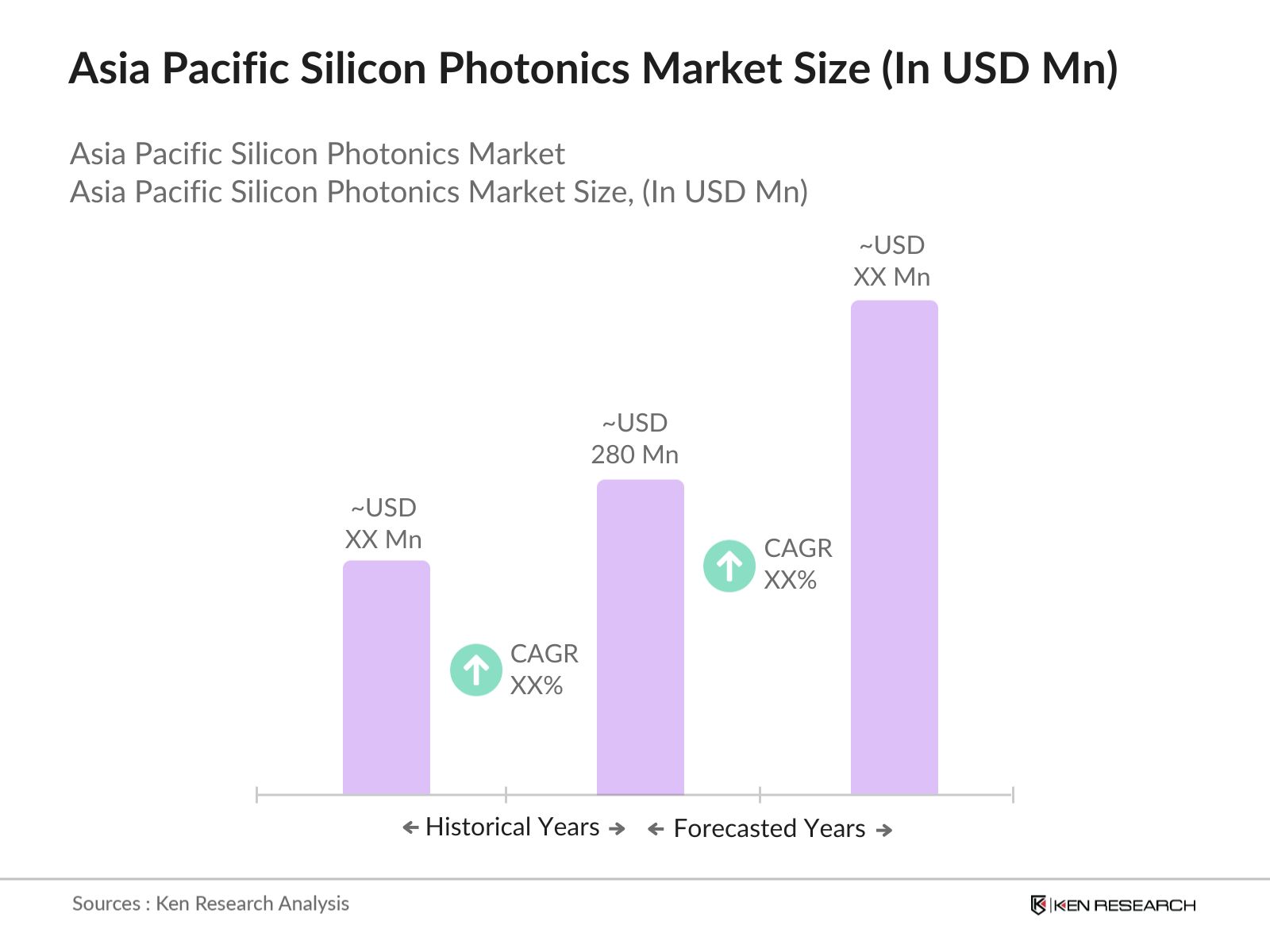
- The Asia Pacific silicon photonics market is valued at USD 280 million, based on a five-year historical analysis. This market size is driven by the rising demand for high-speed data transmission, increasing use of cloud computing, and the exponential growth of data centers across the region. As data usage surges with advancements in AI, IoT, and 5G technologies, the demand for faster, efficient, and low-latency data processing solutions has been a significant contributor to market growth.
- China and Japan are the dominant countries in the Asia Pacific silicon photonics market, primarily due to their strong technological infrastructure and large-scale investments in data centers and telecommunications. China, with its rapid 5G deployment and government support for advanced photonic research, leads the market. Japan, with its high-tech semiconductor manufacturing capabilities, has become a key player, driving innovation and adoption of photonic technologies in various sectors including telecommunications and healthcare.
- The Chinese government has launched a nationwide initiative to support the development of silicon photonics technology, allocating over $1 billion in 2024 to boost domestic production capabilities. This initiative focuses on integrating silicon photonics into next-generation 5G networks and data centers to solidify Chinas position as a leader in telecommunication technologies.
Asia Pacific Silicon Photonics Market Segmentation
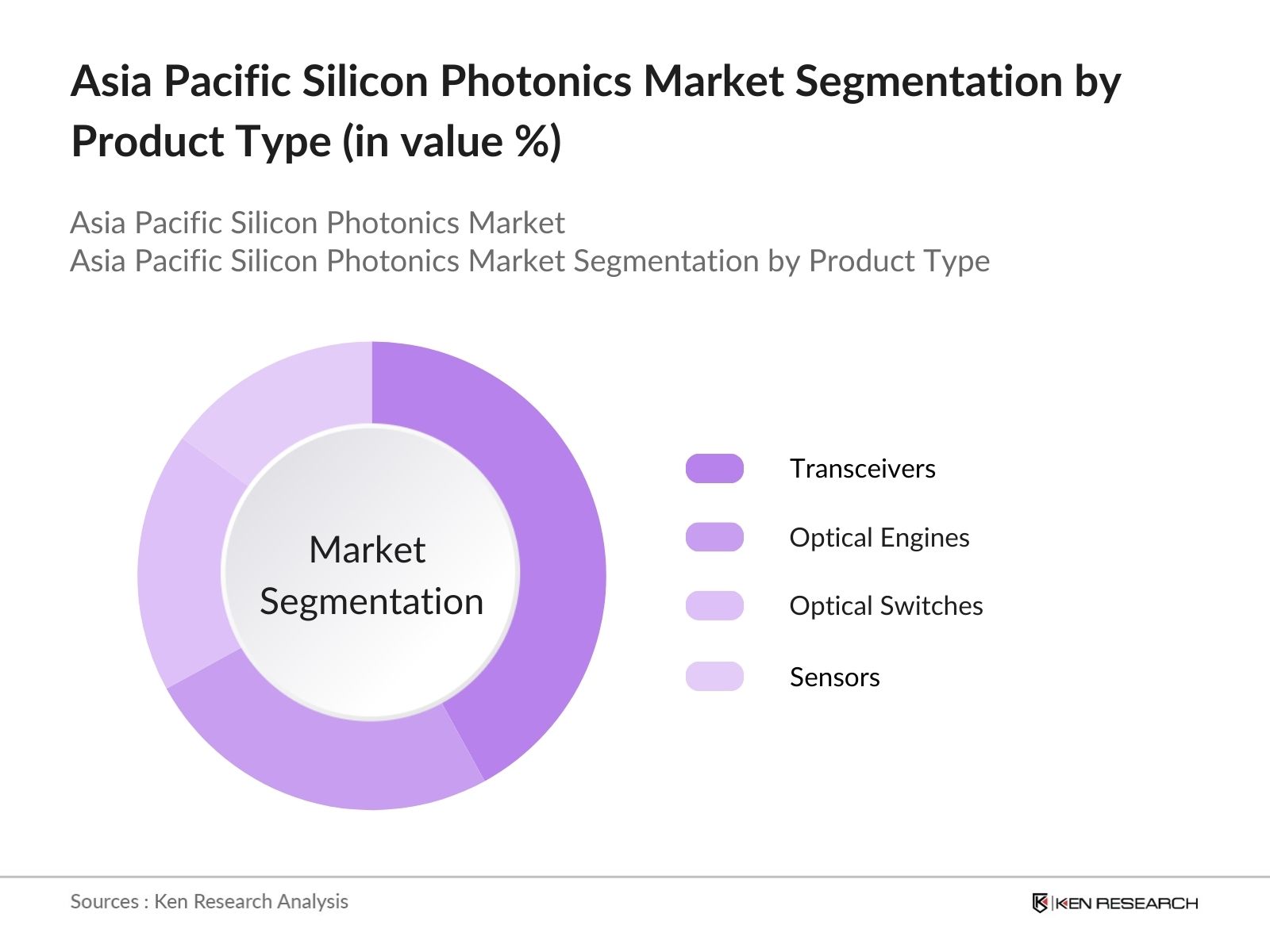
By Product Type: The Asia Pacific silicon photonics market is segmented by product type into transceivers, optical engines, optical switches, and sensors. Recently, transceivers have taken a dominant market share under this segmentation due to their critical role in high-speed data communication, especially in data centers. The growing demand for cloud services and the shift towards 400G and 800G modules have made transceivers an essential component in maintaining low latency and high bandwidth across large-scale data networks.
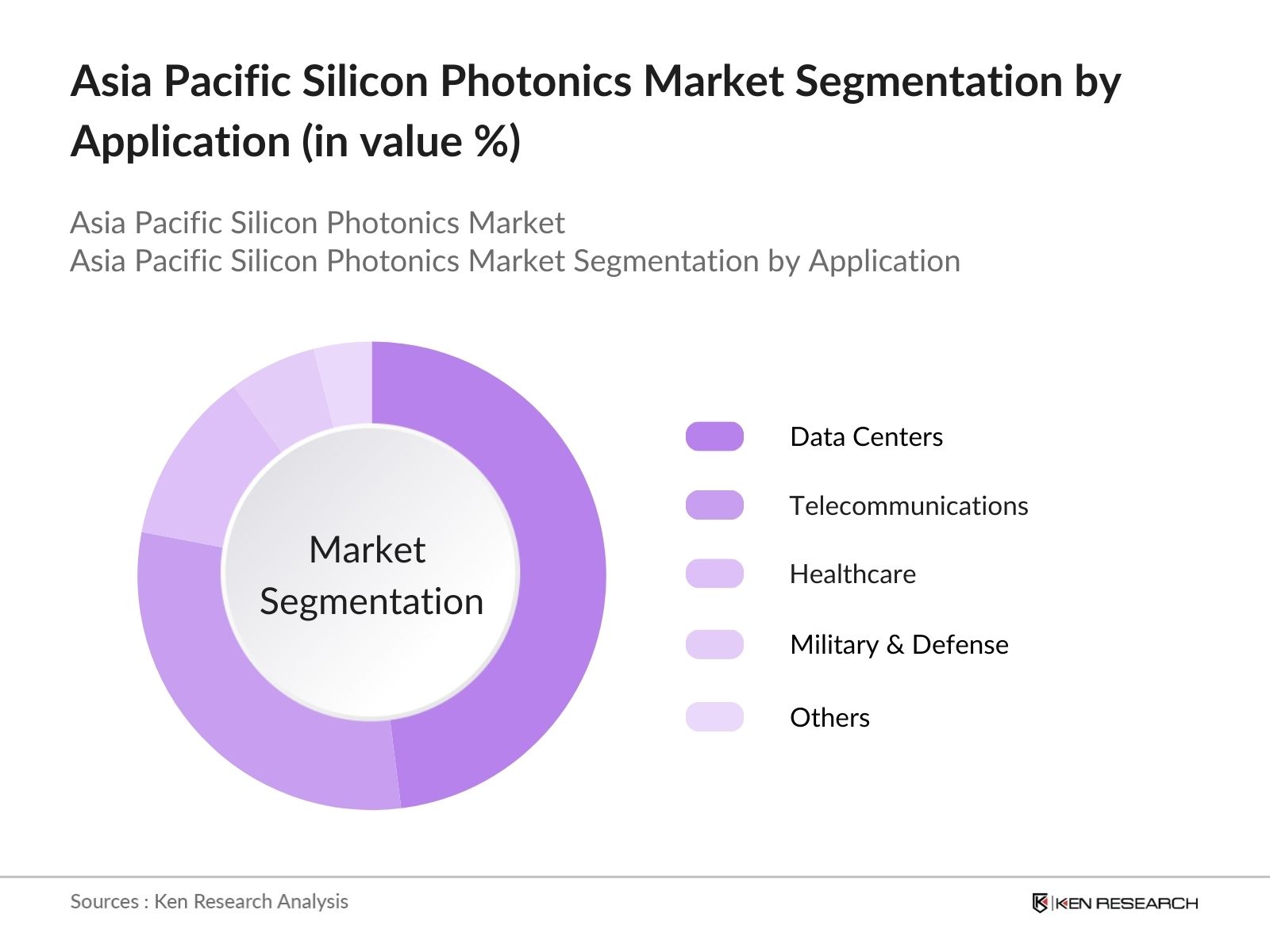
By Application: By application, the silicon photonics market is segmented into data centers, telecommunications, healthcare, military & defense, and others (consumer electronics, automotive). Data centers hold the largest market share in this segment, attributed to the growing demand for cloud computing services and data storage. The expansion of hyperscale data centers and the increasing shift towards edge computing further drives this segments dominance, as silicon photonics technology is critical for managing the vast amounts of data generated globally.
Asia Pacific Silicon Photonics Market Competitive Landscape
The Asia Pacific silicon photonics market is dominated by a few key players who have consolidated their positions through technological advancements and strategic partnerships. This consolidation reflects the significant influence of companies like Intel Corporation and Huawei Technologies. These market leaders are known for their robust R&D investments and strong partnerships with cloud service providers and telecommunications giants. Additionally, local players in Japan and China have been gaining ground through innovation in photonic integrated circuits.
|
Company Name |
Establishment Year |
Headquarters |
R&D Spending |
Revenue |
Employee Count |
Market Strategy |
Key Partnerships |
Product Portfolio |
|
Intel Corporation |
1968 |
Santa Clara, USA |
- | - | - | - | - | - |
|
Huawei Technologies |
1987 |
Shenzhen, China |
- | - | - | - | - | - |
|
Cisco Systems Inc. |
1984 |
San Jose, USA |
- | - | - | - | - | - |
|
Juniper Networks |
1996 |
Sunnyvale, USA |
- | - | - | - | - | - |
|
STMicroelectronics |
1987 |
Geneva, Switzerland |
- | - | - | - | - | - |
Asia Pacific Silicon Photonics Market Analysis
Growth Drivers
- Adoption of High-Speed Data Transmission: The Asia Pacific region is witnessing an accelerated demand for high-speed data transmission in key industries like telecommunications, healthcare, and IT services. The expansion of data centers across countries such as China and India has been driving the need for ultra-fast communication systems. By 2024, the number of data centers in China is expected to reach over 2,000, with the majority requiring advanced photonics technology for high-speed data processing. Governments across the region are also pushing for digital infrastructure development, further propelling the adoption of silicon photonics-based solutions in sectors such as 5G networks and artificial intelligence.
- Growth in Data Centers: With over 800 new data centers expected to be operational by 2025 in the Asia Pacific, the silicon photonics market is positioned for significant growth. Silicon photonics offers efficient data transfer at lower power consumption levels, which is critical for managing the rapidly expanding data volumes in industries such as cloud computing and financial services. The increasing dependency on cloud services due to digital transformation initiatives by governments further supports the rise in demand for photonics technology across the region.
- Technological Collaboration and R&D Investments: Countries like Japan and South Korea are investing heavily in research and development for silicon photonics. In 2024, the Japanese government allocated approximately $500 million towards the advancement of photonics technologies, fostering innovation in fields such as integrated circuits and quantum computing. These collaborations are expected to create robust ecosystems where the private sector, academia, and government bodies work together to push the market forward.
Market Challenges
- Integration Challenges: The complex integration of silicon photonics with existing electronic systems poses a significant challenge. Many manufacturers face difficulties in merging traditional semiconductor processes with photonics technology. As a result, production costs increase and the scalability of solutions is constrained. For example, companies in Taiwan report that integrating silicon photonics into their manufacturing pipeline requires substantial capital investments, often in the range of $100 million per facility.
- High Cost of Infrastructure: Establishing a silicon photonics infrastructure in emerging economies in the Asia Pacific region remains expensive. Building the necessary manufacturing and testing facilities requires investments exceeding $200 million, which limits the market penetration of smaller players. Countries such as Vietnam and Indonesia, which are still in the early stages of digital transformation, struggle to attract the requisite investments due to higher costs and limited government support in this sector.
Asia Pacific Silicon Photonics Market Future Outlook
Over the next five years, the Asia Pacific silicon photonics market is expected to show significant growth driven by advancements in photonic integrated circuits, the increasing deployment of 5G networks, and the growing demand for low-latency, high-speed data communication systems. As hyperscale data centers continue to expand across the region, coupled with government support for technology innovation, the market is likely to see rapid adoption of silicon photonics technology in both telecommunications and healthcare applications.
Market Opportunities
- Advancement in Photonic Integrated Circuits (PICs): The Asia Pacific region is set to lead advancements in Photonic Integrated Circuits (PICs), which allow for the integration of multiple photonic functions into a single chip. By 2024, PICs are expected to become standard components in data centers and telecommunications networks, driving down costs and improving efficiency. Countries like South Korea are at the forefront of this innovation, with government-backed initiatives pushing for the adoption of PICs in 5G and cloud computing infrastructures.
- 5G Deployment: The ongoing deployment of 5G networks across Asia Pacific presents a major opportunity for the silicon photonics market. By 2025, over 70% of the regions population is expected to have access to 5G networks, with significant investments from governments and private enterprises. Silicon photonics technology will play a critical role in enabling faster data transmission, lower latency, and higher bandwidth, which are essential for the functioning of 5G-enabled services, including IoT devices, autonomous vehicles, and smart cities.
Scope of the Report
|
By Product Type |
Transceivers Optical Engines Switches Sensors |
|
By Application |
Data Centers Telecommunications Healthcare Military & Defense Others |
|
By Component |
Optical Waveguides Modulators Photodetectors Lasers |
|
By Material |
Silicon Indium Phosphide Silicon Nitride |
|
By Region |
China Japan South Korea Australia & New Zealand Southeast Asia |
Products
Key Target Audience
Cloud Service Providers
Semiconductor Manufacturers
Telecommunications Companies
Data Center Operators
Optical Component Suppliers
Military & Defense Organizations
Investors and Venture Capitalist Firms
Government and Regulatory Bodies (e.g., Ministry of Industry and Information Technology, Telecommunications Regulatory Authority)
Companies
Players Mentioned in the Report:
Intel Corporation
Huawei Technologies Co., Ltd.
Cisco Systems Inc.
Juniper Networks Inc.
STMicroelectronics
IBM Corporation
Infinera Corporation
Luxtera, Inc.
Finisar Corporation
Broadcom Inc.
Table of Contents
1. Asia Pacific Silicon Photonics Market Overview
1.1. Definition and Scope
1.2. Market Taxonomy
1.3. Market Dynamics Overview
1.4. Market Segmentation Overview
2. Asia Pacific Silicon Photonics Market Size (In USD Billion)
2.1. Historical Market Size (Key Market Developments and Milestones)
2.2. Year-on-Year Growth Analysis (Drivers of Growth)
2.3. Market Developments (New Product Launches, M&A, Collaborations)
3. Asia Pacific Silicon Photonics Market Analysis
3.1. Growth Drivers (Adoption of High-Speed Data Transmission, Growth in Data Centers)
3.2. Market Challenges (Integration Challenges, High Cost of Infrastructure)
3.3. Opportunities (Advancement in Photonic Integrated Circuits, 5G Deployment)
3.4. Trends (Shift to 400G and 800G Modules, Integration with Quantum Computing)
3.5. Government Regulation (Policy Support for Advanced Communication Technologies, Export/Import Regulations)
3.6. SWOT Analysis (Strengths, Weaknesses, Opportunities, Threats)
3.7. Stake Ecosystem (Key Stakeholders and Roles)
3.8. Porters Five Forces Analysis (Market Power of Buyers, Suppliers, and Competitive Rivalry)
3.9. Competition Ecosystem (Emerging Players, Consolidation of Power)
4. Asia Pacific Silicon Photonics Market Segmentation
4.1. By Product Type (In Value %)
4.1.1. Transceivers
4.1.2. Optical Engines
4.1.3. Optical Switches
4.1.4. Sensors
4.2. By Application (In Value %)
4.2.1. Data Centers
4.2.2. Telecommunications
4.2.3. Healthcare
4.2.4. Military & Defense
4.2.5. Others (Consumer Electronics, Automotive)
4.3. By Component (In Value %)
4.3.1. Optical Waveguides
4.3.2. Modulators
4.3.3. Photodetectors
4.3.4. Lasers
4.4. By Material (In Value %)
4.4.1. Silicon
4.4.2. Indium Phosphide
4.4.3. Silicon Nitride
4.5. By Region (In Value %)
4.5.1. China
4.5.2. Japan
4.5.3. South Korea
4.5.4. Australia & New Zealand
4.5.5. Southeast Asia
5. Asia Pacific Silicon Photonics Market Competitive Analysis
5.1. Detailed Profiles of Major Companies (15 Competitors)
5.1.1. Intel Corporation
5.1.2. Cisco Systems Inc.
5.1.3. Acacia Communications, Inc.
5.1.4. IBM Corporation
5.1.5. Huawei Technologies Co., Ltd.
5.1.6. Juniper Networks Inc.
5.1.7. Infinera Corporation
5.1.8. Luxtera, Inc.
5.1.9. Finisar Corporation
5.1.10. STMicroelectronics
5.1.11. NeoPhotonics Corporation
5.1.12. Broadcom Inc.
5.1.13. NTT Electronics
5.1.14. MACOM Technology Solutions
5.1.15. Lumentum Holdings Inc.
5.2. Cross Comparison Parameters (R&D Spending, Revenue by Region, Strategic Partnerships, Product Offerings)
5.3. Market Share Analysis (Detailed % for Top 5 Companies)
5.4. Strategic Initiatives (Product Launches, Regional Expansions)
5.5. Mergers and Acquisitions (Key Deals Impacting the Market)
5.6. Investment Analysis (Top VC and PE Investors in Silicon Photonics)
5.7. Government Grants (Government Support for R&D and Infrastructure)
5.8. Venture Capital Funding (Emerging Startups in Silicon Photonics)
6. Asia Pacific Silicon Photonics Market Regulatory Framework
6.1. Technology Standards and Compliance
6.2. Data Security Regulations
6.3. Industry Certifications and Approvals
7. Asia Pacific Silicon Photonics Future Market Size (In USD Billion)
7.1. Future Market Size Projections
7.2. Key Drivers for Future Growth (Cloud Expansion, IoT Adoption)
8. Asia Pacific Silicon Photonics Market Analysts Recommendations
8.1. TAM/SAM/SOM Analysis (Total Addressable Market, Serviceable Available Market)
8.2. Emerging Opportunities (Quantum Computing, Edge Computing)
8.3. Go-to-Market Strategies (Expansion into Untapped Segments)
8.4. White Space Opportunity Analysis
Disclaimer Contact UsResearch Methodology
Step 1: Identification of Key Variables
The initial phase involves constructing an ecosystem map encompassing all major stakeholders within the Asia Pacific Silicon Photonics Market. Extensive desk research is used to identify the critical variables that influence market dynamics, such as data traffic, technological innovations, and regional regulatory frameworks.
Step 2: Market Analysis and Construction
This phase compiles and analyzes historical data on the silicon photonics market, focusing on market penetration, technological adoption, and revenue generation across sectors. An evaluation of data centers and telecommunications market trends ensures the reliability and accuracy of our market estimates.
Step 3: Hypothesis Validation and Expert Consultation
Market hypotheses are developed and validated through expert consultations with key industry stakeholders, including representatives from telecommunications firms, data center operators, and optical component suppliers. This step refines the market projections through direct operational insights.
Step 4: Research Synthesis and Final Output
The final phase involves synthesizing the research insights, validated through bottom-up approaches. Data on product segments, sales performance, and consumer preferences are gathered to deliver a comprehensive and accurate analysis of the Asia Pacific Silicon Photonics Market.
Frequently Asked Questions
01. How big is the Asia Pacific Silicon Photonics Market?
The Asia Pacific silicon photonics market is valued at USD 280 million, driven by increasing data center demand and advancements in cloud technologies.
02. What are the challenges in the Asia Pacific Silicon Photonics Market?
Challenges include high integration costs, limited availability of skilled labor, and the complexity of manufacturing photonic integrated circuits.
03. Who are the major players in the Asia Pacific Silicon Photonics Market?
Key players in the market include Intel Corporation, Huawei Technologies, Cisco Systems Inc., Juniper Networks, and STMicroelectronics.
04. What are the growth drivers of the Asia Pacific Silicon Photonics Market?
The market is driven by the demand for high-speed data transmission, 5G network deployment, and the expansion of data centers across the region.
Why Buy From Us?

What makes us stand out is that our consultants follows Robust, Refine and Result (RRR) methodology. i.e. Robust for clear definitions, approaches and sanity checking, Refine for differentiating respondents facts and opinions and Result for presenting data with story

We have set a benchmark in the industry by offering our clients with syndicated and customized market research reports featuring coverage of entire market as well as meticulous research and analyst insights.

While we don't replace traditional research, we flip the method upside down. Our dual approach of Top Bottom & Bottom Top ensures quality deliverable by not just verifying company fundamentals but also looking at the sector and macroeconomic factors.

With one step in the future, our research team constantly tries to show you the bigger picture. We help with some of the tough questions you may encounter along the way: How is the industry positioned? Best marketing channel? KPI's of competitors? By aligning every element, we help maximize success.

Our report gives you instant access to the answers and sources that other companies might choose to hide. We elaborate each steps of research methodology we have used and showcase you the sample size to earn your trust.

If you need any support, we are here! We pride ourselves on universe strength, data quality, and quick, friendly, and professional service.