Asia Pacific Spices Market Outlook to 2030

Region:Asia

Author(s):Shambhavi

Product Code:KROD2553

Published On

November 2024

Total pages

87

About the Report

Asia Pacific Spices Market Overview

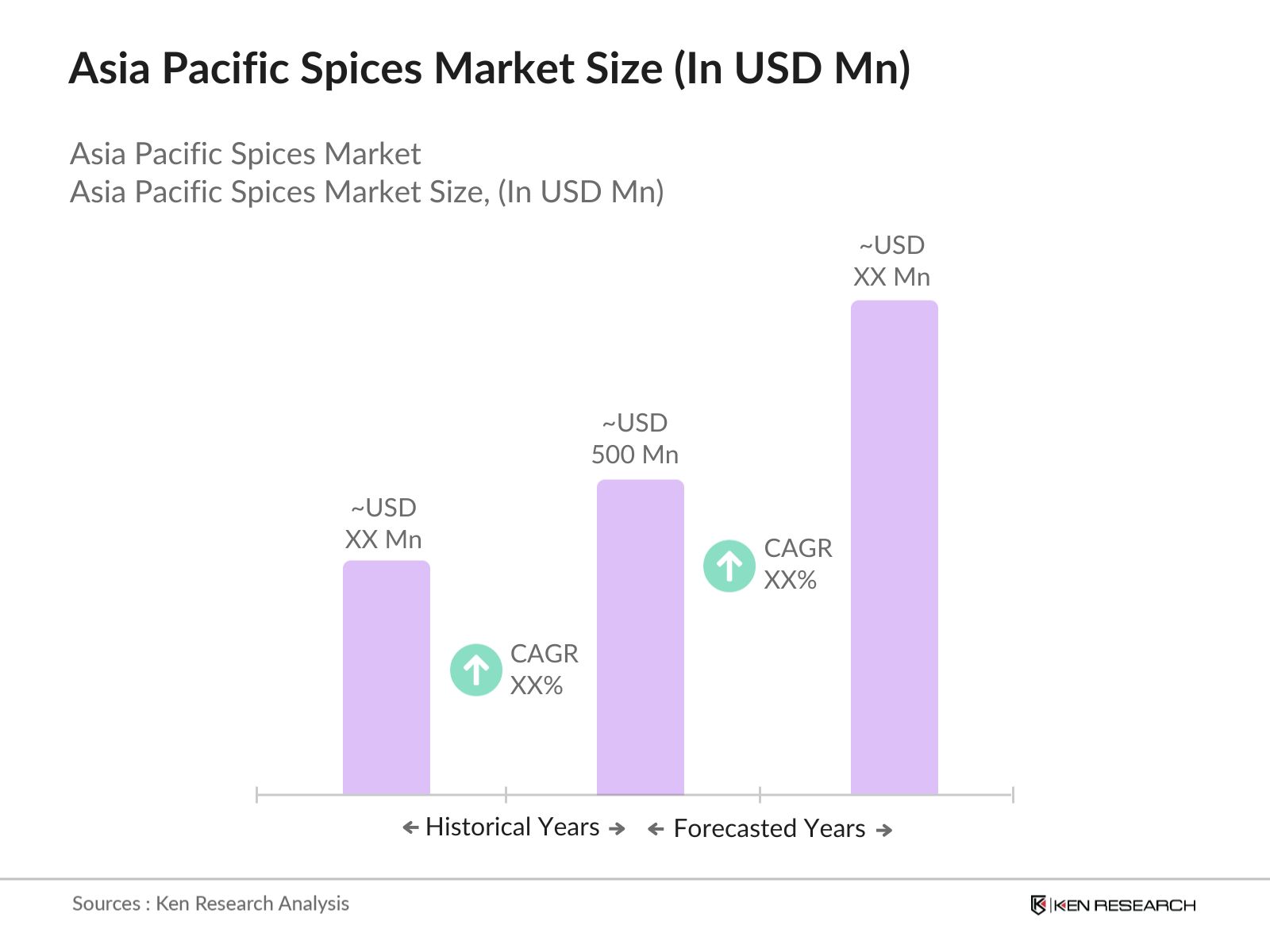
  • The Asia Pacific spices market, valued at USD 500 million, driven by increasing consumer demand for natural flavor enhancers and the rising trend of health-conscious eating habits. Countries such as India, Indonesia, and Vietnam are major contributors to this growth, owing to their vast agricultural output and favorable climatic conditions for spice cultivation. Additionally, government initiatives promoting organic farming have further fueled the demand for high-quality spices across the region. These factors collectively drive the market, with sustained growth expected over the near term.

market overviews

  • The dominance of India in the Asia Pacific spices market is due to its deep-rooted spice heritage, large-scale production, and strong export capabilities. India is a global leader in the production of spices such as turmeric, cumin, and chili, supported by robust agricultural infrastructure. Meanwhile, Indonesia and Vietnam also play a key role, with Indonesia known for its high-quality cloves and nutmeg, while Vietnam dominates the global market for pepper. The strategic geographical positioning of these countries further enhances their export potential, especially to markets in Europe and North America.
  • Governments across the Asia Pacific region have introduced stringent organic certification standards to regulate the production and sale of organic spices. Indias APEDA (Agricultural and Processed Food Products Export Development Authority) has implemented detailed organic certification processes, ensuring that spices such as turmeric, cumin, and coriander meet international organic standards before being exported. As of 2023, India exported organic spices worth USD 300 million, with key markets including the U.S. and Europe.

Asia Pacific Spices Market Segmentation

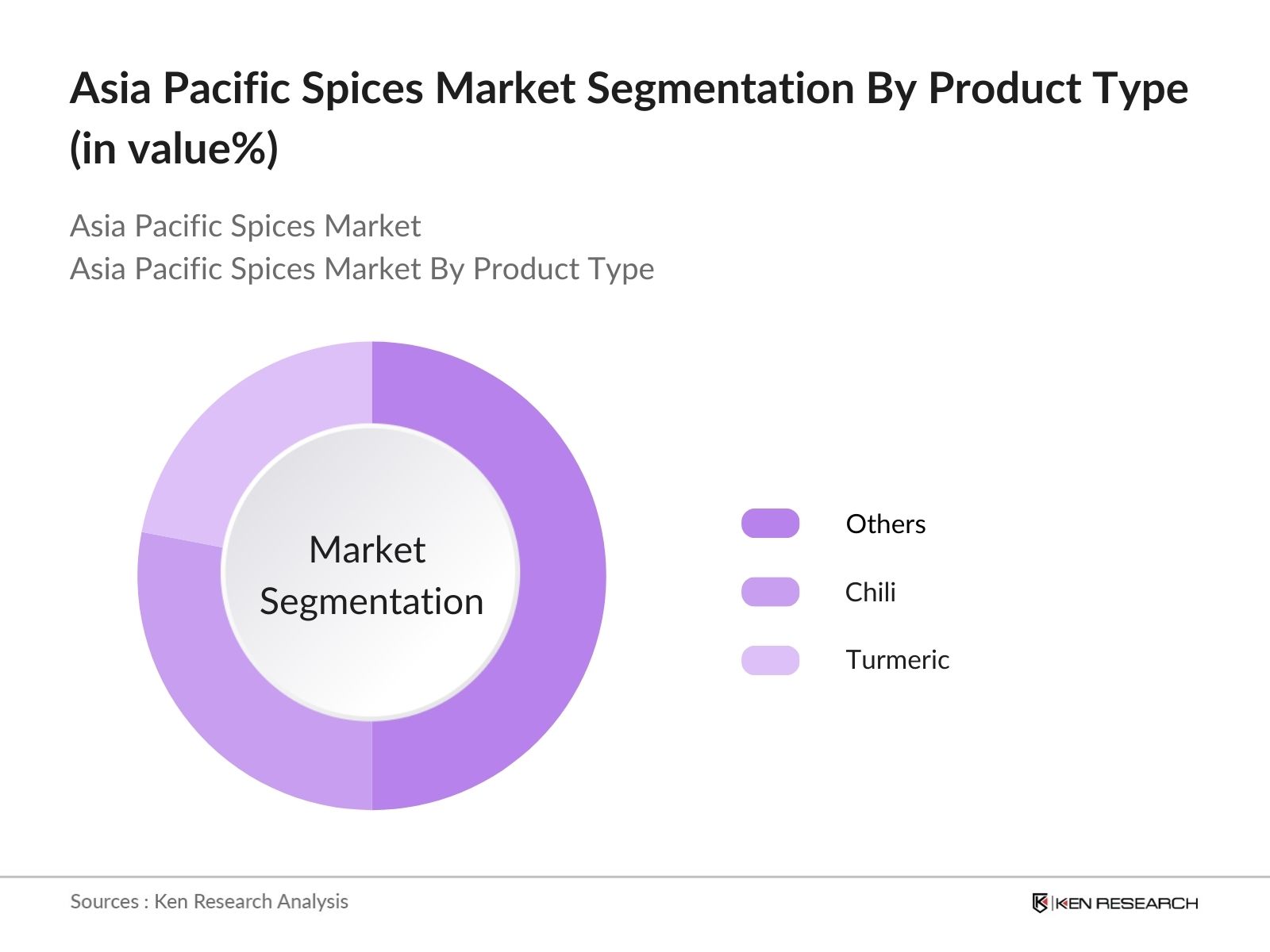
  • By Product Type: The Asia Pacific spices market is segmented by product type into chili, turmeric, pepper, cumin, and ginger. Chili dominates the market under this segmentation due to its widespread use in various culinary applications across the region. The versatility of chili, used in both traditional dishes and processed foods, coupled with its long shelf life, makes it a staple in households and food processing industries. Additionally, countries such as India and Thailand have established themselves as major chili producers, ensuring a steady supply to meet the growing demand.

market overviews

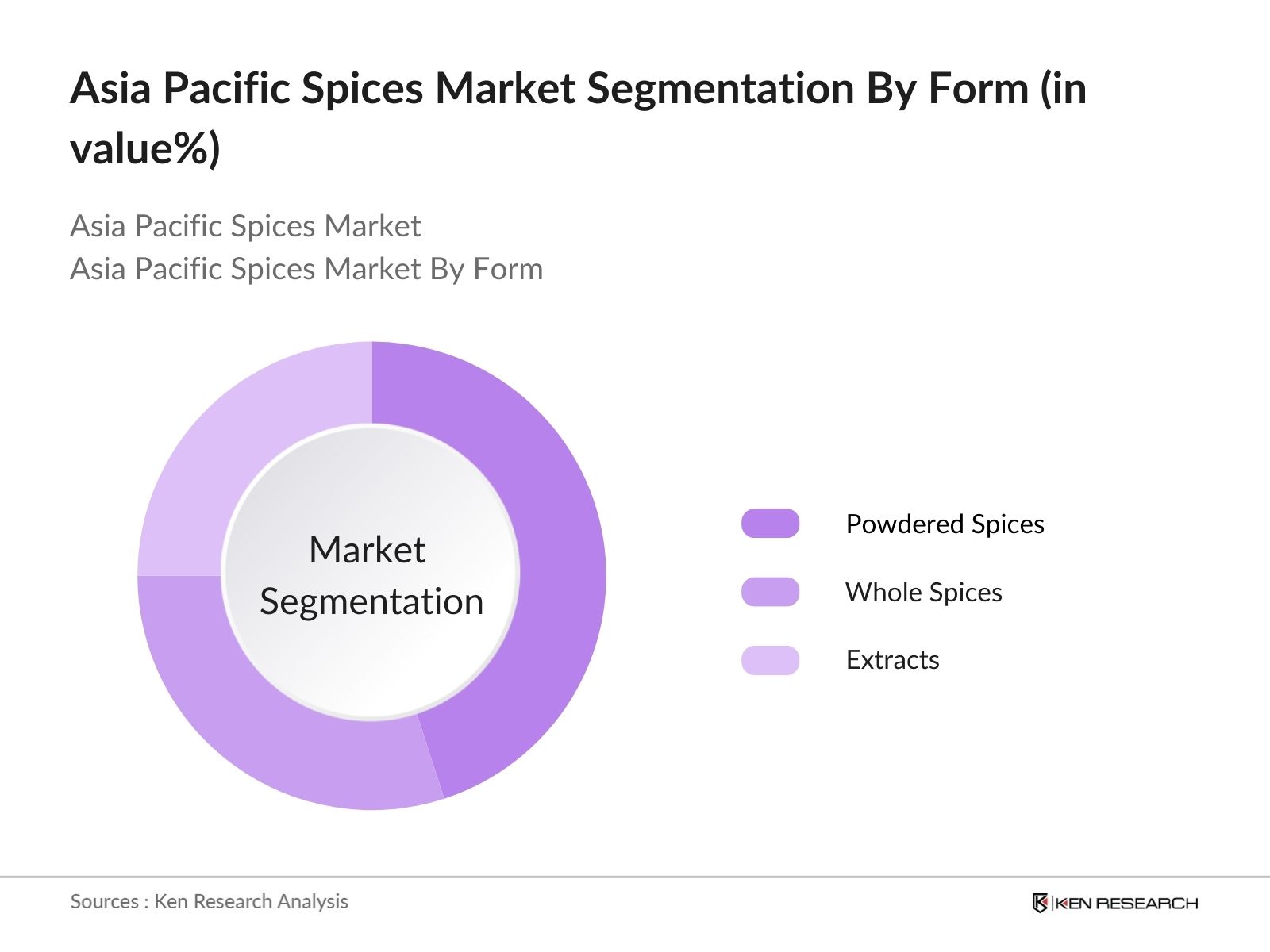
  • By Form: The market is also segmented by form into whole spices, powdered spices, and extracts. Powdered spices hold the largest market share, driven by the convenience they offer to consumers and their extensive use in ready-to-eat and processed food products. Powdered spices are easily stored and require minimal preparation, making them a popular choice for urban consumers with busy lifestyles. The demand for powdered turmeric, cumin, and chili is particularly high in both domestic and international markets, contributing to the segment's dominance.

market overviews

Asia Pacific Spices Market Competitive Landscape

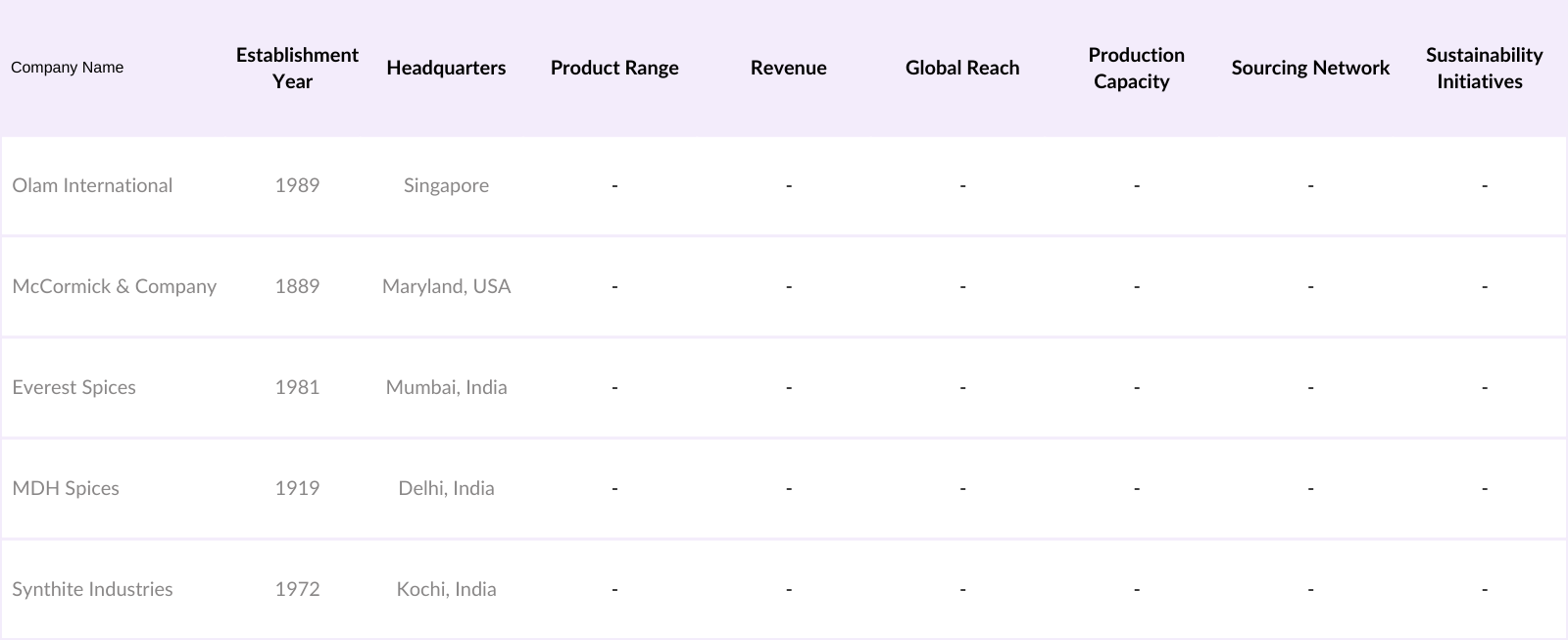
The Asia Pacific spices market is highly competitive, with several key players dominating the landscape. These companies leverage strong agricultural networks, innovative product offerings, and strategic distribution channels to maintain their market positions. The competitive landscape of the Asia Pacific spices market is shaped by both global giants and local manufacturers. Companies such as Olam International and McCormick & Company maintain a strong foothold through extensive sourcing capabilities and diversified product portfolios. Local companies like Everest Spices and MDH Spices have established themselves as household names in the region, owing to their deep market understanding and brand loyalty among consumers.
market overviews

Asia Pacific Spices Market Analysis

Growth Drivers

  • Rising Consumer Preference for Organic Spices: The rising consumer preference for organic spices is driving significant growth in the Asia Pacific spices market. In 2023, organic farming in India saw substantial growth, with over 1.3 million hectares of land certified for organic spice cultivation, according to India's Ministry of Agriculture. The increased consumer demand for chemical-free, pesticide-free products has pushed farmers towards organic practices, particularly in major spice-producing countries like India and Sri Lanka. Organic spices like turmeric and cumin have witnessed strong demand in both domestic and export markets, further bolstering the market growth.
  • Increasing Demand for Ethnic Cuisines: The surge in demand for ethnic cuisines has fueled the need for spices in the Asia Pacific region. This is particularly evident in countries like Japan, South Korea, and Australia, where the consumption of Indian, Thai, and Chinese cuisines has grown by 25% over the past five years, according to the World Bank. The growing immigrant population and international food trends are key factors driving the demand for authentic spice blends. As a result, local and global spice producers are increasingly focusing on catering to this evolving consumer taste profile, with exports from Vietnam and Thailand rising accordingly.
  • Expansion of HoReCa (Hotels, Restaurants, and Cafes) Industry: The Asia Pacific HoReCa industrys expansion is a significant driver for the spices market. The foodservice industry in China and India, valued at USD 1.3 trillion combined, has created a consistent demand for spices used in restaurant cuisines. Government initiatives promoting tourism in countries like Indonesia and Malaysia are expected to boost the foodservice industry further, which will, in turn, increase the use of spices in local and international cuisines. The continued growth of this industry will create sustained demand for bulk purchases of spices, particularly chili, pepper, and cardamom.

Market Challenges

  • Stringent Government Regulations (Regulatory Standards): Strict government regulations concerning food safety and quality standards pose a challenge for the Asia Pacific spices market. Countries like Japan and South Korea have implemented stringent maximum residue levels (MRLs) for pesticides, impacting spice exporters from India and Sri Lanka. According to the Ministry of Commerce in India, compliance with these standards has increased the cost of production for exporters by 15%, as they must invest in better farming techniques and technology to ensure their spices meet these quality requirements.
  • High Production Costs (Agricultural Input Costs): Rising agricultural input costs are a key challenge for spice farmers across the Asia Pacific region. Fertilizer prices in India, for instance, saw a 30% increase in 2022 due to global supply chain disruptions, according to the Food and Agriculture Organization (FAO). The cost of labor, water, and other essential inputs has further burdened farmers, particularly in spice-producing regions like Kerala and Tamil Nadu. These factors contribute to the overall cost of production, making it difficult for small-scale farmers to remain competitive in both local and export markets.

Asia Pacific Spices Market Future Outlook

Over the next five years, the Asia Pacific spices market is poised to experience significant growth driven by the increasing global demand for organic and sustainable food products, coupled with the rising interest in ethnic cuisines. The adoption of advanced farming technologies, supported by government initiatives aimed at enhancing spice production, will further propel the market. Additionally, expanding export opportunities to regions such as Europe and North America will strengthen the region's dominance in the global spice trade.

Opportunities

  • Emergence of Value-Added Spice Products: The emergence of value-added spice products presents a significant opportunity for the Asia Pacific spices market. Products such as spice blends, ready-to-use spice mixes, and organic spice powders have seen a growing demand in urban centers across China, India, and Southeast Asia. For instance, the demand for ready-to-use spice mixes in Indias urban areas grew by 20% in 2023, according to the Ministry of Food Processing Industries.
  • Export Opportunities to Europe and North America: Asia Pacific countries have significant export opportunities for spices, particularly to Europe and North America. India and Vietnam are among the largest exporters of black pepper and cardamom, with the European Union importing USD 1.2 billion worth of spices from these countries in 2023, as reported by the European Commission. The rising preference for ethnic flavours and organic products in these regions has driven demand for spices such as turmeric and ginger.


Scope of the Report

Segments

Sub-segments

Product Type

Chili


Ginger


Pepper


Turmeric


Cumin

Form

Whole Spices


Powdered Spices


Extracts

Application

Food and Beverage Industry


Pharmaceuticals


Cosmetics


Retail

Distribution Channel

Supermarkets and Hypermarkets


Specialty Stores


Online Retail


Direct Sales

Region

Southeast Asia


East Asia


South Asia


Australia and New Zealand


Pacific Island

Products

Key Target Audience

  • Spice Exporters and Importers

  • Food and Beverage Manufacturers

  • Pharmaceuticals (Active Ingredients)

  • Cosmetics Manufacturers

  • HoReCa (Hotels, Restaurants, Cafes) Chains

  • Retailers (Supermarkets, Hypermarkets)

  • Investments and Venture Capitalist Firms

  • Government and Regulatory Bodies (APEDA, FSSAI)

Companies

Players Mentioned in the report

  • Olam International

  • McCormick & Company

  • Everest Spices

  • MDH Spices

  • Synthite Industries

  • Kancor Ingredients Limited

  • Sakthi Masala

  • ITC Spices

  • Jayanti Group

  • British Pepper and Spice

  • Frontier Natural Products Co-op

  • Ajinomoto

  • Naturex

  • Organic Spices Inc.

  • DS Group

Table of Contents

1. Asia Pacific Spices Market Overview

1.1. Definition and Scope
1.2. Market Taxonomy
1.3. Supply Chain Analysis
1.4. Market Segmentation Overview

2. Asia Pacific Spices Market Size (In USD Mn)

2.1. Historical Market Size
2.2. Year-On-Year Growth Analysis
2.3. Key Market Developments and Milestones

3. Asia Pacific Spices Market Analysis

3.1. Growth Drivers
3.1.1. Rising Consumer Preference for Organic Spices
3.1.2. Increasing Demand for Ethnic Cuisines
3.1.3. Expansion of HoReCa (Hotels, Restaurants, and Cafes) Industry
3.1.4. Growth in Health-Conscious Consumer Segment
3.2. Market Challenges
3.2.1. Stringent Government Regulations (Regulatory Standards)
3.2.2. High Production Costs (Agricultural Input Costs)
3.2.3. Limited Availability of Arable Land (Land Utilization)
3.3. Opportunities
3.3.1. Emergence of Value-Added Spice Products
3.3.2. Export Opportunities to Europe and North America
3.3.3. Expansion into Specialty Spices (Niche Market Segments)
3.4. Trends
3.4.1. Increasing Use of Spices in Processed Foods
3.4.2. Adoption of Sustainable Farming Practices
3.4.3. Digitalization in Spice Trade (E-commerce Platforms)
3.5. Government Regulation
3.5.1. Organic Certification Standards
3.5.2. Import/Export Tariffs
3.5.3. Agricultural Subsidies and Incentives
3.5.4. Food Safety and Standards Authority Compliance
3.6. SWOT Analysis
3.7. Stake Ecosystem
3.8. Porters Five Forces
3.9. Competition Ecosystem

4. Asia Pacific Spices Market Segmentation

4.1. By Product Type (In Value %)
4.1.1. Chili
4.1.2. Ginger
4.1.3. Pepper
4.1.4. Turmeric
4.1.5. Cumin
4.2. By Form (In Value %)
4.2.1. Whole Spices
4.2.2. Powdered Spices
4.2.3. Extracts
4.3. By Application (In Value %)
4.3.1. Food and Beverage Industry
4.3.2. Pharmaceuticals
4.3.3. Cosmetics
4.3.4. Retail
4.4. By Distribution Channel (In Value %)
4.4.1. Supermarkets and Hypermarkets
4.4.2. Specialty Stores
4.4.3. Online Retail
4.4.4. Direct Sales
4.5. By Region (In Value %)
4.5.1. Southeast Asia
4.5.2. East Asia
4.5.3. South Asia
4.5.4. Australia and New Zealand
4.5.5. Pacific Islands

5. Asia Pacific Spices Market Competitive Analysis

5.1. Detailed Profiles of Major Companies
5.1.1. Olam International
5.1.2. McCormick & Company
5.1.3. Everest Spices
5.1.4. Synthite Industries
5.1.5. MDH Spices
5.1.6. ITC Spices
5.1.7. Kancor Ingredients Limited
5.1.8. Sakthi Masala
5.1.9. Ajinomoto
5.1.10. DS Group
5.1.11. Jayanti Group
5.1.12. Frontier Natural Products Co-op
5.1.13. Organic Spices Inc.
5.1.14. Naturex
5.1.15. British Pepper and Spice Company
5.2. Cross Comparison Parameters (Revenue, Product Portfolio, Production Capacity, Market Presence, Export Share, Certifications, Technological Adoption, and Sustainability Initiatives)
5.3. Market Share Analysis
5.4. Strategic Initiatives
5.5. Mergers and Acquisitions
5.6. Investment Analysis
5.7. Private Equity Investments
5.8. Joint Ventures and Partnerships

6. Asia Pacific Spices Market Regulatory Framework

6.1. Import/Export Standards
6.2. Organic Certification Processes
6.3. Quality Standards for Processed Spices

7. Asia Pacific Spices Future Market Size (In USD Mn)

7.1. Key Factors Driving Future Market Growth

8. Asia Pacific Spices Future Market Segmentation

8.1. By Product Type (In Value %)
8.2. By Application (In Value %)
8.3. By Region (In Value %)

9. Asia Pacific Spices Market Analysts Recommendations

9.1. TAM/SAM/SOM Analysis
9.2. Customer Cohort Analysis
9.3. Marketing Initiatives
9.4. White Space Opportunity Analysis

Disclaimer  Contact Us

Research Methodology

Step 1: Identification of Key Variables

This stage involves creating an ecosystem map, covering key stakeholders in the Asia Pacific Spices Market. The research uses secondary and proprietary databases to define the critical factors influencing market dynamics.

Step 2: Market Analysis and Construction

The next phase involves compiling historical data to analyze market penetration, the ratio of suppliers to buyers, and revenue generation. Service quality statistics are also evaluated for reliability.

Step 3: Hypothesis Validation and Expert Consultation

Market hypotheses are validated through telephone interviews with industry experts across major spice companies, providing insights into market trends and operational dynamics.

Step 4: Research Synthesis and Final Output

The final step includes consultations with spice manufacturers to gain insights on product segments and consumer preferences, ensuring a validated and comprehensive market analysis.

Frequently Asked Questions

01. How big is the Asia Pacific Spices Market?

The Asia Pacific spices market is valued at USD 500 million, driven by the regions dominance in global spice production and increasing demand for organic and sustainable food ingredients.

02. What are the challenges in the Asia Pacific Spices Market?

Challenges include stringent regulatory standards, high production costs, and climate-related disruptions that affect crop yield and quality, especially in key spice-producing countries.

03. Who are the major players in the Asia Pacific Spices Market?

Key players include Olam International, McCormick & Company, Everest Spices, MDH Spices, and Synthite Industries, known for their extensive product portfolios and global reach.

04. What are the growth drivers of the Asia Pacific Spices Market?

The market is propelled by growing consumer demand for natural flavors, the rise of health-conscious eating habits, and increasing exports to developed markets such as Europe and North America.


Why Buy From Us?

RRR
Refine Robust Result (RRR) Framework

What makes us stand out is that our consultants follows Robust, Refine and Result (RRR) methodology. i.e. Robust for clear definitions, approaches and sanity checking, Refine for differentiating respondents facts and opinions and Result for presenting data with story

Our Reach Is Unmatched

We have set a benchmark in the industry by offering our clients with syndicated and customized market research reports featuring coverage of entire market as well as meticulous research and analyst insights.

Research
Shifting the Research Paradigm

While we don't replace traditional research, we flip the method upside down. Our dual approach of Top Bottom & Bottom Top ensures quality deliverable by not just verifying company fundamentals but also looking at the sector and macroeconomic factors.

Insite
More Insights-Better Decisions

With one step in the future, our research team constantly tries to show you the bigger picture. We help with some of the tough questions you may encounter along the way: How is the industry positioned? Best marketing channel? KPI's of competitors? By aligning every element, we help maximize success.

Trust
Transparency and Trust

Our report gives you instant access to the answers and sources that other companies might choose to hide. We elaborate each steps of research methodology we have used and showcase you the sample size to earn your trust.

support
Round the Clock Support

If you need any support, we are here! We pride ourselves on universe strength, data quality, and quick, friendly, and professional service.

Why Client Choose Us?

400000+ Reports in repository
150+ Consulting project a year
100+ Analysts
8000+ Client Queries in 2022