
Asia-Pacific Tractor Market Outlook to 2030
Region:China
Author(s):Sanjeev
Product Code:KROD3645
Region:China
Author(s):Sanjeev
Product Code:KROD3645
November 2024
84
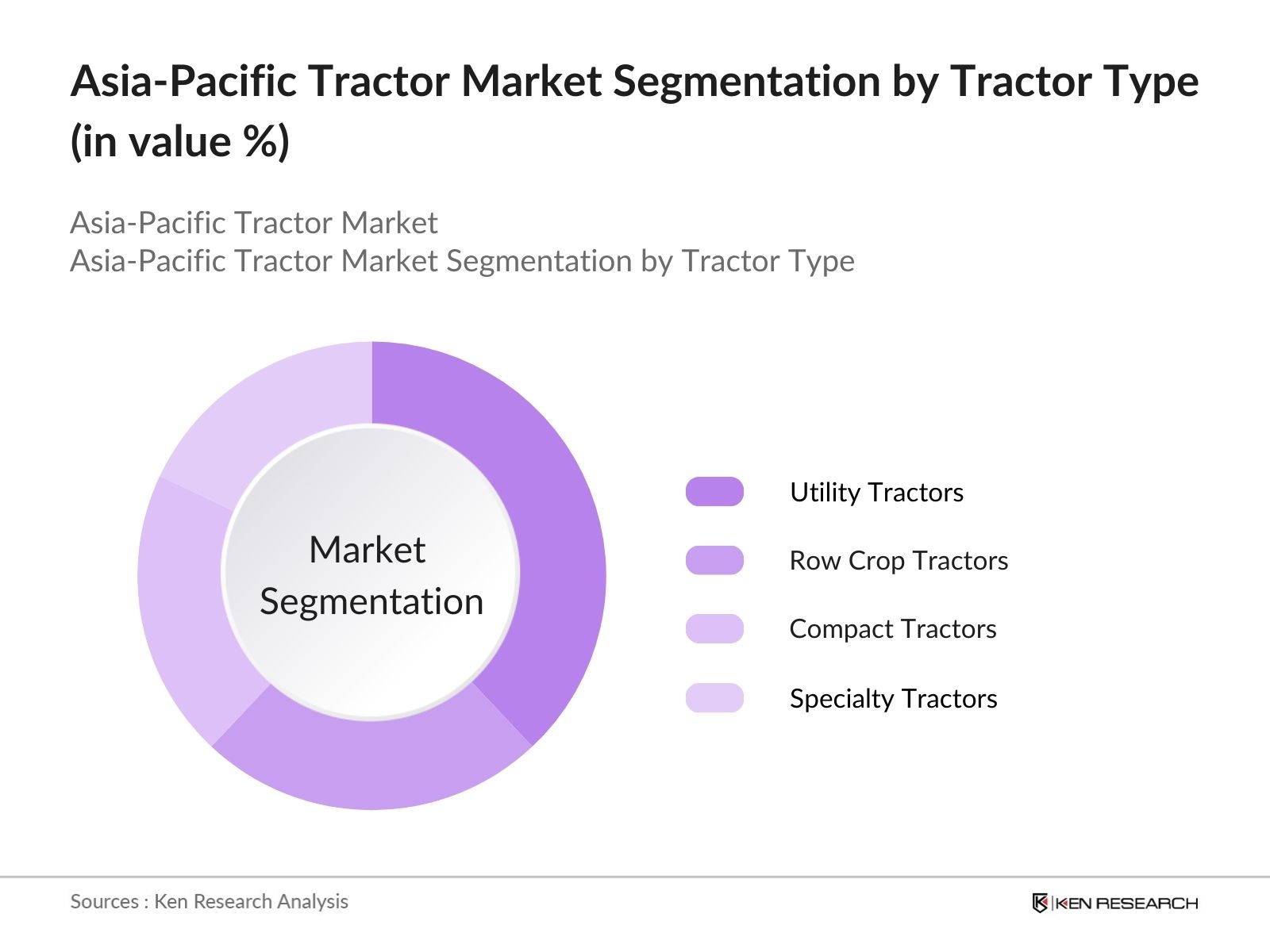
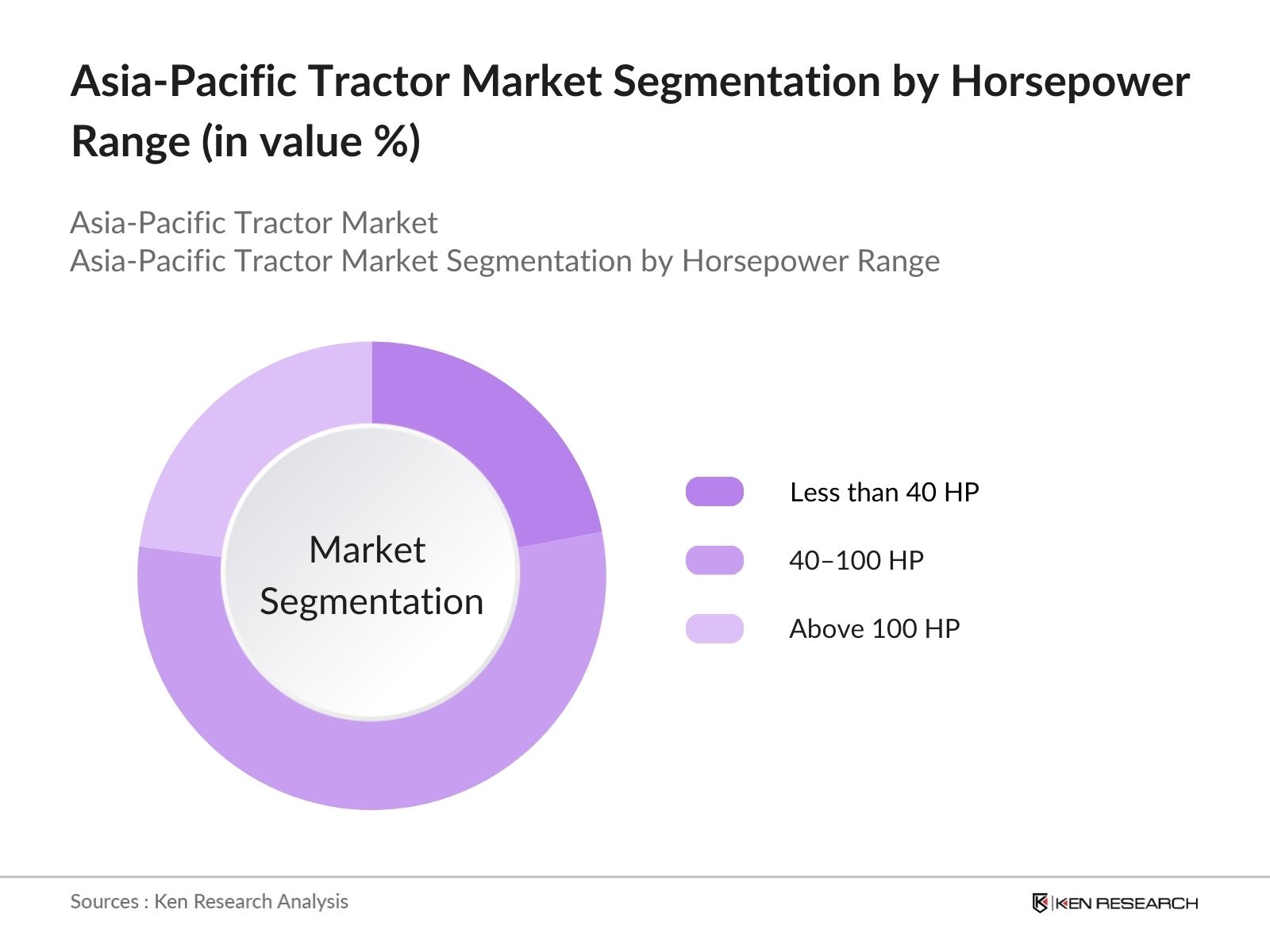
The Asia-Pacific tractor market can be segmented by tractor type and by horsepower.
The Asia-Pacific tractor market is consolidated, with major global and regional players competing for market share. These companies offer a wide range of tractors suited for various agricultural applications and have strong distribution networks across the region. The market is characterized by technological advancements in tractor design, with increasing demand for precision agriculture solutions.
The competition revolves around innovation, product customization, and pricing strategies. Leading players are investing in research and development to introduce advanced tractors with integrated technologies such as GPS, sensors, and IoT capabilities to cater to the evolving needs of the agricultural sector.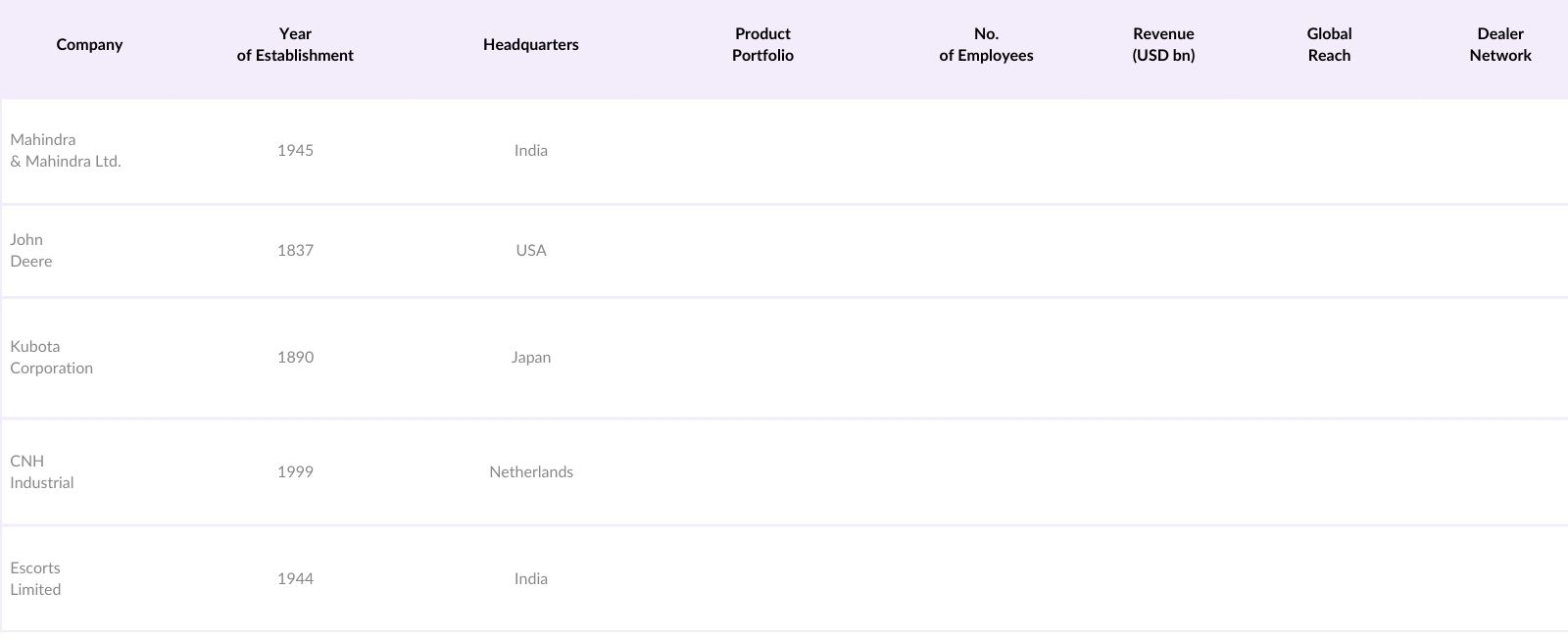
Over the next five years, the Asia-Pacific tractor market is expected to witness significant growth, driven by increasing mechanization in agriculture and the adoption of precision farming techniques. Continuous government support in the form of subsidies and favorable financing schemes will further boost market demand. Additionally, advancements in technology, such as electric tractors and autonomous driving systems, will play a pivotal role in shaping the future of the tractor market in this region.
1.1. Definition and Scope
1.2. Market Taxonomy
1.3. Market Growth Rate
1.4. Market Segmentation Overview
2.1. Historical Market Size
2.2. Key Market Developments and Milestones
2.3. Year-On-Year Growth Analysis
3.1. Growth Drivers
3.1.1. Agricultural Mechanization [Asia-Pacific Mechanization Adoption Rate]
3.1.2. Government Subsidies and Incentives [Market-Impacting Policies and Subsidies]
3.1.3. Increase in Food Production Demand [Regional Crop Demand]
3.2. Market Challenges
3.2.1. High Initial Capital Investment [Average Tractor Cost in APAC]
3.2.2. Fluctuating Raw Material Prices [APAC Steel and Component Costs]
3.2.3. Competition from Low-Cost Imports [Price Sensitivity Across APAC]
3.3. Opportunities
3.3.1. Precision Agriculture Integration [Technology Penetration in Tractor Systems]
3.3.2. Rise in Contract Farming [Regional Penetration of Contract Farming]
3.3.3. Growing Demand for Compact Tractors [Urban and Small Farm Applications]
3.4. Trends
3.4.1. Automation and Electrification in Tractors [Emerging APAC Innovations]
3.4.2. Integration of GPS and Remote Monitoring Systems [IoT Adoption in APAC Agriculture]
3.4.3. Rental Services Expansion [Growth in Tractor Rental Market]
3.5. Government Regulations
3.5.1. Emission Standards for Agricultural Equipment [Regulatory Compliance in APAC]
3.5.2. Sustainable Farming Practices [Government Promotion of Green Agriculture]
3.5.3. Financial Support for Farmers [Regional Loan Schemes for Equipment]
3.6. SWOT Analysis
3.7. Competitive Landscape Overview
3.8. Porters Five Forces Analysis
4.1. By Tractor Type (In Value %)
4.1.1. Utility Tractors
4.1.2. Row Crop Tractors
4.1.3. Compact Tractors
4.1.4. Specialty Tractors
4.2. By Horsepower Range (In Value %)
4.2.1. Less than 40 HP
4.2.2. 40100 HP
4.2.3. Above 100 HP
4.3. By Application (In Value %)
4.3.1. Agriculture
4.3.2. Landscaping
4.3.3. Construction
4.4. By Drive Type (In Value %)
4.4.1. Two-Wheel Drive
4.4.2. Four-Wheel Drive
4.5. By Region (In Value %)
4.5.1. China
4.5.2. India
4.5.3. Japan
4.5.4. Australia
4.5.5. Southeast Asia
5.1. Detailed Profiles of Major Companies
5.1.1. Mahindra & Mahindra Ltd.
5.1.2. John Deere
5.1.3. Kubota Corporation
5.1.4. CNH Industrial
5.1.5. Yanmar Holdings Co. Ltd.
5.1.6. Escorts Limited
5.1.7. AGCO Corporation
5.1.8. Iseki & Co. Ltd.
5.1.9. CLAAS KGaA mbH
5.1.10. SDF Group
5.1.11. Tractors and Farm Equipment Limited (TAFE)
5.1.12. Foton Lovol International Heavy Industry Co. Ltd.
5.1.13. New Holland Agriculture
5.1.14. Massey Ferguson
5.1.15. Sonalika International Tractors Ltd.
5.2. Cross Comparison Parameters (Revenue, Headquarters, Product Portfolio, Market Share, No. of Employees, Dealer Network, Geographic Presence, Product Launches)
5.3. Market Share Analysis
5.4. Strategic Initiatives
5.5. Mergers and Acquisitions
5.6. Investment Analysis
6.1. Emission Standards
6.2. Import/Export Tariffs
6.3. Certification and Compliance Requirements
7.1. Future Market Size Projections
7.2. Key Factors Driving Future Market Growth
8.1. By Tractor Type (In Value %)
8.2. By Horsepower Range (In Value %)
8.3. By Application (In Value %)
8.4. By Drive Type (In Value %)
8.5. By Region (In Value %)
9.1. Customer Cohort Analysis
9.2. Product Positioning Strategy
9.3. Marketing Initiatives
9.4. New Market Entry Strategy
The research begins with the identification of major stakeholders in the Asia-Pacific tractor market, using comprehensive desk research and a proprietary database. This process involves gathering in-depth information on product types, demand drivers, and regional market dynamics to identify critical variables affecting the market.
The second step focuses on analyzing historical data, examining market penetration of tractors across different regions, and assessing their impact on revenue generation. The analysis also involves understanding farmer preferences, operational costs, and the adoption of new technologies like electric tractors.
Market assumptions are validated through consultations with industry experts from leading tractor manufacturers and distributors. These consultations offer insights into current market challenges, growth drivers, and the impact of government policies on the agricultural sector.
In the final phase, data collected from the bottom-up approach is verified through discussions with manufacturers. This ensures accurate reporting on market trends, segmentation, and growth potential, ultimately providing a comprehensive analysis of the Asia-Pacific tractor market.
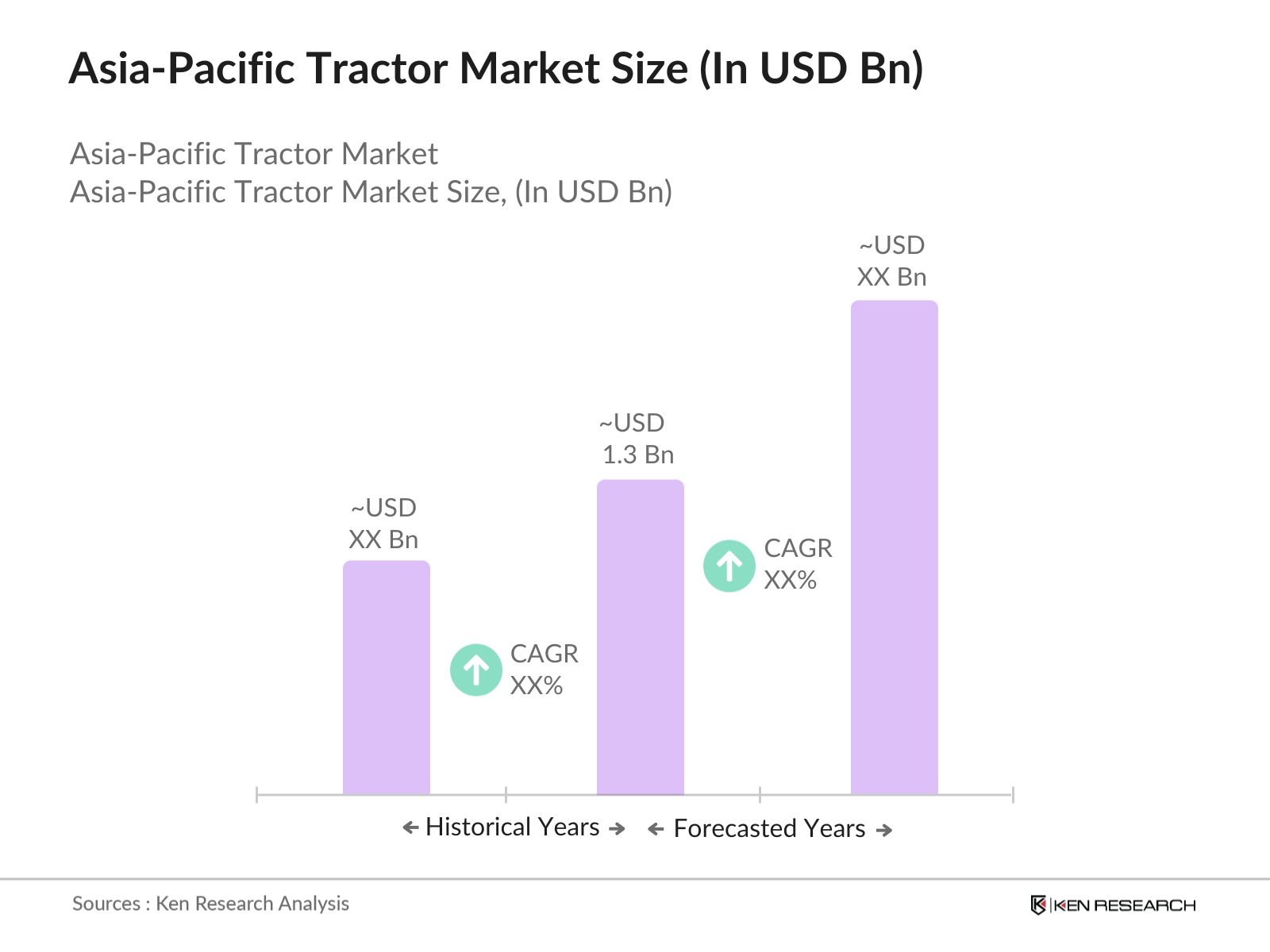
The Asia-Pacific tractor market is valued at USD 1.3 billion, driven by increasing mechanization in agriculture and government support for agricultural modernization. The market shows strong growth prospects due to rising food demand and the need for enhanced productivity.
Challenges in Asia-Pacific tractor market include high capital investment for purchasing tractors, fluctuating raw material prices, and competition from low-cost imported tractors. These factors create pricing pressure for domestic manufacturers, particularly in countries like India and China.
Key players in the Asia-Pacific tractor market include Mahindra & Mahindra Ltd., John Deere, Kubota Corporation, CNH Industrial, and Escorts Limited. These companies dominate due to their strong distribution networks, advanced product offerings, and government partnerships.
Asia-Pacific tractor market Growth drivers include increasing agricultural mechanization, government subsidies for farmers, and advancements in precision farming technologies. The growing demand for food and the need to boost agricultural productivity further support the market.
Asia-Pacific tractor market Opportunities lie in the development of electric and autonomous tractors, as well as expanding into emerging markets within the region. The rise in contract farming and rental services also presents new avenues for growth.

What makes us stand out is that our consultants follows Robust, Refine and Result (RRR) methodology. i.e. Robust for clear definitions, approaches and sanity checking, Refine for differentiating respondents facts and opinions and Result for presenting data with story

We have set a benchmark in the industry by offering our clients with syndicated and customized market research reports featuring coverage of entire market as well as meticulous research and analyst insights.

While we don't replace traditional research, we flip the method upside down. Our dual approach of Top Bottom & Bottom Top ensures quality deliverable by not just verifying company fundamentals but also looking at the sector and macroeconomic factors.

With one step in the future, our research team constantly tries to show you the bigger picture. We help with some of the tough questions you may encounter along the way: How is the industry positioned? Best marketing channel? KPI's of competitors? By aligning every element, we help maximize success.

Our report gives you instant access to the answers and sources that other companies might choose to hide. We elaborate each steps of research methodology we have used and showcase you the sample size to earn your trust.

If you need any support, we are here! We pride ourselves on universe strength, data quality, and quick, friendly, and professional service.