
Asia Pacific UHT Milk Market Outlook to 2030
Region:Asia
Author(s):Vijay Kumar
Product Code:KROD5469
November 2024
98
About the Report
Asia Pacific UHT Milk Market Overview
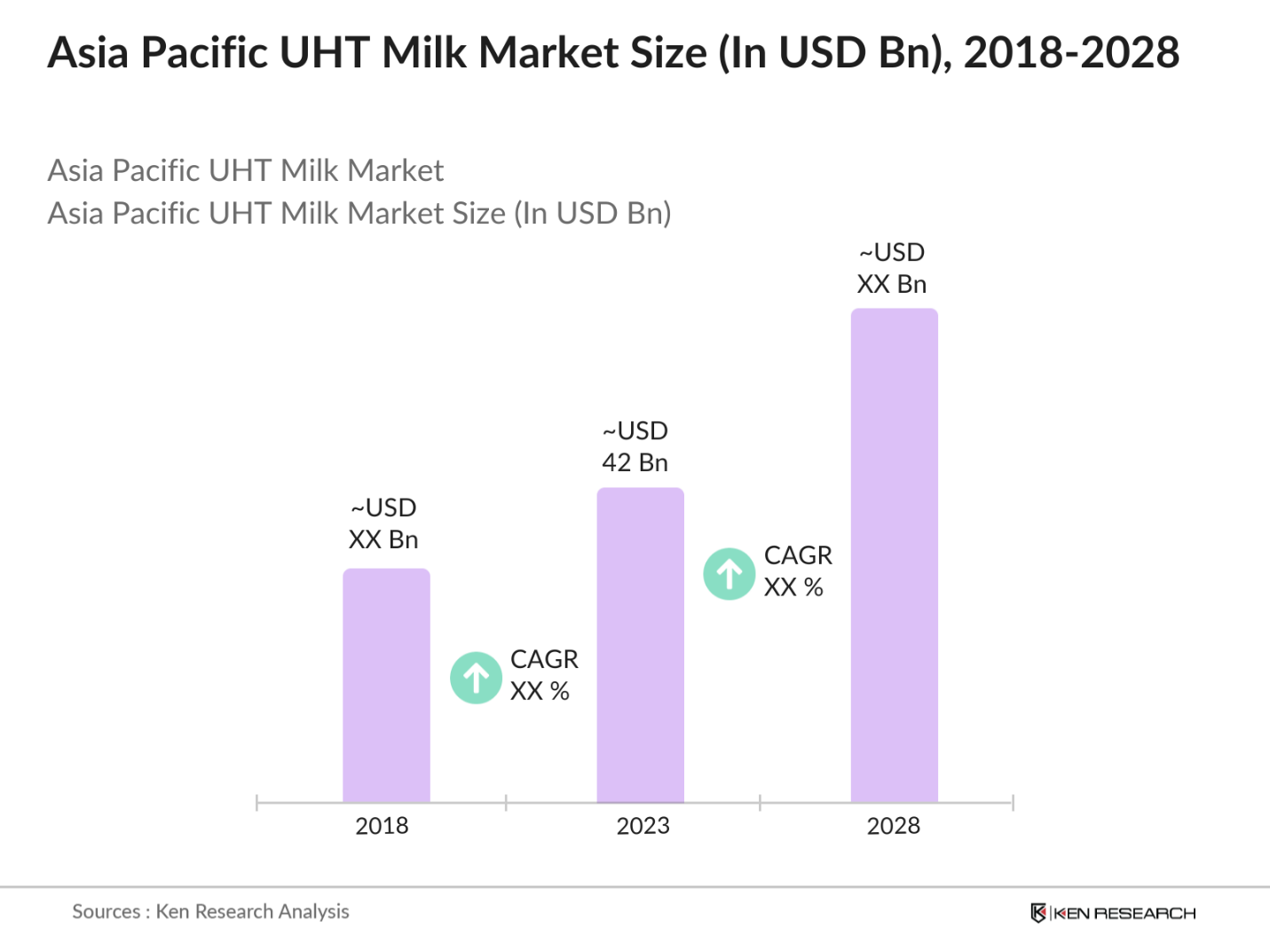
- The Asia Pacific Ultra-High Temperature (UHT) milk market is valued at USD 42 billion, based on a five-year historical analysis. This substantial market size is primarily driven by the region's expanding population, urbanization, and the increasing demand for convenient, long-shelf-life dairy products. The shift towards organized retail and the rising disposable incomes of consumers further bolsters the market's growth.
- China and India are the dominant countries in the Asia Pacific UHT milk market. China's dominance is attributed to its large population and rapid urbanization, leading to higher consumption of packaged dairy products. India's significant market share stems from its growing middle class and increasing preference for convenient dairy options, supported by improvements in cold chain infrastructure and retail distribution networks.
- Trade policies and tariff regulations significantly impact the UHT milk market in the Asia-Pacific region. For instance, in 2020, China imposed tariffs ranging from 5% to 15% on imported dairy products, including UHT milk, to protect domestic producers and encourage local consumption. Similarly, India maintains a 30% tariff on imported dairy products to support its local dairy industry. These trade policies influence the competitiveness of imported UHT milk and affect market dynamics within the region.
Asia Pacific UHT Milk Market Segmentation
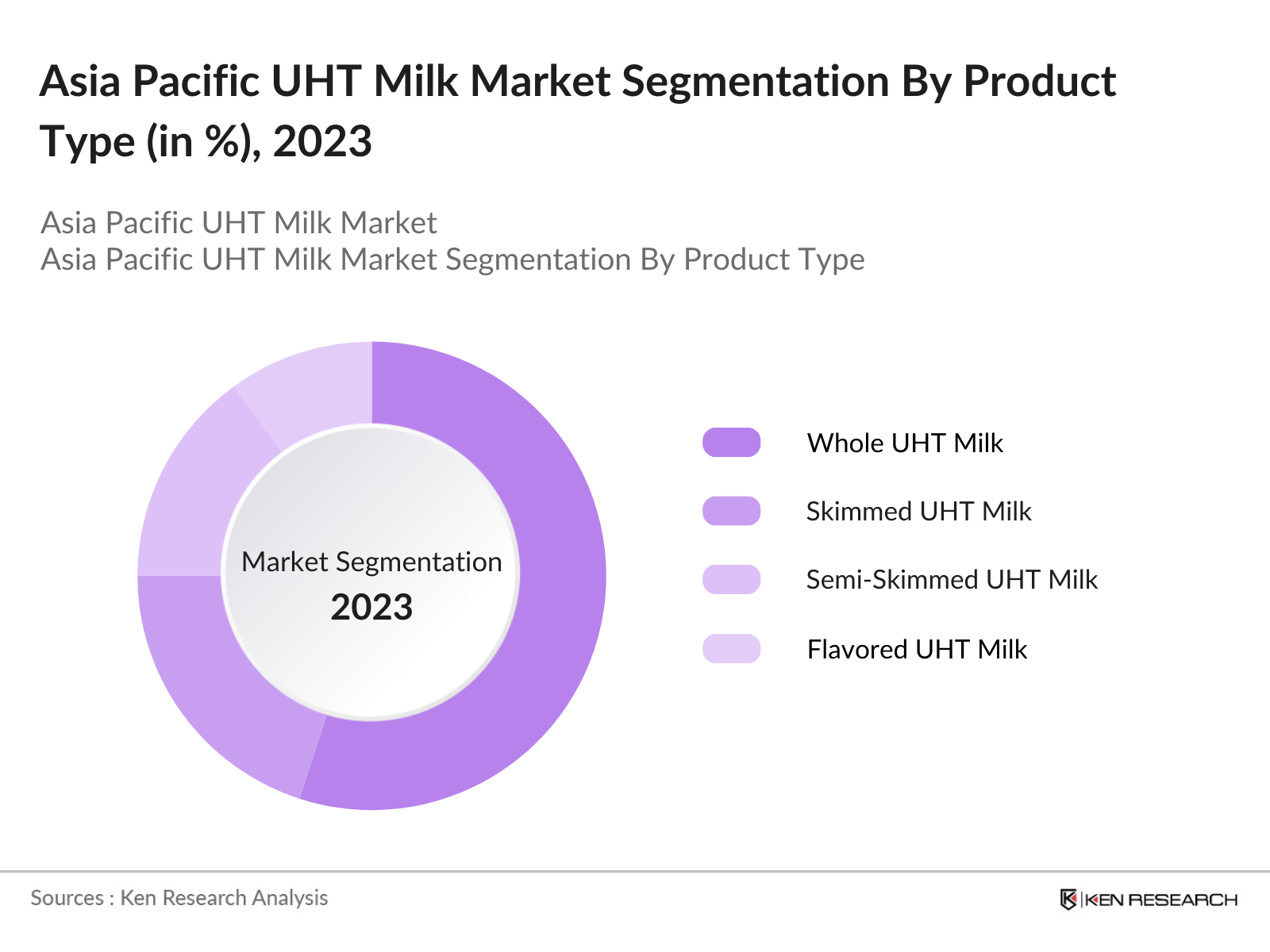
By Product Type: The market is segmented by product type into whole UHT milk, skimmed UHT milk, semi-skimmed UHT milk, flavored UHT milk, and lactose-free UHT milk. Whole UHT milk holds a dominant market share in the region due to its rich taste and nutritional content, which align with consumer preferences. The product's extended shelf life and convenience make it a popular choice among urban populations with busy lifestyles.
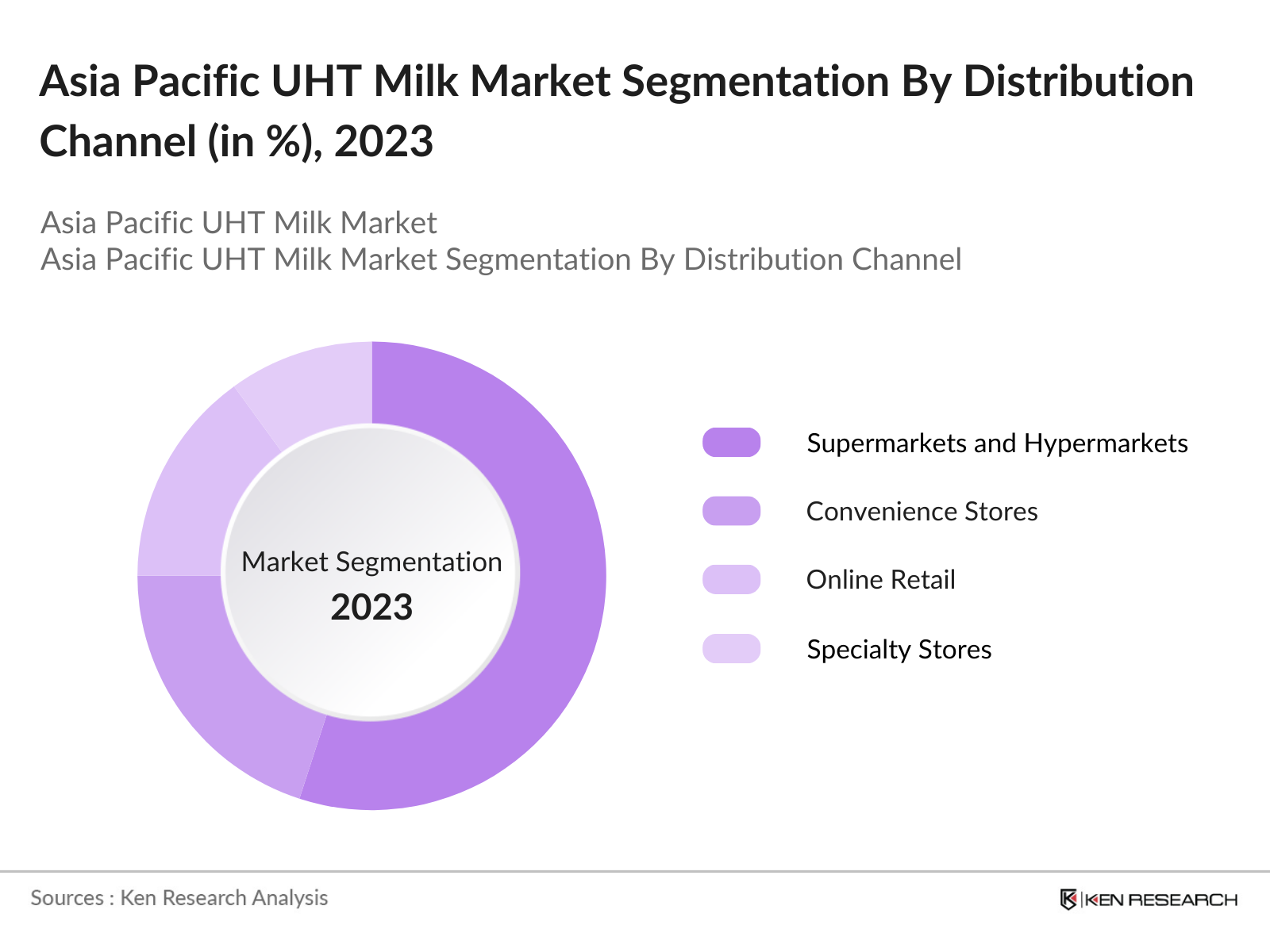
By Distribution Channel: The market is also segmented by distribution channel into supermarkets and hypermarkets, convenience stores, online retail, specialty stores, and direct sales. Supermarkets and hypermarkets dominate the distribution channels, offering a wide variety of UHT milk products and brands under one roof. Their extensive reach and frequent promotional activities attract a large consumer base, contributing to their leading position in the market.
Asia Pacific UHT Milk Market Competitive Landscape
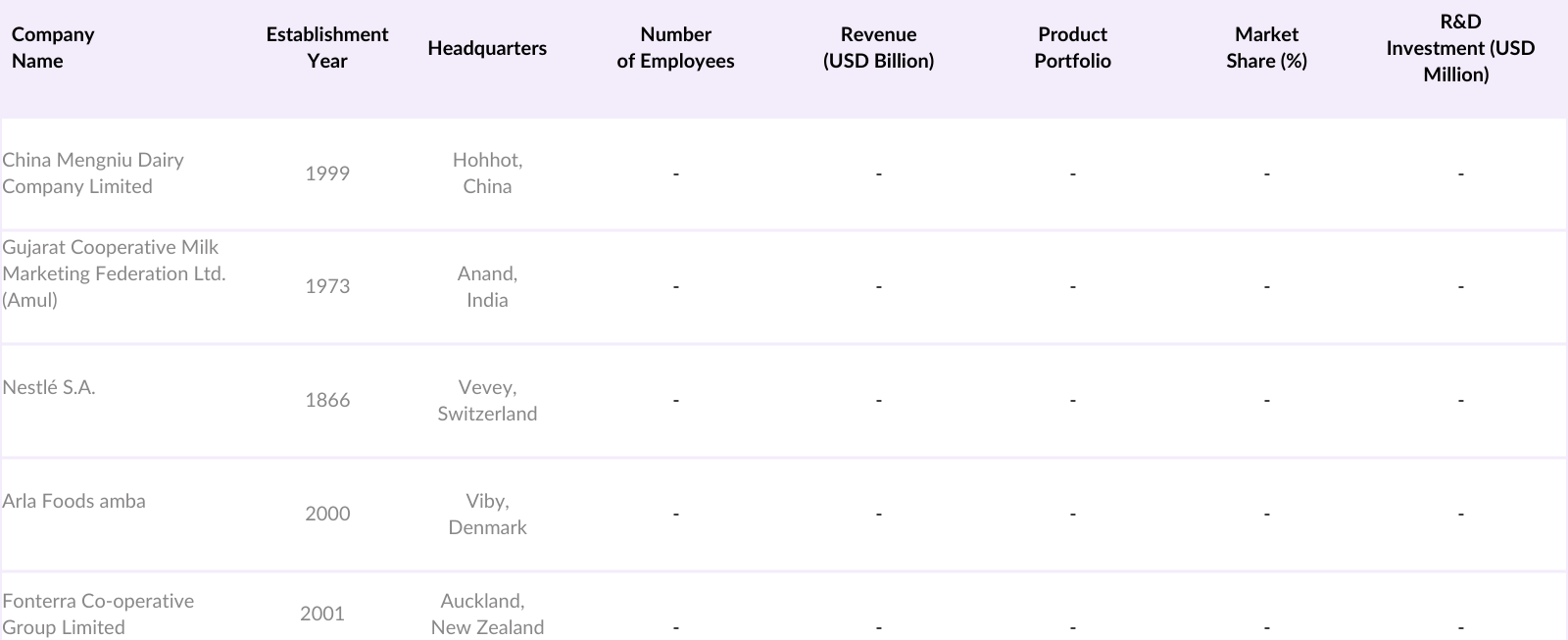
The Asia Pacific UHT milk market is characterized by the presence of both multinational corporations and regional players, leading to a competitive environment. Companies are focusing on product innovation, expanding distribution networks, and strategic partnerships to strengthen their market position.
Asia Pacific UHT Milk Industry Analysis
Growth Drivers
- Urbanization and Lifestyle Changes: The Asia-Pacific region has experienced significant urbanization, with urban populations increasing from 1.2 billion in 2010 to over 1.5 billion in 2020. This shift has led to lifestyle changes, including a preference for convenient food options like UHT milk, which offers extended shelf life without refrigeration. For instance, in China, urbanization has reached 64% as of 2020, up from 50% in 2010, contributing to higher demand for packaged dairy products.
- Demand for Shelf-Stable Dairy Products: In 2020, the Asia-Pacific region produced approximately 300 million metric tons of milk, with a significant portion processed into UHT milk to meet the demand for shelf-stable dairy products. Countries like India and China have seen increased consumption of UHT milk due to its convenience and longer shelf life, catering to consumers without consistent refrigeration access.
- Growth in Organized Retail Sector: The organized retail sector in Asia-Pacific has expanded, with retail sales reaching $3.8 trillion in 2020. This growth has enhanced the distribution of UHT milk through supermarkets and hypermarkets, making it more accessible to consumers. For example, India's organized retail market grew from $60 billion in 2010 to $180 billion in 2020, facilitating wider availability of packaged dairy products.
Market Challenges
- High Production Costs: The production of UHT milk involves advanced processing technologies, leading to higher production costs. In 2020, the average cost of UHT processing equipment ranged from $500,000 to $1 million, posing a barrier for small-scale producers. Additionally, the cost of raw milk has fluctuated, impacting overall production expenses.
- Regulatory Compliance Challenges: Compliance with varying food safety and quality standards across countries in the Asia-Pacific region presents challenges for UHT milk producers. For instance, in 2020, China implemented stricter dairy import regulations, requiring detailed documentation and adherence to specific safety standards, which increased the compliance burden for exporters.
Asia Pacific UHT Milk Market Future Outlook
Over the next five years, the Asia Pacific UHT milk market is expected to exhibit significant growth, driven by increasing consumer demand for convenient dairy products, advancements in UHT processing technology, and the expansion of organized retail channels. The rising health consciousness among consumers and the introduction of innovative products, such as lactose-free and fortified UHT milk, are anticipated to further propel market growth.
Market Opportunities
- Expansion in Emerging Markets: Emerging markets in Southeast Asia, such as Vietnam and Indonesia, have shown increased demand for UHT milk. Vietnam's dairy market grew from $3 billion in 2015 to $5 billion in 2020, with UHT milk accounting for a significant share. This growth presents opportunities for producers to expand their presence in these markets.
- Product Diversification (e.g., Lactose-Free, Organic): Consumers in the Asia-Pacific region is seeking specialized dairy products. In 2020, the market for lactose-free dairy products in China was valued at $1.2 billion, reflecting a growing demand for such options. Similarly, the organic dairy market in Australia reached $500 million, indicating opportunities for product diversification.
Scope of the Report
|
Product Type |
Whole UHT Milk |
|
Source |
Cow Milk |
|
Form |
Liquid |
|
Distribution Channel |
Supermarkets and Hypermarkets |
|
Country |
China |
Products
Key Target Audience
Dairy Product Manufacturers
Retail Chains and Supermarkets
Food and Beverage Distributors
Packaging Companies
Dairy Farmers and Cooperatives
Investment and Venture Capitalist Firms
Government and Regulatory Bodies (e.g., Food Safety and Standards Authority of India, China Food and Drug Administration)
Research and Development Institutions
Companies
Players Mentioned in the Report
China Mengniu Dairy Company Limited
Gujarat Cooperative Milk Marketing Federation Ltd. (Amul)
Nestl S.A.
Arla Foods amba
Fonterra Co-operative Group Limited
Yili Group
Vinamilk
Parag Milk Foods Ltd.
Marigold
Lactalis International
Table of Contents
1. Asia Pacific UHT Milk Market Overview
1.1 Definition and Scope
1.2 Market Taxonomy
1.3 Market Growth Rate
1.4 Market Segmentation Overview
2. Asia Pacific UHT Milk Market Size (In USD Million)
2.1 Historical Market Size
2.2 Year-On-Year Growth Analysis
2.3 Key Market Developments and Milestones
3. Asia Pacific UHT Milk Market Analysis
3.1 Growth Drivers
3.1.1 Urbanization and Lifestyle Changes
3.1.2 Demand for Shelf-Stable Dairy Products
3.1.3 Growth in Organized Retail Sector
3.1.4 Rising Health Awareness
3.2 Market Challenges
3.2.1 High Production Costs
3.2.2 Regulatory Compliance Challenges
3.2.3 Consumer Preference for Fresh Dairy
3.3 Opportunities
3.3.1 Expansion in Emerging Markets
3.3.2 Product Diversification (e.g., Lactose-Free, Organic)
3.3.3 Innovation in Processing and Packaging
3.4 Trends
3.4.1 Growing Demand for Plant-Based UHT Milk
3.4.2 Expansion in Online and Omni-channel Retailing
3.4.3 Rise in Functional and Fortified UHT Products
3.5 Government Regulations
3.5.1 Food Safety and Labeling Standards
3.5.2 Trade Policies and Tariff Regulations
3.5.3 Environmental and Sustainability Regulations
3.6 SWOT Analysis
3.7 Stakeholder Ecosystem
3.8 Porters Five Forces Analysis
3.9 Competitive Landscape
4. Asia Pacific UHT Milk Market Segmentation
4.1 By Product Type (In Value %)
4.1.1 Whole UHT Milk
4.1.2 Skimmed UHT Milk
4.1.3 Semi-Skimmed UHT Milk
4.1.4 Flavored UHT Milk
4.1.5 Lactose-Free UHT Milk
4.2 By Source (In Value %)
4.2.1 Cow Milk
4.2.2 Goat Milk
4.2.3 Plant-Based Milk
4.3 By Form (In Value %)
4.3.1 Liquid
4.3.2 Powder
4.4 By Distribution Channel (In Value %)
4.4.1 Supermarkets and Hypermarkets
4.4.2 Convenience Stores
4.4.3 Online Retail
4.4.4 Specialty Stores
4.4.5 Direct Sales
4.5 By Country (In Value %)
4.5.1 China
4.5.2 India
4.5.3 Japan
4.5.4 Australia
4.5.5 South Korea
4.5.6 Indonesia
4.5.7 Malaysia
4.5.8 Thailand
4.5.9 Vietnam
4.5.10 Philippines
4.5.11 Rest of Asia Pacific
5. Competitive Analysis
5.1 Detailed Profiles of Major Companies
5.1.1 China Mengniu Dairy Company Limited
5.1.2 Gujarat Cooperative Milk Marketing Federation Ltd. (Amul)
5.1.3 Nestl S.A.
5.1.4 Arla Foods amba
5.1.5 Karnataka Milk Federation
5.1.6 FrieslandCampina
5.1.7 Almarai
5.1.8 Vinamilk
5.1.9 Fonterra Co-operative Group Limited
5.1.10 Dutch Mill Group
5.1.11 Yili Group
5.1.12 Parag Milk Foods Ltd.
5.1.13 Marigold
5.1.14 Lactalis International
5.1.15 Britannia Industries Limited
5.2 Cross Comparison Parameters (No. of Employees, Headquarters, Year of Establishment, Revenue, Product Portfolio, Market Share, R&D Investment, Regional Presence)
5.3 Market Share Analysis
5.4 Strategic Initiatives
5.5 Mergers and Acquisitions
5.6 Investment Analysis
5.6.1 Venture Capital Funding
5.6.2 Government Grants
5.6.3 Private Equity Investments
6. Regulatory Framework
6.1 Food Safety Standards
6.2 Certification and Labeling Requirements
6.3 Import and Export Regulations
7. Asia Pacific UHT Milk Future Market Size (In USD Million)
7.1 Market Size Projections
7.2 Key Drivers of Future Growth
8. Asia Pacific UHT Milk Future Market Segmentation
8.1 By Product Type (In Value %)
8.2 By Source (In Value %)
8.3 By Form (In Value %)
8.4 By Distribution Channel (In Value %)
8.5 By Country (In Value %)
9. Asia Pacific UHT Milk Market Analysts Recommendations
9.1 Total Addressable Market (TAM), Serviceable Available Market (SAM), and Serviceable Obtainable Market (SOM) Analysis
9.2 Customer Cohort Analysis
9.3 Marketing Initiatives
9.4 White Space Opportunity Analysis
Research Methodology
Step 1: Identification of Key Variables
The initial phase involves constructing an ecosystem map encompassing all major stakeholders within the Asia Pacific UHT Milk Market. This step is underpinned by extensive desk research, utilizing a combination of secondary and proprietary databases to gather comprehensive industry-level information. The primary objective is to identify and define the critical variables that influence market dynamics.
Step 2: Market Analysis and Construction
In this phase, we compile and analyze historical data pertaining to the Asia Pacific UHT Milk Market. This includes assessing market penetration, the ratio of marketplaces to service providers, and the resultant revenue generation. Furthermore, an evaluation of service quality statistics is conducted to ensure the reliability and accuracy of the revenue estimates.
Step 3: Hypothesis Validation and Expert Consultation
Market hypotheses are developed and subsequently validated through computer-assisted telephone interviews (CATIs) with industry experts representing a diverse array of companies. These consultations provide valuable operational and financial insights directly from industry practitioners, which are instrumental in refining and corroborating the market data. This feedback loop ensures our analysis accurately reflects industry realities and addresses potential biases.
Step 4: Research Synthesis and Final Output
In the final phase, we synthesize all data points, integrating insights from manufacturers, distributors, and retailers across the Asia Pacific region. This process includes a rigorous cross-validation of both primary and secondary data sources to produce a comprehensive, accurate, and validated analysis of the Asia Pacific UHT milk market.
Frequently Asked Questions
01 How big is the Asia Pacific UHT Milk Market?
The Asia Pacific Ultra-High Temperature (UHT) milk market is valued at USD 42 billion, based on a five-year historical analysis. This substantial market size is primarily driven by the region's expanding population, urbanization, and the increasing demand for convenient, long-shelf-life dairy products.
02 What are the primary drivers of the Asia Pacific UHT Milk Market?
Major drivers include urbanization, rising disposable incomes, the need for convenient dairy products, and a shift towards organized retail, making UHT milk a popular choice among busy, urban consumers.
03 Which countries dominate the Asia Pacific UHT Milk Market?
China and India are dominant in the market due to their large populations, evolving dairy preferences, and expanding retail networks, supported by improving cold chain logistics.
04 Who are the major players in the Asia Pacific UHT Milk Market?
Key players include China Mengniu Dairy Company, Gujarat Cooperative Milk Marketing Federation (Amul), Nestl S.A., Arla Foods, and Fonterra, each known for robust distribution and diverse product offerings.
Why Buy From Us?

What makes us stand out is that our consultants follows Robust, Refine and Result (RRR) methodology. i.e. Robust for clear definitions, approaches and sanity checking, Refine for differentiating respondents facts and opinions and Result for presenting data with story

We have set a benchmark in the industry by offering our clients with syndicated and customized market research reports featuring coverage of entire market as well as meticulous research and analyst insights.

While we don't replace traditional research, we flip the method upside down. Our dual approach of Top Bottom & Bottom Top ensures quality deliverable by not just verifying company fundamentals but also looking at the sector and macroeconomic factors.

With one step in the future, our research team constantly tries to show you the bigger picture. We help with some of the tough questions you may encounter along the way: How is the industry positioned? Best marketing channel? KPI's of competitors? By aligning every element, we help maximize success.

Our report gives you instant access to the answers and sources that other companies might choose to hide. We elaborate each steps of research methodology we have used and showcase you the sample size to earn your trust.

If you need any support, we are here! We pride ourselves on universe strength, data quality, and quick, friendly, and professional service.