















Asia-Pacific Underfloor Heating Market Outlook to 2030
Region:Asia
Author(s):Sanjeev
Product Code:KROD1657
October 2024
97
About the Report
Asia-Pacific Underfloor Heating Market Overview
- In 2023, the Asia-Pacific (APAC) Underfloor Heating Market was valued at USD 4.2 billion. This growth is fueled by increasing demand for energy-efficient heating solutions, rising construction activities, and growing awareness of the benefits of underfloor heating systems. These systems are increasingly being adopted in residential, commercial, and industrial buildings for their efficient heat distribution and comfort.
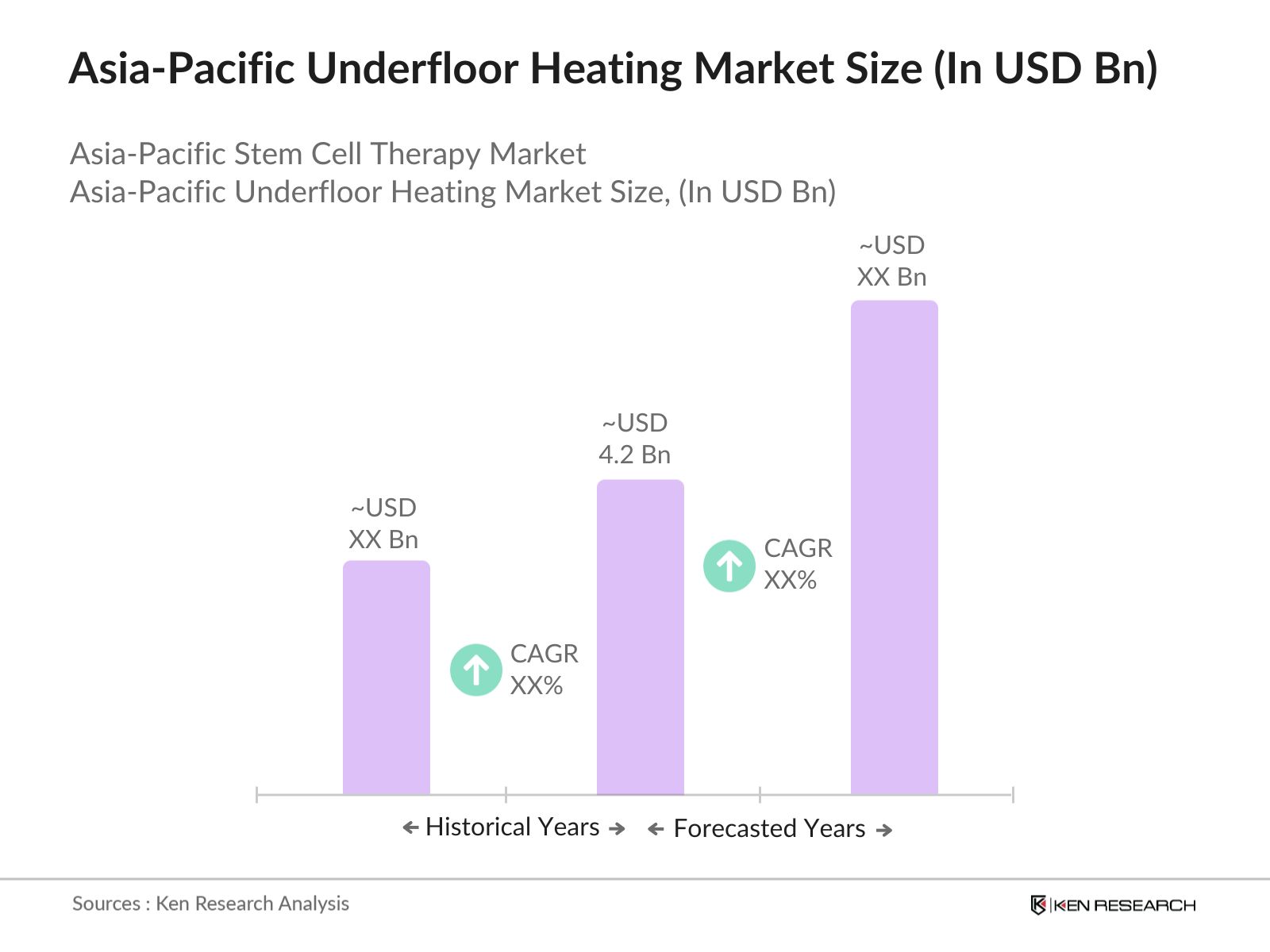
- Major players in the APAC Underfloor Heating market include Uponor Corporation, Danfoss, REHAU AG, Warmup Plc, and Nexans S.A. These companies are recognized for their innovative heating technologies and comprehensive solutions. Uponor Corporation leads with advanced underfloor heating systems that cater to both new constructions and renovation projects.
- Key cities driving the market include Tokyo, Beijing, and Sydney. Tokyo's market prominence is attributed to Japan's energy efficiency initiatives and high adoption rates of modern heating technologies. Beijing's strong market position is due to Chinas rapid urbanization and construction boom. Sydney stands out for its increasing number of sustainable building projects incorporating underfloor heating systems.
- In 2023, Uponor Corporation expanded its product range with new smart controls for underfloor heating systems, aimed at enhancing energy efficiency and user convenience. The company offers a complete suite of underfloor heating solutions, including systems like the Minitec and Siccus, designed to support both traditional and low-profile installations.
Asia-Pacific Underfloor Heating Market Segmentation
The APAC Underfloor Heating market can be segmented by type, application, and region:
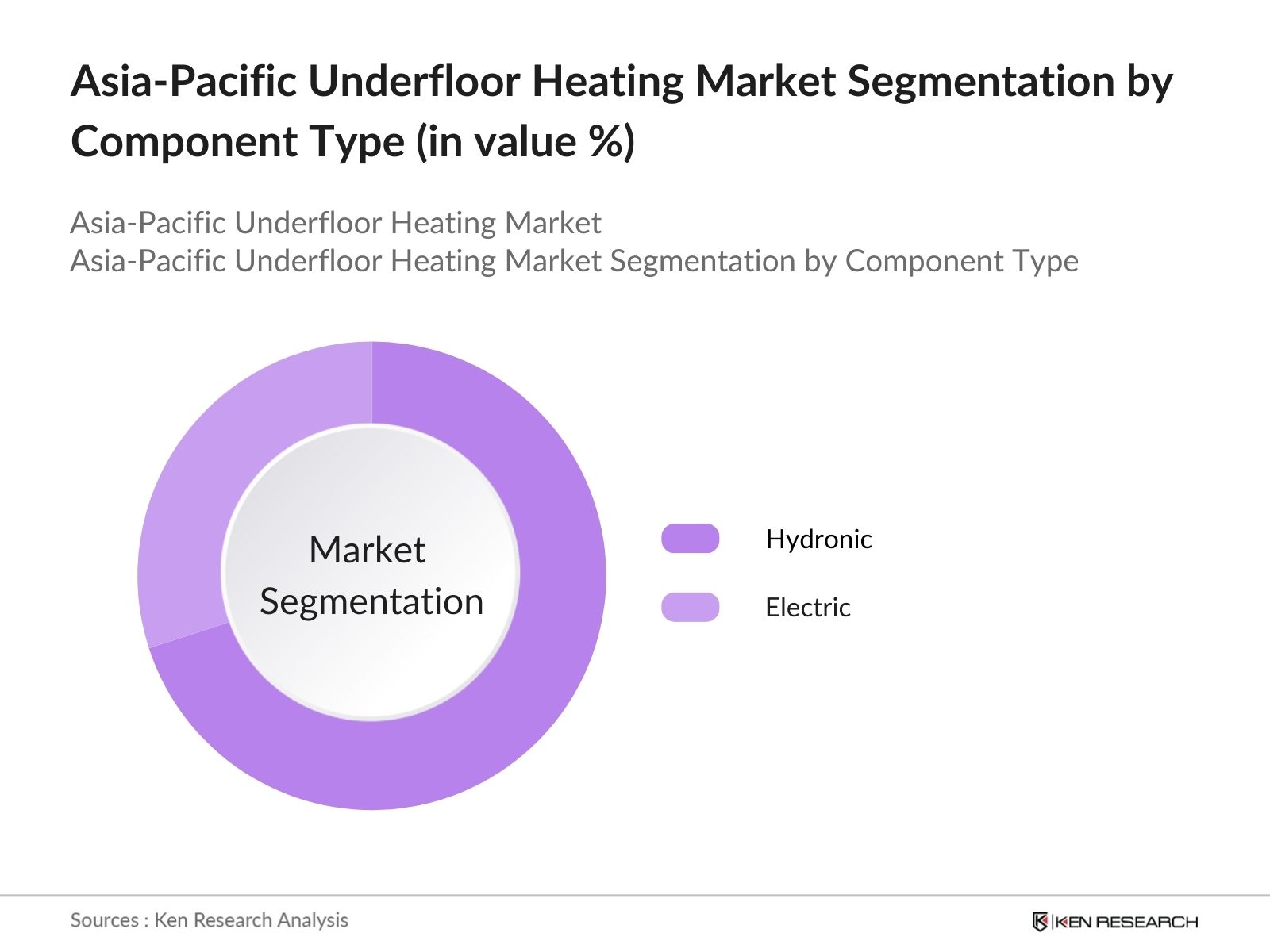
- By Component Type: The APAC Underfloor Heating market is segmented by type into hydronic (water-based) and electric underfloor heating systems. In 2023, electric underfloor heating systems dominated the market due to their ease of installation, especially in renovation projects. Their effectiveness in providing consistent and comfortable heating makes them a popular choice in residential buildings.
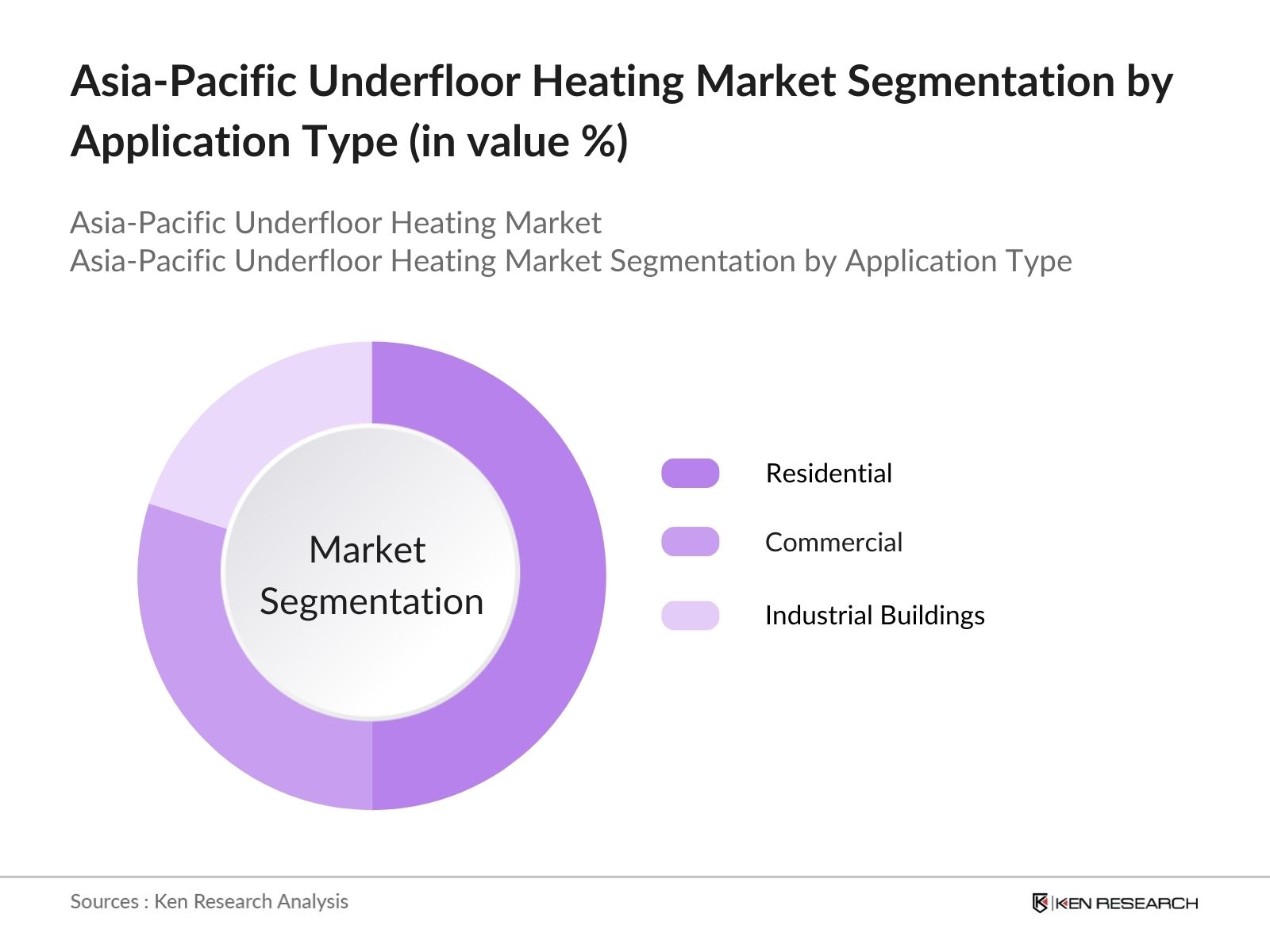
- By Application Type: The APAC Underfloor Heating market is segmented by application into residential, commercial, and industrial buildings. In 2023, residential applications dominated the market due to the increasing adoption of underfloor heating in homes for enhanced comfort and energy savings. The rise in construction of energy-efficient homes is a driver for this segment.
- By Region: The APAC Underfloor Heating market is segmented regionally into China, Japan, South Korea, and Australia. In 2023, China led the Asia-Pacific Underfloor Heating market due to its large-scale construction activities and growing adoption of energy-efficient technologies. Government initiatives promoting sustainable construction also contribute to China's dominant market position.
Asia-Pacific Underfloor Heating Market Competitive Landscape
|
Company |
Establishment Year |
Headquarters |
|
Uponor Corporation |
1918 |
Vantaa, Finland |
|
Danfoss |
1933 |
Nordborg, Denmark |
|
REHAU AG |
1948 |
Muri, Switzerland |
|
Warmup Plc |
1994 |
London, UK |
|
Nexans S.A. |
1897 |
Paris, France |
- REHAU AG: In 2023, REHAU AG launched its RAUTHERM SPEED, a new underfloor heating system that reduces installation time while maintaining high performance. This innovation positions REHAU as a leader in providing flexible and efficient heating solutions, particularly for residential applications. The systems user-friendly design and energy efficiency have made it popular among installers and homeowners alike.
- Warmup Plc: In 2023, Warmup Plc expanded its product line with the introduction of new electric underfloor heating mats designed for easy installation and improved energy efficiency. These mats are particularly suitable for retrofit projects, offering a low-profile solution that integrates seamlessly with existing floors. Warmup's focus on innovation and customer convenience continues to drive its growth in the underfloor heating market.
- Nexans S.A.: In 2023, Nexans S.A. advanced its position in the market by launching a new range of underfloor heating cables that are both durable and energy efficient. These cables are designed for high-performance heating in a variety of building types, from residential to industrial. Nexans' commitment to quality and sustainability is evident in this product line, which also supports the global trend towards green building practices.
Asia-Pacific Underfloor Heating Market Analysis
Market Growth Drivers
-
Increasing Adoption of Energy-Efficient Solutions: By 2025, the demand for energy-efficient heating solutions is expected to rise across the Asia-Pacific region, driven by increasing awareness of environmental sustainability and energy conservation. As more consumers and businesses prioritize reducing energy consumption, the market for underfloor heating systems, known for their efficient heat distribution, is set to grow.
- Growth in Construction and Infrastructure Development: The Asia-Pacific region is experiencing rapid urbanization, with an estimated increase in urban population from 2023 to 2028. This growth fuels the demand for modern heating systems, especially in newly constructed residential, commercial, and industrial buildings. The underfloor heating market is expected to benefit, with a forecasted market value of USD 3.2 billion by 2028, as developers integrate energy-efficient technologies to meet building regulations and consumer expectations.
- Technological Advancements in Heating Systems: Technological innovations in underfloor heating, such as the development of smart thermostats and zoned heating systems, are enhancing the appeal and functionality of these systems. By 2028, it is expected that new underfloor heating installations in the region will incorporate smart technology, allowing for greater control over heating efficiency and energy usage. These advancements are projected to drive market growth, with the Asia-Pacific underfloor heating market expected to reach USD 3.5 billion by 2028.
Market Challenges
-
High Initial Installation Costs: One of the most barriers to the adoption of underfloor heating systems in the Asia-Pacific region is the high initial installation cost. Compared to traditional heating systems, underfloor heating requires more intricate installation processes and specialized materials, which can increase the overall cost by up to 40%. This higher upfront investment can be a deterrent, particularly in developing countries where budget constraints are a concern for both residential and commercial projects.
- Limited Awareness and Education: Despite the benefits of underfloor heating, there is still limited awareness among consumers and even some industry professionals in certain parts of the Asia-Pacific region. A lack of understanding about the efficiency, long-term cost savings, and comfort offered by underfloor heating can hinder market growth. In many rural and less developed areas, traditional heating methods are still preferred due to familiarity and lower perceived costs, slowing the adoption of more modern solutions.
- Complexity in Retrofitting Existing Buildings: Retrofitting underfloor heating systems into existing buildings can be particularly challenging and costly. The process often requires alterations to the structure of the building, including lifting floors and installing new insulation. This complexity can result in increased labor costs and extended project timelines, which discourages many property owners from opting for underfloor heating in renovation projects. In some cases, retrofitting costs can exceed 50% more than installing the system in new constructions.
Government Initiatives
-
Japans Energy Efficiency Standards for Buildings: Japan introduced stringent energy efficiency standards for buildings under the Energy Conservation Act, which was revised in 2020. The regulations require new residential and commercial buildings to meet high energy efficiency criteria, including the use of advanced heating systems like underfloor heating. The Japanese government has allocated 100 billion ($900 million) towards subsidies and incentives for the installation of energy-efficient heating solutions, aiming to reduce overall energy consumption in buildings by 35% by 2030.
- South Koreas Green New Deal: As part of South Koreas Green New Deal, announced in 2020, the government is promoting the use of energy-efficient technologies in both new and existing buildings. The plan includes financial incentives and subsidies for installing advanced heating systems such as underfloor heating. The South Korean government has allocated KRW 73.4 trillion ($62 billion) to green infrastructure projects, with a target to retrofit 225,000 buildings with energy-efficient systems by 2025, which is expected to drive substantial growth in the underfloor heating market.
Asia-Pacific Underfloor Heating Market Future Outlook
The Asia-Pacific underfloor heating market is poised for growth, driven by technological advancements, increased accessibility, and rising demand for energy-efficient heating solutions.
Future Market Trends
-
Integration with Smart Home Ecosystems: The integration of underfloor heating systems with smart home ecosystems is expected to be a trend in the coming years. As smart home technologies become more widespread, consumers will increasingly demand heating systems that can be controlled remotely via smartphones, voice assistants, or home automation platforms.
- Increased Adoption in Commercial Spaces: While underfloor heating has traditionally been more popular in residential applications, its adoption in commercial spaces is expected to grow. Factors such as energy efficiency regulations, the need for sustainable building certifications (like LEED and BREEAM), and the desire for improved indoor comfort in office and retail spaces are driving this trend.
- Advancements in Energy-Efficient Materials: The development of new materials that enhance the efficiency and performance of underfloor heating systems is a key future trend. Innovations such as improved insulation materials, more efficient heating cables, and advanced heat transfer fluids are likely to reduce energy consumption further and enhance the effectiveness of these systems. Research and development in this area are expected to lead to a 15% increase in system efficiency by 2028, making underfloor heating more appealing to environmentally conscious consumers.
Scope of the Report
|
By Region |
North America Europe Asia-Pacific Latin America Middle East & Africa |
|
By Component Type |
Hydronic Underfloor Heating Systems Electric Underfloor Heating Systems Smart Thermostats & Control Systems Insulation Panels & Boards Pipes & Manifolds |
|
By Application Type |
Residential Buildings Commercial Buildings Industrial Buildings Healthcare Facilities Educational Institutions Hospitality (Hotels & Resorts) |
Products
Key Target Audience Organizations and Entities Who Can Benefit by Subscribing to This Report:
Construction Companies
Real Estate Developers
Government Agencies and Regulatory Bodies (METI, MOHURD, EECA)
HVAC System Manufacturers
Energy Consultants
Smart Home Technology Providers
Sustainability Consultants
Banks and Financial Institutes
Venture Capitalist
Facility Management Companies
Urban Planners
Renewable Energy Companies
Time Period Captured in the Report:
Historical Period: 2018-2023
Base Year: 2023
Forecast Period: 2023-2028
Companies
Players Mentioned in the Report:
Uponor Corporation
Danfoss
REHAU AG
Warmup Plc
Nexans S.A.
Raychem (Pentair Thermal Management)
Devi Electrical Systems
Polypipe
Amuheat
Magnum Heating
Myson (part of Purmo Group)
ThermoSoft International Corporation
Flexel International Ltd.
Henco Industries
Heatcom Corporation
Table of Contents
1.Asia-Pacific Underfloor Heating Market Overview
1.1. Definition and Scope
1.2. Market Taxonomy
1.3. Market Growth Rate
1.4. Market Segmentation Overview
2.Asia-Pacific Underfloor Heating Market Size (in USD Bn), 2018-2023
2.1. Historical Market Size
2.2. Year-on-Year Growth Analysis
2.3. Key Market Developments and Milestones
3.Asia-Pacific Underfloor Heating Market Analysis
3.1. Growth Drivers
3.1.1. Increasing Adoption of Energy-Efficient Solutions
3.1.2. Growth in Construction and Infrastructure Development
3.1.3. Technological Advancements in Heating Systems
3.2. Restraints
3.2.1. High Initial Installation Costs
3.2.2. Limited Awareness and Education
3.2.3. Complexity in Retrofitting Existing Buildings
3.3. Opportunities
3.3.1. Government Regulations and Incentives
3.3.2. Integration with Smart Home Ecosystems
3.3.3. Expansion in Commercial Spaces
3.4. Trends
3.4.1. Advancements in Energy-Efficient Materials
3.4.2. Increased Adoption of Renewable Energy Sources
3.4.3. Development of Zoned Heating Systems
3.5. Government Regulation
3.5.1. Japans Energy Efficiency Standards for Buildings
3.5.2. South Koreas Green New Deal
3.5.3. Australias National Energy Productivity Plan (NEPP)
3.6. SWOT Analysis
3.7. Stake Ecosystem
3.8. Competition Ecosystem
4.Asia-Pacific Underfloor Heating Market Segmentation, 2023
4.1. By Component Type (in Value %)
4.1.1. Hydronic Underfloor Heating Systems
4.1.2. Electric Underfloor Heating Systems
4.1.3. Smart Thermostats & Control Systems
4.1.4. Insulation Panels & Boards
4.1.5. Pipes & Manifolds
4.2. By Application Type (in Value %)
4.2.1. Residential Buildings
4.2.2. Commercial Buildings
4.2.3. Industrial Buildings
4.2.4. Healthcare Facilities
4.2.5. Educational Institutions
4.3. By Technology (in Value %)
4.3.1. Continuous Heating Systems
4.3.2. Intermittent Heating Systems
4.4. By Energy Source (in Value %)
4.4.1. Electric Power
4.4.2. Renewable Energy (Solar, Geothermal)
4.5. By Region (in Value %)
4.5.1. North America
4.5.2. Europe
4.5.3. Asia-Pacific
4.5.4. Latin America
4.5.5. Middle East & Africa
5.Asia-Pacific Underfloor Heating Market Cross Comparison
5.1. Detailed Profiles of Major Companies
5.1.1. Uponor Corporation
5.1.2. Danfoss
5.1.3. REHAU AG
5.1.4. Warmup Plc
5.1.5. Nexans S.A.
5.1.6. Raychem (Pentair Thermal Management)
5.1.7. Devi Electrical Systems
5.1.8. Polypipe
5.1.9. Amuheat
5.1.10. Magnum Heating
5.1.11. Myson (part of Purmo Group)
5.1.12. ThermoSoft International Corporation
5.1.13. Flexel International Ltd.
5.1.14. Henco Industries
5.1.15. Heatcom Corporation
5.2. Cross Comparison Parameters (No. of Employees, Headquarters, Inception Year, Revenue)
6.Asia-Pacific Underfloor Heating Market Competitive Landscape
6.1. Market Share Analysis
6.2. Strategic Initiatives
6.3. Mergers and Acquisitions
6.4. Investment Analysis
6.4.1. Venture Capital Funding
6.4.2. Government Grants
6.4.3. Private Equity Investments
7.Asia-Pacific Underfloor Heating Market Regulatory Framework
7.1. Environmental Standards
7.2. Compliance Requirements
7.3. Certification Processes
8.Asia-Pacific Underfloor Heating Future Market Size (in USD Bn), 2023-2028
8.1. Future Market Size Projections
8.2. Key Factors Driving Future Market Growth
9.Asia-Pacific Underfloor Heating Future Market Segmentation, 2028
9.1. By Component Type (in Value %)
9.2. By Application Type (in Value %)
9.3. By Technology (in Value %)
9.4. By Energy Source (in Value %)
9.5. By Region (in Value %)
10.Asia-Pacific Underfloor Heating Market Analysts Recommendations
10.1. TAM/SAM/SOM Analysis
10.2. Customer Cohort Analysis
10.3. Marketing Initiatives
10.4. White Space Opportunity Analysis
Disclaimer Contact UsResearch Methodology
Step 1: Identifying Key Variables
Creating an ecosystem for all major entities in the Asia-Pacific Underfloor Heating market and referencing multiple secondary and proprietary databases to perform desk research. This includes gathering industry-level information on market drivers, challenges, technological advancements, and key players.
Step 2: Market Building
Collecting and analyzing statistics on the Asia-Pacific Underfloor Heating market over recent years, focusing on the adoption rates of underfloor heating systems, market penetration by key players, and regional market performance. This stage involves examining market share, revenue growth, and technology adoption trends to ensure data accuracy and reliability.
Step 3: Validating and Finalizing
Formulating market hypotheses and conducting CATIs (Computer-Assisted Telephone Interviews) with industry experts from leading companies in the heating and HVAC sectors. These interviews are crucial for validating collected data and gaining operational and financial insights directly from industry professionals.
Step 4: Research Output
Our team will engage with multiple underfloor heating product providers, contractors, and installers to understand product segment dynamics, consumer preferences, and sales trends. This process ensures that the final data reflects actual market conditions, verified through a bottom-up approach.
Frequently Asked Questions
1. How big is the Asia-Pacific Underfloor Heating Market?
In 2023, the Asia-Pacific Underfloor Heating Market was valued at USD 4.2 billion. The market is driven by increasing demand for energy-efficient heating solutions and growing construction activities across the region.
2. What are the challenges in the Asia-Pacific Underfloor Heating Market?
Challenges in the Asia-Pacific Underfloor Heating market include high initial installation costs, limited awareness and education among consumers, the complexity of retrofitting systems in existing buildings, and regulatory disparities across the region.
3. Who are the major players in the Asia-Pacific Underfloor Heating Market?
Major players in the Asia-Pacific Underfloor Heating Market include Uponor Corporation, Danfoss, REHAU AG, Warmup Plc, and Nexans S.A. These companies lead the market with their innovative heating solutions and strong regional presence.
4. What are the growth drivers of the Asia-Pacific Underfloor Heating Market?
Growth drivers in the Asia-Pacific Underfloor Heating Market include the increasing adoption of energy-efficient solutions, growth in construction and infrastructure development, government regulations and incentives for green buildings, and technological advancements in heating systems. These factors are contributing to the market's expansion and development.
Why Buy From Us?

What makes us stand out is that our consultants follows Robust, Refine and Result (RRR) methodology. i.e. Robust for clear definitions, approaches and sanity checking, Refine for differentiating respondents facts and opinions and Result for presenting data with story

We have set a benchmark in the industry by offering our clients with syndicated and customized market research reports featuring coverage of entire market as well as meticulous research and analyst insights.

While we don't replace traditional research, we flip the method upside down. Our dual approach of Top Bottom & Bottom Top ensures quality deliverable by not just verifying company fundamentals but also looking at the sector and macroeconomic factors.

With one step in the future, our research team constantly tries to show you the bigger picture. We help with some of the tough questions you may encounter along the way: How is the industry positioned? Best marketing channel? KPI's of competitors? By aligning every element, we help maximize success.

Our report gives you instant access to the answers and sources that other companies might choose to hide. We elaborate each steps of research methodology we have used and showcase you the sample size to earn your trust.

If you need any support, we are here! We pride ourselves on universe strength, data quality, and quick, friendly, and professional service.