















Asia-Pacific Unmanned Ground Vehicle (UGV) Market Outlook to 2030
Region:Asia
Author(s):Vijay Kumar
Product Code:KROD2352
December 2024
82
About the Report
Asia-Pacific UGV Market Overview
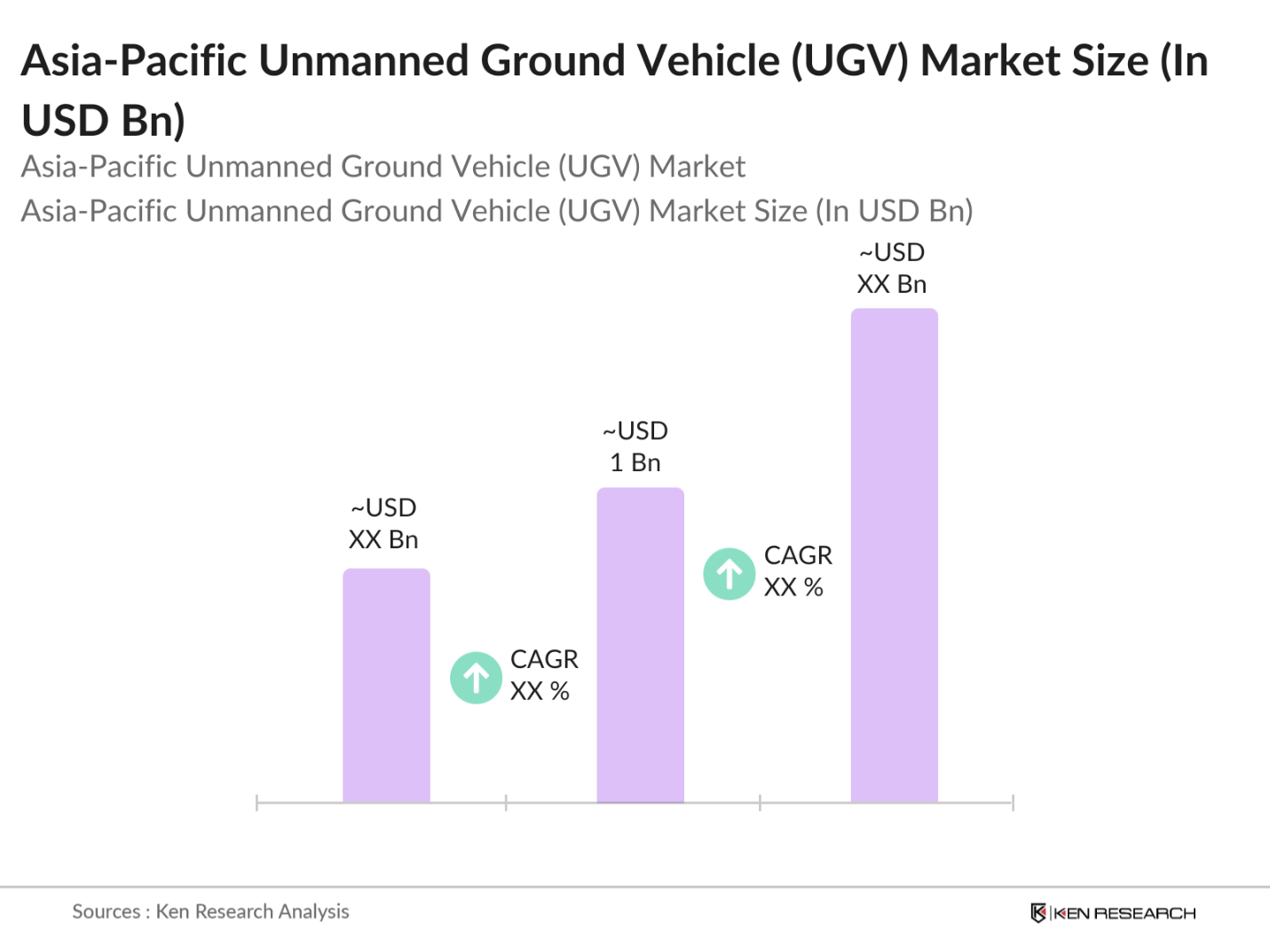
- The Asia-Pacific Unmanned Ground Vehicle (UGV) market was valued at USD 1 billion in 2023, driven by increased investments in defense and security sectors. Advancements in artificial intelligence (AI) and robotics, coupled with growing demand for UGVs in military and industrial applications, are key factors propelling market growth. The rising need for autonomous surveillance and combat systems in countries like China, India, and South Korea is further boosting the UGV market.
- Major players in the market include Mitsubishi Heavy Industries, QinetiQ Group, Hanwha Defense, Milrem Robotics, and Lockheed Martin. These companies have established strong market positions through advanced technological offerings and government collaborations. Their continuous investment in research and development strengthens their foothold in the growing UGV market.
- In 2023, Hanwha Defense secured a contract worth $200 million to supply unmanned ground vehicles to the South Korean military. This is part of South Koreas defense modernization program aimed at incorporating autonomous vehicles for surveillance and reconnaissance missions. The contract highlights the increasing adoption of unmanned technologies in the regions defense sector, which is driving market growth.
- Beijing, Seoul, and Tokyo are among the dominant cities in the Asia-Pacific UGV market. Beijing leads with significant investments in military technology and industrial automation, while Seouls rapid adoption of autonomous systems in defense and commercial sectors supports its dominance. Tokyo, with its robust R&D infrastructure, has emerged as a key center for UGV technological advancements.
Asia-Pacific UGV Market Segmentation
The Asia-Pacific Unmanned Ground Vehicle (UGV) Market can be segmented based on Application, Type, and Region.
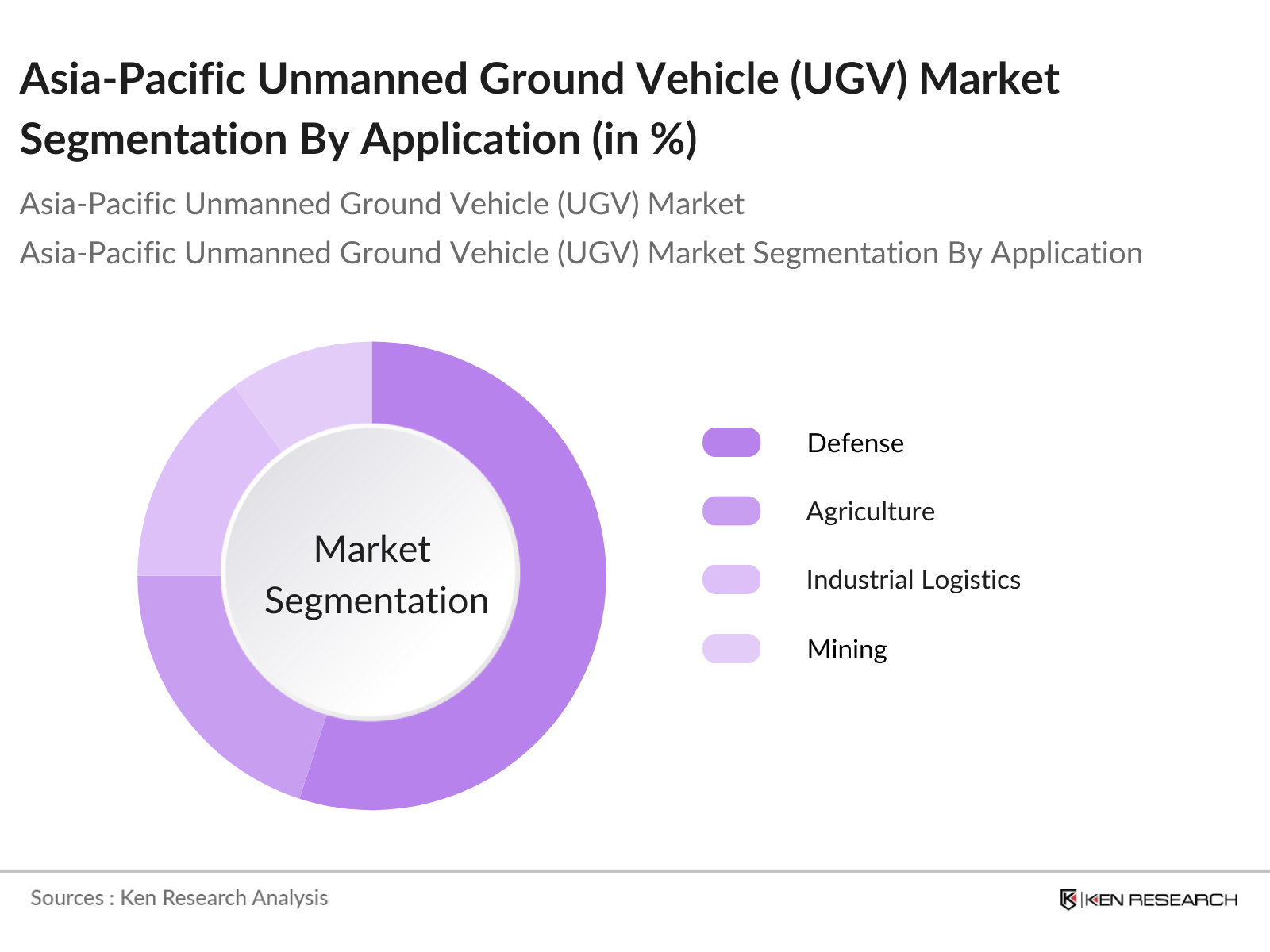
By Application: The market is segmented by application into Defense, Agriculture, Industrial Logistics, and Mining. In 2023, the defense segment held the largest market share is driven by increasing investments in unmanned systems for surveillance and reconnaissance missions.
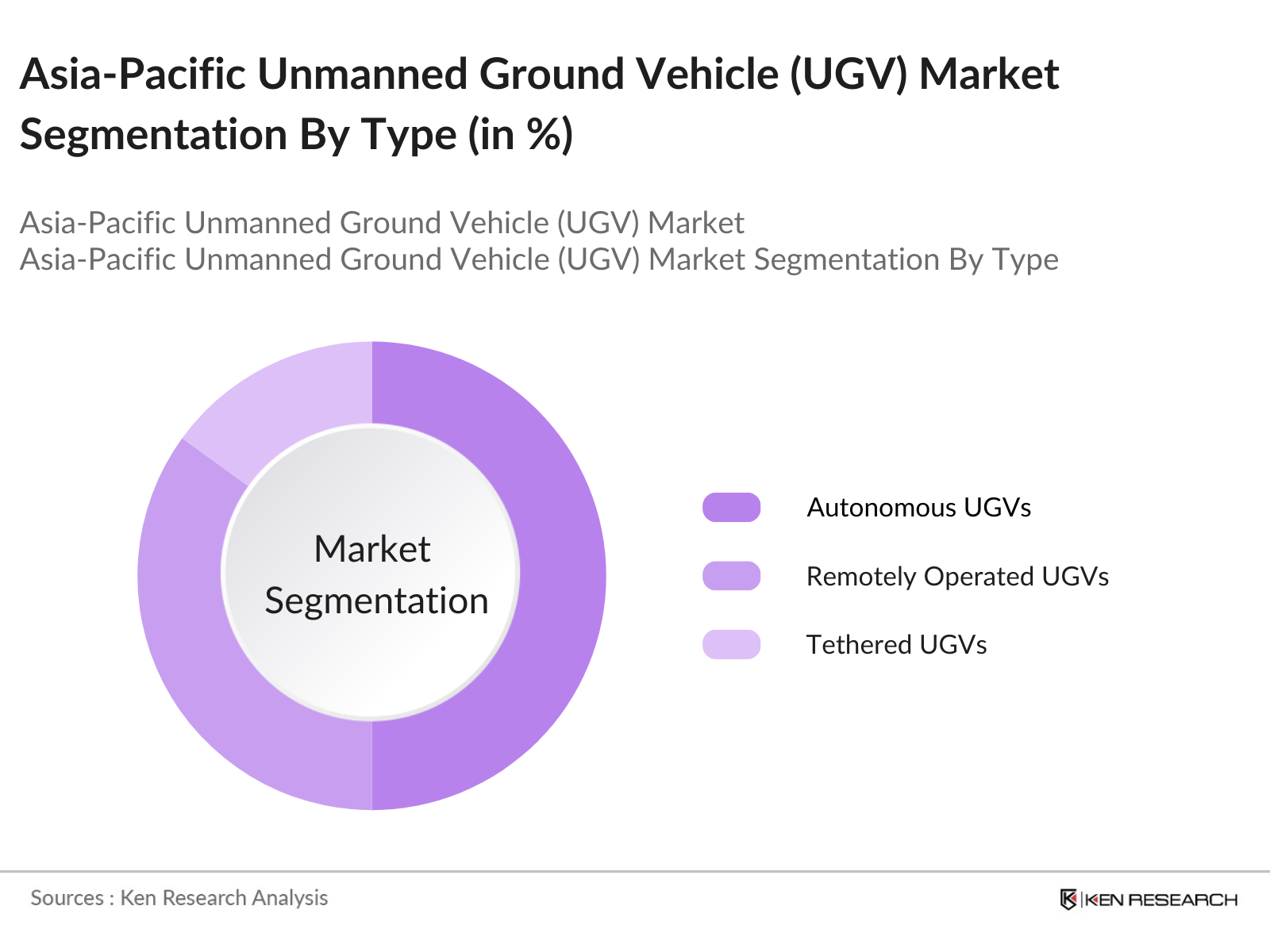
By Type: The UGV market is also segmented by type into Autonomous UGVs, Remotely Operated UGVs, and Tethered UGVs. Autonomous UGVs dominated the market with a share in 2023 due to advancements in AI and the growing demand for fully autonomous systems. Autonomous UGVs are favored in defense for their capability to navigate challenging terrains without human intervention.
By Region: The Asia-Pacific UGV market is geographically segmented into North, South, East, and West. The North region, led by China and Japan, held the highest market share in 2023, contributing to the market. This dominance is attributed to large-scale defense projects, advanced industrial activities, and a high concentration of UGV manufacturing and research centers in these countries.
Asia-Pacific UGV Market Competitive Landscape
|
Company |
Establishment Year |
Headquarters |
|
Mitsubishi Heavy Industries |
1884 |
Tokyo, Japan |
|
QinetiQ Group |
2001 |
Farnborough, UK |
|
Hanwha Defense |
1977 |
Seoul, South Korea |
|
Milrem Robotics |
2013 |
Tallinn, Estonia |
|
Lockheed Martin |
1912 |
Bethesda, USA |
- Milrem Robotics: In 2024, Milrem Robotics secured a contract to provide three THeMIS UGVs to the Japanese Ground Self-Defense Forces (JGSDF). These vehicles, designed for tasks like supply transport and intelligence gathering, feature Milrem's Intelligent Functions Kit (MIFIK) for autonomous operations. The contract is part of Japan's Rapid Acquisition Program to enhance defense capabilities using unmanned systems.
- Lockheed Martin: In 2023, Lockheed Martin won a contract with Japan to supply additional F-35A fighter jets and SM-6 missiles. Although unrelated to UGVs, this contract highlights Lockheed Martin's strong presence in the Asia-Pacific defense market and its capability to secure significant defense agreements in the region.
Asia-Pacific UGV Market Analysis
Asia-Pacific UGV Market Growth Drivers
- Rising Defense Budgets: The Asia-Pacific region experienced significant growth in defense spending, with countries like China allocating USD 224 billion for defense in 2023. This has accelerated the adoption of UGVs in surveillance, intelligence gathering, and combat operations, further boosting market growth.
- Increased Defense Spending in the Asia-Pacific Region (2024): The Asia-Pacific region witnessed a significant boost in defense budgets, with China leading the way, having allocated $224 billion in its 2023 defense budget. Countries such as India, Japan, and South Korea also saw substantial increases in military funding, totaling over $320 billion combined. The strategic focus on modernizing defense infrastructure and adopting autonomous technologies has significantly driven the demand for UGVs in the region.
- Rising Border Security and Counter-Terrorism Initiatives (2023-2024): The escalating geopolitical tensions and border disputes in the region, particularly between India and China, have prompted a sharp rise in border security measures. In 2023, the Indian government allocated an additional $5 billion to strengthen border security, with a focus on integrating unmanned systems such as UGVs for patrolling and reconnaissance operations.
Asia-Pacific UGV Market Challenges
- High Costs of Advanced UGV Systems (2023-2024): One of the critical challenges facing the Asia-Pacific UGV market is the high cost of advanced UGV systems. For instance, the development and procurement of UGVs for military use often involve substantial investments. In South Korea, the procurement of a fleet of UGVs in 2024 was estimated to cost the government $200 million.
- Regulatory and Ethical Concerns (2023-2024) The deployment of unmanned systems, especially in military operations, raises concerns related to regulations and ethical implications. In 2024, the Japanese government was forced to delay the deployment of certain UGV systems due to public concerns regarding the use of autonomous lethal force in combat situations.
Asia-Pacific UGV Market Government Initiatives
- China's Autonomous Military Vehicle Initiative (2023): In 2023, China launched a government-backed program aimed at developing autonomous military vehicles, including UGVs, as part of its military modernization efforts. The program received $50 million in funding and is expected to be fully operational by 2025. The initiative aims to integrate UGVs into China's military infrastructure, particularly for border security and reconnaissance missions, solidifying the country's leadership in the regional UGV market.
- Japan's Advanced UGV Research Fund (2024): In 2024, Japans Ministry of Defense established a $30 million research fund to promote the development of next-generation UGVs. The fund is intended to support research on UGVs that can perform logistical tasks, such as transporting supplies and ammunition during military operations. This initiative is aligned with Japans broader goal of reducing reliance on human personnel in high-risk environments.
Asia-Pacific Unmanned Ground Vehicle (UGV) Market Future Market Outlook
The Asia-Pacific Unmanned Ground Vehicle (UGV) Market is set for substantial growth, driven by advancements in AI and robotics, increasing defense budgets across the region, and the rising demand for autonomous systems in both military and civilian applications.
Future Market Trends
- Market Outlook 2028 Driven by AI and Robotics: The Asia-Pacific UGV market is expected to witness a significant transformation by 2028, driven by the rapid advancements in AI and robotics technologies. AI-powered UGVs will become more prevalent across both military and industrial sectors. Countries such as Japan and South Korea will lead the charge in adopting AI-driven UGVs for logistical support, surveillance, and autonomous combat operations. This trend will be supported by a projected increase in AI funding, expected to surpass $100 million in the region by 2028.
- Widespread Use of UGVs in Border Security Operations: Over the next five years, the Asia-Pacific UGV market will see increased deployment in border security operations, particularly in conflict-prone regions such as the India-China border. Governments will continue to invest heavily in UGV technologies to enhance surveillance and patrolling capabilities. By 2028, UGVs are expected to be a standard feature in most military arsenals, with China and India emerging as the largest users of these technologies.
Scope of the Report
|
By Application |
Defense Agriculture Industrial Logistics |
|
By Type |
Autonomous UGVs Remotely Operated UGVs Tethered UGVs |
|
By Region |
North South East West |
Products
Key Target Audience Organizations and Entities Who Can Benefit by Subscribing This Report:
Defense Ministries of APAC nations
Government and Regulatory Bodies (e.g., Ministry of Defense of China, Ministry of Defense of Japan)
Military and Defense Contractors
Automotive Automation Companies
Agricultural Machinery Manufacturers
Industrial Robotics Firms
Mining Companies
Homeland Security Agencies
Investment and Venture Capitalist Firms
Technological Research Centers
Time Period Captured in the Report
Historical Period: 2018-2023
Base Year: 2023
Forecast Period: 2023-2028
Companies
Players Mentioned in the Report
Mitsubishi Heavy Industries
QinetiQ Group
Milrem Robotics
Hanwha Defense
Lockheed Martin
Israel Aerospace Industries
Rheinmetall AG
Oshkosh Defense
General Dynamics Corporation
Hyundai Rotem
Table of Contents
1. Asia-Pacific UGV Market Overview
1.1. Definition and Scope
1.2. Market Taxonomy
1.3. Market Growth Rate
1.4. Market Segmentation Overview
2. Asia-Pacific UGV Market Size (in USD Bn), 2018-2023
2.1. Historical Market Size
2.2. Year-on-Year Growth Analysis
2.3. Key Market Developments and Milestones
3. Asia-Pacific UGV Market Analysis
3.1. Growth Drivers
3.1.1. Increasing Defense Budgets in the Asia-Pacific Region
3.1.2. Growing Demand for Border Security Technologies
3.1.3. Advancements in AI and Robotics Integration
3.2. Restraints
3.2.1. High Costs of Advanced UGV Systems
3.2.2. Regulatory and Ethical Concerns in Military Use
3.2.3. Lack of Skilled Workforce for Operation and Maintenance
3.3. Opportunities
3.3.1. Growing Civilian Applications of UGVs in Agriculture and Mining
3.3.2. Expansion of Autonomous UGV Capabilities
3.3.3. Increased Use of UGVs in Disaster Relief Operations
3.4. Trends
3.4.1. Rise of AI-Powered Autonomous UGVs
3.4.2. Deployment of UGVs for Border Surveillance
3.4.3. Use of UGVs in Industrial Logistics and Automation
3.5. Government Regulation
3.5.1. Defense and Military Unmanned Systems Regulations
3.5.2. Licensing Requirements for Autonomous Systems
3.5.3. Ethical Guidelines for Autonomous Military Technologies
3.6. SWOT Analysis
3.7. Stakeholder Ecosystem
3.8. Competition Ecosystem
4. Asia-Pacific UGV Market Segmentation, 2023
4.1. By Application (in Value %)
4.1.1. Defense
4.1.2. Agriculture
4.1.3. Industrial Logistics
4.1.4. Mining
4.2. By Type (in Value %)
4.2.1. Autonomous UGVs
4.2.2. Remotely Operated UGVs
4.2.3. Tethered UGVs
4.3. By Region (in Value %)
4.3.1. North (China, Japan)
4.3.2. South
4.3.3. East
4.3.4. West
5. Asia-Pacific UGV Market Cross Comparison
5.1. Detailed Profiles of Major Companies
5.1.1. Mitsubishi Heavy Industries
5.1.2. QinetiQ Group
5.1.3. Hanwha Defense
5.1.4. Milrem Robotics
5.1.5. Lockheed Martin
5.2. Cross Comparison Parameters (No. of Employees, Headquarters, Inception Year, Revenue)
6. Asia-Pacific UGV Market Competitive Landscape
6.1. Market Share Analysis
6.2. Strategic Initiatives
6.3. Mergers and Acquisitions
6.4. Investment Analysis
6.4.1. Venture Capital Funding
6.4.2. Government Grants
6.4.3. Private Equity Investments
6. Asia-Pacific UGV Market Regulatory Framework
7.1. Defense Unmanned Systems Policies
7.2. Licensing Requirements for UGV Deployment
7.3. Data Privacy and Security in Autonomous Systems
8. Asia-Pacific UGV Future Market Size (in USD Bn), 2023-2028
8.1. Future Market Size Projections
8.2. Key Factors Driving Future Market Growth
9. Asia-Pacific UGV Future Market Segmentation, 2028
9.1. By Application (in Value %)
9.2. By Type (in Value %)
9.3. By Region (in Value %)
10. Asia-Pacific UGV Market Analysts Recommendations
10.1. TAM/SAM/SOM Analysis
10.2. Customer Cohort Analysis
10.3. Strategic Initiatives for UGV Development
10.4. White Space Opportunity Analysis
Disclaimer
Contact Us
Research Methodology
Step 1: Identifying Key Variables
Creating an ecosystem for all major entities within the Asia-Pacific Unmanned Ground Vehicle (UGV) Market by referencing a combination of secondary and proprietary databases to conduct comprehensive desk research. This step gathers industry-level data, key trends, and insights into the competitive landscape to ensure a holistic analysis.
Step 2: Market Building
Compiling statistics on the Asia-Pacific UGV Market over the years, analyzing market penetration across application segments, and evaluating the performance of leading companies. This includes reviewing production capacities, market shares, and sales data to calculate the revenue generated in the UGV market. Data accuracy is ensured through quality checks.
Step 3: Validating and Finalizing
Developing market hypotheses and conducting Computer Assisted Telephone Interviews (CATIs) with industry experts and stakeholders from leading UGV companies. These interviews validate collected data, refine market forecasts, and gather critical operational and financial insights directly from industry participants.
Step 4: Research Output
Collaborating with key UGV industry players to understand product segment dynamics, customer demands, and market challenges. This involves using a bottom-up approach to validate the data, ensuring that final insights and statistics reflect the actual market conditions and support strategic decision-making for stakeholders.
Frequently Asked Questions
1. How big is the Asia-Pacific Unmanned Ground Vehicle (UGV) Market?
The Asia-Pacific Unmanned Ground Vehicle (UGV) market was valued at USD 1 billion in 2023. This growth is driven by increasing investments in defense and security, advancements in AI and robotics, and the adoption of UGVs in civilian sectors like agriculture and logistics.
2. What are the challenges in the Asia-Pacific Unmanned Ground Vehicle (UGV) Market?
Challenges in the Asia-Pacific UGV market include high costs of advanced UGV systems, regulatory concerns regarding autonomous combat vehicles, and a lack of skilled personnel for operation and maintenance. These factors limit the full adoption of UGVs in several countries across the region.
3. Who are the major players in the Asia-Pacific Unmanned Ground Vehicle (UGV) Market?
Key players in the Asia-Pacific UGV market include Mitsubishi Heavy Industries, QinetiQ Group, Hanwha Defense, Lockheed Martin, and Milrem Robotics. These companies lead the market through their advanced UGV technologies and significant defense contracts in the region.
4. What are the growth drivers of the Asia-Pacific Unmanned Ground Vehicle (UGV) Market?
The UGV market in Asia-Pacific is driven by rising defense spending, increasing demand for border security solutions, and the integration of AI into unmanned systems. Additionally, governments are investing in autonomous systems to enhance operational efficiency and reduce human risk in military operations.
Why Buy From Us?

What makes us stand out is that our consultants follows Robust, Refine and Result (RRR) methodology. i.e. Robust for clear definitions, approaches and sanity checking, Refine for differentiating respondents facts and opinions and Result for presenting data with story

We have set a benchmark in the industry by offering our clients with syndicated and customized market research reports featuring coverage of entire market as well as meticulous research and analyst insights.

While we don't replace traditional research, we flip the method upside down. Our dual approach of Top Bottom & Bottom Top ensures quality deliverable by not just verifying company fundamentals but also looking at the sector and macroeconomic factors.

With one step in the future, our research team constantly tries to show you the bigger picture. We help with some of the tough questions you may encounter along the way: How is the industry positioned? Best marketing channel? KPI's of competitors? By aligning every element, we help maximize success.

Our report gives you instant access to the answers and sources that other companies might choose to hide. We elaborate each steps of research methodology we have used and showcase you the sample size to earn your trust.

If you need any support, we are here! We pride ourselves on universe strength, data quality, and quick, friendly, and professional service.