















Asia Pacific WiGig Market Outlook to 2030
Region:Asia
Author(s):Abhinav kumar
Product Code:KROD4176
December 2024
94
About the Report
Asia Pacific WiGig Market Overview
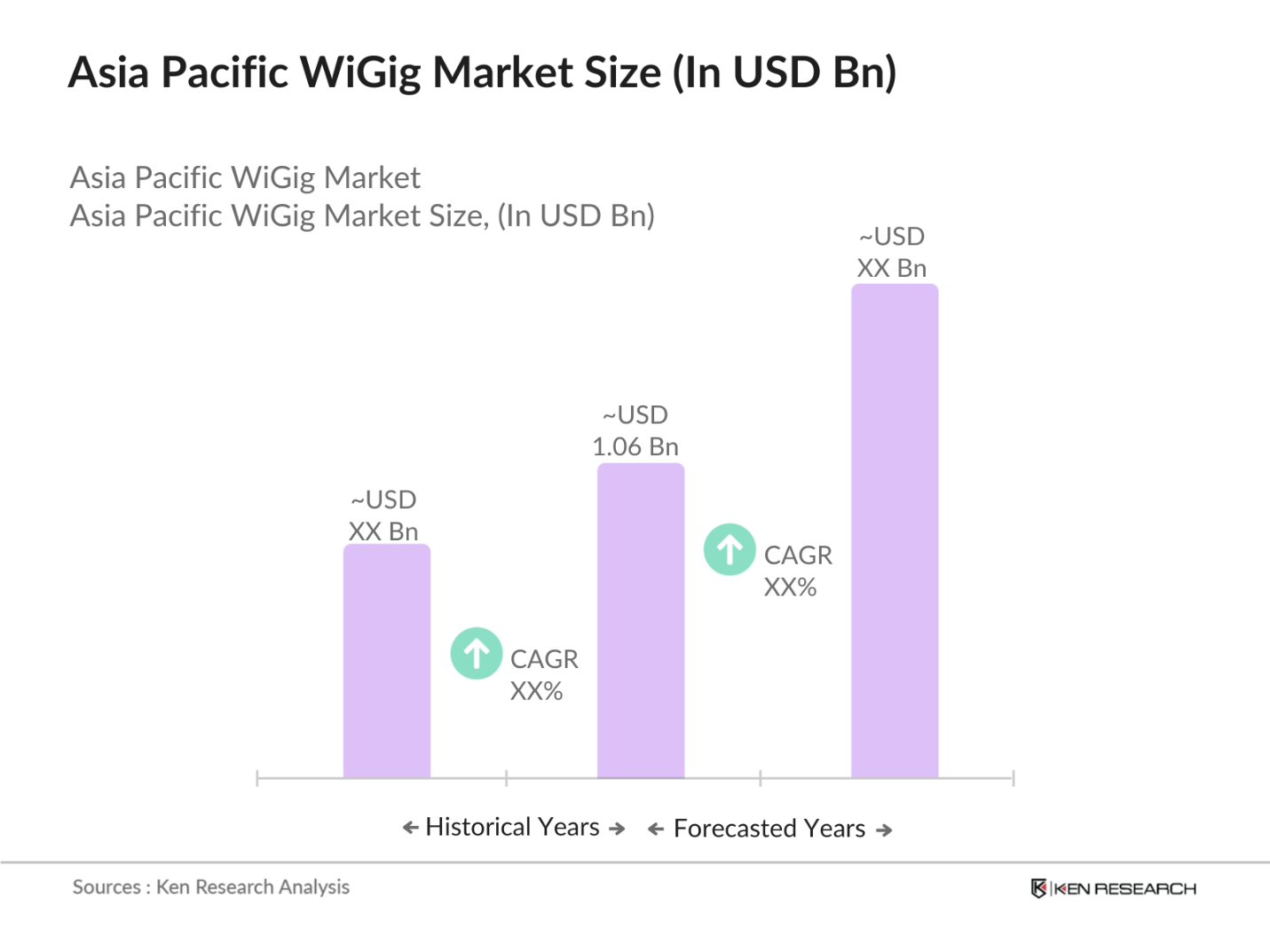
- The Asia Pacific WiGig market is valued at USD 1.06 billion, driven by the rising demand for high-speed wireless communication solutions across various sectors. Factors such as the proliferation of smart devices and increased connectivity requirements have contributed significantly to market growth. As businesses and consumers seek faster data transfer speeds and low-latency communication, WiGig technology is becoming an essential part of the digital infrastructure. The continued advancements in technology and expanding applications in sectors like healthcare, automotive, and consumer electronics are expected to propel further growth.
- The market is dominated by key players and regions such as Japan, South Korea, and China, which are at the forefront of technological innovation. Japan's focus on developing advanced communication systems, South Korea's leadership in telecommunications, and China's vast consumer electronics market contribute to the dominance of these countries in the WiGig landscape. These nations invest heavily in research and development, creating a robust ecosystem for WiGig technology adoption and expansion.
- The adoption of cloud-based solutions is a key trend influencing WiGig growth in the Asia Pacific. As of 2024, cloud computing services generated over $200 billion in revenue across the region. WiGigs high-speed data transfer capability allows seamless integration with cloud applications, enhancing user experiences in data-heavy tasks such as video conferencing, cloud gaming, and remote work. The increasing reliance on cloud services for enterprise and personal use further underscores the importance of WiGig in delivering faster, more reliable connections.
Asia Pacific WiGig Market Segmentation
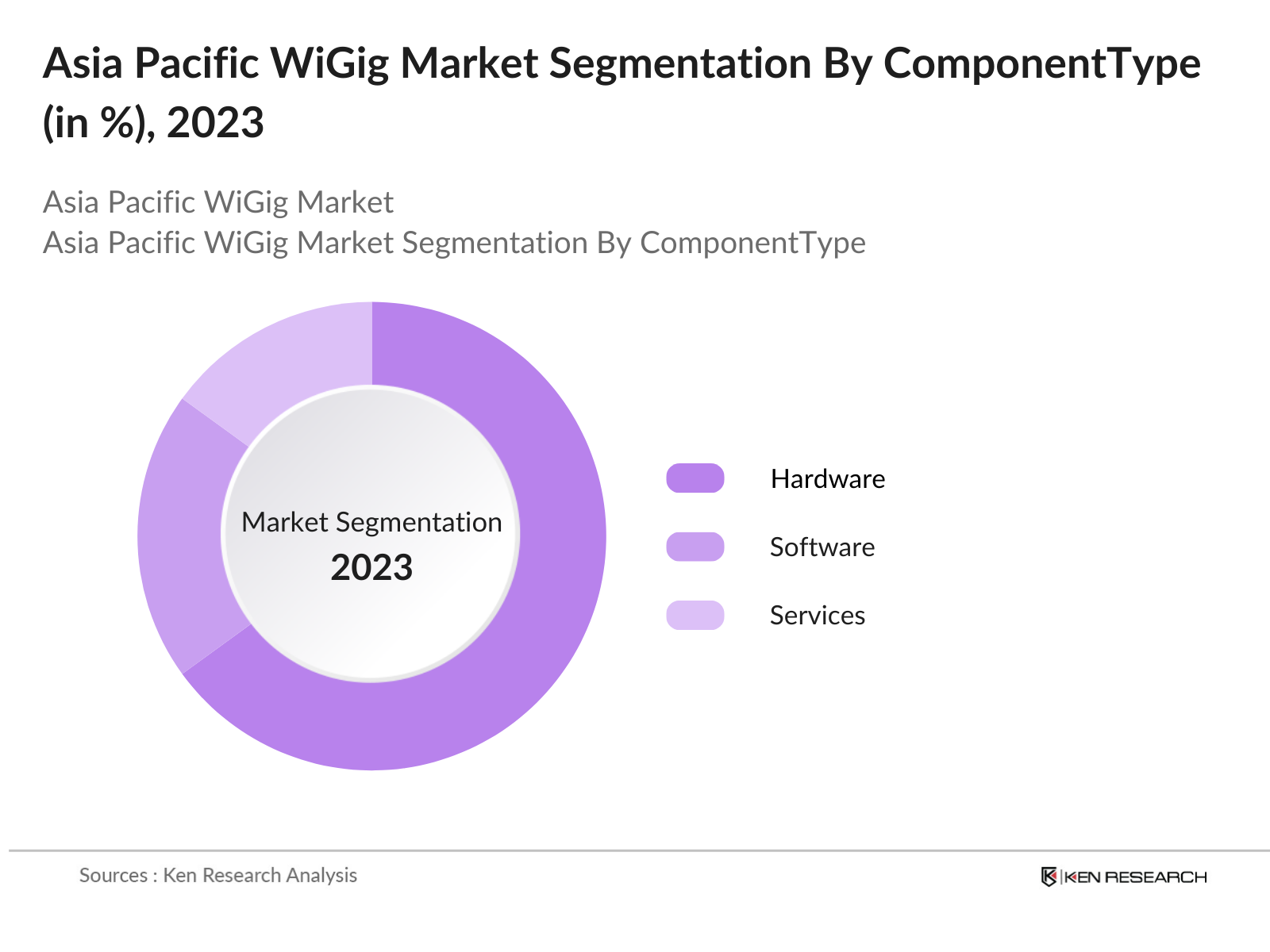
By Component: The Asia Pacific WiGig market is segmented by component into hardware, software, and services. In this segmentation, the hardware sub-segment holds a dominant market share, primarily due to the increasing demand for networking devices that support WiGig technology. The proliferation of smart devices, along with advancements in semiconductor technology, has made it easier for manufacturers to produce high-performance hardware solutions. Notably, products like routers, access points, and adapters have become essential for ensuring seamless connectivity in both residential and commercial settings.
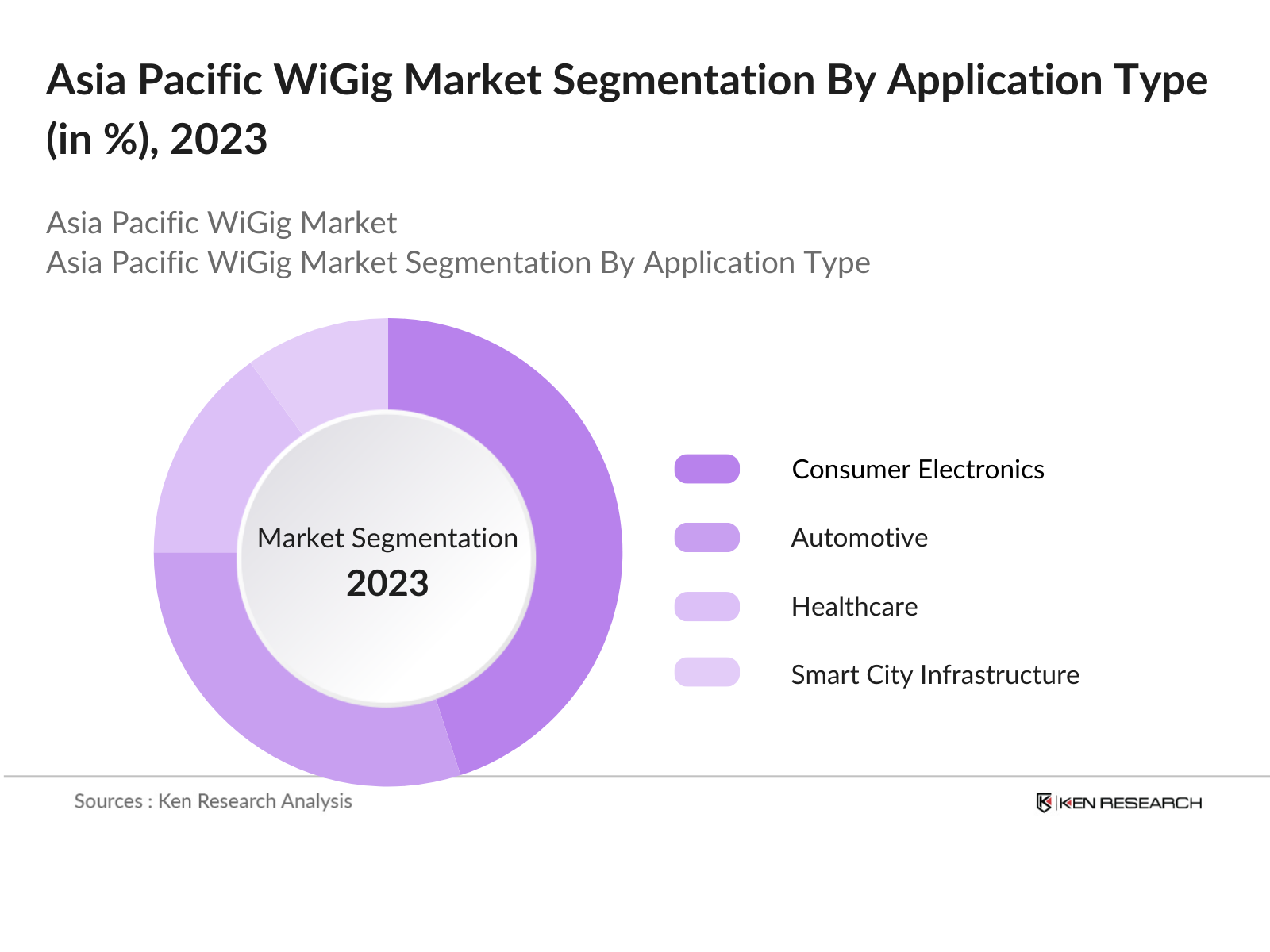
By Application: The Asia Pacific WiGig market is also segmented by application into consumer electronics, automotive, healthcare, smart city infrastructure, and industrial automation. Among these, the consumer electronics sub-segment dominates the market share, driven by the growing adoption of high-speed internet and the need for faster data transmission. As consumers increasingly rely on devices such as smartphones, tablets, and gaming consoles, the demand for WiGig-enabled products has surged. Major brands are integrating WiGig technology to enhance user experience and provide seamless connectivity.
Asia Pacific WiGig Market Competitive Landscape
The Asia Pacific WiGig market is characterized by a competitive landscape featuring major players such as Intel Corporation, Qualcomm Technologies, Inc., Broadcom Inc., NXP Semiconductors, and Cypress Semiconductor Corporation. These companies leverage their technological expertise and strong R&D capabilities to maintain a significant presence in the market. The consolidation among key players indicates their influence in shaping the industry landscape through innovation and strategic partnerships.
|
Company |
Establishment Year |
Headquarters |
Number of Employees |
Revenue (USD Billion) |
R&D Expenditure (USD Billion) |
Market Focus |
Product Portfolio |
|
Intel Corporation |
1968 |
Santa Clara, USA |
_ |
_ |
_ |
_ |
_ |
|
Qualcomm Technologies, Inc. |
1985 |
San Diego, USA |
_ |
_ |
_ |
_ |
_ |
|
Broadcom Inc. |
1991 |
San Jose, USA |
_ |
_ |
_ |
_ |
_ |
|
NXP Semiconductors |
2006 |
Eindhoven, Netherlands |
_ |
_ |
_ |
_ |
_ |
|
Cypress Semiconductor Corporation |
1982 |
San Jose, USA |
_ |
_ |
_ |
_ |
_ |
Asia Pacific WiGig Industry Analysis
Growth Drivers
- Increasing Demand for High-Speed Data Transfer: The rapid rise in demand for high-speed data transfer is driving WiGig adoption across the Asia Pacific. With 2024 broadband subscriptions surpassing 1.2 billion in the region, driven by an increase in online content consumption, there is a growing need for ultra-fast wireless connectivity. According to the World Bank, the average internet speed in developed APAC nations such as South Korea has reached over 213 Mbps, supporting high-data services like 4K streaming and gaming. The demand for efficient WiGig solutions in such environments is crucial for facilitating seamless communication and data transfer.
- Proliferation of Smart Devices: The proliferation of smart devices in the Asia Pacific region has accelerated WiGig market growth. By 2024, it is estimated that over 7.5 billion IoT devices will be operational in the region, requiring high-speed, low-latency connectivity. Countries like China have been at the forefront, with 1.2 billion IoT connections as of 2023. WiGig technology, offering speeds up to 10 Gbps, is key in managing the surge of data traffic generated by these devices, supporting smart homes, smart cities, and industries.
- Expansion of IoT Applications: Asia Pacific is experiencing a surge in IoT applications across industries, further driving WiGig technology adoption. By 2024, the region's IoT spending is expected to exceed $315 billion, significantly impacting manufacturing, healthcare, and transport sectors. WiGig's ability to provide ultra-fast, low-latency data transfer is essential in ensuring seamless IoT application performance, especially in smart cities and industrial automation. The integration of WiGig with IoT enhances productivity and offers new opportunities for growth across various sectors.
Market Challenges
- Interference with Existing Technologies: One of the major challenges for WiGig technology is its interference with existing wireless technologies, such as Wi-Fi. WiGig operates on the 60 GHz spectrum, which can interfere with other high-frequency wireless devices. In countries like Japan, where wireless penetration is over 120% as of 2024, managing interference between Wi-Fi, WiGig, and other wireless technologies presents a technical hurdle. Addressing these compatibility issues is essential for widespread WiGig adoption, especially in dense urban environments where multiple devices operate concurrently.
- Limited Range and Coverage: WiGig technology faces challenges due to its limited range and coverage. WiGig operates on a high-frequency 60 GHz band, which, while providing faster data rates, suffers from short transmission distances and is susceptible to obstacles like walls. In countries like South Korea and Japan, where high-density urban areas are common, deploying WiGig over large areas remains a challenge. The average WiGig range is 10 meters, significantly lower than Wi-Fi, limiting its usage to confined spaces or requiring additional access points for broader coverage.
Asia Pacific WiGig Market Future Outlook
Over the next few years, the Asia Pacific WiGig market is expected to exhibit substantial growth, driven by continuous advancements in wireless technology, increasing consumer demand for high-speed internet, and rising investments in smart city initiatives. The integration of WiGig solutions in various sectors, including healthcare and automotive, is anticipated to enhance operational efficiency and improve user experiences. As businesses seek to leverage the advantages of faster data transfer rates, the WiGig market is poised for rapid expansion.
Opportunities
- Development of 5G Networks: The integration of WiGig with 5G networks presents a significant opportunity for growth in the Asia Pacific region. Countries like China and South Korea have already made substantial investments in 5G, with Chinas 5G subscriptions crossing 400 million in 2024. WiGig, with its high-frequency operation, can complement 5G by providing ultra-fast data transfer for localized applications, such as smart homes and AR/VR. The combined use of WiGig and 5G will help overcome bandwidth limitations, ensuring more efficient data transfer in high-demand areas.
- Growth in Smart Home Applications: WiGig technology has tremendous potential in the growing smart home segment across Asia Pacific. In 2024, the smart home market in countries like Japan and Australia reached an estimated $14 billion, driven by the adoption of IoT devices. WiGig's ability to provide fast, low-latency connections is ideal for applications like video streaming, home automation, and wireless VR, all of which are integral to smart home setups. As smart home adoption increases, so does the need for reliable, high-speed wireless solutions like WiGig.
Scope of the Report
|
Component |
Hardware Software Services |
|
Application |
Consumer Electronics Automotive Healthcare Smart City Infrastructure Industrial Automation |
|
Technology |
60 GHz Band Multi-Gigabit Connectivity |
|
Region |
East Asia Southeast Asia South Asia Oceania |
Products
Key Target Audience
Investor and Venture Capitalist Firms
Government and Regulatory Bodies (e.g., Ministry of Communications and Information Technology)
Telecommunications Companies
Semiconductor Companies
Smart Device Industries
Automotive Industries
Healthcare Technology Firms
Smart City Development Companies
Companies
Major Players
Intel Corporation
Qualcomm Technologies, Inc.
Broadcom Inc.
NXP Semiconductors
Cypress Semiconductor Corporation
Texas Instruments
MediaTek Inc.
Peraso Technologies
Keysight Technologies
Eband Communications Inc.
Panasonic Corporation
Sony Corporation
Marvell Technology Group Ltd.
Celeno Communications
Huawei Technologies Co., Ltd.
Table of Contents
1. Asia Pacific WiGig Market Overview
1.1. Definition and Scope
1.2. Market Taxonomy
1.3. Market Growth Rate
1.4. Market Segmentation Overview
2. Asia Pacific WiGig Market Size (In USD Bn)
2.1. Historical Market Size
2.2. Year-On-Year Growth Analysis
2.3. Key Market Developments and Milestones
3. Asia Pacific WiGig Market Analysis
3.1. Growth Drivers
3.1.1. Increasing Demand for High-Speed Data Transfer
3.1.2. Proliferation of Smart Devices
3.1.3. Expansion of IoT Applications
3.1.4. Government Support for Wireless Technology
3.2. Market Challenges
3.2.1. Interference with Existing Technologies
3.2.2. Limited Range and Coverage
3.2.3. High Implementation Costs
3.3. Opportunities
3.3.1. Development of 5G Networks
3.3.2. Growth in Smart Home Applications
3.3.3. Integration with Augmented and Virtual Reality
3.4. Trends
3.4.1. Adoption of Cloud-Based Solutions
3.4.2. Advancements in Chipset Technology
3.4.3. Increasing Focus on Energy Efficiency
3.5. Government Regulation
3.5.1. Compliance Standards for Wireless Technologies
3.5.2. Spectrum Allocation Policies
3.5.3. Incentives for Research and Development
3.6. SWOT Analysis
3.7. Stake Ecosystem
3.8. Porters Five Forces
3.9. Competition Ecosystem
4. Asia Pacific WiGig Market Segmentation
4.1. By Component (In Value %)
4.1.1. Hardware
4.1.2. Software
4.1.3. Services
4.2. By Application (In Value %)
4.2.1. Consumer Electronics
4.2.2. Automotive
4.2.3. Healthcare
4.2.4. Smart City Infrastructure
4.2.5. Industrial Automation
4.3. By Technology (In Value %)
4.3.1. 60 GHz Band
4.3.2. Multi-Gigabit Connectivity
4.4. By Region (In Value %)
4.4.1. East Asia
4.4.2. Southeast Asia
4.4.3. South Asia
4.4.4. Oceania
5. Asia Pacific WiGig Market Competitive Analysis
5.1. Detailed Profiles of Major Companies
5.1.1. Intel Corporation
5.1.2. Qualcomm Technologies, Inc.
5.1.3. Broadcom Inc.
5.1.4. NXP Semiconductors N.V.
5.1.5. Texas Instruments Incorporated
5.1.6. Cypress Semiconductor Corporation
5.1.7. MediaTek Inc.
5.1.8. Marvell Technology Group Ltd.
5.1.9. Peraso Technologies
5.1.10. Eband Communications Inc.
5.1.11. Keysight Technologies
5.1.12. Celeno Communications
5.1.13. Panasonic Corporation
5.1.14. Sony Corporation
5.1.15. Huawei Technologies Co., Ltd.
5.2. Cross Comparison Parameters (Number of Employees, Headquarters, Inception Year, Revenue, R&D Expenditure, Market Share, Product Portfolio, Strategic Partnerships)
5.3. Market Share Analysis
5.4. Strategic Initiatives
5.5. Mergers and Acquisitions
5.6. Investment Analysis
5.7. Venture Capital Funding
5.8. Government Grants
5.9. Private Equity Investments
6. Asia Pacific WiGig Market Regulatory Framework
6.1. International Standards for Wireless Communication
6.2. Compliance Requirements
6.3. Certification Processes
7. Asia Pacific WiGig Future Market Size (In USD Bn)
7.1. Future Market Size Projections
7.2. Key Factors Driving Future Market Growth
8. Asia Pacific WiGig Future Market Segmentation
8.1. By Component (In Value %)
8.2. By Application (In Value %)
8.3. By Technology (In Value %)
8.4. By Region (In Value %)
9. Asia Pacific WiGig Market Analysts Recommendations
9.1. TAM/SAM/SOM Analysis
9.2. Customer Cohort Analysis
9.3. Marketing Initiatives
9.4. White Space Opportunity Analysis
Disclaimer
Contact Us
Research Methodology
Step 1: Identification of Key Variables
The initial phase involves constructing an ecosystem map encompassing all major stakeholders within the Asia Pacific WiGig market. This step is underpinned by extensive desk research, utilizing a combination of secondary and proprietary databases to gather comprehensive industry-level information. The primary objective is to identify and define the critical variables that influence market dynamics.
Step 2: Market Analysis and Construction
In this phase, we will compile and analyze historical data pertaining to the Asia Pacific WiGig market. This includes assessing market penetration, the ratio of marketplaces to service providers, and the resultant revenue generation. Furthermore, an evaluation of service quality statistics will be conducted to ensure the reliability and accuracy of the revenue estimates.
Step 3: Hypothesis Validation and Expert Consultation
Market hypotheses will be developed and subsequently validated through computer-assisted telephone interviews (CATIs) with industry experts representing a diverse array of companies. These consultations will provide valuable operational and financial insights directly from industry practitioners, which will be instrumental in refining and corroborating the market data.
Step 4: Research Synthesis and Final Output
The final phase involves direct engagement with multiple WiGig technology manufacturers to acquire detailed insights into product segments, sales performance, consumer preferences, and other pertinent factors. This interaction will serve to verify and complement the statistics derived from the bottom-up approach, thereby ensuring a comprehensive, accurate, and validated analysis of the Asia Pacific WiGig market.
Frequently Asked Questions
01. How big is the Asia Pacific WiGig market?
The Asia Pacific WiGig market is valued at USD 1.06 billion, driven by the rising demand for high-speed wireless communication solutions and increased connectivity requirements across various sectors.
02. What are the challenges in the Asia Pacific WiGig market?
Challenges include interference with existing technologies, limited range and coverage, and high implementation costs, which may hinder widespread adoption of WiGig solutions.
03. Who are the major players in the Asia Pacific WiGig market?
Key players include Intel Corporation, Qualcomm Technologies, Inc., Broadcom Inc., and NXP Semiconductors. These companies dominate due to their technological expertise and strong R&D capabilities.
04. What are the growth drivers of the Asia Pacific WiGig market?
The market is propelled by increasing consumer demand for high-speed internet, advancements in wireless technology, and rising investments in smart city initiatives that integrate WiGig solutions.
Why Buy From Us?

What makes us stand out is that our consultants follows Robust, Refine and Result (RRR) methodology. i.e. Robust for clear definitions, approaches and sanity checking, Refine for differentiating respondents facts and opinions and Result for presenting data with story

We have set a benchmark in the industry by offering our clients with syndicated and customized market research reports featuring coverage of entire market as well as meticulous research and analyst insights.

While we don't replace traditional research, we flip the method upside down. Our dual approach of Top Bottom & Bottom Top ensures quality deliverable by not just verifying company fundamentals but also looking at the sector and macroeconomic factors.

With one step in the future, our research team constantly tries to show you the bigger picture. We help with some of the tough questions you may encounter along the way: How is the industry positioned? Best marketing channel? KPI's of competitors? By aligning every element, we help maximize success.

Our report gives you instant access to the answers and sources that other companies might choose to hide. We elaborate each steps of research methodology we have used and showcase you the sample size to earn your trust.

If you need any support, we are here! We pride ourselves on universe strength, data quality, and quick, friendly, and professional service.