Australia Furniture and Smart Office Interiors Market

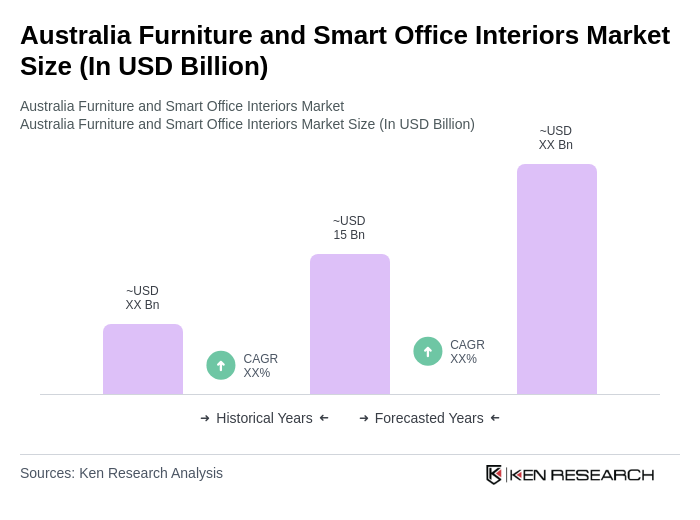
Australia Furniture and Smart Office Interiors Market, valued at USD 15 billion, grows with ergonomic designs, remote setups, and sustainable practices in key cities like Sydney and Melbourne.

Region:Global

Author(s):Dev

Product Code:KRAA5382

Pages:93

Published On:September 2025
About the Report

Base Year 2024

Australia Furniture and Smart Office Interiors Market Overview

  • The Australia Furniture and Smart Office Interiors Market is valued at USD 15 billion, based on a five-year historical analysis. This growth is primarily driven by the increasing demand for ergonomic and multifunctional office furniture, as well as the rise of remote working trends that have led to a surge in home office setups. Additionally, the integration of smart technology in office furniture is enhancing user experience and productivity.
  • Key cities dominating the market include Sydney, Melbourne, and Brisbane. These urban centers are characterized by a high concentration of corporate offices, educational institutions, and co-working spaces, which drive the demand for innovative and stylish office furniture. The presence of major furniture manufacturers and retailers in these cities further solidifies their dominance in the market.
  • In 2023, the Australian government implemented regulations aimed at promoting sustainable practices in the furniture industry. This includes guidelines for the use of eco-friendly materials and the reduction of waste in manufacturing processes. The initiative encourages companies to adopt sustainable sourcing and production methods, aligning with global trends towards environmental responsibility.
Australia Furniture and Smart Office Interiors Market Size

Australia Furniture and Smart Office Interiors Market Segmentation

By Type:The market is segmented into various types of furniture, including office desks, office chairs, conference tables, storage solutions, collaborative furniture, acoustic solutions, and others. Among these, office chairs and desks are the most dominant segments, driven by the increasing focus on ergonomic designs and comfort in workspaces. The demand for collaborative furniture is also rising as companies seek to create more interactive and flexible work environments.
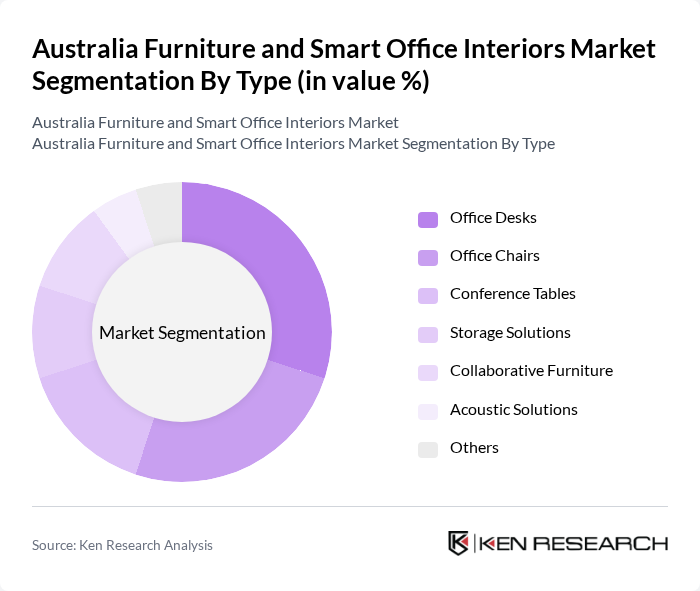
Australia Furniture and Smart Office Interiors Market segmentation by Type.

By End-User:The end-user segmentation includes corporates, educational institutions, government offices, healthcare facilities, co-working spaces, retail outlets, and others. Corporates represent the largest segment, driven by the need for modern office environments that enhance employee productivity and well-being. Co-working spaces are also gaining traction, reflecting the shift towards flexible work arrangements.
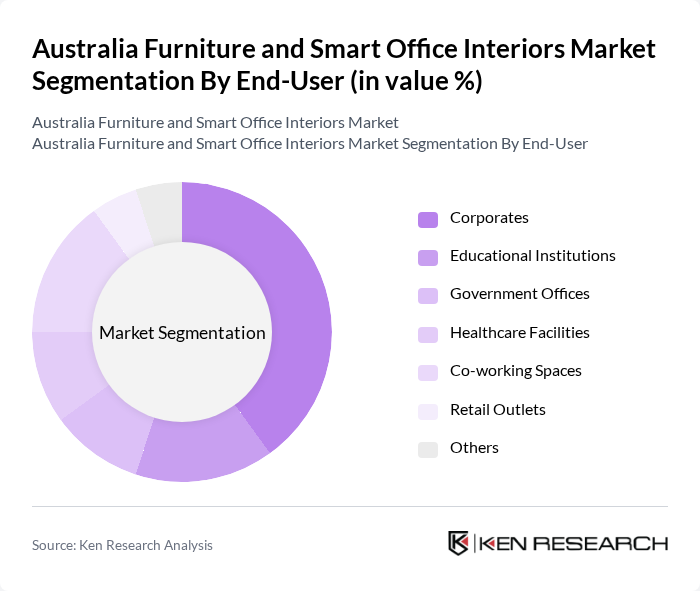
Australia Furniture and Smart Office Interiors Market segmentation by End-User.

Australia Furniture and Smart Office Interiors Market Competitive Landscape

The Australia Furniture and Smart Office Interiors Market is characterized by a dynamic mix of regional and international players. Leading participants such as Steelcase Inc., Herman Miller, Inc., Haworth, Inc., Knoll, Inc., IKEA Australia, Workstation Solutions, Tait Design, Workspace Commercial Furniture, Zenith Interiors, HNI Corporation, Global Furniture Group, Boss Design, Allermuir, Vitra, Teknion contribute to innovation, geographic expansion, and service delivery in this space.

Steelcase Inc.

1912

Grand Rapids, Michigan, USA

Herman Miller, Inc.

1923

Zeeland, Michigan, USA

Haworth, Inc.

1948

Holland, Michigan, USA

Knoll, Inc.

1938

East Greenville, Pennsylvania, USA

IKEA Australia

1975

Tempe, New South Wales, Australia

Company

Establishment Year

Headquarters

Group Size (Large, Medium, or Small as per industry convention)

Revenue Growth Rate

Market Penetration Rate

Customer Retention Rate

Average Order Value

Pricing Strategy

Australia Furniture and Smart Office Interiors Market Industry Analysis

Growth Drivers

  • Increasing Demand for Ergonomic Furniture:The Australian furniture market is witnessing a significant shift towards ergonomic designs, driven by a growing awareness of health and wellness. In future, the ergonomic furniture segment is projected to reach AUD 1.2 billion, reflecting a 15% increase from the previous year. This surge is supported by the Australian Bureau of Statistics reporting that 60% of employees prioritize comfort in their workspaces, leading companies to invest in ergonomic solutions to enhance productivity and employee satisfaction.
  • Rise in Remote Working Trends:The trend of remote working has accelerated, with 40% of Australian workers expected to continue working from home in future. This shift has led to a surge in demand for home office furniture, projected to grow to AUD 800 million. According to the Australian Institute of Health and Welfare, 70% of remote workers are investing in home office setups, driving manufacturers to innovate and cater to this expanding market segment with functional and stylish solutions.
  • Technological Advancements in Smart Office Solutions:The integration of technology in office furniture is transforming the workspace. In future, the smart office furniture market is anticipated to reach AUD 500 million, fueled by innovations such as IoT-enabled desks and smart lighting systems. The Australian government’s investment in digital infrastructure, amounting to AUD 1.5 billion, is further propelling this trend, as businesses seek to enhance operational efficiency and employee engagement through advanced office solutions.

Market Challenges

  • High Competition Among Local and International Players:The Australian furniture market is characterized by intense competition, with over 1,200 registered furniture manufacturers. This saturation leads to price wars and reduced profit margins, as companies strive to differentiate themselves. According to IBISWorld, the industry’s profit margin is projected to decline to 5.2% in future, compelling businesses to innovate and enhance their value propositions to maintain market share amidst fierce rivalry.
  • Fluctuating Raw Material Prices:The volatility in raw material prices poses a significant challenge for furniture manufacturers. In future, timber prices are expected to rise by 10%, driven by supply chain disruptions and increased demand from the construction sector. The Australian Bureau of Agricultural and Resource Economics and Sciences reports that these fluctuations can lead to increased production costs, forcing manufacturers to either absorb the costs or pass them onto consumers, impacting overall sales.

Australia Furniture and Smart Office Interiors Market Future Outlook

The future of the Australia furniture and smart office interiors market appears promising, driven by ongoing trends in remote work and technological integration. As companies increasingly prioritize employee well-being and productivity, investments in ergonomic and smart furniture solutions are expected to rise. Additionally, the growing emphasis on sustainability will likely lead to innovations in eco-friendly materials and designs, positioning businesses to meet evolving consumer preferences while enhancing their competitive edge in the market.

Market Opportunities

  • Growth in the E-commerce Furniture Segment:The e-commerce furniture market in Australia is projected to reach AUD 1 billion in future, driven by the convenience of online shopping. With 75% of consumers preferring to shop online for furniture, businesses can capitalize on this trend by enhancing their digital presence and offering seamless online purchasing experiences to attract a broader customer base.
  • Expansion of Co-working Spaces:The co-working space sector is expected to grow by 20% in future, with over 500 new locations anticipated across Australia. This expansion presents a lucrative opportunity for furniture manufacturers to provide tailored solutions that meet the unique needs of co-working environments, including flexible and multifunctional furniture that can adapt to various work styles and preferences.

Scope of the Report

SegmentSub-Segments
By Type

Office Desks

Office Chairs

Conference Tables

Storage Solutions

Collaborative Furniture

Acoustic Solutions

Others

By End-User

Corporates

Educational Institutions

Government Offices

Healthcare Facilities

Co-working Spaces

Retail Outlets

Others

By Distribution Channel

Online Retail

Offline Retail

Direct Sales

B2B Sales

Showrooms

Others

By Material

Wood

Metal

Plastic

Glass

Fabric

Others

By Price Range

Budget

Mid-Range

Premium

Luxury

Others

By Functionality

Fixed Furniture

Modular Furniture

Adjustable Furniture

Multi-functional Furniture

Others

By Design Style

Modern

Contemporary

Traditional

Industrial

Minimalist

Others

Key Target Audience

Investors and Venture Capitalist Firms

Government and Regulatory Bodies (e.g., Australian Competition and Consumer Commission, Department of Industry, Science, Energy and Resources)

Manufacturers and Producers

Distributors and Retailers

Commercial Real Estate Developers

Interior Designers and Architects

Technology Providers

Financial Institutions

Players Mentioned in the Report:

Steelcase Inc.

Herman Miller, Inc.

Haworth, Inc.

Knoll, Inc.

IKEA Australia

Workstation Solutions

Tait Design

Workspace Commercial Furniture

Zenith Interiors

HNI Corporation

Global Furniture Group

Boss Design

Allermuir

Vitra

Teknion

Table of Contents

Market Assessment Phase

1. Executive Summary and Approach


2. Australia Furniture and Smart Office Interiors Market Overview

2.1 Key Insights and Strategic Recommendations

2.2 Australia Furniture and Smart Office Interiors Market Overview

2.3 Definition and Scope

2.4 Evolution of Market Ecosystem

2.5 Timeline of Key Regulatory Milestones

2.6 Value Chain & Stakeholder Mapping

2.7 Business Cycle Analysis

2.8 Policy & Incentive Landscape


3. Australia Furniture and Smart Office Interiors Market Analysis

3.1 Growth Drivers

3.1.1 Increasing demand for ergonomic furniture
3.1.2 Rise in remote working trends
3.1.3 Technological advancements in smart office solutions
3.1.4 Sustainability and eco-friendly furniture options

3.2 Market Challenges

3.2.1 High competition among local and international players
3.2.2 Fluctuating raw material prices
3.2.3 Supply chain disruptions
3.2.4 Changing consumer preferences

3.3 Market Opportunities

3.3.1 Growth in the e-commerce furniture segment
3.3.2 Expansion of co-working spaces
3.3.3 Increasing investments in smart city projects
3.3.4 Demand for customized furniture solutions

3.4 Market Trends

3.4.1 Integration of IoT in office furniture
3.4.2 Focus on health and wellness in workplace design
3.4.3 Rise of multifunctional furniture
3.4.4 Adoption of biophilic design principles

3.5 Government Regulation

3.5.1 Compliance with Australian safety standards
3.5.2 Environmental regulations for sustainable materials
3.5.3 Incentives for energy-efficient office designs
3.5.4 Regulations on import tariffs for furniture

4. SWOT Analysis


5. Stakeholder Analysis


6. Porter's Five Forces Analysis


7. Australia Furniture and Smart Office Interiors Market Market Size, 2019-2024

7.1 By Value

7.2 By Volume

7.3 By Average Selling Price


8. Australia Furniture and Smart Office Interiors Market Segmentation

8.1 By Type

8.1.1 Office Desks
8.1.2 Office Chairs
8.1.3 Conference Tables
8.1.4 Storage Solutions
8.1.5 Collaborative Furniture
8.1.6 Acoustic Solutions
8.1.7 Others

8.2 By End-User

8.2.1 Corporates
8.2.2 Educational Institutions
8.2.3 Government Offices
8.2.4 Healthcare Facilities
8.2.5 Co-working Spaces
8.2.6 Retail Outlets
8.2.7 Others

8.3 By Distribution Channel

8.3.1 Online Retail
8.3.2 Offline Retail
8.3.3 Direct Sales
8.3.4 B2B Sales
8.3.5 Showrooms
8.3.6 Others

8.4 By Material

8.4.1 Wood
8.4.2 Metal
8.4.3 Plastic
8.4.4 Glass
8.4.5 Fabric
8.4.6 Others

8.5 By Price Range

8.5.1 Budget
8.5.2 Mid-Range
8.5.3 Premium
8.5.4 Luxury
8.5.5 Others

8.6 By Functionality

8.6.1 Fixed Furniture
8.6.2 Modular Furniture
8.6.3 Adjustable Furniture
8.6.4 Multi-functional Furniture
8.6.5 Others

8.7 By Design Style

8.7.1 Modern
8.7.2 Contemporary
8.7.3 Traditional
8.7.4 Industrial
8.7.5 Minimalist
8.7.6 Others

9. Australia Furniture and Smart Office Interiors Market Competitive Analysis

9.1 Market Share of Key Players

9.2 Cross Comparison of Key Players

9.2.1 Company Name
9.2.2 Group Size (Large, Medium, or Small as per industry convention)
9.2.3 Revenue Growth Rate
9.2.4 Market Penetration Rate
9.2.5 Customer Retention Rate
9.2.6 Average Order Value
9.2.7 Pricing Strategy
9.2.8 Product Diversification Index
9.2.9 Brand Recognition Score
9.2.10 Supply Chain Efficiency

9.3 SWOT Analysis of Top Players

9.4 Pricing Analysis

9.5 Detailed Profile of Major Companies

9.5.1 Steelcase Inc.
9.5.2 Herman Miller, Inc.
9.5.3 Haworth, Inc.
9.5.4 Knoll, Inc.
9.5.5 IKEA Australia
9.5.6 Workstation Solutions
9.5.7 Tait Design
9.5.8 Workspace Commercial Furniture
9.5.9 Zenith Interiors
9.5.10 HNI Corporation
9.5.11 Global Furniture Group
9.5.12 Boss Design
9.5.13 Allermuir
9.5.14 Vitra
9.5.15 Teknion

10. Australia Furniture and Smart Office Interiors Market End-User Analysis

10.1 Procurement Behavior of Key Ministries

10.1.1 Government procurement policies
10.1.2 Budget allocation for office furniture
10.1.3 Preference for local suppliers
10.1.4 Sustainability considerations in procurement

10.2 Corporate Spend on Infrastructure & Energy

10.2.1 Investment in office renovations
10.2.2 Budget for smart office technologies
10.2.3 Expenditure on employee wellness initiatives

10.3 Pain Point Analysis by End-User Category

10.3.1 Need for flexible workspaces
10.3.2 Challenges in sourcing sustainable materials
10.3.3 Issues with space optimization

10.4 User Readiness for Adoption

10.4.1 Awareness of smart office solutions
10.4.2 Training needs for new technologies
10.4.3 Acceptance of ergonomic furniture

10.5 Post-Deployment ROI and Use Case Expansion

10.5.1 Measurement of productivity improvements
10.5.2 Feedback mechanisms for furniture performance
10.5.3 Opportunities for further investment

11. Australia Furniture and Smart Office Interiors Market Future Size, 2025-2030

11.1 By Value

11.2 By Volume

11.3 By Average Selling Price


Go-To-Market Strategy Phase

1. Whitespace Analysis + Business Model Canvas

1.1


2. Marketing and Positioning Recommendations

2.1


3. Distribution Plan

3.1


4. Channel & Pricing Gaps

4.1


5. Unmet Demand & Latent Needs

5.1


6. Customer Relationship

6.1


7. Value Proposition

7.1


8. Key Activities

8.1


9. Entry Strategy Evaluation

9.1 Domestic Market Entry Strategy

9.1.1

9.2 Export Entry Strategy

9.2.1

10. Entry Mode Assessment

10.1


11. Capital and Timeline Estimation

11.1


12. Control vs Risk Trade-Off

12.1


13. Profitability Outlook

13.1


14. Potential Partner List

14.1


15. Execution Roadmap

15.1 Phased Plan for Market Entry

15.1.1

15.2 Key Activities and Milestones

15.2.1

Research Methodology

ApproachModellingSample

Phase 1: Approach1

Desk Research

  • Analysis of industry reports from Australian furniture and smart office interior associations
  • Review of market trends and forecasts from government publications and trade journals
  • Examination of consumer behavior studies and demographic data from Australian Bureau of Statistics

Primary Research

  • Interviews with key stakeholders including furniture manufacturers and interior designers
  • Surveys targeting office managers and facility planners in various sectors
  • Focus groups with end-users to gather insights on preferences and purchasing behavior

Validation & Triangulation

  • Cross-validation of findings through multiple data sources including sales data and expert opinions
  • Triangulation of qualitative insights from interviews with quantitative data from surveys
  • Sanity checks conducted through expert panel reviews to ensure data reliability

Phase 2: Market Size Estimation1

Top-down Assessment

  • Estimation of market size based on national office space growth and furniture spending trends
  • Segmentation of market by product categories such as desks, chairs, and smart technology
  • Incorporation of economic indicators and business investment trends in office infrastructure

Bottom-up Modeling

  • Collection of sales data from leading furniture retailers and manufacturers
  • Estimation of average transaction values and purchase frequencies across different sectors
  • Analysis of installation and service costs associated with smart office solutions

Forecasting & Scenario Analysis

  • Multi-variable forecasting using economic growth rates and remote work trends
  • Scenario analysis based on potential shifts in workplace design and technology adoption
  • Development of baseline, optimistic, and pessimistic market projections through 2030

Phase 3: CATI Sample Composition1

Scope Item/SegmentSample SizeTarget Respondent Profiles
Corporate Office Furniture Purchases150Office Managers, Procurement Officers
Smart Office Technology Integration100IT Managers, Facility Managers
Home Office Furniture Trends80Remote Workers, Freelancers
Interior Design Preferences70Interior Designers, Architects
Furniture Sustainability Practices60Sustainability Officers, Product Managers

Frequently Asked Questions

What is the current value of the Australia Furniture and Smart Office Interiors Market?

The Australia Furniture and Smart Office Interiors Market is valued at approximately USD 15 billion, reflecting a significant growth trend driven by the demand for ergonomic and multifunctional office furniture, as well as the rise of remote working setups.

Which cities are the key players in the Australia Furniture Market?

What are the main drivers of growth in the Australian furniture market?

How has the Australian government influenced the furniture industry?

Other Regional/Country Reports

Indonesia Furniture and Smart Office Interiors Market

Malaysia Furniture and Smart Office Interiors Market

KSA Furniture and Smart Office Interiors Market

APAC Furniture and Smart Office Interiors Market

SEA Furniture and Smart Office Interiors Market

Vietnam Furniture and Smart Office Interiors Market

Other Adjacent Reports

UAE Interior Design Services Market

South Africa Smart Building Technology Market

Indonesia Ergonomic Accessories Market

UAE Commercial Real Estate Market

Mexico Sustainable Materials Market

Malaysia Office Lighting Solutions Market

Egypt Acoustic Solutions Market

Bahrain Co-Working Space Management Market

Brazil Home Office Setup Market

Oman E-Commerce Furniture Retail Market

Why Buy From Us?

Refine Robust Result (RRR) Framework

What makes us stand out is that our consultants follow Robust, Refine and Result (RRR) methodology. Robust for clear definitions, approaches and sanity checking, Refine for differentiating respondents' facts and opinions, and Result for presenting data with story.

Our Reach Is Unmatched

We have set a benchmark in the industry by offering our clients with syndicated and customized market research reports featuring coverage of entire market as well as meticulous research and analyst insights.

Shifting the Research Paradigm

While we don't replace traditional research, we flip the method upside down. Our dual approach of Top Bottom & Bottom Top ensures quality deliverable by not just verifying company fundamentals but also looking at the sector and macroeconomic factors.

More Insights-Better Decisions

With one step in the future, our research team constantly tries to show you the bigger picture. We help with some of the tough questions you may encounter along the way: How is the industry positioned? Best marketing channel? KPI's of competitors? By aligning every element, we help maximize success.

Transparency and Trust

Our report gives you instant access to the answers and sources that other companies might choose to hide. We elaborate each steps of research methodology we have used and showcase you the sample size to earn your trust.

Round the Clock Support

If you need any support, we are here! We pride ourselves on universe strength, data quality, and quick, friendly, and professional service.

Why Clients Choose Us?

400000+
Reports in repository
150+
Consulting projects a year
100+
Analysts
8000+
Client Queries in 2022








