Brazil Airbag Systems Market

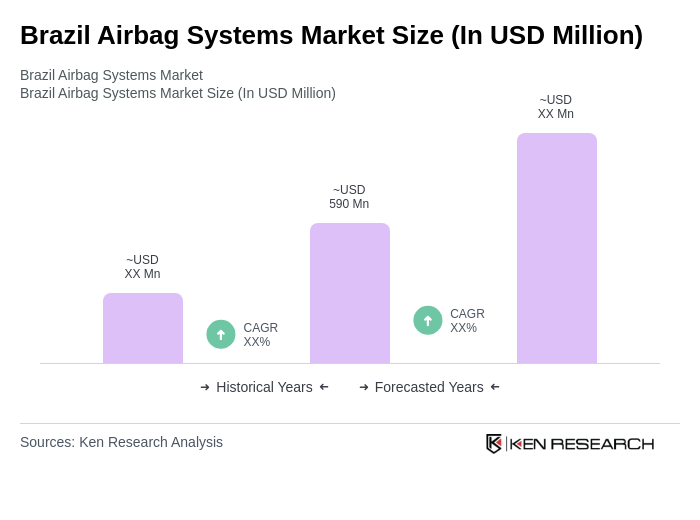
Brazil airbag systems market is valued at USD 590 million, fueled by increasing automotive production, stringent safety rules, and awareness, projecting growth in OEM and aftermarket segments.

Region:Central and South America

Author(s):Shubham

Product Code:KRAA1754

Pages:95

Published On:August 2025
About the Report

Base Year 2024

Brazil Airbag Systems Market Overview

  • The Brazil Airbag Systems Market is valued at USD 590 million, based on a five-year historical analysis. This is consistent with industry reporting that places the market near the high hundreds of millions, supported by the expansion of Brazil’s automotive sector and active safety adoption . This growth is primarily driven by increasing vehicle production, stringent safety regulations, and rising consumer awareness regarding vehicle safety features. The demand for advanced airbag systems, including multi-stage and smart airbags, has risen alongside OEM integration of frontal, side, curtain, and knee airbags in new models .
  • Key cities such as São Paulo, Rio de Janeiro, and Belo Horizonte are important to the market due to high vehicle density and the concentration of OEMs and suppliers in Brazil’s Southeast region, which accounts for the majority of national vehicle production and supports localized supply chains for safety components .
  • Brazil mandates driver and front passenger airbags as standard in new vehicles under its safety rules, and regulators have progressively tightened safety requirements; however, there is no nationwide rule requiring at least six airbags in all new vehicles. Six-airbag configurations are increasingly offered by OEMs for higher safety ratings, but a universal mandate for six airbags has not been enacted .
Brazil Airbag Systems Market Size

Brazil Airbag Systems Market Segmentation

By Type:The airbag systems market can be segmented into various types, including Driver/Frontal Airbags, Passenger Frontal Airbags, Side (Thorax) Airbags, Curtain (Side-Curtain) Airbags, Knee Airbags, Pedestrian Protection Airbags, and Other Airbags (Center, Rear-Seat). Among these, Driver/Frontal Airbags and Passenger Frontal Airbags are the most widely used due to their essential role in protecting occupants during frontal collisions, and because they are the primary configurations regulated and factory-fitted by OEMs across mass-market models in Brazil. Growing adoption of side and curtain airbags is supported by OEM safety packages and consumer demand for higher safety ratings .

Brazil Airbag Systems Market segmentation by Type.

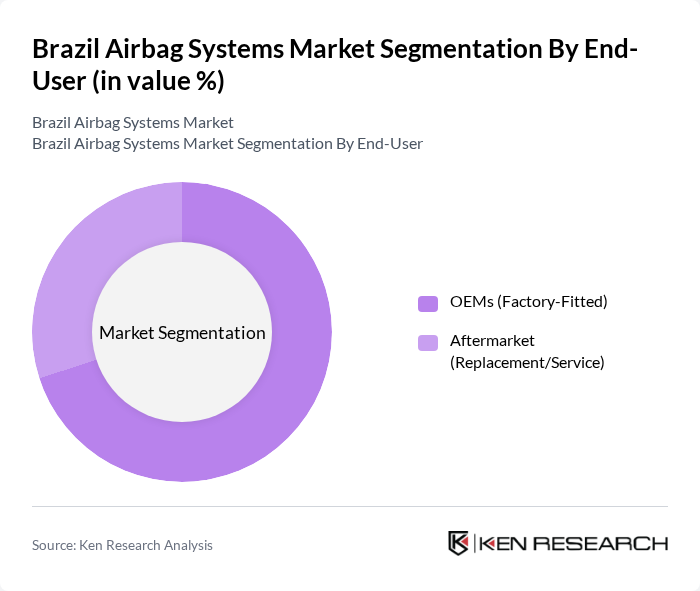
By End-User:The market is segmented into OEMs (Factory-Fitted) and Aftermarket (Replacement/Service). The OEM segment dominates as automakers integrate multi-airbag systems to meet safety standards and consumer expectations, with aftermarket demand driven by replacements and service following deployments or recalls .
Brazil Airbag Systems Market segmentation by End-User.

Brazil Airbag Systems Market Competitive Landscape

The Brazil Airbag Systems Market is characterized by a dynamic mix of regional and international players. Leading participants such as Autoliv Inc., Joyson Safety Systems (including legacy Takata assets), ZF Friedrichshafen AG (ZF Passive Safety Systems), Continental AG, DENSO Corporation, Hyundai Mobis Co., Ltd., Toyoda Gosei Co., Ltd., Nihon Plast Co., Ltd., Daicel Corporation (Daicel Pyrotech/Inflator business), Ashimori Industry Co., Ltd., Toyota Boshoku Corporation, Bosch (Robert Bosch GmbH), Aptiv PLC, Mando Corporation, Aisin Corporation contribute to innovation, geographic expansion, and service delivery in this space .

Autoliv Inc.

1953

Stockholm, Sweden

Joyson Safety Systems

2016

Auburn Hills, Michigan, USA

ZF Friedrichshafen AG

1915

Friedrichshafen, Germany

Continental AG

1871

Hanover, Germany

DENSO Corporation

1949

Kariya, Japan

Company

Establishment Year

Headquarters

Brazil Presence Scale (Local Manufacturing, Assembly, or Import)

Revenue from Brazil (USD, latest available)

OEM Program Coverage in Brazil (Number of Models/Brands Supplied)

Product Portfolio Breadth (Frontal, Side, Curtain, Knee, Pedestrian, Center)

Localization Level (Content %, Local Suppliers)

Production Capacity in Brazil (Units/Year)

Brazil Airbag Systems Market Industry Analysis

Growth Drivers

  • Increasing Vehicle Production:Brazil's automotive sector is projected to produce approximately 2.6 million vehicles in future, reflecting a 5% increase from the previous year. This surge in production is driven by rising domestic demand and export opportunities, particularly in Latin America. As vehicle production escalates, the need for airbag systems will correspondingly rise, enhancing safety features in new models and contributing to market growth. The Brazilian automotive industry is a significant contributor to the national GDP, further supporting this trend.
  • Rising Consumer Awareness of Safety Features:In Brazil, consumer awareness regarding vehicle safety has significantly increased, with 75% of car buyers prioritizing safety features in their purchasing decisions. This shift is influenced by high-profile accidents and a growing emphasis on road safety. As a result, manufacturers are compelled to integrate advanced airbag systems into their vehicles to meet consumer expectations, thereby driving market growth. The increasing focus on safety is expected to enhance the demand for innovative airbag technologies in the coming years.
  • Stringent Government Regulations on Vehicle Safety:The Brazilian government has implemented strict regulations mandating the installation of airbags in all new vehicles since 2020. Compliance with these regulations is crucial for manufacturers, as non-compliance can lead to significant penalties. In future, the government plans to introduce additional safety standards, further reinforcing the need for advanced airbag systems. This regulatory environment not only ensures consumer safety but also stimulates market growth by compelling manufacturers to invest in airbag technology.

Market Challenges

  • High Manufacturing Costs:The production of airbag systems in Brazil faces significant challenges due to high manufacturing costs, which can exceed BRL 1,200 per unit. Factors contributing to these costs include expensive raw materials, labor, and advanced technology requirements. As manufacturers strive to maintain profitability while adhering to safety standards, these high costs can hinder market expansion. Consequently, companies may need to explore cost-reduction strategies to remain competitive in the evolving automotive landscape.
  • Limited Availability of Raw Materials:The airbag systems market in Brazil is currently challenged by a limited supply of essential raw materials, such as nylon and propellant chemicals. In future, the country is expected to import over 65% of these materials, leading to potential supply chain disruptions. This dependency on imports can result in increased costs and delays in production, ultimately affecting the availability of airbag systems in the market. Manufacturers must navigate these challenges to ensure consistent supply and quality.

Brazil Airbag Systems Market Future Outlook

The Brazil airbag systems market is poised for significant transformation driven by technological advancements and evolving consumer preferences. As the automotive industry increasingly embraces electric vehicles, the demand for innovative airbag solutions tailored to these new models will rise. Additionally, the integration of artificial intelligence in airbag systems is expected to enhance safety features, making vehicles smarter and more responsive. These trends indicate a dynamic market landscape, with opportunities for growth and innovation in the coming years.

Market Opportunities

  • Expansion of Electric Vehicle Market:The electric vehicle market in Brazil is projected to grow by 35% in future, creating a substantial opportunity for airbag manufacturers to develop specialized systems. As automakers focus on safety features for electric models, the demand for advanced airbag technologies will increase, driving innovation and market growth.
  • Growth in Automotive Aftermarket Services:The Brazilian automotive aftermarket is expected to reach BRL 120 billion in future, presenting opportunities for airbag system upgrades and replacements. As vehicle owners prioritize safety, the demand for aftermarket airbag services will rise, allowing manufacturers to tap into this lucrative segment and enhance their market presence.

Scope of the Report

SegmentSub-Segments
By Type

Driver/Frontal Airbags

Passenger Frontal Airbags

Side (Thorax) Airbags

Curtain (Side-Curtain) Airbags

Knee Airbags

Pedestrian Protection Airbags

Other Airbags (Center, Rear-Seat)

By End-User

OEMs (Factory-Fitted)

Aftermarket (Replacement/Service)

By Vehicle Type

Passenger Cars

Light Commercial Vehicles (LCVs)

Medium & Heavy Trucks

Buses & Coaches

By Distribution Channel

OEM Supply

Independent Aftermarket

Authorized Service Networks

By Region

Southeast (São Paulo, Minas Gerais, Rio de Janeiro, Espírito Santo)

South (Paraná, Santa Catarina, Rio Grande do Sul)

Midwest/Central-West (Goiás, Mato Grosso, Mato Grosso do Sul, DF)

Northeast

North

By Price Range

Economy

Mid-Range

Premium

By Application

Passenger Safety Compliance (Regulatory)

Occupant Protection Enhancement (Multi-stage/Smart Airbags)

Fleet Safety and TCO Optimization

Pedestrian Safety

Key Target Audience

Investors and Venture Capitalist Firms

Government and Regulatory Bodies (e.g., National Traffic Department, Brazilian Institute of Geography and Statistics)

Automobile Manufacturers

Automotive Component Suppliers

Insurance Companies

Safety Standards Organizations

Automotive Aftermarket Service Providers

Logistics and Supply Chain Companies

Players Mentioned in the Report:

Autoliv Inc.

Joyson Safety Systems (including legacy Takata assets)

ZF Friedrichshafen AG (ZF Passive Safety Systems)

Continental AG

DENSO Corporation

Hyundai Mobis Co., Ltd.

Toyoda Gosei Co., Ltd.

Nihon Plast Co., Ltd.

Daicel Corporation (Daicel Pyrotech/Inflator business)

Ashimori Industry Co., Ltd.

Toyota Boshoku Corporation

Bosch (Robert Bosch GmbH)

Aptiv PLC

Mando Corporation

Aisin Corporation

Table of Contents

Market Assessment Phase

1. Executive Summary and Approach


2. Brazil Airbag Systems Market Overview

2.1 Key Insights and Strategic Recommendations

2.2 Brazil Airbag Systems Market Overview

2.3 Definition and Scope

2.4 Evolution of Market Ecosystem

2.5 Timeline of Key Regulatory Milestones

2.6 Value Chain & Stakeholder Mapping

2.7 Business Cycle Analysis

2.8 Policy & Incentive Landscape


3. Brazil Airbag Systems Market Analysis

3.1 Growth Drivers

3.1.1 Increasing Vehicle Production
3.1.2 Rising Consumer Awareness of Safety Features
3.1.3 Stringent Government Regulations on Vehicle Safety
3.1.4 Technological Advancements in Airbag Systems

3.2 Market Challenges

3.2.1 High Manufacturing Costs
3.2.2 Limited Availability of Raw Materials
3.2.3 Competition from Alternative Safety Technologies
3.2.4 Regulatory Compliance Complexity

3.3 Market Opportunities

3.3.1 Expansion of Electric Vehicle Market
3.3.2 Growth in Automotive Aftermarket Services
3.3.3 Increasing Investment in R&D for Advanced Safety Features
3.3.4 Collaborations with Tech Companies for Smart Airbags

3.4 Market Trends

3.4.1 Integration of AI in Airbag Systems
3.4.2 Shift Towards Lightweight Materials
3.4.3 Focus on Customization and Personalization
3.4.4 Rise of Autonomous Vehicles and Their Safety Needs

3.5 Government Regulation

3.5.1 Mandatory Airbag Installation in New Vehicles
3.5.2 Compliance with International Safety Standards
3.5.3 Incentives for Manufacturers Adopting Advanced Safety Technologies
3.5.4 Periodic Safety Inspections for Vehicles

4. SWOT Analysis


5. Stakeholder Analysis


6. Porter's Five Forces Analysis


7. Brazil Airbag Systems Market Market Size, 2019-2024

7.1 By Value

7.2 By Volume

7.3 By Average Selling Price


8. Brazil Airbag Systems Market Segmentation

8.1 By Type

8.1.1 Driver/Frontal Airbags
8.1.2 Passenger Frontal Airbags
8.1.3 Side (Thorax) Airbags
8.1.4 Curtain (Side-Curtain) Airbags
8.1.5 Knee Airbags
8.1.6 Pedestrian Protection Airbags
8.1.7 Other Airbags (Center, Rear-Seat)

8.2 By End-User

8.2.1 OEMs (Factory-Fitted)
8.2.2 Aftermarket (Replacement/Service)

8.3 By Vehicle Type

8.3.1 Passenger Cars
8.3.2 Light Commercial Vehicles (LCVs)
8.3.3 Medium & Heavy Trucks
8.3.4 Buses & Coaches

8.4 By Distribution Channel

8.4.1 OEM Supply
8.4.2 Independent Aftermarket
8.4.3 Authorized Service Networks

8.5 By Region

8.5.1 Southeast (São Paulo, Minas Gerais, Rio de Janeiro, Espírito Santo)
8.5.2 South (Paraná, Santa Catarina, Rio Grande do Sul)
8.5.3 Midwest/Central-West (Goiás, Mato Grosso, Mato Grosso do Sul, DF)
8.5.4 Northeast
8.5.5 North

8.6 By Price Range

8.6.1 Economy
8.6.2 Mid-Range
8.6.3 Premium

8.7 By Application

8.7.1 Passenger Safety Compliance (Regulatory)
8.7.2 Occupant Protection Enhancement (Multi-stage/Smart Airbags)
8.7.3 Fleet Safety and TCO Optimization
8.7.4 Pedestrian Safety

9. Brazil Airbag Systems Market Competitive Analysis

9.1 Market Share of Key Players

9.2 Cross Comparison of Key Players

9.2.1 Company Name
9.2.2 Brazil Presence Scale (Local Manufacturing, Assembly, or Import)
9.2.3 Revenue from Brazil (USD, latest available)
9.2.4 OEM Program Coverage in Brazil (Number of Models/Brands Supplied)
9.2.5 Product Portfolio Breadth (Frontal, Side, Curtain, Knee, Pedestrian, Center)
9.2.6 Localization Level (Content %, Local Suppliers)
9.2.7 Production Capacity in Brazil (Units/Year)
9.2.8 R&D/Engineering Footprint in Brazil (Facilities, Headcount)
9.2.9 Quality/Recall Metrics (PPM, Field Actions in Brazil)
9.2.10 Compliance & Ratings (Latin NCAP alignment, ABNT/INMETRO)
9.2.11 Key OEM Relationships (e.g., VW, GM, Stellantis, Toyota, Hyundai, Honda)
9.2.12 Aftermarket Reach (Authorized service network coverage)
9.2.13 Pricing Positioning (Economy/Mid/Premium)
9.2.14 ESG & Safety Certifications (ISO 26262, IATF 16949)

9.3 SWOT Analysis of Top Players

9.4 Pricing Analysis

9.5 Detailed Profile of Major Companies

9.5.1 Autoliv Inc.
9.5.2 Joyson Safety Systems (including legacy Takata assets)
9.5.3 ZF Friedrichshafen AG (ZF Passive Safety Systems)
9.5.4 Continental AG
9.5.5 DENSO Corporation
9.5.6 Hyundai Mobis Co., Ltd.
9.5.7 Toyoda Gosei Co., Ltd.
9.5.8 Nihon Plast Co., Ltd.
9.5.9 Daicel Corporation (Daicel Pyrotech/Inflator business)
9.5.10 Ashimori Industry Co., Ltd.
9.5.11 Toyota Boshoku Corporation
9.5.12 Bosch (Robert Bosch GmbH)
9.5.13 Aptiv PLC
9.5.14 Mando Corporation
9.5.15 Aisin Corporation

10. Brazil Airbag Systems Market End-User Analysis

10.1 Procurement Behavior of Key Ministries

10.1.1 Government Vehicle Procurement Policies
10.1.2 Safety Standards Compliance Requirements
10.1.3 Budget Allocation for Vehicle Safety Enhancements

10.2 Corporate Spend on Infrastructure & Energy

10.2.1 Investment in Safety Technologies
10.2.2 Budgeting for Vehicle Fleet Upgrades
10.2.3 Expenditure on Compliance and Safety Training

10.3 Pain Point Analysis by End-User Category

10.3.1 Cost of Compliance with Safety Regulations
10.3.2 Availability of Advanced Safety Features
10.3.3 Reliability of Airbag Systems

10.4 User Readiness for Adoption

10.4.1 Awareness of Airbag Benefits
10.4.2 Willingness to Invest in Safety Features

10.5 Post-Deployment ROI and Use Case Expansion

10.5.1 Evaluation of Safety Performance
10.5.2 Long-term Cost Savings from Safety Features
10.5.3 Opportunities for Upgrading Existing Systems

11. Brazil Airbag Systems Market Future Size, 2025-2030

11.1 By Value

11.2 By Volume

11.3 By Average Selling Price


Go-To-Market Strategy Phase

1. Whitespace Analysis + Business Model Canvas

1.1 Market Gaps Identification

1.2 Value Proposition Development

1.3 Revenue Model Structuring

1.4 Key Partnerships Identification

1.5 Customer Segmentation Analysis

1.6 Competitive Landscape Overview

1.7 Risk Assessment


2. Marketing and Positioning Recommendations

2.1 Branding Strategies

2.2 Product USPs

2.3 Target Market Identification

2.4 Communication Strategy

2.5 Digital Marketing Approach

2.6 Customer Engagement Tactics


3. Distribution Plan

3.1 Urban Retail Strategies

3.2 Rural NGO Tie-ups

3.3 E-commerce Integration

3.4 Logistics and Supply Chain Management

3.5 Distribution Channel Optimization


4. Channel & Pricing Gaps

4.1 Underserved Routes

4.2 Pricing Bands Analysis

4.3 Competitor Pricing Strategies

4.4 Customer Price Sensitivity

4.5 Value-Based Pricing Models


5. Unmet Demand & Latent Needs

5.1 Category Gaps Identification

5.2 Consumer Segments Analysis

5.3 Emerging Trends and Preferences

5.4 Product Development Opportunities


6. Customer Relationship

6.1 Loyalty Programs

6.2 After-sales Service Enhancements

6.3 Customer Feedback Mechanisms

6.4 Community Engagement Initiatives


7. Value Proposition

7.1 Sustainability Initiatives

7.2 Integrated Supply Chains

7.3 Customer-Centric Innovations

7.4 Competitive Differentiation Strategies


8. Key Activities

8.1 Regulatory Compliance

8.2 Branding Initiatives

8.3 Distribution Setup

8.4 Market Research and Analysis


9. Entry Strategy Evaluation

9.1 Domestic Market Entry Strategy

9.1.1 Product Mix Considerations
9.1.2 Pricing Band Strategy
9.1.3 Packaging Innovations

9.2 Export Entry Strategy

9.2.1 Target Countries Identification
9.2.2 Compliance Roadmap Development

10. Entry Mode Assessment

10.1 Joint Ventures

10.2 Greenfield Investments

10.3 Mergers & Acquisitions

10.4 Distributor Model Evaluation


11. Capital and Timeline Estimation

11.1 Capital Requirements Analysis

11.2 Timelines for Market Entry


12. Control vs Risk Trade-Off

12.1 Ownership vs Partnerships


13. Profitability Outlook

13.1 Breakeven Analysis

13.2 Long-term Sustainability Strategies


14. Potential Partner List

14.1 Distributors

14.2 Joint Ventures

14.3 Acquisition Targets


15. Execution Roadmap

15.1 Phased Plan for Market Entry

15.1.1 Market Setup
15.1.2 Market Entry
15.1.3 Growth Acceleration
15.1.4 Scale & Stabilize

15.2 Key Activities and Milestones

15.2.1 Milestone Planning
15.2.2 Activity Tracking

Research Methodology

ApproachModellingSample

Phase 1: Approach1

Desk Research

  • Analysis of industry reports from automotive safety organizations and regulatory bodies in Brazil
  • Review of market data from Brazilian automotive associations and airbag manufacturers
  • Examination of published articles and white papers on airbag technology advancements and market trends

Primary Research

  • Interviews with automotive engineers and safety compliance officers from leading car manufacturers
  • Surveys with automotive parts suppliers and distributors focusing on airbag systems
  • Field interviews with automotive safety experts and regulatory officials

Validation & Triangulation

  • Cross-validation of findings through multiple data sources including trade publications and government reports
  • Triangulation of market insights from primary interviews and secondary data analysis
  • Sanity checks conducted through expert panel reviews to ensure data accuracy

Phase 2: Market Size Estimation1

Top-down Assessment

  • Estimation of the total addressable market based on national vehicle production and sales data
  • Segmentation of the market by vehicle type (passenger cars, commercial vehicles) and airbag deployment systems
  • Incorporation of government regulations mandating airbag installations in new vehicles

Bottom-up Modeling

  • Collection of sales data from major airbag manufacturers and suppliers in Brazil
  • Estimation of average selling prices for different types of airbag systems
  • Volume calculations based on historical sales trends and projected growth rates in vehicle production

Forecasting & Scenario Analysis

  • Multi-factor regression analysis incorporating economic indicators, consumer preferences, and safety regulations
  • Scenario modeling based on potential changes in automotive safety standards and technological advancements
  • Development of baseline, optimistic, and pessimistic forecasts through 2030

Phase 3: CATI Sample Composition1

Scope Item/SegmentSample SizeTarget Respondent Profiles
Passenger Vehicle Manufacturers90Product Development Managers, Safety Compliance Officers
Commercial Vehicle Manufacturers70Engineering Managers, Procurement Specialists
Airbag System Suppliers60Sales Directors, Technical Support Engineers
Automotive Safety Regulators40Policy Makers, Regulatory Affairs Managers
Automotive Aftermarket Retailers50Store Managers, Product Line Managers

Frequently Asked Questions

What is the current value of the Brazil Airbag Systems Market?

The Brazil Airbag Systems Market is valued at approximately USD 590 million, reflecting a significant growth trend driven by increased vehicle production, stringent safety regulations, and heightened consumer awareness regarding vehicle safety features.

What factors are driving the growth of the airbag systems market in Brazil?

Which cities are crucial for the Brazil Airbag Systems Market?

What types of airbags are most commonly used in Brazil?

Other Regional/Country Reports

Indonesia Airbag Systems Market

Malaysia Airbag Systems Market

KSA Airbag Systems Market

APAC Airbag Systems Market

SEA Airbag Systems Market

Vietnam Airbag Systems Market

Why Buy From Us?

Refine Robust Result (RRR) Framework

What makes us stand out is that our consultants follow Robust, Refine and Result (RRR) methodology. Robust for clear definitions, approaches and sanity checking, Refine for differentiating respondents' facts and opinions, and Result for presenting data with story.

Our Reach Is Unmatched

We have set a benchmark in the industry by offering our clients with syndicated and customized market research reports featuring coverage of entire market as well as meticulous research and analyst insights.

Shifting the Research Paradigm

While we don't replace traditional research, we flip the method upside down. Our dual approach of Top Bottom & Bottom Top ensures quality deliverable by not just verifying company fundamentals but also looking at the sector and macroeconomic factors.

More Insights-Better Decisions

With one step in the future, our research team constantly tries to show you the bigger picture. We help with some of the tough questions you may encounter along the way: How is the industry positioned? Best marketing channel? KPI's of competitors? By aligning every element, we help maximize success.

Transparency and Trust

Our report gives you instant access to the answers and sources that other companies might choose to hide. We elaborate each steps of research methodology we have used and showcase you the sample size to earn your trust.

Round the Clock Support

If you need any support, we are here! We pride ourselves on universe strength, data quality, and quick, friendly, and professional service.

Why Clients Choose Us?

400000+
Reports in repository
150+
Consulting projects a year
100+
Analysts
8000+
Client Queries in 2022








