















Canada Bio-implant Market Outlook to 2030
Region:North America
Author(s):Sanjeev
Product Code:KROD9107
November 2024
90
About the Report
Canada Bio-implant Market Overview
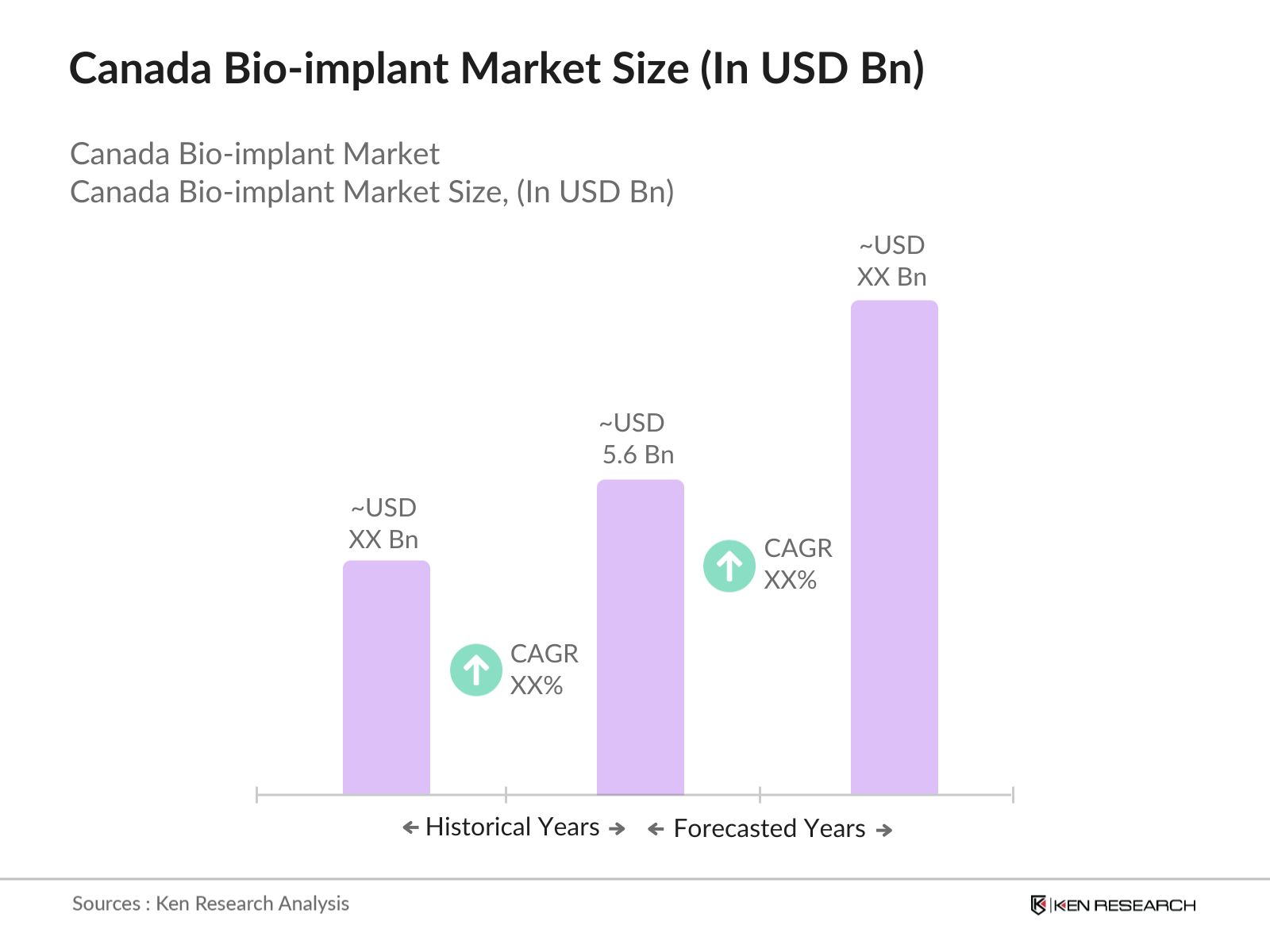
- The Canada Bio-implant market is valued at USD 5.6 billion, based on a five-year historical analysis, and is driven by advancements in biomaterial technologies and increasing demand for minimally invasive surgeries. Growing healthcare expenditure, combined with an aging population and an increased prevalence of chronic diseases, has resulted in greater adoption of bio-implants. These implants, widely used in orthopedic, cardiovascular, and dental applications, are becoming more popular due to their ability to improve patient outcomes and reduce recovery time.
- Ontario and Quebec dominate the bio-implant market in Canada. This is attributed to their well-established healthcare infrastructure, high levels of healthcare expenditure, and the presence of advanced research institutions. The concentration of key medical device manufacturers and bio-implant companies in these regions also contributes to their dominance. Additionally, these provinces have more favorable regulatory frameworks, enabling faster product approval and market entry for bio-implant products.
- Health Canadas stringent regulatory framework ensures all bio-implants meet rigorous safety and efficacy standards before approval. In 2024, Health Canada introduced updated guidelines for bio-implant approval, emphasizing patient safety and stringent material testing. This comprehensive regulatory approach ensures that only high-quality, thoroughly tested bio-implants are available in the market, maintaining patient trust and compliance with national health standards.
Canada Bio-implant Market Segmentation
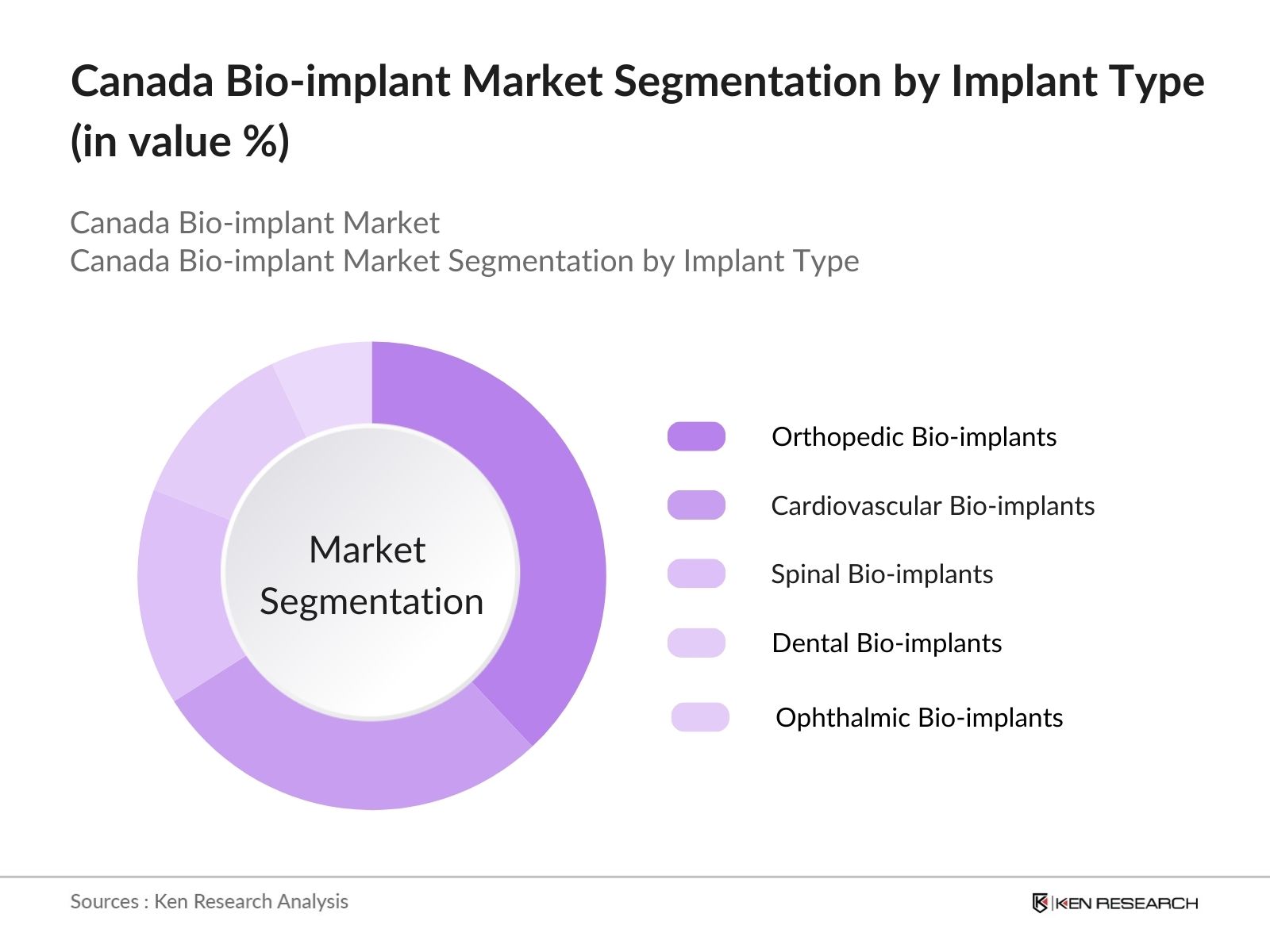
The Canada Bio-implant market can be segmented by type and by material.
- By Implant Type: The Canada Bio-implant market is segmented by product type into cardiovascular bio-implants, orthopedic bio-implants, spinal bio-implants, dental bio-implants, and ophthalmic bio-implants. Recently, orthopedic bio-implants have held a dominant market share under the segmentation by type. This is due to the rising number of elderly patients with osteoarthritis and other degenerative bone diseases requiring joint replacements. The growing adoption of minimally invasive surgical techniques for knee and hip replacements, as well as advancements in bio-materials that reduce recovery time, have fueled demand in this sub-segment.
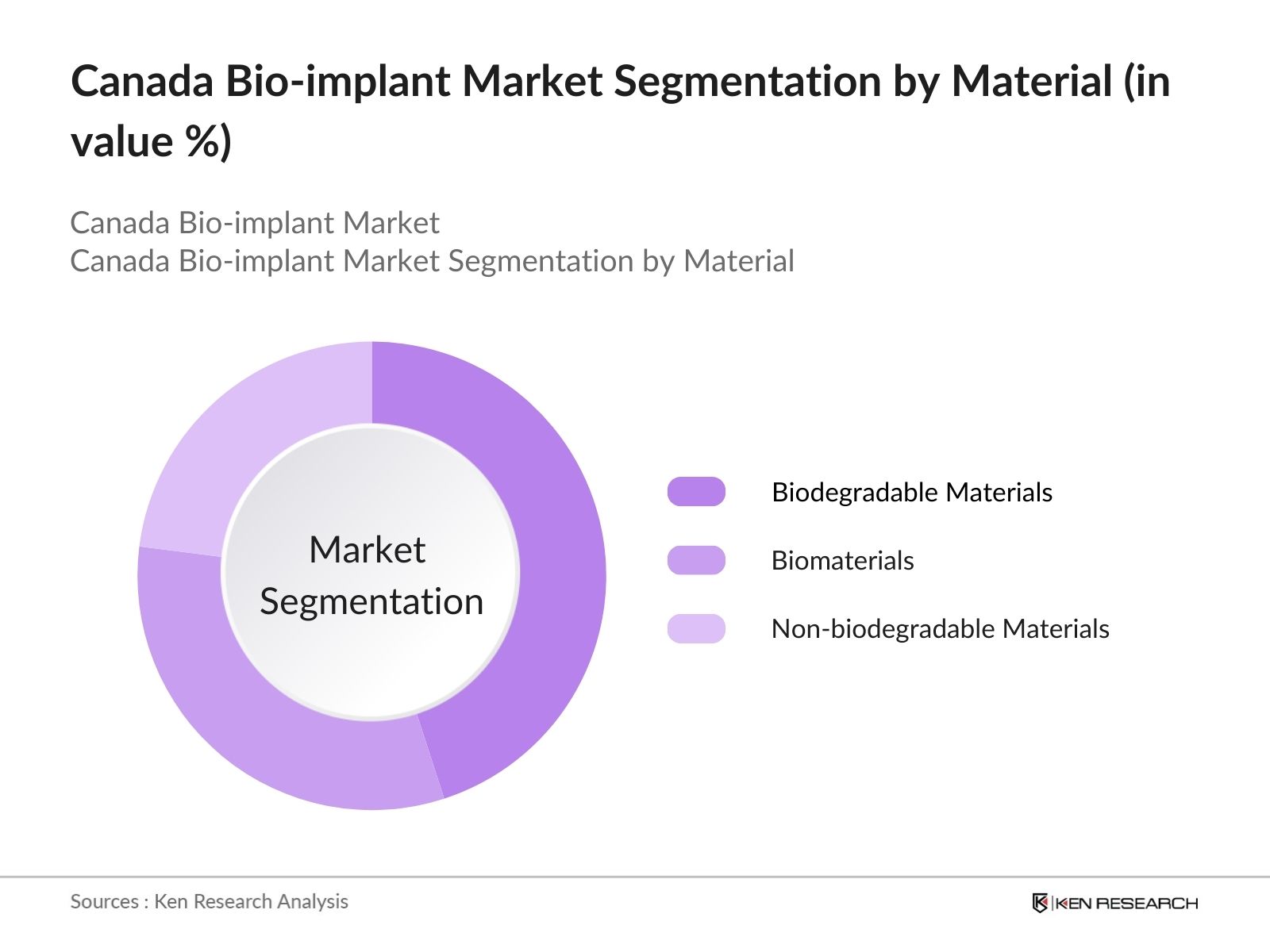
- By Material: The market is segmented by material into biodegradable materials, non-biodegradable materials, and biomaterials (metals, ceramics, polymers, composites). Biodegradable materials are dominating the market due to their advantages in reducing post-surgical complications and eliminating the need for secondary surgeries for implant removal. Surgeons are increasingly favoring these materials, especially in cardiovascular and dental bio-implants, as they allow the body to gradually absorb the implant over time, leading to improved patient outcomes and reduced risk of infection.
Canada Bio-implant Market Competitive Landscape
The Canada Bio-implant market is dominated by global medical device manufacturers and a few domestic companies, with key players focusing on innovation in biomaterials and minimally invasive techniques. Companies like Medtronic, Zimmer Biomet, and Johnson & Johnson (DePuy Synthes) lead the market due to their vast product portfolios, strong R&D investments, and well-established distribution channels. These firms continuously innovate to develop bio-implants that offer better biocompatibility, durability, and improved patient outcomes, giving them a competitive edge in the market.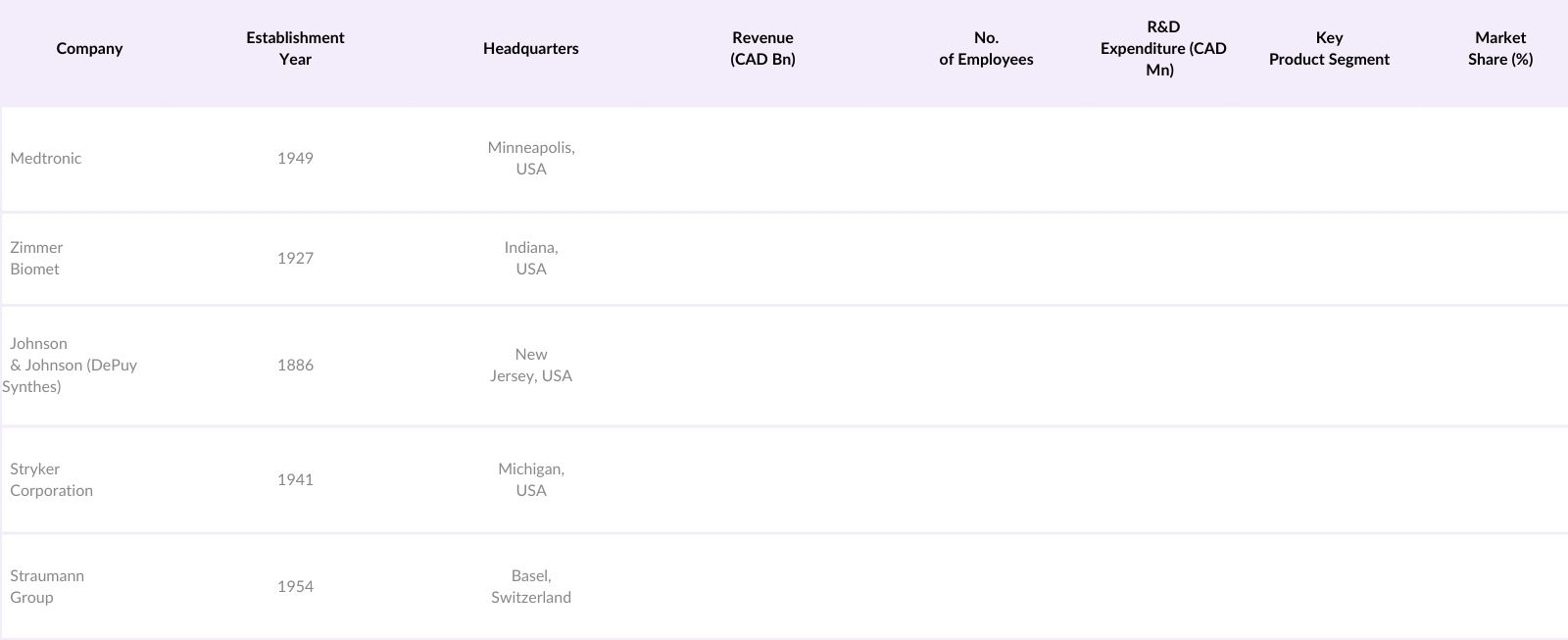
Canada Bio-implant Market Analysis
Growth Drivers
- Increasing Prevalence of Chronic Diseases: The rising incidence of chronic diseases in Canada, especially cardiovascular and orthopedic conditions, is driving the demand for bio-implants. In 2024, the Canadian Institute for Health Information reported over 1.4 million hospitalizations for chronic conditions, including heart disease and diabetes, emphasizing a significant need for bio-implants in medical treatments. The country's population aged 65 and older represents nearly 20%, experiencing higher rates of chronic illnesses that often require implants. This prevalence of chronic conditions is creating substantial demand for bio-implant technologies to support quality of life and effective treatment outcomes.
- Advancements in Biomaterial Technology: Technological advancements in biomaterials have made bio-implants more durable and biocompatible, essential for high-quality implant outcomes. The National Research Council of Canada highlights progress in biomaterial technology, such as nanostructured surfaces, which improve bio-implant functionality by enhancing tissue integration. In 2024, federal funding for biomedical research reached CAD 300 million, supporting biomaterial innovations crucial for bio-implant advancements. This government-backed technological innovation is directly enhancing the quality and safety of bio-implants available in Canadas healthcare system.
- Aging Population: Canada's aging population, with over 7.5 million individuals above the age of 65 as of 2024, is significantly contributing to the bio-implant market. Seniors frequently require hip, knee, and dental implants due to age-related degenerative diseases. Statistics Canada indicates that older adults are projected to account for over 23% of the population within the next decade, highlighting a sustained demand for bio-implants to address the healthcare needs of an aging demographic.
Market Challenges
- High Cost of Bio-implants: The high cost of bio-implants, with average prices ranging from CAD 5,000 to CAD 30,000 depending on the type and complexity, remains a substantial barrier in the Canadian market. Health Canada and Statistics Canada report that these costs create affordability challenges, especially for non-urgent implants that may not be covered by universal healthcare. Despite government healthcare subsidies, the financial burden for patients requiring implants remains high.
- Stringent Regulatory Policies: Health Canada's strict regulatory requirements for bio-implants to ensure safety and efficacy contribute to lengthy approval processes. The Medical Device Regulations mandate rigorous testing and quality control for all bio-implants, sometimes leading to delays in market entry. In 2024, Health Canada reported an average regulatory review period of up to 15 months for high-risk bio-implants, presenting an obstacle for timely patient access to these devices.
Canada Bio-implant Market Future Outlook
Over the next five years, the Canada Bio-implant market is expected to show consistent growth driven by continuous advancements in biomaterial technology and increasing demand for minimally invasive surgeries. The aging population and the rise in chronic diseases are also key factors boosting the adoption of bio-implants in various medical fields. The development of personalized medicine, along with innovations like 3D-printed bio-implants and bioabsorbable materials, is expected to further accelerate market growth.
Future Market Opportunities
- Innovation in 3D-printed Bio-implants: The rise of 3D printing technology offers promising growth in the bio-implant market by enabling customized, precise implants tailored to individual patient needs. Canadian institutions like the University of Toronto and private enterprises have begun utilizing 3D-printed implants, particularly in orthopedic and dental applications. The National Research Council of Canada invested over CAD 20 million in 2023 to support 3D printing research, showcasing government support for innovations that can lower production costs and improve patient outcomes.
- Expansion in Emerging Healthcare Markets: With healthcare market expansion in Canadian provinces like Ontario and Quebec, the bio-implant sector is witnessing increased support and investment. Ontario alone allocated CAD 1.4 billion towards healthcare technology upgrades in 2023, paving the way for bio-implant adoption across urban and rural healthcare facilities. This expansion aligns with the governments commitment to advanced medical care access, particularly in underserved communities.
Scope of the Report
|
Cardiovascular Bio-implants Orthopedic Bio-implants Spinal Bio-implants Dental Bio-implants, Ophthalmic Bio-implants |
|
|
By Material |
Biomaterials (Metals, Ceramics, Polymers, Composites) Biodegradable Materials Non-biodegradable Materials |
|
By Application |
Cardiovascular Procedures Orthopedic Surgeries Dental Restorations Ophthalmic Surgeries Spinal Repair |
|
By End-User |
Hospitals Specialized Clinics Ambulatory Surgical Centers |
|
By Region |
North East West South |
Products
Key Target Audience
Healthcare Providers (Hospitals, Specialized Clinics)
Bio-implant Manufacturers
Investors and Venture Capitalist Firms
Medical Device Distributors
Government and Regulatory Bodies (Health Canada, Federal Drug Administration)
Research and Development Institutions
Pharmaceutical Companies
Ambulatory Surgical Centers
Companies
Major Players in the Market
Medtronic
Zimmer Biomet
Johnson & Johnson (DePuy Synthes)
Stryker Corporation
Straumann Group
Boston Scientific
Abbott Laboratories
Cochlear Limited
Dentsply Sirona
B. Braun Melsungen AG
Wright Medical Group
Integra LifeSciences
Smith & Nephew
Conmed Corporation
Edwards Lifesciences
Table of Contents
1. Canada Bio-implant Market Overview
1.1 Definition and Scope
1.2 Market Taxonomy (By Type, Material, Application, End-User)
1.3 Market Growth Rate
1.4 Market Segmentation Overview
2. Canada Bio-implant Market Size (In CAD Mn)
2.1 Historical Market Size
2.2 Year-On-Year Growth Analysis
2.3 Key Market Developments and Milestones (Regulatory Approvals, Major Partnerships, Industry Investments)
3. Canada Bio-implant Market Analysis
3.1 Growth Drivers
3.1.1 Increasing Prevalence of Chronic Diseases
3.1.2 Advancements in Biomaterial Technology
3.1.3 Aging Population
3.1.4 Rising Demand for Minimally Invasive Surgeries
3.2 Market Challenges
3.2.1 High Cost of Bio-implants
3.2.2 Stringent Regulatory Policies
3.2.3 Limited Reimbursement Policies
3.2.4 Complex Manufacturing Processes
3.3 Opportunities
3.3.1 Innovation in 3D-printed Bio-implants
3.3.2 Expansion in Emerging Healthcare Markets
3.3.3 Personalized Medicine
3.4 Trends
3.4.1 Development of Smart Bio-implants
3.4.2 Integration with Digital Health Technologies
3.4.3 Growing Popularity of Bioabsorbable Implants
3.5 Government Regulation (Health Canada Approvals, Federal Reimbursement Programs)
3.5.1 Health Canada's Regulatory Framework
3.5.2 National Bio-implant Standards
3.5.3 Reimbursement and Healthcare Policies
3.6 SWOT Analysis
3.7 Stakeholder Ecosystem
3.8 Porters Five Forces Analysis
3.9 Competition Ecosystem
4. Canada Bio-implant Market Segmentation
4.1 By Type (In Value %)
4.1.1 Cardiovascular Bio-implants
4.1.2 Orthopedic Bio-implants
4.1.3 Spinal Bio-implants
4.1.4 Dental Bio-implants
4.1.5 Ophthalmic Bio-implants
4.2 By Material (In Value %)
4.2.1 Biomaterials (Metals, Ceramics, Polymers, Composites)
4.2.2 Biodegradable Materials
4.2.3 Non-biodegradable Materials
4.3 By Application (In Value %)
4.3.1 Cardiovascular Procedures
4.3.2 Orthopedic Surgeries
4.3.3 Dental Restorations
4.3.4 Ophthalmic Surgeries
4.3.5 Spinal Repair
4.4 By End-User (In Value %)
4.4.1 Hospitals
4.4.2 Specialized Clinics
4.4.3 Ambulatory Surgical Centers
4.5 By Region (In Value %)
4.5.1 North
4.5.2 East
4.5.3 West
4.5.4 South
5. Canada Bio-implant Market Competitive Analysis
5.1 Detailed Profiles of Major Competitors
5.1.1 Medtronic
5.1.2 Zimmer Biomet
5.1.3 Johnson & Johnson (DePuy Synthes)
5.1.4 Abbott Laboratories
5.1.5 Boston Scientific
5.1.6 Stryker Corporation
5.1.7 Smith & Nephew
5.1.8 Straumann Group
5.1.9 Cochlear Limited
5.1.10 Edwards Lifesciences
5.1.11 B. Braun Melsungen AG
5.1.12 Dentsply Sirona
5.1.13 Conmed Corporation
5.1.14 Wright Medical Group
5.1.15 Integra LifeSciences
5.2 Cross Comparison Parameters (Revenue, Number of Employees, Product Portfolio, Innovation Index, R&D Investment, Market Presence, Regulatory Approvals, Mergers and Acquisitions)
5.3 Market Share Analysis
5.4 Strategic Initiatives
5.5 Mergers And Acquisitions
5.6 Investment Analysis
5.7 Venture Capital Funding
5.8 Government Grants
5.9 Private Equity Investments
6. Canada Bio-implant Market Regulatory Framework
6.1 Health Canada Certification Processes
6.2 Compliance Requirements
6.3 International Bio-implant Standards
7. Canada Bio-implant Future Market Size (In CAD Mn)
7.1 Future Market Size Projections
7.2 Key Factors Driving Future Market Growth
8. Canada Bio-implant Future Market Segmentation
8.1 By Type (In Value %)
8.2 By Material (In Value %)
8.3 By Application (In Value %)
8.4 By End-User (In Value %)
8.5 By Region (In Value %)
9. Canada Bio-implant Market Analysts Recommendations
9.1 Total Addressable Market (TAM), Serviceable Available Market (SAM), and Serviceable Obtainable Market (SOM) Analysis
9.2 Customer Cohort Analysis
9.3 White Space Opportunity Analysis
9.4 Key Marketing Initiatives
Disclaimer
Contact Us
Research Methodology
Step 1: Identification of Key Variables
The initial phase involves constructing an ecosystem map encompassing all major stakeholders within the Canada Bio-implant market. This step is underpinned by extensive desk research, utilizing secondary and proprietary databases to gather comprehensive industry-level information. The primary objective is to identify and define the critical variables that influence market dynamics.
Step 2: Market Analysis and Construction
In this phase, we compile and analyze historical data pertaining to the Canada Bio-implant market. This includes assessing market penetration, the ratio of marketplaces to service providers, and resultant revenue generation. An evaluation of quality statistics is also conducted to ensure the reliability of revenue estimates.
Step 3: Hypothesis Validation and Expert Consultation
Market hypotheses are developed and subsequently validated through consultations with industry experts representing a diverse array of companies. These consultations provide valuable operational and financial insights from practitioners in the bio-implant industry.
Step 4: Research Synthesis and Final Output
The final phase involves engaging with multiple bio-implant manufacturers to acquire detailed insights into product segments, sales performance, and consumer preferences. This interaction verifies and complements statistics derived from the bottom-up approach, ensuring a comprehensive, accurate, and validated analysis of the Canada Bio-implant market.
Frequently Asked Questions
01. How big is the Canada Bio-implant market?
The Canada Bio-implant market was valued at USD 5.6 billion, driven by technological advancements and the rising prevalence of chronic diseases.
02. What are the challenges in the Canada Bio-implant market?
Challenges in Canada Bio-implant market include high costs of bio-implants, stringent regulatory policies, and limited reimbursement options, particularly for newer bio-material innovations.
03. Who are the major players in the Canada Bio-implant market?
Key players in Canada Bio-implant market include Medtronic, Zimmer Biomet, Johnson & Johnson (DePuy Synthes), Stryker Corporation, and Straumann Group. These companies dominate due to their extensive product portfolios and significant investments in R&D.
04. What are the growth drivers of the Canada Bio-implant market?
The Canada Bio-implant market is propelled by increasing healthcare expenditure, an aging population, advancements in biomaterial technologies, and a shift towards minimally invasive surgeries.
05. Which regions dominate the Canada Bio-implant market?
Ontario and Quebec dominate due to their well-established healthcare infrastructure and higher healthcare expenditures, contributing to the rapid adoption of bio-implants.
Why Buy From Us?

What makes us stand out is that our consultants follows Robust, Refine and Result (RRR) methodology. i.e. Robust for clear definitions, approaches and sanity checking, Refine for differentiating respondents facts and opinions and Result for presenting data with story

We have set a benchmark in the industry by offering our clients with syndicated and customized market research reports featuring coverage of entire market as well as meticulous research and analyst insights.

While we don't replace traditional research, we flip the method upside down. Our dual approach of Top Bottom & Bottom Top ensures quality deliverable by not just verifying company fundamentals but also looking at the sector and macroeconomic factors.

With one step in the future, our research team constantly tries to show you the bigger picture. We help with some of the tough questions you may encounter along the way: How is the industry positioned? Best marketing channel? KPI's of competitors? By aligning every element, we help maximize success.

Our report gives you instant access to the answers and sources that other companies might choose to hide. We elaborate each steps of research methodology we have used and showcase you the sample size to earn your trust.

If you need any support, we are here! We pride ourselves on universe strength, data quality, and quick, friendly, and professional service.