
China CMM Measurement Market Outlook to 2030
Region:Asia
Author(s):Sanjna Verma
Product Code:KROD9880
Region:Asia
Author(s):Sanjna Verma
Product Code:KROD9880
December 2024
89
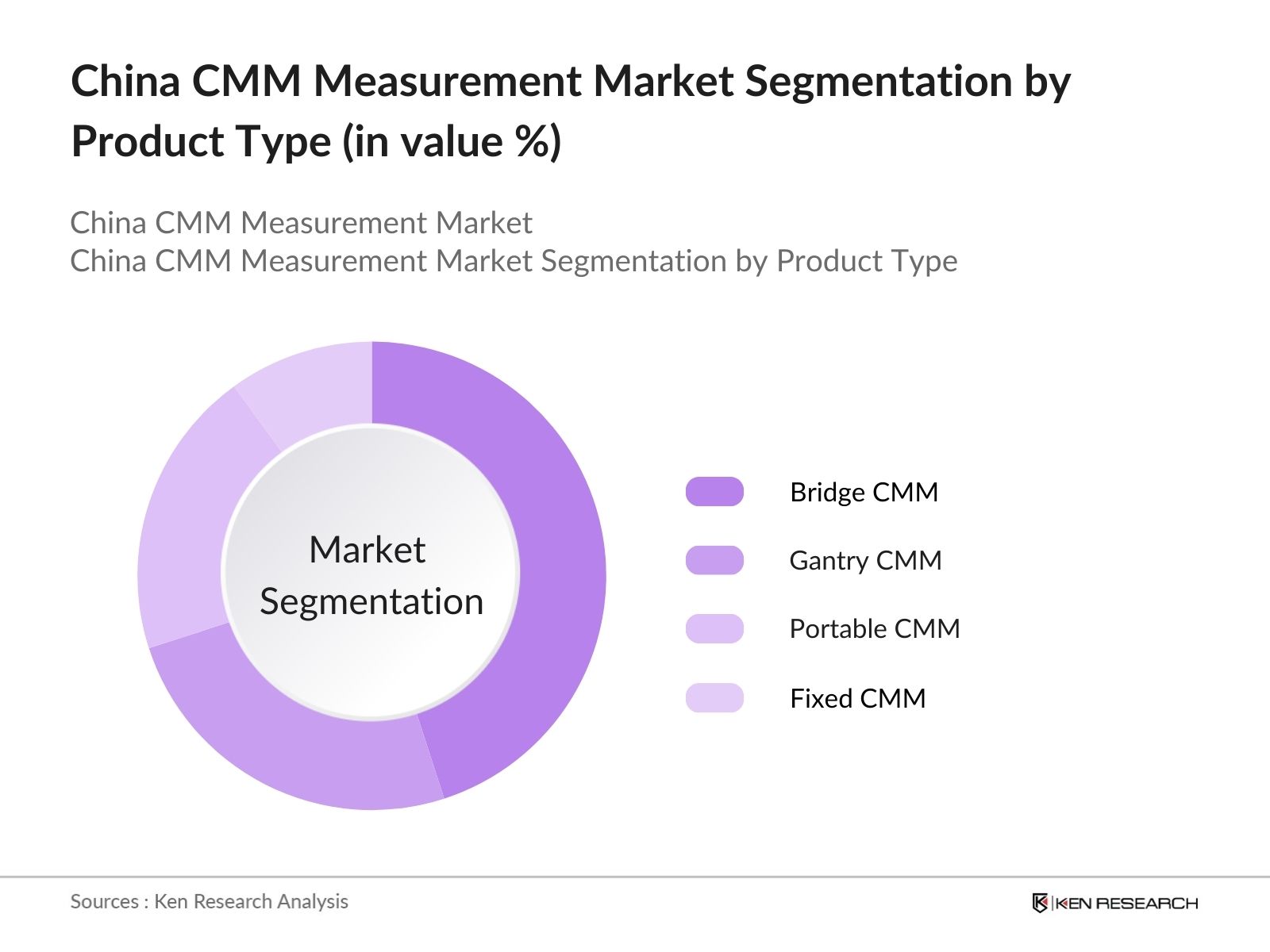
By Product Type: China's CMM Measurement market is segmented by product type into Fixed CMM, Portable CMM, Gantry CMM, and Bridge CMM. Bridge CMMs hold the dominant market share due to their widespread usage in industries such as automotive and aerospace for quality assurance in large-scale manufacturing. Their ability to provide precise measurements and durability in industrial settings makes them a preferred choice for high-volume applications.
By Application: The CMM Measurement market is also segmented by application into Automotive, Aerospace & Defense, Electronics & Semiconductors, Heavy Machinery, and Medical Devices. Automotive leads the application segment, driven by the need for high-precision measurement in manufacturing components such as engines, gearboxes, and body panels. Chinas status as a global automotive manufacturing hub ensures consistent demand for CMM technology.
The China CMM Measurement Market is characterized by the presence of both domestic and international players. The market is competitive, with significant investments in R&D and technological advancements to maintain leadership. The competitive landscape is shaped by innovation in metrology technologies and a focus on customer-specific solutions. Major players continue to expand their market presence through strategic collaborations, investments in automation technologies, and global partnerships.
|
Company |
Establishment Year |
Headquarters |
No. of Employees |
R&D Investment (RMB) |
Revenue (RMB) |
Geographical Reach |
Technological Capabilities |
Strategic Partnerships |
|
Hexagon AB |
1992 |
Sweden |
- |
- |
- |
- |
- |
- |
|
Mitutoyo Corporation |
1934 |
Japan |
- |
- |
- |
- |
- |
- |
|
ZEISS Group |
1846 |
Germany |
- |
- |
- |
- |
- |
- |
|
Nikon Metrology NV |
1917 |
Belgium |
- |
- |
- |
- |
- |
- |
|
Wenzel Group GmbH & Co. |
1968 |
Germany |
- |
- |
- |
- |
- |
- |
China CMM Measurement Market is expected to experience substantial growth due to increased industrial automation, demand for precision in advanced manufacturing, and adoption of new metrology technologies. Government initiatives aimed at upgrading Chinas manufacturing capabilities will further drive the market. Additionally, rising demand from sectors such as medical devices, electronics, and aerospace is anticipated to fuel growth.
The continuous evolution of multi-sensor CMM systems, integration with Industry 4.0 technologies, and expansion of portable CMM solutions are likely to emerge as key trends. Furthermore, regional expansion beyond the major industrial hubs into developing areas will offer new growth opportunities for both domestic and international players.
|
By Product Type |
Fixed CMM Portable CMM Gantry CMM Bridge CMM |
|
By Application |
Automotive Aerospace and Defense Electronics and Semiconductors Heavy Machinery, Medical Devices |
|
By Technology |
Touch Trigger Probing Laser Probing White Light Scanning Optical Scanning |
|
By End-User |
OEMs Third-Party Service Providers R&D Institutions |
|
By Region |
East China North China South Central China Southwest China |
1.1 Definition and Scope
1.2 Market Taxonomy
1.3 Market Growth Rate
1.4 Market Segmentation Overview
2.1 Historical Market Size
2.2 Year-On-Year Growth Analysis
2.3 Key Market Developments and Milestones
3.1 Growth Drivers
3.1.1 Precision Engineering in Automotive Sector
3.1.2 Rising Aerospace Investments
3.1.3 Expansion in the Electronics and Semiconductor Industry
3.1.4 Government Policies Supporting Manufacturing and Quality Control (Made in China 2025)
3.2 Market Challenges
3.2.1 High Initial Costs for CMM Systems (Capital Investment Constraints)
3.2.2 Limited Skilled Workforce in Metrology (Training and Expertise Gaps)
3.2.3 Complexities in Calibration and Maintenance (Technical Barriers)
3.2.4 Competition from Emerging Non-Contact Measurement Technologies
3.3 Opportunities
3.3.1 Increased Adoption in Small and Medium Enterprises (SMEs) (Automation Growth)
3.3.2 Technological Innovations in Multi-Sensor CMM Systems
3.3.3 Integration of CMM with Smart Factories and IoT (Industry 4.0 Adoption)
3.3.4 Strategic Alliances and International Collaborations
3.4 Trends
3.4.1 Miniaturization of CMM for Compact Use in Electronics Industry
3.4.2 Increasing Use of Portable CMM in Field Applications
3.4.3 Growing Demand for 3D CMM Systems (Technological Trends)
3.4.4 Focus on Environmental Sustainability in CMM Design and Usage
3.5 Government Regulations
3.5.1 Regulations for Precision Measurement Standards (National Measurement Standards)
3.5.2 Government Funding for Technological Upgradation in Manufacturing
3.5.3 Subsidies for Advanced Metrology Systems in Key Sectors (Automotive, Aerospace)
3.5.4 Implementation of ISO Standards in Metrology
3.6 SWOT Analysis
3.7 Stakeholder Ecosystem
3.8 Porters Five Forces Analysis
3.9 Competition Ecosystem
4.1 By Product Type (In Value %)
4.1.1 Fixed CMM
4.1.2 Portable CMM
4.1.3 Gantry CMM
4.1.4 Bridge CMM
4.2 By Application (In Value %)
4.2.1 Automotive Industry
4.2.2 Aerospace and Defense
4.2.3 Electronics and Semiconductors
4.2.4 Heavy Machinery
4.2.5 Medical Devices
4.3 By Technology (In Value %)
4.3.1 Touch Trigger Probing
4.3.2 Laser Probing
4.3.3 White Light Scanning
4.3.4 Optical Scanning
4.4 By End-User (In Value %)
4.4.1 OEMs
4.4.2 Third-Party Service Providers
4.4.3 Research & Development Institutions
4.5 By Region (In Value %)
4.5.1 East China
4.5.2 North China
4.5.3 South Central China
4.5.4 Southwest China
5.1 Detailed Profiles of Major Companies
5.1.1 Hexagon AB
5.1.2 Mitutoyo Corporation
5.1.3 ZEISS Group
5.1.4 Nikon Metrology NV
5.1.5 Wenzel Group GmbH & Co. KG
5.1.6 FARO Technologies, Inc.
5.1.7 Keyence Corporation
5.1.8 Aberlink Ltd.
5.1.9 Dukin Co., Ltd.
5.1.10 Leitz Metrology
5.2 Cross Comparison Parameters (Market Share, Product Portfolio, Technological Capabilities, R&D Spending, Market Reach, Employee Strength, Geographic Presence, Strategic Partnerships)
5.3 Market Share Analysis
5.4 Strategic Initiatives
5.5 Mergers and Acquisitions
5.6 Investment Analysis
5.7 Government Grants
5.8 Private Equity Investments
6.1 Precision Measurement Legislation
6.2 Compliance with National Measurement Standards
6.3 Certification Processes and Approvals
7.1 Future Market Size Projections
7.2 Key Factors Driving Future Market Growth
8.1 By Product Type (In Value %)
8.2 By Application (In Value %)
8.3 By Technology (In Value %)
8.4 By End-User (In Value %)
8.5 By Region (In Value %)
9.1 TAM/SAM/SOM Analysis
9.2 Customer Cohort Analysis
9.3 Marketing Initiatives
9.4 White Space Opportunity Analysis
The initial phase involves identifying all relevant stakeholders and key factors that influence the China CMM Measurement Market. This is accomplished through comprehensive desk research, leveraging a mix of proprietary databases, industry publications, and governmental sources to gather crucial market data and insights.
We compile and analyze historical data to understand market trends, revenue patterns, and growth drivers. By assessing CMM adoption rates, product utilization, and service quality, we generate precise estimates of current and future market size. The analysis also factors in the revenue generated from key segments and regions.
Market hypotheses are developed based on the preliminary findings and validated through consultations with industry experts. These consultations help to verify the data and refine our market analysis, offering valuable insights from professionals directly engaged in the CMM measurement market.
In the final phase, we synthesize all the data gathered and integrate findings from industry consultations to produce a comprehensive report. This stage involves engaging directly with CMM manufacturers and end-users to ensure accurate representation of market dynamics and to validate the accuracy of our forecasts.
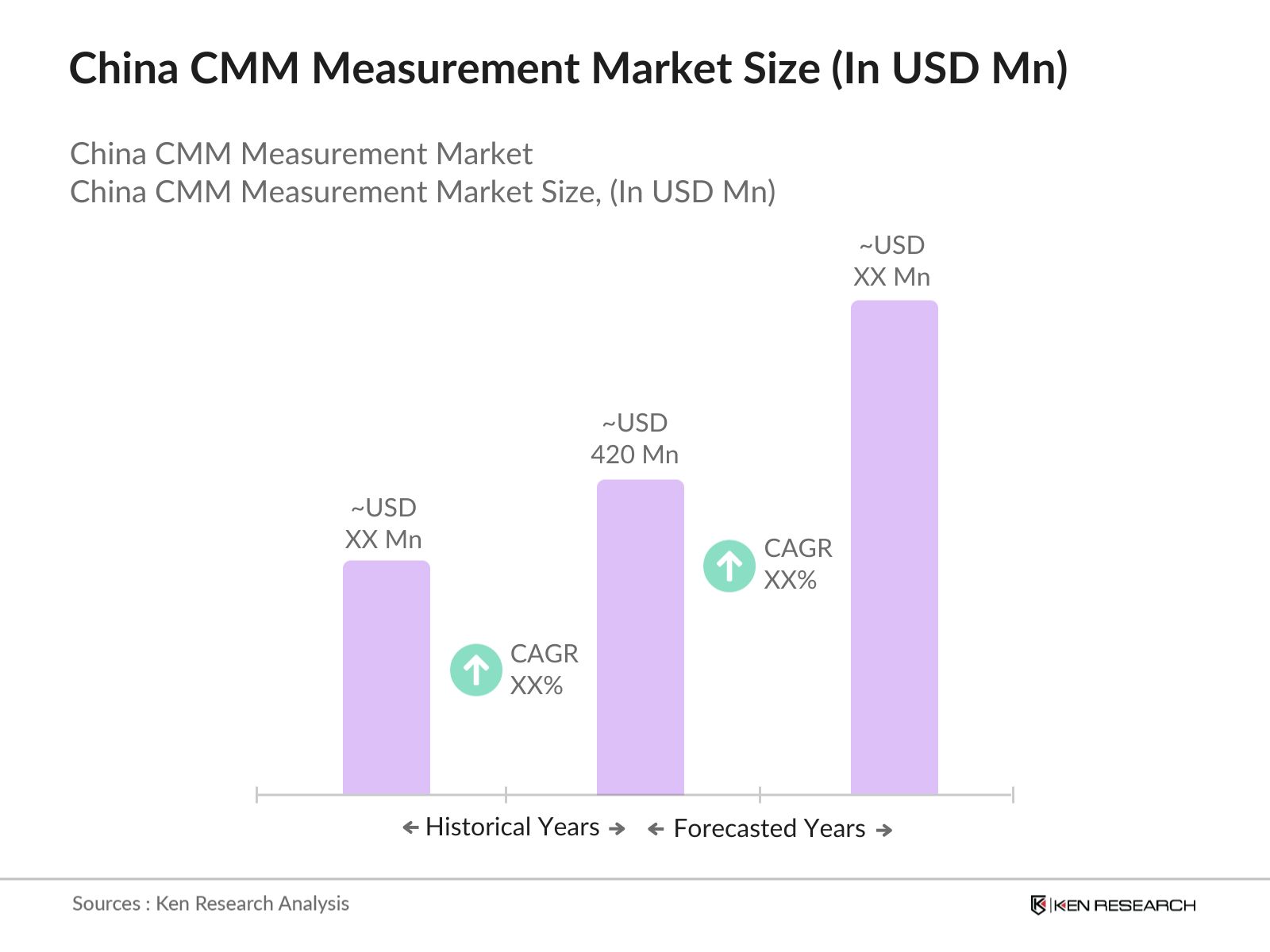
The China CMM Measurement Market is valued at USD 420 million, primarily driven by the demand for high-precision measurement tools in the automotive, aerospace, and electronics industries.
Challenges in China CMM Measurement Market include the high initial cost of CMM systems, the shortage of skilled metrology professionals, and the rising competition from non-contact measurement technologies.
Key players in China CMM Measurement Market include Hexagon AB, Mitutoyo Corporation, ZEISS Group, Nikon Metrology NV, and Wenzel Group GmbH & Co., with these companies dominating through innovation and strategic partnerships.
China CMM Measurement Market is driven by the rising demand for precision in manufacturing, government policies promoting advanced metrology, and the growing integration of Industry 4.0 technologies in production lines.

What makes us stand out is that our consultants follows Robust, Refine and Result (RRR) methodology. i.e. Robust for clear definitions, approaches and sanity checking, Refine for differentiating respondents facts and opinions and Result for presenting data with story

We have set a benchmark in the industry by offering our clients with syndicated and customized market research reports featuring coverage of entire market as well as meticulous research and analyst insights.

While we don't replace traditional research, we flip the method upside down. Our dual approach of Top Bottom & Bottom Top ensures quality deliverable by not just verifying company fundamentals but also looking at the sector and macroeconomic factors.

With one step in the future, our research team constantly tries to show you the bigger picture. We help with some of the tough questions you may encounter along the way: How is the industry positioned? Best marketing channel? KPI's of competitors? By aligning every element, we help maximize success.

Our report gives you instant access to the answers and sources that other companies might choose to hide. We elaborate each steps of research methodology we have used and showcase you the sample size to earn your trust.

If you need any support, we are here! We pride ourselves on universe strength, data quality, and quick, friendly, and professional service.