China Premium Motorcycle Helmet Market

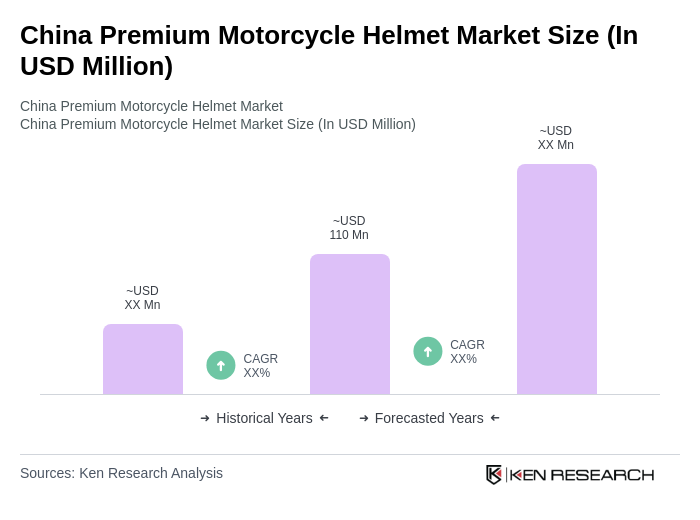
The China premium motorcycle helmet market, worth USD 110 million, is growing due to increased safety regulations, urban commuting trends, and demand for full-face helmets among commuters.

Region:Asia

Author(s):Geetanshi

Product Code:KRAA0104

Pages:88

Published On:August 2025
About the Report

Base Year 2024

China Premium Motorcycle Helmet Market Overview

  • The China Premium Motorcycle Helmet Market is valued at USD 110 million, based on a five-year historical analysis. This growth is primarily driven by increasing motorcycle ownership, rising disposable incomes, heightened safety awareness among riders, and the growing trend of premium and high-quality helmets that offer enhanced protection and comfort. The market has seen a significant shift towards premium products as consumers prioritize safety, style, and advanced features such as lightweight materials and improved ventilation systems .
  • Key cities dominating the market includeBeijing, Shanghai, and Guangzhou, where the concentration of motorcycle users is high. These urban centers have robust infrastructure for motorcycle use and a growing population of motorcycle enthusiasts, contributing to the demand for premium helmets. Additionally, the presence of major retailers, brand showrooms, and expanding online sales channels in these cities enhances market accessibility .
  • In recent years, the Chinese government has implemented stricter regulations regarding helmet safety standards, mandating that all motorcycle helmets sold in the market must comply with theGB 811-2010standard. This regulation aims to improve rider safety and reduce accidents, thereby increasing the demand for compliant premium helmets that meet these enhanced safety criteria .
China Premium Motorcycle Helmet Market Size

China Premium Motorcycle Helmet Market Segmentation

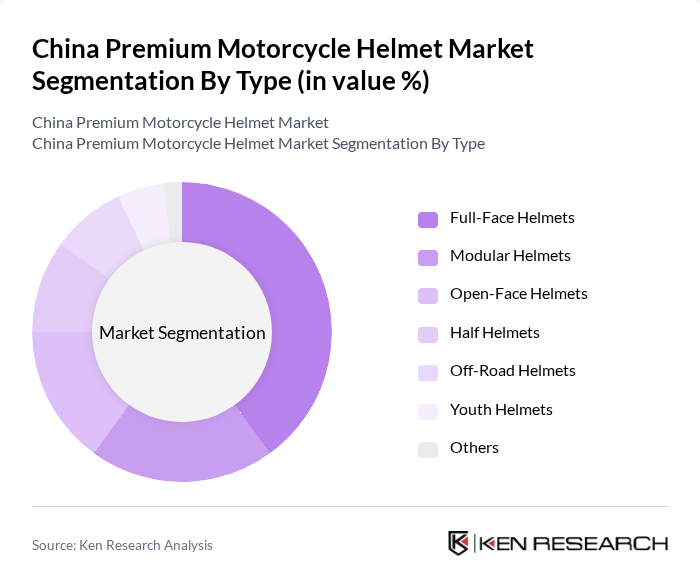
By Type:The market is segmented into various types of helmets, includingFull-Face Helmets, Modular Helmets, Open-Face Helmets, Half Helmets, Off-Road Helmets, Youth Helmets, and Others. Among these,Full-Face Helmetsdominate the market due to their comprehensive protection and popularity among both commuters and racers. The trend toward safety, the increasing number of motorcycle accidents, and consumer preference for helmets that offer maximum coverage and advanced features such as anti-fog visors and aerodynamic designs have led to greater demand for full-face models .
China Premium Motorcycle Helmet Market segmentation by Type.

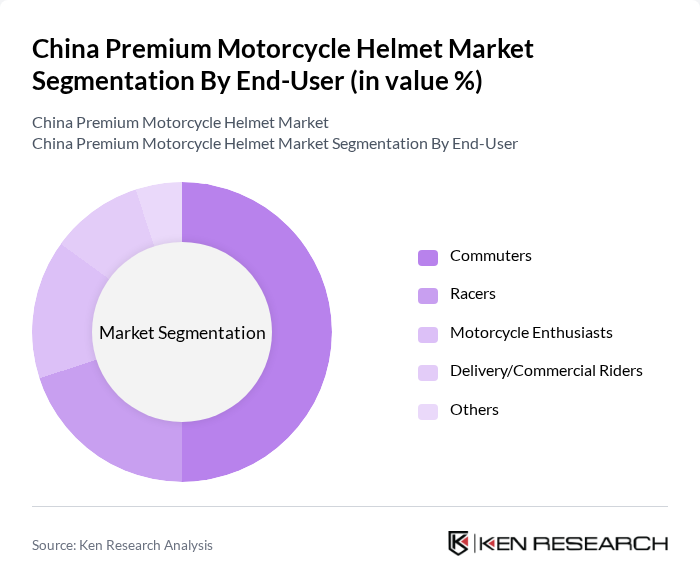
By End-User:The end-user segmentation includesCommuters, Racers, Motorcycle Enthusiasts, Delivery/Commercial Riders, and Others.Commutersrepresent the largest segment, driven by the increasing number of individuals using motorcycles for daily transportation. The rise in urban traffic congestion and the growth of the delivery sector have made motorcycles a preferred choice, leading to higher demand for premium helmets that ensure safety, comfort, and compliance with regulatory standards during commutes .
China Premium Motorcycle Helmet Market segmentation by End-User.

China Premium Motorcycle Helmet Market Competitive Landscape

The China Premium Motorcycle Helmet Market is characterized by a dynamic mix of regional and international players. Leading participants such asShoei Co., Ltd., Arai Helmet Ltd., HJC Helmets, AGV (Dainese Group), Schuberth GmbH, Nolan Group, LS2 Helmets (Jiangmen Pengcheng Helmet Manufacturing Co., Ltd.), Shark Helmets, KYT Helmets, YOHE Helmets (Guangzhou YOHE Helmet Manufacturing Co., Ltd.), YEMA Helmet (Yongkang Yema Helmet Co., Ltd.), Bilmola, X-Lite (Nolan Group), Origine Helmets, and Masei Helmetscontribute to innovation, geographic expansion, and service delivery in this space.

Company

Establishment Year

Headquarters

Market Share (%)

Annual Revenue (USD Million)

Revenue Growth Rate (%)

Product Portfolio Breadth

Distribution Network Strength (Online/Offline)

R&D Investment (% of Revenue)

Shoei Co., Ltd.

1959

Tokyo, Japan

Arai Helmet Ltd.

1937

Saitama, Japan

HJC Helmets

1971

Seoul, South Korea

AGV (Dainese Group)

1947

Molvena, Italy

Schuberth GmbH

1922

Magdeburg, Germany

China Premium Motorcycle Helmet Market Industry Analysis

Growth Drivers

  • Increasing Safety Awareness Among Riders:The rising number of motorcycle accidents in China has heightened safety awareness among riders. In future, the country reported over 48,000 motorcycle-related fatalities, prompting a shift towards premium helmets that offer better protection. Government campaigns and educational programs have also contributed to this trend, with a reported 30% increase in helmet sales attributed to heightened safety consciousness. This growing awareness is expected to drive demand for high-quality helmets significantly.
  • Rising Disposable Income in Urban Areas:Urban disposable income in China reached approximately CNY 43,000 per capita, reflecting a 6% increase from the previous period. This economic growth has enabled consumers to invest in premium motorcycle helmets, which are often priced higher than standard options. As urbanization continues, more individuals are willing to spend on safety and quality, leading to a projected increase in premium helmet purchases, particularly in metropolitan areas where motorcycle ownership is prevalent.
  • Growth in Motorcycle Ownership:The number of registered motorcycles in China surpassed 48 million, marking a 5% increase from the previous period. This surge in ownership is driven by urban commuting needs and the popularity of motorcycles as a cost-effective transportation option. As more individuals acquire motorcycles, the demand for premium helmets is expected to rise correspondingly, as new riders prioritize safety and quality in their purchases, further bolstering the market.

Market Challenges

  • Intense Competition from Low-Cost Alternatives:The Chinese market is flooded with low-cost helmet options, with prices often under CNY 200. This intense competition poses a significant challenge for premium helmet manufacturers, as budget-conscious consumers may opt for cheaper alternatives despite the safety benefits of premium products. In future, low-cost helmets accounted for approximately 60% of total helmet sales, making it difficult for premium brands to capture market share and maintain profitability.
  • Regulatory Compliance Complexities:The regulatory landscape for motorcycle helmets in China is intricate, with multiple safety standards enforced by the government. Manufacturers must navigate these regulations, which can vary by region, leading to increased compliance costs. In future, approximately 25% of manufacturers reported challenges in meeting these standards, which can hinder product launches and limit market entry for new premium helmet brands, ultimately affecting overall market growth.

China Premium Motorcycle Helmet Market Future Outlook

The future of the China premium motorcycle helmet market appears promising, driven by technological advancements and evolving consumer preferences. As smart helmets equipped with communication and navigation features gain traction, manufacturers are likely to invest in innovative designs. Additionally, the trend towards eco-friendly materials is expected to shape product offerings, appealing to environmentally conscious consumers. With the expansion of online sales channels, premium brands can reach a broader audience, enhancing market penetration and growth potential in future.

Market Opportunities

  • Technological Advancements in Helmet Safety:The integration of advanced safety technologies, such as impact sensors and Bluetooth connectivity, presents a significant opportunity for premium helmet manufacturers. As consumer demand for innovative features increases, brands that invest in research and development can differentiate themselves, potentially capturing a larger market share and enhancing brand loyalty among tech-savvy riders.
  • Expansion into Rural Markets:With rural motorcycle ownership on the rise, targeting these markets offers a lucrative opportunity for premium helmet brands. In future, rural areas accounted for approximately 30% of new motorcycle registrations. By educating consumers on the benefits of premium helmets and establishing distribution channels, manufacturers can tap into this growing segment, driving sales and brand recognition in previously underserved regions.

Scope of the Report

SegmentSub-Segments
By Type

Full-Face Helmets

Modular Helmets

Open-Face Helmets

Half Helmets

Off-Road Helmets

Youth Helmets

Others

By End-User

Commuters

Racers

Motorcycle Enthusiasts

Delivery/Commercial Riders

Others

By Price Range

Mid-Range Segment

Premium Segment

Luxury Segment

Others

By Distribution Channel

Online Retail

Offline Retail (Specialty Stores, Dealerships)

Others

By Material

Fiberglass

Carbon Fiber

Polycarbonate

Composite Materials

Others

By Brand Positioning

International Premium Brands

Leading Domestic Brands

Niche/Custom Brands

Others

By Region

North China

South China

East China

West China

Central China

Others

Key Target Audience

Investors and Venture Capitalist Firms

Government and Regulatory Bodies (e.g., Ministry of Industry and Information Technology, State Administration for Market Regulation)

Manufacturers and Producers

Distributors and Retailers

Motorcycle Associations and Clubs

Insurance Companies

Logistics and Supply Chain Companies

Safety and Standards Organizations

Players Mentioned in the Report:

Shoei Co., Ltd.

Arai Helmet Ltd.

HJC Helmets

AGV (Dainese Group)

Schuberth GmbH

Nolan Group

LS2 Helmets (Jiangmen Pengcheng Helmet Manufacturing Co., Ltd.)

Shark Helmets

KYT Helmets

YOHE Helmets (Guangzhou YOHE Helmet Manufacturing Co., Ltd.)

YEMA Helmet (Yongkang Yema Helmet Co., Ltd.)

Bilmola

X-Lite (Nolan Group)

Origine Helmets

Masei Helmets

Table of Contents

Market Assessment Phase

1. Executive Summary and Approach


2. China Premium Motorcycle Helmet Market Overview

2.1 Key Insights and Strategic Recommendations

2.2 China Premium Motorcycle Helmet Market Overview

2.3 Definition and Scope

2.4 Evolution of Market Ecosystem

2.5 Timeline of Key Regulatory Milestones

2.6 Value Chain & Stakeholder Mapping

2.7 Business Cycle Analysis

2.8 Policy & Incentive Landscape


3. China Premium Motorcycle Helmet Market Analysis

3.1 Growth Drivers

3.1.1 Increasing safety awareness among riders
3.1.2 Rising disposable income in urban areas
3.1.3 Growth in motorcycle ownership
3.1.4 Expansion of premium motorcycle segments

3.2 Market Challenges

3.2.1 Intense competition from low-cost alternatives
3.2.2 Regulatory compliance complexities
3.2.3 Limited consumer awareness of premium products
3.2.4 Supply chain disruptions

3.3 Market Opportunities

3.3.1 Technological advancements in helmet safety
3.3.2 Growing trend of customization
3.3.3 Expansion into rural markets
3.3.4 Collaborations with motorcycle manufacturers

3.4 Market Trends

3.4.1 Increasing demand for smart helmets
3.4.2 Eco-friendly materials gaining traction
3.4.3 Rise of online sales channels
3.4.4 Focus on ergonomic designs

3.5 Government Regulation

3.5.1 Mandatory safety standards for helmets
3.5.2 Import tariffs on motorcycle accessories
3.5.3 Incentives for manufacturers adopting safety technologies
3.5.4 Regulations on advertising and marketing of helmets

4. SWOT Analysis


5. Stakeholder Analysis


6. Porter's Five Forces Analysis


7. China Premium Motorcycle Helmet Market Market Size, 2019-2024

7.1 By Value

7.2 By Volume

7.3 By Average Selling Price


8. China Premium Motorcycle Helmet Market Segmentation

8.1 By Type

8.1.1 Full-Face Helmets
8.1.2 Modular Helmets
8.1.3 Open-Face Helmets
8.1.4 Half Helmets
8.1.5 Off-Road Helmets
8.1.6 Youth Helmets
8.1.7 Others

8.2 By End-User

8.2.1 Commuters
8.2.2 Racers
8.2.3 Motorcycle Enthusiasts
8.2.4 Delivery/Commercial Riders
8.2.5 Others

8.3 By Price Range

8.3.1 Mid-Range Segment
8.3.2 Premium Segment
8.3.3 Luxury Segment
8.3.4 Others

8.4 By Distribution Channel

8.4.1 Online Retail
8.4.2 Offline Retail (Specialty Stores, Dealerships)
8.4.3 Others

8.5 By Material

8.5.1 Fiberglass
8.5.2 Carbon Fiber
8.5.3 Polycarbonate
8.5.4 Composite Materials
8.5.5 Others

8.6 By Brand Positioning

8.6.1 International Premium Brands
8.6.2 Leading Domestic Brands
8.6.3 Niche/Custom Brands
8.6.4 Others

8.7 By Region

8.7.1 North China
8.7.2 South China
8.7.3 East China
8.7.4 West China
8.7.5 Central China
8.7.6 Others

9. China Premium Motorcycle Helmet Market Competitive Analysis

9.1 Market Share of Key Players

9.2 Cross Comparison of Key Players

9.2.1 Company Name
9.2.2 Market Share (%)
9.2.3 Annual Revenue (USD Million)
9.2.4 Revenue Growth Rate (%)
9.2.5 Product Portfolio Breadth
9.2.6 Distribution Network Strength (Online/Offline)
9.2.7 R&D Investment (% of Revenue)
9.2.8 Average Selling Price (ASP)
9.2.9 Brand Recognition (Consumer Survey Score)
9.2.10 Compliance with China GB Standards
9.2.11 Customer Satisfaction Index
9.2.12 After-Sales Service Coverage

9.3 SWOT Analysis of Top Players

9.4 Pricing Analysis

9.5 Detailed Profile of Major Companies

9.5.1 Shoei Co., Ltd.
9.5.2 Arai Helmet Ltd.
9.5.3 HJC Helmets
9.5.4 AGV (Dainese Group)
9.5.5 Schuberth GmbH
9.5.6 Nolan Group
9.5.7 LS2 Helmets (Jiangmen Pengcheng Helmet Manufacturing Co., Ltd.)
9.5.8 Shark Helmets
9.5.9 KYT Helmets
9.5.10 YOHE Helmets (Guangzhou YOHE Helmet Manufacturing Co., Ltd.)
9.5.11 YEMA Helmet (Yongkang Yema Helmet Co., Ltd.)
9.5.12 Bilmola
9.5.13 X-Lite (Nolan Group)
9.5.14 Origine Helmets
9.5.15 Masei Helmets

10. China Premium Motorcycle Helmet Market End-User Analysis

10.1 Procurement Behavior of Key Ministries

10.1.1 Government procurement policies.
10.1.2 Budget allocation for safety equipment.
10.1.3 Evaluation criteria for helmet procurement.
10.1.4 Supplier selection process.

10.2 Corporate Spend on Infrastructure & Energy

10.2.1 Investment in safety training programs.
10.2.2 Budget for employee safety gear.
10.2.3 Corporate responsibility initiatives.
10.2.4 Partnerships with helmet manufacturers.

10.3 Pain Point Analysis by End-User Category

10.3.1 Safety concerns among riders.
10.3.2 Cost sensitivity in purchasing decisions.
10.3.3 Availability of premium options.
10.3.4 Need for customization.

10.4 User Readiness for Adoption

10.4.1 Awareness of helmet safety standards.
10.4.2 Willingness to pay for premium features.
10.4.3 Adoption of smart helmet technologies.
10.4.4 Feedback mechanisms for product improvement.

10.5 Post-Deployment ROI and Use Case Expansion

10.5.1 Evaluation of safety improvements.
10.5.2 Cost savings from reduced accidents.
10.5.3 Expansion of product lines based on user feedback.
10.5.4 Long-term partnerships with suppliers.

11. China Premium Motorcycle Helmet Market Future Size, 2025-2030

11.1 By Value

11.2 By Volume

11.3 By Average Selling Price


Go-To-Market Strategy Phase

1. Whitespace Analysis + Business Model Canvas

1.1 Market gaps and opportunities.

1.2 Business model components.

1.3 Value proposition analysis.

1.4 Revenue streams identification.

1.5 Cost structure evaluation.

1.6 Key partnerships and resources.

1.7 Customer segments and relationships.


2. Marketing and Positioning Recommendations

2.1 Branding strategies.

2.2 Product USPs.

2.3 Target audience identification.

2.4 Marketing channels selection.

2.5 Promotional tactics.

2.6 Customer engagement strategies.

2.7 Performance metrics for marketing.


3. Distribution Plan

3.1 Urban retail strategies.

3.2 Rural NGO tie-ups.

3.3 E-commerce platform integration.

3.4 Logistics and supply chain management.

3.5 Distribution partnerships.

3.6 Inventory management practices.

3.7 Performance evaluation of distribution channels.


4. Channel & Pricing Gaps

4.1 Underserved routes analysis.

4.2 Pricing bands evaluation.

4.3 Competitor pricing strategies.

4.4 Customer willingness to pay.

4.5 Price elasticity of demand.

4.6 Discounting strategies.

4.7 Pricing model recommendations.


5. Unmet Demand & Latent Needs

5.1 Category gaps identification.

5.2 Consumer segments analysis.

5.3 Product feature demand.

5.4 Service expectations.

5.5 Market entry barriers.

5.6 Future trends forecasting.

5.7 Recommendations for product development.


6. Customer Relationship

6.1 Loyalty programs design.

6.2 After-sales service strategies.

6.3 Customer feedback mechanisms.

6.4 Community engagement initiatives.

6.5 Customer education programs.

6.6 Relationship management tools.

6.7 Performance metrics for customer relationships.


7. Value Proposition

7.1 Sustainability initiatives.

7.2 Integrated supply chains.

7.3 Unique selling propositions.

7.4 Customer-centric product development.

7.5 Brand loyalty factors.

7.6 Value delivery mechanisms.

7.7 Performance evaluation of value propositions.


8. Key Activities

8.1 Regulatory compliance strategies.

8.2 Branding initiatives.

8.3 Distribution setup processes.

8.4 Marketing campaign execution.

8.5 Training and development programs.

8.6 Performance monitoring activities.

8.7 Risk management practices.


9. Entry Strategy Evaluation

9.1 Domestic Market Entry Strategy

9.1.1 Product mix considerations.
9.1.2 Pricing band analysis.
9.1.3 Packaging strategies.

9.2 Export Entry Strategy

9.2.1 Target countries identification.
9.2.2 Compliance roadmap development.

10. Entry Mode Assessment

10.1 JV opportunities.

10.2 Greenfield investment analysis.

10.3 M&A considerations.

10.4 Distributor model evaluation.

10.5 Risk assessment of entry modes.

10.6 Strategic fit analysis.

10.7 Performance metrics for entry modes.


11. Capital and Timeline Estimation

11.1 Capital requirements analysis.

11.2 Timelines for market entry.

11.3 Budget allocation strategies.

11.4 Financial forecasting.

11.5 Funding sources identification.

11.6 Cost management practices.

11.7 Performance evaluation of capital investments.


12. Control vs Risk Trade-Off

12.1 Ownership vs Partnerships analysis.

12.2 Risk management strategies.

12.3 Control mechanisms evaluation.

12.4 Performance metrics for control vs risk.


13. Profitability Outlook

13.1 Breakeven analysis.

13.2 Long-term sustainability strategies.

13.3 Profit margin optimization.

13.4 Revenue growth strategies.

13.5 Cost reduction initiatives.

13.6 Performance evaluation of profitability strategies.


14. Potential Partner List

14.1 Distributors identification.

14.2 JV opportunities.

14.3 Acquisition targets analysis.

14.4 Strategic alliances evaluation.

14.5 Performance metrics for partnerships.


15. Execution Roadmap

15.1 Phased Plan for Market Entry

15.1.1 Market Setup.
15.1.2 Market Entry.
15.1.3 Growth Acceleration.
15.1.4 Scale & Stabilize.

15.2 Key Activities and Milestones

15.2.1 Activity timelines.
15.2.2 Milestone tracking.
15.2.3 Performance evaluation of activities.

Research Methodology

ApproachModellingSample

Phase 1: Approach1

Desk Research

  • Industry reports from Chinese motorcycle helmet manufacturers and trade associations
  • Market analysis from government publications and transportation safety agencies
  • Consumer behavior studies and trend reports from market research firms

Primary Research

  • Interviews with product managers at leading motorcycle helmet brands
  • Surveys with motorcycle retailers and distributors across major cities
  • Focus groups with motorcycle riders to gather insights on preferences and safety concerns

Validation & Triangulation

  • Cross-validation of data from multiple sources including sales figures and consumer feedback
  • Triangulation of market trends with insights from industry experts and analysts
  • Sanity checks through expert panel reviews to ensure data accuracy and relevance

Phase 2: Market Size Estimation1

Top-down Assessment

  • Analysis of total motorcycle sales in China as a basis for helmet demand
  • Segmentation of the market by helmet type (full-face, modular, open-face) and price range
  • Incorporation of safety regulations and their impact on helmet adoption rates

Bottom-up Modeling

  • Estimation of production volumes from major helmet manufacturers in China
  • Cost analysis based on material sourcing and manufacturing processes
  • Sales data from retail channels to establish average selling prices and market penetration

Forecasting & Scenario Analysis

  • Multi-factor regression analysis incorporating economic indicators and consumer trends
  • Scenario modeling based on potential changes in safety regulations and market dynamics
  • Baseline, optimistic, and pessimistic forecasts through 2030 to account for market volatility

Phase 3: CATI Sample Composition1

Scope Item/SegmentSample SizeTarget Respondent Profiles
Retail Market Insights100Store Owners, Sales Managers
Consumer Preferences120Motorcycle Riders, Safety Advocates
Manufacturing Insights80Production Managers, Quality Control Officers
Distribution Channel Analysis60Logistics Coordinators, Supply Chain Managers
Regulatory Impact Assessment40Policy Makers, Industry Regulators

Frequently Asked Questions

What is the current value of the China Premium Motorcycle Helmet Market?

The China Premium Motorcycle Helmet Market is valued at approximately USD 110 million, reflecting a significant growth trend driven by increased motorcycle ownership, rising disposable incomes, and heightened safety awareness among riders.

Which cities are the key players in the China Premium Motorcycle Helmet Market?

What safety standards must helmets comply with in China?

What types of helmets are most popular in the China Premium Motorcycle Helmet Market?

Other Regional/Country Reports

Indonesia Premium Motorcycle Helmet Market

Malaysia Premium Motorcycle Helmet Market

KSA Premium Motorcycle Helmet Market

APAC Premium Motorcycle Helmet Market

SEA Premium Motorcycle Helmet Market

Vietnam Premium Motorcycle Helmet Market

Why Buy From Us?

Refine Robust Result (RRR) Framework

What makes us stand out is that our consultants follow Robust, Refine and Result (RRR) methodology. Robust for clear definitions, approaches and sanity checking, Refine for differentiating respondents' facts and opinions, and Result for presenting data with story.

Our Reach Is Unmatched

We have set a benchmark in the industry by offering our clients with syndicated and customized market research reports featuring coverage of entire market as well as meticulous research and analyst insights.

Shifting the Research Paradigm

While we don't replace traditional research, we flip the method upside down. Our dual approach of Top Bottom & Bottom Top ensures quality deliverable by not just verifying company fundamentals but also looking at the sector and macroeconomic factors.

More Insights-Better Decisions

With one step in the future, our research team constantly tries to show you the bigger picture. We help with some of the tough questions you may encounter along the way: How is the industry positioned? Best marketing channel? KPI's of competitors? By aligning every element, we help maximize success.

Transparency and Trust

Our report gives you instant access to the answers and sources that other companies might choose to hide. We elaborate each steps of research methodology we have used and showcase you the sample size to earn your trust.

Round the Clock Support

If you need any support, we are here! We pride ourselves on universe strength, data quality, and quick, friendly, and professional service.

Why Clients Choose Us?

400000+
Reports in repository
150+
Consulting projects a year
100+
Analysts
8000+
Client Queries in 2022








