Ken Research Logo

China VR Headset Market Outlook to 2030

Region:Asia

Author(s):Sanjeev

Product Code:KROD9411

Published On

November 2024

Total pages

88

About the Report

China VR Headset Market Overview

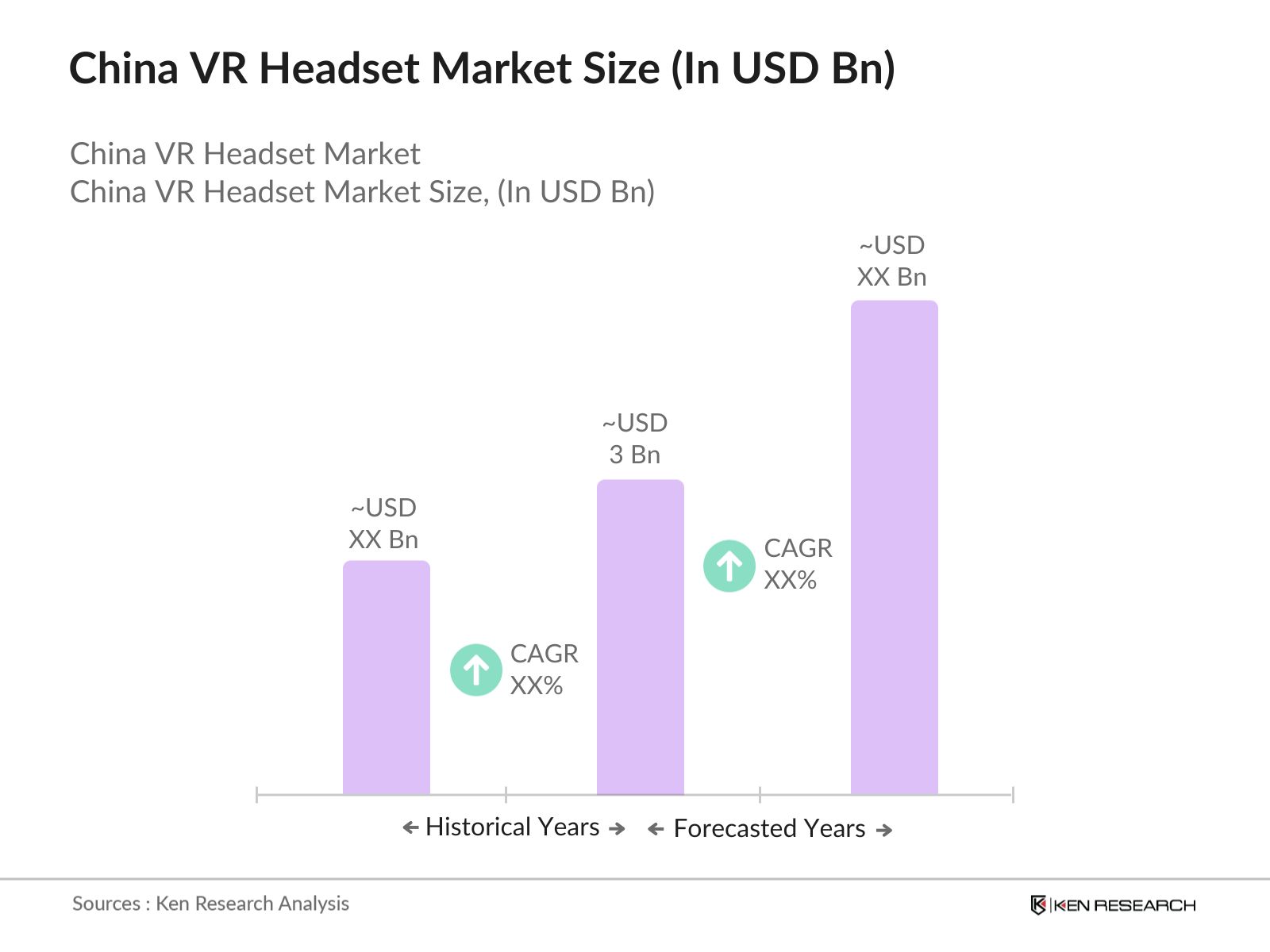
  • The China VR Headset market is valued at USD 3 billion, based on a five-year historical analysis. This growth is driven by the expanding gaming and entertainment industry, alongside the rapid adoption of VR technology in sectors such as healthcare, education, and corporate training. The demand is also fueled by increasing consumer interest in immersive experiences, the deployment of 5G infrastructure across major cities, and investments in R&D by local tech companies.
  • Major cities like Beijing, Shanghai, and Shenzhen dominate the China VR Headset market due to their advanced tech ecosystems and concentration of key industry players. These cities have strong support from local governments, enabling the adoption of cutting-edge technology and innovation in the VR space. The proximity to tech giants like Huawei and Xiaomi, alongside a high concentration of tech-savvy consumers, also contributes to their dominance.
  • China's National Digital Economy Policy, launched in 2021, promotes the development of cutting-edge technologies like VR. By 2023, the policy had mobilized $20 billion in investments for digital infrastructure, including VR technologies. This policy also includes incentives for local manufacturers to produce VR components and devices, reducing reliance on imported technologies. The government's focus on expanding the digital economy aligns with its broader goal of becoming a global leader in technology and innovation, providing a favorable regulatory environment for VR businesses.

market overviews

China VR Headset Market Segmentation

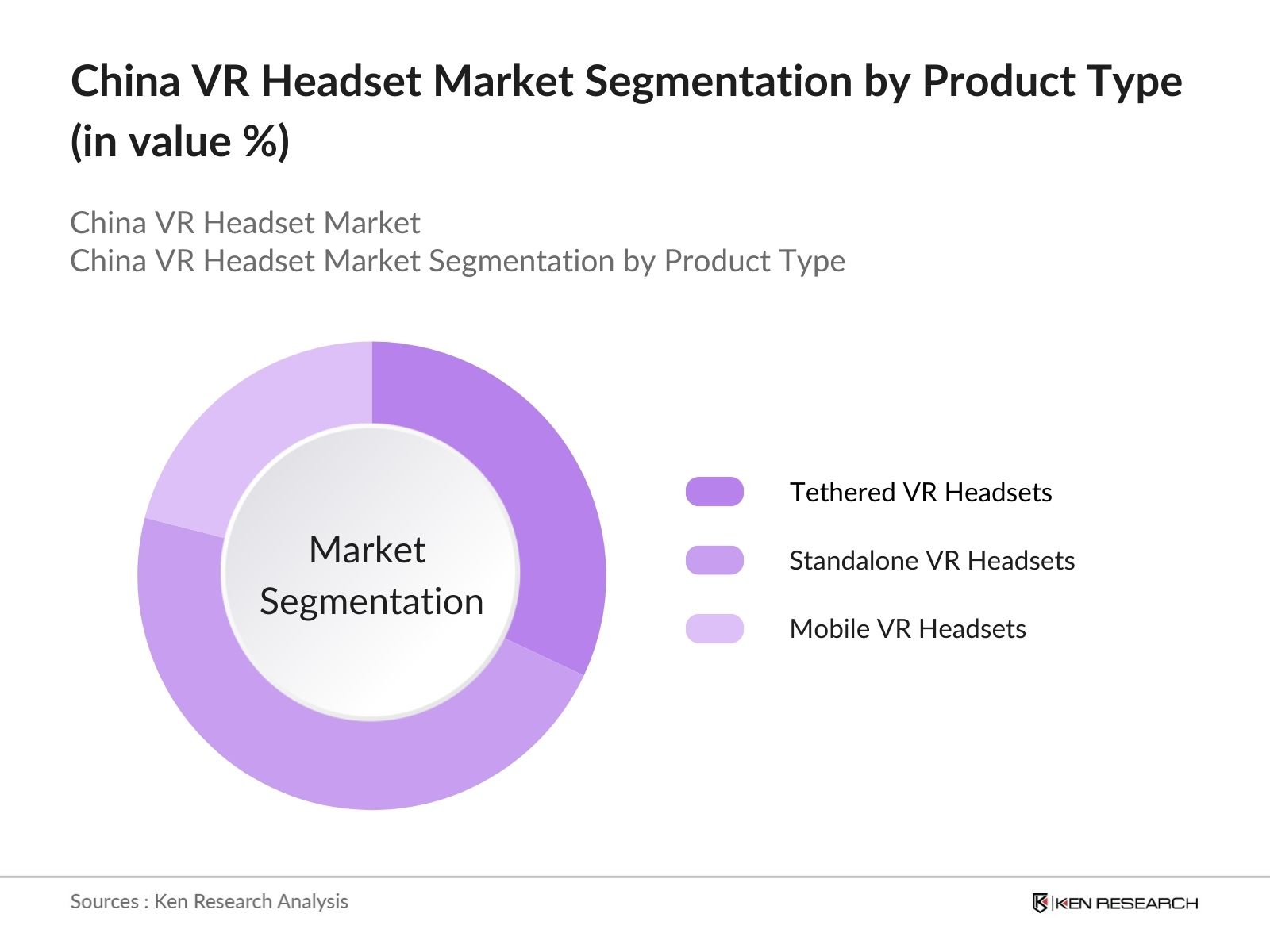
  • By Product Type: The market is segmented by product type into tethered VR headsets, standalone VR headsets, and mobile VR headsets. Among these, standalone VR headsets have a dominant market share due to their portability and ease of use, especially among younger consumers and gaming enthusiasts. The absence of a requirement for external hardware like PCs or consoles has made standalone headsets more popular in the market, driving widespread adoption for both personal and enterprise use.market overviews
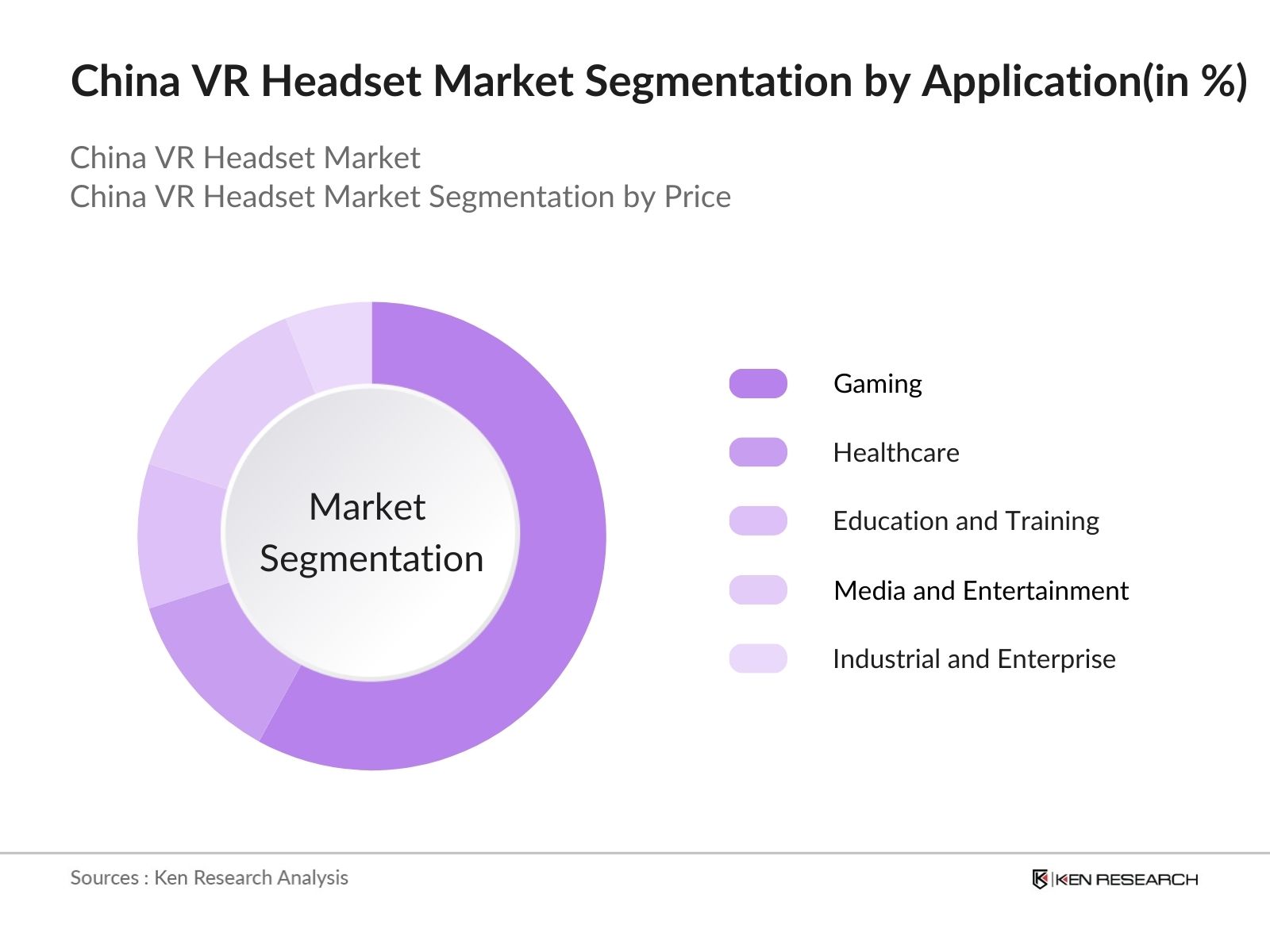
  • By Application: The market is segmented by application into gaming, healthcare, education and training, media and entertainment, and industrial and enterprise. Gaming has the largest share of the market as Chinese consumers continue to invest in immersive, next-generation experiences. The rise of eSports, online multiplayer games, and VR-exclusive content has positioned gaming as the primary growth driver in the market.

market overviews

China VR Headset Market Competitive Landscape

The China VR Headset market is dominated by a mix of local and international players, with companies such as HTC, Oculus (Meta), and Pico Interactive leading the charge. This competitive landscape is characterized by constant innovation, heavy investments in R&D, and strategic partnerships to tap into growing consumer demand for VR technology.

Company

Establishment Year

Headquarters

Product Portfolio

R&D Investments

Market Penetration

Strategic Partnerships

Revenue

Technological Advancements

HTC Corporation

1997

Taiwan


Oculus (Meta Platforms)

2012

USA


Pico Interactive

2015

China


Huawei Technologies Co., Ltd

1987

China


Lenovo Group

1984

China


China VR Headset Industry Analysis

Market Growth Drivers

  • Adoption in Healthcare and Education: The healthcare sector in China has embraced VR for medical training and rehabilitation. By 2023, over 200 hospitals had incorporated VR-based therapy and medical training. With China allocating $230 billion to healthcare in 2023, VR technology is gaining traction in diagnostics and therapy. In education, over 2,000 schools had adopted VR-based learning modules, supported by government initiatives like the "Smart Education Pilot" program launched in 2022. These initiatives aim to make VR a key tool in learning, enhancing student engagement in subjects like science and engineering.
  • Expanding 5G Infrastructure: China leads the world in 5G implementation, with 2.31 million 5G base stations installed by 2023, a number expected to increase in 2024. The widespread rollout of 5G ensures low latency and high-speed data transmission, which are crucial for the VR experience. In 2023, China's investment in 5G infrastructure amounted to $27 billion. The improved bandwidth provided by 5G facilitates seamless VR applications across sectors like entertainment, education, and healthcare, driving the demand for VR headsets.
  • Government Initiatives on Digital Innovation: The Chinese government's 14th Five-Year Plan (2021-2025) emphasizes digital transformation across all industries, with investment in immersive technologies like VR. The government allocated $10 billion in 2022 for digital innovation projects that include VR development. This push for digitalization includes supporting domestic tech companies in developing VR technologies for various sectors, such as healthcare, education, and entertainment. Furthermore, the "Digital China" strategy aims to integrate VR into the national economy, propelling further growth in the VR headset market.

Market Challenges

  • High Production Costs: The production of VR headsets in China faces high costs due to advanced components like motion sensors, high-resolution displays, and precision optics. In 2023, the average production cost of a VR headset ranged between $300 and $500. These costs are influenced by China's reliance on imported high-tech components, despite its efforts to localize the supply chain. The high costs limit the affordability of VR devices, restricting adoption to more affluent consumers, which poses a barrier to mass-market penetration.
  • Limited Content Availability: Although China's VR hardware industry is advancing, the availability of localized, high-quality VR content remains limited. As of 2023, only about 400 VR-ready titles were available for Chinese consumers, compared to over 1,000 in more mature markets like the United States. This limited content library, coupled with the high cost of developing VR-specific applications, slows consumer adoption rates. Developers in China face challenges due to the complex technical demands of creating immersive VR content, which further restricts growth in the market.

China VR Headset Market Future Outlook

Over the next five years, the China VR Headset market is expected to show growth driven by increasing adoption across consumer and enterprise applications. The rapid expansion of 5G networks, coupled with advancements in VR software and hardware, will further drive innovation. Additionally, the growing use of VR in industries like healthcare, education, and real estate presents a promising future for the market. Government support and subsidies for tech innovation will continue to encourage domestic manufacturers to push the boundaries of immersive technology.

Future Market Opportunities

  • Growth in Augmented Reality Integration: China's VR market is increasingly converging with augmented reality (AR) technologies, creating hybrid solutions for businesses and consumers. In 2023, 30% of VR applications in China were developed with AR components. This combination enhances real-world applications in industries like real estate, retail, and tourism, offering immersive virtual experiences alongside physical environments. Chinese tech giants such as Huawei and Tencent are investing in AR-VR technologies, which will drive the expansion of corporate and consumer use cases beyond entertainment and gaming.
  • Expanding Corporate and Industrial Applications: Beyond gaming and entertainment, China's corporate sector is showing increased interest in VR technologies for training, remote work, and product design. In 2023, approximately 20,000 companies in China adopted VR for employee training and remote collaboration. This trend is particularly prominent in industries like manufacturing and construction, where VR simulations can improve efficiency and reduce costs. The industrial adoption of VR is also supported by government programs aimed at fostering innovation in digital tools within traditional industries.

Scope of the Report

By Product Type

Tethered VR Headsets

Standalone VR Headsets

Mobile VR Headsets

By Application

Gaming

Healthcare

Education and Training

Media and Entertainment

Industrial and Enterprise

By Technology

3DoF (Three Degrees of Freedom)

6DoF (Six Degrees of Freedom)

By Distribution Channel

Online Retail

Offline Retail

By Region

North

East

West

South

Products

Key Target Audience

  • VR Headset Manufacturers

  • 5G Infrastructure Providers

  • Content Creators and Game Developers

  • Hospitals and Medical Institutions

  • Educational Institutions (using VR for immersive learning)

  • Industrial and Enterprise Training Firms

  • Investors and Venture Capitalist Firms

  • Government and Regulatory Bodies (Ministry of Industry and Information Technology, MIIT)

Companies

China VR Headset Market Major Players

  • HTC Corporation

  • Oculus (Meta Platforms)

  • Pico Interactive

  • Huawei Technologies Co., Ltd

  • Lenovo Group

  • Xiaomi Corporation

  • DPVR (Deepoon VR)

  • Sony Corporation

  • Valve Corporation

  • Samsung Electronics Co., Ltd.

  • Pimax Technology

  • Qualcomm Technologies

  • Varjo Technologies

  • Google LLC

  • Microsoft Corporation

Table of Contents

1. China VR Headset Market Overview

1.1. Definition and Scope

1.2. Market Taxonomy

1.3. Market Growth Rate

1.4. Market Segmentation Overview

2. China VR Headset Market Size (In USD Bn)

2.1. Historical Market Size
2.2. Year-On-Year Growth Analysis
2.3. Key Market Developments and Milestones

3. China VR Headset Market Analysis

3.1. Growth Drivers
3.1.1. Increasing Demand in Gaming and Entertainment
3.1.2. Adoption in Healthcare and Education
3.1.3. Expanding 5G Infrastructure
3.1.4. Government Initiatives on Digital Innovation
3.2. Market Challenges
3.2.1. High Production Costs
3.2.2. Limited Content Availability
3.2.3. Consumer Skepticism on VR Health Impacts
3.3. Opportunities
3.3.1. Growth in Augmented Reality Integration
3.3.2. Expanding Corporate and Industrial Applications
3.3.3. Technological Advancements in Visual and Immersive Experiences
3.4. Trends
3.4.1. Integration with AI for Enhanced User Experience
3.4.2. Cloud VR Advancements
3.4.3. Social VR Platforms and Virtual Events
3.5. Government Regulations
3.5.1. National Digital Economy Policy
3.5.2. Guidelines for Consumer Safety and Health in VR Use
3.5.3. Support for VR Adoption in Education
3.6. SWOT Analysis
3.7. Stakeholder Ecosystem
3.8. Porters Five Forces Analysis
3.9. Competitive Ecosystem Analysis

4. China VR Headset Market Segmentation

4.1. By Product Type (In Value %)

4.1.1. Tethered VR Headsets
4.1.2. Standalone VR Headsets
4.1.3. Mobile VR Headsets
4.2. By Application (In Value %) 4.2.1. Gaming
4.2.2. Healthcare
4.2.3. Education and Training
4.2.4. Media and Entertainment
4.2.5. Industrial and Enterprise
4.3. By Technology (In Value %)

4.3.1. 3DoF (Three Degrees of Freedom)
4.3.2. 6DoF (Six Degrees of Freedom)
4.4. By Distribution Channel (In Value %)

4.4.1. Online Retail
4.4.2. Offline Retail
4.5. By Region (In Value %)

4.5.1. North

4.5.2. South

4.5.3. East

4.5.4. West

5. China VR Headset Market Competitive Analysis

5.1. Detailed Profiles of Major Companies
5.1.1. HTC Corporation
5.1.2. Sony Corporation
5.1.3. Oculus (Meta Platforms)
5.1.4. Pico Interactive
5.1.5. Huawei Technologies Co., Ltd.
5.1.6. Lenovo Group
5.1.7. DPVR (Deepoon VR)
5.1.8. Xiaomi Corporation
5.1.9. Valve Corporation
5.1.10. Samsung Electronics Co., Ltd.
5.1.11. Microsoft Corporation
5.1.12. Google LLC
5.1.13. Pimax Technology
5.1.14. Qualcomm Technologies
5.1.15. Varjo Technologies

5.2. Cross Comparison Parameters

(Headquarters, Inception Year, Product Portfolio, Market Penetration, R&D Investment, Strategic Partnerships, Unit Shipments, Product Differentiation)

5.3. Market Share Analysis

5.4. Strategic Initiatives

5.5. Mergers And Acquisitions

5.6. Investment Analysis

5.7. Venture Capital Funding

5.8. Government Grants

5.9. Private Equity Investments

6. China VR Headset Market Regulatory Framework

6.1. Safety and Consumer Protection Guidelines
6.2. Data Privacy and Security Standards for VR Applications
6.3. Government Incentives for VR Technology Development

7. China VR Headset Future Market Size (In USD Bn)

7.1. Future Market Size Projections
7.2. Key Factors Driving Future Market Growth

8. China VR Headset Future Market Segmentation

8.1. By Product Type (In Value %)
8.2. By Application (In Value %)
8.3. By Technology (In Value %)
8.4. By Distribution Channel (In Value %)
8.5. By Region (In Value %)

9. China VR Headset Market Analysts Recommendations

9.1. TAM/SAM/SOM Analysis
9.2. Customer Cohort Analysis
9.3. Marketing Initiatives
9.4. White Space Opportunity Analysis

Disclaimer

Contact Us

Research Methodology

Step 1: Identification of Key Variables

The initial phase involves constructing an ecosystem map encompassing all major stakeholders within the China VR Headset market. Extensive desk research is performed, utilizing secondary and proprietary databases to gather comprehensive market information. The goal is to define the critical variables influencing market growth, such as 5G deployment and consumer trends.

Step 2: Market Analysis and Construction

This phase focuses on compiling and analyzing historical data regarding market size, product segmentation, and industry revenue generation. Evaluation of VR headset adoption by end-users will be conducted to ensure data reliability.

Step 3: Hypothesis Validation and Expert Consultation

We validate the constructed market hypotheses through interviews with industry experts. These consultations offer operational and financial insights, which help refine the market data and trends analysis.

Step 4: Research Synthesis and Final Output

The final step entails direct engagement with VR manufacturers and industry players, which ensures a comprehensive understanding of product offerings and sales performance. This process helps in delivering a validated and holistic analysis of the market.

Frequently Asked Questions

01. How big is the China VR Headset market?

The China VR Headset market is valued at USD 3 billion, driven by increasing adoption in gaming, healthcare, and industrial applications, alongside investments in VR hardware and software innovations.

02. What are the challenges in the China VR Headset market?

Key challenges in China VR Headset market include high production costs, limited high-quality content, and consumer health concerns related to prolonged VR usage. Additionally, there is a need for improved compatibility and comfort in headset design.

03. Who are the major players in the China VR Headset market?

Key players in China VR Headset market include HTC Corporation, Oculus (Meta Platforms), Pico Interactive, Huawei Technologies Co., Ltd., and Lenovo Group. These companies dominate due to their strong product portfolios, R&D investments, and strategic partnerships.

04. What are the growth drivers of the China VR Headset market?

The China VR Headset market is driven by advancements in 5G infrastructure, increasing demand for immersive entertainment experiences, and growing use in education, healthcare, and industrial training sectors.

05. What are the emerging trends in the China VR Headset market?

Emerging trends in China VR Headset market include the integration of AI in VR systems for enhanced user experiences, cloud-based VR solutions, and the growth of social VR platforms for virtual events and interactions.

Why Buy From Us?

RRR
Refine Robust Result (RRR) Framework

What makes us stand out is that our consultants follows Robust, Refine and Result (RRR) methodology. i.e. Robust for clear definitions, approaches and sanity checking, Refine for differentiating respondents facts and opinions and Result for presenting data with story

Our Reach Is Unmatched

We have set a benchmark in the industry by offering our clients with syndicated and customized market research reports featuring coverage of entire market as well as meticulous research and analyst insights.

Research
Shifting the Research Paradigm

While we don't replace traditional research, we flip the method upside down. Our dual approach of Top Bottom & Bottom Top ensures quality deliverable by not just verifying company fundamentals but also looking at the sector and macroeconomic factors.

Insite
More Insights-Better Decisions

With one step in the future, our research team constantly tries to show you the bigger picture. We help with some of the tough questions you may encounter along the way: How is the industry positioned? Best marketing channel? KPI's of competitors? By aligning every element, we help maximize success.

Trust
Transparency and Trust

Our report gives you instant access to the answers and sources that other companies might choose to hide. We elaborate each steps of research methodology we have used and showcase you the sample size to earn your trust.

support
Round the Clock Support

If you need any support, we are here! We pride ourselves on universe strength, data quality, and quick, friendly, and professional service.

Why Client Choose Us?

400000+ Reports in repository
150+ Consulting project a year
100+ Analysts
8000+ Client Queries in 2022