
Europe 3PL Market Outlook to 2030
Region:Europe
Author(s):Paribhasha Tiwari
Product Code:KROD10043
Region:Europe
Author(s):Paribhasha Tiwari
Product Code:KROD10043
December 2024
83
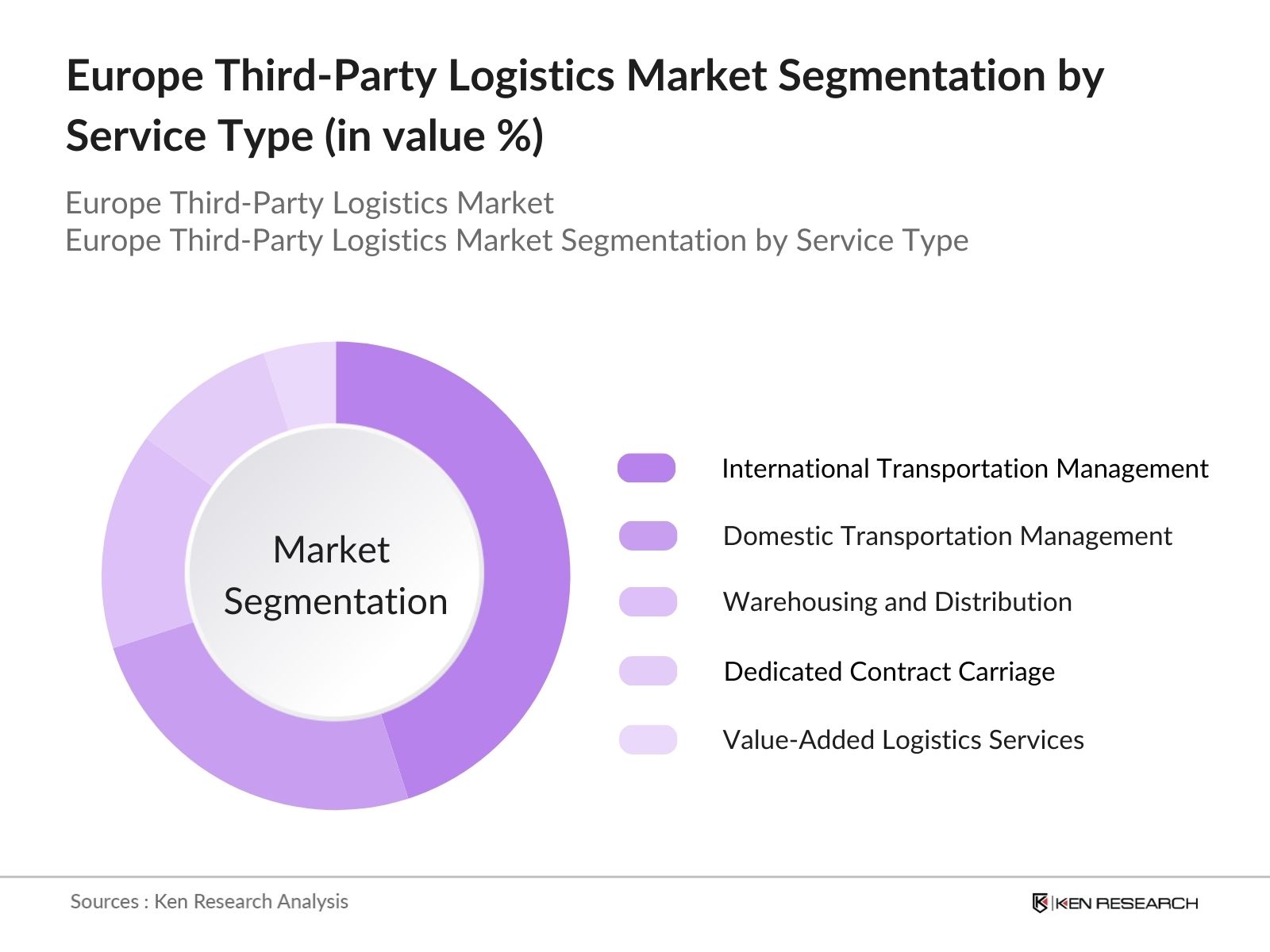
By Service Type: The Europe 3PL market is segmented by service type into Domestic Transportation Management (DTM), International Transportation Management (ITM), Warehousing and Distribution, Dedicated Contract Carriage (DCC), and Value-Added Logistics Services (VALs). Among these, International Transportation Management holds a dominant market share due to the high volume of cross-border trade within Europe and between Europe and other continents. The need for efficient management of international shipments, customs clearance, and compliance with varying regulations makes ITM services indispensable for businesses engaged in global trade.
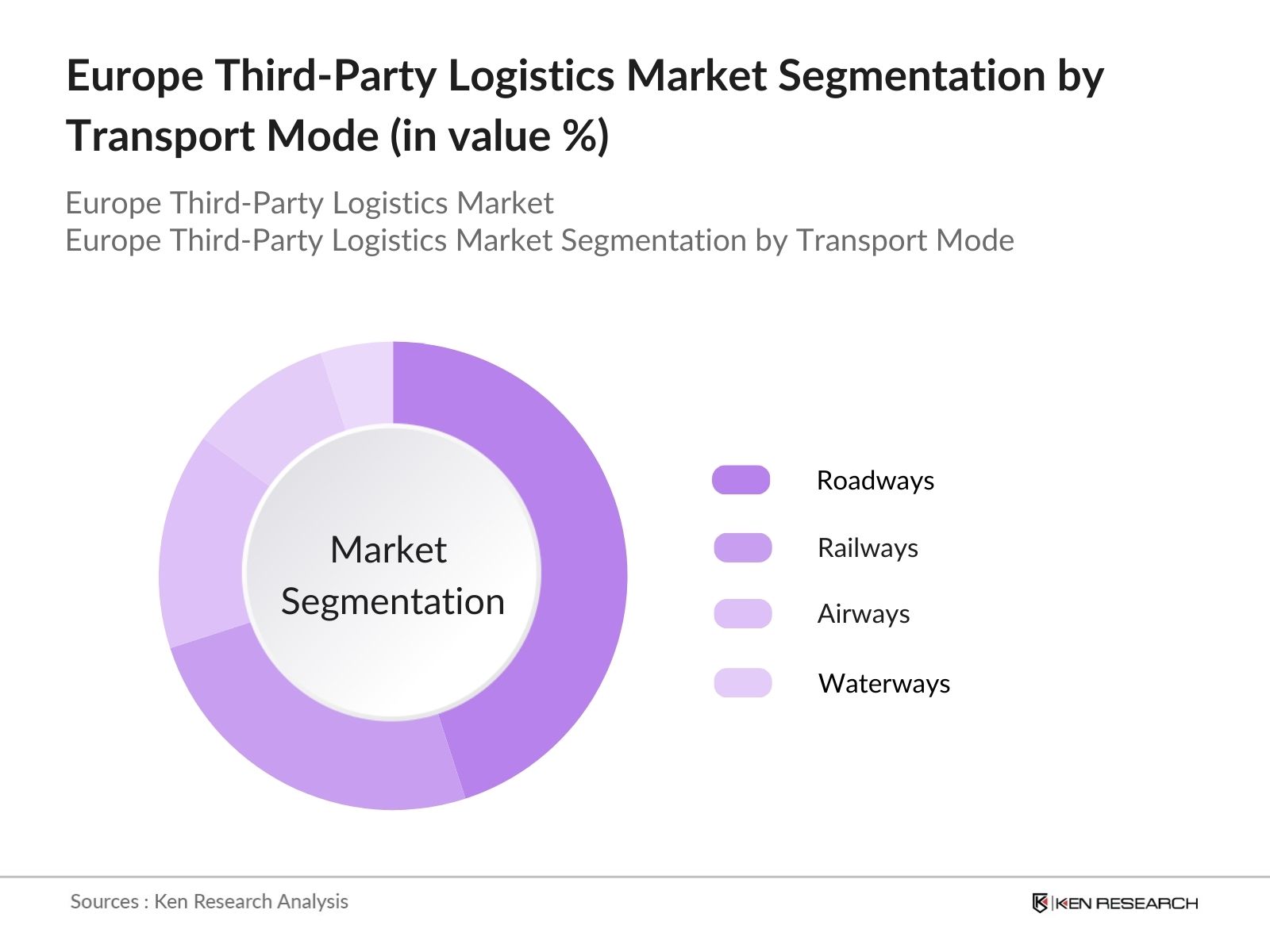
By Transport Mode: The market is also segmented by transport mode into Roadways, Railways, Waterways, and Airways. Roadways dominate the market share, primarily because of Europe's extensive and well-developed road network, which facilitates efficient door-to-door delivery services. The flexibility and cost-effectiveness of road transport make it the preferred choice for both domestic and international logistics within the continent.
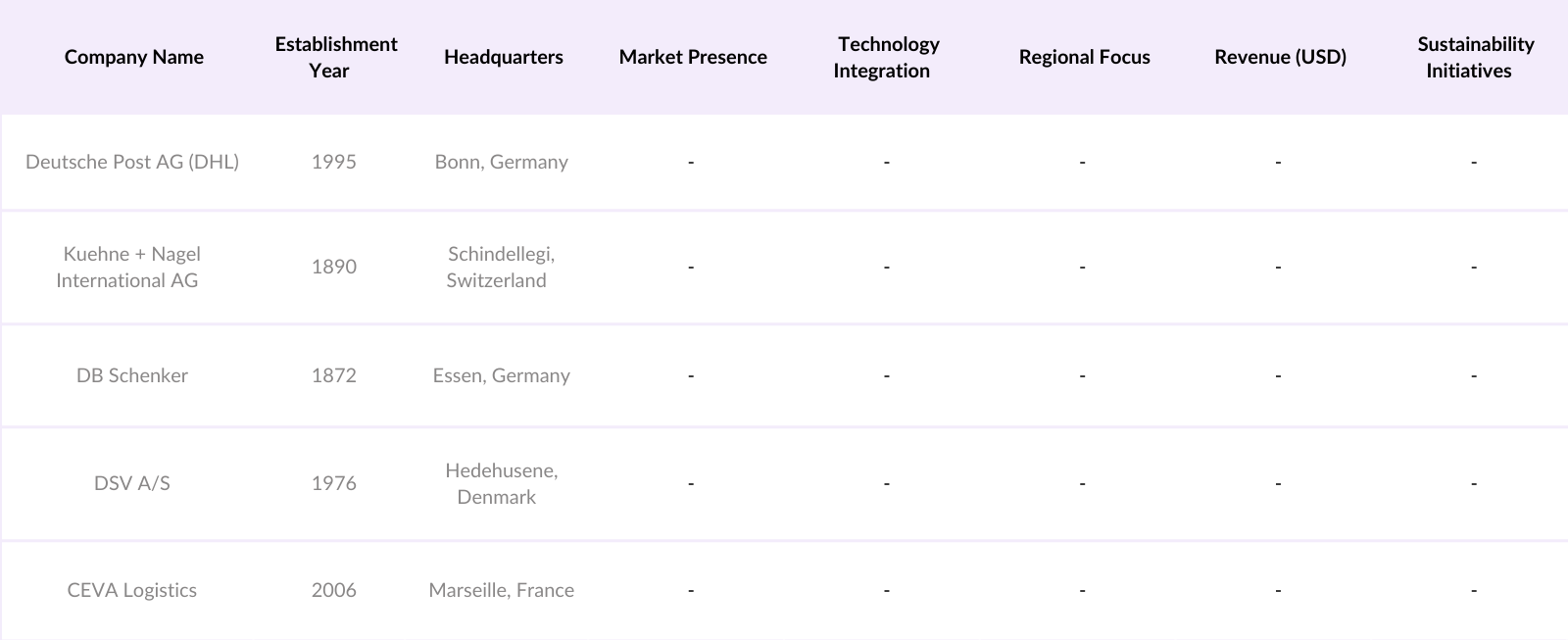
The European 3PL market is characterized by the presence of several key players who offer a wide range of logistics services. These companies leverage advanced technologies and extensive networks to provide efficient and reliable logistics solutions.
Over the next five years, the Europe 3PL market is expected to experience significant growth, driven by the continuous expansion of e-commerce, advancements in logistics technology, and increasing demand for efficient supply chain solutions. The integration of technologies such as the Internet of Things (IoT), blockchain, and artificial intelligence is anticipated to enhance operational efficiency and transparency in logistics operations.
|
By Service |
Domestic Transportation Management (DTM) |
|
By Transport Mode |
Roadways |
|
By End-Use Industry |
Retail |
|
By Country |
Germany |
1.1 Definition and Scope
1.2 Market Taxonomy
1.3 Market Growth Rate
1.4 Market Segmentation Overview
2.1 Historical Market Size
2.2 Year-On-Year Growth Analysis
2.3 Key Market Developments and Milestones
3.1 Growth Drivers
3.1.1 Expansion of E-commerce Sector
3.1.2 Globalization and International Trade
3.1.3 Technological Advancements in Logistics
3.1.4 Focus on Core Competencies by Businesses
3.2 Market Challenges
3.2.1 Regulatory Compliance and Trade Barriers
3.2.2 High Operational Costs
3.2.3 Limited Use of Information Technology
3.2.4 Geopolitical Instabilities
3.3 Opportunities
3.3.1 Adoption of Green Logistics Solutions
3.3.2 Integration of Big Data and Analytics
3.3.3 Growth in Emerging Markets
3.3.4 Development of Multi-modal Transportation Networks
3.4 Trends
3.4.1 Emergence of Big Data in Logistics
3.4.2 Growth in Online Retailing
3.4.3 Increase in Mergers and Acquisitions
3.4.4 Shift Towards Omni-channel Distribution
3.5 Government Regulations
3.5.1 EU Logistics Policies
3.5.2 Environmental Regulations
3.5.3 Trade Agreements and Tariffs
3.5.4 Customs and Border Control Policies
3.6 SWOT Analysis
3.7 Stakeholder Ecosystem
3.8 Porters Five Forces Analysis
3.9 Competitive Landscape
4.1 By Service (In Value %)
4.1.1 Domestic Transportation Management (DTM)
4.1.2 International Transportation Management (ITM)
4.1.3 Warehousing and Distribution
4.1.4 Dedicated Contract Carriage (DCC)
4.1.5 Value-Added Logistics Services (VALs)
4.2 By Transport Mode (In Value %)
4.2.1 Roadways
4.2.2 Railways
4.2.3 Waterways
4.2.4 Airways
4.3 By End-Use Industry (In Value %)
4.3.1 Retail
4.3.2 Manufacturing
4.3.3 Healthcare
4.3.4 Automotive
4.3.5 Consumer Goods
4.4 By Country (In Value %)
4.4.1 Germany
4.4.2 United Kingdom
4.4.3 France
4.4.4 Italy
4.4.5 Spain
4.4.6 Rest of Europe
5.1 Detailed Profiles of Major Companies
5.1.1 Deutsche Post AG (DHL)
5.1.2 DB Schenker
5.1.3 Kuehne + Nagel International AG
5.1.4 DSV A/S
5.1.5 XPO Logistics, Inc.
5.1.6 CEVA Logistics
5.1.7 FedEx Corporation
5.1.8 UPS Supply Chain Solutions
5.1.9 Geodis
5.1.10 Panalpina World Transport (Holding) Ltd.
5.1.11 Nippon Express Co., Ltd.
5.1.12 Yusen Logistics Co., Ltd.
5.1.13 Agility Logistics
5.1.14 Bollor Logistics
5.1.15 Expeditors International of Washington, Inc.
5.2 Cross Comparison Parameters
5.2.1 Number of Employees
5.2.2 Headquarters Location
5.2.3 Year of Establishment
5.2.4 Annual Revenue
5.2.5 Service Portfolio
5.2.6 Geographic Presence
5.2.7 Technological Capabilities
5.2.8 Strategic Partnerships
5.3 Market Share Analysis
5.4 Strategic Initiatives
5.5 Mergers and Acquisitions
5.6 Investment Analysis
5.7 Venture Capital Funding
5.8 Government Grants
5.9 Private Equity Investments
6.1 Environmental Standards
6.2 Compliance Requirements
6.3 Certification Processes
7.1 Future Market Size Projections
7.2 Key Factors Driving Future Market Growth
8.1 By Service (In Value %)
8.2 By Transport Mode (In Value %)
8.3 By End-Use Industry (In Value %)
8.4 By Country (In Value %)
9.1 Total Addressable Market (TAM), Serviceable Available Market (SAM), and Serviceable Obtainable Market (SOM) Analysis
9.2 Customer Cohort Analysis
9.3 Marketing Initiatives
9.4 White Space Opportunity Analysis
The initial phase involves constructing an ecosystem map encompassing all major stakeholders within the Europe Third-Party Logistics (3PL) Market. This step is underpinned by extensive desk research, utilizing a combination of secondary and proprietary databases to gather comprehensive industry-level information. The primary objective is to identify and define the critical variables that influence market dynamics.
In this phase, we will compile and analyze historical data pertaining to the Europe 3PL Market. This includes assessing market penetration, the ratio of marketplaces to service providers, and the resultant revenue generation. Furthermore, an evaluation of service quality statistics will be conducted to ensure the reliability and accuracy of the revenue estimates.
Market hypotheses will be developed and subsequently validated through computer-assisted telephone interviews (CATIs) with industry experts representing a diverse array of companies. These consultations will provide valuable operational and financial insights directly from industry practitioners, which will be instrumental in refining and corroborating the market data.
The final phase involves direct engagement with multiple logistics service providers to acquire detailed insights into service segments, operational performance, customer preferences, and other pertinent factors. This interaction will serve to verify and complement the statistics derived from the bottom-up approach, thereby ensuring a comprehensive, accurate, and validated analysis of the Europe 3PL market.
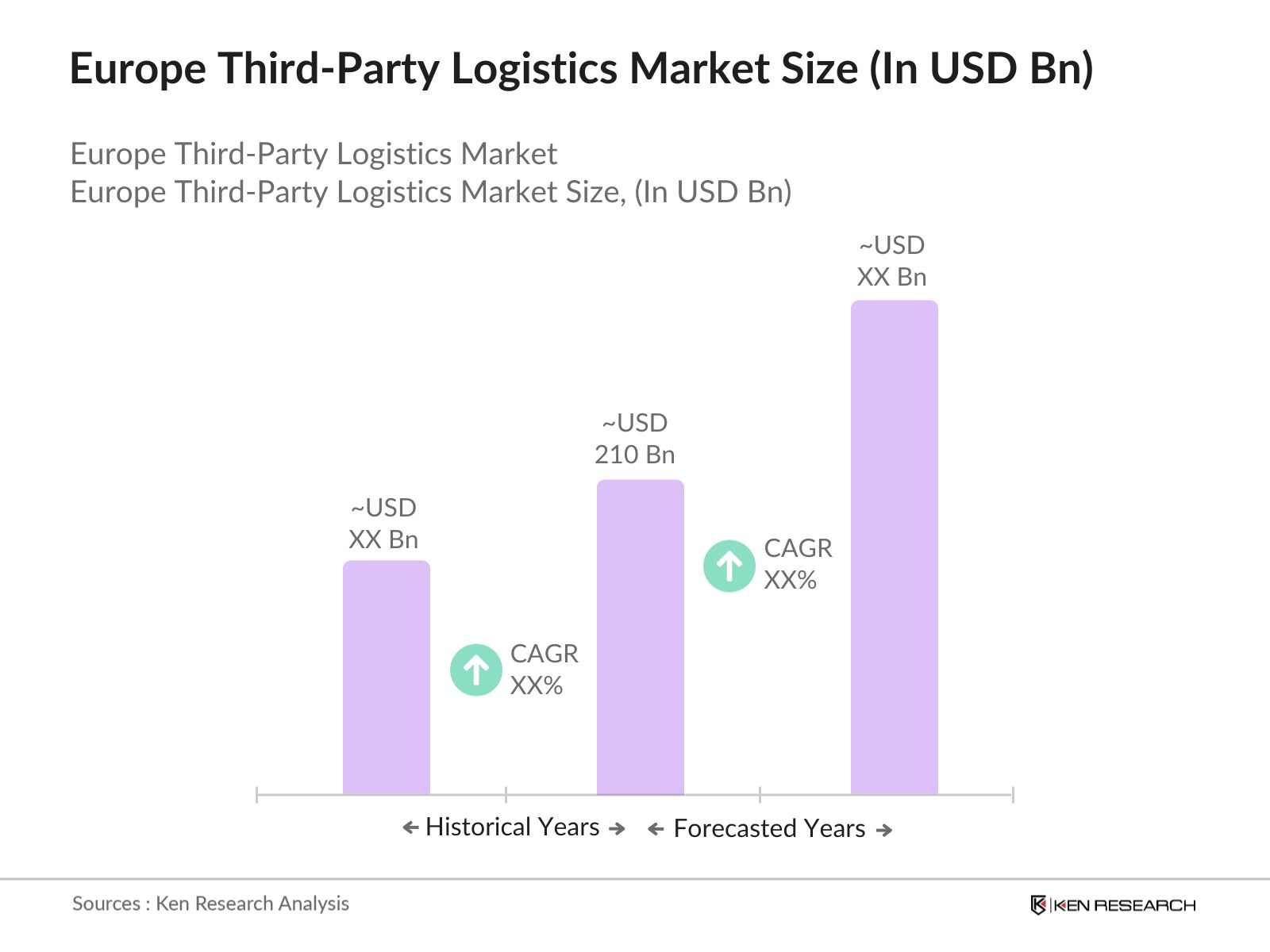
The Europe Third-Party Logistics (3PL) market is valued at USD 210 billion, based on a five-year historical analysis.
Challenges in the Europe 3PL Market include regulatory compliance complexities, high operational costs, limited adoption of advanced information technology, and geopolitical instabilities affecting cross-border logistics.
Key players in the Europe 3PL Market include Deutsche Post AG (DHL), Kuehne + Nagel International AG, DB Schenker, DSV A/S, and CEVA Logistics. These companies dominate due to their extensive service portfolios, technological integration, and expansive regional networks.
The Europe 3PL Market is propelled by factors such as the expansion of international trade, growth in e-commerce activities, technological advancements in logistics, and businesses' focus on core competencies leading to increased outsourcing of logistics functions.

What makes us stand out is that our consultants follows Robust, Refine and Result (RRR) methodology. i.e. Robust for clear definitions, approaches and sanity checking, Refine for differentiating respondents facts and opinions and Result for presenting data with story

We have set a benchmark in the industry by offering our clients with syndicated and customized market research reports featuring coverage of entire market as well as meticulous research and analyst insights.

While we don't replace traditional research, we flip the method upside down. Our dual approach of Top Bottom & Bottom Top ensures quality deliverable by not just verifying company fundamentals but also looking at the sector and macroeconomic factors.

With one step in the future, our research team constantly tries to show you the bigger picture. We help with some of the tough questions you may encounter along the way: How is the industry positioned? Best marketing channel? KPI's of competitors? By aligning every element, we help maximize success.

Our report gives you instant access to the answers and sources that other companies might choose to hide. We elaborate each steps of research methodology we have used and showcase you the sample size to earn your trust.

If you need any support, we are here! We pride ourselves on universe strength, data quality, and quick, friendly, and professional service.