
Europe Agricultural Robots Market Outlook to 2030
Region:Europe
Author(s):Sanjna
Product Code:KROD3036
Region:Europe
Author(s):Sanjna
Product Code:KROD3036
November 2024
94

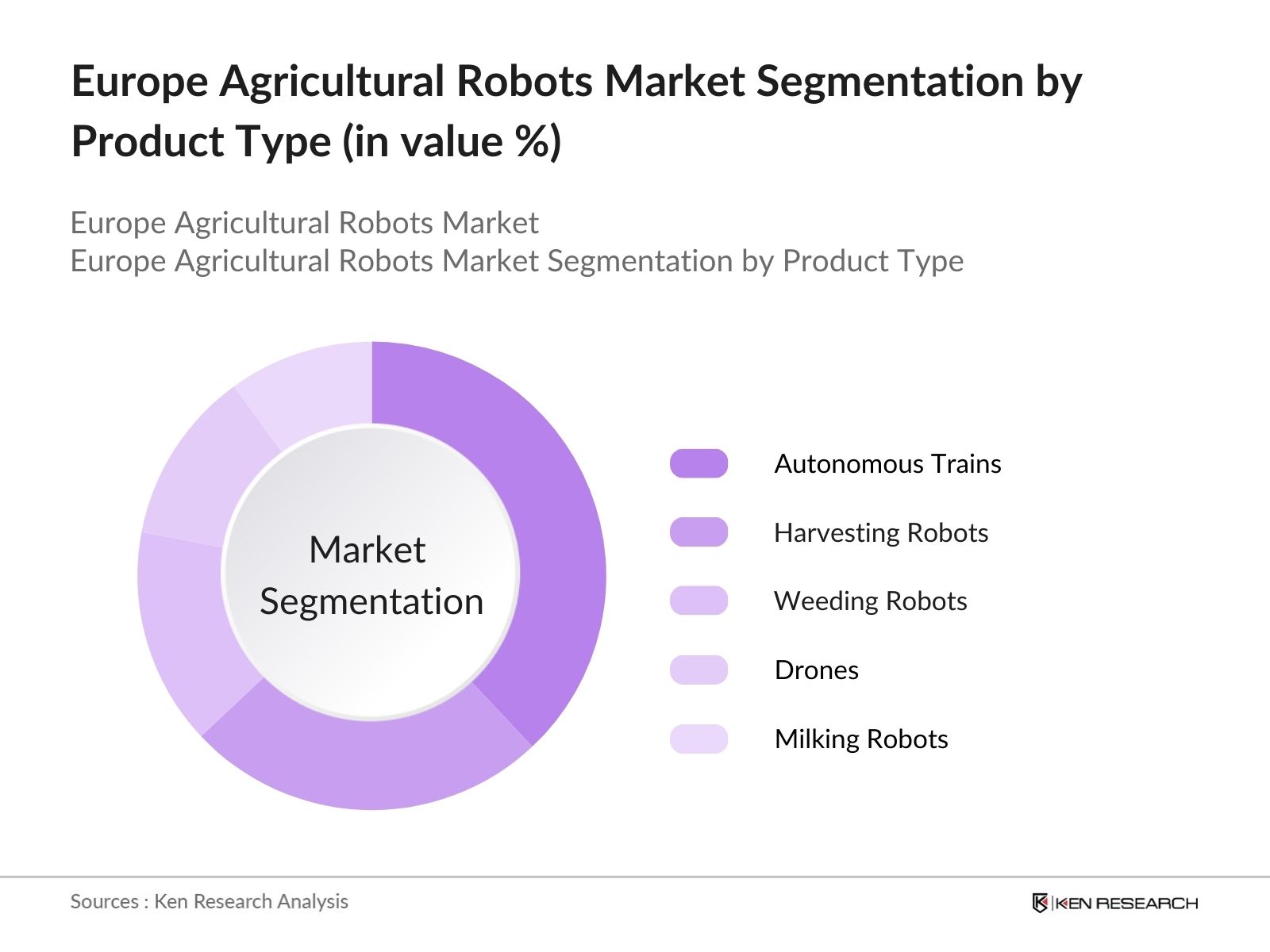
By Product Type: The Europe Agricultural Robots market is segmented by product type into autonomous tractors, harvesting robots, weeding robots, drones, and milking robots. Recently, autonomous tractors have a dominant market share due to their integration with advanced GPS systems and AI technologies, which allow for precision in fieldwork. This helps to reduce manual labor and improve efficiency, which is particularly valuable in regions experiencing agricultural labor shortages. Major players such as John Deere have been actively innovating in this area, further driving demand for autonomous tractors.
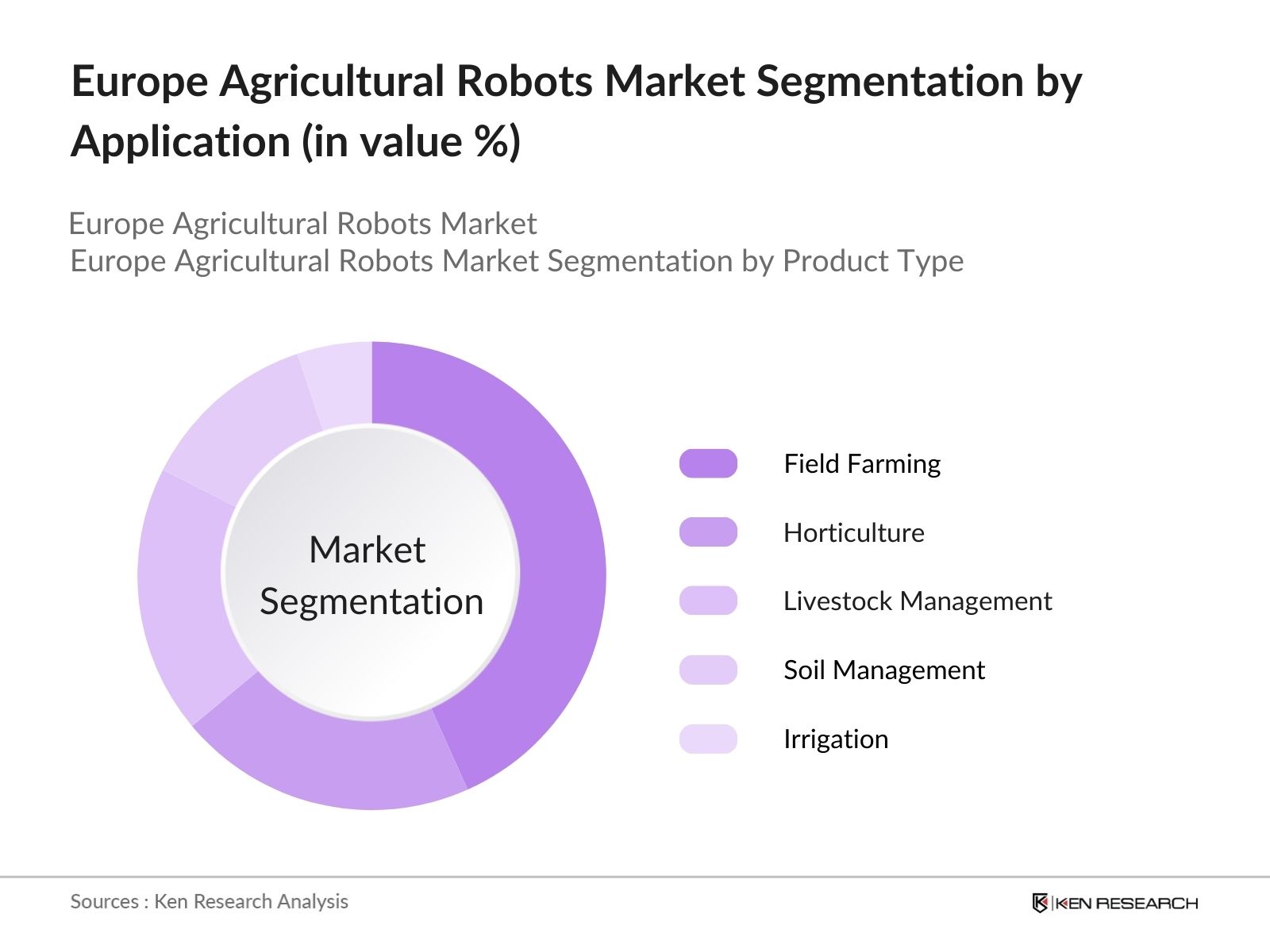
By Application: The market is also segmented by application into field farming, horticulture, livestock management, soil management, and irrigation. Field farming holds the largest share of the market due to the extensive use of robots for seeding, weeding, and harvesting across vast areas of land. The ability to automate tasks such as tillage and planting has made field farming the primary focus of agricultural robotics innovation, especially in countries like France and Germany, where large-scale farms benefit significantly from such technologies.
The Europe Agricultural Robots market is dominated by several key players who have strong technological capabilities and have heavily invested in R&D. Companies like John Deere, AGCO Corporation, and Kubota Corporation are leading the market with their innovative product portfolios. These companies leverage their extensive distribution networks, global presence, and strategic partnerships to maintain their market position.
|
Company |
Established |
Headquarters |
Product Portfolio |
Innovation Focus |
Revenue |
Market Presence |
Strategic Partnerships |
R&D Investment |
Customer Base |
|||
|
John Deere |
1837 |
Illinois, USA |
- |
- |
- |
- |
- |
- |
- |
|||
|
CNH Industrial |
1999 |
London, UK |
- |
- |
- |
- |
- |
- |
- |
|||
|
Kubota Corporation |
1890 |
Osaka, Japan |
- |
- |
- |
- |
- |
- |
- |
|||
|
AGCO Corporation |
1990 |
Georgia, USA |
- |
- |
- |
- |
- |
- |
- |
|||
|
Trimble Inc. |
1978 |
California, USA |
- |
- |
- |
- |
- |
- |
- |
|||
The competition in the market is characterized by a high level of technological advancements and strong focus on innovation, particularly in areas such as AI, IoT, and autonomous systems. As companies compete to develop more efficient and reliable robotic solutions, the market is expected to witness further consolidation, with major players acquiring smaller, specialized firms.
Over the next five years, the Europe Agricultural Robots market is expected to grow significantly, driven by increasing automation in agriculture, advances in AI and machine learning technologies, and the implementation of government policies supporting sustainable farming. The expansion of smart farming technologies, especially the integration of IoT and AI-based systems, will further stimulate the market, making agricultural robots more accessible and efficient for farmers across Europe.
|
Segment |
Sub-Segments |
|
Product Type |
Autonomous Tractors |
|
Harvesting Robots |
|
|
Weeding Robots |
|
|
Drones |
|
|
Milking Robots |
|
|
Application |
Field Farming |
|
Horticulture |
|
|
Livestock Management |
|
|
Soil Management |
|
|
Irrigation |
|
|
Technology |
GPS Technology |
|
AI and Machine Learning |
|
|
Robotics & Automation Systems |
|
|
Vision Systems & Sensors |
|
|
IoT and Connectivity Solutions |
|
|
End-User |
Small & Medium-Sized Farms |
|
Large Farms |
|
|
Cooperative Farming |
|
|
Region |
Western Europe |
|
Eastern Europe |
|
|
Southern Europe |
|
|
Northern Europe |
|
|
Central Europe |
1.1 Definition and Scope
1.2 Market Taxonomy
1.3 Market Growth Rate
1.4 Market Segmentation Overview
2.1 Historical Market Size
2.2 Year-On-Year Growth Analysis
2.3 Key Market Developments and Milestones
3.1 Growth Drivers
3.1.1 Increased Demand for Precision Agriculture (Technological Integration in Farming)
3.1.2 Shortage of Agricultural Workforce (Automation to Compensate Labor Shortage)
3.1.3 Rising Adoption of Smart Farming Practices (IoT in Agriculture)
3.1.4 Government Incentives for Sustainable Farming (Subsidies for Robotic Solutions)
3.2 Market Challenges
3.2.1 High Initial Investment Costs (Capital Expenditure for Robotics Equipment)
3.2.2 Lack of Skilled Workforce for Robotic Operations (Technical Barriers for Farmers)
3.2.3 Regulatory Concerns (EU Robotics and Safety Regulations)
3.3 Opportunities
3.3.1 Advances in AI and Machine Learning for Robotics (AI in Agricultural Drones)
3.3.2 Integration of 5G and IoT Networks (Smart Farm Connectivity)
3.3.3 Expansion of Robotic Leasing Models (Cost-Effective Adoption for Small Farmers)
3.4 Trends
3.4.1 Adoption of Fully Autonomous Robots (Autonomous Weeding and Seeding Systems)
3.4.2 Increasing Use of Drones in Agriculture (Drone-Based Crop Monitoring and Spraying)
3.4.3 Vertical Farming and Robotics (Urban Agriculture Integration)
3.5 Government Regulation
3.5.1 EU Policies on Precision Agriculture (Common Agricultural Policy, CAP)
3.5.2 Subsidies for Robotic Implementations (Funding for Automation)
3.5.3 Environmental Regulations for Robotic Equipment (Carbon Emission Targets)
3.5.4 Data Protection Laws Impacting Smart Farms (GDPR Compliance for Data from Robots)
3.6 SWOT Analysis
3.7 Stake Ecosystem
3.8 Porters Five Forces
3.9 Competition Ecosystem
4.1 By Product Type (In Value %)
4.1.1 Autonomous Tractors
4.1.2 Harvesting Robots
4.1.3 Weeding Robots
4.1.4 Drones
4.1.5 Milking Robots
4.2 By Application (In Value %)
4.2.1 Field Farming
4.2.2 Horticulture
4.2.3 Livestock Management
4.2.4 Soil Management
4.2.5 Irrigation
4.3 By Technology (In Value %)
4.3.1 GPS Technology
4.3.2 AI and Machine Learning
4.3.3 Robotics & Automation Systems
4.3.4 Vision Systems & Sensors
4.3.5 IoT and Connectivity Solutions
4.4 By End-User (In Value %)
4.4.1 Small & Medium-Sized Farms
4.4.2 Large Farms
4.4.3 Cooperative Farming
4.5 By Region (In Value %)
4.5.1 Western Europe
4.5.2 Eastern Europe
4.5.3 Southern Europe
4.5.4 Northern Europe
4.5.5 Central Europe
5.1 Detailed Profiles of Major Companies
5.1.1 John Deere
5.1.2 CNH Industrial
5.1.3 Kubota Corporation
5.1.4 AGCO Corporation
5.1.5 Trimble Inc.
5.1.6 AgEagle Aerial Systems
5.1.7 DeLaval
5.1.8 Boumatic Robotics
5.1.9 DJI
5.1.10 Nao Technologies
5.1.11 Autonomous Solutions Inc.
5.1.12 Fendt (AGCO)
5.1.13 Harvest Automation
5.1.14 Lely Industries N.V.
5.1.15 Robotic Harvesting
5.2 Cross Comparison Parameters (Product Portfolio, Market Presence, Innovation Focus, Technology Capabilities, Revenue, Customer Base, Investment in R&D, Strategic Partnerships)
5.3 Market Share Analysis
5.4 Strategic Initiatives
5.5 Mergers and Acquisitions
5.6 Investment Analysis
5.7 Venture Capital Funding
5.8 Government Grants
5.9 Private Equity Investments
6.1 Environmental Standards for Robotic Machinery
6.2 Compliance Requirements for Safety Standards
6.3 Certification Processes for Autonomous Systems
7.1 Future Market Size Projections
7.2 Key Factors Driving Future Market Growth
8.1 By Product Type (In Value %)
8.2 By Application (In Value %)
8.3 By Technology (In Value %)
8.4 By End-User (In Value %)
8.5 By Region (In Value %)
9.1 TAM/SAM/SOM Analysis
9.2 Customer Cohort Analysis
9.3 Marketing Initiatives
9.4 White Space Opportunity Analysis
The first phase of research involved identifying the key variables within the Europe Agricultural Robots market by conducting extensive desk research and utilizing a combination of proprietary and secondary data sources. This phase involved constructing an ecosystem map that highlighted all stakeholders in the agricultural robotics industry.
Historical market data were analyzed to understand trends and identify the key drivers impacting market dynamics. An evaluation of farm sizes, technological adoption rates, and labor trends were carried out to estimate revenue and penetration rates across European countries.
Interviews with industry experts, including robotic manufacturers and farm operators, were conducted to validate market hypotheses. These consultations offered direct insights into the market's operational challenges, opportunities, and financial performance.
The final phase synthesized all primary and secondary data to develop market forecasts and derive detailed insights into product segments, technological adoption, and revenue generation. These insights were verified through direct engagement with agricultural manufacturers and stakeholders.
The Europe Agricultural Robots market is valued at USD 3 billion and is driven by the increasing need for automation in agriculture due to labor shortages and the demand for more efficient farming practices.
Challenges include high initial costs for robotic equipment, regulatory concerns related to the safety and operation of autonomous systems, and a lack of skilled workforce to manage advanced robotics on farms.
Key players include John Deere, CNH Industrial, AGCO Corporation, Kubota Corporation, and Trimble Inc., who dominate due to their technological advancements, large-scale operations, and global distribution networks.
The market is propelled by the adoption of precision agriculture technologies, government support for sustainable farming practices, and technological advancements in AI and IoT, which make robotics more accessible to farmers.

What makes us stand out is that our consultants follows Robust, Refine and Result (RRR) methodology. i.e. Robust for clear definitions, approaches and sanity checking, Refine for differentiating respondents facts and opinions and Result for presenting data with story

We have set a benchmark in the industry by offering our clients with syndicated and customized market research reports featuring coverage of entire market as well as meticulous research and analyst insights.

While we don't replace traditional research, we flip the method upside down. Our dual approach of Top Bottom & Bottom Top ensures quality deliverable by not just verifying company fundamentals but also looking at the sector and macroeconomic factors.

With one step in the future, our research team constantly tries to show you the bigger picture. We help with some of the tough questions you may encounter along the way: How is the industry positioned? Best marketing channel? KPI's of competitors? By aligning every element, we help maximize success.

Our report gives you instant access to the answers and sources that other companies might choose to hide. We elaborate each steps of research methodology we have used and showcase you the sample size to earn your trust.

If you need any support, we are here! We pride ourselves on universe strength, data quality, and quick, friendly, and professional service.