
Europe Air Purifier Market Outlook to 2030
Region:Europe
Author(s):Paribhasha Tiwari
Product Code:KROD5208
December 2024
99
About the Report
Europe Air Purifier Market Overview
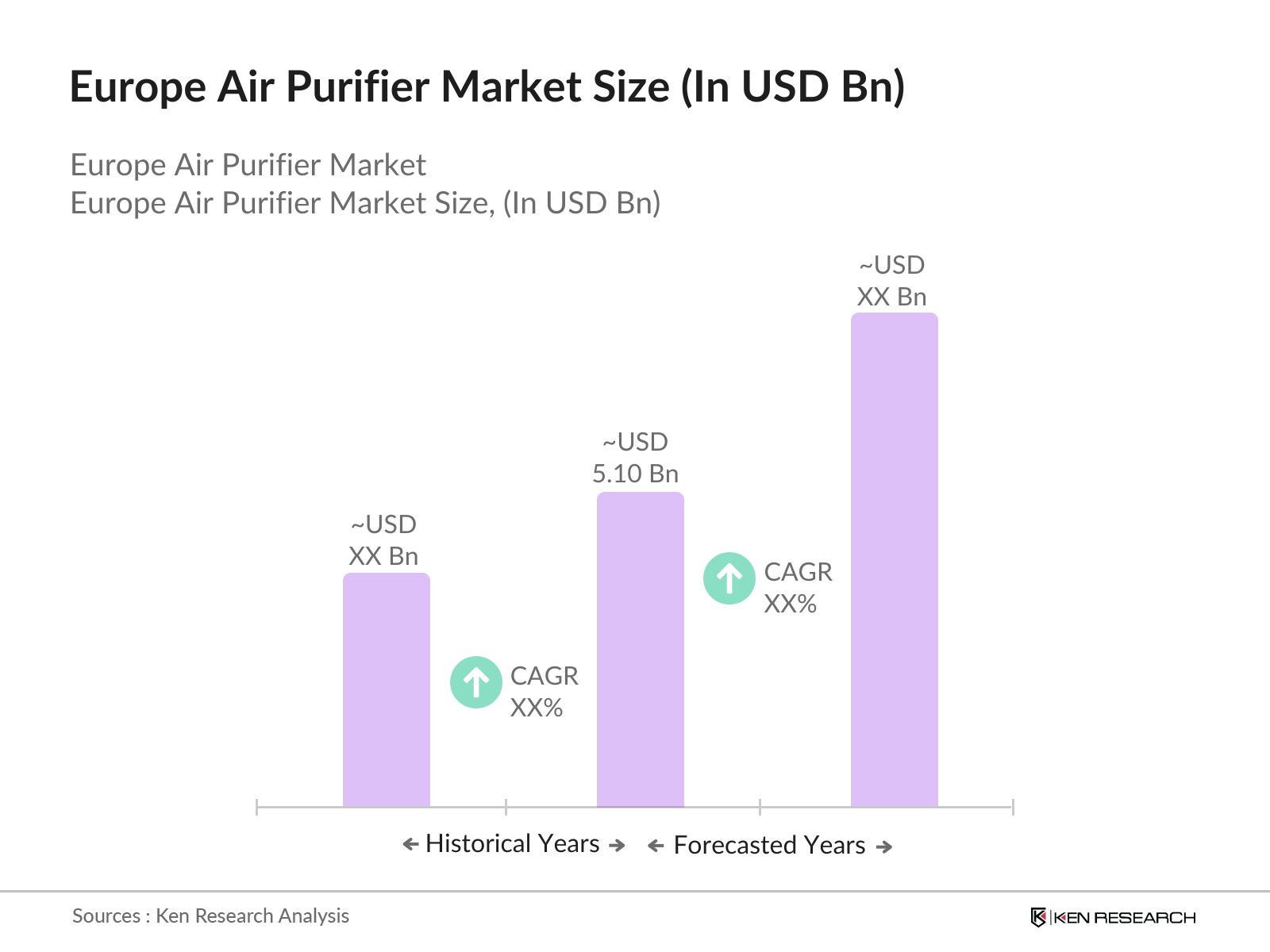
- The Europe Air Purifier Market is valued at USD 5.10 billion, based on a five-year historical analysis. The growth of this market is primarily driven by increasing health consciousness, the rising prevalence of airborne diseases, and stringent government regulations focused on improving indoor air quality. Air purifiers are becoming a staple in residential, commercial, and industrial spaces as the demand for clean air continues to grow in urban areas with high pollution levels.
- Countries like Germany, France, and the UK dominate the European air purifier market. Germany's dominance is attributed to its robust industrial sector, which increases the demand for air purifiers in both commercial and industrial settings. France and the UK also have significant market presence due to higher urbanization rates, heightened awareness of pollution, and government initiatives to improve indoor air quality standards in public spaces.
- The World Health Organization's updated 2023 guidelines on indoor air quality are pushing European governments to enforce stricter IAQ regulations. The European Commission has encouraged member states to align their public building standards with WHO guidelines, ensuring that indoor pollutant levels remain below safe thresholds. This initiative is expected to drive the installation of air purifiers in schools, hospitals, and government offices across the region.
Europe Air Purifier Market Segmentation
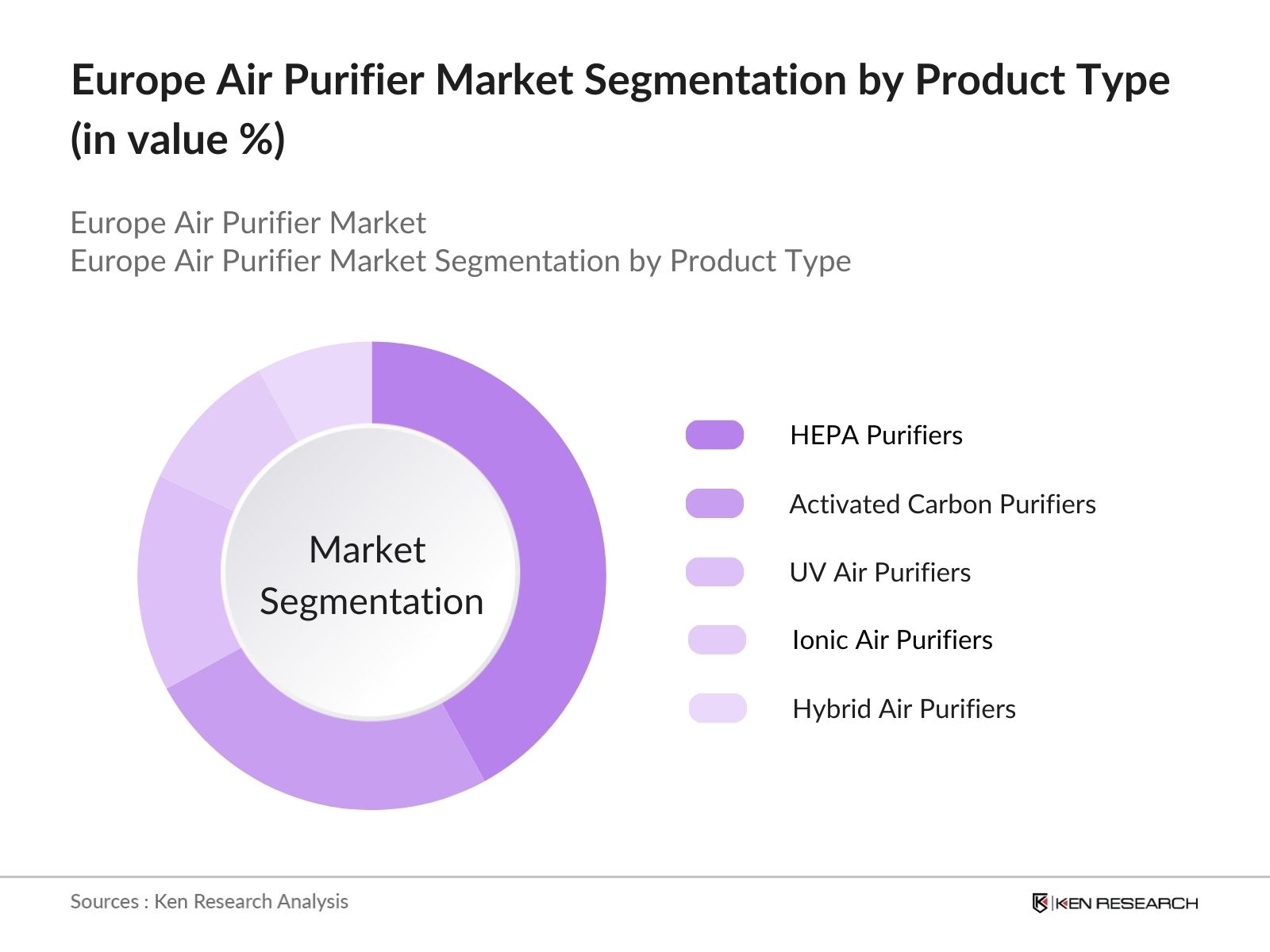
By Product Type: The Europe Air Purifier market is segmented by product type into HEPA Purifiers, Activated Carbon Purifiers, UV Air Purifiers, Ionic Air Purifiers, and Hybrid Air Purifiers. Recently, HEPA Purifiers hold the dominant market share under this segmentation, driven by their proven efficiency in trapping particles as small as 0.3 microns. HEPA technology is widely adopted across households and healthcare facilities, where air quality is a priority. The demand for HEPA purifiers has been reinforced by increased concerns over allergens, asthma, and other respiratory conditions.
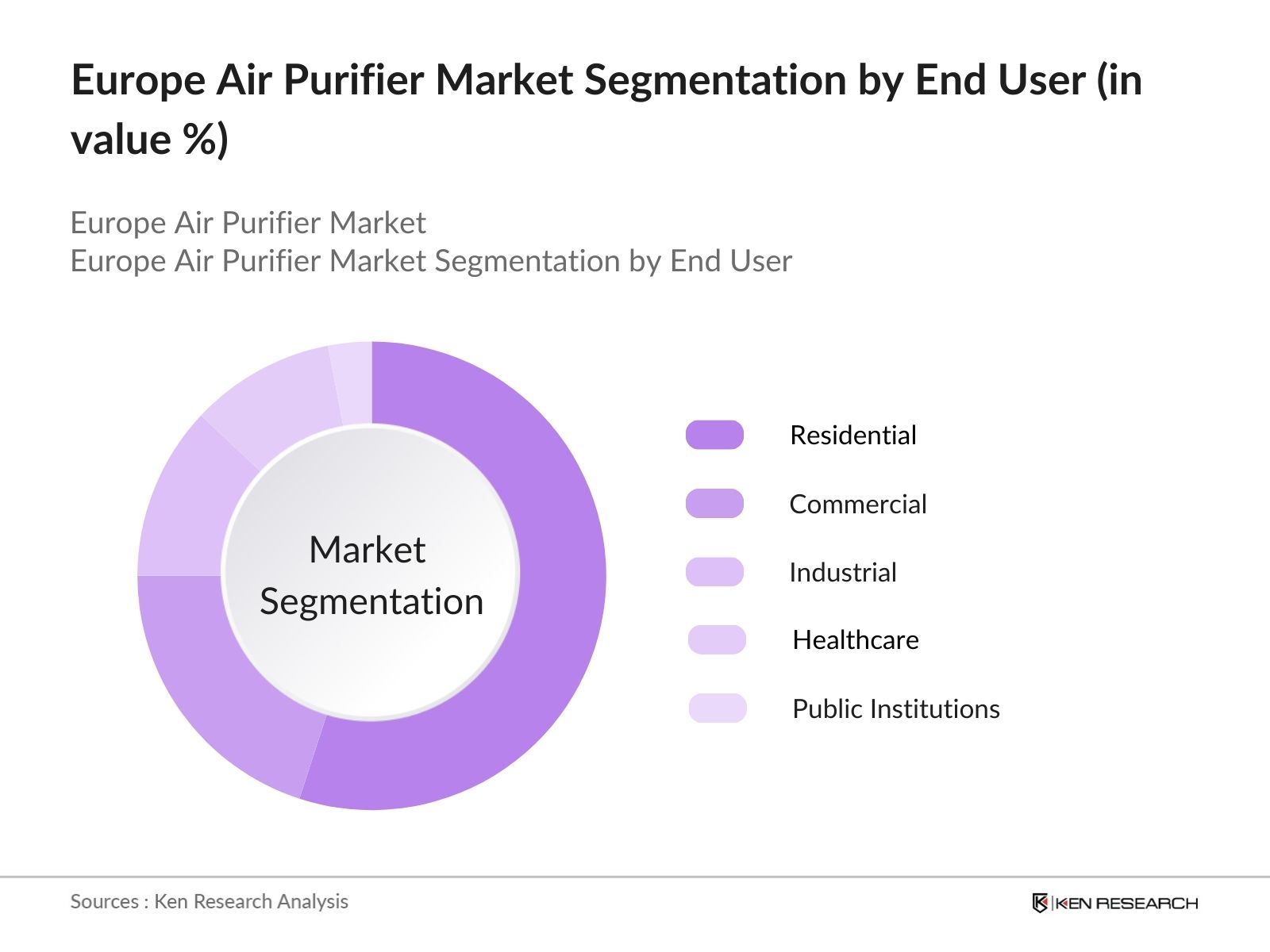
By End-User: The Europe Air Purifier market is also segmented by end-user into Residential, Commercial, Industrial, Healthcare, and Public Institutions. Residential air purifiers dominate this segmentation due to the growing awareness among homeowners about indoor air pollution and its health effects. Increasing disposable incomes and a surge in home renovations have also contributed to the rising demand for air purifiers in homes. Additionally, the COVID-19 pandemic has played a pivotal role in amplifying the demand for air purifiers in the residential segment, as people spend more time indoors and prioritize clean and healthy air in their living spaces.
Europe Air Purifier Market Competitive Landscape
The Europe Air Purifier Market is consolidated, with major players capturing a significant share of the market. Key companies are focusing on product innovation, sustainable filtration technologies, and smart air purification solutions to gain a competitive edge. International giants like Philips and Dyson continue to lead the market, while regional players maintain their strong presence through specialized offerings.
|
Company |
Establishment Year |
Headquarters |
Product Portfolio |
Technological Innovation |
Sustainability Initiatives |
Filtration Efficiency |
Global Presence |
Revenue (2023) |
Smart Technology Capabilities |
|
Philips |
1891 |
Netherlands |
- | - | - | - | - | - | - |
|
Dyson |
1991 |
UK |
- | - | - | - | - | - | - |
|
Blueair |
1996 |
Sweden |
- | - | - | - | - | - | - |
|
Panasonic Corporation |
1918 |
Japan |
- | - | - | - | - | - | - |
|
Sharp Corporation |
1912 |
Japan |
- | - | - | - | - | - | - |
Europe Air Purifier Market Analysis
Growth Drivers
- Increased Respiratory Diseases in Europe: The increasing prevalence of respiratory issues such as asthma, bronchitis, and allergies is a significant driver of the air purifier market. In 2024, Europe saw over 30 million individuals diagnosed with asthma and over 10 million children affected by respiratory conditions. The rise of these diseases has fueled demand for air purification systems that improve indoor air quality in residential, healthcare, and educational settings, making air purifiers essential for health-conscious consumers.
- Indoor Air Quality Concerns in Commercial Spaces: Commercial buildings, including offices, schools, and healthcare facilities, are under pressure to improve indoor air quality (IAQ). Over 60% of Europeans spend 90% of their time indoors, leading to heightened awareness of air quality in commercial environments. The European Unions 2023 directives emphasize the need for better ventilation and air purification systems in public buildings, directly driving the demand for advanced air purifiers across Europe.
- Technological Advancements in Filtration Systems: Technological innovations in air filtration systems are boosting market growth in Europe. In 2023, Europe saw a surge in demand for High-Efficiency Particulate Air (HEPA) filters, which can capture 99.97% of particles as small as 0.3 microns. Advanced air purifiers now integrate multiple filtration stages, including carbon filters, UV-C lights, and ionizers, which target various indoor air pollutants such as VOCs (volatile organic compounds), pollen, and smoke. The integration of IoT in air purifiers has also gained traction, with devices now being able to monitor and adjust air quality levels autonomously, increasing their popularity in households and commercial spaces.
Market Challenges
- High Product Costs for Consumers: Air purifiers, particularly high-efficiency models with advanced filtration systems, remain expensive for the average European household. In 2024, the average cost of a high-quality air purifier ranges from 300 to 700, with additional maintenance expenses of 100 to 200 annually. These high costs limit adoption, especially in lower-income households, hindering the widespread use of air purifiers across Europe.
- Low Awareness in Rural Areas: Despite growing urban demand, rural areas in Europe face a lack of awareness and education on indoor air quality solutions. In 2024, fewer than 20% of rural households in Europe are familiar with air purifiers, compared to 65% in urban areas. This lack of awareness poses a significant barrier to market expansion in these regions, particularly in countries with vast rural populations such as Romania and Poland.
Europe Air Purifier Market Future Outlook
Over the next five years, the Europe Air Purifier Market is expected to witness significant growth driven by rising pollution levels, increasing health consciousness, and government initiatives to improve air quality in both public and private spaces. With the advancement of smart technologies and IoT-enabled devices, air purifiers are likely to become more integrated with other smart home solutions, thereby driving demand. Moreover, growing consumer preference for eco-friendly, energy-efficient products will stimulate the market's shift towards sustainable air purifiers.
Market Opportunities
- Rising Demand for Smart Air Purifiers: The smart air purifier segment is projected to grow at a compound annual growth rate (CAGR) of 8% by 2028. This growth is fueled by advancements in technology, allowing consumers to control air purifiers via smartphone apps and monitor air quality in real-time. The increasing prevalence of respiratory diseases and heightened awareness of indoor air quality are driving consumers towards smart solutions that offer convenience and efficiency.
- Expansion in Online Sales Channels: With the growing penetration of the internet, the online sales channel for air purifiers is expected to witness a CAGR of 6.9% from 2024 to 2030. Major e-commerce platforms are enhancing their offerings to reach new consumers, reflecting a shift in purchasing behavior towards online shopping for home appliances, including air purifiers. This trend is bolstered by the increasing urgency for improved air quality solutions, particularly in urban areas with high pollution levels.
Scope of the Report
|
By Product Type |
HEPA Purifiers Activated Carbon Purifiers UV Air Purifiers Ionic Air Purifiers Hybrid Air Purifiers |
|
By Technology |
HEPA Filtration Ultraviolet Germicidal Irradiation (UV-C) Electrostatic Precipitation Ozone Generators Activated Carbon Filtration |
|
By End-User |
Residential Commercial Industrial Healthcare Public Institutions |
|
By Distribution Channel |
Online Retail Offline Retail Distributors Direct Sales |
|
By Region |
West East Central North South |
Products
Key Target Audience
Air Purifier Manufacturers
Distribution Channels (Wholesale/Retailers)
Residential Property Developers
Commercial Building Developers
Industrial Facility Operators
Government and Regulatory Bodies (EU Environmental Agency)
Investments and Venture Capitalist Firms
Healthcare Providers (Hospitals, Clinics)
Companies
Players Mentioned in the Report:
Philips
Dyson
Blueair
Panasonic Corporation
Sharp Corporation
Honeywell International
Daikin Industries
LG Electronics
Samsung Electronics
Xiaomi Corporation
Table of Contents
1. Europe Air Purifier Market Overview
1.1. Definition and Scope
1.2. Market Taxonomy
1.3. Market Growth Rate
1.4. Market Segmentation Overview
2. Europe Air Purifier Market Size (In USD Bn)
2.1. Historical Market Size
2.2. Year-On-Year Growth Analysis
2.3. Key Market Developments and Milestones
3. Europe Air Purifier Market Analysis
3.1. Growth Drivers
3.1.1. Increased Health Awareness
3.1.2. Rising Urban Pollution Levels
3.1.3. Government Regulations on Indoor Air Quality
3.1.4. Technological Advancements in Filtration Systems
3.2. Market Challenges
3.2.1. High Product and Maintenance Costs
3.2.2. Lack of Awareness in Rural Areas
3.2.3. Technical Limitations in Air Purification for Large Spaces
3.3. Opportunities
3.3.1. Integration with Smart Home Ecosystems
3.3.2. Expanding Use in Commercial and Industrial Applications
3.3.3. New Product Launches with Multi-Stage Filtration
3.4. Trends
3.4.1. Adoption of Portable and Hybrid Air Purifiers
3.4.2. Increasing Focus on Eco-Friendly Air Purifiers
3.4.3. Demand for Personalized Air Quality Monitoring Systems
3.5. Government Regulations
3.5.1. EU Directives on Air Quality
3.5.2. Energy Efficiency Regulations for Air Purifiers
3.5.3. Indoor Air Quality Standards
3.6. SWOT Analysis
3.7. Stakeholder Ecosystem
3.8. Porters Five Forces
3.9. Competitive Ecosystem
4. Europe Air Purifier Market Segmentation
4.1. By Product Type
4.1.1. HEPA Purifiers
4.1.2. Activated Carbon Purifiers
4.1.3. UV Air Purifiers
4.1.4. Ionic Air Purifiers
4.1.5. Hybrid Air Purifiers
4.2. By Technology
4.2.1. HEPA Filtration
4.2.2. Ultraviolet Germicidal Irradiation (UV-C)
4.2.3. Electrostatic Precipitation
4.2.4. Ozone Generators
4.2.5. Activated Carbon Filtration
4.3. By End-User
4.3.1. Residential
4.3.2. Commercial
4.3.3. Industrial
4.3.4. Healthcare
4.3.5. Public Institutions
4.4. By Distribution Channel
4.4.1. Online Retail
4.4.2. Offline Retail
4.4.3. Distributors
4.4.4. Direct Sales
4.5. By Region
4.5.1. Western Europe
4.5.2. Central and Eastern Europe
4.5.3. Northern Europe
4.5.4. Southern Europe
5. Europe Air Purifier Market Competitive Analysis
5.1. Detailed Profiles of Major Companies
5.1.1. Dyson
5.1.2. Philips
5.1.3. Honeywell International
5.1.4. Blueair
5.1.5. Sharp Corporation
5.1.6. Panasonic Corporation
5.1.7. Coway Co., Ltd.
5.1.8. Daikin Industries
5.1.9. LG Electronics
5.1.10. Samsung Electronics
5.1.11. Xiaomi Corporation
5.1.12. Midea Group
5.1.13. Winix Inc.
5.1.14. Levoit
5.1.15. IQAir
5.2. Cross Comparison Parameters
5.3. Market Share Analysis
5.4. Strategic Initiatives
5.5. Mergers and Acquisitions
5.6. Investment Analysis
5.7. Venture Capital Funding
5.8. Government Grants
5.9. Private Equity Investments
6. Europe Air Purifier Market Regulatory Framework
6.1. EU Environmental Standards
6.2. Compliance Requirements for Manufacturers
6.3. Certification and Labelling Processes
7. Europe Air Purifier Future Market Size
7.1. Future Market Size Projections
7.2. Key Factors Driving Future Market Growth
8. Europe Air Purifier Future Market Segmentation
8.1. By Product Type
8.2. By Technology
8.3. By End-User
8.4. By Distribution Channel
8.5. By Region
9. Europe Air Purifier Market Analysts Recommendations
9.1. TAM/SAM/SOM Analysis
9.2. Customer Cohort Analysis
9.3. Marketing Initiatives
9.4. White Space Opportunity Analysis
Research Methodology
Step 1: Identification of Key Variables
In this phase, we developed a comprehensive ecosystem map covering all key stakeholders in the Europe Air Purifier Market. Desk research, combined with proprietary databases, was utilized to gather market-specific data and identify the critical variables influencing market growth, including technological trends and consumer behavior shifts.
Step 2: Market Analysis and Construction
This step involved assessing historical data of the Europe Air Purifier Market, including product penetration rates and market revenues. Special attention was given to segment-specific growth, focusing on residential and industrial sectors, and evaluating shifts in consumer preferences towards sustainable and smart technologies.
Step 3: Hypothesis Validation and Expert Consultation
We conducted CATI interviews with experts from leading air purifier manufacturers and distributors to validate our market hypotheses. Their insights provided valuable feedback on market challenges, emerging technologies, and consumer behavior patterns across different regions of Europe.
Step 4: Research Synthesis and Final Output
The final phase synthesized quantitative data from manufacturers and industry experts to validate our bottom-up market models. This comprehensive approach ensured the final market size estimations and forecasts for the Europe Air Purifier Market were robust and accurate.
Frequently Asked Questions
01. How big is the Europe Air Purifier Market?
The Europe Air Purifier Market was valued at USD 5.10 billion. This growth is driven by rising health consciousness and stringent government regulations focused on indoor air quality improvement.
02. What are the challenges in the Europe Air Purifier Market?
Challenges in the Europe Air Purifier Market include high initial costs of air purifiers, technical limitations in purifying large spaces, and low penetration in rural areas where awareness of air quality remains limited.
03. Who are the major players in the Europe Air Purifier Market?
Major players in the Europe Air Purifier Market include Philips, Dyson, Blueair, Panasonic Corporation, and Sharp Corporation, dominating due to their innovative products, wide distribution networks, and global presence.
04. What are the growth drivers of the Europe Air Purifier Market?
Growth of Europe Air Purifier Market is propelled by increasing pollution levels, rising health awareness, and government policies aimed at improving air quality in urban areas and public spaces. The demand for smart, eco-friendly air purifiers is also driving market growth.
Why Buy From Us?

What makes us stand out is that our consultants follows Robust, Refine and Result (RRR) methodology. i.e. Robust for clear definitions, approaches and sanity checking, Refine for differentiating respondents facts and opinions and Result for presenting data with story

We have set a benchmark in the industry by offering our clients with syndicated and customized market research reports featuring coverage of entire market as well as meticulous research and analyst insights.

While we don't replace traditional research, we flip the method upside down. Our dual approach of Top Bottom & Bottom Top ensures quality deliverable by not just verifying company fundamentals but also looking at the sector and macroeconomic factors.

With one step in the future, our research team constantly tries to show you the bigger picture. We help with some of the tough questions you may encounter along the way: How is the industry positioned? Best marketing channel? KPI's of competitors? By aligning every element, we help maximize success.

Our report gives you instant access to the answers and sources that other companies might choose to hide. We elaborate each steps of research methodology we have used and showcase you the sample size to earn your trust.

If you need any support, we are here! We pride ourselves on universe strength, data quality, and quick, friendly, and professional service.