















Europe Automotive ECU Market Outlook to 2030
Region:Europe
Author(s):Paribhasha Tiwari
Product Code:KROD5152
November 2024
98
About the Report
Europe Automotive ECU Market Overview
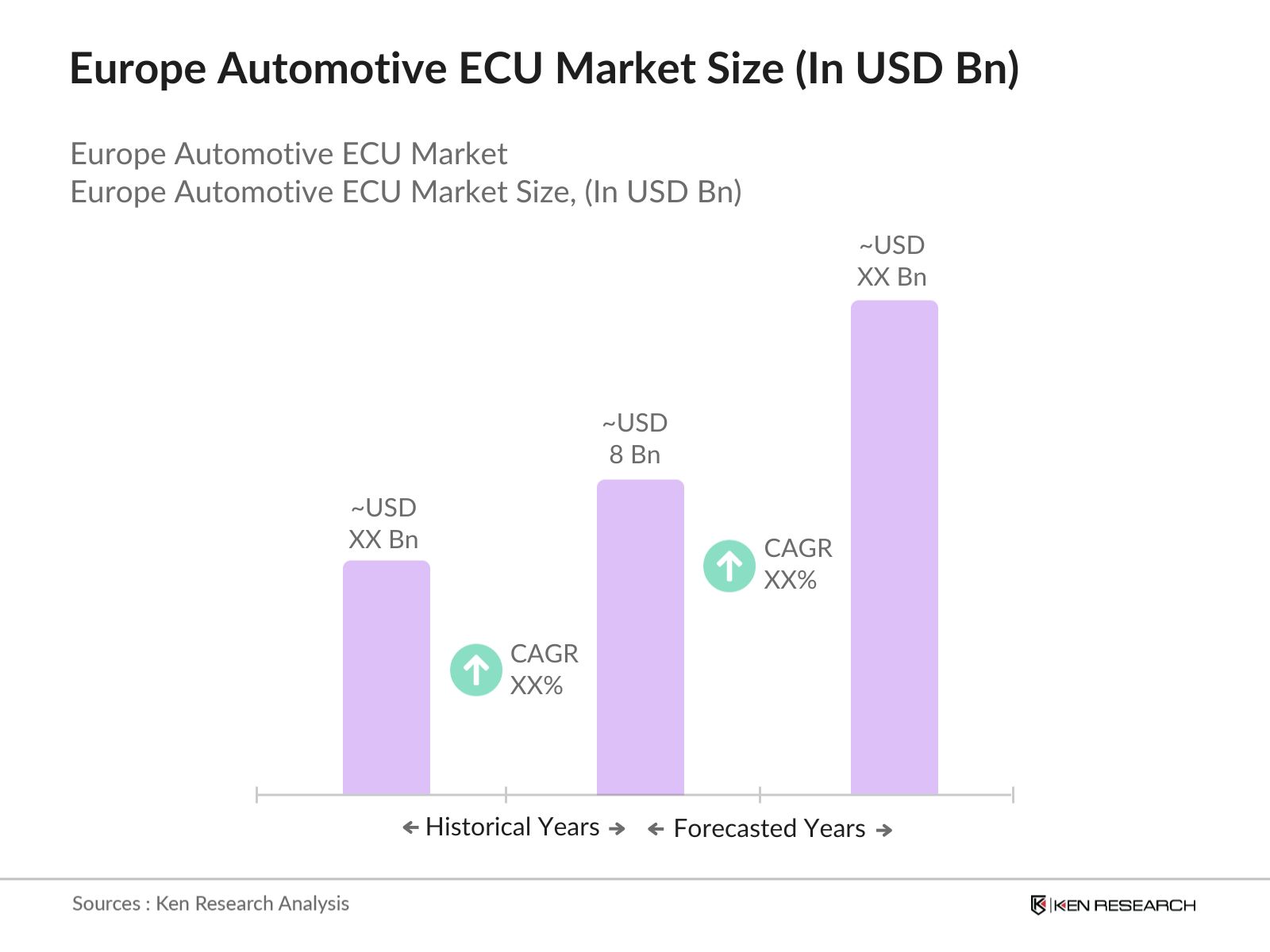
- The Europe Automotive ECU (Electronic Control Unit) market is currently valued at USD 8 billion. This market has been driven by significant advancements in vehicle electrification and the increasing adoption of autonomous driving technologies. The demand for ECUs is directly linked to the growing number of electric vehicles (EVs) and hybrid vehicles on European roads. The introduction of strict emissions regulations has further catalyzed ECU demand, particularly for powertrain control and emissions monitoring.
- Germany and France dominate the Europe Automotive ECU market due to their strong automotive manufacturing infrastructure and a high focus on innovation in vehicle technology. Germany, being home to major OEMs such as Volkswagen, BMW, and Daimler, leads the charge in ECU integration, particularly with its early adoption of autonomous driving systems and electrification of its fleet. France also plays a key role, driven by its progressive stance on vehicle emissions and a strong automotive supply chain.
- The European Green Deal, introduced in 2020, continues to drive the electrification of the automotive sector, with a strong focus on reducing CO2 emissions. By 2024, the European Union has allocated $50 billion to initiatives supporting EV development, including the deployment of advanced ECUs for battery management systems (BMS) and other key EV components.
Europe Automotive ECU Market Segmentation
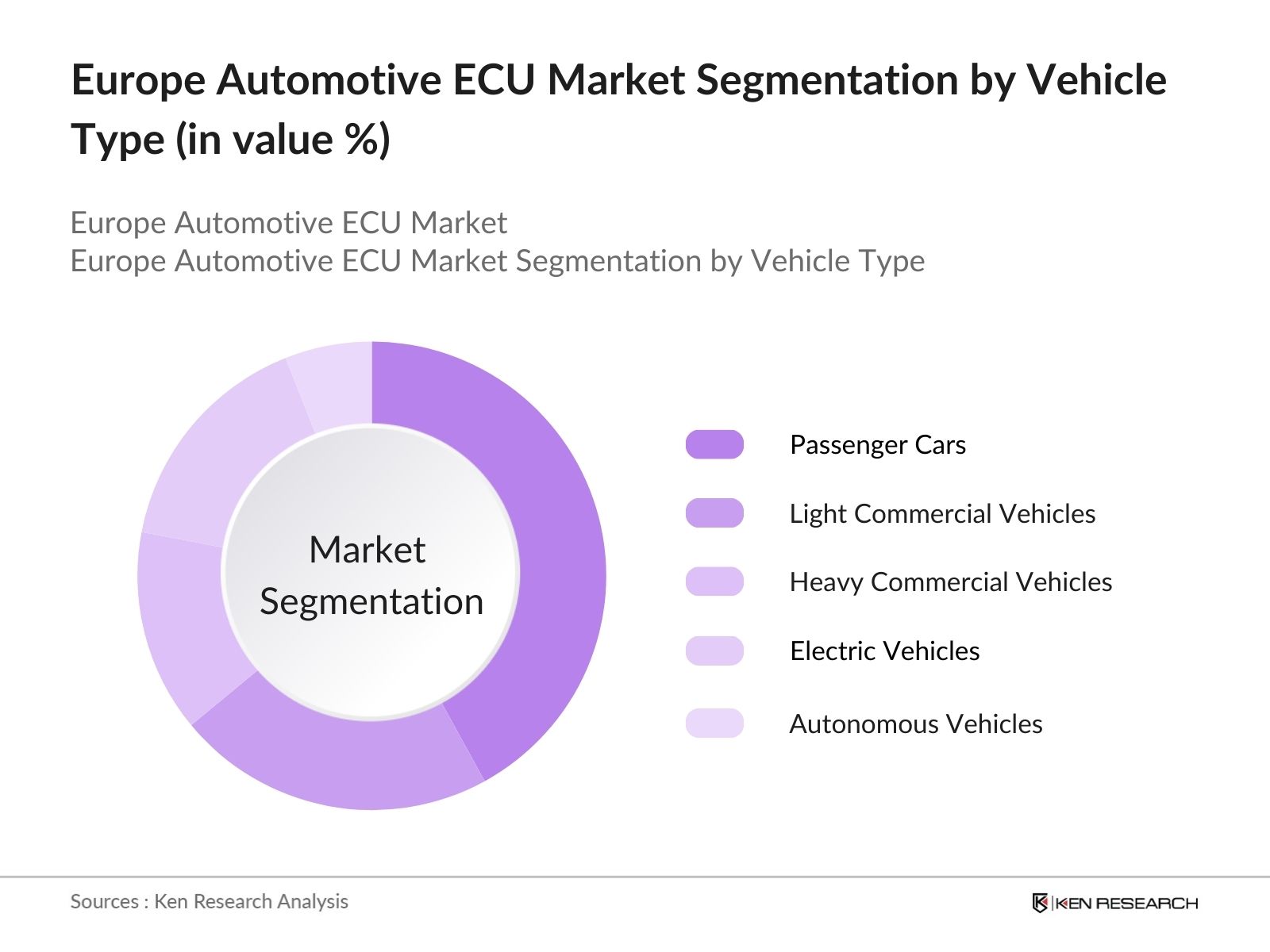
By Vehicle Type: The Europe Automotive ECU market is segmented by vehicle type into passenger cars, light commercial vehicles, heavy commercial vehicles, electric vehicles, and autonomous vehicles. Electric vehicles dominate this segmentation as the European Union continues its push for emission-free mobility. Governments across Europe have incentivized EV production and adoption, making this segment the fastest-growing within the market. The complex ECUs required for battery management, powertrain, and safety systems in EVs are driving their dominance.
By Function
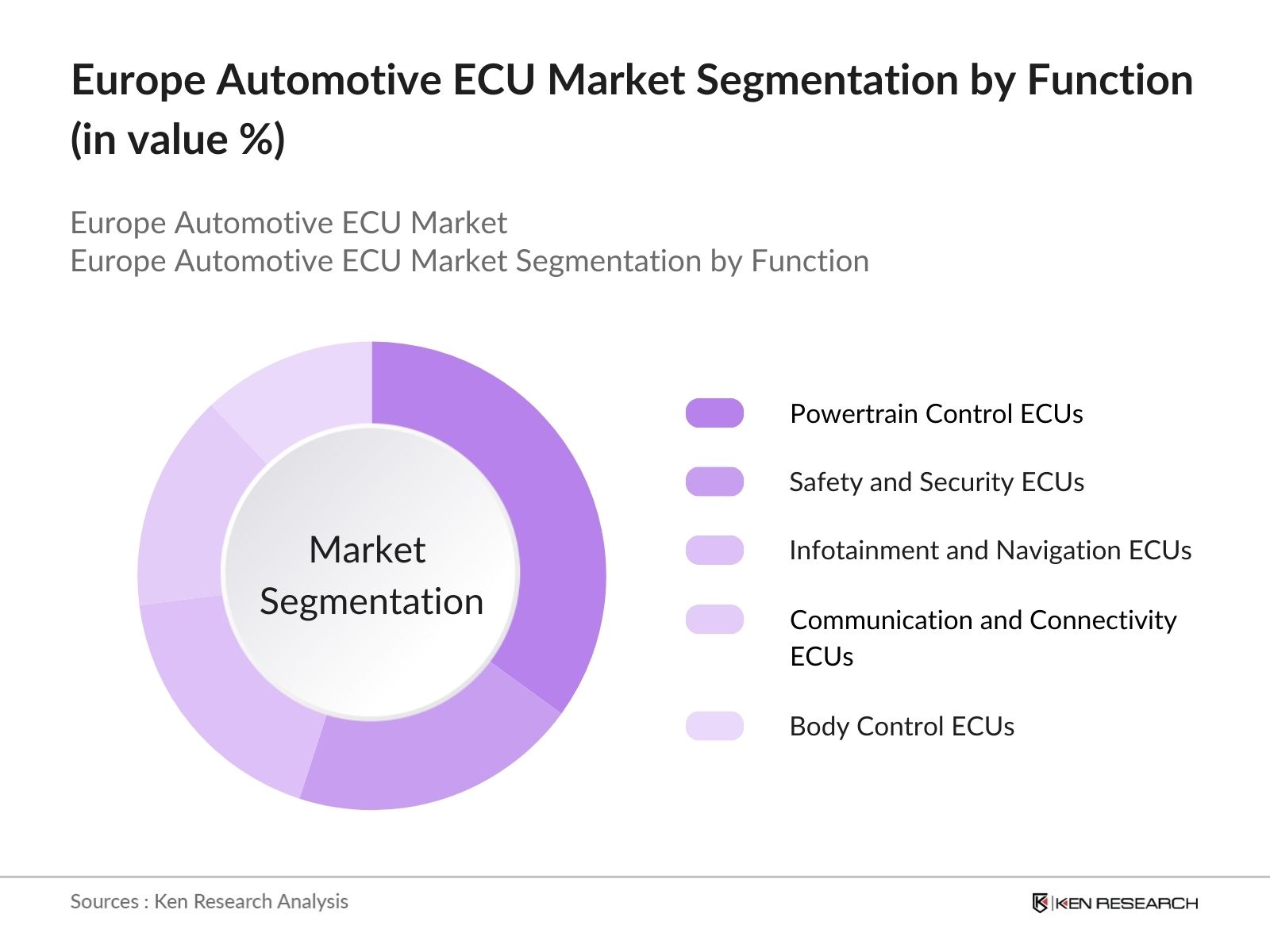
The market is also segmented by function into powertrain control ECUs, safety and security ECUs, infotainment and navigation ECUs, communication and connectivity ECUs, and body control ECUs. Powertrain control ECUs dominate this segment due to stringent European emissions standards, which have led to an increasing focus on improving fuel efficiency and reducing CO2 emissions. ECUs in this segment help optimize engine performance and fuel consumption, making them indispensable in meeting regulatory requirements.
Europe Automotive ECU Competitive Landscape
The Europe Automotive ECU market is dominated by a few key players that have established themselves as leaders in vehicle electronics innovation. These companies benefit from strong partnerships with automakers, extensive research and development (R&D) efforts, and advancements in ECU integration. The competition remains fierce, as the market is driven by continuous technological advancements and the transition to electric and autonomous vehicles.
|
Company |
Establishment Year |
Headquarters |
Market Presence |
Technology Integration |
Regional Focus |
Revenue (USD) |
Employees |
Sustainability Initiatives |
|---|---|---|---|---|---|---|---|---|
|
Continental AG |
1871 |
Hanover, Germany |
- | - | - | - | - | - |
|
Robert Bosch GmbH |
1886 |
Gerlingen, Germany |
- | - | - | - | - | - |
|
Denso Corporation |
1949 |
Kariya, Japan |
- | - | - | - | - | - |
|
Delphi Technologies |
2017 |
London, UK |
- | - | - | - | - | - |
|
Magneti Marelli S.p.A. |
1919 |
Corbetta, Italy |
- | - | - | - | - | - |
Europe Automotive ECU Market Analysis
Growth Drivers
- Compliance with Euro 6/7 Emission Standards: The introduction of the Euro 6 and Euro 7 emission standards continues to drive the demand for advanced ECUs in Europe. These standards require enhanced control over exhaust systems, boosting the development and integration of sophisticated engine and transmission control units. According to the European Commission, the Euro 7 standards, expected to be enforced in 2025, will mandate stricter NOx and CO2 emission controls, necessitating greater electronic control over combustion processes.
- Increasing Electrification of Vehicles: The transition to electric vehicles (EVs) is rapidly expanding the use of ECUs in Europe, especially for managing powertrains, battery management, and energy distribution systems. By 2024, the European Union's regulations on CO2 emissions have incentivized manufacturers to shift toward EV production, leading to an estimated increase of 20% in ECU units dedicated to electric powertrain management by that year, according to EU vehicle production estimates.
- Growing Demand for Autonomous and Connected Vehicles: The push for autonomous and connected vehicles in Europe has significantly boosted the need for ECUs that handle communication, sensor data, and real-time processing. By 2024, the EUs autonomous vehicle initiatives, particularly in Germany and France, have led to significant investments in ECUs tailored for vehicle-to-infrastructure (V2I) and vehicle-to-everything (V2X) communication systems. The rise in autonomous vehicle trials, with over 250,000 connected cars expected by 2025, requires extensive ECU integration.
Market Challenges
- Semiconductor Supply Chain Disruptions: Ongoing semiconductor shortages have directly impacted ECU production, leading to delayed vehicle manufacturing in Europe. By mid-2024, it is projected that the shortage will result in a backlog of approximately 2 million vehicles awaiting ECUs for completion, as indicated by reports from European automotive associations. This issue stems from global supply chain disruptions exacerbated by the geopolitical landscape.
- High Costs of ECU Development and Testing: Developing and testing ECUs, especially for electric and autonomous vehicles, has become increasingly expensive. For instance, the average cost of ECU testing infrastructure in Europe has increased to $500 million by 2024 due to the need for robust validation under stringent regulatory conditions. Manufacturers are being pressured to invest heavily in R&D to keep pace with evolving standards.
Europe Automotive ECU Future Outlook
Over the next five years, the Europe Automotive ECU market is expected to witness substantial growth, driven by the ongoing electrification of vehicles and the shift toward autonomous mobility. The transition from internal combustion engines to electric vehicles will increase the demand for more complex ECUs, particularly in areas such as battery management, in-vehicle communication, and advanced driver assistance systems (ADAS). Furthermore, government support for sustainable transport, coupled with the growing consumer preference for electric vehicles, will drive ECU innovation and adoption.
Market Opportunities
- Advancements in ECU Software Development: The evolution of ECU software, particularly in AI and machine learning, presents significant opportunities. By 2024, the European market has seen a surge in demand for software that enhances vehicle performance and energy efficiency. Germany, for example, has invested over $1.2 billion into ECU software innovations, driving advancements in real-time processing capabilities and OTA update functionalities.
- Growing Use of Electric Vehicles (EVs): As EV adoption rises in Europe, opportunities for ECU integration in power management, energy recovery, and thermal regulation systems have expanded. By 2024, with over 3 million EVs sold in Europe, the demand for EV-specific ECUs is expected to reach 30% of the total ECU market. Countries like Norway and the Netherlands are leading this shift, with increased infrastructure investments further boosting ECU demand.
Scope of the Report
|
By Vehicle Type |
Passenger Cars Light Commercial Vehicles Heavy Commercial Vehicles Electric Vehicles Autonomous Vehicles |
|
By Function |
Powertrain Control ECUs Safety and Security ECUs Infotainment and Navigation ECUs Communication and Connectivity ECUs Body Control ECUs |
|
By Technology |
Transmission Control ECUs Chassis Control ECUs Driver Assistance ECUs Autonomous Driving ECUs |
|
By Sales Channel |
OEMs Aftermarket |
|
By Region |
West Central East North South |
Products
Key Target Audience
Investors and Venture Capitalist Firms
Government and Regulatory Bodies (European Commission, UNECE)
Automotive Manufacturers (OEMs)
ECU Manufacturers
Electric Vehicle Manufacturers
Automotive Software Developers
Cybersecurity Firms
Automotive Testing and Validation Companies
Companies
Players Mentioned in the Report:
Continental AG
Robert Bosch GmbH
Denso Corporation
Delphi Technologies
Magneti Marelli S.p.A.
ZF Friedrichshafen AG
Valeo SA
Visteon Corporation
Infineon Technologies AG
Aptiv PLC
Table of Contents
1. Europe Automotive ECU Market Overview
1.1. Definition and Scope
1.2. Market Taxonomy
1.3. Growth Rate (CAGR of Key Segments in Value)
1.4. Key Milestones and Developments
2. Europe Automotive ECU Market Size (in USD Bn)
2.1. Historical Market Size (In USD Bn)
2.2. Year-on-Year Growth Analysis (Percentage Change)
2.3. Key Milestones in Industry Evolution
3. Europe Automotive ECU Market Analysis
3.1. Growth Drivers
3.1.1. Compliance with Euro 6/7 Emission Standards
3.1.2. Increasing Electrification of Vehicles
3.1.3. Growing Demand for Autonomous and Connected Vehicles
3.1.4. Integration of Advanced Driver Assistance Systems (ADAS)
3.2. Market Challenges
3.2.1. Semiconductor Supply Chain Disruptions
3.2.2. High Costs of ECU Development and Testing
3.2.3. Cybersecurity Challenges in Connected ECUs
3.2.4. Vehicle Cost Optimization Pressures
3.3. Opportunities
3.3.1. Advancements in ECU Software Development
3.3.2. Growing Use of Electric Vehicles (EVs)
3.3.3. Adoption of Multi-Domain ECU Platforms
3.3.4. Expansion of Over-the-Air (OTA) Updates for ECUs
3.4. Trends
3.4.1. ECU Consolidation for Simplified Architecture
3.4.2. AI and Machine Learning in ECU Development
3.4.3. Increased Use of ECUs in Electric and Hybrid Vehicles
3.4.4. Focus on Functional Safety Standards (ISO 26262)
3.5. Government Regulation
3.5.1. Stringent Emission and Fuel Efficiency Standards
3.5.2. Regulations Supporting Autonomous Vehicle Adoption
3.5.3. Cybersecurity Regulations for Automotive Electronics
3.5.4. Public Funding for Automotive Digitalization Projects
3.6. Stake Ecosystem (Tier-1, OEMs, Software Suppliers, Regulators)
3.7. Porters Five Forces Analysis (Bargaining Power, Threats, Industry Rivalry)
3.8. Competitive Ecosystem (OEM, Tier-1, and Tier-2 Players)
4. Europe Automotive ECU Market Segmentation
4.1. By Vehicle Type (In Value %)
4.1.1. Passenger Cars
4.1.2. Light Commercial Vehicles
4.1.3. Heavy Commercial Vehicles
4.1.4. Electric Vehicles
4.1.5. Autonomous Vehicles
4.2. By Function (In Value %)
4.2.1. Powertrain Control ECUs
4.2.2. Safety and Security ECUs
4.2.3. Infotainment and Navigation ECUs
4.2.4. Communication and Connectivity ECUs
4.2.5. Body Control ECUs
4.3. By Technology (In Value %)
4.3.1. Transmission Control ECUs
4.3.2. Chassis Control ECUs
4.3.3. Driver Assistance ECUs
4.3.4. Autonomous Driving ECUs
4.4. By Sales Channel (In Value %)
4.4.1. OEMs
4.4.2. Aftermarket
4.5. By Region (In Value %)
4.5.1. Western Europe
4.5.2. Central and Eastern Europe
4.5.3. Northern Europe
4.5.4. Southern Europe
5. Europe Automotive ECU Competitive Analysis
5.1. Detailed Profiles of Major Companies
5.1.1. Continental AG
5.1.2. Robert Bosch GmbH
5.1.3. Denso Corporation
5.1.4. Delphi Technologies
5.1.5. Magneti Marelli S.p.A.
5.1.6. ZF Friedrichshafen AG
5.1.7. Valeo SA
5.1.8. Visteon Corporation
5.1.9. Lear Corporation
5.1.10. Infineon Technologies AG
5.1.11. NXP Semiconductors
5.1.12. Hella GmbH & Co. KGaA
5.1.13. Aptiv PLC
5.1.14. Hitachi Automotive Systems Ltd.
5.1.15. Renesas Electronics Corporation
5.2. Cross Comparison Parameters (Number of ECUs Produced, Headquarters, Inception Year, Revenue, Software/Hardware Integration, Platform Compatibility, Cybersecurity Features, R&D Investment)
5.3. Market Share Analysis
5.4. Strategic Initiatives
5.5. Mergers & Acquisitions
5.6. R&D Investment and Innovation
6. Europe Automotive ECU Market Regulatory Framework
6.1. European Automotive Safety Standards
6.2. Compliance Requirements for Autonomous Driving
6.3. Cybersecurity Regulations for Connected Vehicles
6.4. Emission Reduction Regulations
7. Europe Automotive ECU Future Market Size (In USD Bn)
7.1. Market Size Projections
7.2. Key Factors Driving Future Market Growth
8. Europe Automotive ECU Future Market Segmentation
8.1. By Vehicle Type (In Value %)
8.2. By Function (In Value %)
8.3. By Technology (In Value %)
8.4. By Sales Channel (In Value %)
8.5. By Region (In Value %)
9. Europe Automotive ECU Market Analysts Recommendations
9.1. TAM/SAM/SOM Analysis
9.2. Competitor Benchmarking
9.3. Market Positioning Strategy
9.4. Investment and M&A Opportunities
Research Methodology
Step 1: Identification of Key Variables
The first step involves building an ecosystem map of key stakeholders in the Europe Automotive ECU market. Through comprehensive secondary research and proprietary databases, critical variables such as market drivers, challenges, and innovations are identified.
Step 2: Market Analysis and Construction
In this step, historical data on market penetration, ECU production rates, and vehicle adoption trends are compiled and analyzed. Market dynamics such as OEM partnerships, regulatory compliance, and ECU demand are assessed to ensure accurate forecasting.
Step 3: Hypothesis Validation and Expert Consultation
Market hypotheses are validated through in-depth interviews with industry professionals, including automotive engineers, OEMs, and tier-1 suppliers. These consultations are instrumental in refining the analysis and ensuring the datas relevance to industry trends.
Step 4: Research Synthesis and Final Output
The final output includes data verification through engagement with ECU manufacturers and automakers. This step ensures the integration of both bottom-up and top-down analysis to provide a complete and validated market overview.
Frequently Asked Questions
1. How big is the Europe Automotive ECU Market?
The Europe Automotive ECU market is valued at USD 8 billion, driven by increasing demand for electric vehicles and the rise of autonomous driving technologies.
2. What are the major growth drivers in the Europe Automotive ECU Market?
Key growth drivers in the Europe Automotive ECU market include the transition to electric vehicles, advancements in autonomous driving systems, and stringent European Union regulations on vehicle emissions.
3. What challenges does the Europe Automotive ECU Market face?
Challenges in the Europe Automotive ECU market include semiconductor supply chain disruptions, cybersecurity concerns, and the high cost of ECU development for modern, complex vehicle systems.
4. Which are the leading companies in the Europe Automotive ECU Market?
Major companies in the Europe Automotive ECU market include Continental AG, Robert Bosch GmbH, Denso Corporation, Delphi Technologies, and Magneti Marelli S.p.A.
Why Buy From Us?

What makes us stand out is that our consultants follows Robust, Refine and Result (RRR) methodology. i.e. Robust for clear definitions, approaches and sanity checking, Refine for differentiating respondents facts and opinions and Result for presenting data with story

We have set a benchmark in the industry by offering our clients with syndicated and customized market research reports featuring coverage of entire market as well as meticulous research and analyst insights.

While we don't replace traditional research, we flip the method upside down. Our dual approach of Top Bottom & Bottom Top ensures quality deliverable by not just verifying company fundamentals but also looking at the sector and macroeconomic factors.

With one step in the future, our research team constantly tries to show you the bigger picture. We help with some of the tough questions you may encounter along the way: How is the industry positioned? Best marketing channel? KPI's of competitors? By aligning every element, we help maximize success.

Our report gives you instant access to the answers and sources that other companies might choose to hide. We elaborate each steps of research methodology we have used and showcase you the sample size to earn your trust.

If you need any support, we are here! We pride ourselves on universe strength, data quality, and quick, friendly, and professional service.