
Europe Cloud Gaming Market Outlook to 2030
Region:Albania
Author(s):Sanjna
Product Code:KROD3415
Region:Albania
Author(s):Sanjna
Product Code:KROD3415
December 2024
83
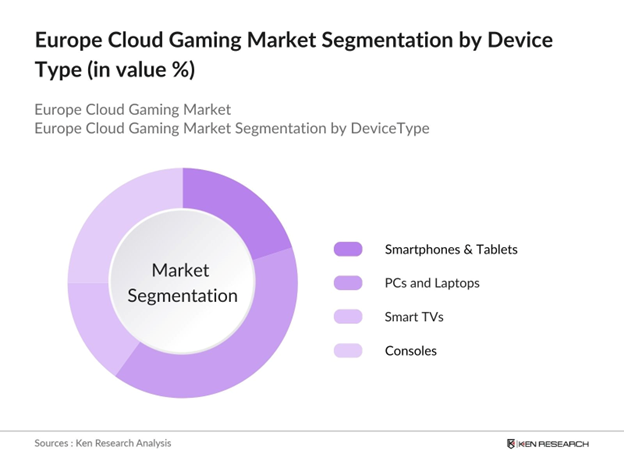
By Device Type: The Europe Cloud Gaming market is segmented by device type into smartphones and tablets, PCs and laptops, smart TVs, and consoles. Recently, PCs and laptops have secured the dominant market share, accounting for 40% in 2023. This dominance is attributed to the high performance and flexibility these devices offer, allowing gamers to access a vast library of titles with superior graphics and minimal latency. Additionally, the widespread availability of high-speed internet connections in Europe enhances the gaming experience on these platforms.
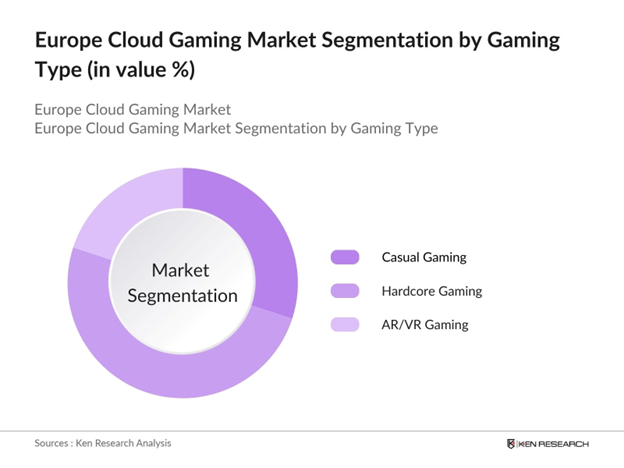
By Gaming Type: The market is further segmented by gaming type into casual gaming, hardcore gaming, and AR/VR gaming. Hardcore gaming leads the segmentation with a 50% market share in 2023. This segment dominates due to the high demand for immersive and graphically intensive games that require substantial computational power, which cloud gaming platforms effectively provide. The integration of advanced technologies such as AI and machine learning enhances the gaming experience, attracting a dedicated user base that seeks high-quality and competitive gaming environments.
The Europe Cloud Gaming market is dominated by a few major players, including global giants such as Google Stadia, Microsoft xCloud, Nvidia GeForce Now, Sony PlayStation Now, and Amazon Luna. This consolidation highlights the significant influence of these key companies, which leverage their extensive technological expertise, vast gaming libraries, and strategic partnerships to maintain a competitive edge in the market.
|
Company |
Establishment Year |
Headquarters |
Revenue (2023) |
Subscription Growth |
Data Center Infrastructure |
Game Library Size |
|
Google Stadia |
2019 |
Mountain View, USA |
- |
- |
- |
- |
|
Microsoft xCloud |
2020 |
Redmond, USA |
- |
- |
- |
- |
|
Nvidia GeForce Now |
2017 |
Santa Clara, USA |
- |
- |
- |
- |
|
Sony PlayStation Now |
2014 |
Tokyo, Japan |
- |
- |
- |
- |
|
Amazon Luna |
2020 |
Seattle, USA |
- |
- |
- |
- |
Europe Cloud Gaming Market Analysis
Growth Drivers
Challenges
Europe Cloud Gaming market is expected to exhibit substantial growth, driven by continuous advancements in cloud computing technologies, increasing consumer demand for high-quality gaming experiences, and the expansion of 5G networks. The integration of virtual reality (VR) and augmented reality (AR) into cloud gaming platforms will further enhance user engagement, while strategic partnerships between technology providers and game developers will foster innovation and market expansion.
Market Opportunities
|
Device Type |
Smartphones and Tablets PCs and Laptops Smart TVs Consoles |
|
Gaming Type |
Casual Gaming Hardcore Gaming AR/VR Gaming |
|
Service Model |
Business-to-Consumer (B2C) Business-to-Business (B2B) |
|
Subscription Model |
Free-to-Play Subscription-Based Pay-Per-Play |
|
Region |
Germany France United Kingdom Italy Spain Netherlands Switzerland Sweden |
1.1 Definition and Scope
1.2 Market Taxonomy
1.3 Market Growth Rate
1.4 Market Segmentation Overview
2.1 Historical Market Size
2.2 Year-On-Year Growth Analysis
2.3 Key Market Developments and Milestones
3.1 Growth Drivers
3.1.1 Expanding Broadband Connectivity (Fiber, 5G)
3.1.2 Adoption of Edge Computing in Gaming Infrastructure
3.1.3 Rise in Subscription-based Gaming Services
3.1.4 Increased Mobile Gaming Penetration
3.2 Market Challenges
3.2.1 Latency and Bandwidth Limitations (Network Performance)
3.2.2 High Data Costs (Mobile and Fixed Broadband)
3.2.3 Content Licensing and Ownership Restrictions
3.3 Opportunities
3.3.1 Integration with VR and AR Platforms
3.3.2 Growing Demand for Cross-Platform Play (PC, Console, Mobile)
3.3.3 Partnerships Between Telecom Providers and Gaming Studios
3.4 Trends
3.4.1 Emergence of Cloud-based Esports
3.4.2 Increased Adoption of AI for Gaming Enhancements
3.4.3 Cloud-based Game Streaming on Social Media Platforms
3.5 Regulatory Landscape
3.5.1 Data Privacy and Security Regulations (GDPR Impact on Cloud Services)
3.5.2 Content Moderation Laws (Europes Digital Services Act)
3.5.3 Cross-border Gaming Licensing Agreements
3.6 SWOT Analysis
3.7 Stakeholder Ecosystem (Cloud Providers, Game Studios, Hardware Vendors)
3.8 Porters Five Forces
3.9 Competition Ecosystem
4.1 By Device Type (In Value %)
4.1.1 Smartphones and Tablets
4.1.2 PCs and Laptops
4.1.3 Smart TVs
4.1.4 Consoles
4.2 By Gaming Type (In Value %)
4.2.1 Casual Gaming
4.2.2 Hardcore Gaming
4.2.3 AR/VR Gaming
4.3 By Service Model (In Value %)
4.3.1 Business-to-Consumer (B2C)
4.3.2 Business-to-Business (B2B)
4.4 By Subscription Model (In Value %)
4.4.1 Free-to-Play
4.4.2 Subscription-Based
4.4.3 Pay-Per-Play
4.5 By Region (In Value %)
4.5.1 Germany
4.5.2 France
4.5.3 United Kingdom
4.5.4 Italy
4.5.5 Spain
4.5.6 Netherlands
4.5.7 Switzerland
4.5.8 Sweden
5.1 Detailed Profiles of Major Companies
5.1.1 Google Stadia
5.1.2 Microsoft xCloud
5.1.3 Nvidia GeForce Now
5.1.4 Sony PlayStation Now
5.1.5 Amazon Luna
5.1.6 Shadow
5.1.7 Vortex Cloud Gaming
5.1.8 LiquidSky
5.1.9 GameFly
5.1.10 Parsec
5.1.11 Boosteroid
5.1.12 Playkey
5.1.13 Blacknut
5.1.14 Ubitus
5.1.15 Blade SAS
5.2 Cross Comparison Parameters (Revenue, Subscription Growth, Data Center Infrastructure, Game Library Size, Latency Metrics, Regional Availability, Service Scalability, Hardware Requirements)
5.3 Market Share Analysis
5.4 Strategic Initiatives
5.5 Mergers and Acquisitions
5.6 Investment Analysis
5.7 Venture Capital Funding
5.8 Government Grants
5.9 Private Equity Investments
6.1 Data Security Compliance (GDPR, ISO/IEC 27001)
6.2 Content Streaming Regulations (Streaming Rights Management)
6.3 Licensing and Cross-Border Gaming Compliance
7.1 Future Market Size Projections
7.2 Key Factors Driving Future Market Growth
8.1 By Device Type (In Value %)
8.2 By Gaming Type (In Value %)
8.3 By Service Model (In Value %)
8.4 By Subscription Model (In Value %)
8.5 By Region (In Value %)
9.1 TAM/SAM/SOM Analysis
9.2 Customer Cohort Analysis
9.3 Marketing Initiatives
9.4 White Space Opportunity Analysis
The initial phase involves constructing an ecosystem map encompassing all major stakeholders within the Europe Cloud Gaming Market. This step is underpinned by extensive desk research, utilizing a combination of secondary and proprietary databases to gather comprehensive industry-level information. The primary objective is to identify and define the critical variables that influence market dynamics.
In this phase, we compile and analyze historical data pertaining to the Europe Cloud Gaming Market. This includes assessing market penetration, the ratio of service providers to gaming studios, and the resultant revenue generation. Furthermore, an evaluation of service quality statistics will be conducted to ensure the reliability and accuracy of the revenue estimates.
Market hypotheses will be developed and subsequently validated through computer-assisted telephone interviews (CATI) with industry experts representing a diverse array of companies. These consultations will provide valuable operational and financial insights directly from industry practitioners, which will be instrumental in refining and corroborating the market data.
The final phase involves direct engagement with multiple cloud gaming service providers to acquire detailed insights into service segments, user preferences, technological advancements, and other pertinent factors. This interaction will serve to verify and complement the statistics derived from the bottom-up approach, thereby ensuring a comprehensive, accurate, and validated analysis of the Europe Cloud Gaming market.
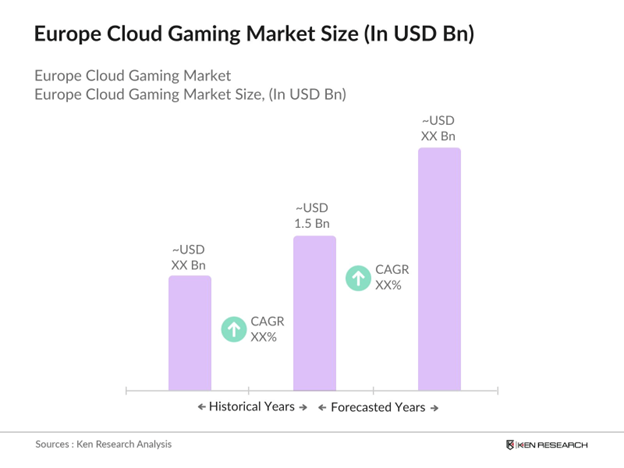
The Europe Cloud Gaming market is valued at USD 1.5 billion in 2023, driven by the expansion of high-speed internet infrastructure and the increasing adoption of cloud-based gaming services across the region.
Key growth drivers include the rapid advancement of cloud computing technologies, the proliferation of high-speed internet and 5G networks, and the rising demand for seamless, cross-platform gaming experiences among consumers.
Major players include Google Stadia, Microsoft xCloud, Nvidia GeForce Now, Sony PlayStation Now, and Amazon Luna. These companies dominate the market through their extensive gaming libraries, robust technological infrastructure, and strategic partnerships.
Challenges include latency and bandwidth limitations in certain regions, high data costs, and content licensing and ownership restrictions, which can impede the seamless delivery of cloud gaming services.

What makes us stand out is that our consultants follows Robust, Refine and Result (RRR) methodology. i.e. Robust for clear definitions, approaches and sanity checking, Refine for differentiating respondents facts and opinions and Result for presenting data with story

We have set a benchmark in the industry by offering our clients with syndicated and customized market research reports featuring coverage of entire market as well as meticulous research and analyst insights.

While we don't replace traditional research, we flip the method upside down. Our dual approach of Top Bottom & Bottom Top ensures quality deliverable by not just verifying company fundamentals but also looking at the sector and macroeconomic factors.

With one step in the future, our research team constantly tries to show you the bigger picture. We help with some of the tough questions you may encounter along the way: How is the industry positioned? Best marketing channel? KPI's of competitors? By aligning every element, we help maximize success.

Our report gives you instant access to the answers and sources that other companies might choose to hide. We elaborate each steps of research methodology we have used and showcase you the sample size to earn your trust.

If you need any support, we are here! We pride ourselves on universe strength, data quality, and quick, friendly, and professional service.