
Europe E-Commerce Market Outlook to 2030
Region:Albania
Author(s):Sanjna Verma
Product Code:KROD10244
Region:Albania
Author(s):Sanjna Verma
Product Code:KROD10244
December 2024
91
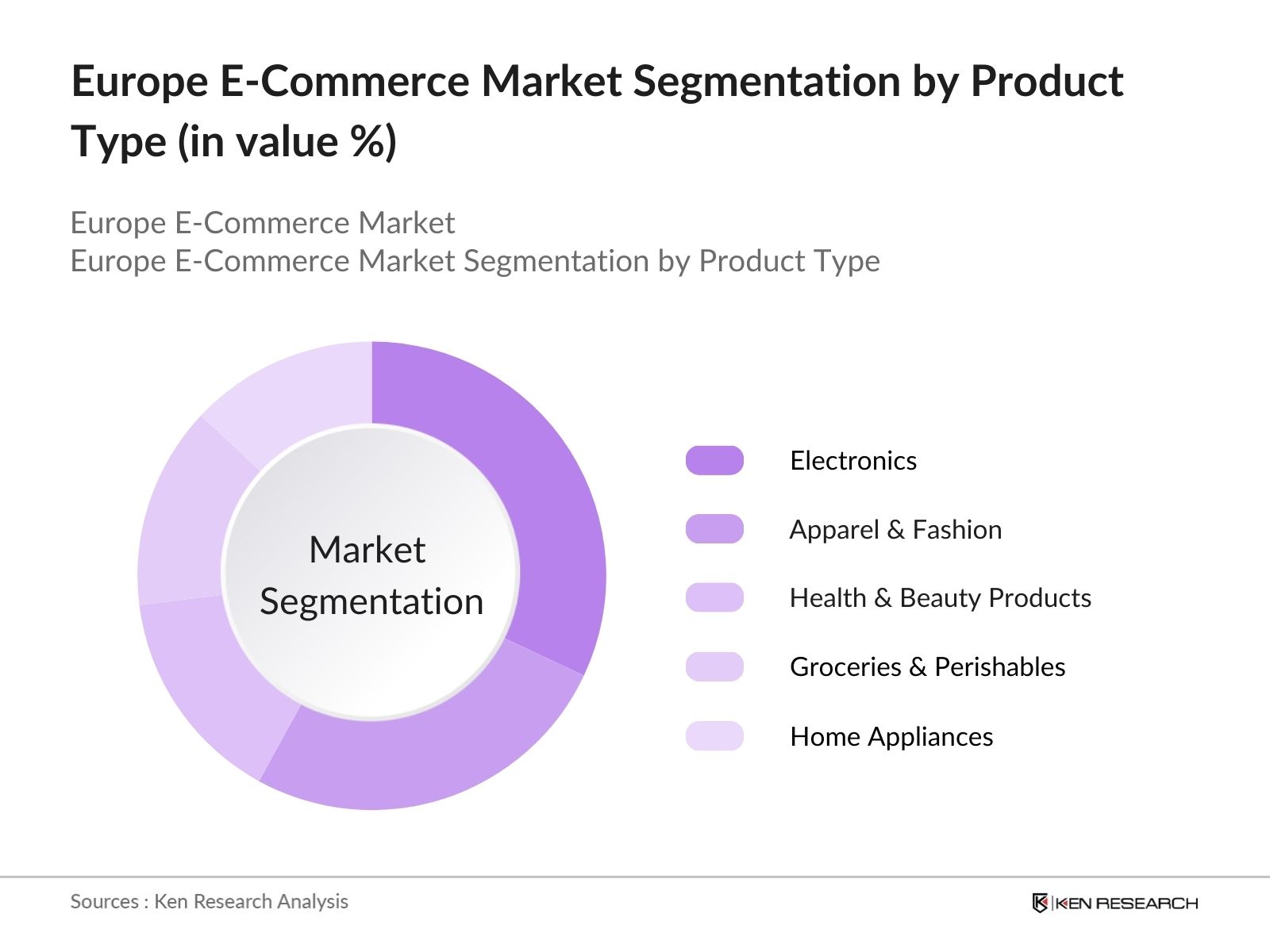
By Product Type: The Europe e-commerce market is segmented by product type into electronics, apparel & fashion, health & beauty products, groceries & perishables, and home appliances. Recently, electronics have a dominant market share under the segmentation by product type. This is primarily due to the increasing demand for gadgets, such as smartphones, laptops, and smart home devices. Brands like Apple, Samsung, and Xiaomi have maintained strong footholds, offering a wide range of devices that cater to both tech enthusiasts and everyday consumers. Moreover, consumers' growing reliance on electronics for both work and leisure has driven sales in this segment.
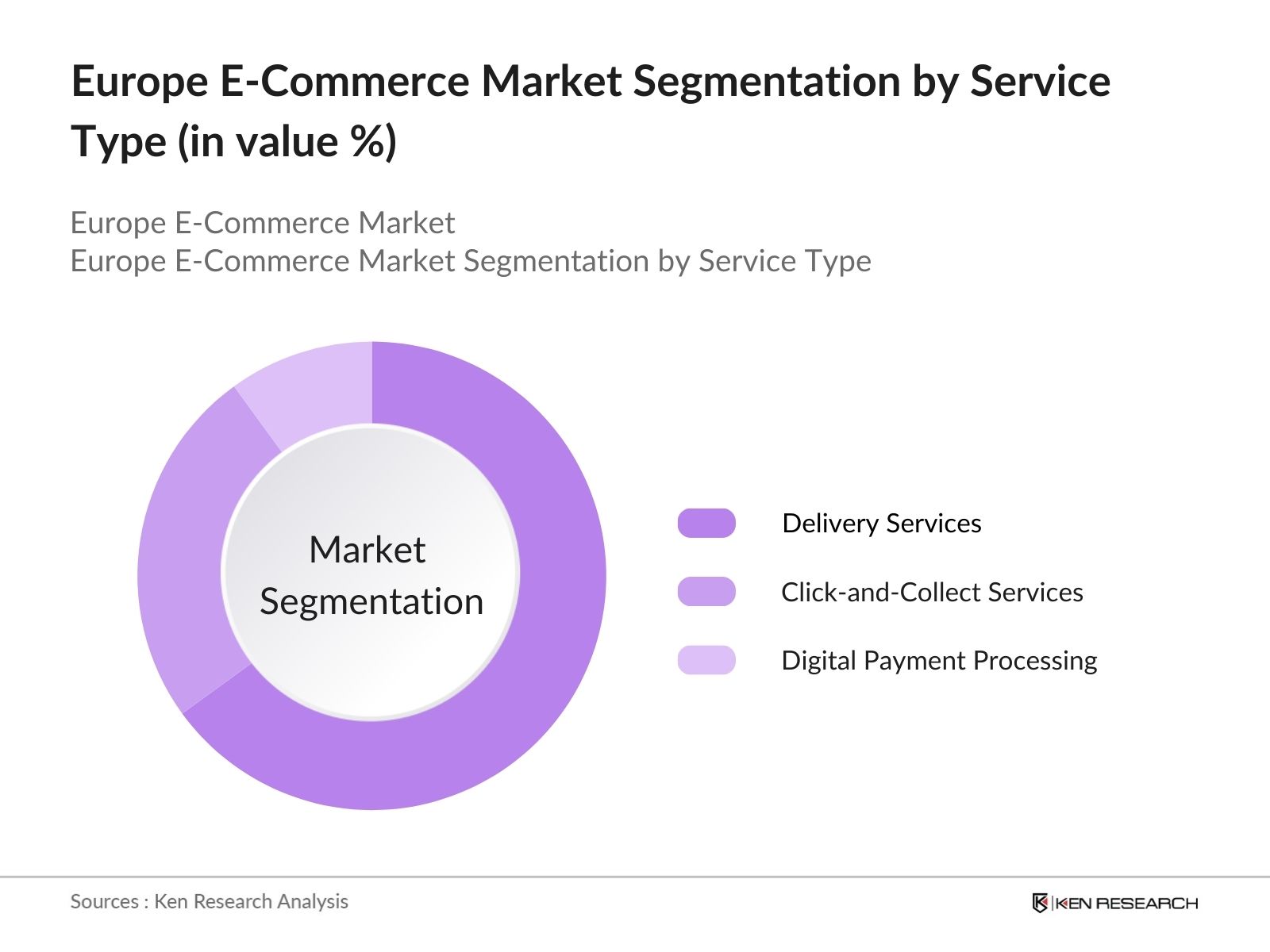
By Service Type: The Europe e-commerce market is segmented by service type into delivery services, click-and-collect services, and digital payment processing. Among these, delivery services hold the largest market share. The dominance of delivery services is attributed to consumers' preference for the convenience of home delivery, especially in densely populated cities where time efficiency is critical. E-commerce platforms, supported by strong logistics networks, have optimized their operations to offer same-day or next-day delivery services, significantly boosting consumer satisfaction.
The Europe e-commerce market is dominated by several key players, including global giants and regional leaders. This market consolidation highlights the influence of established companies that continue to drive competition through innovation and market penetration. Key players, such as Amazon, eBay, and Zalando, have enhanced their offerings by integrating cutting-edge technologies like artificial intelligence and machine learning to improve customer experiences. The competition also revolves around rapid delivery, robust product offerings, and exceptional customer service.
|
Company |
Year of Establishment |
Headquarters |
Active Users (Mn) |
Revenue (USD Bn) |
Number of Warehouses |
Technology Investments (USD Bn) |
No. of Products Offered |
Customer Satisfaction (%) |
Employees (Thousand) |
|
Amazon |
1994 |
Seattle, USA |
- |
- |
- |
- |
- |
- |
- |
|
eBay |
1995 |
San Jose, USA |
- |
- |
- |
- |
- |
- |
- |
|
Zalando |
2008 |
Berlin, Germany |
- |
- |
- |
- |
- |
- |
- |
|
Allegro |
1999 |
Poznan, Poland |
- |
- |
- |
- |
- |
- |
- |
|
ASOS |
2000 |
London, UK |
- |
- |
- |
- |
- |
- |
- |
Europe e-commerce market is expected to witness continued growth, driven by technological advancements, evolving consumer preferences, and the integration of AI-based recommendation systems. The expansion of digital payment options, cross-border shopping, and personalized shopping experiences will further strengthen market demand. Companies are likely to invest in improving logistics networks, enhancing customer service, and focusing on sustainable delivery options to align with consumer preferences for eco-friendly shopping.
|
By Segments |
Sub-Segments |
|
By Product Type |
Electronics Apparel & Fashion Health & Beauty Products Groceries & Perishables Home Appliances |
|
By Service Type |
Delivery Services Click-and-Collect Services Digital Payment Processing |
|
By Customer Base |
B2C B2B C2C |
|
By Platform Type |
Desktop Platforms Mobile Platforms |
|
By Region |
Germany United Kingdom France Italy Spain Netherlands Poland Sweden Belgium Denmark |
1.1 Definition and Scope
1.2 Market Taxonomy
1.3 Market Growth Rate (Market penetration, usage patterns, and digital transformation)
1.4 Market Segmentation Overview (By region, by product, by service type, by customer base, by platform type)
2.1 Historical Market Size (Evolution of market size, key milestones, market expansions)
2.2 Year-on-Year Growth Analysis (Market growth patterns, transaction volumes)
2.3 Key Market Developments and Milestones (Major mergers, technological integrations, policy shifts)
3.1 Growth Drivers
3.1.1 Rise of Mobile Commerce (Smartphone penetration, app-based commerce)
3.1.2 Expanding Payment Infrastructure (Digital wallets, new payment gateways)
3.1.3 Cross-Border Shopping (Intra-EU e-commerce, removal of VAT barriers)
3.1.4 Increasing Consumer Trust in Online Platforms (Data security laws, customer service)
3.2 Market Challenges
3.2.1 Logistics and Supply Chain Barriers (Complexity in last-mile delivery, high costs)
3.2.2 Regulatory Compliance (GDPR compliance, country-specific regulations)
3.2.3 Intense Market Competition (Pressure on pricing strategies, customer retention)
3.2.4 Lack of Skilled Workforce for Digital Platforms (Shortage of e-commerce talent, training gaps)
3.3 Opportunities
3.3.1 Emergence of Omnichannel Solutions (Integration of online and offline retail, customer experience)
3.3.2 Sustainability in E-Commerce (Green logistics, carbon-neutral delivery)
3.3.3 Expansion into New Markets (Eastern Europe, rural areas)
3.3.4 Rise of B2B E-Commerce (Growth in wholesale e-commerce, digital procurement)
3.4 Trends
3.4.1 AI-Powered Personalization (Advanced recommendation engines, customer data analytics)
3.4.2 Increasing Role of Social Commerce (Influencer marketing, shopping on social platforms)
3.4.3 Shift to Subscription-Based E-Commerce Models (Recurring revenue, personalized product subscriptions)
3.4.4 Growth in Voice Commerce (Voice-activated shopping, integration with smart home devices)
3.5 Government Regulation
3.5.1 Data Protection and Privacy Laws (GDPR enforcement, customer data protection)
3.5.2 E-Commerce Consumer Rights Regulations (Return policies, warranties, customer rights)
3.5.3 Cross-Border E-Commerce Regulations (Custom duties, VAT, trade agreements)
3.5.4 Cybersecurity and Fraud Prevention Measures (Implementation of security standards, fraud management)
4.1 By Product Type (In Value %)
4.1.1 Electronics
4.1.2 Apparel & Fashion
4.1.3 Health & Beauty Products
4.1.4 Groceries & Perishables
4.1.5 Home Appliances
4.2 By Service Type (In Value %)
4.2.1 Delivery Services
4.2.2 Click-and-Collect Services
4.2.3 Digital Payment Processing
4.3 By Customer Base (In Value %)
4.3.1 Business-to-Consumer (B2C)
4.3.2 Business-to-Business (B2B)
4.3.3 Consumer-to-Consumer (C2C)
4.4 By Platform Type (In Value %)
4.4.1 Desktop Platforms
4.4.2 Mobile Platforms (Mobile apps, responsive websites)
4.5 By Region (In Value %)
4.5.1 Germany
4.5.2 United Kingdom
4.5.3 France
4.5.4 Italy
4.5.5 Spain
4.5.6 Netherlands
4.5.7 Poland
4.5.8 Sweden
4.5.9 Belgium
4.5.10 Denmark
5.1 Detailed Profiles of Major Companies
5.1.1 Amazon
5.1.2 eBay
5.1.3 Zalando
5.1.4 Allegro
5.1.5 Rakuten
5.1.6 ASOS
5.1.7 Carrefour
5.1.8 Otto Group
5.1.9 Tesco
5.1.10 Fnac-Darty
5.2 Cross Comparison Parameters (Revenue, No. of active users, Market share, Number of fulfilment centers, Regional reach, Partnerships with logistics, Customer satisfaction ratings, Technology investments)
5.3 Market Share Analysis (Company-wise analysis, regional distribution of market shares)
5.4 Strategic Initiatives (Expansion strategies, product diversification, international expansions)
5.5 Mergers and Acquisitions (Recent M&As, impact on competition)
5.6 Investment Analysis (VC and PE funding rounds, large-scale investments)
5.7 Government Grants and Incentives (E-commerce digital transformation funding, tax incentives)
6.1 Taxation on E-Commerce Transactions (VAT rules, cross-border tax regulations)6.2 Data Protection and Privacy Laws (GDPR compliance, handling of customer data)
6.3 Compliance with Consumer Protection Laws (Dispute resolution mechanisms, e-commerce fraud prevention)
7.1 Future Market Size Projections
7.2 Key Factors Driving Future Market Growth
8.1 By Product Type (In Value %)
8.2 By Service Type (In Value %)
8.3 By Customer Base (In Value %)
8.4 By Platform Type (In Value %)
8.5 By Region (In Value %)
9.1 TAM/SAM/SOM Analysis (Total Addressable Market, Serviceable Available Market, Serviceable Obtainable Market)
9.2 Marketing Initiatives (Customer retention strategies, growth hacking techniques)
9.3 White Space Opportunity Analysis (Unexplored regions, niche product segments)
9.4 Customer Cohort Analysis (Buying patterns, customer demographics, repeat customer rates)
In the initial phase, we identify key variables by mapping out the e-commerce ecosystem in Europe, involving all major stakeholders. Desk research plays a crucial role here, where data is extracted from secondary databases, reports, and proprietary databases. The goal is to identify key market drivers, growth inhibitors, and consumer behavior patterns.
This step involves analyzing historical data on e-commerce penetration, transaction volumes, and market shifts. Insights on logistics efficiency, digital payment adoption, and supply chain disruptions are examined to build accurate projections and assess the overall health of the market.
We validate initial market hypotheses through expert consultations and CATI surveys with key industry players. Insights from e-commerce platforms, logistics providers, and payment gateway operators help refine our market understanding, ensuring reliability.
In this phase, we engage with e-commerce stakeholders to gather detailed feedback on current challenges and opportunities in the market. The information is synthesized into the final report, cross-verified with data collected through the bottom-up approach, ensuring accuracy and depth of analysis.
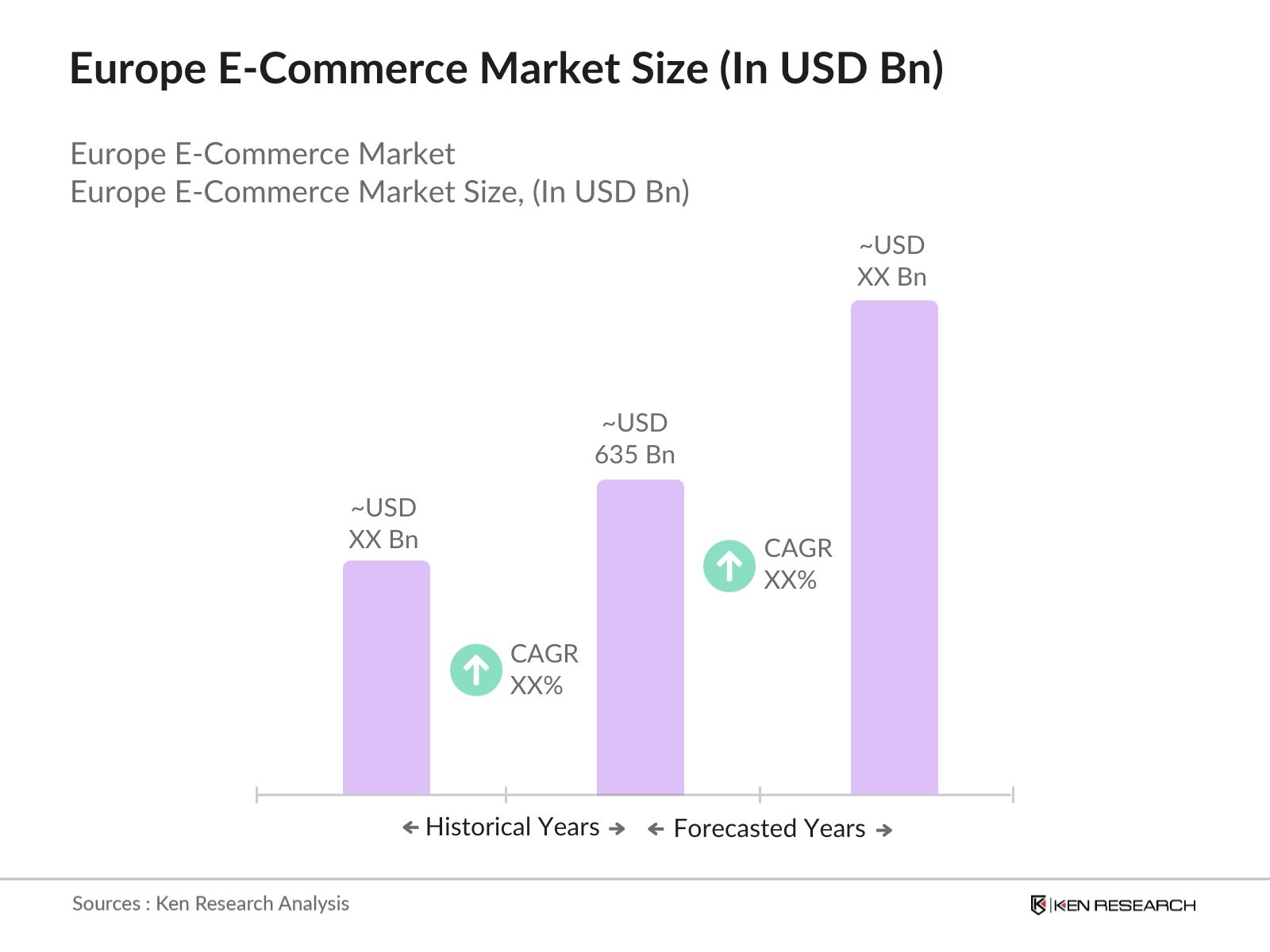
The Europe e-commerce market is valued at USD 635 billion, driven by increased internet penetration, enhanced digital payment infrastructure, and a consumer shift towards online shopping.
Challenges in Europe e-commerce market include high logistics costs, supply chain inefficiencies, and regulatory compliance with data protection laws like GDPR. Additionally, the market faces intense competition from established players and cross-border complexities.
Key players in Europe e-commerce market include Amazon, eBay, Zalando, Allegro, and ASOS, which dominate due to their extensive product offerings, advanced technology integrations, and vast fulfillment networks.
Europe e-commerce market is propelled by increased internet penetration, the rise of mobile commerce, digital payment advancements, and growing consumer trust in e-commerce platforms.

What makes us stand out is that our consultants follows Robust, Refine and Result (RRR) methodology. i.e. Robust for clear definitions, approaches and sanity checking, Refine for differentiating respondents facts and opinions and Result for presenting data with story

We have set a benchmark in the industry by offering our clients with syndicated and customized market research reports featuring coverage of entire market as well as meticulous research and analyst insights.

While we don't replace traditional research, we flip the method upside down. Our dual approach of Top Bottom & Bottom Top ensures quality deliverable by not just verifying company fundamentals but also looking at the sector and macroeconomic factors.

With one step in the future, our research team constantly tries to show you the bigger picture. We help with some of the tough questions you may encounter along the way: How is the industry positioned? Best marketing channel? KPI's of competitors? By aligning every element, we help maximize success.

Our report gives you instant access to the answers and sources that other companies might choose to hide. We elaborate each steps of research methodology we have used and showcase you the sample size to earn your trust.

If you need any support, we are here! We pride ourselves on universe strength, data quality, and quick, friendly, and professional service.