
Europe Homogeneous Precious Metal Catalyst Market Outlook to 2030
Region:Europe
Author(s):Meenakshi Bisht
Product Code:KROD9952
December 2024
96
About the Report
Europe Homogeneous Precious Metal Catalyst Market Overview
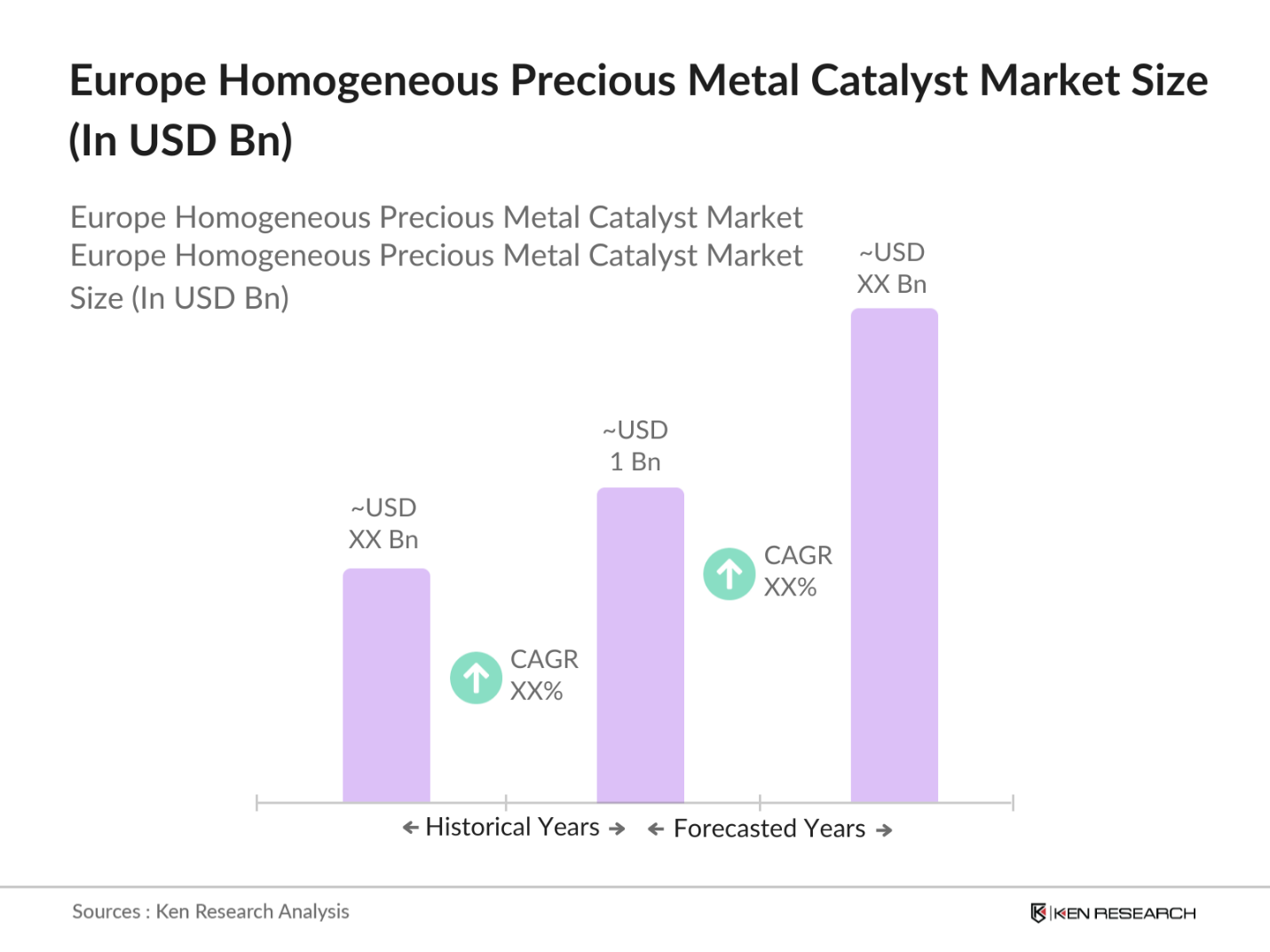
- The Europe Homogeneous Precious Metal Catalyst market is valued at USD 1 billion, based on a five-year historical analysis. This market is driven by the increasing demand for catalytic processes in industries such as chemicals, pharmaceuticals, and petrochemicals. Homogeneous catalysts, especially those involving precious metals like platinum, palladium, and rhodium, are crucial in enhancing chemical reactions' efficiency.
- In terms of dominance, countries like Germany, the UK, and France lead the European Homogeneous Precious Metal Catalyst market. Germany's well-established chemical industry, coupled with advanced R&D in catalyst technologies, positions it as a leader. The UK's emphasis on pharmaceutical innovations and Frances strong petrochemical sector further contribute to their dominance.
- The EUs emissions reduction policies, particularly those under the European Green Deal, have had a profound impact on the homogeneous precious metal catalyst market. The EU's broader goal of achieving carbon neutrality by 2050. The reduction target was established under the European Climate Law and is included in the "Fit for 55" legislative package, which aims to align various policies with this ambitious climate goal. Precious metal catalysts, especially platinum and palladium, are widely used in emissions reduction technologies.
Europe Homogeneous Precious Metal Catalyst Market Segmentation
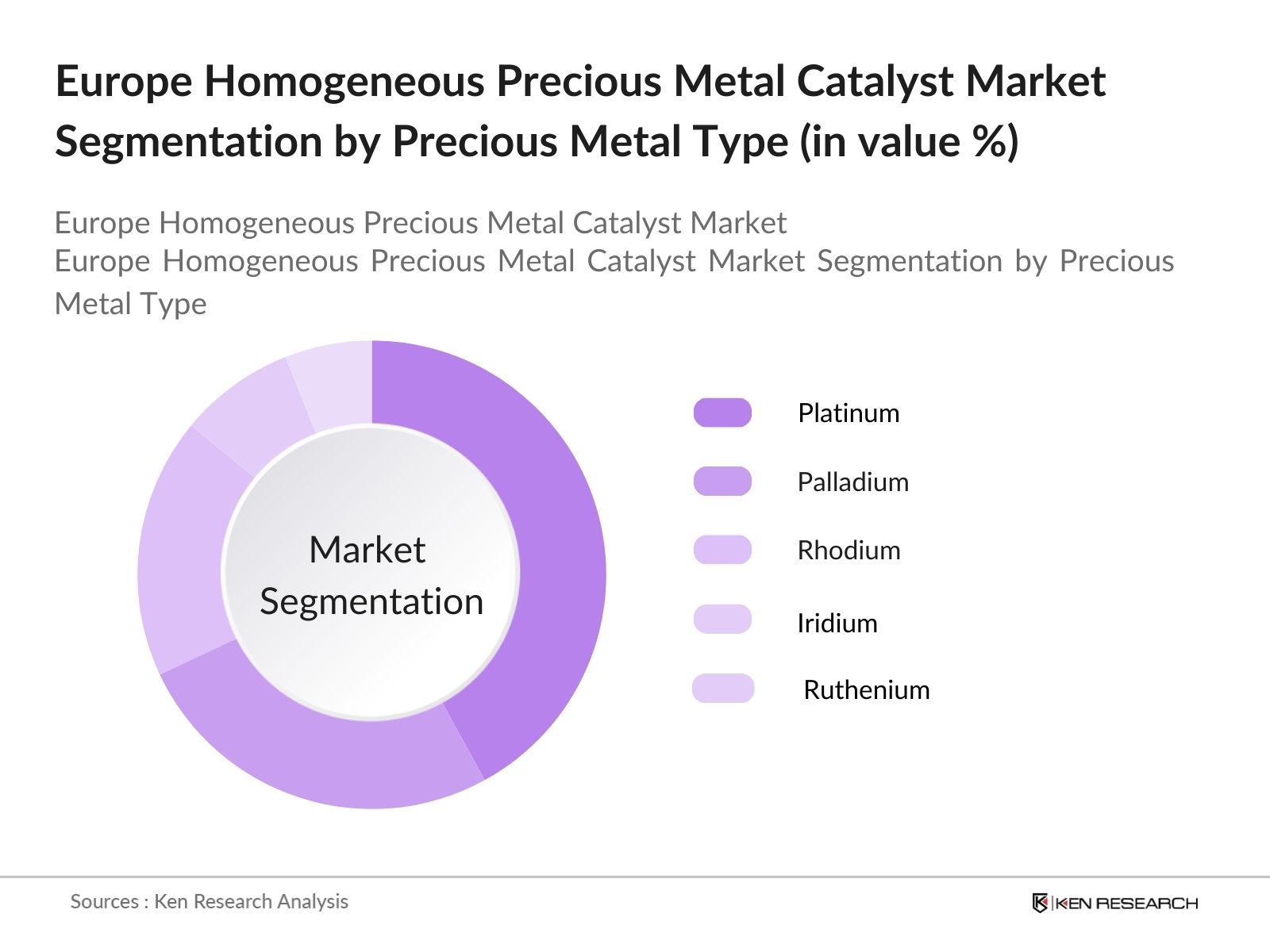
By Precious Metal Type: The market is segmented by precious metal type into platinum, palladium, rhodium, iridium, and ruthenium. Recently, platinum has dominated this segment due to its wide applicability in chemical processes such as refining and polymerization, especially in petrochemicals. Its superior catalytic properties, high thermal stability, and efficiency in various reaction mechanisms make it a preferred choice. Additionally, platinums role in the production of green hydrogen and fuel cells has expanded its demand in sustainable energy projects.
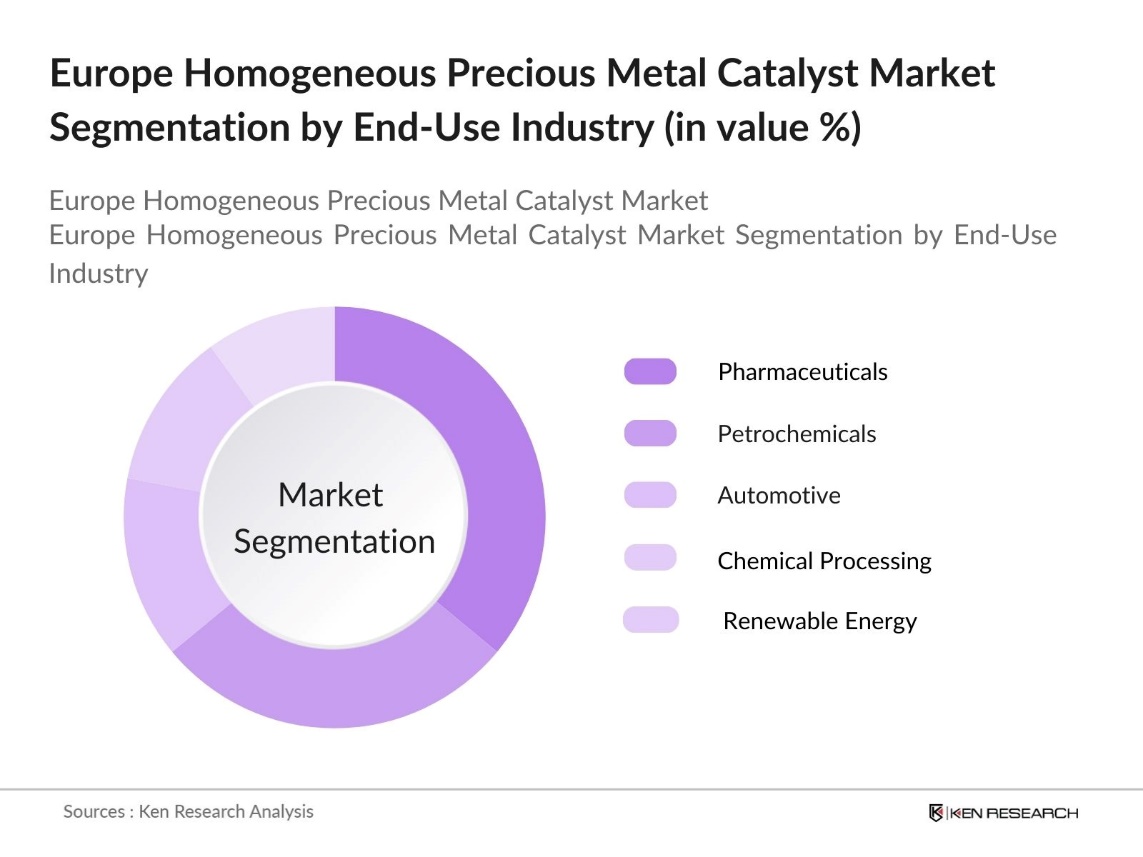
By End-Use Industry: The market is segmented by end-use industry into pharmaceuticals, petrochemicals, automotive, chemical processing, and renewable energy. The pharmaceutical industry holds a dominant market share due to the increasing use of homogeneous catalysts in drug manufacturing and fine chemicals production. Precious metal catalysts, particularly palladium and platinum, are vital in producing active pharmaceutical ingredients (APIs) and other specialty chemicals. The industrys need for high selectivity and efficiency in reactions has contributed to the extensive use of these catalysts.
Europe Homogeneous Precious Metal Catalyst Market Competitive Landscape
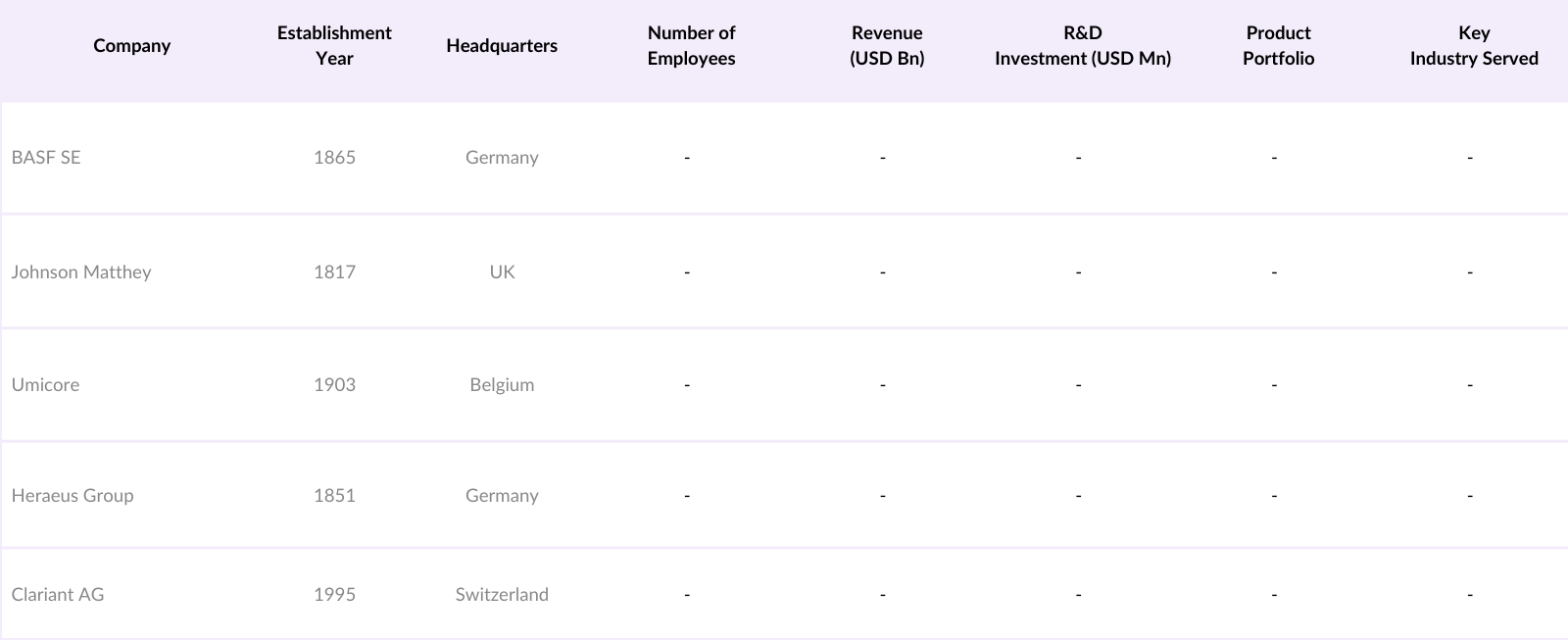
The European Homogeneous Precious Metal Catalyst market is dominated by a few major players. Companies like BASF SE, Johnson Matthey, and Umicore have established themselves as market leaders due to their extensive product portfolios, strong R&D capabilities, and strategic partnerships with key industries like automotive and pharmaceuticals. These companies are focusing on technological advancements to improve catalyst efficiency, which strengthens their position in the market.
Europe Homogeneous Precious Metal Catalyst Industry Analysis
Growth Drivers
- Increasing Focus on Sustainability (Eco-friendly Catalysis, CO2 Reduction): European industries are increasingly prioritizing sustainability in their production processes, leveraging precious metal catalysts for CO2 reduction and eco-friendly catalysis. The EU has committed to reducing greenhouse gas emissions by at least 55% by 2030, requiring innovative solutions like homogeneous catalysts to meet stringent targets. The European chemical industry is highlighting the critical role of advanced catalysts in reducing environmental impacts.
- Precious Metal Recycling Advancements: Europe has become a global leader in precious metal recycling, driven by advancements in refining technologies. In 2022, Europe recycled PGMs from industrial waste, representing about 20% of its total consumption. The increase in recycling rates not only helps reduce dependency on mined resources but also aligns with the EUs circular economy action plan, which aims to minimize waste generation and resource depletion. Enhanced recycling technologies will continue to support the availability of precious metals for catalytic processes.
- Industrial Catalysis Demand: The demand for homogeneous precious metal catalysts in Europe is fueled by their vital role in refining, petrochemical, and chemical synthesis industries. These catalysts enhance reaction efficiency and reduce energy consumption, making them essential for producing high-value chemicals and fuels. As industries seek to optimize production and lower environmental impact, the use of these catalysts continues to support industrial growth across key sectors.
Market Challenges
- High Volatility in Precious Metal Prices (Platinum, Palladium, Rhodium): The homogeneous precious metal catalyst market faces challenges due to the significant price volatility of precious metals like platinum, palladium, and rhodium. Fluctuations in these prices create uncertainty for manufacturers and end-users, making it difficult to predict input costs and impacting overall profitability. This volatility adds complexity to managing resources in the catalyst production industry, affecting both supply chains and pricing strategies.
- Competition from Heterogeneous Catalysts: Heterogeneous catalysts, which differ from homogeneous catalysts in their phase of operation, are becoming increasingly competitive in industrial applications. These catalysts offer advantages such as easier recovery and reuse, particularly in bulk chemical production, where cost-efficiency is critical. Ongoing research and improvements in heterogeneous catalyst technologies continue to pose challenges to the growth of homogeneous catalyst adoption, especially in large-scale industrial processes.
Europe Homogeneous Precious Metal Catalyst Market Future Outlook
The Europe Homogeneous Precious Metal Catalyst market is poised for significant growth driven by the increasing adoption of sustainable chemical processes, government initiatives for cleaner emissions, and technological advancements in catalysis. As industries focus on reducing environmental impact, there will be an enhanced demand for high-performance catalysts. Furthermore, the pharmaceutical and petrochemical sectors are expected to continue being major contributors to market demand, supported by ongoing innovations in fine chemical production and fuel cell technologies.
Market Opportunities
- Emerging Applications in Pharmaceuticals and Fine Chemicals: The pharmaceutical and fine chemical industries are increasingly utilizing homogeneous precious metal catalysts due to their superior selectivity and efficiency in facilitating complex organic reactions. These catalysts are crucial in synthesizing specialty chemicals and active pharmaceutical ingredients (APIs), making them indispensable for advancing drug development and fine chemical production. Their use in these sectors presents new growth opportunities, as industries focus on improving process efficiency and product quality.
- Advancements in Catalyst Efficiency (Improved Turnover Frequencies, Catalyst Longevity): Technological advancements have significantly enhanced the efficiency of homogeneous precious metal catalysts, particularly in terms of turnover frequencies and longevity. These improvements enable greater productivity and reduced resource consumption, fostering broader adoption across industries such as fine chemicals and energy. Enhanced catalyst efficiency drives market growth, as industries benefit from improved performance and sustainability in their processes.
Scope of the Report
|
Precious Metal Type |
Platinum Palladium Rhodium Iridium Ruthenium |
|
Catalyst Type |
Acid Catalysts Base Catalysts Organometallic Catalysts |
|
Application |
Fine Chemicals Pharmaceuticals Petrochemicals Refining Renewable Energy |
|
End-Use Industry |
Automotive Chemical Processing Pharmaceuticals Energy Food Processing |
|
Region |
West East North South |
Products
Key Target Audience
Catalyst Manufacturers
Pharmaceutical Companies
Chemical Processing Firms
Automotive Manufacturers
Energy Companies
Government and Regulatory Bodies (European Environment Agency, European Commission)
Investors and venture capital Firms
Banks and Financial Institutions
Companies
Players Mentioned in the Report
BASF SE
Johnson Matthey Plc
Umicore N.V.
Heraeus Group
Clariant AG
Solvay S.A.
Evonik Industries AG
Alfa Aesar (Thermo Fisher Scientific)
Strem Chemicals
DOW Chemicals
Table of Contents
1. Europe Homogeneous Precious Metal Catalyst Market Overview
1.1. Definition and Scope
1.2. Market Taxonomy (Catalyst Types, Precious Metals, End-Use Industries)
1.3. Market Growth Rate (Economic Factors, Industrial Demand, Environmental Regulations)
1.4. Market Segmentation Overview
2. Europe Homogeneous Precious Metal Catalyst Market Size (In USD Mn)
2.1. Historical Market Size
2.2. Year-On-Year Growth Analysis
2.3. Key Market Developments and Milestones (Innovations in Catalyst Technology, New Patents, Key Project Completions)
3. Europe Homogeneous Precious Metal Catalyst Market Analysis
3.1. Growth Drivers
3.1.1. Industrial Catalysis Demand (Refining, Petrochemical, Chemical Synthesis)
3.1.2. Increasing Focus on Sustainability (Eco-friendly Catalysis, CO2 Reduction)
3.1.3. Government Initiatives for Clean Energy (Green Hydrogen, Renewable Fuels)
3.1.4. Precious Metal Recycling Advancements
3.2. Market Challenges
3.2.1. High Volatility in Precious Metal Prices (Platinum, Palladium, Rhodium)
3.2.2. Competition from Heterogeneous Catalysts
3.2.3. Stringent Environmental and Safety Regulations
3.3. Opportunities
3.3.1. Emerging Applications in Pharmaceuticals and Fine Chemicals
3.3.2. Advancements in Catalyst Efficiency (Improved Turnover Frequencies, Catalyst Longevity)
3.3.3. Strategic Collaborations with Research Institutes (R&D Investments)
3.4. Trends
3.4.1. Shift Towards Bimetallic and Trimodal Catalysts
3.4.2. Adoption of Green Catalysis (Bio-based Catalysts, Low-emission Processes)
3.4.3. Expanding Precious Metal Leasing Services
3.5. Government Regulation
3.5.1. EU Emissions Reduction Policies
3.5.2. Waste Management and Precious Metal Recycling Mandates
3.5.3. REACH Regulations on Catalysts
3.6. SWOT Analysis
3.6.1. Strengths (Highly Specialized Expertise, Essential in Key Industries)
3.6.2. Weaknesses (High Cost of Precious Metals, Sensitivity to Supply Chain)
3.6.3. Opportunities (Rising Demand in Renewable Energy Sectors, Market Penetration in Eastern Europe)
3.6.4. Threats (Global Market Uncertainty, Potential Substitutes)
3.7. Stake Ecosystem
3.7.1. Suppliers of Precious Metals
3.7.2. Catalyst Manufacturers
3.7.3. End-User Industries (Petrochemical, Chemical, Pharmaceutical, Automotive)
3.8. Porters Five Forces
3.8.1. Bargaining Power of Suppliers (Precious Metal Suppliers)
3.8.2. Bargaining Power of Buyers (Chemical Companies, Pharmaceutical Firms)
3.8.3. Threat of Substitutes (Heterogeneous Catalysts, Non-precious Metal Catalysts)
3.8.4. Threat of New Entrants
3.8.5. Competitive Rivalry (Industry Players, Innovations in Catalyst Formulations)
3.9. Competition Ecosystem
4. Europe Homogeneous Precious Metal Catalyst Market Segmentation
4.1. By Precious Metal Type (In Value %)
4.1.1. Platinum
4.1.2. Palladium
4.1.3. Rhodium
4.1.4. Iridium
4.1.5. Ruthenium
4.2. By Catalyst Type (In Value %)
4.2.1. Acid Catalysts
4.2.2. Base Catalysts
4.2.3. Organometallic Catalysts
4.3. By Application (In Value %)
4.3.1. Fine Chemicals
4.3.2. Pharmaceuticals
4.3.3. Petrochemicals
4.3.4. Refining
4.3.5. Renewable Energy
4.4. By End-Use Industry (In Value %)
4.4.1. Automotive
4.4.2. Chemical Processing
4.4.3. Pharmaceuticals
4.4.4. Energy
4.4.5. Food Processing
4.5. By Region (In Value %)
4.5.1. Western Europe
4.5.2. Eastern Europe
4.5.3. Northern Europe
4.5.4. Southern Europe
5. Europe Homogeneous Precious Metal Catalyst Market Competitive Analysis
5.1 Detailed Profiles of Major Companies
5.1.1. BASF SE
5.1.2. Johnson Matthey Plc
5.1.3. Heraeus Group
5.1.4. Umicore N.V.
5.1.5. Clariant AG
5.1.6. Solvay S.A.
5.1.7. Evonik Industries AG
5.1.8. Alfa Aesar (Thermo Fisher Scientific)
5.1.9. Strem Chemicals
5.1.10. DOW Chemicals
5.1.11. Sabin Metal Corporation
5.1.12. American Elements
5.1.13. Vineeth Precious Catalysts Pvt. Ltd
5.1.14. Catalyst Refiners and Suppliers International
5.1.15. Johnson-Matthey Process Technologies
5.2 Cross Comparison Parameters (Number of Employees, Headquarters Location, Inception Year, Revenue, Market Share, Product Portfolio, R&D Investments, Sustainability Initiatives)
5.3. Market Share Analysis (Top Competitors, Regional Dominance)
5.4. Strategic Initiatives (New Product Launches, Partnerships, Collaborations)
5.5. Mergers and Acquisitions (Recent Deals in the Market)
5.6. Investment Analysis (Venture Capital, Private Equity)
5.7. Government Grants (Support for Precious Metal Catalysis Research)
5.8. Private Equity Investments (Key Investors in Precious Metal Catalyst Firms)
6. Europe Homogeneous Precious Metal Catalyst Market Regulatory Framework
6.1. Environmental Standards (Emission Reduction Targets, Carbon Neutrality)
6.2. Compliance Requirements (REACH, EU Directives)
6.3. Certification Processes (ISO Certifications, Environmental Certifications)
7. Europe Homogeneous Precious Metal Catalyst Future Market Size (In USD Mn)
7.1. Future Market Size Projections
7.2. Key Factors Driving Future Market Growth
8. Europe Homogeneous Precious Metal Catalyst Future Market Segmentation
8.1. By Precious Metal Type
8.2. By Catalyst Type
8.3. By Application
8.4. By End-Use Industry
8.5. By Region
9. Europe Homogeneous Precious Metal Catalyst Market Analysts Recommendations
9.1. TAM/SAM/SOM Analysis
9.2. Customer Cohort Analysis
9.3. Marketing Initiatives
9.4. White Space Opportunity Analysis
Disclaimer Contact UsResearch Methodology
Step 1: Identification of Key Variables
The initial phase involves constructing an ecosystem map encompassing all major stakeholders within the Europe Homogeneous Precious Metal Catalyst market. This step is underpinned by extensive desk research, utilizing secondary and proprietary databases to gather comprehensive industry-level information. The primary objective is to identify and define the critical variables influencing market dynamics.
Step 2: Market Analysis and Construction
In this phase, historical data pertaining to the market is compiled and analyzed. This includes assessing market penetration, the ratio of catalyst manufacturers to end-users, and the resultant revenue generation. Additionally, an evaluation of industry trends and regulatory compliance is conducted to ensure the accuracy of the revenue estimates.
Step 3: Hypothesis Validation and Expert Consultation
Market hypotheses are developed and subsequently validated through in-depth interviews with industry experts. These consultations provide valuable operational and financial insights directly from industry practitioners, instrumental in refining and corroborating the market data.
Step 4: Research Synthesis and Final Output
The final phase involves direct engagement with key players to acquire detailed insights into product segments, sales performance, and consumer preferences. This interaction serves to verify and complement the data derived from the bottom-up approach, ensuring a comprehensive, accurate, and validated analysis.
Frequently Asked Questions
01 How big is the Europe Homogeneous Precious Metal Catalyst Market?
The Europe Homogeneous Precious Metal Catalyst market was valued at USD 1 billion, driven by the increasing demand for efficient catalytic processes in chemical, pharmaceutical, and energy industries.
02 What are the challenges in the Europe Homogeneous Precious Metal Catalyst Market?
Key challenges in Europe Homogeneous Precious Metal Catalyst market include high volatility in precious metal prices, competition from heterogeneous catalysts, and stringent environmental and safety regulations.
03 Who are the major players in the Europe Homogeneous Precious Metal Catalyst Market?
Major players in the Europe Homogeneous Precious Metal Catalyst market include BASF SE, Johnson Matthey, Umicore, Heraeus Group, and Clariant AG. These companies dominate due to their strong R&D investments, extensive product portfolios, and strategic partnerships with end-use industries.
04 What drives the growth of the Europe Homogeneous Precious Metal Catalyst Market?
The Europe Homogeneous Precious Metal Catalyst market growth is driven by the increasing adoption of sustainable chemical processes, advancements in catalyst technologies, and government initiatives for reducing industrial emissions.
Why Buy From Us?

What makes us stand out is that our consultants follows Robust, Refine and Result (RRR) methodology. i.e. Robust for clear definitions, approaches and sanity checking, Refine for differentiating respondents facts and opinions and Result for presenting data with story

We have set a benchmark in the industry by offering our clients with syndicated and customized market research reports featuring coverage of entire market as well as meticulous research and analyst insights.

While we don't replace traditional research, we flip the method upside down. Our dual approach of Top Bottom & Bottom Top ensures quality deliverable by not just verifying company fundamentals but also looking at the sector and macroeconomic factors.

With one step in the future, our research team constantly tries to show you the bigger picture. We help with some of the tough questions you may encounter along the way: How is the industry positioned? Best marketing channel? KPI's of competitors? By aligning every element, we help maximize success.

Our report gives you instant access to the answers and sources that other companies might choose to hide. We elaborate each steps of research methodology we have used and showcase you the sample size to earn your trust.

If you need any support, we are here! We pride ourselves on universe strength, data quality, and quick, friendly, and professional service.