















Europe Industrial Robot Market Outlook to 2030
Region:Europe
Author(s):Shreya Garg
Product Code:KROD9890
December 2024
80
About the Report
Europe Industrial Robot Market Overview
- The Europe Industrial Robot market, valued at USD 4.2 billion, is driven by substantial investments in automation across various manufacturing sectors, from automotive to pharmaceuticals. This market expansion is largely influenced by the need for efficiency, cost-saving, and precision. Government policies encouraging Industry 4.0 adoption further strengthen the market by supporting advanced robotics and AI integration. Additionally, technological advancements have led to greater adoption rates, especially for applications in material handling, welding, and assembly.
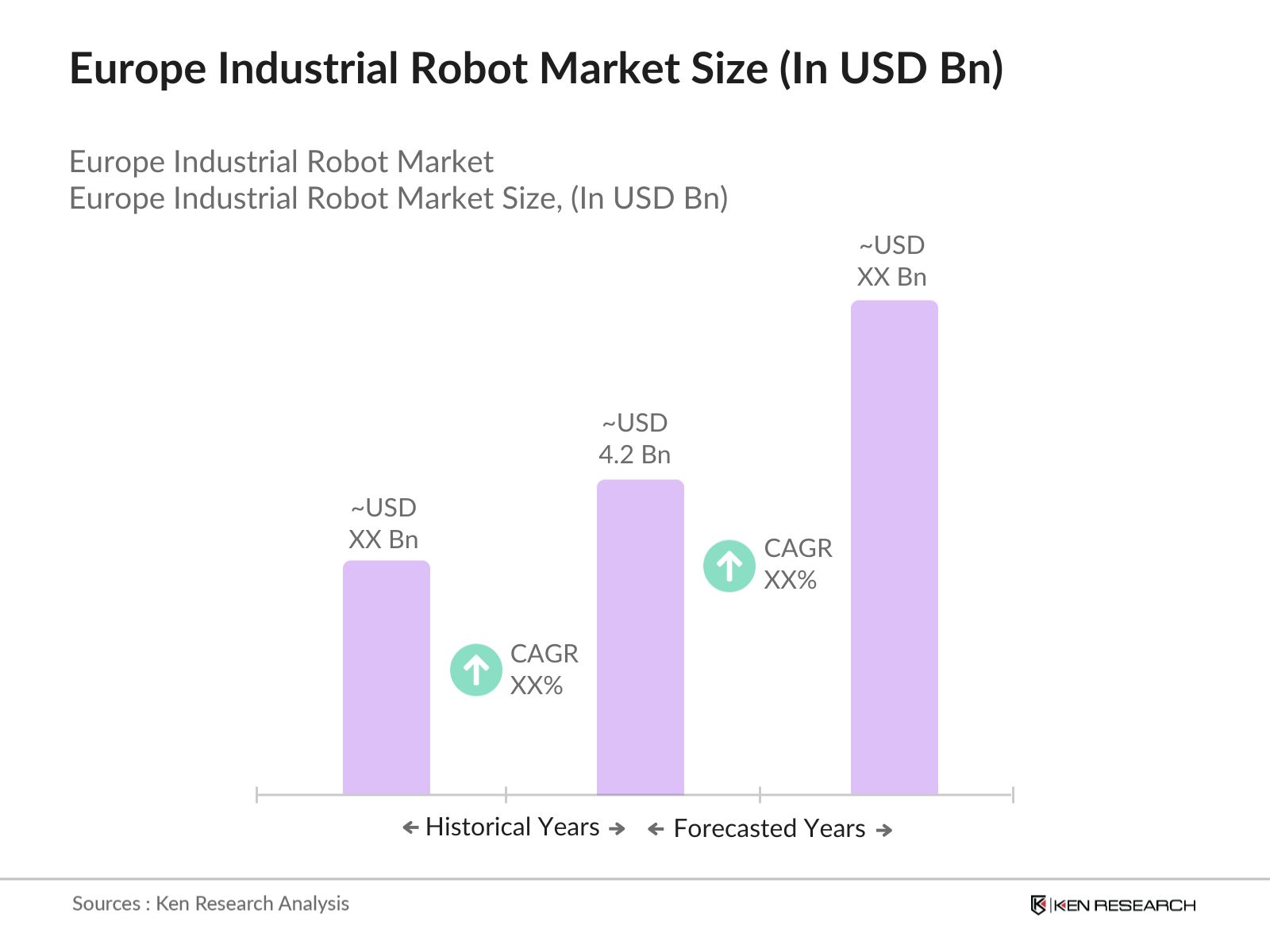
- Germany and Italy are the leading contributors to the Europe Industrial Robot market due to their advanced manufacturing infrastructure and strong foothold in automotive production. Germany's focus on technological innovation and workforce upskilling, paired with Italy's established machinery and automotive sectors, give them a competitive edge. Additionally, favorable government initiatives in these countries promote robotics integration, placing them at the forefront of the European industrial robot landscape.
- European robotics manufacturers comply with stringent safety standards established by the EUs Machinery Directive, which governs robotic operations to ensure worker safety. The EU certified over 5,000 robotics systems in 2024, prioritizing safety in high-risk environments like automotive and electronics manufacturing. Compliance mandates reduce accident rates, positioning Europe as a global leader in safe industrial robotics operations
Europe Industrial Robot Market Segmentation
By Robot Type: The market is segmented by robot type into articulated robots, SCARA robots, parallel robots, cylindrical robots, and collaborative robots (cobots). Articulated robots currently dominate this segment due to their extensive applications across heavy industries, including automotive and metalworking. Their flexibility and precision, particularly for tasks requiring multi-axis movement, have made articulated robots indispensable in complex assembly and welding processes. 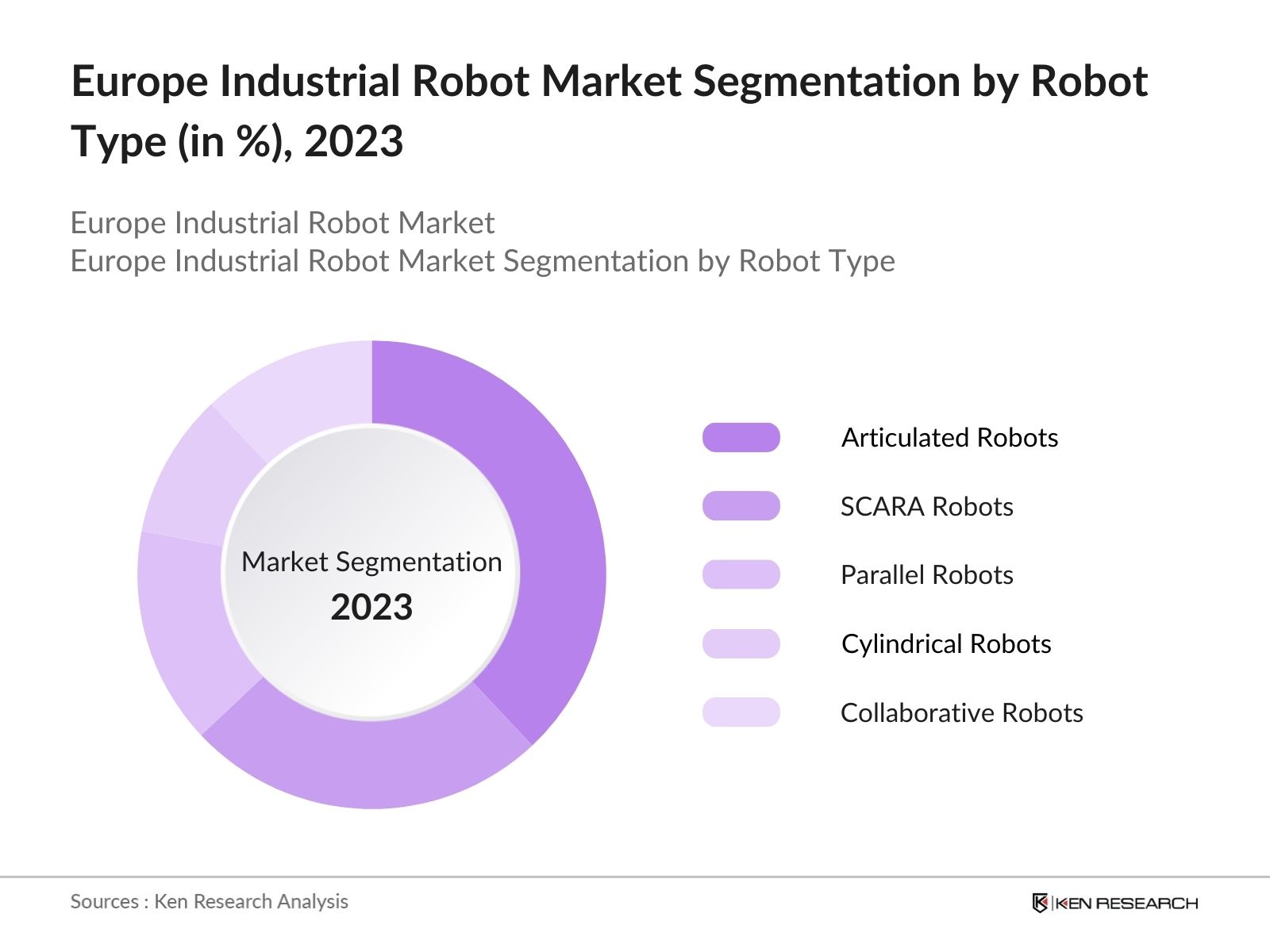
By End-User Industry: The end-user industry segmentation includes automotive, electronics & semiconductor, food & beverage, pharmaceuticals & healthcare, and plastics & rubber. The automotive sector holds a dominant position due to Europes significant automotive production, with manufacturers relying on robots to enhance assembly precision, quality control, and labor cost management. Robotics in this sector has helped streamline operations, reduce human error, and meet high production standards. 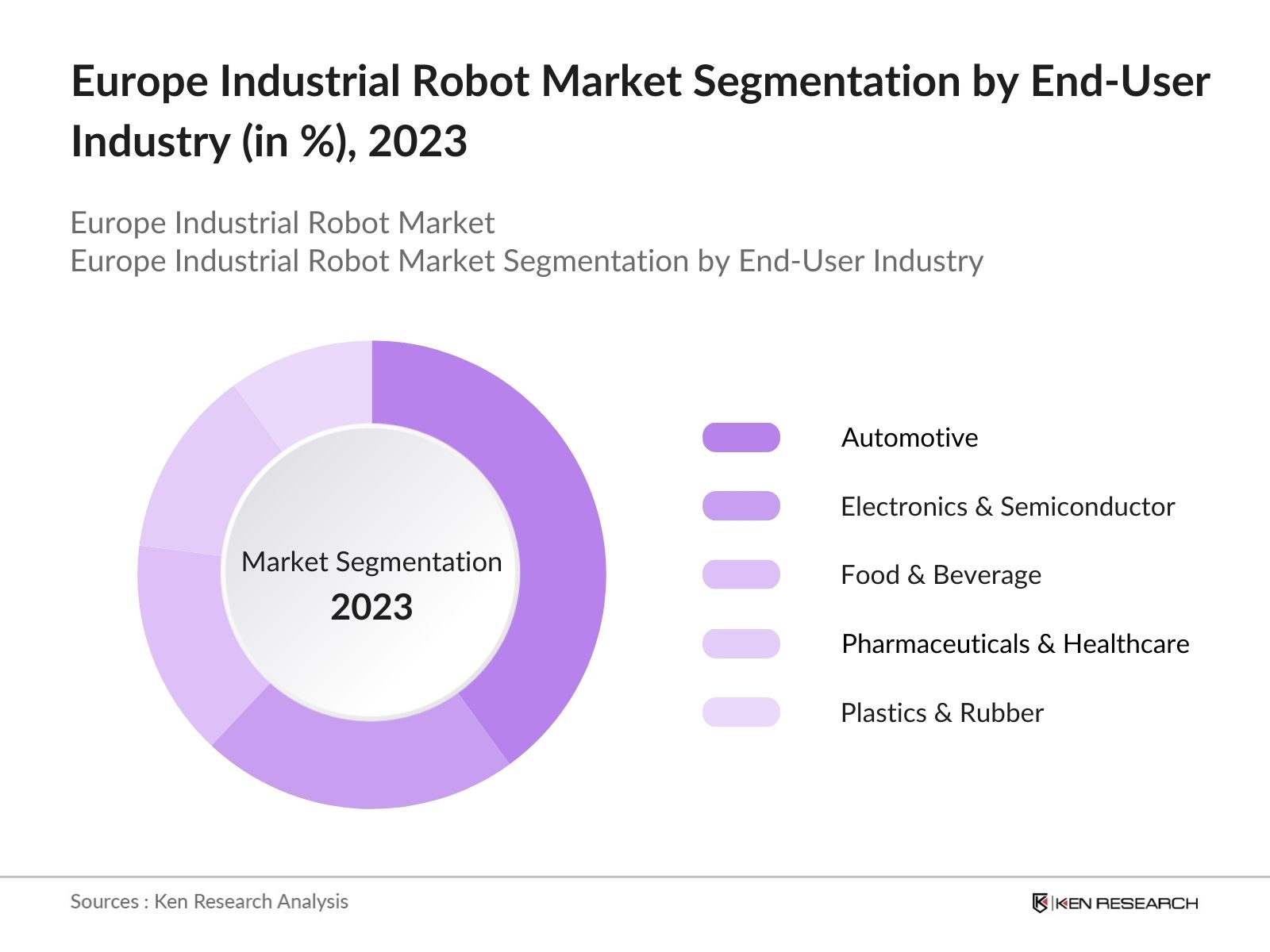
Europe Industrial Robot Market Competitive Landscape
The Europe Industrial Robot market is led by prominent companies, each leveraging its strengths in technological innovation, strategic collaborations, and market penetration to gain a competitive edge. Major players include ABB Ltd., KUKA AG, and Fanuc Corporation, showcasing a consolidated market with substantial influence from these established names.
|
Company |
Establishment Year |
Headquarters |
Technology Portfolio |
Revenue (EUR Bn) |
R&D Spending |
Regional Presence |
Employees |
Market Position |
Strategic Partnerships |
|
ABB Ltd. |
1883 |
Zurich, Switzerland |
|||||||
|
KUKA AG |
1898 |
Augsburg, Germany |
|||||||
|
Fanuc Corporation |
1956 |
Yamanashi, Japan |
|||||||
|
Yaskawa Electric Corp |
1915 |
Kitakyushu, Japan |
|||||||
|
Mitsubishi Electric |
1921 |
Tokyo, Japan |
Europe Industrial Robot Industry Analysis
Growth Drivers
- Increased Demand for Automation: The European manufacturing sector has witnessed substantial automation to address labor shortages and drive operational efficiency. Germany and France, for example, have both increased automation levels, with Germany reporting around 120 robots per 10,000 employees in automotive manufacturing in 2024. The surge in automation is evident across multiple industries, where companies invest to maintain competitiveness amid global labor shortages. Recent data indicates Europes annual robotics installations reached about 80,000 units, aligning with the goal to mitigate production disruptions.
- Workforce Skill Gaps: Skill gaps in the workforce are intensifying Europes reliance on industrial robots. Recent European Union (EU) statistics highlight that 22% of manufacturers report difficulties finding adequately skilled workers, pushing firms toward automation. For instance, Spains advanced robotics deployment in 2024 compensates for its manufacturing workforce deficit, where vacancies are left unfilled. In Germany, the government has invested 4 billion in vocational training to bridge these gaps, enhancing the workforces capability to operate robotics systems.
- Adoption of Advanced Robotics in Manufacturing: European manufacturers are rapidly adopting advanced robotics technologies, especially in Germany, Italy, and France, to optimize production. According to EU statistics, around 35,000 industrial robots were installed in German manufacturing alone by 2024, facilitating intricate, high-volume tasks. These deployments highlight a shift towards precision-driven industries such as electronics and pharmaceuticals, aiming to achieve efficient production rates. This trend reflects the region's commitment to integrating advanced technology for sustained competitive advantage.
Market Challenges
- High Initial Costs: The high capital costs associated with advanced industrial robots are a deterrent for small and medium-sized enterprises (SMEs). In Europe, robotics deployment costs for a standard assembly line can reach up to 250,000, which remains a challenge for many mid-sized manufacturers. According to EU data, only about 18% of SMEs can afford full automation. This financial barrier underscores the need for government grants or financing programs to encourage SMEs to adopt robotics technology.
- Limited Interoperability: Limited interoperability between different robotics systems hinders the seamless integration of advanced robots across manufacturing units in Europe. This challenge is particularly significant for mixed-manufacturer environments where robots from multiple vendors coexist, creating compatibility issues. For instance, approximately 40% of manufacturers in France report challenges with system integration. Initiatives by the EU to standardize protocols across robotics manufacturers are under consideration to resolve these compatibility issues.
Europe Industrial Robot Market Future Outlook
The Europe Industrial Robot market is projected to experience robust development, driven by increasing automation demands, advancements in AI-integrated robotics, and strategic government incentives promoting digitalization. Expanding applications in sectors such as food & beverage and healthcare, along with the rise of collaborative robots (cobots), will further fuel market growth. This trajectory is anticipated to position Europe as a global leader in industrial robotics.
Future Market Opportunities
- Integration with Artificial Intelligence: Integrating AI with robotics is a significant growth opportunity in Europe, where advanced data-driven robots streamline production efficiency and accuracy. For instance, AI-empowered robots in Germany's automotive sector now perform tasks with a precision level of 95%. The EU-funded AI4EU project has allocated 20 million to support AI development in robotics, benefiting industries like aerospace and electronics that demand high precision. These advancements provide a strong foundation for improving productivity through smart automation.
- Expansion of Collaborative Robotics: Collaborative robots (cobots) offer notable potential for Europes SMEs, which require cost-effective automation solutions. In Denmark, cobot installations increased by 18% in 2024, emphasizing the demand for cobots in lightweight manufacturing tasks. According to European Robotics Association data, cobots can reduce production time by up to 30%, with nearly 5,000 cobots operational in the EUs manufacturing sector. These robots enable SMEs to implement flexible automation without complex restructuring.
Scope of the Report
|
Robot Type |
Articulated Robots |
|
Application |
Material Handling |
|
End-User Industry |
Automotive |
|
Payload Capacity |
Up to 10 kg |
|
Region |
Western |
Products
Key Target Audience
Automotive Manufacturers
Electronics & Semiconductor Manufacturers
Food & Beverage Producers
Pharmaceuticals & Healthcare Providers
Heavy Machinery & Metalworking Companies
Plastics & Rubber Manufacturers
Investors and Venture Capitalist Firms
Banks and Financial Institutes
Government and Regulatory Bodies (e.g., European Commission, European Robotics Association)
Companies
Major Players
ABB Ltd.
KUKA AG
Fanuc Corporation
Yaskawa Electric Corporation
Mitsubishi Electric Corporation
Denso Corporation
Kawasaki Robotics
Universal Robots A/S
Omron Corporation
Staubli International AG
Seiko Epson Corporation
Nachi-Fujikoshi Corporation
Comau S.p.A.
Epson Robots
Siasun Robot & Automation Co., Ltd.
Table of Contents
1. Europe Industrial Robot Market Overview
1.1. Definition and Scope
1.2. Market Taxonomy
1.3. Market Dynamics Overview (Growth Drivers, Challenges, Opportunities)
1.4. Market Segmentation Overview
2. Europe Industrial Robot Market Size (In USD Million)
2.1. Historical Market Size Analysis
2.2. Market Growth Rate (Y-o-Y Analysis)
2.3. Key Developments and Technological Milestones
3. Europe Industrial Robot Market Analysis
3.1. Growth Drivers
3.1.1. Increased Demand for Automation
3.1.2. Workforce Skill Gaps
3.1.3. Adoption of Advanced Robotics in Manufacturing
3.1.4. Regulatory Initiatives and Standards
3.2. Market Challenges
3.2.1. High Initial Costs
3.2.2. Limited Interoperability
3.2.3. Dependency on Skilled Labor
3.3. Opportunities
3.3.1. Integration with Artificial Intelligence (AI)
3.3.2. Expansion of Collaborative Robotics (Cobots)
3.3.3. New Applications in SMEs
3.4. Key Trends
3.4.1. Rise in Robotic Process Automation (RPA)
3.4.2. Increasing Focus on Industrial IoT (IIoT) Integration
3.4.3. Shift Toward Lightweight Robotics
3.5. Government Regulations
3.5.1. Safety and Compliance Standards
3.5.2. European Union Robotics Legislation
3.5.3. Tax Incentives for Robotics Adoption
3.6. SWOT Analysis
3.7. Value Chain Analysis
3.8. Porters Five Forces
3.9. Competitive Ecosystem Overview
4. Europe Industrial Robot Market Segmentation
4.1. By Type (In Value %)
4.1.1. Articulated Robots
4.1.2. SCARA Robots
4.1.3. Parallel Robots
4.1.4. Cylindrical Robots
4.1.5. Collaborative Robots (Cobots)
4.2. By Application (In Value %)
4.2.1. Material Handling
4.2.2. Assembly Line Operations
4.2.3. Welding & Soldering
4.2.4. Packaging & Labeling
4.2.5. Quality Inspection
4.3. By End-User Industry (In Value %)
4.3.1. Automotive
4.3.2. Electronics & Semiconductor
4.3.3. Food & Beverage
4.3.4. Pharmaceuticals & Healthcare
4.3.5. Plastics & Rubber
4.4. By Payload Capacity (In Value %)
4.4.1. Up to 10 kg
4.4.2. 10 kg 50 kg
4.4.3. 50 kg 200 kg
4.4.4. Above 200 kg
4.5. By Region (In Value %)
4.5.1. Western
4.5.2. Eastern
4.5.3. Northern
4.5.4. Southern
4.5.5. Central
5. Europe Industrial Robot Market Competitive Analysis
5.1. Detailed Profiles of Key Competitors
5.1.1. ABB Ltd.
5.1.2. Fanuc Corporation
5.1.3. KUKA AG
5.1.4. Yaskawa Electric Corporation
5.1.5. Mitsubishi Electric Corporation
5.1.6. Kawasaki Robotics
5.1.7. Denso Corporation
5.1.8. Universal Robots A/S
5.1.9. Staubli International AG
5.1.10. Omron Corporation
5.1.11. Comau S.p.A.
5.1.12. Epson Robots
5.1.13. Nachi-Fujikoshi Corporation
5.1.14. Seiko Epson Corporation
5.1.15. Siasun Robot & Automation Co., Ltd.
5.2. Cross-Comparison Parameters (Market Share, Revenue, Technology Portfolio, Workforce Size, Regional Presence, R&D Spending, Vertical Integration, Strategic Partnerships)
5.3. Market Share Analysis
5.4. Strategic Initiatives & Expansion Activities
5.5. Mergers and Acquisitions (M&A)
5.6. Investment Analysis
5.7. Venture Capital Funding
5.8. Government Grants & Subsidies
5.9. Private Equity Investments
6. Europe Industrial Robot Market Regulatory Framework
6.1. EU Robotics Safety Standards
6.2. Industrial Compliance Requirements
6.3. Certification Processes and Robotics Standards
7. Europe Industrial Robot Market Future Projections
7.1. Forecasted Market Growth Drivers
7.2. Key Technological Advancements Expected
8. Europe Industrial Robot Market Future Segmentation Analysis
8.1. By Robot Type (In Value %)
8.2. By Application Scope (In Value %)
8.3. By Industry Segment (In Value %)
8.4. By Payload Capacity (In Value %)
8.5. By Regional Expansion (In Value %)
9. Europe Industrial Robot Market Analysts Recommendations
9.1. Total Addressable Market (TAM) Analysis
9.2. Customer Cohort Analysis
9.3. Market Expansion Strategies
9.4. Unexplored White Space Opportunities
Disclaimer
Contact Us
Research Methodology
Step 1: Identification of Key Variables
This initial phase involves constructing an in-depth market framework, identifying key industry variables and stakeholder interests across the Europe Industrial Robot Market. Sources include secondary databases and government publications, ensuring accurate and relevant market coverage.
Step 2: Market Analysis and Construction
Here, historical data on robotics adoption, market demand, and segment-specific usage trends are collected and analyzed. The process includes evaluating revenue data to provide reliable market size and segmentation statistics.
Step 3: Hypothesis Validation and Expert Consultation
Hypotheses based on data trends are validated through interviews with industry experts. These consultations, including robotic manufacturers and distributors, help to refine market forecasts and operational insights.
Step 4: Research Synthesis and Final Output
This final phase consolidates direct insights from robotics manufacturers, enabling a thorough validation of market statistics. A bottom-up approach confirms data accuracy, providing a comprehensive analysis of the Europe Industrial Robot Market.
Frequently Asked Questions
1. How big is the Europe Industrial Robot Market?
The Europe Industrial Robot market is valued at USD 4.2 billion, driven by significant adoption across manufacturing and automotive sectors.
2. What challenges face the Europe Industrial Robot Market?
Key challenges in the Europe Industrial Robot market include high costs, dependency on skilled labor, and interoperability issues. Addressing these factors will be critical for sustained growth.
3. Who are the major players in the Europe Industrial Robot Market?
Leading companies in the Europe Industrial Robot market include ABB Ltd., KUKA AG, and Fanuc Corporation, known for their extensive technological portfolios and strategic presence in the region.
4. What are the growth drivers of the Europe Industrial Robot Market?
Growth in the Europe Industrial Robot market is propelled by increasing automation needs, government incentives, and advancements in robotics technology across diverse industrial applications.
5. Which segments are prominent in the Europe Industrial Robot Market?
Segments such as articulated robots and automotive end-users dominate the Europe Industrial Robot market due to their established roles in improving operational efficiency and precision.
Why Buy From Us?

What makes us stand out is that our consultants follows Robust, Refine and Result (RRR) methodology. i.e. Robust for clear definitions, approaches and sanity checking, Refine for differentiating respondents facts and opinions and Result for presenting data with story

We have set a benchmark in the industry by offering our clients with syndicated and customized market research reports featuring coverage of entire market as well as meticulous research and analyst insights.

While we don't replace traditional research, we flip the method upside down. Our dual approach of Top Bottom & Bottom Top ensures quality deliverable by not just verifying company fundamentals but also looking at the sector and macroeconomic factors.

With one step in the future, our research team constantly tries to show you the bigger picture. We help with some of the tough questions you may encounter along the way: How is the industry positioned? Best marketing channel? KPI's of competitors? By aligning every element, we help maximize success.

Our report gives you instant access to the answers and sources that other companies might choose to hide. We elaborate each steps of research methodology we have used and showcase you the sample size to earn your trust.

If you need any support, we are here! We pride ourselves on universe strength, data quality, and quick, friendly, and professional service.